Overview
The purpose of an experiment is a foundational concept in the ACT Science Research Summaries section, representing one of the most frequently tested skills across all science passages. Understanding experimental purpose requires students to identify why researchers designed and conducted a particular study—what question they sought to answer, what hypothesis they tested, or what relationship they investigated. This skill goes beyond simply reading a passage; it demands critical analysis of experimental design, variables, and the logical structure of scientific inquiry.
On the ACT Science test, questions about experimental purpose typically appear 2-3 times per exam, often in the Research Summaries passages that comprise approximately one-third of the Science section. These questions assess whether students can distinguish between the overall goal of an experiment and the specific methods used to achieve that goal. Mastering this topic is essential because it serves as the gateway to understanding all other aspects of experimental design—if a student cannot identify what an experiment aims to accomplish, they will struggle to evaluate its methodology, interpret its results, or assess its conclusions.
The ACT purpose of an experiment questions connect directly to broader scientific reasoning skills, including understanding independent and dependent variables, recognizing controlled conditions, and evaluating the validity of experimental conclusions. This topic forms the conceptual foundation for the entire Research Summaries passage type, making it one of the highest-yield areas for focused study. Students who excel at identifying experimental purpose consistently score higher on the Science section because they can quickly orient themselves within complex passages and predict what information will be most relevant for answering subsequent questions.
Learning Objectives
- [ ] Identify when Purpose of an experiment is being tested in ACT Science passages
- [ ] Explain the core rule or strategy behind Purpose of an experiment questions
- [ ] Apply Purpose of an experiment concepts to ACT-style questions accurately
- [ ] Distinguish between the overall purpose of an experiment and the specific methods employed
- [ ] Recognize the relationship between experimental purpose and hypothesis testing
- [ ] Evaluate whether a proposed purpose statement accurately reflects the experimental design
- [ ] Predict the types of data that would support a given experimental purpose
Prerequisites
- Basic understanding of scientific method: Necessary to recognize the logical flow from question to hypothesis to experimental design
- Familiarity with independent and dependent variables: Essential for identifying what researchers manipulate and measure to achieve their purpose
- Reading comprehension of scientific passages: Required to extract relevant information from complex experimental descriptions
- Understanding of cause-and-effect relationships: Fundamental to recognizing what experiments aim to demonstrate or investigate
Why This Topic Matters
Understanding experimental purpose has profound real-world significance beyond standardized testing. Scientists design experiments with specific goals in mind—whether testing a new medication's effectiveness, investigating climate change patterns, or exploring chemical reactions. The ability to identify an experiment's purpose is the first step in evaluating scientific claims, a critical skill in an era of information overload where distinguishing valid research from pseudoscience has become increasingly important.
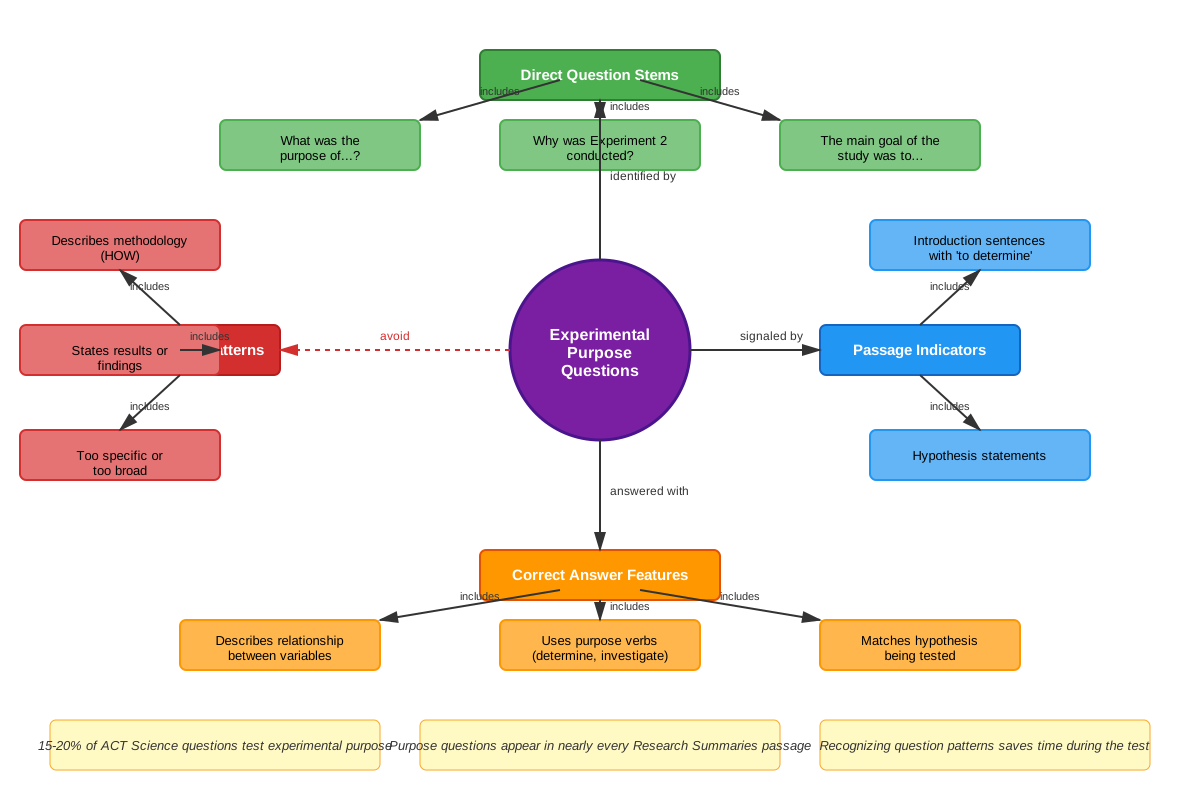
On the ACT Science test, experimental purpose questions appear with remarkable consistency. Statistical analysis of recent ACT exams reveals that approximately 15-20% of all Science questions relate directly or indirectly to understanding experimental purpose. These questions typically appear in two formats: direct questions asking "What was the purpose of this experiment?" and indirect questions requiring students to apply their understanding of purpose to evaluate procedures, predict outcomes, or identify flaws in experimental design.
Research Summaries passages—which always contain at least one experiment with a clear purpose—make up 3 of the 6-7 passages on each ACT Science test. Within these passages, purpose-related questions often appear as the first or second question, serving as a gateway to understanding the entire passage. Students who correctly identify experimental purpose on these early questions gain momentum and context that helps them answer subsequent questions more efficiently. Common manifestations include questions about why a particular variable was manipulated, what hypothesis the researchers tested, or how the experimental design relates to the stated research question.
Core Concepts
Defining Experimental Purpose
The purpose of an experiment refers to the specific research question, hypothesis, or relationship that scientists investigate through systematic observation and manipulation of variables. Unlike a simple description of what researchers did (the procedure), the purpose explains why they did it—what knowledge gap they aimed to fill or what prediction they sought to test. On the ACT, experimental purpose typically takes one of three forms: testing a hypothesis about cause-and-effect relationships, investigating how one variable affects another, or comparing the effects of different conditions on an outcome.
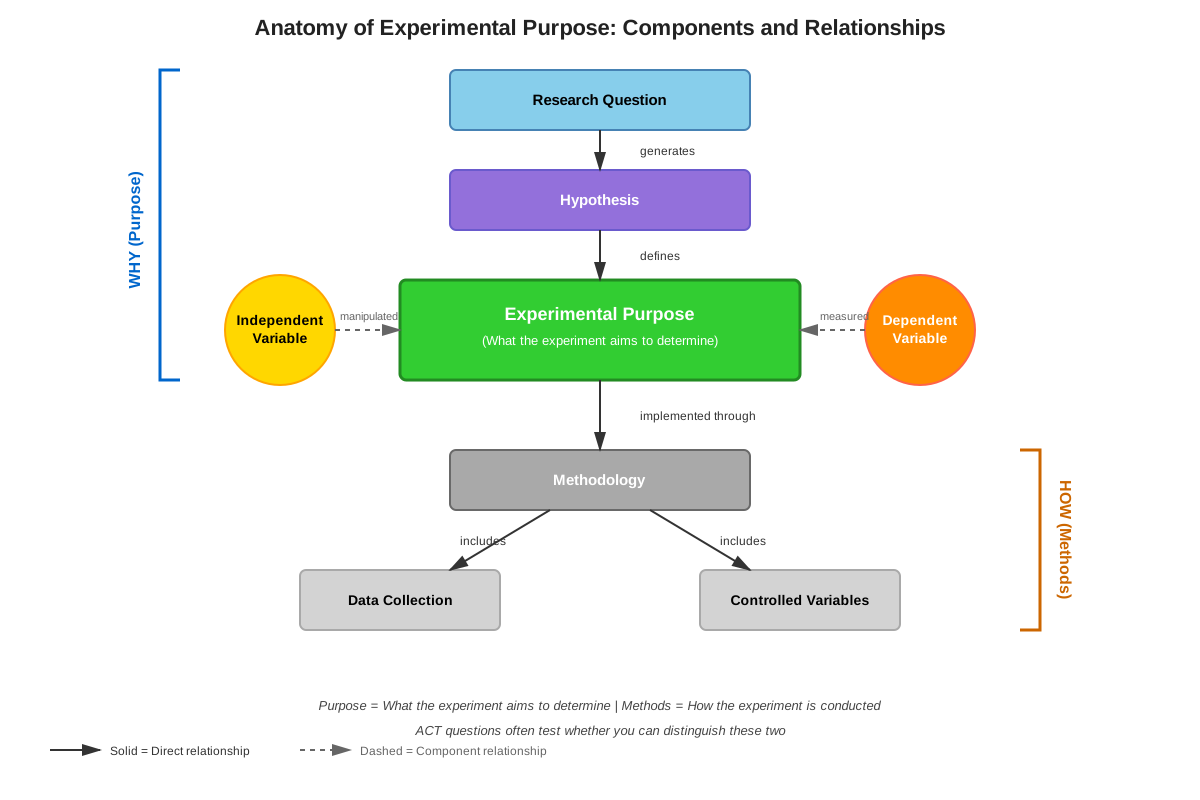
A well-defined experimental purpose contains three key elements: the independent variable (what is manipulated), the dependent variable (what is measured), and the relationship being investigated. For example, "to determine how temperature affects the rate of enzyme activity" clearly identifies temperature as the independent variable, enzyme activity rate as the dependent variable, and the relationship (effect of temperature on rate) as the focus of investigation.
Types of Experimental Purposes
ACT Science passages feature several distinct categories of experimental purposes, each with characteristic language and structure:
| Purpose Type | Description | Common Trigger Words | Example |
|---|---|---|---|
| Hypothesis Testing | Evaluating whether a predicted relationship exists | "to test whether," "to determine if" | To test whether increased CO₂ levels accelerate plant growth |
| Comparative Analysis | Examining differences between groups or conditions | "to compare," "to contrast" | To compare the effectiveness of three different catalysts |
| Relationship Investigation | Exploring how variables relate without predicting direction | "to investigate," "to examine the relationship" | To investigate the relationship between pH and bacterial growth |
| Effect Determination | Identifying the impact of one variable on another | "to determine the effect," "to assess how" | To determine the effect of light intensity on photosynthesis rate |
Distinguishing Purpose from Procedure
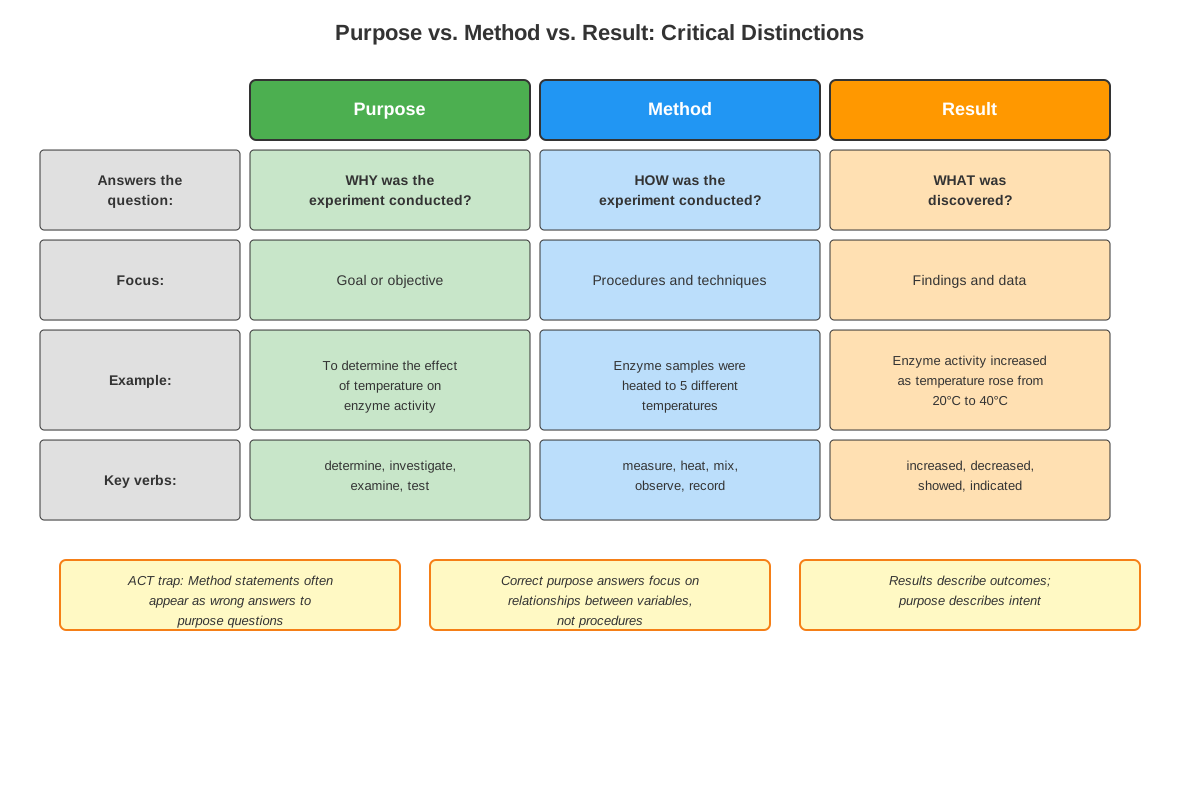
A critical skill for ACT success involves separating experimental purpose from experimental procedure. The procedure describes the specific steps researchers followed—the "how" of the experiment. The purpose explains the underlying reason for conducting those steps—the "why" behind the research. This distinction frequently appears in wrong answer choices designed to trap students who confuse methodology with objectives.
Consider this example: In an experiment where researchers measure plant height after applying different fertilizer concentrations, the procedure might state "Scientists grew 30 plants in identical conditions, applying fertilizer solutions of 0%, 5%, 10%, and 15% concentration, then measured plant height after 4 weeks." The purpose, however, would be "to determine how fertilizer concentration affects plant growth." Notice how the purpose focuses on the relationship being investigated rather than the specific steps taken.
Purpose and Hypothesis Connection
Experimental purpose and hypothesis are closely related but distinct concepts. A hypothesis is a testable prediction about the relationship between variables, while the purpose is the broader goal of investigating that relationship. The purpose often frames the question, while the hypothesis proposes a specific answer. For instance, the purpose might be "to investigate whether exercise duration affects heart rate recovery time," while the hypothesis could be "longer exercise duration will increase heart rate recovery time."
On the ACT, questions may ask students to identify which hypothesis an experiment was designed to test. These questions require understanding that the experimental purpose determines what hypotheses can be validly tested. An experiment designed to investigate temperature effects on reaction rate cannot test hypotheses about pressure effects, even if pressure data were incidentally collected.
Identifying Purpose in Passage Structure
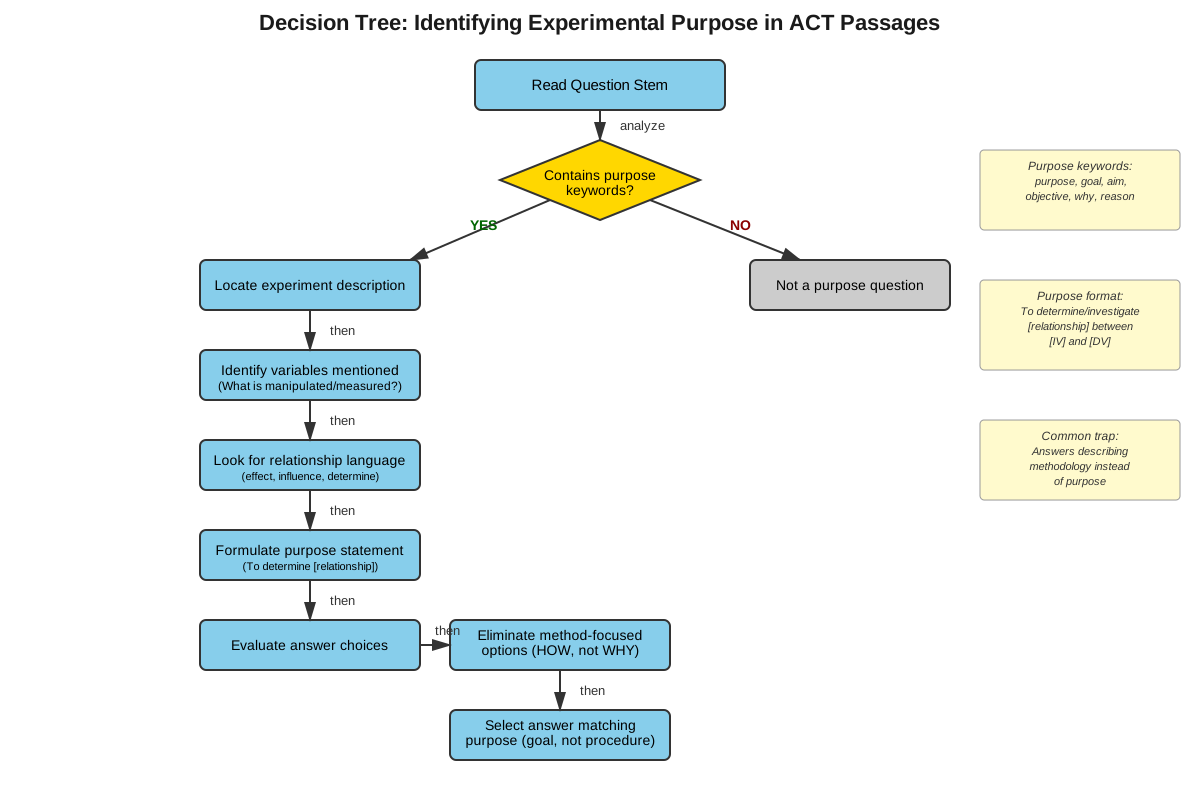
ACT Research Summaries passages typically present experimental purpose in predictable locations within the passage structure. The purpose often appears in the introductory paragraph, frequently in the last sentence before the experimental description begins. Key phrases that signal purpose statements include "Scientists wanted to determine," "The experiment was designed to investigate," "Researchers tested whether," and "The study examined."
However, some passages require students to infer the purpose from the experimental design itself. When explicit purpose statements are absent, students should identify what variables were manipulated (independent variables) and what outcomes were measured (dependent variables), then construct a purpose statement connecting these elements. The pattern follows: "to determine/investigate/examine how [independent variable] affects/influences/relates to [dependent variable]."
Multiple Experiments and Distinct Purposes
Many ACT passages describe multiple related experiments, each with its own specific purpose that contributes to an overarching research goal. Students must distinguish between the individual purpose of each experiment and the broader purpose of the entire study. For example, Experiment 1 might aim "to determine the optimal temperature for enzyme activity," while Experiment 2 might aim "to investigate how pH affects enzyme activity at the optimal temperature." Both experiments contribute to the broader goal of "characterizing factors that influence enzyme function."
Questions about multi-experiment passages may ask about the purpose of a specific experiment or the overall purpose of the research. Reading carefully to determine whether the question references "Experiment 2" or "the study" is essential for selecting the correct answer.
Concept Relationships
The concept of experimental purpose serves as the central organizing principle for understanding Research Summaries passages. The purpose directly determines the experimental design → which variables are manipulated (independent variables) and measured (dependent variables) → which in turn determines what data are collected → which ultimately determines what conclusions can be drawn. This linear relationship means that misunderstanding the purpose creates a cascade of comprehension errors throughout the passage.
Experimental purpose connects backward to prerequisite knowledge of the scientific method, specifically the relationship between research questions and hypothesis formation. It connects forward to more advanced topics like experimental design evaluation, data interpretation, and conclusion validity. Understanding purpose enables students to predict what types of data should appear in results tables and what patterns would support or refute the researchers' goals.
Within the topic itself, the relationships flow as follows: Defining Experimental Purpose → establishes the foundation → Types of Experimental Purposes → provides categories for classification → Distinguishing Purpose from Procedure → prevents common errors → Purpose and Hypothesis Connection → deepens understanding of scientific reasoning → Identifying Purpose in Passage Structure → enables efficient information location → Multiple Experiments and Distinct Purposes → handles complex passages. Each concept builds upon previous ones, creating a comprehensive framework for approaching any Research Summaries passage.
High-Yield Facts
⭐ The purpose of an experiment explains WHY researchers conducted the study, not HOW they conducted it—this distinction appears in 80% of purpose-related questions.
⭐ Experimental purpose typically involves investigating the relationship between an independent variable (manipulated) and a dependent variable (measured).
⭐ Purpose statements commonly begin with "to determine," "to investigate," "to test whether," or "to examine how"—these phrases signal purpose in passages.
⭐ The purpose of an experiment must be testable through the specific methods described—if the stated purpose cannot be addressed by the experimental design, it is incorrect.
⭐ Multiple experiments in a single passage usually have distinct individual purposes that contribute to a broader research goal.
- Purpose questions often appear early in the question sequence for Research Summaries passages, typically as question 1 or 2.
- Wrong answer choices frequently describe procedures, results, or conclusions rather than the actual purpose.
- The purpose determines what variables must be controlled to ensure valid results.
- An experiment can have only one primary purpose, though it may address multiple related questions.
- Purpose statements should be specific enough to guide experimental design but broad enough to encompass all aspects of the study.
- The purpose of an experiment differs from its significance or applications—purpose focuses on the immediate research question.
- Identifying the purpose helps predict what data tables and graphs will show, improving efficiency on data interpretation questions.
Quick check — test yourself on Purpose of an experiment so far.
Try Flashcards →Common Misconceptions
Misconception: The purpose of an experiment is the same as its procedure or methodology.
Correction: The purpose explains the research question or hypothesis being investigated (the "why"), while the procedure describes the specific steps taken to conduct the research (the "how"). An experiment's purpose might be "to determine how temperature affects reaction rate," while the procedure would detail the specific temperatures tested, equipment used, and measurements taken.
Misconception: The purpose of an experiment is always explicitly stated in the passage introduction.
Correction: While purpose often appears in the introductory paragraph, some ACT passages require students to infer the purpose from the experimental design, variables manipulated, and data collected. Students must be prepared to construct purpose statements by identifying what relationships the experiment investigates.
Misconception: An experiment can have multiple equally important purposes.
Correction: While experiments may address related questions, each experiment has one primary purpose that drives its design. Multiple experiments within a study may each have distinct purposes, but a single experiment focuses on one specific relationship or hypothesis. Questions asking about "the purpose" expect identification of the primary, overarching goal.
Misconception: The purpose of an experiment is the same as its conclusion or results.
Correction: The purpose is determined before the experiment begins and guides the experimental design; it represents what researchers aimed to discover. The conclusion is determined after the experiment ends and represents what researchers actually found. An experiment's purpose might be "to test whether fertilizer increases plant growth," while the conclusion might be "fertilizer increased plant growth by 25%."
Misconception: If an experiment measures multiple variables, it must have multiple purposes.
Correction: Experiments often measure multiple dependent variables or test multiple levels of an independent variable while maintaining a single, unified purpose. For example, an experiment measuring both plant height and leaf count at different fertilizer concentrations still has one purpose: "to determine how fertilizer concentration affects plant growth." The multiple measurements simply provide different indicators of the same phenomenon.
Misconception: The purpose of an experiment includes explaining why the research is important or useful.
Correction: The purpose focuses specifically on the research question being investigated, not the broader significance or applications of the findings. While a passage might mention that understanding enzyme activity has medical applications, the experimental purpose remains "to investigate factors affecting enzyme activity," not "to develop new medical treatments."
Worked Examples
Example 1: Single Experiment Purpose Identification
Passage Summary: Scientists studied the effect of light wavelength on photosynthesis rate in aquatic plants. They placed identical plants in separate tanks and exposed each tank to light of a different wavelength (red, blue, green, or white). After 2 hours, they measured the oxygen production in each tank as an indicator of photosynthesis rate.
Question: What was the primary purpose of this experiment?
A) To measure oxygen production in aquatic plants
B) To determine which light wavelength produces the highest photosynthesis rate
C) To compare aquatic plants with terrestrial plants
D) To test whether aquatic plants can survive in different colored light
Solution Process:
Step 1: Identify the independent variable (what researchers manipulated)
- Light wavelength was systematically varied across different conditions
Step 2: Identify the dependent variable (what researchers measured)
- Oxygen production (as an indicator of photosynthesis rate) was measured
Step 3: Determine the relationship being investigated
- The experiment examines how light wavelength affects photosynthesis rate
Step 4: Evaluate each answer choice:
- Choice A describes a measurement (part of the procedure), not the purpose
- Choice B correctly identifies the relationship between light wavelength (independent variable) and photosynthesis rate (dependent variable)
- Choice C introduces a comparison not present in the experimental design
- Choice D focuses on survival rather than the rate of photosynthesis, which was the actual focus
Correct Answer: B
Connection to Learning Objectives: This example demonstrates how to identify when purpose is being tested (the question directly asks "what was the purpose"), apply the core strategy of identifying independent and dependent variables, and accurately select the answer that describes the relationship being investigated rather than procedures or unrelated concepts.
Example 2: Multiple Experiments with Distinct Purposes
Passage Summary: Researchers conducted two experiments on bacterial growth. In Experiment 1, they grew bacteria at five different temperatures (10°C, 20°C, 30°C, 40°C, 50°C) and measured colony size after 24 hours. In Experiment 2, they selected the temperature that produced the largest colonies from Experiment 1, then grew bacteria at that temperature while varying pH levels (4, 5, 6, 7, 8) and again measured colony size after 24 hours.
Question: What was the purpose of Experiment 2?
A) To determine the optimal temperature for bacterial growth
B) To investigate how pH affects bacterial growth at the optimal temperature
C) To compare the effects of temperature and pH on bacterial growth
D) To test whether bacteria can survive in acidic conditions
Solution Process:
Step 1: Distinguish between the two experiments
- Experiment 1 investigated temperature effects
- Experiment 2 investigated pH effects
Step 2: Identify what makes Experiment 2 distinct
- Experiment 2 used the optimal temperature from Experiment 1 as a constant condition
- Experiment 2 manipulated pH as the independent variable
Step 3: Recognize the sequential relationship
- Experiment 2 builds on Experiment 1's findings by holding temperature constant at the optimal level
Step 4: Evaluate each answer choice:
- Choice A describes Experiment 1's purpose, not Experiment 2's
- Choice B correctly identifies that Experiment 2 investigates pH effects specifically at the optimal temperature identified in Experiment 1
- Choice C suggests a simultaneous comparison that doesn't match the sequential design
- Choice D focuses on survival rather than growth rate and doesn't acknowledge the optimal temperature condition
Correct Answer: B
Connection to Learning Objectives: This example illustrates how to identify purpose in multi-experiment passages, distinguish between individual experiment purposes and overall study goals, and recognize how sequential experiments build upon each other. It also demonstrates the importance of reading carefully to determine which specific experiment the question addresses.
Exam Strategy
When approaching ACT Science questions about experimental purpose, employ a systematic strategy that maximizes accuracy while minimizing time investment. Begin by quickly scanning the passage introduction and the first sentence of each experiment description—these locations contain explicit purpose statements in approximately 70% of Research Summaries passages. Look for trigger phrases like "to determine," "to investigate," "to test whether," or "to examine the relationship between."
If no explicit purpose statement appears, immediately identify the independent and dependent variables. The independent variable is what researchers systematically changed or manipulated across different conditions or groups. The dependent variable is what they measured or observed as an outcome. Once identified, construct a mental purpose statement following this template: "to determine/investigate how [independent variable] affects/influences [dependent variable]." This strategy works for virtually all ACT experimental purpose questions.
Exam Tip: When evaluating answer choices, eliminate any option that describes a procedure (specific steps taken), a result (what was found), or a conclusion (what the data mean). The correct answer will describe the research question or relationship being investigated.
Watch for specific trigger words in questions that signal purpose is being tested:
- "What was the purpose of..."
- "The experiment was designed to..."
- "Why did the scientists..."
- "What question were the researchers trying to answer..."
- "The goal of the study was to..."
Process-of-elimination strategies specific to purpose questions include:
- Eliminate procedure descriptions: If an answer choice describes specific steps, equipment, or measurements without explaining why those steps were taken, eliminate it immediately.
- Eliminate overly broad statements: Answers like "to advance scientific knowledge" or "to study biology" are too vague to represent a specific experimental purpose.
- Eliminate statements about significance: Answers focusing on why the research matters or its potential applications describe importance, not purpose.
- Eliminate mismatched variables: If an answer choice mentions variables not manipulated or measured in the experiment, it cannot be the correct purpose.
Time allocation for purpose questions should be approximately 20-30 seconds per question. These questions typically require less time than data interpretation or conflicting viewpoints questions because they focus on passage comprehension rather than complex analysis. However, rushing increases the risk of confusing purpose with procedure—the most common error on these questions. Invest the full 20-30 seconds to carefully evaluate each answer choice against the independent and dependent variables you've identified.
Memory Techniques
The "Why-What-How" Framework: Remember that Purpose = WHY (the research question), Variables = WHAT (is manipulated and measured), and Procedure = HOW (the steps taken). When you see a purpose question, immediately think "WHY are they doing this?" rather than "WHAT did they do?" or "HOW did they do it?"
The IV-DV Purpose Builder: Create a mental acronym "I Determine V" where I = Independent variable, D = Determine/investigate, and V = dependent variable. This reminds you that purpose statements connect the independent variable to the dependent variable through an investigative verb.
The PERM Checklist for evaluating purpose answer choices:
- Purpose (not procedure)
- Explicit variables (mentioned in the experiment)
- Relationship (describes connection between variables)
- Matchable (can be tested by the described methods)
Visualization Strategy: Picture the experimental purpose as a bridge connecting two islands—one island represents the independent variable (what researchers control), and the other represents the dependent variable (what they measure). The bridge itself represents the relationship being investigated. Wrong answer choices either describe the islands themselves (the variables alone) or the materials used to build the bridge (the procedure).
The "To Determine" Mnemonic: Most correct purpose statements can be rewritten to begin with "to determine," "to investigate," or "to test." If you can't naturally insert one of these phrases at the beginning of an answer choice, it's likely describing something other than purpose.
Summary
Understanding the purpose of an experiment is fundamental to success on ACT Science Research Summaries passages. The purpose explains why researchers conducted a study—what research question they aimed to answer or what relationship they sought to investigate—rather than how they conducted it or what they found. Identifying experimental purpose requires recognizing the independent variable (what was manipulated), the dependent variable (what was measured), and the relationship being investigated between them. On the ACT, purpose questions appear frequently, often as early questions in Research Summaries passages, and serve as gateways to understanding the entire experimental design. Students must distinguish purpose from procedure, results, and conclusions while recognizing that purpose statements typically use phrases like "to determine," "to investigate," or "to test whether." Mastering this topic enables efficient passage navigation, accurate question answering, and improved performance across all Research Summaries questions.
Key Takeaways
- The purpose of an experiment explains WHY researchers conducted the study, focusing on the research question or hypothesis being investigated, not the methods used or results obtained.
- Identify purpose by locating the independent variable (manipulated) and dependent variable (measured), then determining what relationship between them the experiment investigates.
- Purpose statements typically begin with "to determine," "to investigate," "to test whether," or "to examine how" and connect variables through these investigative verbs.
- Distinguish purpose from procedure (the specific steps taken), results (what was found), and conclusions (what the findings mean)—this distinction is the most common source of wrong answers.
- In multi-experiment passages, each experiment typically has a distinct purpose that contributes to the broader research goal; read carefully to determine whether questions ask about a specific experiment or the overall study.
- Purpose questions appear frequently on the ACT Science test (15-20% of questions relate to purpose) and often serve as the first or second question in Research Summaries passages.
- Efficient purpose identification improves performance on all subsequent questions by providing context for understanding experimental design, data interpretation, and conclusion evaluation.
Related Topics
Experimental Design and Variables: Understanding how scientists structure experiments to test specific hypotheses builds directly on purpose identification. Once students know why an experiment was conducted, they can evaluate whether the design appropriately addresses that purpose.
Controlled Variables and Constants: Recognizing what factors must be held constant to validly test an experimental purpose deepens understanding of scientific methodology and frequently appears in ACT questions about experimental validity.
Data Interpretation in Research Summaries: After identifying an experiment's purpose, students must interpret whether the collected data actually address that purpose—a skill that combines purpose understanding with quantitative reasoning.
Hypothesis Formation and Testing: The relationship between hypotheses and experimental purpose represents a more advanced application of purpose concepts, helping students understand the theoretical framework underlying experimental design.
Practice CTA
Now that you've mastered the core concepts of experimental purpose, it's time to reinforce your understanding through active practice. Attempt the practice questions designed specifically for this topic, focusing on applying the strategies you've learned: identifying independent and dependent variables, distinguishing purpose from procedure, and evaluating answer choices using the PERM checklist. Use the flashcards to drill high-yield facts until you can instantly recognize purpose-related trigger words and common wrong answer patterns. Remember, understanding experimental purpose is one of the highest-yield skills for ACT Science success—every minute you invest in mastering this topic will pay dividends across multiple questions on test day. You've built a strong foundation; now solidify it through deliberate practice!
Sign up free to keep reading
Create a free AnvayaPrep account to finish this ACT guide on Purpose of an experiment — plus flashcards and practice questions.