Overview
Algebra DS (Data Sufficiency) represents one of the most critical and frequently tested question types on the GMAT Data Insights section. Unlike traditional problem-solving questions that require calculating a specific numerical answer, GMAT Algebra DS questions challenge test-takers to determine whether given information is sufficient to answer a question—without necessarily solving for the answer itself. This fundamental shift in approach requires a unique analytical mindset that combines algebraic manipulation skills with logical reasoning.
Mastering Algebra DS is essential for GMAT success because these questions appear consistently throughout the Data Insights section and often determine score differentiation at higher percentiles. The questions test not just algebraic knowledge but also the ability to recognize patterns, identify what information is truly necessary, and avoid the trap of over-solving. Students who excel at Algebra DS demonstrate sophisticated mathematical reasoning by knowing when to stop working—a counterintuitive skill that separates high scorers from average performers.
Within the broader Data Insights framework, Algebra DS serves as a bridge between pure quantitative reasoning and analytical decision-making. These questions integrate seamlessly with other Data Insights concepts by requiring test-takers to evaluate information critically, recognize sufficiency patterns, and make strategic decisions under time pressure. The algebraic foundation supports more complex multi-source reasoning and table analysis questions, making this topic a cornerstone of GMAT quantitative success.
Learning Objectives
- [ ] Identify Algebra DS question types and formats on the GMAT
- [ ] Explain the fundamental principles and structure of Data Sufficiency questions involving algebra
- [ ] Apply Algebra DS strategies to GMAT questions efficiently and accurately
- [ ] Evaluate each statement independently before considering them together
- [ ] Recognize common algebraic sufficiency patterns (linear equations, quadratics, inequalities)
- [ ] Distinguish between questions requiring actual values versus relative relationships
- [ ] Avoid calculation traps by determining sufficiency without complete solving
Prerequisites
- Basic algebraic manipulation: Essential for simplifying expressions and isolating variables in DS statements
- Linear equations and systems: Required to recognize when statements provide enough equations to solve for unknowns
- Inequalities: Necessary to understand range-based sufficiency and constraint analysis
- Exponent and radical rules: Needed to evaluate statements involving powers and roots
- Absolute value properties: Critical for analyzing statements with distance and magnitude concepts
Why This Topic Matters
Algebra DS questions constitute approximately 30-40% of all Data Sufficiency questions on the GMAT, making them one of the highest-yield topics for score improvement. The GMAT uses these questions to assess not just mathematical knowledge but also analytical efficiency—a key predictor of business school success. Test-takers who master Algebra DS typically see score improvements of 30-50 points in the quantitative section alone.
In real-world business contexts, the skills tested by Algebra DS mirror critical decision-making scenarios: determining whether available data is sufficient to make informed choices, recognizing when additional information is needed, and avoiding analysis paralysis by over-collecting data. These questions prepare future business leaders to work with incomplete information and make strategic judgments about resource allocation.
On the GMAT, Algebra DS appears in multiple formats: single-variable problems, systems of equations, inequality constraints, absolute value scenarios, and function-based questions. The exam frequently combines algebraic concepts with word problems involving rates, mixtures, age relationships, and geometric formulas. High-difficulty questions often feature statements that appear sufficient individually but contain hidden constraints or special cases that render them insufficient.
Core Concepts
The Data Sufficiency Format
Data Sufficiency questions present a question stem followed by two statements labeled (1) and (2). The task is to determine whether the information provided is sufficient to answer the question—not to actually solve for the answer. The five answer choices remain constant across all DS questions:
- (A) Statement (1) ALONE is sufficient, but statement (2) alone is not sufficient
- (B) Statement (2) ALONE is sufficient, but statement (1) alone is not sufficient
- (C) BOTH statements TOGETHER are sufficient, but NEITHER statement ALONE is sufficient
- (D) EACH statement ALONE is sufficient
- (E) Statements (1) and (2) TOGETHER are NOT sufficient
This standardized format allows test-takers to develop systematic evaluation strategies rather than memorizing answer patterns.
The AD/BCE Decision Tree
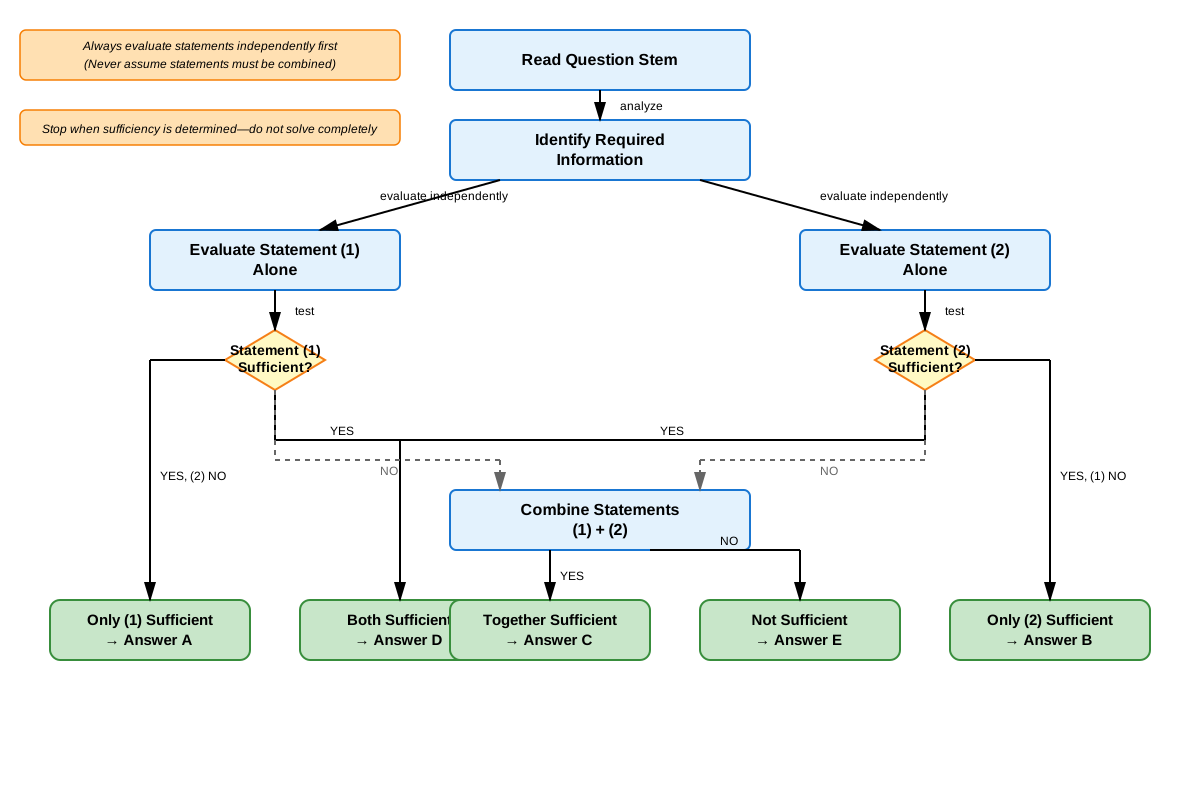
The most efficient approach to Algebra DS follows a two-stage decision process. First, evaluate Statement (1) alone. If Statement (1) is sufficient, the answer must be either (A) or (D)—eliminate (B), (C), and (E). If Statement (1) is insufficient, the answer must be (B), (C), or (E)—eliminate (A) and (D). This initial evaluation immediately narrows the possibilities to two choices.
Second, evaluate Statement (2) alone (always independently of Statement (1)). If working with the AD branch and Statement (2) is also sufficient, choose (D). If Statement (2) is insufficient, choose (A). If working with the BCE branch and Statement (2) is sufficient, choose (B). If Statement (2) is insufficient, proceed to evaluate both statements together: if sufficient together, choose (C); if still insufficient, choose (E).
Sufficiency vs. Solving
The critical distinction in Algebra DS is recognizing that sufficiency means having enough information to determine a unique answer, not necessarily calculating that answer. For example, if asked "What is the value of x?" and given the equation 3x + 7 = 22, the statement is sufficient because it provides one equation with one unknown—even though solving yields x = 5, the actual calculation is unnecessary for determining sufficiency.
This principle saves significant time and reduces calculation errors. Test-takers should ask: "Could I solve this if I had unlimited time?" rather than actually performing the algebra. However, partial simplification often reveals whether statements are sufficient, so strategic algebraic manipulation remains essential.
Equations and Unknowns
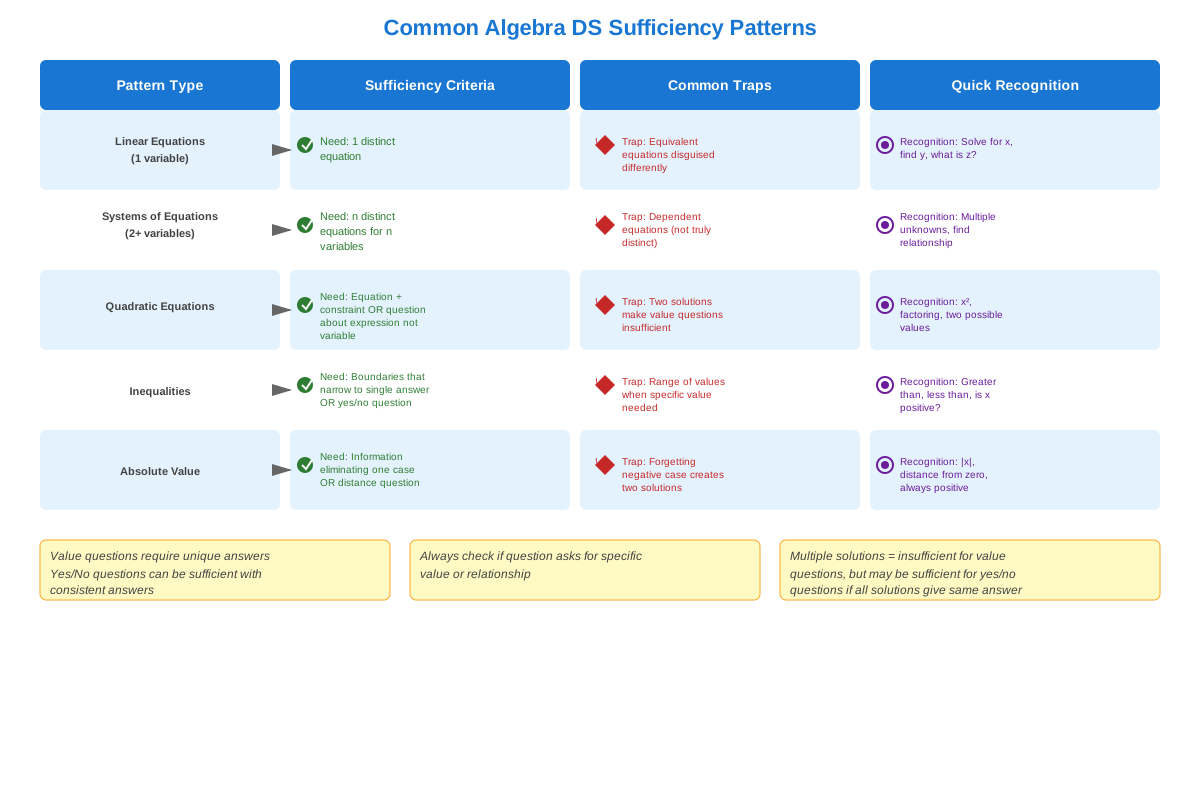
A fundamental algebraic principle governs many DS questions: n independent linear equations are needed to solve for n unknowns. If asked to find the values of x and y, one equation is insufficient (answer cannot be A or B), but two independent equations are sufficient (answer is likely C or D, depending on individual statement structure).
However, "independent" is crucial. The equations 2x + 3y = 12 and 4x + 6y = 24 are not independent—the second is merely the first multiplied by 2. These provide only one unique constraint, making them insufficient to solve for two variables. Similarly, questions asking for a specific expression (like x + y) rather than individual values may be answerable with fewer equations than the number of variables.
Value vs. Yes/No Questions
Algebra DS questions fall into two categories with different sufficiency criteria:
| Question Type | Sufficiency Requirement | Example |
|---|---|---|
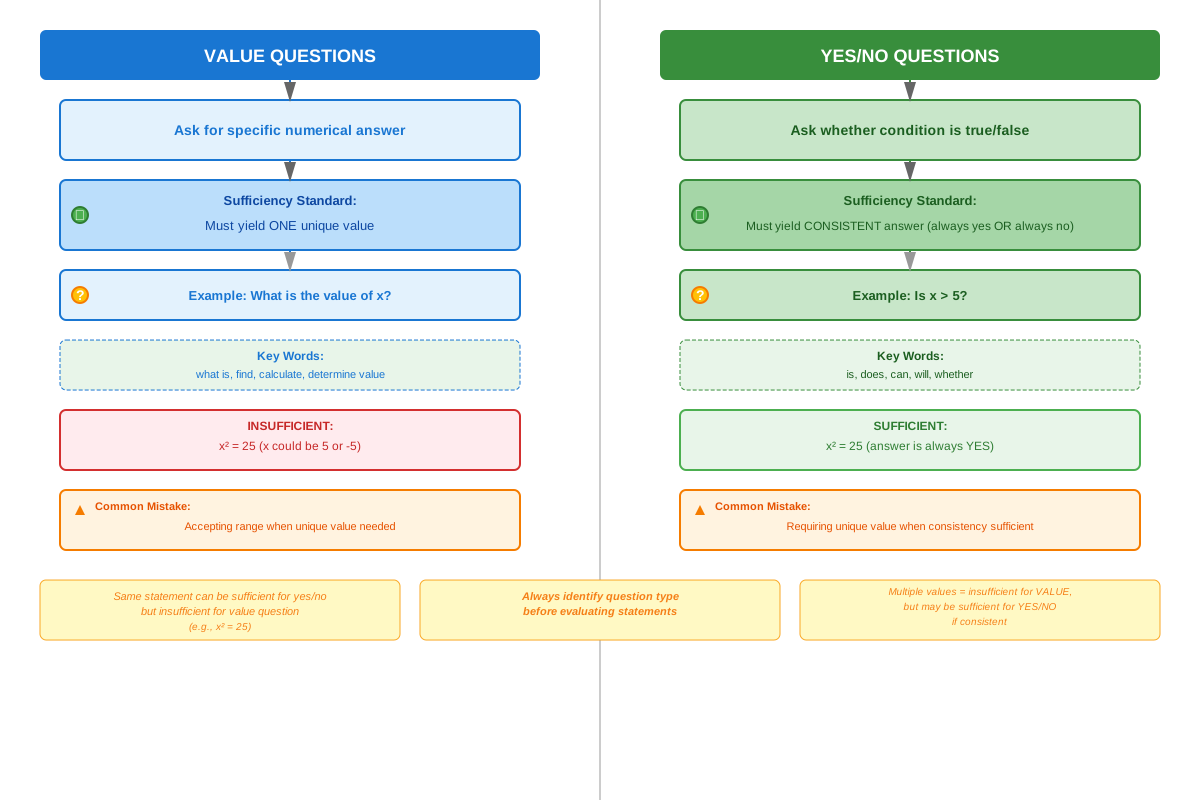
| Value Questions | Must determine a unique numerical answer | "What is the value of x?" |
| Yes/No Questions | Must provide a definitive "yes" or "always no" answer | "Is x > 5?" |
For Yes/No questions, a statement is sufficient if it consistently yields the same answer (always yes or always no), even if different scenarios exist. For example, if asked "Is x positive?" and given "x² = 16," this is insufficient because x could be 4 (yes) or -4 (no). However, if given "x³ = 64," this is sufficient because x must be 4 (always yes).
Inequality Considerations
Inequalities introduce special complexity in Algebra DS. When manipulating inequalities, remember that multiplying or dividing by a negative number reverses the inequality sign. More importantly, statements providing inequality constraints may be sufficient for Yes/No questions but insufficient for value questions.
For instance, if asked "What is x?" and given "x > 3," this is clearly insufficient as x could be any value greater than 3. However, if asked "Is x > 0?" and given "x > 3," this is sufficient (always yes). Conversely, if given "x² > 9," this means x > 3 or x < -3, which is insufficient for "Is x > 0?" because x could be positive or negative.
Absolute Value Scenarios
Absolute value creates two-case scenarios that must both be evaluated. The equation |x| = 5 means x = 5 or x = -5. For sufficiency, if both cases yield the same conclusion, the statement is sufficient; if they yield different conclusions, it's insufficient.
When given |x - 3| = 7, this means x - 3 = 7 (so x = 10) or x - 3 = -7 (so x = -4). For a value question asking "What is x?", this is insufficient. For "Is x > 0?", this is also insufficient (one case yes, one case no). But for "Is |x| > 3?", this is sufficient (both cases satisfy the condition).
Quadratic Equations and Special Cases
Quadratic equations typically yield two solutions, making them insufficient for value questions unless additional constraints eliminate one solution. The equation x² = 25 gives x = ±5. However, if also given that x > 0, the negative solution is eliminated, making the combined information sufficient.
Special factoring patterns appear frequently: difference of squares (x² - y² = (x+y)(x-y)), perfect square trinomials (x² + 2xy + y² = (x+y)²), and sum/product relationships. Recognizing these patterns helps determine sufficiency without complete solving. If asked for x² - y² and given both (x + y) and (x - y), the information is sufficient even without knowing x and y individually.
Zero and Negative Number Traps
Many Algebra DS questions exploit assumptions about positive numbers. When given xy = 20 and asked "Is x > y?", test-takers might assume both are positive. However, both could be negative (x = -4, y = -5 makes x > y true), or one could be negative (x = -2, y = -10 makes x > y true). Always consider zero and negative possibilities unless explicitly restricted.
Division by variables requires special caution. To solve x²y = xy² for the relationship between x and y, dividing both sides by xy seems natural, yielding x = y. However, this is only valid if xy ≠ 0. If either x or y equals zero, the original equation is satisfied regardless of the other variable's value, creating additional solutions the division method misses.
Concept Relationships
The core concepts in Algebra DS build upon each other in a logical hierarchy. The Data Sufficiency format establishes the framework within which all other concepts operate. Understanding this format enables the AD/BCE Decision Tree, which provides the strategic approach to efficiently evaluate statements.
The distinction between Sufficiency vs. Solving fundamentally changes how test-takers apply algebraic knowledge. This principle directly connects to Equations and Unknowns, which provides the mathematical foundation for determining when information is adequate. The equations-unknowns relationship then branches into specialized applications: Value vs. Yes/No Questions (determining what type of answer is required), Inequality Considerations (handling range-based constraints), Absolute Value Scenarios (managing multiple cases), and Quadratic Equations (dealing with multiple solutions).
All these concepts must account for Zero and Negative Number Traps, which represents a cross-cutting consideration that applies to every algebraic manipulation. This creates a relationship map:
DS Format → AD/BCE Strategy → Sufficiency Principle → Equations/Unknowns Foundation → [Value Questions, Yes/No Questions, Inequalities, Absolute Values, Quadratics] → Zero/Negative Considerations
Each specialized concept (inequalities, absolute values, quadratics) represents a different way that the fundamental equations-unknowns relationship can become more complex, requiring additional analysis to determine sufficiency.
Quick check — test yourself on Algebra DS so far.
Try Flashcards →High-Yield Facts
⭐ The AD/BCE decision tree eliminates three answer choices after evaluating just Statement (1), making it the most efficient DS strategy
⭐ For n unknowns, n independent linear equations are needed to solve for unique values, but fewer equations may suffice if asked for a specific expression
⭐ Yes/No questions are sufficient if they yield a consistent answer (always yes or always no), even if multiple scenarios exist within that answer
⭐ Multiplying or dividing an inequality by a negative number reverses the inequality sign; multiplying by a variable of unknown sign creates ambiguity
⭐ Quadratic equations typically produce two solutions, making them insufficient for value questions unless constraints eliminate one solution
- Statements must always be evaluated independently before considering them together; never use information from Statement (2) when evaluating Statement (1)
- The equation x² = 25 is insufficient for "What is x?" but may be sufficient for "What is x²?" or "What is |x|?"
- When asked for a relationship or expression (like x + y or x/y) rather than individual values, fewer equations than unknowns may be sufficient
- Absolute value equations |x| = a create two cases (x = a or x = -a) that must both be evaluated for sufficiency
- Zero is neither positive nor negative; statements involving products, quotients, or inequalities must account for zero as a special case
- Two equations that are multiples of each other (like 2x + y = 5 and 4x + 2y = 10) count as only one independent equation
- For Yes/No questions, "sometimes yes, sometimes no" means insufficient; only "always yes" or "always no" indicates sufficiency
- Squaring both sides of an equation can introduce extraneous solutions; if x = 3, then x² = 9, but x² = 9 doesn't guarantee x = 3
Common Misconceptions
Misconception: Both statements must be evaluated together if neither alone is sufficient → Correction: Always evaluate each statement independently first. Only after determining both are individually insufficient should they be considered together. This prevents contaminating the independent evaluation with information from the other statement.
Misconception: If Statement (1) provides one equation with two unknowns, it's automatically insufficient → Correction: While typically insufficient for finding individual variable values, one equation may be sufficient if the question asks for a specific expression. For example, if given x + y = 10 and asked "What is 2x + 2y?", Statement (1) is sufficient (answer is 20) despite having two unknowns.
Misconception: Sufficiency requires actually calculating the numerical answer → Correction: Sufficiency means having enough information to determine a unique answer, not performing the calculation. Recognizing sufficiency without solving saves time and reduces errors. If you can confidently say "I could solve this with enough time," the statement is sufficient.
Misconception: For Yes/No questions, getting different answers for different values means insufficient → Correction: This is only true if the different scenarios yield different yes/no answers. If x could be 2 or 3 (different values) but both make x > 0 true (same yes/no answer), the statement is sufficient for "Is x > 0?"
Misconception: Negative numbers can be ignored unless the problem explicitly mentions them → Correction: Always consider negative numbers, zero, and fractions unless explicitly restricted. Many GMAT traps exploit the assumption that variables are positive integers. The statement xy > 0 means both are positive OR both are negative, not just that both are positive.
Misconception: If Statement (1) is insufficient and Statement (2) is insufficient, the answer must be (C) or (E) → Correction: While the answer is indeed (C) or (E) when both statements are individually insufficient, test-takers must still evaluate whether combining them provides sufficiency. Don't automatically assume (C) without checking if the combined information actually answers the question.
Misconception: Dividing both sides of an equation by a variable is always valid → Correction: Division by a variable is only valid if that variable cannot equal zero. The equation x²y = xy² can be divided by xy to get x = y only if xy ≠ 0. If either variable could be zero, this creates additional solutions that the division method misses, leading to incorrect sufficiency conclusions.
Worked Examples
Example 1: System of Equations with Expression Target
Question: What is the value of 3x + 2y?
(1) 6x + 4y = 28
(2) x + y = 7
Solution Process:
First, evaluate Statement (1) alone. Notice that 6x + 4y = 28 can be rewritten by factoring: 2(3x + 2y) = 28. Dividing both sides by 2 gives 3x + 2y = 14. This directly answers the question without needing to find individual values of x and y. Statement (1) is SUFFICIENT. We're now in the AD branch.
Next, evaluate Statement (2) alone. The equation x + y = 7 provides one equation with two unknowns. While insufficient to find x and y individually, check if it can determine 3x + 2y. From x + y = 7, we can express y = 7 - x, then substitute: 3x + 2y = 3x + 2(7 - x) = 3x + 14 - 2x = x + 14. This still depends on x, so we cannot determine a unique value for 3x + 2y. Statement (2) is INSUFFICIENT.
Since Statement (1) alone is sufficient but Statement (2) alone is not, the answer is (A).
Key Insight: This example demonstrates that questions asking for expressions rather than individual variables may be answerable with seemingly insufficient information. Recognizing that Statement (1) is a multiple of the target expression (3x + 2y) allows immediate determination of sufficiency without solving for x and y separately.
Example 2: Yes/No Question with Inequality Traps
Question: Is x² > y²?
(1) x > y
(2) x > 0
Solution Process:
Evaluate Statement (1): x > y. Test cases to determine if this consistently answers whether x² > y².
- Case A: x = 3, y = 2. Then x² = 9 > y² = 4. Answer: Yes.
- Case B: x = 2, y = -3. Then x² = 4 but y² = 9, so x² < y². Answer: No.
- Case C: x = -2, y = -3. Then x² = 4 and y² = 9, so x² < y². Answer: No.
Statement (1) yields different answers depending on the values, so it's INSUFFICIENT. We're now in the BCE branch.
Evaluate Statement (2): x > 0. This tells us x is positive but provides no information about y.
- Case A: x = 3, y = 2. Then x² = 9 > y² = 4. Answer: Yes.
- Case B: x = 3, y = 4. Then x² = 9 < y² = 16. Answer: No.
Statement (2) alone is INSUFFICIENT.
Evaluate both statements together: x > y AND x > 0. This means x is positive, but y could still be positive, negative, or zero.
- Case A: x = 3, y = 2 (satisfies both conditions). Then x² = 9 > y² = 4. Answer: Yes.
- Case B: x = 2, y = -3 (satisfies both conditions: 2 > -3 and 2 > 0). Then x² = 4 < y² = 9. Answer: No.
Even together, the statements yield inconsistent answers. The answer is (E).
Key Insight: The trap here is assuming x > y means x² > y². This is only true when both are positive or both are negative with |x| > |y|. When x is positive and y is negative with |y| > |x|, the inequality reverses after squaring. This example emphasizes testing negative numbers and considering absolute value relationships in inequality problems.
Exam Strategy
When approaching Algebra DS questions on the GMAT, begin by carefully reading the question stem to identify whether it's a value question (requiring a unique numerical answer) or a yes/no question (requiring a definitive yes or no). This distinction fundamentally changes the sufficiency criteria and should be noted before evaluating any statements.
Trigger words to watch for include: "What is the value of..." (value question), "Is x greater than..." (yes/no question), "How many..." (value question), and "Does x equal..." (yes/no question). Questions asking for expressions like "What is x + y?" may be answerable even when individual values cannot be determined.
Apply the AD/BCE decision tree systematically. Always evaluate Statement (1) first, completely independently, before looking at Statement (2). After determining Statement (1)'s sufficiency, immediately eliminate three answer choices. This creates a binary decision for the remaining evaluation, significantly reducing cognitive load and time pressure.
Avoid the calculation trap: Don't solve completely unless necessary to determine sufficiency. If you can confidently assess that enough information exists to find a unique answer, mark the statement sufficient and move on. For example, seeing "3x + 7 = 22" is sufficient for "What is x?" without calculating x = 5.
For process of elimination, remember these patterns:
- If Statement (1) is sufficient, eliminate B, C, E immediately
- If Statement (1) is insufficient, eliminate A, D immediately
- If both statements are individually insufficient, the answer must be C or E
- If both statements are individually sufficient, the answer is D
Time allocation: Spend 30-45 seconds understanding the question stem and identifying the question type. Allocate 45-60 seconds for evaluating Statement (1), then 30-45 seconds for Statement (2) (since you've already eliminated three choices). Reserve 15-30 seconds for evaluating both statements together if needed. Total target time: 2-2.5 minutes per question.
When stuck, use strategic testing: Pick simple numbers that satisfy the statement's constraints and test whether they yield consistent answers. For yes/no questions, try to find one case that answers "yes" and another that answers "no"—if you can find both, the statement is insufficient. For value questions, try to find two different values that satisfy the constraints—if you can, it's insufficient.
Red flags indicating potential traps: variables in denominators (consider zero), even exponents (consider negative values), inequalities with variables of unknown sign (consider negative multipliers), and absolute values (consider both positive and negative cases).
Memory Techniques
AD/BCE Mnemonic: "Always Decide first, then Build Complete Evaluation." This reminds you to evaluate Statement (1) first (Always Decide), which leads to either the AD branch or the BCE branch, then complete your evaluation systematically.
Sufficiency Check - "CUDI": Could I solve this? Unique answer? Definitive yes/no? Independent evaluation? This four-question checklist ensures you're properly assessing sufficiency without over-solving.
Equations-Unknowns Rule: "N for N" - N independent equations needed for N unknowns. Visualize a balance scale: each unknown adds weight to one side, each independent equation adds weight to the other. Only when balanced (equal numbers) can you solve.
Yes/No Sufficiency: "SWAN" - Same Way Always = Nailed it. If a yes/no question yields the same answer (always yes or always no) regardless of which valid values you test, you've nailed sufficiency.
Negative Number Reminder: "ZONE" - Zero, One, Negative, Everything else. When testing values, always consider zero first, then one, then negative numbers, before testing other values. This catches most GMAT traps.
Inequality Manipulation: Visualize a seesaw. When you multiply or divide by a negative number, the seesaw flips direction. If you don't know the sign of what you're multiplying by, the seesaw's direction becomes uncertain—a sign of insufficiency.
Absolute Value Cases: Draw a number line with the critical point marked. Absolute value creates a "mirror" effect—solutions appear on both sides of the critical point. If both mirror images yield the same conclusion, you have sufficiency.
Summary
Algebra DS questions represent a unique GMAT challenge that tests analytical reasoning as much as algebraic skill. Success requires understanding the standardized five-answer format and applying the systematic AD/BCE decision tree to efficiently evaluate statements. The fundamental principle distinguishing DS from traditional problem-solving is that sufficiency means having enough information to determine an answer, not actually calculating it. This principle, combined with the equations-unknowns relationship (n independent equations for n unknowns), forms the foundation for evaluating most Algebra DS questions. However, complications arise with inequalities, absolute values, quadratic equations, and special cases involving zero and negative numbers. Value questions require unique numerical answers, while yes/no questions need only consistent directional answers. Mastering these distinctions, avoiding calculation traps, and systematically testing edge cases enables test-takers to navigate Algebra DS efficiently and accurately, making it a high-yield area for score improvement.
Key Takeaways
- Always use the AD/BCE decision tree: evaluate Statement (1) first to eliminate three answer choices immediately, then evaluate Statement (2) within the remaining two-choice framework
- Sufficiency means having enough information to determine a unique answer—stop working once you recognize sufficiency rather than completing calculations
- For n unknowns, n independent linear equations are typically needed, but questions asking for specific expressions may require fewer equations
- Yes/no questions are sufficient when they yield consistent answers (always yes or always no), even if multiple scenarios exist within that answer
- Always consider zero, negative numbers, and fractions unless explicitly restricted—most GMAT traps exploit assumptions about positive integers
- Evaluate each statement completely independently before considering them together; never contaminate Statement (1) evaluation with information from Statement (2)
- Quadratic equations, absolute values, and inequalities with unknown signs create multiple cases that must all be evaluated to determine sufficiency
Related Topics
Linear Equations and Systems: Mastering Algebra DS provides the foundation for more complex multi-variable systems, including three-variable problems and matrix-based approaches that appear in higher-difficulty GMAT questions.
Inequalities and Absolute Value: The sufficiency principles learned here extend to more sophisticated inequality problems involving compound inequalities, quadratic inequalities, and absolute value inequalities that create multiple constraint regions.
Word Problems and Applied Algebra: Algebra DS skills directly transfer to rate problems, mixture problems, work problems, and age problems where determining sufficiency of given information is crucial before attempting solutions.
Coordinate Geometry DS: The same sufficiency framework applies to questions about lines, circles, and parabolas, where determining whether statements provide enough information to identify geometric properties becomes essential.
Number Properties DS: Understanding algebraic sufficiency enables progression to questions combining algebra with divisibility, prime factorization, and integer properties, representing some of the highest-difficulty GMAT questions.
Practice CTA
Now that you've mastered the core concepts of Algebra DS, it's time to cement your understanding through deliberate practice. Attempt the practice questions associated with this topic, focusing on applying the AD/BCE decision tree systematically and recognizing sufficiency without over-solving. Use the flashcards to reinforce high-yield facts and common trap patterns. Remember: Algebra DS is one of the highest-yield topics for score improvement on the GMAT—every question you practice brings you closer to your target score. Approach each problem as an opportunity to refine your analytical reasoning and build the confidence that comes from systematic mastery. You've got this!
Sign up free to keep reading
Create a free AnvayaPrep account to finish this GMAT guide on Algebra DS — plus flashcards and practice questions.