Overview
Inequalities represent one of the most frequently tested mathematical concepts in the GMAT Data Sufficiency section, appearing in approximately 15-20% of quantitative questions. Unlike equations that establish exact equality between expressions, inequalities describe relationships where one quantity is greater than, less than, greater than or equal to, or less than or equal to another quantity. Mastering GMAT inequalities requires not only understanding how to manipulate these mathematical statements algebraically but also developing the strategic thinking necessary to determine when information is sufficient to answer a question definitively.
The GMAT tests inequalities in sophisticated ways that go beyond simple algebraic manipulation. Test-makers design questions that require students to recognize when combining multiple inequalities yields definitive information versus when it leaves ambiguity. This topic integrates seamlessly with absolute values, number properties, and algebraic expressions, making it a cornerstone concept that appears across multiple question types. Students must develop comfort with both linear and quadratic inequalities, understand how multiplication and division by negative numbers affect inequality signs, and recognize when squaring or taking roots of inequalities is valid.
Within the Data Insights framework, inequalities serve as a critical tool for analyzing sufficiency. Many Data Sufficiency questions present inequality constraints in the statements and ask whether these constraints provide enough information to answer questions about ranges, specific values, or relationships between variables. The ability to quickly assess whether inequality information narrows possibilities to a single answer or leaves multiple valid outcomes distinguishes high-scoring test-takers from those who struggle with this question type.
Learning Objectives
- [ ] Identify inequalities in various forms within GMAT questions
- [ ] Explain the properties and rules governing inequality manipulation
- [ ] Apply inequalities to GMAT Data Sufficiency questions effectively
- [ ] Determine when combining multiple inequalities yields sufficient information
- [ ] Recognize special cases where inequality rules change (multiplication/division by negatives, squaring)
- [ ] Evaluate the sufficiency of inequality statements for answering range and value questions
- [ ] Distinguish between situations requiring exact values versus acceptable ranges
Prerequisites
- Basic algebra: Understanding variables, expressions, and equation-solving provides the foundation for manipulating inequality statements
- Number properties: Knowledge of positive/negative numbers, zero, and their behaviors is essential since these properties determine when inequality signs flip
- Absolute value concepts: Many inequality problems involve absolute values, requiring understanding of distance and magnitude
- Data Sufficiency format: Familiarity with the five answer choices (A, B, C, D, E) and the logic of sufficiency testing enables efficient problem-solving
Why This Topic Matters
Inequalities appear throughout real-world applications, from business constraints (budget limitations, minimum production requirements) to scientific measurements (error margins, acceptable ranges). In finance, inequalities describe profit thresholds, risk tolerances, and investment constraints. Engineers use inequalities to specify tolerances and safety margins. This practical ubiquity makes inequalities a natural testing ground for the GMAT's goal of assessing quantitative reasoning in business contexts.
On the GMAT specifically, inequality questions appear in approximately 15-20% of Data Sufficiency problems and 10-15% of Problem Solving questions. The test frequently combines inequalities with other topics: absolute values, quadratic expressions, number properties, and systems of equations. Data Sufficiency questions particularly favor inequalities because they create natural ambiguity—a single inequality constraint often leaves multiple possible values, making it ideal for testing whether students can distinguish sufficient from insufficient information.
Common question patterns include: determining whether statements provide enough information to establish if a variable is positive or negative; assessing whether combined inequalities narrow a range sufficiently; evaluating whether inequality constraints allow determination of which of two quantities is larger; and analyzing whether absolute value inequalities provide sufficient bounds. The GMAT also tests whether students recognize that squaring both sides of an inequality is only valid under certain conditions, and whether they understand how multiplying or dividing by variables of unknown sign affects inequality relationships.
Core Concepts
Basic Inequality Symbols and Meaning
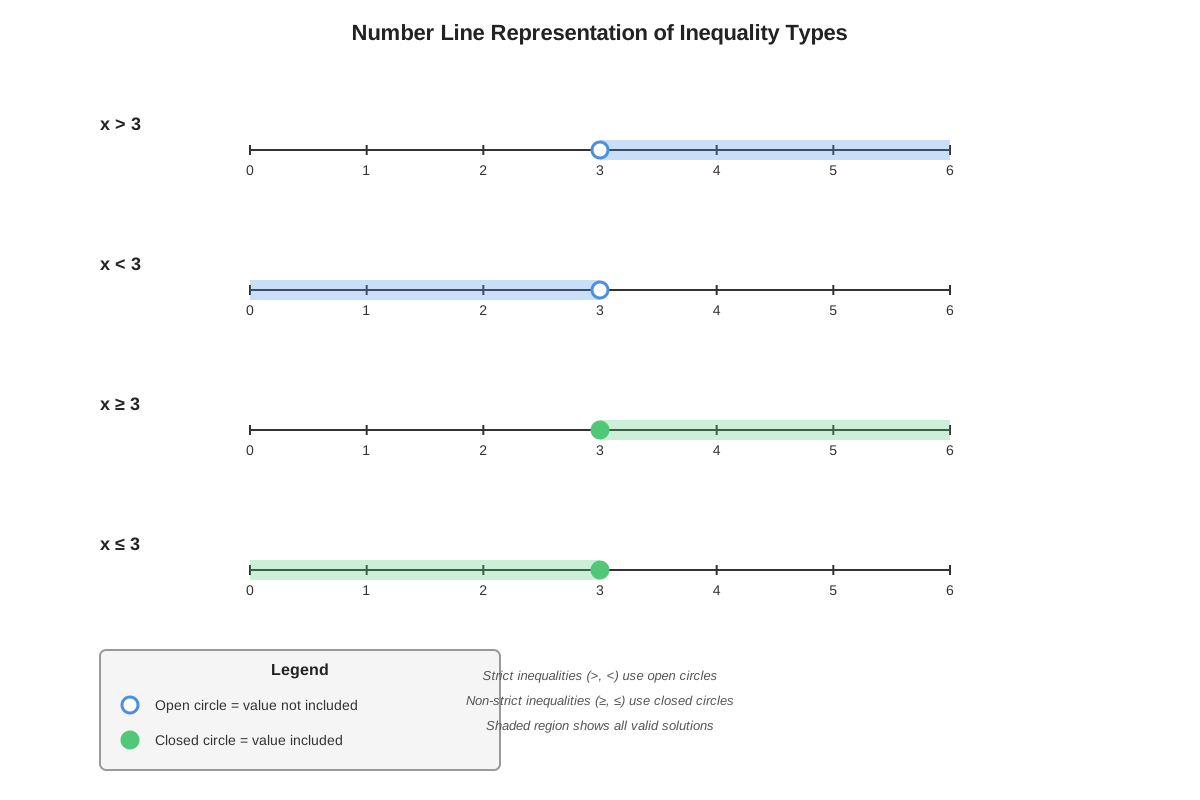
An inequality is a mathematical statement comparing two expressions using symbols that indicate relative magnitude rather than exact equality. The five fundamental inequality symbols are:
<(less than): indicates the left expression is strictly smaller>(greater than): indicates the left expression is strictly larger≤(less than or equal to): allows the left expression to be smaller or equal≥(greater than or equal to): allows the left expression to be larger or equal≠(not equal to): indicates the expressions differ but doesn't specify direction
Understanding the distinction between strict inequalities (<, >) and non-strict inequalities (≤, ≥) proves critical in Data Sufficiency, as this difference often determines whether a statement provides sufficient information.
Fundamental Properties of Inequalities
Several algebraic operations preserve inequality relationships, while others require special attention:
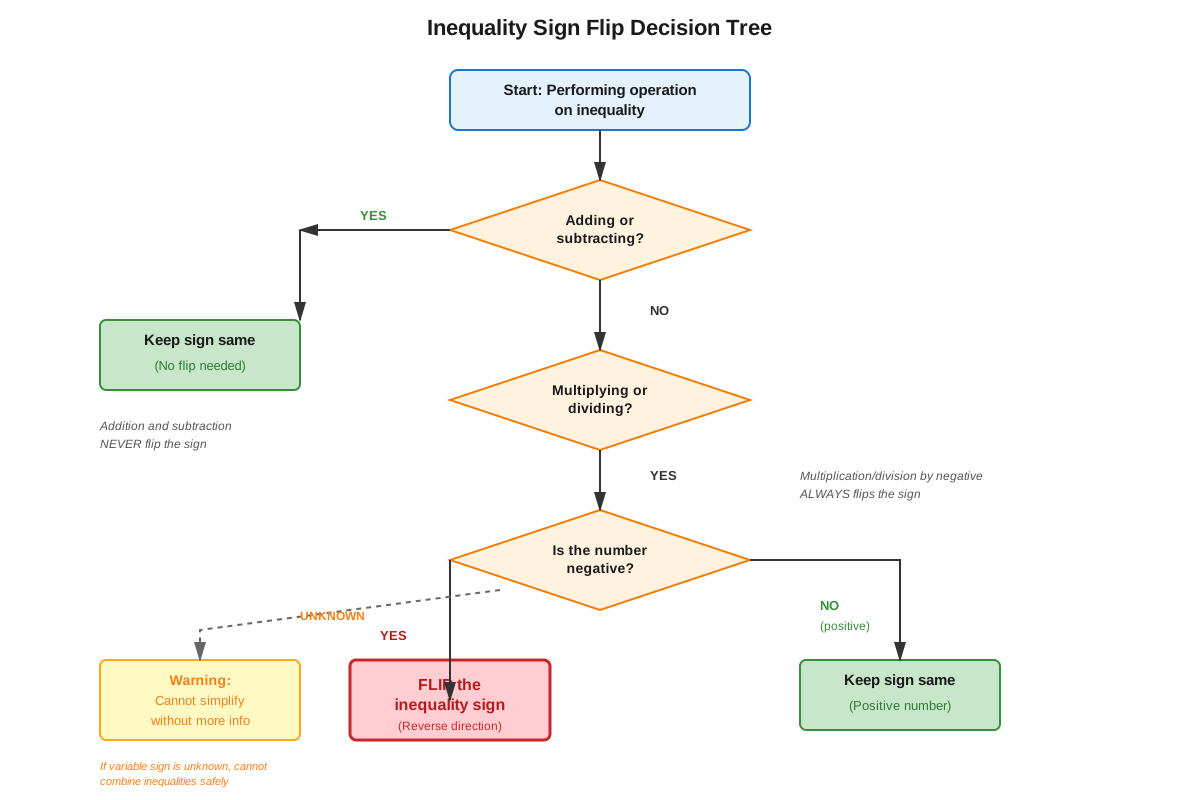
Addition and Subtraction: Adding or subtracting the same value to both sides of an inequality preserves the inequality direction. If a > b, then a + c > b + c and a - c > b - c for any value c. This property allows isolation of variables just as in equation-solving.
Multiplication and Division by Positive Numbers: Multiplying or dividing both sides by a positive number preserves the inequality direction. If a > b and c > 0, then ac > bc and a/c > b/c.
Multiplication and Division by Negative Numbers: This represents the most commonly tested property. When multiplying or dividing both sides by a negative number, the inequality sign must flip. If a > b and c < 0, then ac < bc and a/c < b/c. Many GMAT questions test whether students remember this reversal.
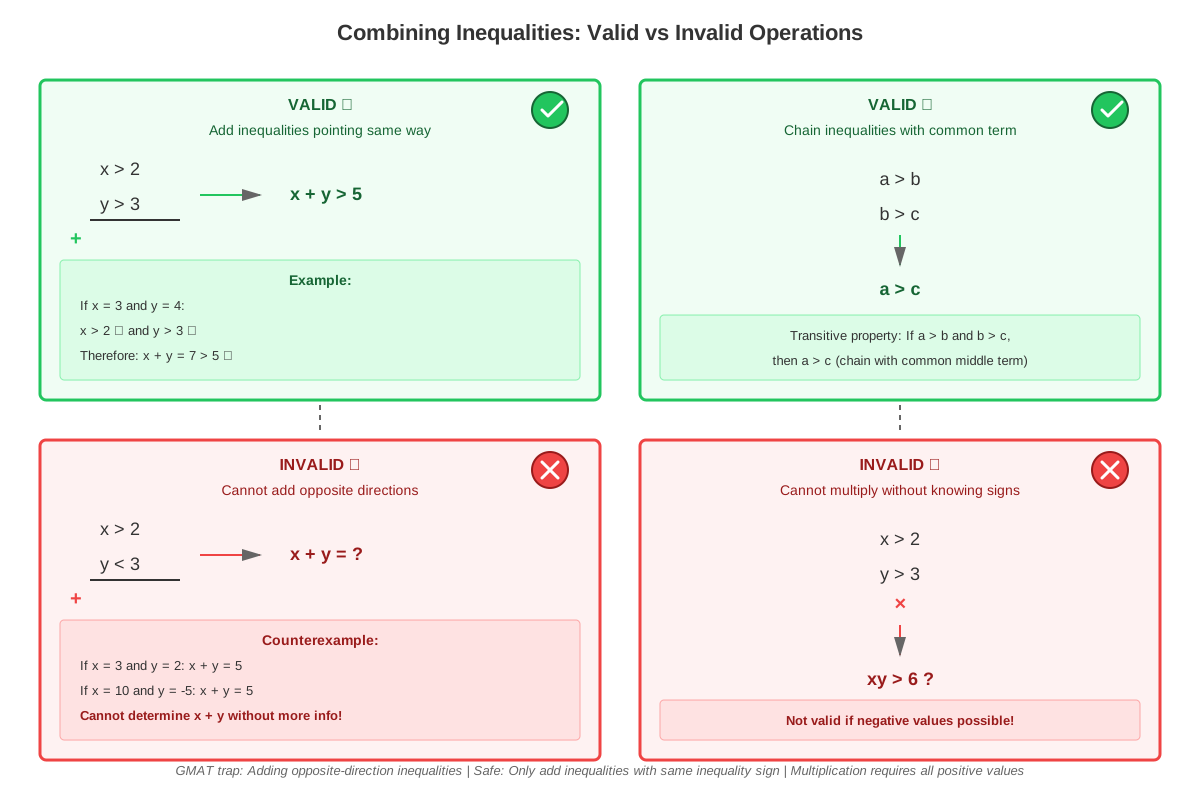
Transitive Property: If a > b and b > c, then a > c. This property enables chaining of inequalities and appears frequently in Data Sufficiency questions that provide multiple inequality statements.
Combining Inequalities
The GMAT frequently tests the ability to combine multiple inequalities correctly:
Same Direction Addition: When inequalities point the same direction, they can be added. If a > b and c > d, then a + c > b + d. This proves useful when statements provide separate constraints that can be combined.
Subtraction Requires Caution: Subtracting inequalities pointing the same direction is NOT generally valid. If a > b and c > d, we cannot conclude that a - c > b - d. The GMAT exploits this common error.
Multiplication of Positive Quantities: If all variables are known to be positive and a > b and c > d, then ac > bd. However, without knowing signs, multiplication becomes problematic.
Inequality Manipulation with Variables of Unknown Sign
When variables can be positive, negative, or zero, certain operations become invalid or require case analysis:
Cannot Multiply/Divide by Variables: If the sign of a variable is unknown, multiplying or dividing both sides by that variable is invalid without considering cases. For example, from x > y, we cannot conclude x² > y² without knowing whether x and y are positive or negative.
Squaring Both Sides: Squaring preserves inequality only when both sides are known to be non-negative. If a > b and both a, b ≥ 0, then a² > b². However, if signs are unknown, squaring can reverse relationships (e.g., -3 < 2 but 9 > 4).
Taking Reciprocals: Taking reciprocals of both sides reverses the inequality sign when both sides are positive. If 0 < a < b, then 1/a > 1/b. This relationship changes if negative numbers are involved.
Absolute Value Inequalities
Absolute value inequalities create two-sided constraints:
Less Than Form: |x| < a (where a > 0) means -a < x < a. This creates a bounded interval.
Greater Than Form: |x| > a (where a > 0) means x < -a or x > a. This creates two unbounded regions.
These forms appear frequently in Data Sufficiency questions testing whether students can translate absolute value constraints into usable ranges.
Quadratic Inequalities
Quadratic inequalities require factoring and sign analysis:
For x² + bx + c > 0, factor as (x - r₁)(x - r₂) > 0 where r₁ and r₂ are roots. The solution depends on the sign of the product in different regions:
- When
x < r₁orx > r₂: both factors have the same sign (product positive) - When
r₁ < x < r₂: factors have opposite signs (product negative)
The GMAT tests whether students can determine solution sets for quadratic inequalities and whether these solution sets provide sufficient information.
Inequality Systems
Systems of inequalities define feasible regions:
x + y > 5
x - y < 3
x > 0
Such systems appear in Data Sufficiency questions asking whether constraints sufficiently narrow possibilities. Solving requires finding the intersection of all constraint regions.
Concept Relationships
The core inequality concepts form an interconnected web of relationships. Basic inequality symbols serve as the foundation, defining the language for all other concepts. These symbols connect directly to fundamental properties, which govern how inequalities can be manipulated algebraically. The most critical property—sign reversal when multiplying/dividing by negatives—branches into the more complex concept of manipulation with variables of unknown sign, which represents a major testing focus.
Combining inequalities builds upon both basic properties and the transitive property, enabling students to synthesize information from multiple statements. This concept connects directly to Data Sufficiency strategy, as many questions require determining whether combining Statement 1 and Statement 2 provides sufficient constraints.
Absolute value inequalities represent a specialized application that combines inequality manipulation with absolute value properties (a prerequisite topic). These create bounded or unbounded regions that connect to inequality systems, which define feasible solution spaces.
Quadratic inequalities integrate factoring skills with sign analysis and connect to number properties (understanding when products are positive or negative). These often appear alongside absolute value inequalities in complex Data Sufficiency scenarios.
The relationship flow: Basic Symbols → Fundamental Properties → (branches to) → Combining Inequalities + Variable Sign Issues → (converge in) → Complex Applications (Absolute Value, Quadratic, Systems) → Data Sufficiency Strategy.
High-Yield Facts
⭐ When multiplying or dividing both sides of an inequality by a negative number, the inequality sign must flip direction
⭐ Inequalities pointing the same direction can be added but generally cannot be subtracted
⭐ Squaring both sides of an inequality is only valid when both sides are known to be non-negative
⭐ |x| < a (where a > 0) translates to -a < x < a, creating a bounded interval
⭐ In Data Sufficiency, a single inequality typically leaves multiple possible values, making it insufficient for "what is the value" questions
- Taking reciprocals of positive quantities reverses the inequality sign: if 0 < a < b, then 1/a > 1/b
- The transitive property allows chaining: if a > b and b > c, then a > c
- Multiplying inequalities with all positive quantities preserves direction: if a > b > 0 and c > d > 0, then ac > bd
- |x| > a (where a > 0) means x < -a or x > a, creating two unbounded regions
- For quadratic inequality (x - r₁)(x - r₂) > 0, the solution is x < r₁ or x > r₂ (outside the roots)
- Adding the same value to all parts of a compound inequality preserves relationships: if a < b < c, then a + k < b + k < c + k
- Cannot multiply both sides by a variable of unknown sign without case analysis
- Zero plays a special role: multiplying by zero makes any inequality into an equality (0 = 0)
Quick check — test yourself on Inequalities so far.
Try Flashcards →Common Misconceptions
Misconception: Inequalities can be subtracted just like they can be added. If a > b and c > d, then a - c > b - d.
Correction: Subtraction of inequalities pointing the same direction is invalid. Consider a = 5, b = 3, c = 4, d = 1: we have 5 > 3 and 4 > 1, but 5 - 4 = 1 is NOT greater than 3 - 1 = 2. Only addition of same-direction inequalities is valid.
Misconception: Squaring both sides always preserves the inequality relationship.
Correction: Squaring preserves inequality only when both sides are non-negative. If -3 < 2, squaring gives 9 > 4, reversing the relationship. Always verify that both sides are non-negative before squaring, or consider cases separately.
Misconception: If x² > 9, then x > 3.
Correction: The inequality x² > 9 means x > 3 OR x < -3. The solution includes both positive and negative regions. Many students forget the negative solution set.
Misconception: Multiplying both sides of an inequality by a variable is always valid.
Correction: Multiplying by a variable of unknown sign requires case analysis. If x > y and we multiply by z, the result depends on whether z is positive (preserving direction), negative (flipping direction), or zero (creating equality). Without knowing z's sign, the operation is invalid.
Misconception: In Data Sufficiency, if a statement provides an inequality constraint, it's automatically insufficient because it doesn't give an exact value.
Correction: Whether an inequality provides sufficient information depends on the question asked. For "Is x positive?" a statement like "x > 5" is sufficient (definite yes). For "What is x?" the same statement is insufficient. Always match the constraint type to the question type.
Misconception: If a > b, then 1/a > 1/b.
Correction: Taking reciprocals reverses the inequality only when both quantities are positive. If 0 < a < b, then 1/a > 1/b. However, if both are negative, the reversal still occurs but in the opposite direction: if a < b < 0, then 1/a > 1/b. If signs differ, reciprocals cannot be compared without more information.
Misconception: Absolute value inequalities always create bounded regions.
Correction: The form |x| < a creates a bounded region (-a < x < a), but |x| > a creates unbounded regions (x < -a or x > a). Understanding which form creates which type of region is essential for Data Sufficiency.
Worked Examples
Example 1: Combining Inequalities in Data Sufficiency
Question: Is x + y > 10?
Statement 1: x > 6
Statement 2: y > 5
Solution Process:
First, identify what the question asks: whether the sum x + y exceeds 10. This is a yes/no Data Sufficiency question requiring a definitive answer.
Analyzing Statement 1 alone: x > 6 provides information only about x. Without any constraint on y, we cannot determine whether x + y > 10. For example:
- If x = 7 and y = 5, then x + y = 12 > 10 (YES)
- If x = 7 and y = 1, then x + y = 8 < 10 (NO)
Since we get both YES and NO answers, Statement 1 is insufficient.
Analyzing Statement 2 alone: y > 5 provides information only about y. By parallel reasoning:
- If y = 6 and x = 5, then x + y = 11 > 10 (YES)
- If y = 6 and x = 1, then x + y = 7 < 10 (NO)
Statement 2 alone is insufficient.
Combining both statements: When x > 6 and y > 5, we can add these inequalities (same direction addition is valid):
x + y > 6 + 5
x + y > 11
Since 11 > 10, we can definitively answer YES to the question "Is x + y > 10?"
Answer: C (Both statements together are sufficient, but neither alone is sufficient)
Key Learning Points: This example demonstrates valid inequality addition and shows how Data Sufficiency questions test whether combining constraints provides definitive answers. Each statement alone leaves too much ambiguity, but together they narrow the range sufficiently.
Example 2: Sign Considerations with Variable Multiplication
Question: Is xy > 0?
Statement 1: x > y
Statement 2: x + y > 0
Solution Process:
The question asks whether the product xy is positive, which occurs when x and y have the same sign (both positive or both negative).
Analyzing Statement 1 alone: x > y tells us the relative magnitude but nothing about signs:
- If x = 3 and y = 2, then xy = 6 > 0 (YES)
- If x = -2 and y = -3, then xy = 6 > 0 (YES)
- If x = 2 and y = -3, then xy = -6 < 0 (NO)
All three scenarios satisfy x > y, but we get different answers. Statement 1 is insufficient.
Analyzing Statement 2 alone: x + y > 0 means the sum is positive, but this doesn't guarantee the product is positive:
- If x = 5 and y = 1, then x + y = 6 > 0 and xy = 5 > 0 (YES)
- If x = 5 and y = -2, then x + y = 3 > 0 but xy = -10 < 0 (NO)
Statement 2 is insufficient.
Combining both statements: Even together, these don't provide sufficient information:
- If x = 3 and y = 2: x > y ✓, x + y = 5 > 0 ✓, xy = 6 > 0 (YES)
- If x = 3 and y = -1: x > y ✓, x + y = 2 > 0 ✓, xy = -3 < 0 (NO)
Both statements together remain insufficient.
Answer: E (Statements together are insufficient)
Key Learning Points: This example illustrates that inequalities about sums and relative magnitudes don't necessarily determine signs of products. The GMAT frequently tests whether students recognize that certain combinations of constraints still leave critical ambiguities. This problem also demonstrates the importance of testing multiple cases, including scenarios with different sign combinations.
Exam Strategy
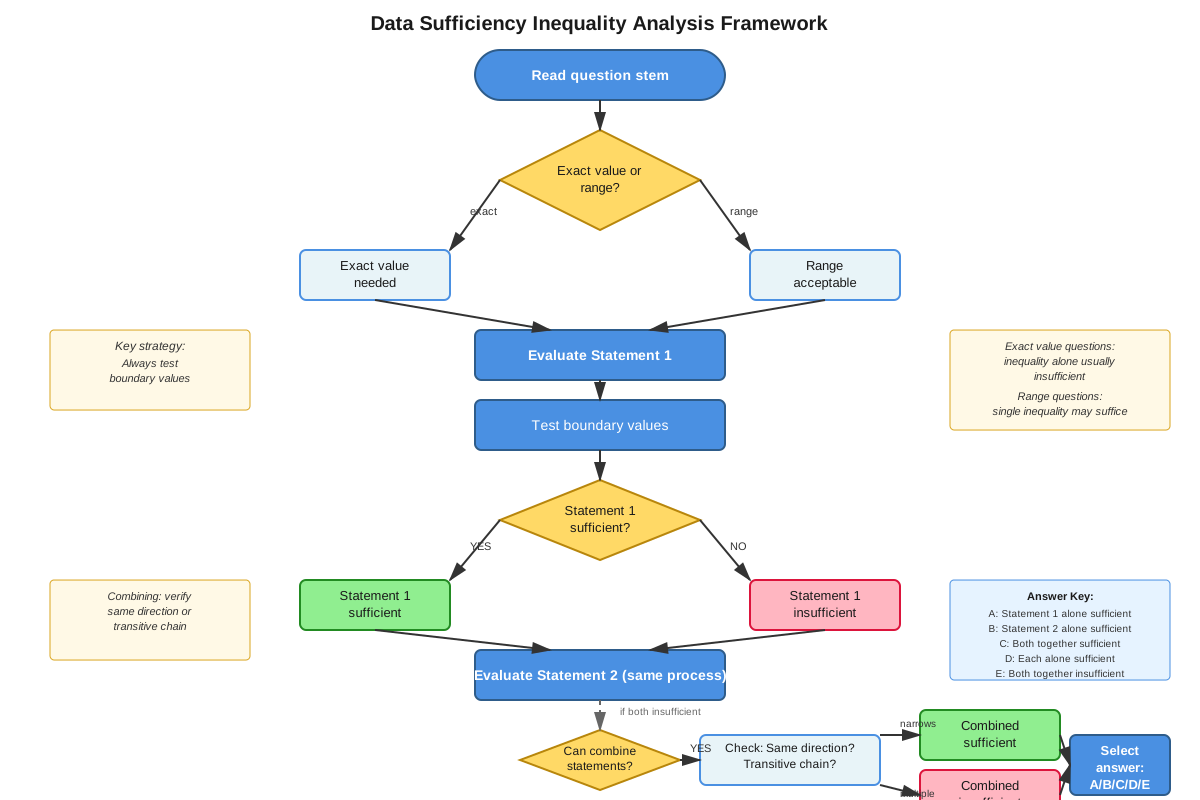
When approaching GMAT inequality questions, begin by identifying the question type. For Data Sufficiency, determine whether the question asks for an exact value, a yes/no answer, or a comparison. Inequality statements typically cannot provide exact values but often suffice for yes/no or comparison questions.
Trigger words and phrases to watch for include: "at least" (≥), "at most" (≤), "more than" (>), "less than" (<), "between," "range," "maximum," "minimum," "positive," "negative," and "exceeds." These signal inequality relationships rather than exact equalities.
Process-of-elimination strategy: In Data Sufficiency, quickly eliminate answer choices by testing extreme cases. If Statement 1 provides an inequality, test boundary values and values well within the range to see if different answers emerge. For yes/no questions, finding even one counterexample proves insufficiency. For "what is the value" questions, showing two different possible values proves insufficiency.
Sign analysis workflow: When variables appear in denominators or as multipliers, immediately note whether their signs are known. If not, consider whether the statements provide sign information. Many GMAT inequality questions hinge on determining signs rather than exact values.
Combination strategy: Before analyzing statements together, predict whether combination will help. If both statements provide inequalities pointing the same direction on the same variables, addition likely yields useful information. If statements constrain different variables, assess whether the question requires relating those variables.
Time allocation: Spend 15-20 seconds identifying what the question asks and what type of information would suffice. Spend 30-40 seconds on each statement individually, testing at least two cases if the sufficiency isn't immediately clear. Reserve 30-40 seconds for combined analysis if needed. Avoid spending more than 2 minutes total on any single Data Sufficiency question.
Red flags: Be suspicious when you can multiply or divide by a variable—this usually signals a trap. Be cautious when squaring both sides. Watch for subtraction of inequalities, which is almost always invalid. Question any conclusion that seems to determine exact values from inequality constraints alone.
Memory Techniques
SAND Mnemonic for multiplication/division rules:
- Same sign (positive): inequality stays
- Always flip for negatives
- Never multiply/divide by variables of unknown sign
- Division by zero is undefined (watch for this trap)
"Add Same, Never Subtract" for combining inequalities: Inequalities pointing the same direction can be added but not subtracted.
"Square with Care" reminder: Before squaring both sides, verify both sides are non-negative. Visualize the number line with negative values squaring to become positive.
Absolute Value Visualization: Picture |x| < a as a "fence" creating a bounded region between -a and a. Picture |x| > a as "outside the fence," creating two unbounded regions. The "less than" form bounds; the "greater than" form expands.
"Flip for Negative Multiplication" physical gesture: When multiplying or dividing by a negative, physically gesture flipping the inequality sign. This kinesthetic reinforcement helps prevent errors under time pressure.
Reciprocal Reversal: Remember "reciprocals reverse" for positive numbers. Visualize 1/2 versus 1/3: the smaller number (1/3) has the larger denominator (3), so reciprocals flip the relationship.
Summary
Inequalities represent a high-yield GMAT topic requiring both algebraic manipulation skills and strategic thinking about sufficiency. The fundamental rules—adding or subtracting preserves direction, multiplying or dividing by positives preserves direction, multiplying or dividing by negatives flips direction—form the foundation for all inequality work. Critical advanced concepts include recognizing that same-direction inequalities can be added but not subtracted, understanding that squaring is only valid when both sides are non-negative, and knowing that multiplication or division by variables of unknown sign requires case analysis. Absolute value inequalities create either bounded regions (|x| < a) or unbounded regions (|x| > a), while quadratic inequalities require factoring and sign analysis. In Data Sufficiency contexts, inequality constraints often provide sufficient information for yes/no questions but insufficient information for exact value questions. Success requires testing multiple cases, particularly considering different sign scenarios, and recognizing when combined constraints narrow possibilities to a single definitive answer versus when ambiguity remains.
Key Takeaways
- Multiplying or dividing both sides of an inequality by a negative number requires flipping the inequality sign—this is the most frequently tested property
- Same-direction inequalities can be added to create new valid inequalities, but subtraction is generally invalid
- Squaring both sides preserves inequality only when both sides are known to be non-negative; otherwise, case analysis is required
- In Data Sufficiency, inequality constraints typically cannot determine exact values but often suffice for yes/no questions and comparisons
- Absolute value inequalities create bounded regions (|x| < a) or unbounded regions (|x| > a), fundamentally different solution types
- Variables of unknown sign cannot be used as multipliers or divisors without considering separate cases for positive and negative scenarios
- Testing extreme cases and boundary values efficiently reveals whether inequality statements provide sufficient information
Related Topics
Absolute Value Equations and Inequalities: Building on basic inequality manipulation, this topic explores the geometric interpretation of absolute value as distance and develops techniques for solving complex absolute value inequalities. Mastering basic inequalities enables progression to these more sophisticated problems.
Quadratic Equations and Inequalities: This advanced topic combines factoring, the quadratic formula, and sign analysis with inequality concepts. Understanding linear inequalities provides the foundation for analyzing when quadratic expressions are positive or negative.
Number Properties and Sign Analysis: This topic explores divisibility, prime numbers, and positive/negative properties in depth. Inequality problems frequently require determining whether expressions are positive or negative, making this a natural extension.
Systems of Equations and Inequalities: Building on single-variable inequalities, this topic addresses multiple variables with multiple constraints, including graphical interpretation and feasible region analysis.
Data Sufficiency Strategy: This broader topic encompasses the logical framework for analyzing sufficiency across all mathematical topics. Mastering inequalities provides concrete practice in distinguishing sufficient from insufficient information.
Practice CTA
Now that you've mastered the core concepts of inequalities, it's time to solidify your understanding through active practice. Attempt the practice questions designed specifically for this topic, focusing on applying the sign-reversal rules, testing multiple cases, and distinguishing sufficient from insufficient information. Use the flashcards to reinforce the high-yield facts and properties until they become automatic. Remember: inequality questions reward systematic thinking and careful case analysis. Each practice problem you solve builds the pattern recognition and strategic thinking that will serve you throughout the GMAT. You've built a strong foundation—now transform that knowledge into test-day confidence through deliberate practice!
Sign up free to keep reading
Create a free AnvayaPrep account to finish this GMAT guide on Inequalities — plus flashcards and practice questions.