Overview
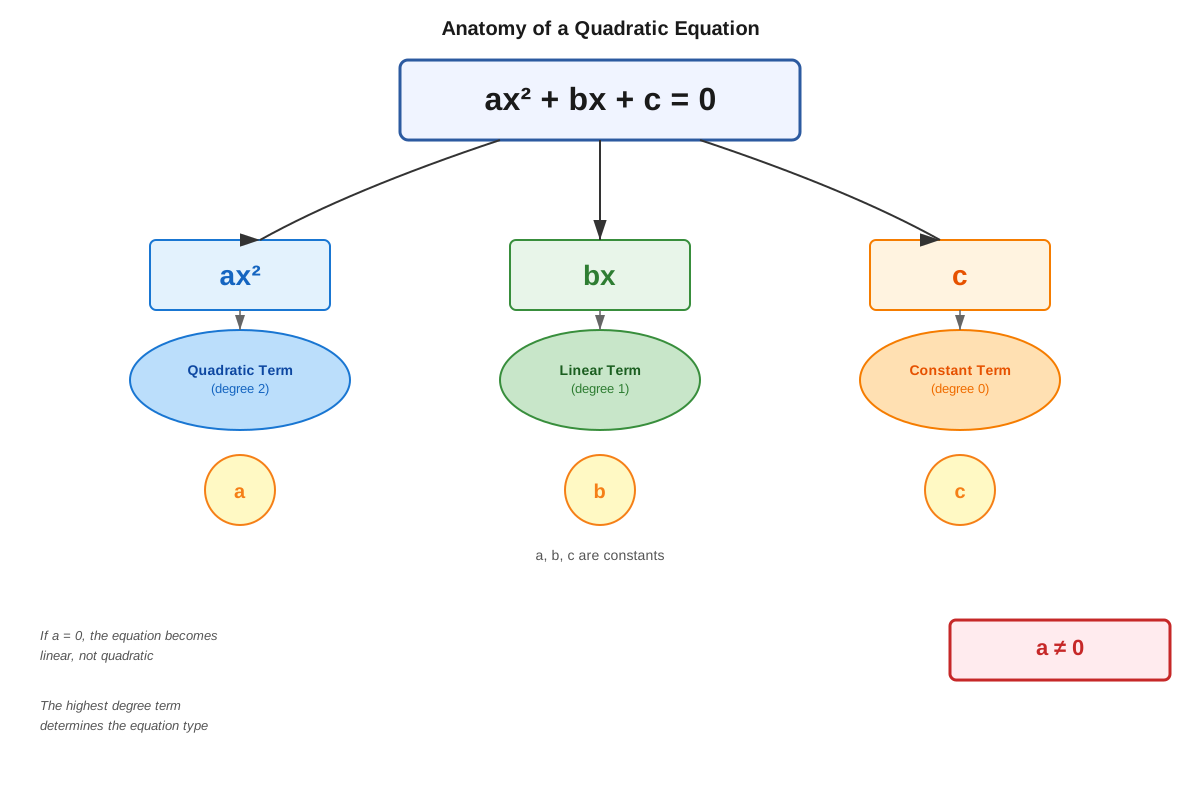
Quadratic equations are polynomial equations of degree two that appear frequently throughout the GMAT Quantitative Reasoning section. These equations take the standard form ax² + bx + c = 0, where a, b, and c are constants and a ≠ 0. Mastering quadratic equations is essential for GMAT success because they form the foundation for numerous problem types, including word problems involving area and geometry, optimization questions, and complex algebraic manipulations. The ability to quickly recognize, factor, and solve quadratic equations can save valuable time during the exam and unlock solutions to problems that initially appear intractable.
On the GMAT, GMAT quadratic equations appear in multiple contexts beyond straightforward "solve for x" problems. Test-makers embed quadratic relationships within data sufficiency questions, requiring students to determine whether given information uniquely identifies solutions. They also appear in word problems involving consecutive integers, projectile motion, work rates, and geometric relationships. Understanding the properties of quadratic equations—including the relationship between coefficients and roots, the discriminant's role in determining solution types, and the symmetry of parabolas—enables students to approach these varied question types with confidence.
The study of quadratic equations connects directly to broader algebraic concepts tested on the GMAT. They build upon fundamental skills in factoring, linear equations, and polynomial operations while serving as prerequisites for understanding functions, coordinate geometry, and inequalities. The techniques learned for solving quadratic equations—factoring, completing the square, and applying the quadratic formula—represent essential problem-solving tools that extend far beyond this single topic, making this one of the highest-yield areas for focused study.
Learning Objectives
- [ ] Identify quadratic equations in standard and non-standard forms
- [ ] Explain the structure and components of quadratic equations
- [ ] Apply quadratic equations to solve GMAT questions efficiently
- [ ] Factor quadratic expressions using multiple techniques
- [ ] Determine the number and nature of solutions using the discriminant
- [ ] Solve word problems that translate into quadratic equations
- [ ] Recognize when quadratic equations appear in data sufficiency contexts
Prerequisites
- Linear equations and basic algebraic manipulation: Essential for understanding how quadratic equations extend single-variable relationships and for performing the algebraic steps required in solution methods
- Factoring techniques: Necessary foundation for the most common method of solving quadratic equations on the GMAT
- Properties of exponents: Required to understand why x² creates two potential solutions and to manipulate terms correctly
- Basic number properties: Needed to work with integer solutions and to recognize patterns in coefficients and roots
- Order of operations: Critical for correctly evaluating expressions and avoiding calculation errors when solving
Why This Topic Matters
Quadratic equations represent one of the most frequently tested algebraic concepts on the GMAT, appearing in approximately 15-20% of Quantitative Reasoning questions either directly or as part of more complex problems. Their prevalence stems from their versatility—they can test multiple mathematical skills simultaneously, including factoring, algebraic manipulation, logical reasoning, and problem-solving strategy. Business schools value these skills because they reflect the type of analytical thinking required in management scenarios involving optimization, resource allocation, and relationship modeling.
In real-world applications, quadratic relationships model numerous business and scientific phenomena. Revenue optimization problems often involve quadratic functions (since revenue = price × quantity, and quantity typically decreases as price increases). Project timelines, compound interest calculations, and supply-demand equilibrium analyses frequently involve quadratic relationships. Understanding these equations provides practical tools for business decision-making beyond the exam context.
On the GMAT, quadratic equations appear in several distinct question formats. Problem-solving questions may ask students to solve equations directly, find the sum or product of roots, or determine values of coefficients given information about solutions. Data sufficiency questions frequently test whether students understand that quadratic equations typically have two solutions, making it crucial to determine if both solutions satisfy problem constraints. Word problems embed quadratic relationships in contexts involving area, consecutive integers, age problems, and work rates. Recognizing these patterns allows for rapid problem identification and solution.
Core Concepts
Standard Form and Structure
A quadratic equation is any equation that can be written in the form ax² + bx + c = 0, where a, b, and c are real numbers and a ≠ 0. The coefficient a is called the leading coefficient, b is the linear coefficient, and c is the constant term. The requirement that a ≠ 0 distinguishes quadratic equations from linear equations; if a = 0, the equation reduces to bx + c = 0, which is linear rather than quadratic.
Quadratic equations may appear in various forms on the GMAT:
- Standard form: ax² + bx + c = 0
- Factored form: a(x - r₁)(x - r₂) = 0, where r₁ and r₂ are the roots
- Vertex form: a(x - h)² + k = 0, where (h, k) represents the vertex of the parabola
- Non-standard forms: Equations requiring algebraic manipulation to reveal their quadratic nature, such as x² = 5x - 6 or (x + 2)² = 9
The ability to recognize quadratic equations in disguised forms is crucial for GMAT success. For example, the equation 3x = x² + 2 is quadratic but must be rearranged to standard form: x² - 3x + 2 = 0.
Solving by Factoring
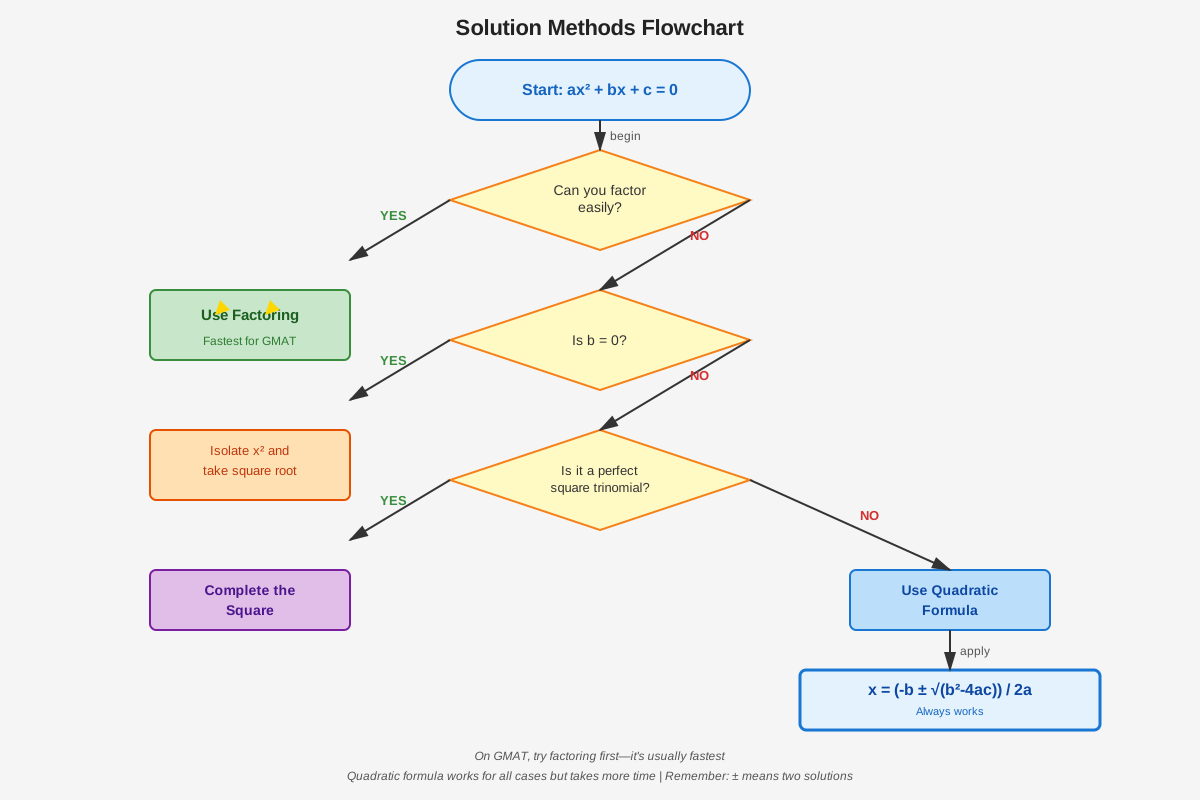
Factoring represents the most efficient method for solving quadratic equations on the GMAT when the equation factors cleanly with integer coefficients. The zero product property states that if ab = 0, then either a = 0 or b = 0 (or both). This property allows us to solve factored quadratic equations by setting each factor equal to zero.
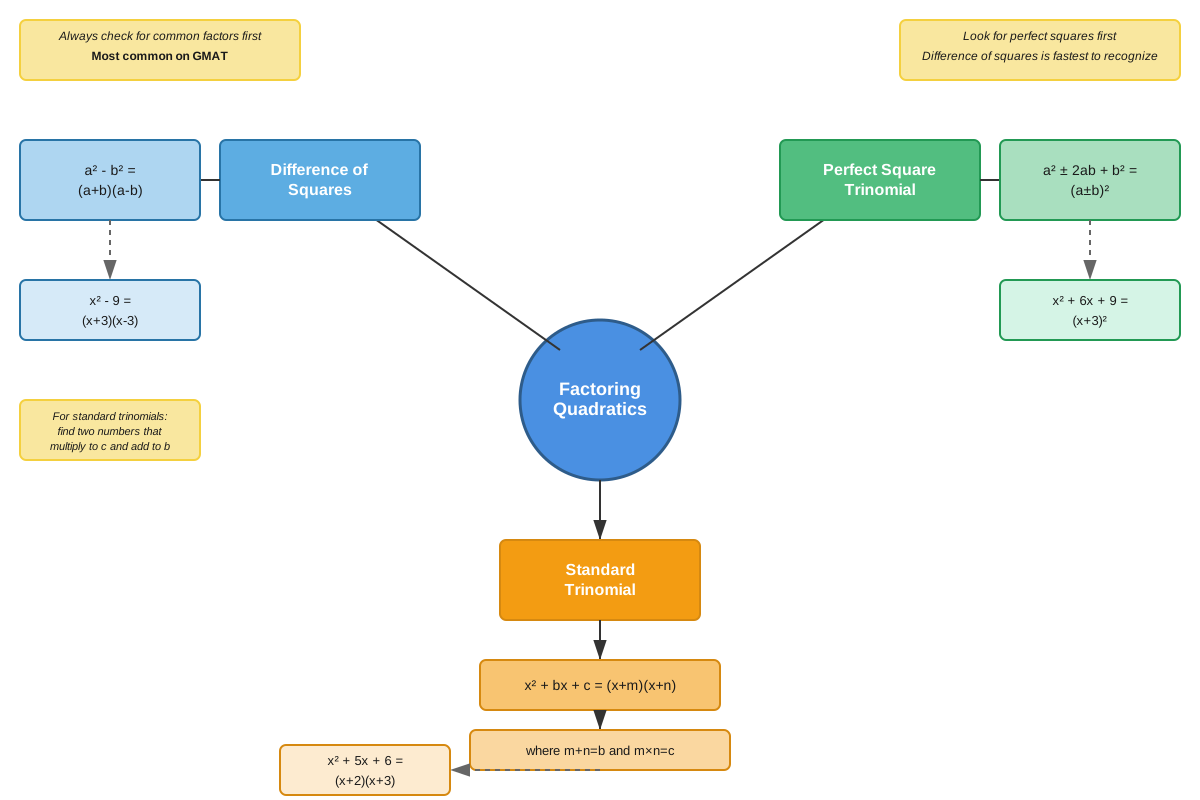
The factoring process for equations in the form x² + bx + c = 0 involves finding two numbers that multiply to c and add to b. For example, to solve x² + 5x + 6 = 0:
- Find two numbers that multiply to 6 and add to 5: the numbers are 2 and 3
- Write the factored form: (x + 2)(x + 3) = 0
- Apply the zero product property: x + 2 = 0 or x + 3 = 0
- Solve each equation: x = -2 or x = -3
For equations in the form ax² + bx + c = 0 where a ≠ 1, additional techniques apply:
Factoring by grouping (for expressions like 2x² + 7x + 3):
- Multiply a and c: 2 × 3 = 6
- Find two numbers that multiply to 6 and add to 7: the numbers are 6 and 1
- Rewrite the middle term: 2x² + 6x + x + 3
- Group and factor: 2x(x + 3) + 1(x + 3) = (2x + 1)(x + 3)
- Solve: 2x + 1 = 0 or x + 3 = 0, giving x = -1/2 or x = -3
The Quadratic Formula
The quadratic formula provides a universal method for solving any quadratic equation, regardless of whether it factors cleanly. For the equation ax² + bx + c = 0, the solutions are:
x = [-b ± √(b² - 4ac)] / (2a)This formula always works but is typically more time-consuming than factoring, making it a secondary choice on the GMAT when factoring is possible. However, it becomes essential for equations that don't factor with integer coefficients or when the problem specifically requires exact solutions involving radicals.
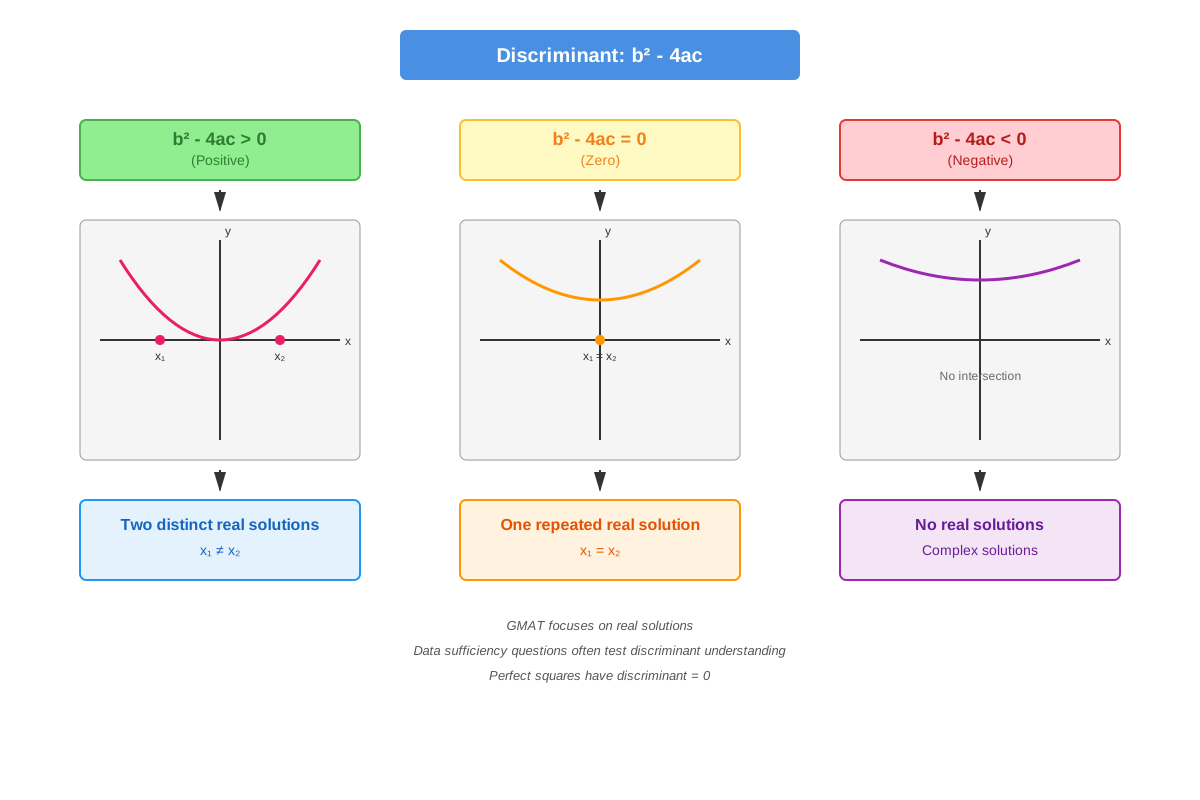
The expression under the square root, b² - 4ac, is called the discriminant and provides crucial information about the nature of solutions without requiring complete calculation:
| Discriminant Value | Number of Real Solutions | Nature of Solutions |
|---|---|---|
| b² - 4ac > 0 | Two distinct real solutions | Rational if perfect square; irrational otherwise |
| b² - 4ac = 0 | One real solution (repeated root) | Always rational |
| b² - 4ac < 0 | No real solutions | Two complex conjugate solutions |
Completing the Square
Completing the square transforms a quadratic equation into vertex form, making it particularly useful for understanding parabola properties and solving certain optimization problems. The technique involves creating a perfect square trinomial on one side of the equation.
To complete the square for x² + bx + c = 0:
- Move the constant to the right side: x² + bx = -c
- Add (b/2)² to both sides: x² + bx + (b/2)² = -c + (b/2)²
- Factor the left side as a perfect square: (x + b/2)² = -c + (b/2)²
- Take the square root of both sides: x + b/2 = ±√[-c + (b/2)²]
- Solve for x: x = -b/2 ± √[-c + (b/2)²]
While completing the square is less commonly required on the GMAT than factoring, understanding this method deepens comprehension of why the quadratic formula works and helps with certain coordinate geometry problems.
Properties of Roots
The relationship between a quadratic equation's coefficients and its roots provides powerful shortcuts for GMAT problems. For the equation ax² + bx + c = 0 with roots r₁ and r₂:
Sum of roots: r₁ + r₂ = -b/a
Product of roots: r₁ × r₂ = c/a
These relationships, known as Vieta's formulas, allow students to answer questions about roots without solving the equation completely. For example, if asked for the sum of the roots of 3x² - 12x + 7 = 0, the answer is -(-12)/3 = 4, requiring no calculation of individual roots.
Special Cases and Patterns
Certain quadratic patterns appear frequently on the GMAT and merit memorization:
Difference of squares: a² - b² = (a + b)(a - b)
- Example: x² - 25 = (x + 5)(x - 5) = 0, so x = 5 or x = -5
Perfect square trinomials: a² + 2ab + b² = (a + b)² and a² - 2ab + b² = (a - b)²
- Example: x² + 6x + 9 = (x + 3)² = 0, so x = -3 (repeated root)
Sum of squares: a² + b² cannot be factored using real numbers
- Example: x² + 4 = 0 has no real solutions
Recognizing these patterns enables rapid factoring and solution identification, saving crucial time during the exam.
Concept Relationships
The concepts within quadratic equations form an interconnected web of mathematical relationships. The standard form serves as the foundation, from which all other representations derive. Factoring transforms standard form into a product of linear expressions, directly revealing the roots through the zero product property. The quadratic formula represents an algebraic derivation using completing the square, providing a universal solution method that works when factoring fails.
The discriminant (b² - 4ac) emerges from the quadratic formula and determines solution characteristics without requiring full calculation. This connects to the properties of roots (Vieta's formulas), which relate coefficients to root sums and products, creating a bidirectional relationship: coefficients determine roots, and root properties constrain possible coefficient values.
Completing the square bridges quadratic equations and coordinate geometry by transforming equations into vertex form, which directly reveals parabola properties. This technique also provides the theoretical foundation for the quadratic formula itself, demonstrating how all solution methods ultimately derive from the same algebraic principles.
The relationship map flows as follows:
Standard Form → Factoring → Roots (via zero product property)
Standard Form → Completing the Square → Vertex Form → Parabola Properties
Standard Form → Quadratic Formula → Roots (universal method)
Quadratic Formula → Discriminant → Solution Type Classification
Coefficients (a, b, c) → Vieta's Formulas → Root Sum and Product
These concepts connect to prerequisite topics through factoring techniques (which extend from factoring linear expressions), algebraic manipulation (building on equation-solving skills), and exponent properties (explaining why x² creates two solutions). They lead forward to functions and coordinate geometry (where quadratic functions describe parabolas), inequalities (where quadratic inequalities require understanding solution intervals), and optimization problems (where vertex form reveals maximum or minimum values).
Quick check — test yourself on Quadratic equations so far.
Try Flashcards →High-Yield Facts
⭐ The standard form of a quadratic equation is ax² + bx + c = 0, where a ≠ 0
⭐ Quadratic equations typically have two solutions, which may be equal, distinct, real, or complex
⭐ The discriminant b² - 4ac determines the number and nature of solutions: positive means two distinct real solutions, zero means one repeated real solution, negative means no real solutions
⭐ For x² + bx + c = 0, factor by finding two numbers that multiply to c and add to b
⭐ The sum of roots equals -b/a and the product of roots equals c/a (Vieta's formulas)
- The quadratic formula x = [-b ± √(b² - 4ac)] / (2a) solves any quadratic equation
- The zero product property states that if ab = 0, then a = 0 or b = 0
- Difference of squares: a² - b² = (a + b)(a - b)
- Perfect square trinomials: a² ± 2ab + b² = (a ± b)²
- When a quadratic equation is set equal to a constant (not zero), move all terms to one side before solving
- In data sufficiency questions, remember that quadratic equations usually have two solutions, so check whether both satisfy problem constraints
- Factoring is faster than the quadratic formula when the equation factors cleanly with integer coefficients
Common Misconceptions
Misconception: All quadratic equations have two different solutions.
Correction: Quadratic equations can have two distinct solutions, one repeated solution (when the discriminant equals zero), or no real solutions (when the discriminant is negative). For example, x² - 6x + 9 = 0 factors as (x - 3)² = 0, yielding only x = 3 as a repeated root.
Misconception: If x² = 16, then x = 4.
Correction: When taking the square root of both sides, both positive and negative roots must be considered: x = ±4. This means x = 4 or x = -4. Forgetting the negative solution is one of the most common errors on the GMAT.
Misconception: The quadratic formula can only be used when factoring doesn't work.
Correction: While factoring is typically faster, the quadratic formula works for all quadratic equations and is sometimes necessary even when an equation factors, particularly when the problem requires exact values involving radicals or when factoring isn't immediately apparent.
Misconception: In the equation ax² + bx + c = 0, the coefficient a can equal zero.
Correction: If a = 0, the equation becomes bx + c = 0, which is linear, not quadratic. By definition, a quadratic equation must have a non-zero coefficient for the x² term.
Misconception: When solving word problems, any solution to the quadratic equation is valid.
Correction: Always check solutions against the problem context. For example, if solving for time or length, negative solutions may be mathematically correct but contextually meaningless. In data sufficiency, both solutions must satisfy the problem constraints for the information to be sufficient.
Misconception: The discriminant tells you the actual solutions to the equation.
Correction: The discriminant (b² - 4ac) only indicates the number and type of solutions—it doesn't provide the solutions themselves. To find actual solutions, you must use factoring, the quadratic formula, or completing the square.
Worked Examples
Example 1: Problem-Solving with Factoring
Problem: If x² - 7x + 12 = 0, what are all possible values of x?
Solution:
Step 1: Recognize this as a quadratic equation in standard form where a = 1, b = -7, and c = 12.
Step 2: Factor by finding two numbers that multiply to 12 and add to -7. The numbers are -3 and -4 because (-3) × (-4) = 12 and (-3) + (-4) = -7.
Step 3: Write the factored form: (x - 3)(x - 4) = 0
Step 4: Apply the zero product property:
- x - 3 = 0, which gives x = 3
- x - 4 = 0, which gives x = 4
Step 5: Verify by substituting back into the original equation:
- For x = 3: (3)² - 7(3) + 12 = 9 - 21 + 12 = 0 ✓
- For x = 4: (4)² - 7(4) + 12 = 16 - 28 + 12 = 0 ✓
Answer: x = 3 or x = 4
Connection to learning objectives: This example demonstrates identifying a quadratic equation in standard form and applying factoring techniques to solve it efficiently—the most common approach on the GMAT.
Example 2: Data Sufficiency with Root Properties
Problem: What is the value of x?
(1) x² - 5x + 6 = 0
(2) x is a prime number
Solution:
Analyze Statement (1):
- This is a quadratic equation that can be factored
- Find two numbers that multiply to 6 and add to -5: -2 and -3
- Factored form: (x - 2)(x - 3) = 0
- Solutions: x = 2 or x = 3
- Statement (1) alone is INSUFFICIENT because it provides two possible values
Analyze Statement (2):
- This tells us x is prime but gives no equation to solve
- Infinitely many prime numbers exist
- Statement (2) alone is INSUFFICIENT
Analyze Both Statements Together:
- From Statement (1): x = 2 or x = 3
- From Statement (2): x must be prime
- Both 2 and 3 are prime numbers
- We still cannot determine a unique value for x
- Both statements together are INSUFFICIENT
Answer: E (Statements (1) and (2) together are not sufficient)
Connection to learning objectives: This example illustrates how quadratic equations appear in data sufficiency contexts and emphasizes the critical point that quadratic equations typically yield two solutions, requiring additional information to determine a unique answer. It also demonstrates the importance of checking whether both solutions satisfy all given constraints.
Exam Strategy
When approaching GMAT questions involving quadratic equations, begin by identifying whether the equation is already in standard form or requires algebraic manipulation. Look for trigger words such as "product," "area," "consecutive integers," or "two numbers" that often signal quadratic relationships in word problems. Before diving into calculations, assess whether the question asks for specific solutions, properties of solutions (like their sum or product), or merely whether solutions exist.
For problem-solving questions, prioritize factoring over the quadratic formula when coefficients are small integers. Spend no more than 15-20 seconds attempting to factor; if factoring isn't immediately apparent, consider whether the answer choices provide clues (such as whether they contain radicals, suggesting the quadratic formula is needed) or whether alternative approaches exist. Remember that some questions can be solved using Vieta's formulas without finding individual roots—if asked for the sum or product of roots, use -b/a or c/a directly.
In data sufficiency questions, the most common trap involves forgetting that quadratic equations typically have two solutions. Always determine whether both solutions satisfy the problem constraints. A statement that provides a quadratic equation alone is usually insufficient unless the question asks for a property that's the same for both roots (like their sum or product) or unless additional constraints eliminate one solution. Watch for restrictions like "x > 0" or "x is an integer" that might reduce two solutions to one.
Time allocation is crucial: straightforward factoring problems should take 60-90 seconds, while complex word problems requiring translation into quadratic form may require 2-2.5 minutes. If a problem requires the quadratic formula and involves messy arithmetic, consider whether you've missed a simpler approach or whether strategic guessing might be more efficient. The GMAT rewards strategic thinking over computational persistence.
Process-of-elimination strategies specific to quadratic equations include: (1) eliminating answer choices that provide only one solution when two are expected, (2) using the discriminant to eliminate choices inconsistent with solution types, (3) testing answer choices by substitution when factoring proves difficult, and (4) eliminating choices that violate Vieta's formulas when the question involves root properties.
Memory Techniques
FACTOR mnemonic for the factoring process:
- Find the standard form (ax² + bx + c = 0)
- Assess whether a = 1 or a ≠ 1
- Choose two numbers (multiply to c, add to b when a = 1)
- Test the factorization by expanding
- Obtain solutions using zero product property
- Review solutions in problem context
Discriminant Decision Tree visualization:
Picture a tree with three branches:
- Positive branch (b² - 4ac > 0): Two distinct real solutions—imagine two separate apples
- Zero branch (b² - 4ac = 0): One repeated solution—imagine one apple split in half
- Negative branch (b² - 4ac < 0): No real solutions—imagine an empty branch
Vieta's Vowels: The two Vieta's formulas involve vowels—Sum uses Addition (r₁ + r₂ = -b/a) and Product uses mUltiplication (r₁ × r₂ = c/a). Remember "SAP" for Sum-Addition-Product.
Perfect Square Pattern: For a² ± 2ab + b², visualize a square with side length (a + b) or (a - b). The area equals the square of the side length, reinforcing that these expressions factor as perfect squares.
Difference of Squares Dance: Picture two dancers (a + b) and (a - b) whose product creates a² - b². The middle terms "dance away" (cancel out), leaving only the squared terms.
Summary
Quadratic equations represent polynomial equations of degree two in the form ax² + bx + c = 0, where a ≠ 0, and they constitute one of the highest-yield topics for GMAT Quantitative Reasoning. Mastery requires proficiency in multiple solution methods—factoring (the fastest approach for equations with integer coefficients), the quadratic formula (the universal method), and completing the square (useful for understanding parabola properties). The discriminant b² - 4ac determines whether equations have two distinct real solutions, one repeated solution, or no real solutions, while Vieta's formulas provide shortcuts for finding the sum (-b/a) and product (c/a) of roots without solving completely. Success on the GMAT requires not only technical skill in solving quadratic equations but also strategic awareness of how they appear in various contexts—from straightforward algebraic problems to complex word problems involving area, consecutive integers, and optimization, to data sufficiency questions that test understanding of solution multiplicity. Students must recognize quadratic equations in disguised forms, check solutions against problem constraints, and leverage properties of roots to work efficiently under time pressure.
Key Takeaways
- Quadratic equations in standard form ax² + bx + c = 0 (where a ≠ 0) typically have two solutions that may be equal, distinct, real, or complex
- Factoring provides the fastest solution method when equations have integer coefficients; look for two numbers that multiply to c and add to b when a = 1
- The discriminant b² - 4ac reveals solution characteristics: positive (two distinct real solutions), zero (one repeated solution), or negative (no real solutions)
- Vieta's formulas allow calculation of root sum (-b/a) and product (c/a) without finding individual roots, saving time on specific GMAT questions
- In data sufficiency contexts, remember that quadratic equations usually yield two solutions, requiring verification that both satisfy problem constraints
- Special patterns (difference of squares, perfect square trinomials) enable rapid factoring and should be memorized for exam efficiency
- Always verify solutions in the problem context, as mathematically correct solutions may be contextually invalid (negative lengths, times, etc.)
Related Topics
Quadratic Functions and Parabolas: Building on quadratic equations, this topic explores how quadratic expressions define parabolic graphs, including vertex identification, axis of symmetry, and optimization problems—essential for coordinate geometry questions.
Quadratic Inequalities: Extends equation-solving skills to inequalities like x² - 5x + 6 > 0, requiring understanding of solution intervals and sign analysis—frequently tested in advanced GMAT problems.
Systems of Equations with Quadratics: Combines linear and quadratic equations, requiring substitution or elimination methods—appears in complex problem-solving questions involving multiple constraints.
Polynomial Factoring: Generalizes factoring techniques beyond quadratics to higher-degree polynomials, building on the same principles of finding roots through factorization.
Exponents and Radicals: Deepens understanding of why quadratic equations have two solutions and provides tools for simplifying expressions involving square roots that appear in quadratic formula solutions.
Practice CTA
Now that you've mastered the core concepts of quadratic equations, it's time to solidify your understanding through active practice. Attempt the practice questions designed specifically for this topic, focusing on applying the factoring techniques, discriminant analysis, and Vieta's formulas you've learned. Use the flashcards to reinforce high-yield facts and special patterns until they become automatic. Remember that GMAT success comes not just from understanding concepts but from developing the speed and strategic thinking to apply them under time pressure. Each practice problem you solve builds the pattern recognition and confidence you need to excel on test day. You've invested the time to learn—now invest the effort to practice, and watch your performance transform!
Sign up free to keep reading
Create a free AnvayaPrep account to finish this GMAT guide on Quadratic equations — plus flashcards and practice questions.