Overview
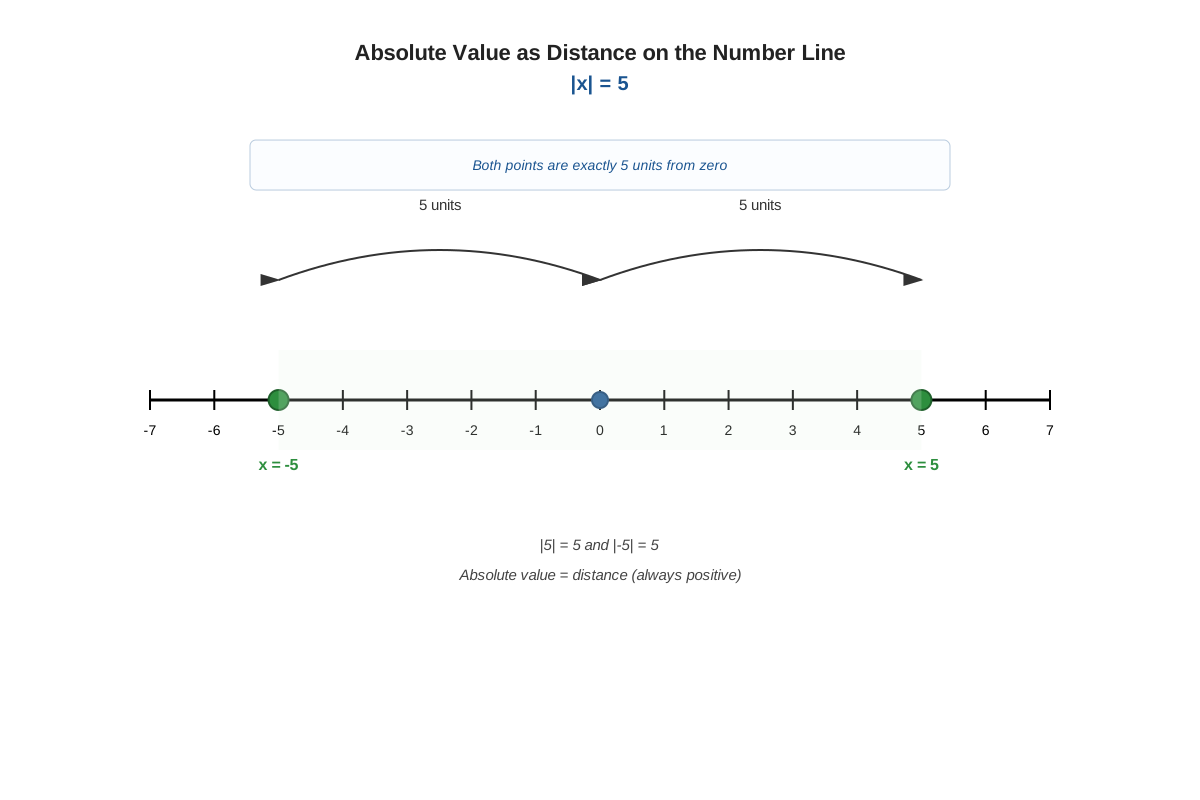
Absolute value equations represent a critical component of the GMAT Quantitative Reasoning section, appearing in approximately 10-15% of algebra questions. These equations involve the absolute value function, which measures the distance of a number from zero on the number line, always yielding a non-negative result. Understanding how to solve gmat absolute value equations requires mastering the fundamental principle that absolute value creates two possible scenarios: one where the expression inside is positive or zero, and another where it is negative.
The complexity of absolute value equations on the GMAT stems from their dual-solution nature and the various forms in which they appear. Test-makers frequently combine absolute value with inequalities, quadratic expressions, and coordinate geometry to create multi-layered problems that assess both conceptual understanding and computational accuracy. Students who master this topic gain a significant advantage, as these questions often separate mid-range scorers from those achieving scores in the 700+ range.
Within the broader landscape of GMAT Quantitative Reasoning, absolute value equations connect directly to number properties, inequalities, functions, and coordinate geometry. They serve as a bridge between basic algebraic manipulation and more advanced problem-solving scenarios. The ability to visualize absolute value geometrically—as distance on a number line—enhances understanding of related topics such as distance formulas, optimization problems, and even data sufficiency questions where determining the range of possible values becomes crucial.
Learning Objectives
- [ ] Identify absolute value equations in various forms and contexts
- [ ] Explain the mathematical principles underlying absolute value equations and their dual-solution nature
- [ ] Apply absolute value equations to GMAT questions with accuracy and efficiency
- [ ] Solve complex absolute value equations involving multiple absolute value expressions
- [ ] Determine when absolute value equations have zero, one, or two solutions
- [ ] Translate word problems involving distance and magnitude into absolute value equations
- [ ] Recognize and avoid common algebraic errors when manipulating absolute value expressions
Prerequisites
- Basic algebraic manipulation: Essential for isolating absolute value expressions and solving the resulting linear equations
- Understanding of positive and negative numbers: Required to comprehend why absolute value creates two cases
- Linear equation solving: Forms the foundation for solving each case after removing absolute value bars
- Number line visualization: Helps conceptualize absolute value as distance, making problems more intuitive
- Substitution and verification: Necessary for checking solutions, as extraneous solutions frequently occur
Why This Topic Matters
Absolute value equations appear consistently on the GMAT in both Problem Solving and Data Sufficiency formats. According to GMAT test analysis, approximately 2-3 questions per exam directly test absolute value concepts, while many additional questions incorporate absolute value as a component of more complex problems. The topic's importance extends beyond its frequency—absolute value questions often serve as score differentiators, with correct answers correlating strongly with higher overall scores.
In real-world applications, absolute value represents magnitude, distance, error tolerance, and deviation from a standard. Engineers use absolute value to express tolerances in manufacturing specifications, financial analysts employ it to measure volatility and risk, and scientists apply it to calculate measurement errors. This practical relevance makes absolute value a favorite topic for GMAT word problems that test both mathematical reasoning and real-world application.
On the GMAT, absolute value appears in multiple question formats: straightforward equation-solving problems, inequalities combined with absolute value, data sufficiency questions asking whether sufficient information exists to determine a unique solution, and word problems involving distance or deviation. The topic frequently combines with other algebraic concepts such as quadratic equations, systems of equations, and function notation, creating multi-step problems that test comprehensive mathematical reasoning.
Core Concepts
Definition and Fundamental Properties
The absolute value of a number x, denoted |x|, represents the distance between x and zero on the number line. By definition:
|x| = x if x ≥ 0
|x| = -x if x < 0
This piecewise definition reveals why absolute value equations typically yield two solutions. When solving |x| = a where a > 0, we must consider both scenarios: x = a (when x is positive) and x = -a (when x is negative).
Key properties of absolute value include:
- |x| ≥ 0 for all real numbers x
- |x| = 0 if and only if x = 0
- |x| = |-x| (absolute value of opposites are equal)
- |xy| = |x| · |y| (absolute value of a product)
- |x/y| = |x|/|y| when y ≠ 0 (absolute value of a quotient)
Standard Form Absolute Value Equations
The most basic form of an absolute value equation is |x| = a. The solution approach depends on the value of a:
Case 1: a > 0
The equation has two solutions: x = a or x = -a
Case 2: a = 0
The equation has one solution: x = 0
Case 3: a < 0
The equation has no solution (absolute value cannot equal a negative number)
For equations in the form |ax + b| = c where c > 0, the solution process involves:
- Set up two equations: ax + b = c and ax + b = -c
- Solve each equation independently
- Verify both solutions in the original equation
Complex Absolute Value Equations
When absolute value equations involve expressions on both sides or multiple absolute value terms, the solution process becomes more sophisticated.
Form: |ax + b| = |cx + d|
This equation means the expressions ax + b and cx + d have the same distance from zero. Two scenarios exist:
- ax + b = cx + d (both expressions are equal)
- ax + b = -(cx + d) (the expressions are opposites)
Form: |ax + b| + |cx + d| = e
This requires considering multiple cases based on the signs of the expressions inside each absolute value. The critical points occur where each expression equals zero, dividing the number line into regions where the signs remain constant.
Geometric Interpretation
Understanding absolute value geometrically provides powerful problem-solving insights. The equation |x - a| = b represents all points whose distance from a equals b. This yields two points: x = a + b and x = a - b.
Similarly, |x - a| + |x - b| = c represents the sum of distances from x to points a and b. When c equals |a - b|, all points between a and b satisfy the equation. When c < |a - b|, no solution exists. When c > |a - b|, exactly two solutions exist outside the interval [a, b].
Solution Verification
A critical step often overlooked is verification. When solving absolute value equations, algebraic manipulation can introduce extraneous solutions—values that satisfy the derived equations but not the original equation. Always substitute potential solutions back into the original equation to confirm validity.
Concept Relationships
The core concepts within absolute value equations build hierarchically. Understanding the definition of absolute value → enables solving standard form equations → which provides the foundation for complex multi-term equations → all of which benefit from geometric interpretation → and require solution verification to ensure accuracy.
Absolute value equations connect to prerequisite topics through direct application: linear equation solving provides the mechanics for solving each case, number line understanding enables geometric visualization, and algebraic manipulation skills facilitate isolating absolute value expressions. The topic extends forward to absolute value inequalities, where solution sets become intervals rather than discrete points, and to piecewise functions, where absolute value serves as a prime example of function behavior changing based on input values.
The relationship to coordinate geometry emerges when considering |x - h| + |y - k| = r, which describes geometric shapes (specifically, diamonds or squares rotated 45 degrees). This connection appears in advanced GMAT problems involving distance and optimization.
High-Yield Facts
⭐ The equation |x| = a has two solutions (x = a and x = -a) only when a > 0
⭐ Always check solutions by substituting back into the original equation to eliminate extraneous solutions
⭐ |x - a| represents the distance between x and a on the number line
⭐ When |expression| = negative number, there is no solution
⭐ For |ax + b| = c, isolate the absolute value first before splitting into two cases
- The absolute value of a product equals the product of absolute values: |xy| = |x| · |y|
- |x|² = x² for all real numbers x
- If |x| < |y|, it does not necessarily mean x < y (consider x = -5 and y = 3)
- The equation |x - a| = |x - b| has solution x = (a + b)/2 when a ≠ b
- Squaring both sides of an absolute value equation can eliminate the absolute value but may introduce extraneous solutions
- |x + y| ≤ |x| + |y| (triangle inequality) with equality when x and y have the same sign
- The maximum value of |x| - |y| is |x - y|, achieved when x and y have opposite signs
Quick check — test yourself on Absolute value equations so far.
Try Flashcards →Common Misconceptions
Misconception: |x + 3| = 5 means x + 3 = 5 only → Correction: The equation requires considering both x + 3 = 5 AND x + 3 = -5, yielding solutions x = 2 and x = -8
Misconception: |x| + 3 = 0 has solutions → Correction: Since |x| ≥ 0 for all x, the minimum value of |x| + 3 is 3, so this equation has no solution
Misconception: |x + y| = |x| + |y| for all x and y → Correction: This equality holds only when x and y have the same sign (both positive or both negative); otherwise |x + y| < |x| + |y|
Misconception: If |x| = |y|, then x = y → Correction: The correct conclusion is x = y OR x = -y (for example, |3| = |-3| but 3 ≠ -3)
Misconception: Removing absolute value bars doesn't change the equation → Correction: Removing absolute value bars requires considering multiple cases based on whether the expression inside is positive or negative
Misconception: |x²| = x → Correction: Since x² is always non-negative, |x²| = x², not x. The equation |x²| = x is only true when x ≥ 0
Misconception: You can distribute absolute value over addition: |a + b| = |a| + |b| → Correction: Absolute value does not distribute over addition; this is only true when a and b have the same sign
Worked Examples
Example 1: Standard Absolute Value Equation
Problem: Solve |2x - 5| = 9
Solution:
Step 1: Recognize this is a standard form equation with the absolute value isolated.
Step 2: Set up two cases based on the definition of absolute value.
Case 1: The expression inside is positive or zero
2x - 5 = 9
2x = 14
x = 7
Case 2: The expression inside is negative
2x - 5 = -9
2x = -4
x = -2
Step 3: Verify both solutions in the original equation.
For x = 7: |2(7) - 5| = |14 - 5| = |9| = 9 ✓
For x = -2: |2(-2) - 5| = |-4 - 5| = |-9| = 9 ✓
Answer: x = 7 or x = -2
This example demonstrates the fundamental principle that absolute value equations typically yield two solutions, and both must be verified.
Example 2: Equation with Absolute Values on Both Sides
Problem: Solve |3x + 2| = |x - 6|
Solution:
Step 1: Recognize that two expressions have equal absolute values when they are either equal or opposites.
Step 2: Set up two cases.
Case 1: The expressions are equal
3x + 2 = x - 6
2x = -8
x = -4
Case 2: The expressions are opposites
3x + 2 = -(x - 6)
3x + 2 = -x + 6
4x = 4
x = 1
Step 3: Verify both solutions.
For x = -4: |3(-4) + 2| = |-12 + 2| = |-10| = 10
|(-4) - 6| = |-10| = 10 ✓
For x = 1: |3(1) + 2| = |5| = 5
|(1) - 6| = |-5| = 5 ✓
Answer: x = -4 or x = 1
This example illustrates how equations with absolute values on both sides require considering when the expressions are equal versus when they are opposites.
Example 3: GMAT-Style Word Problem
Problem: The distance between point x and 7 on the number line is equal to the distance between x and -3. What is the value of x?
Solution:
Step 1: Translate the word problem into an absolute value equation.
"Distance between x and 7" translates to |x - 7|
"Distance between x and -3" translates to |x - (-3)| = |x + 3|
The equation is: |x - 7| = |x + 3|
Step 2: Solve using the two-case method.
Case 1: x - 7 = x + 3
-7 = 3This is impossible, so no solution from this case.
Case 2: x - 7 = -(x + 3)
x - 7 = -x - 3
2x = 4
x = 2
Step 3: Verify and interpret.
For x = 2: |2 - 7| = |-5| = 5 and |2 + 3| = |5| = 5 ✓
Answer: x = 2
This represents the midpoint between 7 and -3, which makes geometric sense: the point equidistant from two points is their midpoint.
Exam Strategy
When approaching gmat absolute value equations, employ a systematic strategy to maximize accuracy and efficiency:
Step 1: Isolate the absolute value expression
Before splitting into cases, ensure the absolute value term stands alone on one side of the equation. If the equation is |2x - 3| + 5 = 12, first subtract 5 to get |2x - 3| = 7.
Step 2: Check for impossible scenarios
If the absolute value equals a negative number, immediately recognize there is no solution. This saves valuable time and prevents algebraic errors.
Step 3: Set up cases systematically
Write out both cases clearly before solving. This organization prevents missing solutions and helps track your work.
Step 4: Always verify solutions
GMAT absolute value problems frequently include answer choices that represent common errors or extraneous solutions. Verification catches these mistakes.
Exam Tip: Watch for trigger phrases like "distance from," "deviation from," "how far from," or "magnitude of difference"—these signal absolute value concepts.
Time allocation: Allocate 2-2.5 minutes for standard absolute value equations. If a problem requires more than 3 minutes, consider whether you're missing a shortcut or should make an educated guess and move forward.
Process of elimination strategies:
- Eliminate answer choices that would make the absolute value negative
- Test answer choices in the original equation rather than solving algebraically when choices are simple numbers
- For Data Sufficiency, remember that absolute value equations typically need enough information to determine both potential solutions
Common trap answers:
- Only one of the two solutions (incomplete solving)
- Extraneous solutions that don't verify
- The negative of the correct answer
- Results from forgetting to consider the negative case
Memory Techniques
Mnemonic for solving process: "I-S-V"
- Isolate the absolute value
- Split into two cases
- Verify all solutions
Visualization technique: Picture absolute value as a "distance machine" that always outputs positive values. When you see |x - 5| = 3, visualize two points on a number line that are exactly 3 units away from 5.
The "Mirror Method": Remember that absolute value creates mirror solutions. If |x| = 7, the solutions are mirror images across zero: 7 and -7.
Acronym for properties: "PANZ"
- Positive: absolute value is always ≥ 0
- Addition: doesn't distribute over addition
- Negative: can't equal a negative
- Zero: equals zero only when the inside equals zero
The "Two-Door Rule": Think of absolute value as a door that opens two ways. When you encounter |expression| = number, you must walk through both doors (positive and negative cases) to find all solutions.
Summary
Absolute value equations form a cornerstone of GMAT algebra, testing both computational skills and conceptual understanding. The fundamental principle—that absolute value measures distance from zero and therefore creates two scenarios—underlies all solution methods. Mastery requires recognizing that |x| = a yields x = a or x = -a when a > 0, understanding how to handle complex equations with multiple absolute value terms or expressions on both sides, and consistently verifying solutions to eliminate extraneous results. The geometric interpretation of absolute value as distance provides intuitive problem-solving power, particularly for word problems and Data Sufficiency questions. Success on GMAT absolute value questions demands systematic case analysis, careful algebraic manipulation, and awareness of common traps such as forgetting the negative case or accepting extraneous solutions without verification.
Key Takeaways
- Absolute value equations typically produce two solutions because they represent distance, which can be achieved in two directions from a reference point
- Always isolate the absolute value expression before splitting into positive and negative cases
- Verification is mandatory—extraneous solutions frequently appear in absolute value problems
- The equation |x| = a has no solution when a < 0, one solution when a = 0, and two solutions when a > 0
- Geometric interpretation (distance on a number line) often provides faster solution paths than pure algebra
- For equations with absolute values on both sides, consider when expressions are equal and when they are opposites
- Watch for GMAT trap answers that represent only one solution or unverified extraneous solutions
Related Topics
Absolute Value Inequalities: Building directly on absolute value equations, inequalities introduce solution sets as intervals rather than discrete points. Mastering equations provides the foundation for understanding compound inequalities like |x - 3| < 5.
Piecewise Functions: Absolute value serves as the quintessential example of piecewise-defined functions, where behavior changes based on input values. Understanding absolute value equations facilitates graphing and analyzing more complex piecewise functions.
Distance Formula and Coordinate Geometry: The concept of absolute value as distance extends to two dimensions through the distance formula, connecting algebra to geometry in ways frequently tested on the GMAT.
Quadratic Equations: Complex problems often combine absolute value with quadratic expressions, requiring integrated problem-solving skills across multiple algebraic domains.
Systems of Equations: Advanced GMAT problems may present systems where one or more equations involve absolute value, demanding synthesis of multiple algebraic techniques.
Practice CTA
Now that you've mastered the core concepts of absolute value equations, it's time to solidify your understanding through practice. Attempt the practice questions to apply these principles in GMAT-style scenarios, and use the flashcards to reinforce key facts and solution strategies. Remember, consistent practice with immediate feedback is the most effective path to GMAT success. Each problem you solve strengthens your pattern recognition and builds the confidence needed to tackle absolute value questions efficiently on test day. Your investment in mastering this high-yield topic will pay dividends across multiple question types in the Quantitative Reasoning section.
Sign up free to keep reading
Create a free AnvayaPrep account to finish this GMAT guide on Absolute value equations — plus flashcards and practice questions.