Overview
Simultaneous conditions represent one of the most critical and frequently tested concepts within the GMAT Data Insights section, particularly in Two-Part Analysis questions. These problems require test-takers to evaluate multiple constraints, requirements, or criteria that must all be satisfied at the same time. Unlike sequential problems where conditions are met one after another, simultaneous conditions demand that all specified requirements hold true concurrently within a single solution or scenario. Mastering this concept is essential because it forms the foundation for complex decision-making scenarios that mirror real-world business situations where multiple stakeholders, constraints, and objectives must be balanced simultaneously.
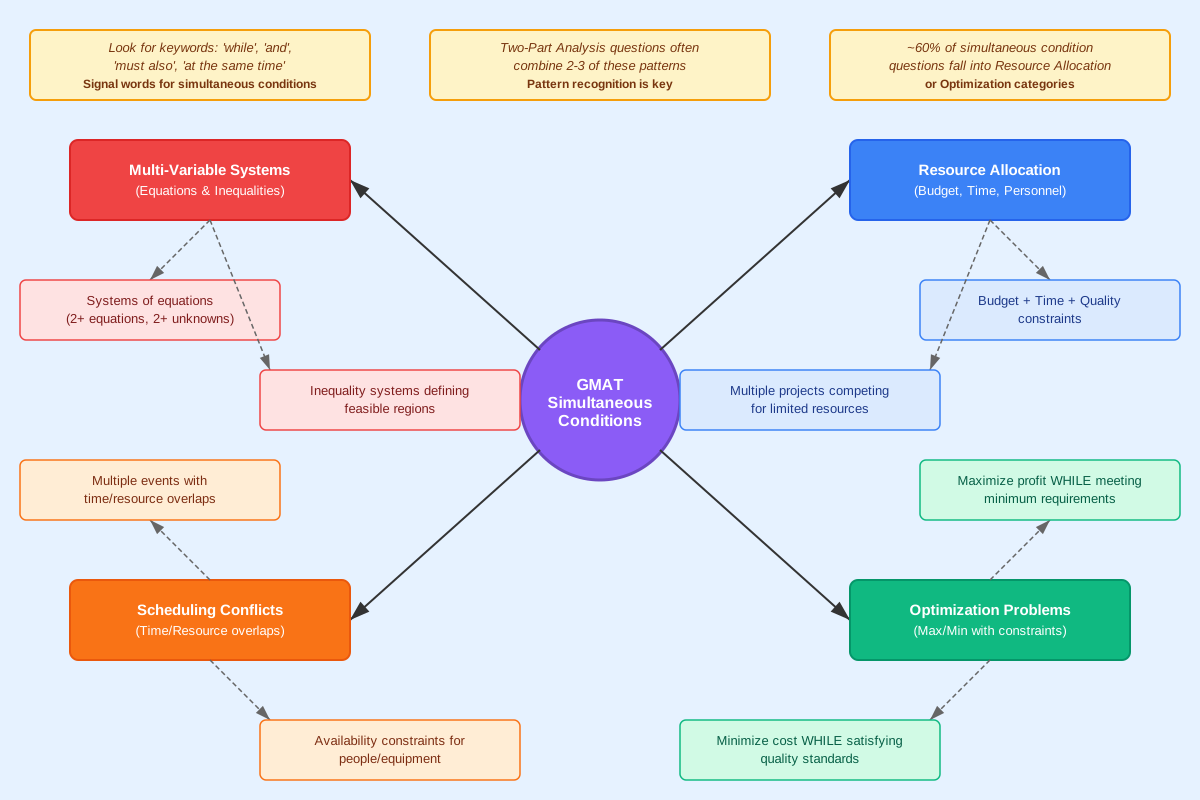
The GMAT tests simultaneous conditions through scenarios involving resource allocation, scheduling conflicts, budget constraints paired with performance targets, or situations where multiple variables must satisfy different equations or inequalities at once. These questions assess a candidate's ability to think systematically, manage multiple constraints, and identify solutions that satisfy all given criteria—skills that are fundamental to graduate-level business education and management decision-making. The complexity arises not from any single condition being difficult, but from the interaction between multiple conditions and the need to find solutions that work across all dimensions simultaneously.
Within the broader Data Insights framework, GMAT simultaneous conditions connect directly to quantitative reasoning, logical analysis, and integrated reasoning skills. They often appear alongside concepts like systems of equations, optimization problems, and constraint satisfaction. Understanding simultaneous conditions also builds the foundation for more advanced topics in operations management, financial modeling, and strategic planning that MBA students will encounter in their coursework. The ability to juggle multiple requirements while identifying viable solutions is precisely what distinguishes strong analytical thinkers in business contexts.
Learning Objectives
By the end of this study guide, students should be able to:
- [ ] Identify simultaneous conditions in GMAT Two-Part Analysis questions
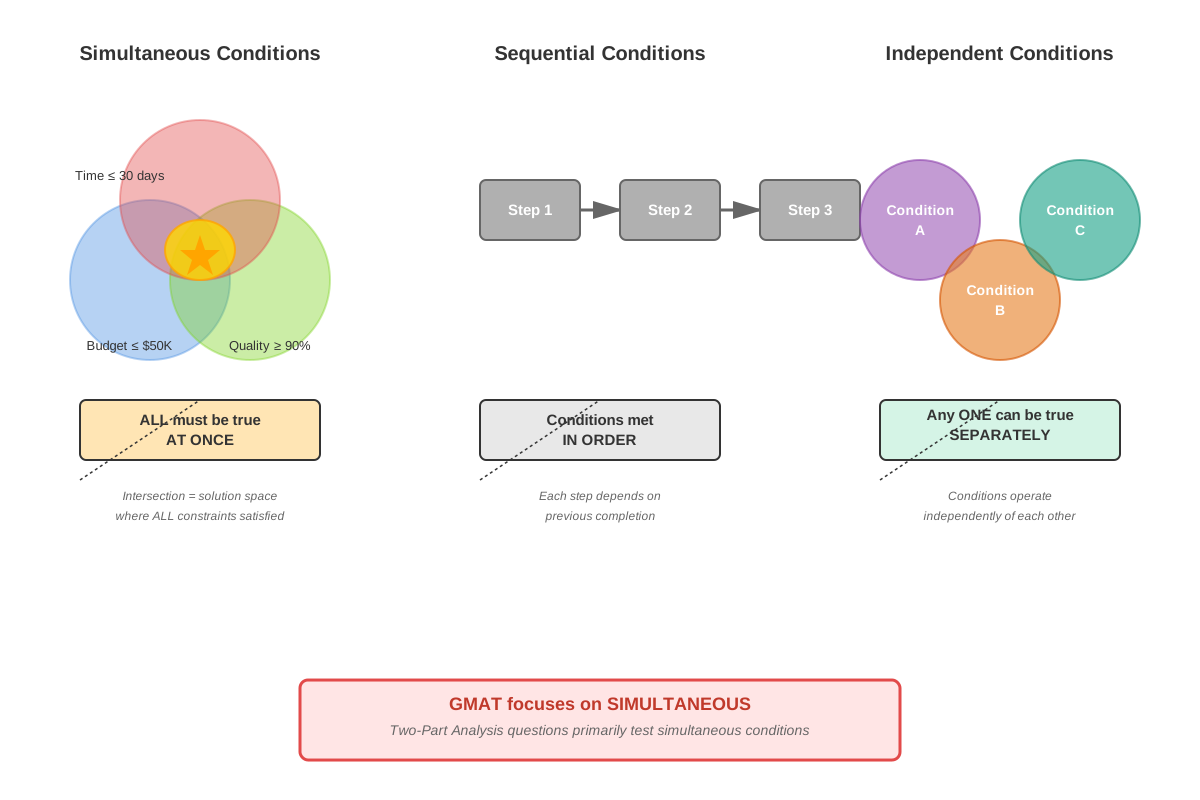
- [ ] Explain simultaneous conditions and how they differ from sequential or independent conditions
- [ ] Apply simultaneous conditions to GMAT questions with accuracy and efficiency
- [ ] Distinguish between dependent and independent simultaneous conditions
- [ ] Systematically test answer choices against multiple constraints
- [ ] Recognize common patterns in how simultaneous conditions are presented on the GMAT
- [ ] Develop efficient solution strategies that minimize calculation time while maximizing accuracy
Prerequisites
Students should have foundational knowledge in the following areas:
- Basic algebra and equation solving: Essential for manipulating expressions and solving for variables when conditions are expressed mathematically
- Linear equations and inequalities: Many simultaneous conditions involve systems of equations or inequality constraints that must be satisfied together
- Logical reasoning fundamentals: Understanding "and" versus "or" logic is crucial for determining when all conditions must be met versus when any condition suffices
- Basic arithmetic operations: Necessary for evaluating whether proposed solutions satisfy numerical constraints
- Reading comprehension: Critical for extracting multiple conditions from complex word problems and business scenarios
Why This Topic Matters
Simultaneous conditions appear in approximately 15-20% of Data Insights questions on the GMAT, making them one of the highest-yield topics for focused study. They are particularly prevalent in Two-Part Analysis questions, where test-takers must select two answers that together satisfy a complex set of requirements. The GMAT favors these questions because they efficiently test multiple competencies: quantitative reasoning, logical thinking, attention to detail, and the ability to manage complexity—all skills essential for success in business school and management careers.
In real-world business contexts, simultaneous conditions mirror everyday decision-making scenarios. Consider a manager who must hire two employees while staying within budget, meeting diversity goals, satisfying skill requirements, and maintaining team chemistry. Or a financial analyst who must construct a portfolio that meets return targets, risk constraints, liquidity requirements, and regulatory guidelines—all at the same time. These scenarios require the same analytical framework tested by GMAT simultaneous conditions questions.
On the exam, simultaneous conditions typically appear in several formats: resource allocation problems (distributing limited resources across multiple needs), scheduling scenarios (arranging events or tasks that have overlapping constraints), optimization questions (maximizing or minimizing an objective while satisfying multiple requirements), and system-of-equations problems (finding values that satisfy multiple mathematical relationships). Recognizing these patterns allows test-takers to quickly identify the appropriate solution strategy and avoid common traps.
Core Concepts
Understanding Simultaneous Conditions
Simultaneous conditions are multiple requirements, constraints, or criteria that must all be satisfied at the same time within a single solution. The key distinguishing feature is the word "and"—all conditions must be true together, not separately or sequentially. When a GMAT question presents simultaneous conditions, it is asking for a solution that exists at the intersection of all the given constraints.
Consider the difference between these two scenarios:
- Sequential: "First, find a number greater than 5. Then, find a number less than 10."
- Simultaneous: "Find a number that is both greater than 5 AND less than 10."
In the sequential case, you could answer with 7 for the first part and 3 for the second part. In the simultaneous case, only numbers between 5 and 10 (exclusive) satisfy both conditions at once—such as 6, 7, 8, or 9.
Types of Simultaneous Conditions
Mathematical Simultaneous Conditions
These involve multiple equations, inequalities, or mathematical relationships that must hold true for the same variable(s). The classic example is a system of equations:
2x + y = 10
x - y = 2
The solution must satisfy both equations simultaneously. In this case, x = 4 and y = 2 is the only solution that works for both equations at the same time.
Logical Simultaneous Conditions
These involve multiple logical criteria that must all be true. For example: "Select a candidate who has an MBA, speaks Spanish, and has at least 5 years of experience." All three conditions must be met by the same candidate.
Resource Constraint Conditions
These involve allocating limited resources while satisfying multiple requirements. For example: "Hire two consultants with a combined budget of $200,000, where at least one must have data science skills and at least one must have industry experience." The solution must satisfy the budget constraint AND both skill requirements simultaneously.
The Intersection Principle
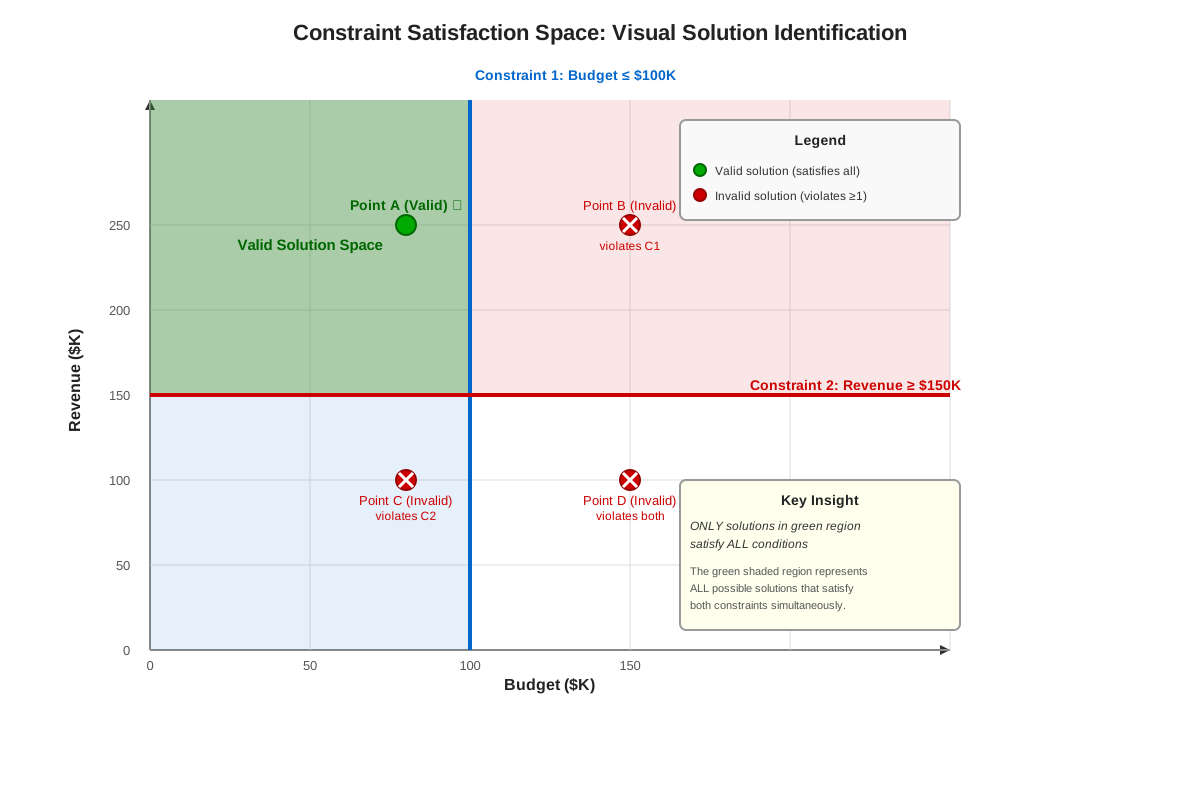
The fundamental principle underlying simultaneous conditions is intersection. When multiple conditions must be satisfied simultaneously, the solution space is the intersection of all individual solution spaces. Visualize this as overlapping circles in a Venn diagram—the valid solutions are only those in the region where all circles overlap.
| Condition Type | Individual Solution Space | Simultaneous Solution Space |
|---|---|---|
| x > 5 | All numbers greater than 5 | |
| x < 10 | All numbers less than 10 | |
| Both conditions | Numbers between 5 and 10 (5 < x < 10) |
Dependent vs. Independent Conditions
Independent simultaneous conditions can be evaluated separately and then combined. For example, if one condition requires x > 5 and another requires y < 10, these can be checked independently because they involve different variables.
Dependent simultaneous conditions interact with each other, and satisfying one may affect the ability to satisfy another. For example, if you must select two items from a list where their costs sum to exactly $100, choosing one item immediately constrains which other items can be selected.
The Testing Framework
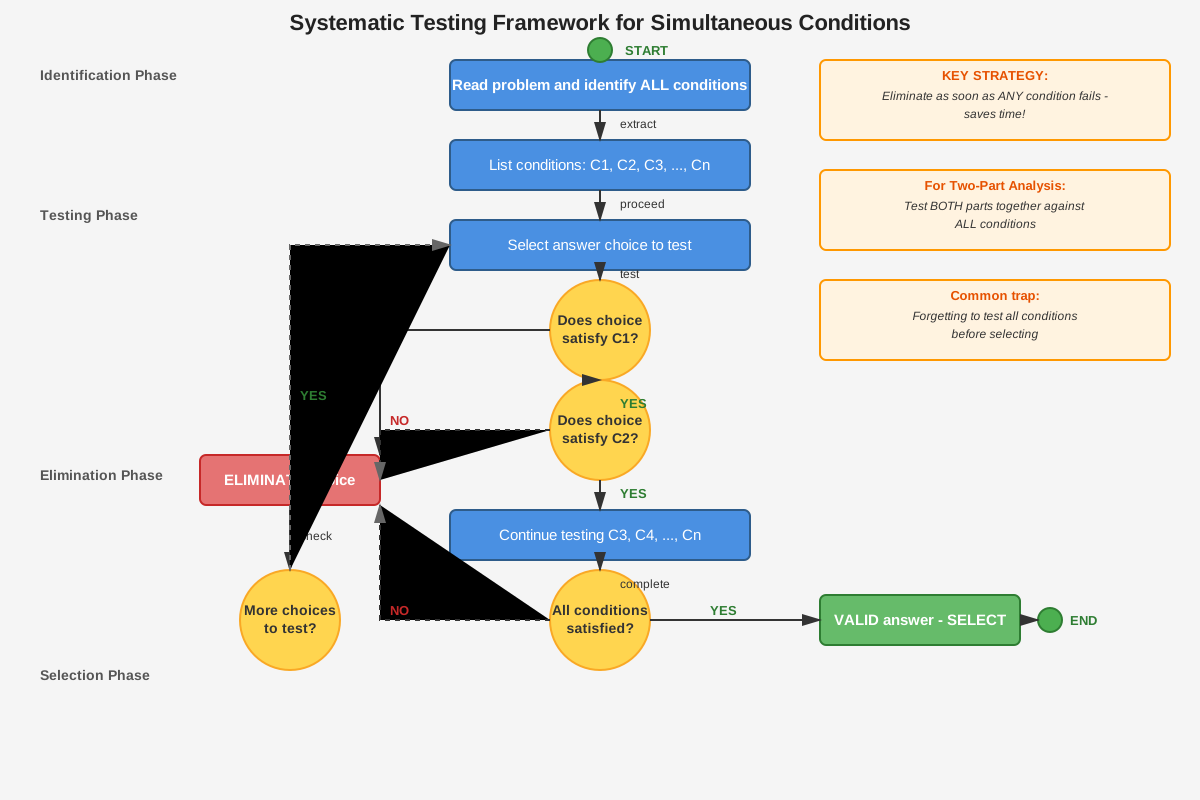
When approaching simultaneous conditions on the GMAT, use this systematic framework:
- Identify all conditions: List every requirement, constraint, or criterion explicitly stated in the problem
- Classify conditions: Determine whether they are mathematical, logical, or resource-based
- Check for dependencies: Identify whether conditions are independent or interact with each other
- Establish the solution space: Determine what range or set of values could potentially satisfy all conditions
- Test systematically: For each answer choice, verify that ALL conditions are satisfied
- Eliminate efficiently: As soon as an answer choice violates any single condition, eliminate it immediately
Common Structures in GMAT Questions
GMAT simultaneous conditions questions typically follow these patterns:
Two-Part Selection: "Select one option from Column A and one option from Column B such that [multiple conditions are satisfied]." Both selections together must satisfy all stated requirements.
Constraint Satisfaction: "Which of the following satisfies all of the given conditions?" The answer must meet every stated criterion.
Optimization with Constraints: "Maximize [objective] while satisfying [multiple constraints]." The solution must be optimal AND satisfy all constraints simultaneously.
Concept Relationships
The concepts within simultaneous conditions are hierarchically related. At the foundation lies the intersection principle, which establishes that solutions must exist in the overlap of all constraint spaces. This principle leads directly to the testing framework, which provides a systematic method for evaluating whether potential solutions satisfy all conditions. The framework distinguishes between independent and dependent conditions, which determines the most efficient testing strategy. All of these concepts support the ultimate goal of identifying valid solutions that satisfy multiple requirements at once.
Simultaneous conditions connect to prerequisite topics in essential ways. Systems of equations from algebra are a specific mathematical manifestation of simultaneous conditions. Logical operators (AND, OR, NOT) from logical reasoning determine how conditions combine. Inequality solving provides the tools to work with range-based simultaneous conditions.
The relationship map flows as follows:
Basic Logic (AND operator) → Intersection Principle → Solution Space Definition → Testing Framework → Efficient Answer Selection
Additionally: Independent Conditions → Parallel Testing (check each separately), while Dependent Conditions → Sequential Testing (check in order, considering interactions)
High-Yield Facts
⭐ Simultaneous conditions require ALL stated requirements to be satisfied at the same time, not separately or sequentially
⭐ The solution space for simultaneous conditions is the intersection of individual condition solution spaces
⭐ In Two-Part Analysis questions, both selected answers together must satisfy all conditions—test them as a pair, not individually
⭐ As soon as an answer choice violates any single condition, it can be eliminated immediately without checking remaining conditions
⭐ The word "and" signals simultaneous conditions; the word "or" signals alternative conditions where only one needs to be satisfied
- Dependent simultaneous conditions require checking how satisfying one condition affects others
- Independent simultaneous conditions can be verified in any order without affecting the outcome
- Resource allocation problems almost always involve simultaneous conditions with budget, quantity, or capacity constraints
- When conditions involve inequalities, the simultaneous solution is often a range rather than a single value
- GMAT simultaneous conditions questions frequently include exactly one answer choice that satisfies all but one condition—this is a deliberate trap
- Mathematical simultaneous conditions with two variables and two equations typically have exactly one solution (unless the equations are dependent or inconsistent)
- Time pressure makes it tempting to check conditions incompletely—systematic verification of ALL conditions is essential
Quick check — test yourself on Simultaneous conditions so far.
Try Flashcards →Common Misconceptions
Misconception: If an answer satisfies most of the conditions, it's probably correct.
Correction: In simultaneous conditions problems, an answer must satisfy ALL conditions without exception. Satisfying 3 out of 4 conditions means the answer is completely wrong. The GMAT deliberately includes attractive wrong answers that satisfy all but one condition.
Misconception: You can evaluate the two parts of a Two-Part Analysis question independently.
Correction: While you evaluate each part against the answer choices, the two selected answers must work together to satisfy all conditions simultaneously. Always test your two selections as a pair against every stated requirement.
Misconception: Simultaneous conditions are the same as sequential conditions.
Correction: Sequential conditions are satisfied one after another (first do A, then do B), while simultaneous conditions must all be true at the same time. The solution to simultaneous conditions is much more constrained because it must satisfy everything at once.
Misconception: If two conditions seem contradictory, the problem has no solution.
Correction: Conditions that initially appear contradictory may actually define a narrow but valid solution space. For example, "x > 5 and x < 10" might seem restrictive, but it has infinitely many solutions (all numbers between 5 and 10). Only truly inconsistent conditions (like "x > 10 and x < 5") have no solution.
Misconception: You should always solve simultaneous equations algebraically.
Correction: On the GMAT, testing answer choices against conditions is often faster than algebraic solving, especially when conditions are complex or involve multiple variables. Strategic answer testing is a valid and often superior approach.
Misconception: All conditions in a problem are equally important.
Correction: While all conditions must be satisfied, some are more restrictive and eliminate more answer choices. Identifying the most restrictive condition first can make elimination more efficient. For example, if one condition is "x is a prime number less than 20" and another is "x is positive," checking the prime condition first is more efficient.
Worked Examples
Example 1: Resource Allocation with Multiple Constraints
Question: A company must hire two consultants from the following list, with a combined annual salary not exceeding $180,000. At least one consultant must have data science expertise, and at least one must have healthcare industry experience. Which two consultants should be hired?
| Consultant | Annual Salary | Data Science | Healthcare Experience |
|---|---|---|---|
| A | $85,000 | Yes | No |
| B | $95,000 | Yes | Yes |
| C | $90,000 | No | Yes |
| D | $100,000 | Yes | No |
| E | $80,000 | No | Yes |
Solution Process:
Step 1: Identify all simultaneous conditions
- Condition 1: Combined salary ≤ $180,000
- Condition 2: At least one consultant has data science expertise
- Condition 3: At least one consultant has healthcare experience
- Condition 4: Exactly two consultants must be selected
Step 2: Analyze the most restrictive conditions
The salary constraint is highly restrictive. Let's identify which pairs satisfy the budget:
- A + B = $180,000 ✓
- A + C = $175,000 ✓
- A + E = $165,000 ✓
- B + C = $185,000 ✗ (exceeds budget)
- B + E = $175,000 ✓
- C + E = $170,000 ✓
Step 3: Test remaining pairs against skill requirements
- A + B: Data science (A, B both have it ✓), Healthcare (B has it ✓) → Satisfies all conditions
- A + C: Data science (A has it ✓), Healthcare (C has it ✓) → Satisfies all conditions
- A + E: Data science (A has it ✓), Healthcare (E has it ✓) → Satisfies all conditions
- B + E: Data science (B has it ✓), Healthcare (B, E both have it ✓) → Satisfies all conditions
- C + E: Data science (neither has it ✗) → Violates condition 2
Step 4: Determine the answer
If the question asks for a single answer, there may be an additional constraint not shown here. However, this demonstrates the process: A + B, A + C, A + E, and B + E all satisfy the simultaneous conditions. The pair C + E fails because while it satisfies the budget and healthcare requirements, it fails the data science requirement.
Key Insight: This problem demonstrates dependent conditions—the choice of the first consultant constrains which second consultant can be selected while satisfying all requirements simultaneously.
Example 2: Mathematical Simultaneous Conditions
Question: In a Two-Part Analysis question, you must select a value for x from Column A and a value for y from Column B such that both of the following conditions are satisfied:
- 2x + y = 14
- x - y = 1
| Column A (x) | Column B (y) |
|---|---|
| 3 | 4 |
| 4 | 6 |
| 5 | 8 |
| 6 | 10 |
Solution Process:
Step 1: Understand the simultaneous conditions
Both equations must be satisfied by the same pair of values (x, y). This is a system of equations.
Step 2: Solve algebraically (optional but efficient here)
From equation 2: x = y + 1
Substitute into equation 1: 2(y + 1) + y = 14
2y + 2 + y = 14
3y = 12
y = 4
Therefore: x = 4 + 1 = 5
Step 3: Verify by testing
Check x = 5, y = 4:
- Equation 1: 2(5) + 4 = 10 + 4 = 14 ✓
- Equation 2: 5 - 4 = 1 ✓
Step 4: Confirm no other pairs work (if time permits)
Test x = 3, y = 4:
- Equation 1: 2(3) + 4 = 10 ≠ 14 ✗
Test x = 4, y = 6:
- Equation 1: 2(4) + 6 = 14 ✓
- Equation 2: 4 - 6 = -2 ≠ 1 ✗
Answer: x = 5 from Column A, y = 4 from Column B
Key Insight: This demonstrates mathematical simultaneous conditions where both equations must be satisfied by the same variable values. Testing answer choices is often faster than algebraic solving on the GMAT, especially when the numbers are manageable.
Exam Strategy
Trigger Words and Phrases
Watch for these phrases that signal simultaneous conditions:
- "Both conditions must be satisfied"
- "At the same time"
- "While also meeting"
- "Such that all of the following are true"
- "Simultaneously"
- "Together" (when referring to combined requirements)
- "And" (when connecting multiple requirements)
Systematic Approach
Exam Tip: Always write down all conditions explicitly before evaluating answer choices. This prevents overlooking a condition under time pressure.
- Extract and list all conditions: Before looking at answer choices, identify every single requirement stated in the question
- Identify the most restrictive condition: Start testing with the condition that eliminates the most answer choices
- Use elimination aggressively: As soon as an answer violates any condition, eliminate it and move on
- Test pairs together in Two-Part Analysis: Never select your two answers independently; always verify they work together
- Double-check your final answer: Verify that your selected answer(s) satisfy every single condition
Time Management
Allocate approximately:
- 30 seconds: Reading and understanding all conditions
- 60-90 seconds: Testing answer choices systematically
- 15 seconds: Final verification
If a problem seems to require extensive calculation, consider whether testing answer choices might be faster than solving algebraically. The GMAT rewards strategic thinking, not just computational ability.
Common Traps to Avoid
The "Almost Right" Trap: The GMAT frequently includes an answer that satisfies all but one condition. Always verify every condition, even if an answer looks perfect.
The Independence Trap: Don't assume you can select answers for each part of a Two-Part Analysis independently. The two selections must work together.
The Calculation Trap: Don't get bogged down in complex calculations. If testing answer choices is faster, use that approach.
Memory Techniques
The "AND Principle" Mnemonic
All conditions
Need to be satisfied
Directly and simultaneously
Visualization Strategy
Picture simultaneous conditions as a series of filters or sieves. A valid solution must pass through ALL filters. If it gets caught in any single filter (violates any condition), it's eliminated. Only solutions that pass through every filter are valid.
The TICS Framework
Test systematically
Identify all conditions first
Check pairs together (in Two-Part Analysis)
Stop testing as soon as a condition is violated
The Intersection Acronym: OVERLAP
Only solutions in the
Valid region where
Every
Requirement
Lines up
Are
Permissible
Summary
Simultaneous conditions represent a critical GMAT Data Insights concept where multiple requirements, constraints, or criteria must all be satisfied at the same time by a single solution or pair of solutions. Unlike sequential or independent conditions, simultaneous conditions demand that test-takers find answers that exist at the intersection of all constraint spaces. The fundamental principle is that ALL conditions must be met together—satisfying most conditions is insufficient. Success requires systematic identification of every condition, strategic testing of answer choices, and careful verification that selected answers satisfy every requirement. In Two-Part Analysis questions, both selected answers must work together to satisfy all conditions, not independently. The most efficient approach involves identifying the most restrictive conditions first, using aggressive elimination when any condition is violated, and maintaining careful attention to detail under time pressure. Mastering simultaneous conditions builds essential analytical skills for complex business decision-making where multiple stakeholders, constraints, and objectives must be balanced concurrently.
Key Takeaways
- Simultaneous conditions require ALL stated requirements to be satisfied at the same time—there is no partial credit for satisfying most conditions
- The solution space is the intersection of all individual condition spaces; visualize overlapping constraints to understand valid solutions
- In Two-Part Analysis, always test your two selected answers together as a pair against every condition
- Eliminate answer choices immediately when they violate any single condition—don't waste time checking remaining conditions
- Identify and test the most restrictive condition first to eliminate answer choices most efficiently
- Watch for trigger words like "and," "simultaneously," "while also," and "both" that signal simultaneous conditions
- Strategic answer testing is often faster than algebraic solving on the GMAT—choose your approach based on efficiency
Related Topics
Systems of Linear Equations: Builds directly on simultaneous conditions by exploring algebraic methods for solving multiple equations with multiple variables. Mastering simultaneous conditions provides the conceptual foundation for understanding why systems of equations require solutions that satisfy all equations at once.
Optimization Problems: Extends simultaneous conditions by adding an objective function to maximize or minimize while satisfying multiple constraints. Understanding simultaneous conditions is essential before tackling optimization.
Constraint Satisfaction in Operations Management: Applies simultaneous conditions to real-world business scenarios involving resource allocation, scheduling, and logistics. The analytical framework developed here transfers directly to these applications.
Venn Diagrams and Set Theory: Provides visual and mathematical tools for understanding intersections, which is the core principle underlying simultaneous conditions. This topic offers alternative representations of the same underlying concepts.
Multi-Source Reasoning: Another Data Insights question type that often involves synthesizing information from multiple sources to satisfy simultaneous conditions across different data sets.
Practice CTA
Now that you've mastered the conceptual framework for simultaneous conditions, it's time to solidify your understanding through practice. Attempt the practice questions associated with this topic, focusing on applying the systematic testing framework and identifying all conditions before evaluating answer choices. Use the flashcards to reinforce high-yield facts and common patterns. Remember: simultaneous conditions appear in 15-20% of Data Insights questions, making this one of the highest-yield topics for your GMAT preparation. Every practice question you complete builds the pattern recognition and systematic thinking that will serve you on test day. You've got this!
Sign up free to keep reading
Create a free AnvayaPrep account to finish this GMAT guide on Simultaneous conditions — plus flashcards and practice questions.