Overview
Algebra word problems represent one of the most frequently tested and high-value question types on the GMAT Quantitative Reasoning section. These problems require test-takers to translate real-world scenarios into mathematical equations and then solve for unknown variables. Unlike straightforward algebraic equations presented in symbolic form, GMAT algebra word problems embed mathematical relationships within narrative contexts involving rates, mixtures, work, age, distance, consecutive integers, and various other scenarios. The ability to decode these verbal descriptions and construct appropriate algebraic models is essential for achieving competitive scores on the GMAT.
The challenge of algebra word problems extends beyond mere computational ability. Success requires a systematic approach to reading comprehension, variable assignment, equation construction, and solution verification. Test-takers must identify what the question asks, determine which quantities are known versus unknown, establish relationships between variables, and translate these relationships into solvable equations. This multi-step cognitive process makes algebra word problems particularly valuable for business schools seeking candidates who can analyze complex situations and formulate mathematical solutions to practical problems.
Within the broader Quantitative Reasoning framework, algebra word problems serve as an integrative topic that connects pure algebraic manipulation with applied problem-solving. These questions test not only algebraic proficiency but also logical reasoning, reading comprehension, and the ability to work under time pressure. Mastery of this topic provides a foundation for tackling more advanced quantitative concepts and demonstrates the analytical thinking skills essential for graduate-level business education.
Learning Objectives
- [ ] Identify algebra word problems on the GMAT by recognizing characteristic language patterns and question structures
- [ ] Explain the underlying mathematical relationships embedded within word problem narratives
- [ ] Apply systematic translation techniques to convert word problems into algebraic equations
- [ ] Construct appropriate variable definitions that simplify problem-solving
- [ ] Solve multi-step algebra word problems efficiently within GMAT time constraints
- [ ] Verify solutions by checking whether answers satisfy the original problem conditions
- [ ] Recognize common word problem categories and apply category-specific solution strategies
Prerequisites
- Linear equations and inequalities: Essential for setting up and solving the equations derived from word problems
- Systems of equations: Many word problems involve multiple unknowns requiring simultaneous equation solving
- Basic arithmetic operations: Necessary for manipulating expressions and computing final answers
- Ratio and proportion concepts: Frequently appear in mixture, rate, and scaling problems
- Percentage calculations: Common in problems involving discounts, interest, and percent change
- Exponent and polynomial manipulation: Required for problems involving area, volume, and growth rates
Why This Topic Matters
Algebra word problems constitute approximately 25-30% of GMAT Quantitative Reasoning questions, making them one of the highest-frequency topics on the exam. Business schools value this skill because it directly mirrors the analytical challenges faced in management contexts: extracting quantitative relationships from verbal descriptions, formulating mathematical models, and deriving actionable solutions. The ability to translate business scenarios into mathematical frameworks is fundamental to finance, operations, marketing analytics, and strategic planning.
In real-world applications, professionals constantly encounter situations requiring algebraic modeling: calculating break-even points, optimizing resource allocation, projecting growth trajectories, analyzing cost structures, and evaluating investment returns. The word problem format on the GMAT simulates these practical challenges by embedding mathematical relationships within realistic scenarios rather than presenting abstract equations.
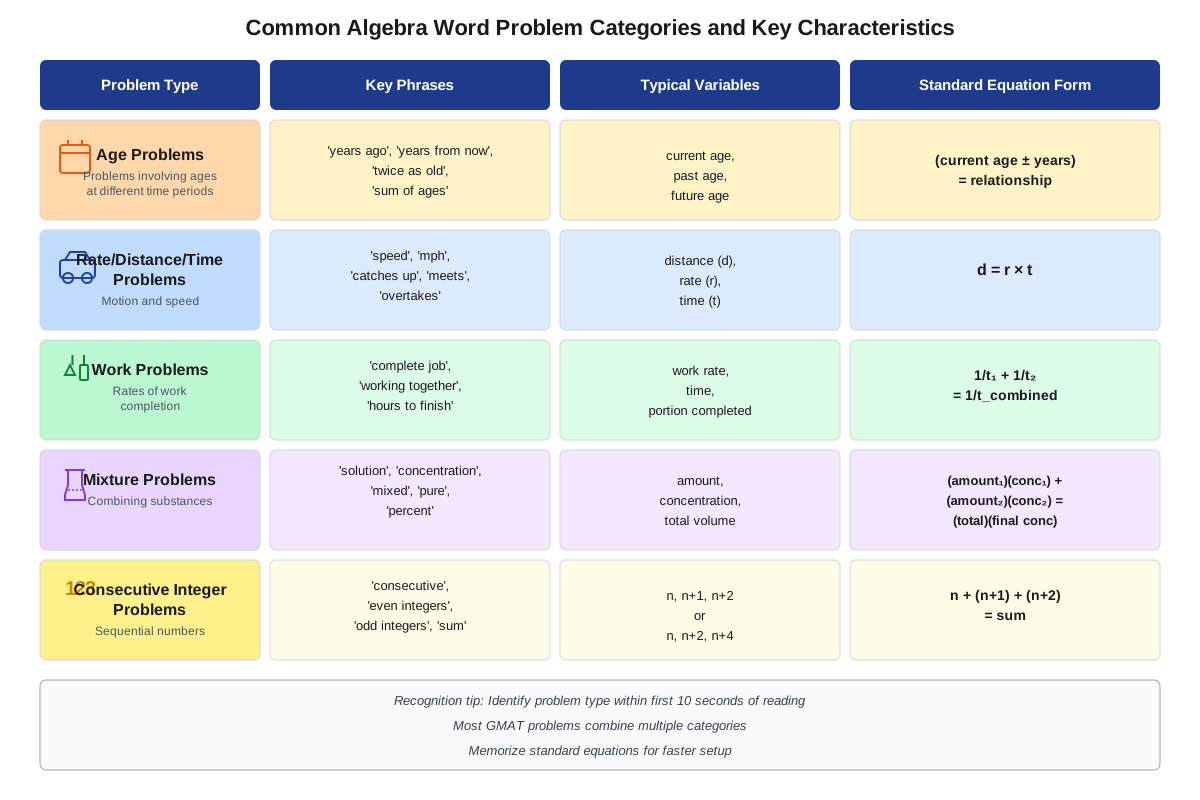
On the GMAT, algebra word problems appear in both Problem Solving and Data Sufficiency formats. Problem Solving questions typically present a scenario and ask for a specific numerical answer, while Data Sufficiency questions test whether given information is adequate to solve the problem. Common manifestations include rate problems (distance-rate-time, work rates), mixture problems (combining solutions or populations), age problems (relationships between people's ages), consecutive integer problems, profit and pricing problems, and set theory problems. Recognizing these patterns enables efficient problem categorization and solution strategy selection.
Core Concepts
Translation Framework
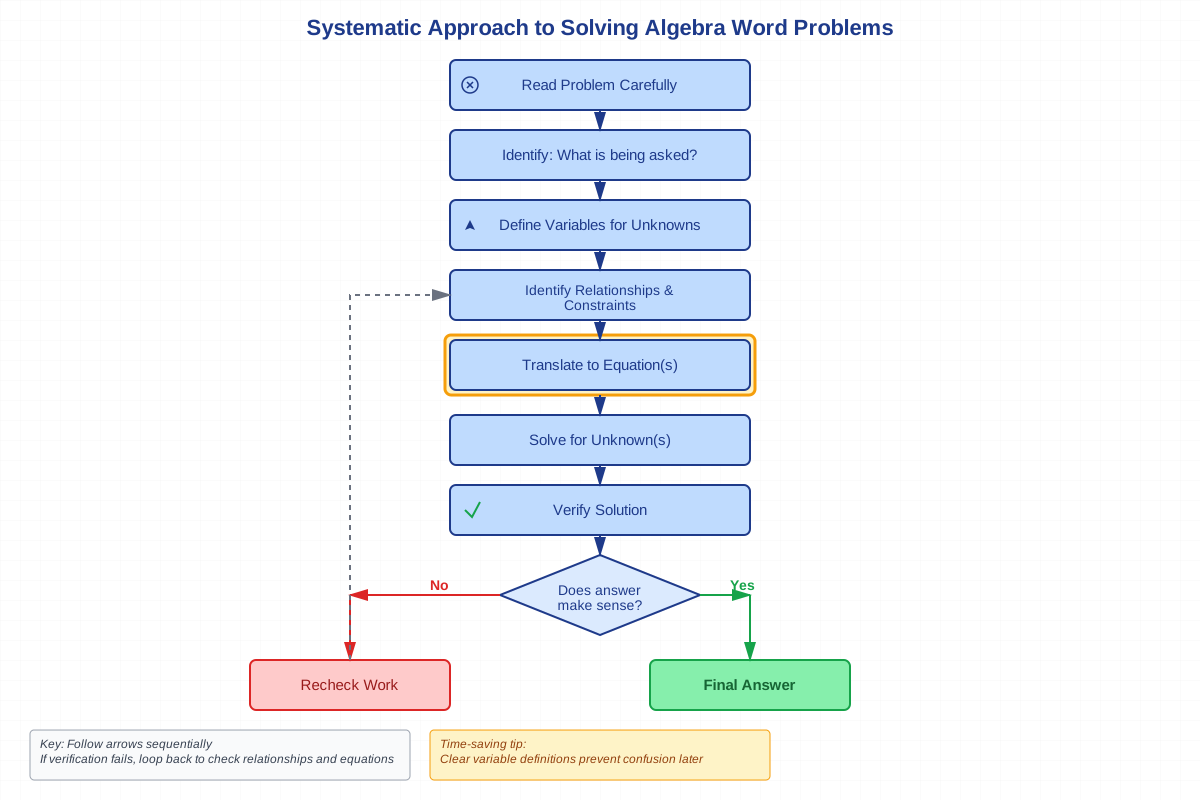
The foundation of solving algebra word problems lies in systematic translation from verbal descriptions to mathematical expressions. This process involves four critical steps:
- Identify the unknown: Determine what the question asks and assign variables to unknown quantities
- Extract given information: List all numerical values and relationships provided
- Establish relationships: Identify how variables relate to each other through the problem narrative
- Construct equations: Convert verbal relationships into algebraic equations
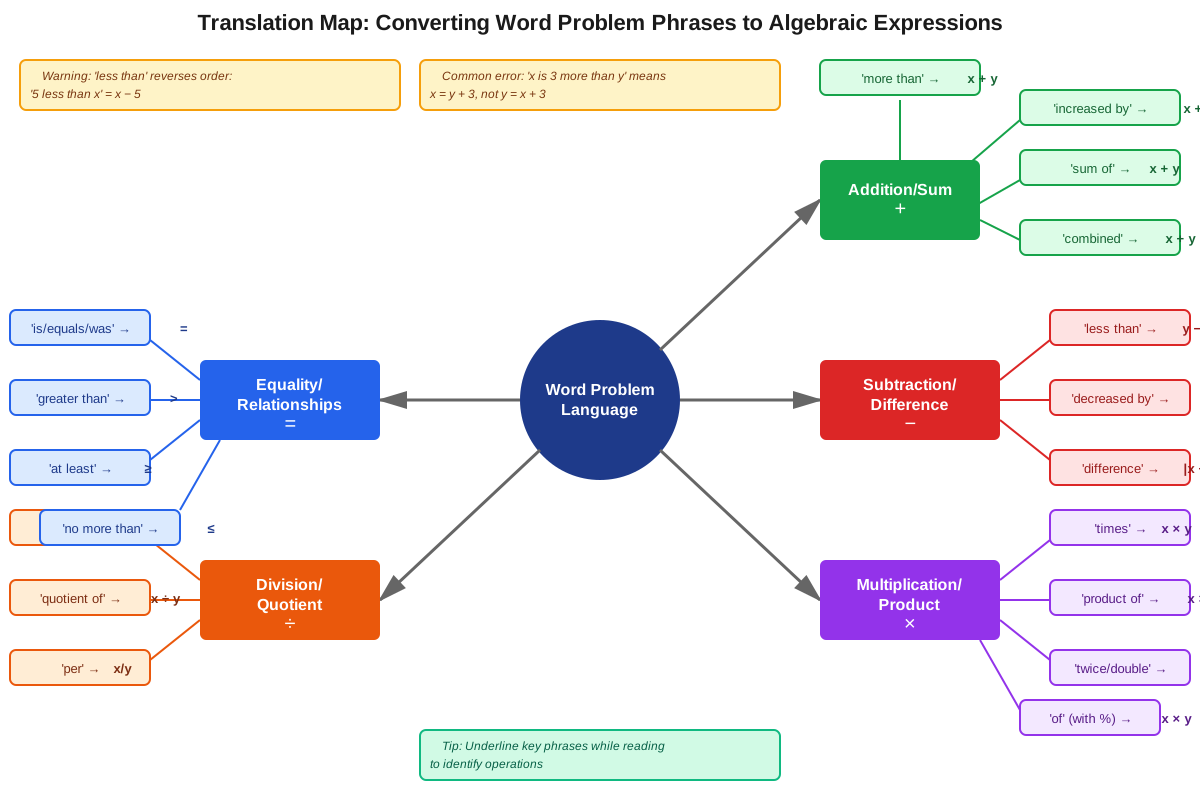
The translation process requires recognizing key linguistic signals. Phrases like "is," "equals," "amounts to," and "totals" typically indicate equality (=). Words such as "more than," "increased by," and "sum" suggest addition (+), while "less than," "decreased by," and "difference" indicate subtraction (−). "Times," "product," and "of" signal multiplication (×), and "per," "quotient," and "ratio" suggest division (÷).
Variable Assignment Strategy
Effective variable assignment dramatically simplifies problem-solving. The optimal approach assigns the variable to the quantity the question ultimately asks about, making the final answer immediately available once the equation is solved. When multiple unknowns exist, express secondary variables in terms of the primary variable whenever possible to reduce the system to a single equation.
For example, if a problem states "John is 5 years older than Mary," and asks for John's age, assign x to John's age (the target) and express Mary's age as (x − 5) rather than introducing a second variable. This strategy minimizes algebraic complexity and reduces computational errors.
Common Problem Categories
Rate Problems (Distance-Rate-Time)
These problems utilize the fundamental relationship: Distance = Rate × Time (D = RT). Variations include:
- Opposite direction travel: Combined rate equals sum of individual rates
- Same direction travel: Relative rate equals difference of individual rates
- Round-trip problems: Often involve different rates for each leg
Distance = Rate × Time
D = R × T
Work Rate Problems
Work problems employ the principle that Rate = Work/Time. When multiple entities work together, their rates add:
Rate₁ + Rate₂ = Combined Rate
1/Time₁ + 1/Time₂ = 1/Time_combined
If person A completes a job in 4 hours and person B in 6 hours, their combined rate is 1/4 + 1/6 = 5/12 of the job per hour.
Mixture Problems
Mixture problems involve combining substances with different concentrations or values. The key principle: (Amount₁)(Concentration₁) + (Amount₂)(Concentration₂) = (Total Amount)(Final Concentration).
| Mixture Type | Key Equation | Common Variants |
|---|---|---|
| Solution mixing | V₁C₁ + V₂C₂ = V_total × C_final | Dilution, concentration increase |
| Value mixing | Q₁P₁ + Q₂P₂ = Q_total × P_avg | Blending products, average price |
| Population mixing | N₁R₁ + N₂R₂ = N_total × R_combined | Demographics, test scores |
Age Problems
Age problems establish relationships between people's ages at different time points. The critical insight: everyone ages at the same rate, so time changes affect all individuals equally.
Standard approach:
- Define variables for current ages
- Express past or future ages by adding/subtracting the time difference
- Set up equations based on stated relationships
Consecutive Integer Problems
Consecutive integers follow patterns:
- Consecutive integers: n, n+1, n+2, ...
- Consecutive even integers: n, n+2, n+4, ... (where n is even)
- Consecutive odd integers: n, n+2, n+4, ... (where n is odd)
Key property: The sum of consecutive integers equals (number of terms) × (average of first and last term).
Equation Construction Techniques
After translation, construct equations that capture all problem constraints. For problems with multiple conditions, each condition typically generates one equation. A system with n unknowns requires n independent equations for unique solution.
Constraint identification involves recognizing explicit statements ("the sum is 50") and implicit constraints (quantities must be positive, integers, or within realistic bounds). These constraints often enable elimination of incorrect answer choices without complete algebraic solution.
Solution Verification
Always verify solutions by substituting back into the original problem context, not just the derived equations. This catches translation errors that algebraic checking misses. Confirm that:
- The answer addresses the question asked (not a different variable)
- The solution makes logical sense in context
- All stated conditions are satisfied
- Units are appropriate
Concept Relationships
The core concepts within algebra word problems form an interconnected framework. The translation framework serves as the foundational skill enabling all other techniques. Effective variable assignment strategy streamlines the translation process and simplifies subsequent algebraic manipulation. Both skills apply universally across all problem categories (rate, work, mixture, age, consecutive integers).
Each problem category represents a specialized application of the general translation framework with category-specific formulas and relationships. For instance, rate problems always involve the D = RT relationship, while work problems use the reciprocal time relationship. Recognizing the category immediately activates the relevant formula template.
Equation construction techniques bridge translation and solution, converting the verbal-to-mathematical translation into solvable algebraic systems. These techniques draw on prerequisite knowledge of linear equations and systems of equations. Finally, solution verification closes the loop by connecting the algebraic answer back to the original verbal context, ensuring the mathematical solution actually answers the posed question.
The relationship map flows: Problem Recognition → Translation Framework → Variable Assignment → Category Identification → Equation Construction → Algebraic Solution → Verification → Final Answer. Each stage depends on the previous, and weakness in any component compromises overall problem-solving effectiveness.
High-Yield Facts
⭐ The fundamental rate equation D = RT applies to all distance, speed, and time problems; memorize this relationship and its algebraic rearrangements (R = D/T, T = D/R).
⭐ For work rate problems, if person A completes a job in 'a' hours and person B in 'b' hours, working together they complete the job in (ab)/(a+b) hours.
⭐ In mixture problems, the amount of pure substance equals (volume or quantity) × (concentration as a decimal).
⭐ When objects travel in opposite directions, add their speeds to find the rate at which distance between them increases; when traveling in the same direction, subtract speeds.
⭐ The sum of n consecutive integers equals n times the middle value (if n is odd) or n times the average of the two middle values (if n is even).
- Age problems always maintain constant age differences: if A is 5 years older than B now, A will always be 5 years older than B at any time point.
- In percent problems, distinguish between "percent of" (multiplication) and "percent more/less than" (requires baseline comparison).
- For problems involving averages, remember: Sum = Average × Number of items; this relationship enables solving for any one component given the other two.
- When a problem states "x is 20% less than y," the equation is x = 0.8y, not y = 0.8x; the reference point matters.
- Consecutive even or odd integers differ by 2, not 1; represent them as n, n+2, n+4, etc.
- In ratio problems, if the ratio of A to B is 3:5, express as A = 3x and B = 5x for some multiplier x, not A = 3 and B = 5.
- Problems involving "twice as old" or similar multiplicative age relationships require careful attention to whether the relationship holds now, in the past, or in the future.
- When combining solutions of different concentrations, the final concentration must fall between the two original concentrations (unless adding pure substance or pure solvent).
- For problems with multiple rates (like different speeds for uphill and downhill), the average rate is NOT the arithmetic mean of the two rates; use total distance divided by total time.
- In profit problems, distinguish between markup (based on cost) and margin (based on selling price); these yield different calculations.
Quick check — test yourself on Algebra word problems so far.
Try Flashcards →Common Misconceptions
Misconception: In age problems, if "John is twice as old as Mary," this relationship remains constant over time.
Correction: Age ratios change over time because everyone ages by the same absolute amount. If John is currently 20 and Mary is 10 (ratio 2:1), in 10 years John will be 30 and Mary 20 (ratio 3:2). Only age differences remain constant.
Misconception: For work problems, if A takes 4 hours and B takes 6 hours, together they take (4+6)/2 = 5 hours.
Correction: Rates add, not times. A's rate is 1/4 job/hour, B's rate is 1/6 job/hour, combined rate is 1/4 + 1/6 = 5/12 job/hour, so together they take 12/5 = 2.4 hours, not 5 hours.
Misconception: "x is 30% more than y" translates to x = y + 30.
Correction: Percentage increases are multiplicative, not additive. The correct translation is x = y + 0.30y = 1.30y. The misconception confuses percentage points with absolute values.
Misconception: In mixture problems, when combining equal volumes of 20% and 40% solutions, the result is 30% concentration.
Correction: This is actually correct for equal volumes, but the misconception extends to unequal volumes where simple averaging fails. With unequal volumes, use the weighted average formula: (V₁C₁ + V₂C₂)/(V₁ + V₂).
Misconception: The variable should always represent the smallest or simplest quantity in the problem.
Correction: The variable should represent the quantity the question asks for, even if it's not the simplest. This eliminates an extra step of solving for the desired quantity after finding the variable value.
Misconception: In distance problems, average speed equals (speed₁ + speed₂)/2.
Correction: Average speed equals total distance divided by total time, not the arithmetic mean of speeds. If traveling 60 mph for 1 hour and 30 mph for 1 hour, average speed is 120 miles / 2 hours = 60 mph (which happens to equal the arithmetic mean), but if traveling 60 mph for 1 hour and 30 mph for 3 hours, average speed is 150 miles / 4 hours = 37.5 mph, not 45 mph.
Misconception: All word problems require setting up equations; sometimes estimation or answer choice testing is faster.
Correction: While systematic equation setup is reliable, GMAT rewards efficiency. For some problems, testing answer choices (especially when answers are simple numbers) or using logical reasoning can be faster than algebraic solution.
Worked Examples
Example 1: Work Rate Problem
Problem: Machine A can complete a job in 6 hours. Machine B can complete the same job in 9 hours. If both machines work together for 2 hours, then Machine A breaks down and Machine B continues alone, how many additional hours will Machine B need to finish the job?
Solution:
Step 1: Identify what the question asks.
The question asks for additional hours Machine B works alone after the 2-hour joint period.
Step 2: Determine individual rates.
- Machine A's rate: 1/6 of the job per hour
- Machine B's rate: 1/9 of the job per hour
Step 3: Calculate work completed during joint operation.
Combined rate = 1/6 + 1/9 = 3/18 + 2/18 = 5/18 of the job per hour
Work completed in 2 hours = 2 × (5/18) = 10/18 = 5/9 of the job
Step 4: Calculate remaining work.
Remaining work = 1 - 5/9 = 4/9 of the job
Step 5: Calculate time for Machine B to complete remaining work.
Time = Work / Rate = (4/9) / (1/9) = (4/9) × (9/1) = 4 hours
Answer: Machine B needs 4 additional hours to finish the job.
Verification: Total work = (2 hours × 5/18) + (4 hours × 1/9) = 10/18 + 4/9 = 10/18 + 8/18 = 18/18 = 1 complete job ✓
This problem demonstrates the work rate category, requiring understanding that rates add when working together and that work equals rate multiplied by time.
Example 2: Mixture Problem
Problem: A chemist has 10 liters of a solution that is 30% acid. How many liters of pure acid must be added to create a solution that is 50% acid?
Solution:
Step 1: Identify the unknown.
Let x = liters of pure acid to be added (this is what the question asks)
Step 2: Set up the mixture equation.
The amount of pure acid before + amount of pure acid added = amount of pure acid after
Step 3: Express each component.
- Pure acid initially: 10 × 0.30 = 3 liters
- Pure acid added: x × 1.00 = x liters (pure acid is 100% concentration)
- Total volume after: 10 + x liters
- Pure acid finally: (10 + x) × 0.50 liters
Step 4: Construct the equation.
3 + x = 0.50(10 + x)
Step 5: Solve for x.
3 + x = 5 + 0.5x
x - 0.5x = 5 - 3
0.5x = 2
x = 4
Answer: 4 liters of pure acid must be added.
Verification:
- Initial acid: 3 liters
- Added acid: 4 liters
- Total acid: 7 liters
- Total volume: 14 liters
- Final concentration: 7/14 = 0.50 = 50% ✓
This problem illustrates the mixture category, emphasizing that concentration multiplied by volume gives the amount of pure substance, and that pure substances have 100% concentration.
Exam Strategy
When approaching GMAT algebra word problems, implement this systematic process:
Initial Assessment (15-20 seconds):
- Read the entire problem carefully, noting what the question asks
- Identify the problem category (rate, work, mixture, age, etc.)
- Scan answer choices for clues about magnitude and form
Setup Phase (30-45 seconds):
- Assign variables strategically, preferring to let x represent the target quantity
- List all given information and relationships
- Identify the number of unknowns and ensure sufficient equations exist
Solution Phase (60-90 seconds):
- Translate verbal relationships into equations
- Solve algebraically, showing clear steps to avoid errors
- Consider alternative approaches if algebra becomes complex (testing answers, logical reasoning)
Verification Phase (15-20 seconds):
- Check that the answer addresses the actual question
- Verify the solution makes logical sense in context
- Confirm units are appropriate
Trigger words and phrases to watch for:
- "How many more/less" → requires subtraction of two quantities
- "What fraction/percent" → answer will be a ratio or percentage, not an absolute value
- "At this rate" → signals a rate problem requiring proportional reasoning
- "Working together" → indicates combined rates in work problems
- "In terms of" → may require expressing answer as an algebraic expression, not a number
Process-of-elimination strategies:
- Eliminate answers that violate logical constraints (negative ages, speeds exceeding reasonable limits)
- Test extreme cases: if the problem involves percentages, check whether 0% or 100% would make sense
- For Data Sufficiency, recognize that statements providing the same information in different forms are insufficient together
- Use answer choice structure: if four answers are close and one is very different, the outlier is often incorrect
Time management:
- Allocate 2 minutes maximum per Problem Solving question
- If stuck after 60 seconds, consider testing answer choices rather than continuing algebraic approach
- For complex problems, estimate the answer range first to guide solution and catch errors
- Mark difficult problems for review if time permits, but make an educated guess before moving on
Memory Techniques
D-R-T Triangle Mnemonic: Visualize a triangle with D (Distance) at the top, R (Rate) and T (Time) at the bottom corners. Cover the quantity you're solving for; the remaining two show the operation: D = R × T, R = D/T, T = D/R.
WORK Rate Acronym:
- Work equals rate times time
- Opposite operations: if given time, take reciprocal for rate
- Rates add when working together
- Keep units consistent (jobs per hour, not hours per job)
Mixture Memory Aid: "Pure times Volume equals Amount" (PVA). The amount of pure substance equals concentration (as decimal) times volume. For final mixture: PVA₁ + PVA₂ = PVA_final.
Age Problem Visualization: Draw a simple table with rows for each person and columns for different time points (past, present, future). This visual organization prevents confusion about when relationships hold.
Consecutive Integer Patterns:
- Consecutive: n, n+1, n+2 (difference of 1)
- Even: n, n+2, n+4 (difference of 2, n even)
- Odd: n, n+2, n+4 (difference of 2, n odd)
Remember: "CEO" for Consecutive, Even, Odd patterns.
Translation Phrase Bank: Create mental associations:
- "IS" = equals sign (=)
- "OF" = multiplication (×) when following a fraction or percent
- "MORE THAN" = addition (+)
- "LESS THAN" = subtraction (−), but watch word order: "5 less than x" is x−5, not 5−x
Percent Change Formula: Visualize "New = Old × (1 ± percent change as decimal)". For increases, use +; for decreases, use −. This single formula handles all percent change problems.
Summary
Algebra word problems constitute a critical high-frequency topic on the GMAT Quantitative Reasoning section, requiring systematic translation of verbal scenarios into mathematical equations. Success depends on mastering a structured approach: identifying what the question asks, assigning variables strategically, recognizing problem categories (rate, work, mixture, age, consecutive integers), translating verbal relationships into equations, solving algebraically, and verifying solutions in context. Each problem category has characteristic formulas and relationships—D = RT for rate problems, reciprocal time relationships for work problems, weighted averages for mixtures—that enable efficient solution once the category is recognized. The key to consistent performance is methodical translation rather than rushing to equations, strategic variable assignment that minimizes algebraic complexity, and careful verification that answers address the actual question asked. Time management is essential: allocate approximately two minutes per problem, consider testing answer choices when algebra becomes unwieldy, and maintain awareness of logical constraints that enable elimination of impossible answers. Mastery of algebra word problems demonstrates the analytical reasoning and quantitative modeling skills that business schools value and that prove essential in graduate-level coursework and professional practice.
Key Takeaways
- Systematic translation from verbal descriptions to algebraic equations is the foundational skill; never skip the careful reading and variable assignment phase
- Assign variables to the target quantity the question asks for, expressing other unknowns in terms of this primary variable whenever possible
- Recognize problem categories (rate, work, mixture, age, consecutive integers) to activate category-specific formulas and solution approaches
- Rates add when working together; for work problems, combined rate equals 1/t₁ + 1/t₂, not (t₁ + t₂)/2
- Verify solutions in the original context, not just algebraically; ensure answers make logical sense and address the actual question
- Use answer choices strategically through testing values or eliminating logically impossible options, especially when algebra becomes complex
- Master the fundamental relationships: D = RT for rate problems, Work = Rate × Time for work problems, and weighted averages for mixture problems
Related Topics
Systems of Equations: Many complex algebra word problems require solving systems with multiple variables; deepening proficiency with substitution and elimination methods enhances word problem solving efficiency.
Inequalities and Optimization: Advanced word problems may ask for maximum or minimum values subject to constraints, requiring translation into inequality systems and optimization techniques.
Functions and Sequences: Some GMAT word problems embed functional relationships or arithmetic/geometric sequences within narrative contexts, extending the translation framework to more abstract mathematical structures.
Statistics and Data Interpretation: Word problems involving averages, weighted means, and data analysis connect algebraic reasoning with statistical concepts, appearing frequently in integrated reasoning sections.
Geometry Word Problems: Applying algebraic techniques to geometric scenarios (perimeter, area, volume problems with unknown dimensions) represents a natural extension of the translation framework to spatial reasoning.
Mastering algebra word problems provides the foundation for all these advanced topics, as the core skill of translating verbal descriptions into mathematical models applies universally across quantitative reasoning domains.
Practice CTA
Now that you've mastered the systematic approach to algebra word problems, it's time to solidify your understanding through deliberate practice. Attempt the practice questions associated with this topic, focusing on implementing the translation framework and category recognition strategies you've learned. Work through problems methodically rather than rushing, and review both correct and incorrect answers to understand the reasoning behind each solution. Use the flashcards to reinforce key formulas, translation phrases, and problem-solving strategies until they become automatic. Remember: consistent, focused practice with immediate feedback is the most effective path to GMAT excellence. Each problem you solve strengthens your pattern recognition and builds the confidence needed to tackle any algebra word problem on test day. You've built the foundation—now apply it!
Sign up free to keep reading
Create a free AnvayaPrep account to finish this GMAT guide on Algebra word problems — plus flashcards and practice questions.