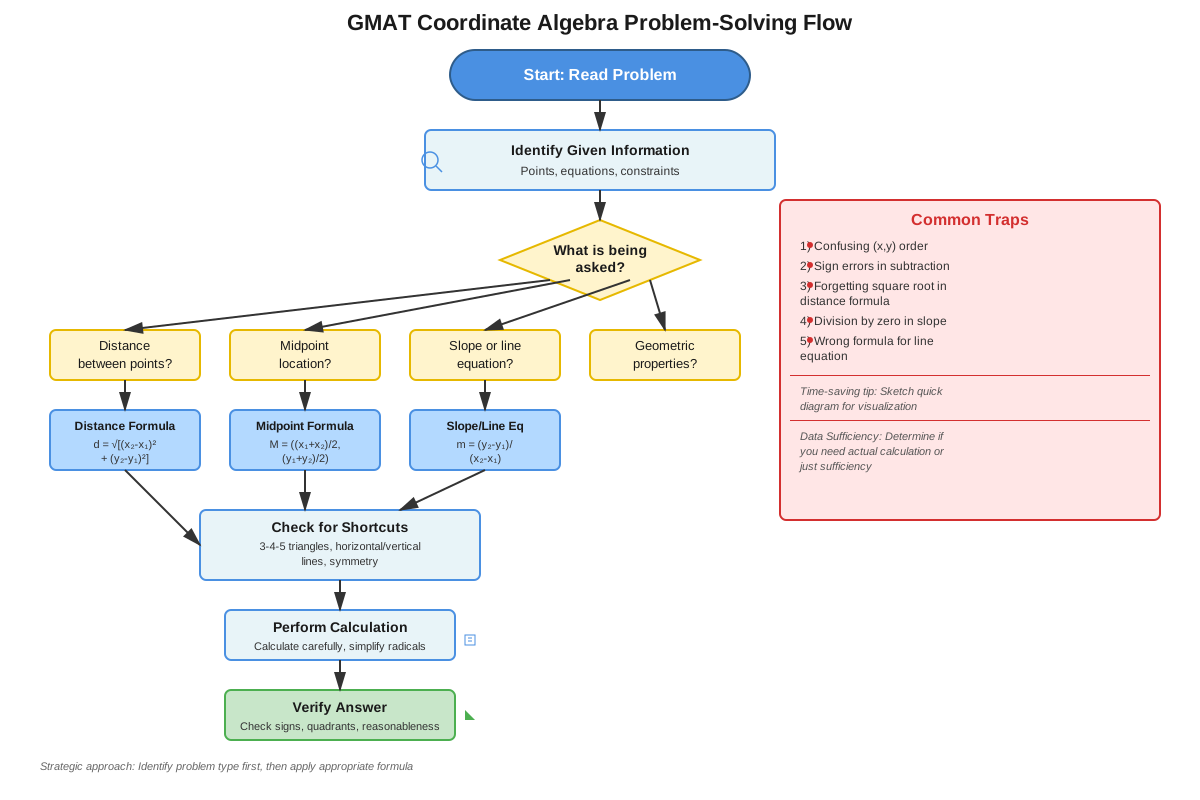
Overview
Coordinate algebra is a fundamental mathematical framework that combines algebraic equations with the coordinate plane, enabling the representation and analysis of geometric relationships through numerical coordinates and equations. On the GMAT, GMAT coordinate algebra questions test the ability to work with points, lines, distances, slopes, and geometric figures plotted on the xy-coordinate system. This topic bridges pure algebra with geometric visualization, requiring test-takers to translate between graphical representations and algebraic expressions seamlessly.
Mastery of coordinate algebra is essential for the GMAT because it appears in approximately 10-15% of Quantitative Reasoning questions, often in problem-solving and data sufficiency formats. These questions frequently combine multiple mathematical concepts, testing not only coordinate geometry skills but also algebraic manipulation, equation solving, and logical reasoning. The ability to quickly identify relationships between points, determine line equations, calculate distances, and analyze geometric properties on the coordinate plane can significantly impact overall performance.
Within the broader Quantitative Reasoning framework, coordinate algebra serves as a critical intersection between algebra and geometry. It builds upon foundational algebraic skills such as solving linear equations and working with variables, while simultaneously providing tools for analyzing geometric shapes, transformations, and spatial relationships. Understanding coordinate algebra enables students to tackle complex multi-step problems that integrate distance formulas, midpoint calculations, slope analysis, and equation manipulation—all common elements in higher-difficulty GMAT questions.
Learning Objectives
- [ ] Identify coordinate algebra concepts and structures in GMAT questions
- [ ] Explain the fundamental principles of coordinate algebra including points, lines, and distances
- [ ] Apply coordinate algebra formulas and techniques to solve GMAT questions efficiently
- [ ] Calculate slopes, distances, and midpoints between points on the coordinate plane
- [ ] Determine equations of lines in various forms (slope-intercept, point-slope, standard)
- [ ] Analyze geometric figures and their properties using coordinate algebra methods
- [ ] Solve data sufficiency questions involving coordinate relationships with strategic reasoning
Prerequisites
- Linear equations and inequalities: Essential for understanding line equations and solving for coordinates, as coordinate algebra heavily relies on manipulating linear expressions
- Basic geometry concepts: Knowledge of triangles, circles, and polygons provides the foundation for analyzing these shapes on the coordinate plane
- Algebraic manipulation: Ability to solve for variables, factor expressions, and work with formulas is necessary for deriving and applying coordinate algebra formulas
- Number properties: Understanding positive/negative numbers, absolute values, and square roots is crucial for distance calculations and coordinate analysis
- Exponent rules: Required for working with the distance formula and other calculations involving squared terms
Why This Topic Matters
Coordinate algebra represents one of the most practical applications of mathematics in real-world contexts. Engineers use coordinate systems to design structures and map spatial relationships, computer graphics rely on coordinate transformations to render images, GPS navigation systems employ coordinate algebra to calculate distances and routes, and data scientists visualize relationships between variables using coordinate plots. The skills developed through coordinate algebra—spatial reasoning, pattern recognition, and the ability to translate between visual and algebraic representations—extend far beyond test preparation.
On the GMAT, coordinate algebra questions appear with high frequency and in diverse formats. Approximately 3-5 questions per exam directly test coordinate algebra concepts, while many additional questions incorporate these principles indirectly. Problem-solving questions might ask test-takers to find the distance between two points, determine whether three points are collinear, or calculate the area of a triangle given vertices. Data sufficiency questions often present coordinate information across two statements, requiring strategic analysis of what information is sufficient to determine slopes, distances, or geometric properties.
Common question patterns include: determining line equations from given conditions, finding intersection points of lines, calculating distances and midpoints, analyzing perpendicular and parallel lines, determining coordinates of geometric figure vertices, and solving optimization problems involving coordinate constraints. The GMAT particularly favors questions that combine coordinate algebra with other topics such as inequalities (shaded regions), absolute value (distance interpretations), and geometry (area and perimeter calculations). Recognizing these patterns and developing systematic approaches to coordinate algebra problems can significantly improve both accuracy and speed.
Core Concepts
The Coordinate Plane and Points
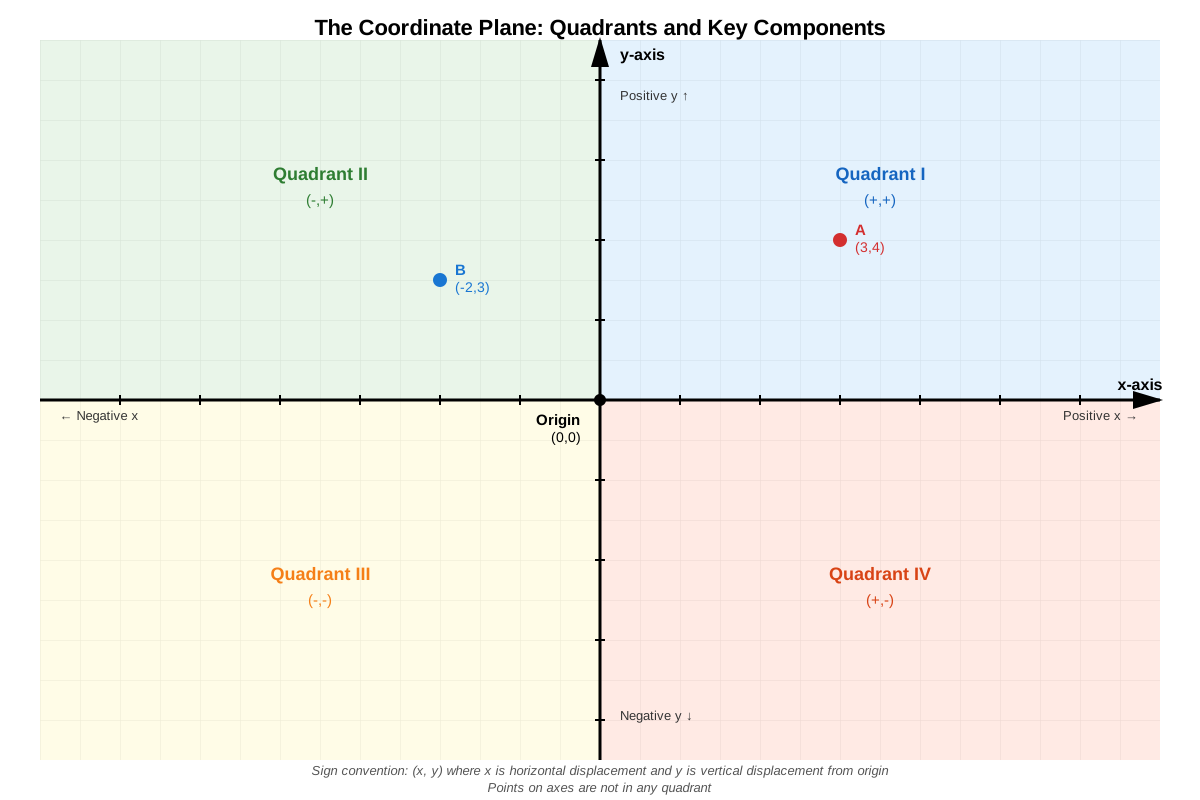
The coordinate plane consists of two perpendicular number lines: the horizontal x-axis and the vertical y-axis, intersecting at the origin (0, 0). Every point on the plane is uniquely identified by an ordered pair (x, y), where x represents the horizontal displacement from the origin and y represents the vertical displacement. The plane is divided into four quadrants: Quadrant I (x > 0, y > 0), Quadrant II (x < 0, y > 0), Quadrant III (x < 0, y < 0), and Quadrant IV (x > 0, y < 0).
Understanding quadrant properties is crucial for GMAT questions. Points on the axes themselves are not in any quadrant: points on the x-axis have y-coordinate 0, while points on the y-axis have x-coordinate 0. The signs of coordinates determine geometric properties and relationships, particularly when analyzing distances, slopes, and regions defined by inequalities.
Distance Formula
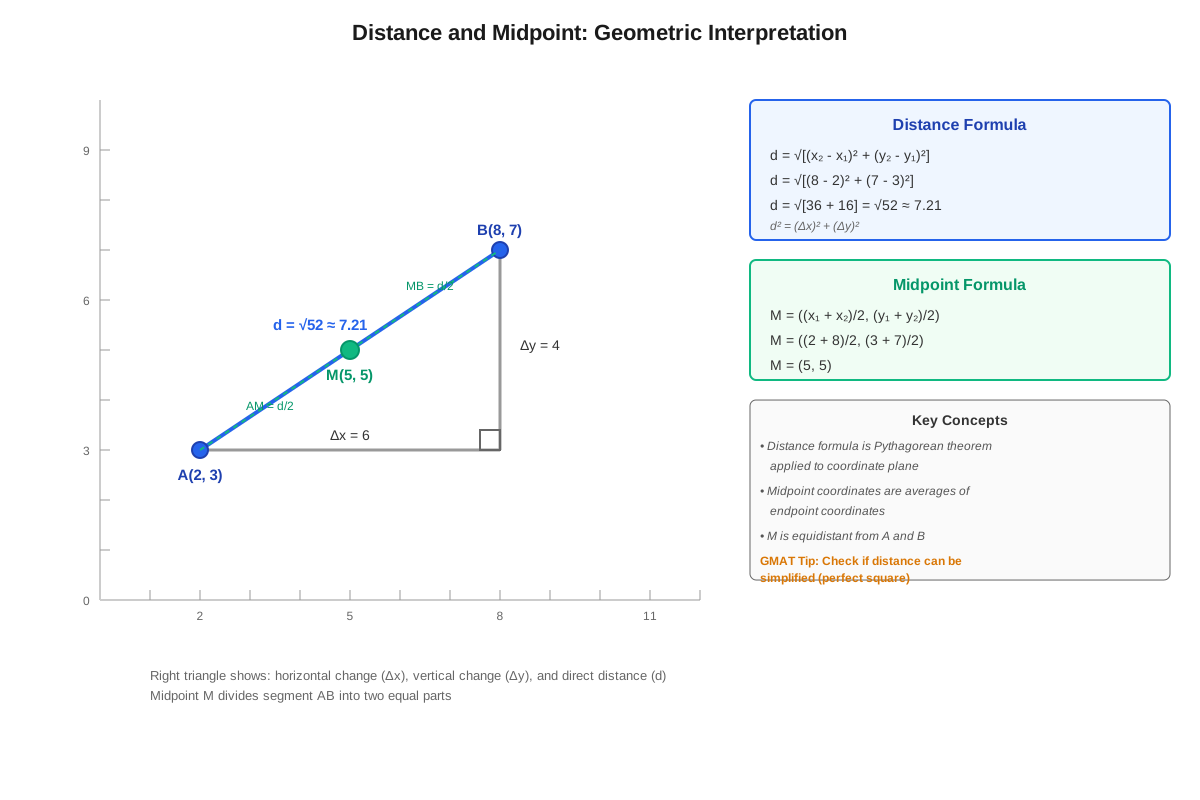
The distance formula calculates the straight-line distance between two points (x₁, y₁) and (x₂, y₂):
d = √[(x₂ - x₁)² + (y₂ - y₁)²]This formula derives from the Pythagorean theorem, treating the horizontal and vertical distances as legs of a right triangle. The distance is always positive (or zero if the points are identical) and represents the shortest path between two points.
Key applications include:
- Determining whether points are equidistant from a reference point (circle problems)
- Calculating perimeters of polygons given vertices
- Finding the radius of a circle when given center and a point on the circle
- Verifying geometric properties like isosceles triangles (two equal sides)
For horizontal or vertical distances, the formula simplifies: between (x₁, y) and (x₂, y), distance = |x₂ - x₁|; between (x, y₁) and (x, y₂), distance = |y₂ - y₁|.
Midpoint Formula
The midpoint formula finds the point exactly halfway between two points (x₁, y₁) and (x₂, y₂):
M = ((x₁ + x₂)/2, (y₁ + y₂)/2)The midpoint coordinates are simply the averages of the respective coordinates. This concept extends to finding any point that divides a line segment in a given ratio, though the basic midpoint (1:1 ratio) is most commonly tested on the GMAT.
Strategic uses include:
- Finding the center of a circle given endpoints of a diameter
- Determining missing vertices of parallelograms (diagonals bisect each other)
- Solving problems involving symmetric points across a line
- Working backward from a midpoint to find unknown endpoints
Slope of a Line
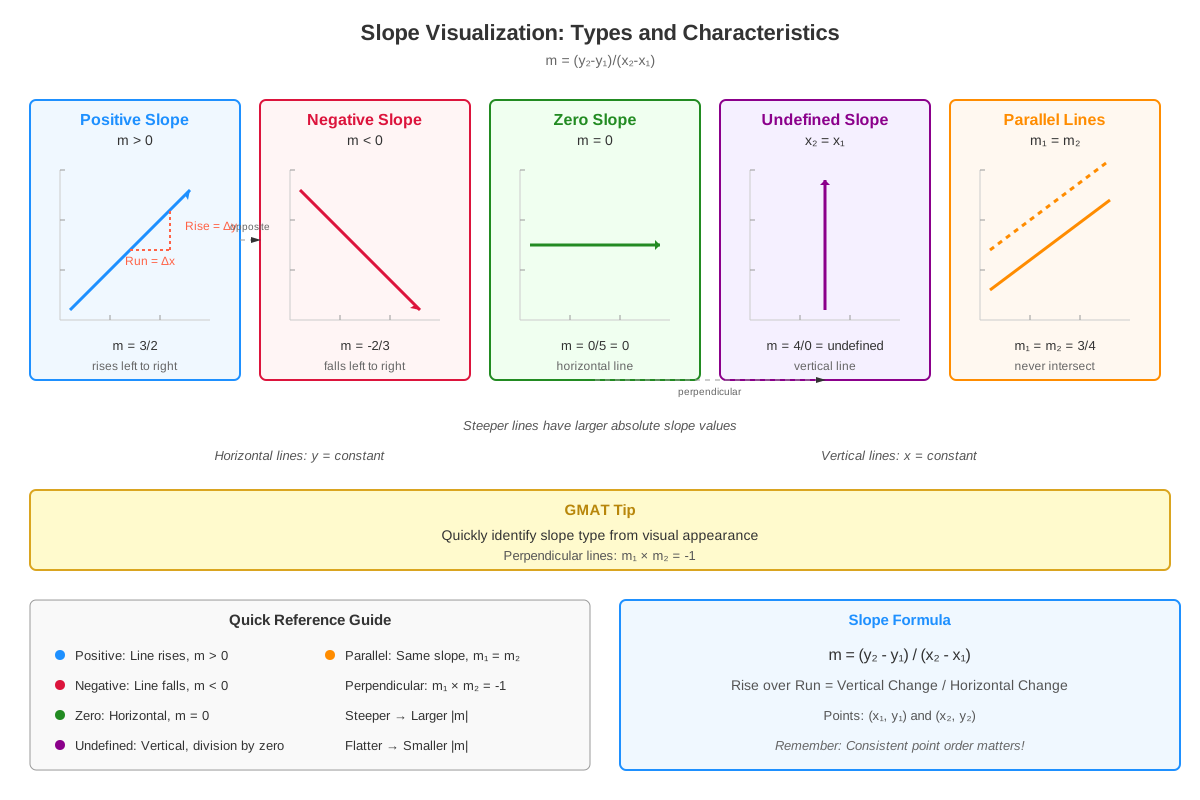
The slope (m) of a line through points (x₁, y₁) and (x₂, y₂) measures the rate of vertical change per unit of horizontal change:
m = (y₂ - y₁)/(x₂ - x₁) = rise/runSlope interpretation is critical:
- Positive slope: line rises from left to right
- Negative slope: line falls from left to right
- Zero slope: horizontal line (y₂ = y₁)
- Undefined slope: vertical line (x₂ = x₁)
The magnitude of the slope indicates steepness: larger absolute values mean steeper lines. A slope of 1 means a 45-degree angle with the x-axis (rising one unit vertically for each unit horizontally).
Parallel and Perpendicular Lines
Parallel lines have identical slopes (m₁ = m₂) and never intersect. This property is frequently tested in questions asking whether lines are parallel or in problems involving parallelograms and trapezoids.
Perpendicular lines have slopes that are negative reciprocals: if one line has slope m, a perpendicular line has slope -1/m (provided neither is vertical). Equivalently, the product of perpendicular slopes equals -1: m₁ × m₂ = -1. This relationship is essential for problems involving rectangles, squares, and right triangles on the coordinate plane.
Equations of Lines
Lines can be expressed in multiple forms, each useful for different purposes:
| Form | Equation | Best Used When |
|---|---|---|
| Slope-intercept | y = mx + b | Slope (m) and y-intercept (b) are known or needed |
| Point-slope | y - y₁ = m(x - x₁) | Slope and one point are known |
| Standard form | Ax + By = C | Working with intercepts or integer coefficients |
| Two-point form | (y - y₁)/(y₂ - y₁) = (x - x₁)/(x₂ - x₁) | Two points are given |
The y-intercept is the point where the line crosses the y-axis (x = 0), giving the point (0, b). The x-intercept is where the line crosses the x-axis (y = 0), found by solving for x when y = 0.
Converting between forms is a valuable skill. To convert from standard form Ax + By = C to slope-intercept form, solve for y: y = (-A/B)x + C/B, revealing slope m = -A/B and y-intercept b = C/B.
Graphing Linear Inequalities
Linear inequalities define regions of the coordinate plane. The inequality y > mx + b represents all points above the line y = mx + b (not including the line itself), while y < mx + b represents points below the line. Using ≥ or ≤ includes the boundary line itself.
For inequalities in standard form:
- Ax + By > C: region on one side of the line Ax + By = C
- Test a point (often the origin if not on the line) to determine which side satisfies the inequality
Shaded regions and boundary lines (solid for ≤/≥, dashed for ) are common in GMAT diagrams. Questions may ask about points within regions, intersection of multiple inequality regions, or optimization within constrained areas.
Special Coordinate Geometry Figures
Circles on the coordinate plane have the equation:
(x - h)² + (y - k)² = r²where (h, k) is the center and r is the radius. This derives from the distance formula: all points (x, y) at distance r from center (h, k) satisfy this equation.
Triangles given by three vertices can be analyzed for:
- Area using the coordinate formula: Area = ½|x₁(y₂ - y₃) + x₂(y₃ - y₁) + x₃(y₁ - y₂)|
- Type (right, isosceles, equilateral) using distance and slope calculations
- Collinearity of points (area = 0 if three points are collinear)
Rectangles and squares are identified by perpendicular sides and equal side lengths (for squares). The diagonals of rectangles bisect each other, and for squares, diagonals are equal in length and perpendicular.
Concept Relationships
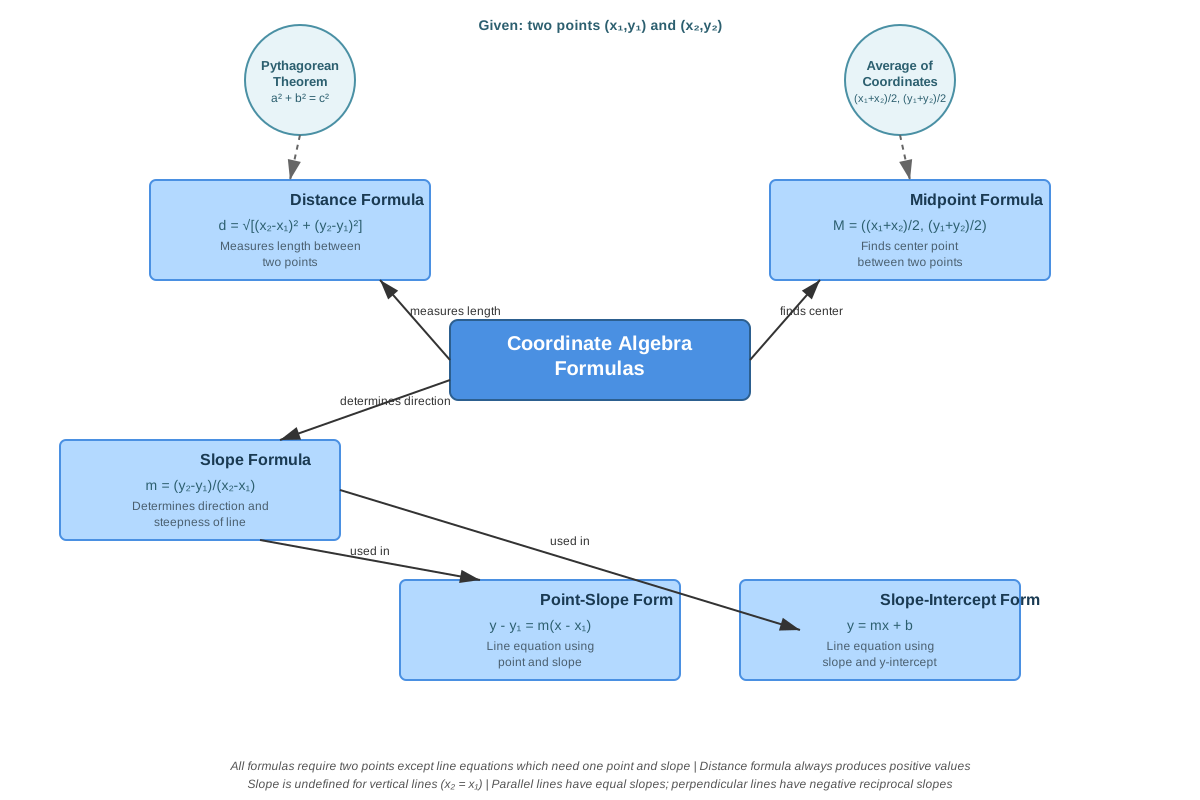
Coordinate algebra concepts form an interconnected web where each element builds upon and reinforces others. The coordinate plane serves as the foundational structure upon which all other concepts rest. Points on this plane are connected by line segments, whose properties are quantified through the distance formula and midpoint formula. These formulas rely on the Pythagorean theorem and averaging, respectively, demonstrating how coordinate algebra synthesizes geometric and algebraic thinking.
The slope concept emerges naturally from comparing two points and leads directly to understanding line equations. Slope determines whether lines are parallel (equal slopes) or perpendicular (negative reciprocal slopes), which in turn affects the properties of geometric figures. Line equations in various forms provide different strategic advantages: slope-intercept form immediately reveals slope and y-intercept, while standard form facilitates finding both intercepts quickly.
The progression flows: Points → Distance/Midpoint → Slope → Line Equations → Geometric Figures. Each concept enables analysis of increasingly complex structures. For example, determining whether a quadrilateral is a rectangle requires calculating slopes (to verify perpendicular sides) and distances (to verify opposite sides are equal), then potentially using midpoint formulas to verify that diagonals bisect each other.
Coordinate algebra also connects to prerequisite topics: linear equations provide the algebraic manipulation skills needed for deriving line equations and solving for coordinates; geometry supplies the spatial reasoning and figure properties that coordinate algebra quantifies; exponent rules enable working with the distance formula's squared terms. Moving forward, coordinate algebra enables study of functions and graphs, conic sections, and transformations—all topics that extend coordinate concepts to more sophisticated applications.
Quick check — test yourself on Coordinate algebra so far.
Try Flashcards →High-Yield Facts
⭐ The distance between points (x₁, y₁) and (x₂, y₂) is √[(x₂ - x₁)² + (y₂ - y₁)²]
⭐ The midpoint of a segment with endpoints (x₁, y₁) and (x₂, y₂) is ((x₁ + x₂)/2, (y₁ + y₂)/2)
⭐ The slope of a line through (x₁, y₁) and (x₂, y₂) is m = (y₂ - y₁)/(x₂ - x₁)
⭐ Parallel lines have equal slopes; perpendicular lines have slopes whose product is -1
⭐ The slope-intercept form of a line is y = mx + b, where m is slope and b is the y-intercept
- A horizontal line has slope 0 and equation y = k; a vertical line has undefined slope and equation x = h
- The x-intercept is found by setting y = 0; the y-intercept is found by setting x = 0
- Three points are collinear if and only if the slope between any two pairs is identical
- The equation of a circle with center (h, k) and radius r is (x - h)² + (y - k)² = r²
- In Quadrant I, both coordinates are positive; in Quadrant II, x is negative and y is positive; in Quadrant III, both are negative; in Quadrant IV, x is positive and y is negative
- The distance from a point to the origin (0, 0) is √(x² + y²)
- For a line in standard form Ax + By = C, the slope is -A/B (when B ≠ 0)
- The diagonals of a rectangle bisect each other at their midpoint
- If two lines are perpendicular and one has slope m, the other has slope -1/m (provided m ≠ 0)
- The area of a triangle with vertices at (x₁, y₁), (x₂, y₂), and (x₃, y₃) can be calculated using the coordinate formula without finding base and height separately
Common Misconceptions
Misconception: The distance formula can be applied without considering absolute value, so distance can be negative.
Correction: Distance is always non-negative. The distance formula includes squaring (which eliminates negative signs) followed by taking the square root, ensuring a positive result. The formula automatically handles the absolute value through this process.
Misconception: The slope formula is (x₂ - x₁)/(y₂ - y₁).
Correction: The slope formula is (y₂ - y₁)/(x₂ - x₁)—rise over run, not run over rise. The vertical change (y-values) goes in the numerator, and the horizontal change (x-values) goes in the denominator. Reversing this produces the reciprocal of the actual slope.
Misconception: Perpendicular lines have slopes that are opposite in sign but equal in magnitude.
Correction: Perpendicular lines have slopes that are negative reciprocals, not just opposite signs. If one line has slope 2, a perpendicular line has slope -1/2, not -2. The relationship is m₁ × m₂ = -1.
Misconception: The midpoint formula requires taking the square root like the distance formula.
Correction: The midpoint formula simply averages the x-coordinates and y-coordinates separately: ((x₁ + x₂)/2, (y₁ + y₂)/2). No square roots are involved. Students sometimes confuse this with the distance formula's structure.
Misconception: A line with equation x = 5 has slope 0.
Correction: A vertical line (x = constant) has undefined slope, not zero slope. The slope formula would require dividing by zero (since x₂ - x₁ = 0), which is undefined. Horizontal lines (y = constant) have slope 0.
Misconception: Points on the axes are in Quadrant I or another quadrant.
Correction: Points on the x-axis or y-axis are not in any quadrant. Only points with both coordinates non-zero belong to quadrants. The point (3, 0) is on the x-axis, not in Quadrant I or IV.
Misconception: The y-intercept of a line is the x-coordinate where the line crosses the y-axis.
Correction: The y-intercept is the y-coordinate (or the point itself) where the line crosses the y-axis. For the line y = 2x + 3, the y-intercept is 3 (or the point (0, 3)), not 0.
Worked Examples
Example 1: Multi-Concept Problem Solving
Question: Point A is at (2, 5) and point B is at (8, 13). Point C is the midpoint of segment AB. What is the distance from point C to the origin?
Solution:
Step 1: Find the coordinates of point C using the midpoint formula.
The midpoint formula states that for endpoints (x₁, y₁) and (x₂, y₂), the midpoint is:
M = ((x₁ + x₂)/2, (y₁ + y₂)/2)Applying this to points A(2, 5) and B(8, 13):
C = ((2 + 8)/2, (5 + 13)/2) = (10/2, 18/2) = (5, 9)Step 2: Calculate the distance from C(5, 9) to the origin O(0, 0).
Using the distance formula:
d = √[(x₂ - x₁)² + (y₂ - y₁)²]
d = √[(5 - 0)² + (9 - 0)²]
d = √[25 + 81]
d = √106Answer: The distance from point C to the origin is √106 (approximately 10.3).
Connection to learning objectives: This problem requires identifying coordinate algebra concepts (midpoint and distance), explaining their application, and applying formulas systematically—demonstrating mastery of all three primary learning objectives.
Example 2: Data Sufficiency with Lines
Question: Line L passes through point P(3, 7). Is line L perpendicular to the line with equation y = 2x + 5?
Statement (1): Line L passes through point Q(5, 3).
Statement (2): Line L has a y-intercept of 13.
Solution:
Step 1: Determine what information is needed.
For line L to be perpendicular to y = 2x + 5, line L must have a slope that is the negative reciprocal of 2. Since the given line has slope m = 2, line L must have slope m = -1/2 for the lines to be perpendicular.
Step 2: Evaluate Statement (1).
Statement (1) provides a second point Q(5, 3) on line L. With two points P(3, 7) and Q(5, 3), we can calculate the slope:
m = (y₂ - y₁)/(x₂ - x₁) = (3 - 7)/(5 - 3) = -4/2 = -2Line L has slope -2, not -1/2, so line L is NOT perpendicular to the given line. Statement (1) alone is SUFFICIENT to answer the question (the answer is "no").
Step 3: Evaluate Statement (2).
Statement (2) tells us the y-intercept is 13, meaning line L passes through (0, 13). Combined with point P(3, 7), we can calculate the slope:
m = (7 - 13)/(3 - 0) = -6/3 = -2Again, line L has slope -2, so it is NOT perpendicular to the given line. Statement (2) alone is also SUFFICIENT.
Answer: D (Each statement alone is sufficient)
Strategic insight: In data sufficiency problems involving lines, recognize that determining a line's slope requires either (1) two points on the line, or (2) one point and the y-intercept (which is itself a point), or (3) one point and the slope directly stated. Both statements provided enough information to calculate the slope, making each sufficient independently.
Exam Strategy
When approaching GMAT coordinate algebra questions, begin by identifying what the question asks for: a distance, a slope, coordinates of a point, an equation, or a geometric property. This determines which formulas and concepts to deploy. Sketch a quick coordinate plane diagram when possible—visual representation often reveals relationships that pure algebra might obscure, especially for questions involving multiple points or geometric figures.
Trigger words and phrases to recognize include:
- "Distance between" → distance formula
- "Midpoint," "halfway," "center" → midpoint formula
- "Slope," "rate of change," "steepness" → slope formula
- "Parallel" → equal slopes
- "Perpendicular," "right angle" → negative reciprocal slopes
- "Equation of the line" → determine appropriate form based on given information
- "Passes through" → substitute point coordinates into equation
- "Intercept" → set x or y to zero
- "Collinear" → check if slopes between point pairs are equal
For data sufficiency questions, systematically determine what information would be sufficient before evaluating the statements. For line problems, remember that a unique line is determined by either two points, or one point and a slope. For distance problems, you need coordinates of both points. For circle problems, you need the center and radius (or center and one point on the circle).
Process-of-elimination strategies:
- If a question involves perpendicular lines and an answer choice shows slopes that aren't negative reciprocals, eliminate it immediately
- For distance calculations, eliminate any negative answer choices (distance is always non-negative)
- If asked about quadrants and an answer choice contradicts the signs of coordinates, eliminate it
- When finding midpoints, the result must have coordinates between the original points' coordinates
Time allocation: Straightforward formula application questions (distance, midpoint, slope) should take 1-1.5 minutes. Multi-step problems combining several concepts may require 2-2.5 minutes. For data sufficiency, spend 30-45 seconds understanding what's sufficient before evaluating statements. If a problem requires extensive calculation, check whether estimation or answer choice comparison can save time—GMAT often designs questions where exact calculation isn't necessary.
Common shortcuts:
- For horizontal or vertical distances, skip the full distance formula and use simple subtraction
- When checking perpendicularity, multiply slopes—if the product is -1, they're perpendicular
- For midpoints, recognize that the midpoint's coordinates are always between the endpoints' coordinates
- If three points form a right triangle, verify using slopes (perpendicular sides) rather than calculating all three distances
Memory Techniques
Distance Formula Mnemonic: "Difference Squared Summed Square-rooted" (DSSS)
- Difference: subtract coordinates (x₂ - x₁) and (y₂ - y₁)
- Squared: square both differences
- Summed: add the squared differences
- Square-rooted: take the square root of the sum
Midpoint Memory: "Average Everything" (AE)
- Simply average the x-coordinates and average the y-coordinates separately
- Think: "meeting in the middle means averaging"
Slope Visualization: "You Rise X-tra Run"
- You Rise: y-values go in the numerator (rise)
- X-tra Run: x-values go in the denominator (run)
- Visual: imagine climbing stairs—rise (vertical) over run (horizontal)
Perpendicular Slopes: "Flip and Negate" (FN)
- Flip: take the reciprocal (2 becomes 1/2)
- Negate: change the sign (1/2 becomes -1/2)
- Or remember: "perpendicular slopes multiply to negative one"
Quadrant Signs: Use the acronym "All Students Take Calculus" moving counterclockwise from Quadrant I:
- All (Quadrant I): All coordinates positive (+, +)
- Students (Quadrant II): Sine positive, meaning y positive (-, +)
- Take (Quadrant III): Tangent positive, but both coordinates negative (-, -)
- Calculus (Quadrant IV): Cosine positive, meaning x positive (+, -)
Line Forms: "Slope Intercept is Simple" vs. "Point Slope Precise"
- Slope Intercept (y = mx + b): Simple when you know slope and y-intercept
- Point Slope (y - y₁ = m(x - x₁)): Precise when you have a point and slope
Summary
Coordinate algebra integrates algebraic techniques with geometric visualization on the xy-coordinate plane, providing powerful tools for analyzing points, lines, distances, and shapes. Mastery requires fluency with core formulas: the distance formula √[(x₂ - x₁)² + (y₂ - y₁)²] for calculating lengths, the midpoint formula ((x₁ + x₂)/2, (y₁ + y₂)/2) for finding centers, and the slope formula (y₂ - y₁)/(x₂ - x₁) for determining line steepness and direction. Understanding line equations in multiple forms—particularly slope-intercept (y = mx + b) and point-slope (y - y₁ = m(x - x₁))—enables efficient problem-solving across diverse question types. Critical relationships include parallel lines having equal slopes and perpendicular lines having slopes that multiply to -1. GMAT questions frequently test these concepts in combination, requiring test-takers to move fluidly between calculating coordinates, determining line properties, and analyzing geometric figures. Success depends on recognizing which formulas apply to each situation, executing calculations accurately, and leveraging strategic shortcuts when appropriate. The ability to visualize coordinate relationships while applying algebraic precision distinguishes high-performing test-takers on these medium-to-high difficulty questions.
Key Takeaways
- Coordinate algebra combines algebraic formulas with geometric visualization, requiring both computational accuracy and spatial reasoning skills
- Three essential formulas form the foundation: distance formula for lengths, midpoint formula for centers, and slope formula for line properties
- Parallel lines share identical slopes; perpendicular lines have slopes that are negative reciprocals (product equals -1)
- Line equations appear in multiple forms, each optimal for different given information—know when to use slope-intercept, point-slope, or standard form
- Quadrant analysis and coordinate signs provide quick insights into point locations and geometric properties
- GMAT questions often combine multiple coordinate concepts in single problems, requiring systematic multi-step approaches
- Visual sketching and strategic formula selection significantly improve both accuracy and speed on coordinate algebra questions
Related Topics
Functions and Graphs: Coordinate algebra provides the foundation for understanding function notation, domain and range, and graphical transformations. Mastering coordinate concepts enables analysis of more complex function behaviors and relationships.
Conic Sections: Circles, parabolas, ellipses, and hyperbolas extend coordinate algebra to curved figures, using similar distance-based definitions and algebraic equations. The circle equation builds directly on coordinate distance concepts.
Systems of Linear Equations: Finding intersection points of lines requires solving systems of equations, combining coordinate algebra with algebraic solution techniques. This topic deepens understanding of how multiple linear relationships interact.
Vectors and Transformations: Advanced coordinate algebra includes vector representations of points and lines, plus transformations like translations, rotations, and reflections—all described using coordinate operations.
Optimization Problems: Many GMAT optimization questions involve coordinate constraints, using coordinate algebra to model and solve problems about maximum distances, minimum perimeters, or optimal locations.
Practice CTA
Now that you've mastered the core concepts of coordinate algebra, it's time to solidify your understanding through active practice. Attempt the practice questions designed specifically for this topic, focusing on applying the formulas and strategies you've learned. Work through problems systematically, sketching diagrams when helpful and checking your work against the solution explanations. Use the flashcards to reinforce key formulas, relationships, and common question patterns until they become automatic. Remember: coordinate algebra questions reward both conceptual understanding and computational precision—practice builds both. Each problem you solve strengthens your pattern recognition and increases your confidence for test day. You've got this!
Sign up free to keep reading
Create a free AnvayaPrep account to finish this GMAT guide on Coordinate algebra — plus flashcards and practice questions.