Overview
Exponential equations are algebraic expressions in which variables appear in the exponent position, such as 2^x = 8 or 3^(2x+1) = 27. These equations form a critical component of the GMAT Quantitative Reasoning section, appearing regularly in both Problem Solving and Data Sufficiency questions. Understanding how to manipulate and solve exponential equations efficiently is essential for achieving a competitive score, as these problems test not only computational skills but also pattern recognition and strategic thinking under time pressure.
The GMAT frequently tests exponential equations because they assess multiple mathematical competencies simultaneously: understanding of exponent rules, ability to recognize equivalent forms, algebraic manipulation skills, and logical reasoning. Questions involving GMAT exponential equations often appear in medium to high-difficulty ranges and can significantly impact overall performance. These problems may be presented as straightforward solve-for-x scenarios, embedded within word problems involving growth and decay, or disguised within Data Sufficiency questions where recognizing exponential relationships becomes crucial.
Exponential equations connect deeply with other Quantitative Reasoning concepts including properties of exponents, logarithms, sequences and series, and functions. They serve as a bridge between basic algebra and more advanced mathematical reasoning, requiring students to apply multiple algebraic principles simultaneously. Mastery of this topic enhances problem-solving efficiency across various GMAT question types and demonstrates the mathematical maturity that business schools value.
Learning Objectives
- [ ] Identify exponential equations in various forms and contexts
- [ ] Explain the fundamental properties and characteristics of exponential equations
- [ ] Apply exponential equations to solve GMAT questions efficiently
- [ ] Convert exponential equations to common bases to facilitate solution
- [ ] Recognize when exponential equations require special techniques versus standard algebraic approaches
- [ ] Evaluate Data Sufficiency statements involving exponential relationships
- [ ] Distinguish between exponential growth and decay patterns in applied contexts
Prerequisites
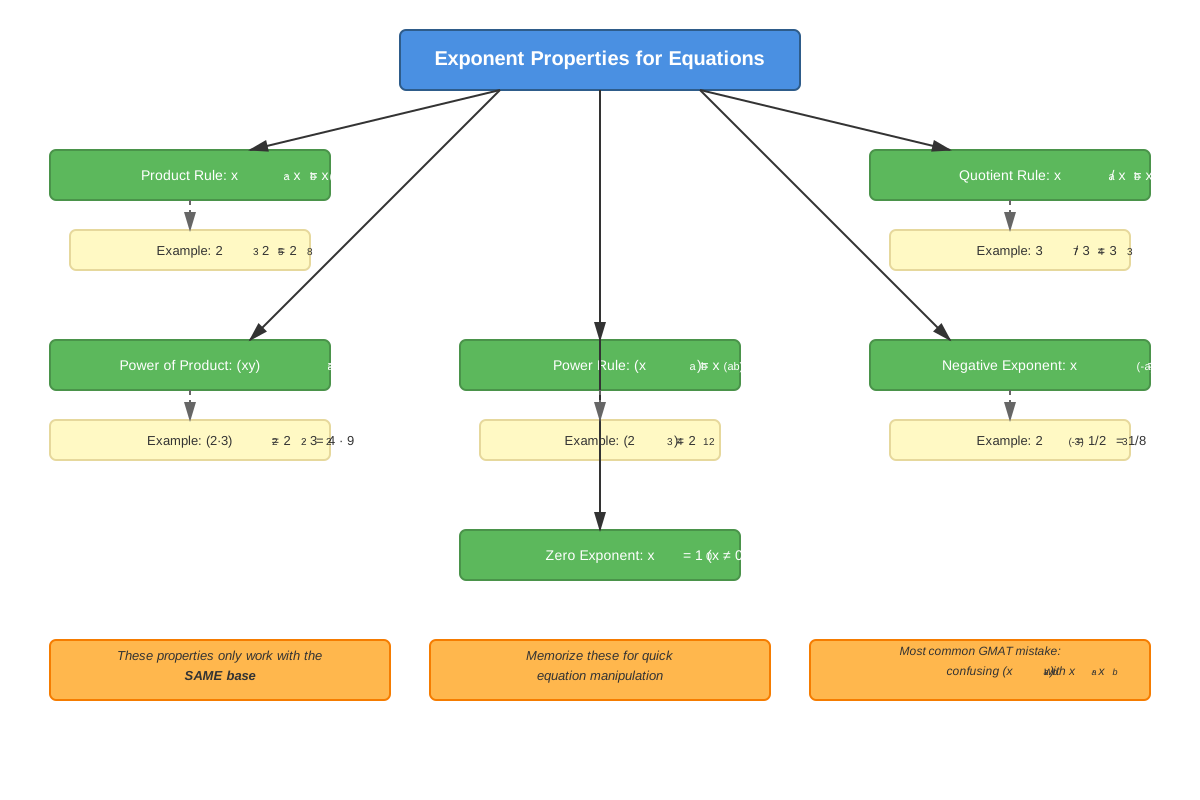
- Properties of exponents: Understanding rules such as x^a · x^b = x^(a+b) and (x^a)^b = x^(ab) is fundamental to manipulating exponential equations
- Basic algebra: Solving linear and quadratic equations provides the foundation for isolating variables in exponential contexts
- Integer operations: Facility with positive and negative integers, fractions, and zero as exponents is necessary for recognizing equivalent exponential forms
- Factoring skills: Recognizing common factors and prime factorization enables conversion to common bases
- Order of operations: Proper sequencing of mathematical operations ensures accurate simplification of complex exponential expressions
Why This Topic Matters
Exponential equations appear in approximately 8-12% of GMAT Quantitative Reasoning questions, making them a high-yield topic for focused study. These questions typically fall in the 600-750 difficulty range, meaning they significantly influence scores for students targeting top business schools. The GMAT tests exponential equations through multiple question formats: direct algebraic problems requiring solution for a variable, word problems involving compound growth or decay, comparison questions testing understanding of exponential behavior, and Data Sufficiency questions where recognizing exponential relationships determines sufficiency.
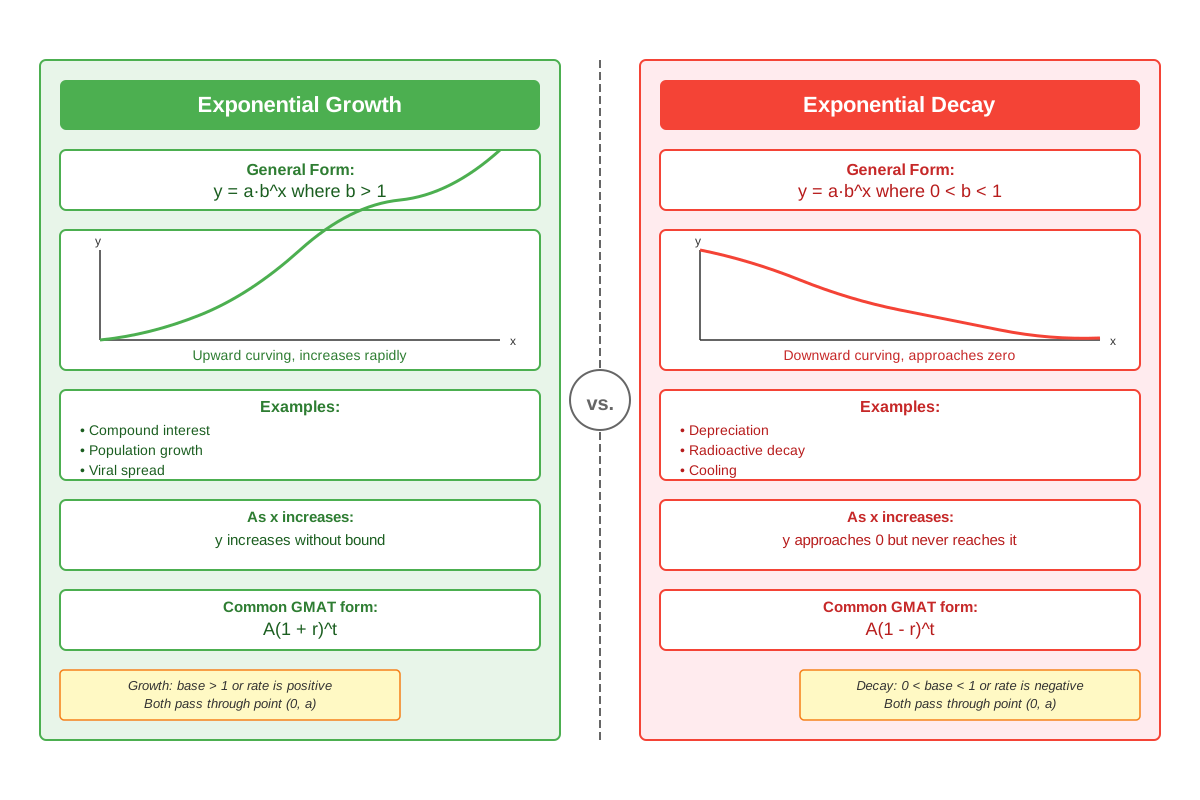
In real-world business contexts, exponential equations model critical phenomena including compound interest calculations, population growth projections, viral marketing spread, depreciation schedules, and investment returns. Business professionals regularly encounter exponential relationships when analyzing growth rates, forecasting trends, and making strategic decisions. The GMAT's emphasis on exponential equations reflects their practical importance in business analytics and quantitative decision-making.
Common GMAT presentations include: solving for an unknown exponent (2^x = 32), solving for an unknown base (x^3 = 125), equations with variables in both base and exponent positions, systems involving multiple exponential expressions, and word problems requiring translation of verbal descriptions into exponential equations. Recognition of these patterns accelerates problem-solving and improves accuracy under time constraints.
Core Concepts
Definition and Structure of Exponential Equations
An exponential equation is any equation in which the variable appears in an exponent position. The general form is b^x = c, where b is the base (a positive real number not equal to 1), x is the exponent containing the variable, and c is a constant. Unlike polynomial equations where variables appear in the base with constant exponents, exponential equations reverse this relationship, creating fundamentally different solution approaches.
The key characteristic distinguishing exponential equations from other algebraic equations is the variable's position in the exponent. This positioning means that changes in the variable produce multiplicative rather than additive effects on the equation's value, creating the characteristic rapid growth or decay behavior of exponential functions. Understanding this structural difference is crucial for selecting appropriate solution strategies.
Fundamental Solution Strategy: Common Base Method
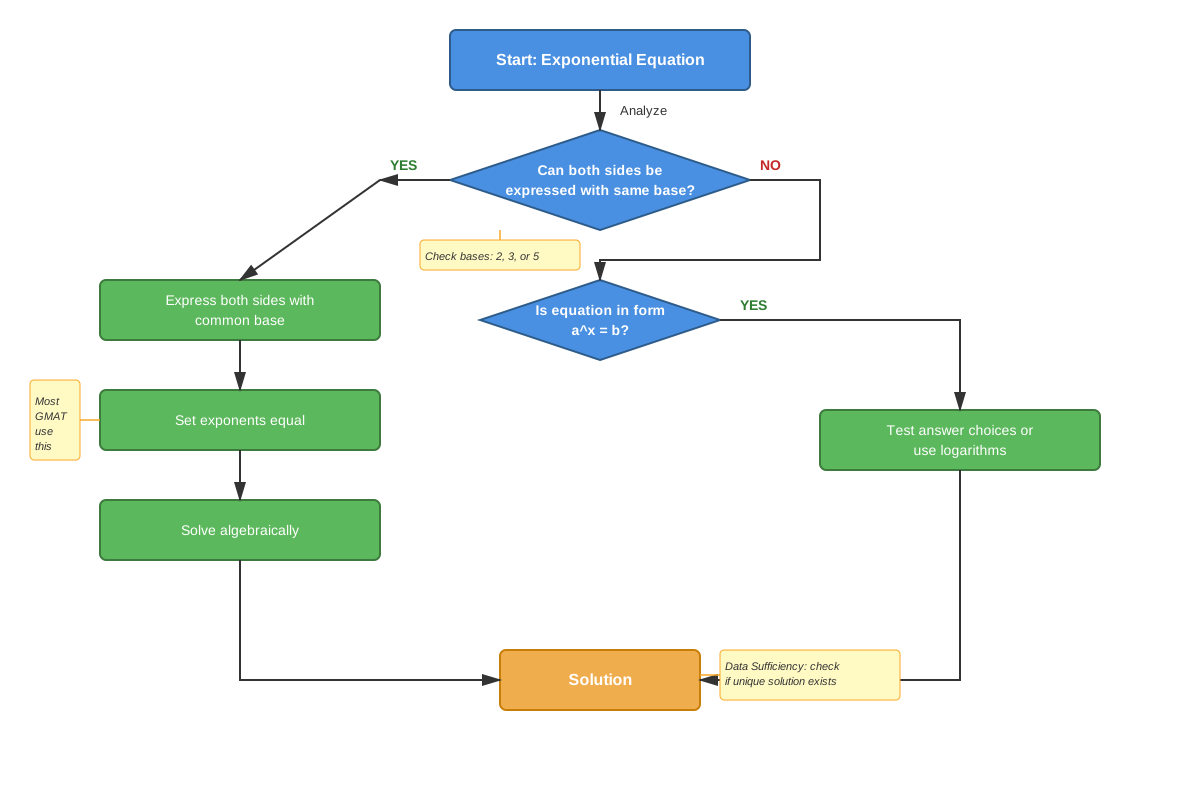
The most powerful technique for solving exponential equations involves expressing both sides of the equation using the same base. When both sides share a common base, the exponents must be equal, transforming the exponential equation into a simpler algebraic equation. For example, if 2^(3x) = 2^9, then 3x = 9, yielding x = 3.
The common base method follows these steps:
- Identify whether both sides can be expressed as powers of the same base
- Rewrite each side using that common base
- Apply the principle that if b^m = b^n (where b > 0 and b ≠ 1), then m = n
- Solve the resulting algebraic equation for the variable
- Verify the solution in the original equation
This method works efficiently for equations like 4^x = 64 (rewrite as 2^(2x) = 2^6, giving 2x = 6, so x = 3) or 27^(x-1) = 9^(2x) (rewrite as 3^(3(x-1)) = 3^(4x), giving 3x - 3 = 4x, so x = -3).
Prime Factorization and Base Conversion
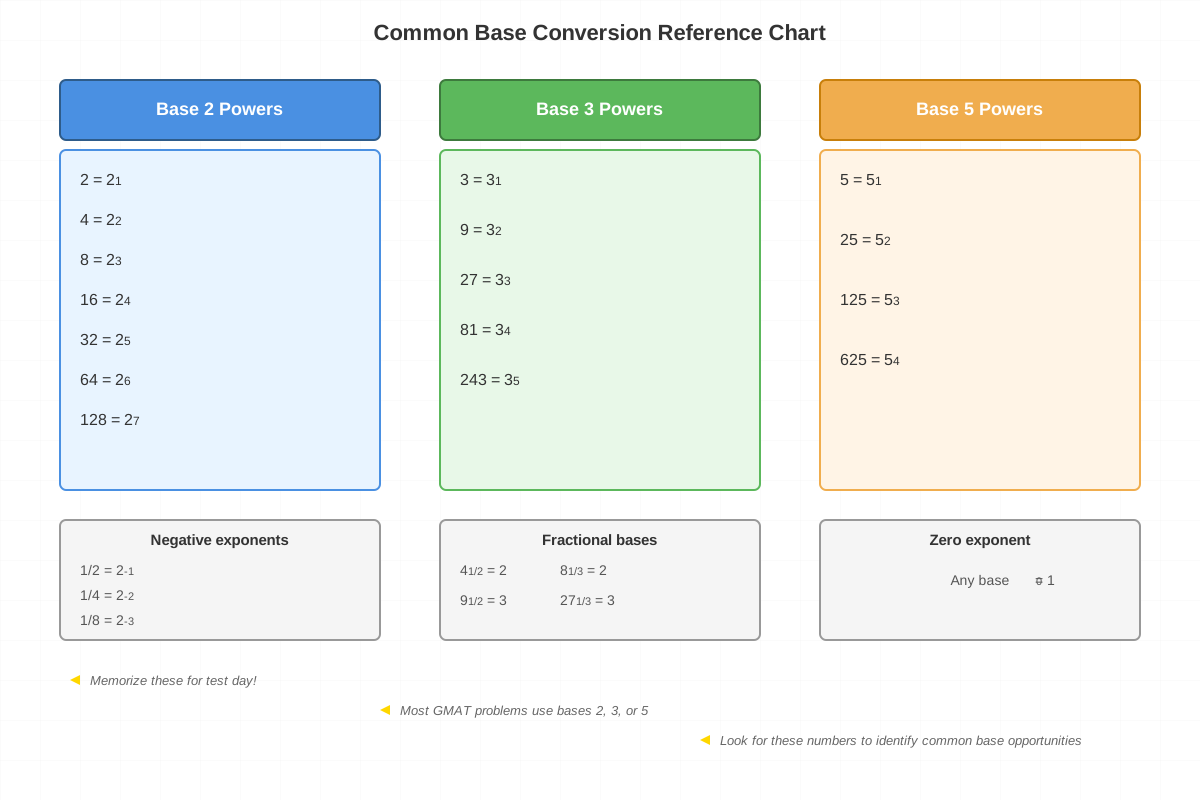
Recognizing that numbers can be expressed as powers of prime factors is essential for applying the common base method. The GMAT frequently uses numbers that are powers of small primes (2, 3, 5, 7) to make common base conversion possible. For instance, 8 = 2^3, 16 = 2^4, 32 = 2^5, 9 = 3^2, 27 = 3^3, 81 = 3^4, 25 = 5^2, and 125 = 5^3.
When encountering an exponential equation, immediately factor both sides to identify potential common bases. Consider 8^(x+2) = 32^(x-1). Rewriting: (2^3)^(x+2) = (2^5)^(x-1), which simplifies to 2^(3x+6) = 2^(5x-5). Setting exponents equal: 3x + 6 = 5x - 5, yielding 11 = 2x, so x = 11/2.
Special Cases and Patterns
Several special exponential patterns appear frequently on the GMAT:
Zero exponent: Any non-zero base raised to the zero power equals 1 (b^0 = 1). This principle helps solve equations like 5^(2x-4) = 1, which immediately gives 2x - 4 = 0, so x = 2.
Negative exponents: A negative exponent indicates reciprocal (b^(-n) = 1/b^n). Equations like 2^x = 1/8 can be rewritten as 2^x = 2^(-3), giving x = -3.
Fractional exponents: Fractional exponents represent roots (b^(1/n) = ⁿ√b). The equation x^(1/2) = 5 means √x = 5, so x = 25.
Exponential equations equal to 1: Since any base to the zero power equals 1, if b^f(x) = 1, then either f(x) = 0 or b = 1 (though b = 1 is typically excluded).
Equations with Different Bases
When exponential equations involve bases that cannot be converted to a common base, alternative approaches become necessary. For equations like 2^x = 3, exact algebraic solutions require logarithms (beyond typical GMAT scope), but the GMAT may ask for approximate values or comparisons rather than exact solutions.
The GMAT more commonly presents equations where strategic manipulation reveals a common base. For instance, 6^x = 36 might initially seem to involve base 6, but recognizing 36 = 6^2 allows immediate solution: x = 2. Similarly, (1/4)^x = 16 can be rewritten as 4^(-x) = 4^2, giving -x = 2, so x = -2.
Systems of Exponential Equations
The GMAT occasionally presents systems involving multiple exponential equations. These require combining equations strategically to eliminate variables or create solvable relationships. For example:
2^x · 3^y = 72
2^x = 8
From the second equation, x = 3. Substituting into the first: 8 · 3^y = 72, so 3^y = 9, giving y = 2.
Exponential Equations in Word Problems
Applied problems often describe exponential growth or decay situations requiring equation setup and solution. Key phrases include "doubles every," "triples each," "grows by a factor of," "decays by half," and "compounds." For example: "A population doubles every 3 years. If the initial population is 1000, after how many years will it reach 8000?" This translates to 1000 · 2^(t/3) = 8000, simplifying to 2^(t/3) = 8 = 2^3, giving t/3 = 3, so t = 9 years.
Concept Relationships
The core concepts within exponential equations form an interconnected hierarchy. Prime factorization serves as the foundation, enabling base conversion, which facilitates the common base method—the primary solution strategy. Understanding exponent properties (zero, negative, and fractional exponents) expands the range of equations solvable through common base approaches. These fundamental techniques then extend to systems of exponential equations and applied word problems.
Exponential equations connect backward to prerequisite topics: properties of exponents provide the manipulation rules necessary for base conversion and simplification; algebraic equation-solving skills apply once exponential equations are reduced to polynomial form; factoring enables recognition of common bases through prime decomposition.
Forward connections include logarithms (the inverse operation of exponentiation, occasionally tested on advanced GMAT questions), sequences and series (particularly geometric sequences where each term is an exponential function of position), and functions (exponential functions as a specific function family with unique properties).
Relationship map: Prime Factorization → Base Conversion → Common Base Method → Solution of Simple Exponential Equations → Systems of Exponential Equations → Applied Word Problems. Parallel path: Exponent Properties → Special Cases → Enhanced Solution Techniques.
High-Yield Facts
⭐ If b^m = b^n where b > 0 and b ≠ 1, then m = n (the fundamental principle for solving exponential equations with common bases)
⭐ Any non-zero number raised to the zero power equals 1 (b^0 = 1 for all b ≠ 0)
⭐ Common GMAT bases and their powers: 2^3=8, 2^4=16, 2^5=32, 3^2=9, 3^3=27, 3^4=81, 5^2=25, 5^3=125
⭐ Negative exponents indicate reciprocals: b^(-n) = 1/b^n
⭐ Fractional exponents represent roots: b^(1/n) = ⁿ√b and b^(m/n) = (ⁿ√b)^m
- When multiplying exponential expressions with the same base, add exponents: b^m · b^n = b^(m+n)
- When dividing exponential expressions with the same base, subtract exponents: b^m / b^n = b^(m-n)
- When raising a power to a power, multiply exponents: (b^m)^n = b^(mn)
- Exponential growth increases multiplicatively, not additively (doubling means multiplying by 2, not adding 2)
- If an exponential equation equals 1, the exponent must equal zero (assuming base ≠ 1)
- The equation b^x = c has exactly one solution when b > 0, b ≠ 1, and c > 0
- Exponential functions with base greater than 1 are always increasing; with base between 0 and 1, always decreasing
Quick check — test yourself on Exponential equations so far.
Try Flashcards →Common Misconceptions
Misconception: When solving 2^x = 8, students might write x = 8/2 = 4, treating the exponent like a coefficient. → Correction: Exponential equations require recognizing that 8 = 2^3, so x = 3. Division doesn't apply to exponents in this context; instead, express both sides with a common base.
Misconception: Believing that 2^3 · 2^4 = 2^12 by multiplying exponents when multiplying bases. → Correction: When multiplying expressions with the same base, add exponents: 2^3 · 2^4 = 2^(3+4) = 2^7 = 128. Multiplying exponents applies only when raising a power to a power: (2^3)^4 = 2^12.
Misconception: Thinking that (2^x)^3 = 2^(x+3) by adding exponents. → Correction: When raising a power to a power, multiply exponents: (2^x)^3 = 2^(3x). Addition of exponents applies when multiplying same-base expressions, not when raising to powers.
Misconception: Assuming that if 2^x = 2^y, then x and y could have different values. → Correction: If b^m = b^n where b > 0 and b ≠ 1, then m must equal n. This is the fundamental principle enabling the common base method. The exponential function is one-to-one for any fixed base.
Misconception: Believing that negative bases behave the same as positive bases in exponential equations. → Correction: Negative bases create complications because (-2)^x is not defined for all real x (e.g., (-2)^(1/2) involves imaginary numbers). The GMAT restricts exponential equation bases to positive real numbers not equal to 1.
Misconception: Thinking that 0^0 = 0 because "zero to any power is zero." → Correction: 0^0 is actually undefined (or defined as 1 in some contexts). While 0^n = 0 for positive n, the case of 0^0 is indeterminate. The GMAT avoids this edge case, but understanding that b^0 = 1 requires b ≠ 0 is important.
Misconception: Assuming exponential growth means "fast growth" without understanding the multiplicative nature. → Correction: Exponential growth specifically means growth by a constant factor over equal intervals. A quantity that "doubles every year" grows exponentially (multiplies by 2), while one that "increases by 100 every year" grows linearly (adds 100).
Worked Examples
Example 1: Common Base Method with Algebraic Manipulation
Problem: Solve for x: 4^(2x-1) = 8^(x+2)
Solution:
Step 1: Identify a common base. Both 4 and 8 are powers of 2 (4 = 2^2 and 8 = 2^3).
Step 2: Rewrite both sides using base 2:
- Left side: 4^(2x-1) = (2^2)^(2x-1) = 2^(2(2x-1)) = 2^(4x-2)
- Right side: 8^(x+2) = (2^3)^(x+2) = 2^(3(x+2)) = 2^(3x+6)
Step 3: The equation becomes 2^(4x-2) = 2^(3x+6)
Step 4: Since the bases are equal, set the exponents equal: 4x - 2 = 3x + 6
Step 5: Solve the linear equation:
- 4x - 3x = 6 + 2
- x = 8
Step 6: Verify by substituting x = 8 into the original equation:
- Left: 4^(2(8)-1) = 4^15
- Right: 8^(8+2) = 8^10 = (2^3)^10 = 2^30 = (2^2)^15 = 4^15 ✓
Connection to learning objectives: This example demonstrates identifying an exponential equation, applying the common base method, and using algebraic manipulation—core skills for GMAT exponential equation problems.
Example 2: Word Problem with Exponential Growth
Problem: A bacteria culture triples every 4 hours. If the culture starts with 200 bacteria, how many hours will it take for the population to reach 16,200?
Solution:
Step 1: Set up the exponential equation. If the population triples every 4 hours, after t hours, the population is:
- Population = 200 · 3^(t/4)
Step 2: Set this equal to the target population:
- 200 · 3^(t/4) = 16,200
Step 3: Simplify by dividing both sides by 200:
- 3^(t/4) = 81
Step 4: Express 81 as a power of 3:
- 81 = 3^4
Step 5: The equation becomes 3^(t/4) = 3^4
Step 6: Set exponents equal:
- t/4 = 4
Step 7: Solve for t:
- t = 16 hours
Step 8: Verify: After 16 hours, the population is 200 · 3^(16/4) = 200 · 3^4 = 200 · 81 = 16,200 ✓
Connection to learning objectives: This example shows how to translate a real-world exponential growth scenario into an exponential equation, then solve it using the common base method—a high-yield GMAT skill combining multiple competencies.
Example 3: Data Sufficiency with Exponential Equations
Problem: What is the value of x?
(1) 2^(x+3) = 32
(2) 3^x · 3^2 = 243
Solution:
Analyze Statement (1):
- 2^(x+3) = 32
- Express 32 as a power of 2: 32 = 2^5
- Therefore: 2^(x+3) = 2^5
- Setting exponents equal: x + 3 = 5
- Solving: x = 2
- Statement (1) alone is SUFFICIENT
Analyze Statement (2):
- 3^x · 3^2 = 243
- Apply exponent rule for multiplication: 3^(x+2) = 243
- Express 243 as a power of 3: 243 = 3^5
- Therefore: 3^(x+2) = 3^5
- Setting exponents equal: x + 2 = 5
- Solving: x = 3
- Statement (2) alone is SUFFICIENT
Answer: D (Each statement alone is sufficient)
Note: Both statements provide sufficient information but yield different values for x, which is acceptable in Data Sufficiency—each statement is evaluated independently.
Connection to learning objectives: This example demonstrates applying exponential equation techniques to Data Sufficiency questions, a critical GMAT skill requiring recognition of when sufficient information exists to solve.
Exam Strategy
When approaching GMAT exponential equation questions, immediately scan for numbers that are powers of small primes (2, 3, 5, 7). This recognition triggers the common base method, the most efficient solution strategy. If both sides of an equation contain numbers like 8, 16, 32 (powers of 2) or 9, 27, 81 (powers of 3), the problem almost certainly requires base conversion.
Trigger phrases indicating exponential equations include: "raised to the power," "exponential," "doubles every," "triples each," "grows by a factor of," "compounds," and "decays by half." In Data Sufficiency, watch for statements providing exponential relationships that might seem complex but simplify dramatically through common base conversion.
Process of elimination tips:
- Eliminate answer choices that violate basic exponent properties (e.g., if the equation requires x to be positive but an answer is negative)
- Test answer choices by substitution when algebraic solution seems complex—often faster on the GMAT
- For comparison questions, recognize that exponential functions with base > 1 grow faster than polynomial functions for large x
- In Data Sufficiency, if a statement provides an exponential equation with one variable, it's likely sufficient (assuming you can solve it)
Time allocation: Straightforward exponential equations should take 60-90 seconds. Complex problems involving systems or word problems may require up to 2 minutes. If base conversion isn't immediately apparent after 20 seconds, consider whether the problem requires a different approach or whether you've missed a factorization. Don't spend more than 2.5 minutes on any single problem—guess strategically and move forward if stuck.
Strategic approach sequence:
- Identify the equation type (0-5 seconds)
- Factor both sides to find common base (5-15 seconds)
- Rewrite with common base (10-20 seconds)
- Set exponents equal and solve (20-40 seconds)
- Verify solution if time permits (10-20 seconds)
Memory Techniques
Mnemonic for common powers: "2-4-8-16-32" (powers of 2: 2^1, 2^2, 2^3, 2^4, 2^5) and "3-9-27-81" (powers of 3: 3^1, 3^2, 3^3, 3^4). Memorize these sequences to enable instant recognition during the exam.
Acronym BESAME for exponent rules:
- Bases same when multiplying → add exponents
- Exponents multiply when raising power to power
- Subtract exponents when dividing same bases
- Any base to zero equals one
- Minus exponent means reciprocal
- Equal bases mean equal exponents
Visualization strategy: Picture exponential equations as "matching game"—the goal is to make both sides look the same (same base). Once they match, the exponents must be equal. This mental model reinforces the common base method.
Rhyme for negative exponents: "Negative power, flip the tower" (negative exponents create reciprocals, moving expressions from numerator to denominator or vice versa).
Pattern recognition: Create a mental "power table" for quick reference:
| Base 2 | Base 3 | Base 5 |
|---|---|---|
| 2^1=2 | 3^1=3 | 5^1=5 |
| 2^2=4 | 3^2=9 | 5^2=25 |
| 2^3=8 | 3^3=27 | 5^3=125 |
| 2^4=16 | 3^4=81 | 5^4=625 |
| 2^5=32 | 3^5=243 |
Summary
Exponential equations, where variables appear in exponent positions, represent a high-yield GMAT topic requiring mastery of base conversion and exponent properties. The fundamental solution strategy involves expressing both sides of an equation using a common base, then setting exponents equal to create a solvable algebraic equation. Success requires immediate recognition of numbers as powers of small primes (particularly 2, 3, and 5), fluency with exponent rules including zero, negative, and fractional exponents, and ability to translate word problems into exponential form. The GMAT tests these concepts through direct algebraic problems, growth and decay applications, and Data Sufficiency questions where recognizing exponential relationships determines sufficiency. Efficient problem-solving depends on pattern recognition—identifying when common base conversion applies—and systematic application of exponent properties. Students must distinguish exponential equations from polynomial equations, understanding that variables in exponent positions create multiplicative rather than additive relationships. Mastery of exponential equations enhances performance across multiple Quantitative Reasoning question types and demonstrates the mathematical reasoning essential for GMAT success.
Key Takeaways
- Exponential equations place variables in exponent positions and require specialized solution techniques distinct from polynomial equations
- The common base method—expressing both sides with the same base and setting exponents equal—solves most GMAT exponential equations efficiently
- Memorize powers of 2, 3, and 5 up to at least the fourth or fifth power for instant pattern recognition
- Apply the fundamental principle: if b^m = b^n (where b > 0, b ≠ 1), then m = n
- Master special cases: b^0 = 1, b^(-n) = 1/b^n, and b^(1/n) = ⁿ√b
- Recognize exponential growth/decay language in word problems: "doubles every," "triples each," "grows by a factor of"
- In Data Sufficiency, exponential equations with one variable typically provide sufficient information for solution
Related Topics
Logarithms: The inverse operation of exponentiation, logarithms provide alternative methods for solving exponential equations when common base conversion isn't feasible. While less commonly tested on the GMAT, understanding the relationship between exponential and logarithmic forms deepens mathematical comprehension.
Geometric Sequences: Sequences where each term is a constant multiple of the previous term follow exponential patterns. The nth term formula (a_n = a_1 · r^(n-1)) is fundamentally an exponential equation, connecting sequence problems to exponential reasoning.
Compound Interest: Financial problems involving compound interest use exponential equations of the form A = P(1 + r)^t. Mastering exponential equations enables efficient solution of these high-yield GMAT word problems.
Inequalities with Exponents: Extending exponential equation techniques to inequalities requires additional considerations about base values (whether greater than or less than 1) and how they affect inequality direction. This advanced topic builds directly on exponential equation foundations.
Functions and Graphs: Understanding exponential functions as a function family, including their graphs, domains, ranges, and asymptotic behavior, provides broader context for exponential equations and appears in advanced GMAT questions.
Practice CTA
Now that you've mastered the core concepts of exponential equations, reinforce your learning by attempting the practice questions designed specifically for this topic. These problems mirror actual GMAT question formats and difficulty levels, providing essential experience with the patterns and techniques you'll encounter on test day. Additionally, use the flashcards to drill the high-yield facts—particularly the powers of 2, 3, and 5—until recognition becomes automatic. Consistent practice transforms understanding into the rapid, confident problem-solving that distinguishes top GMAT performers. Your investment in mastering exponential equations will pay dividends across multiple Quantitative Reasoning question types. Begin practicing now to solidify these critical skills!
Sign up free to keep reading
Create a free AnvayaPrep account to finish this GMAT guide on Exponential equations — plus flashcards and practice questions.