Overview
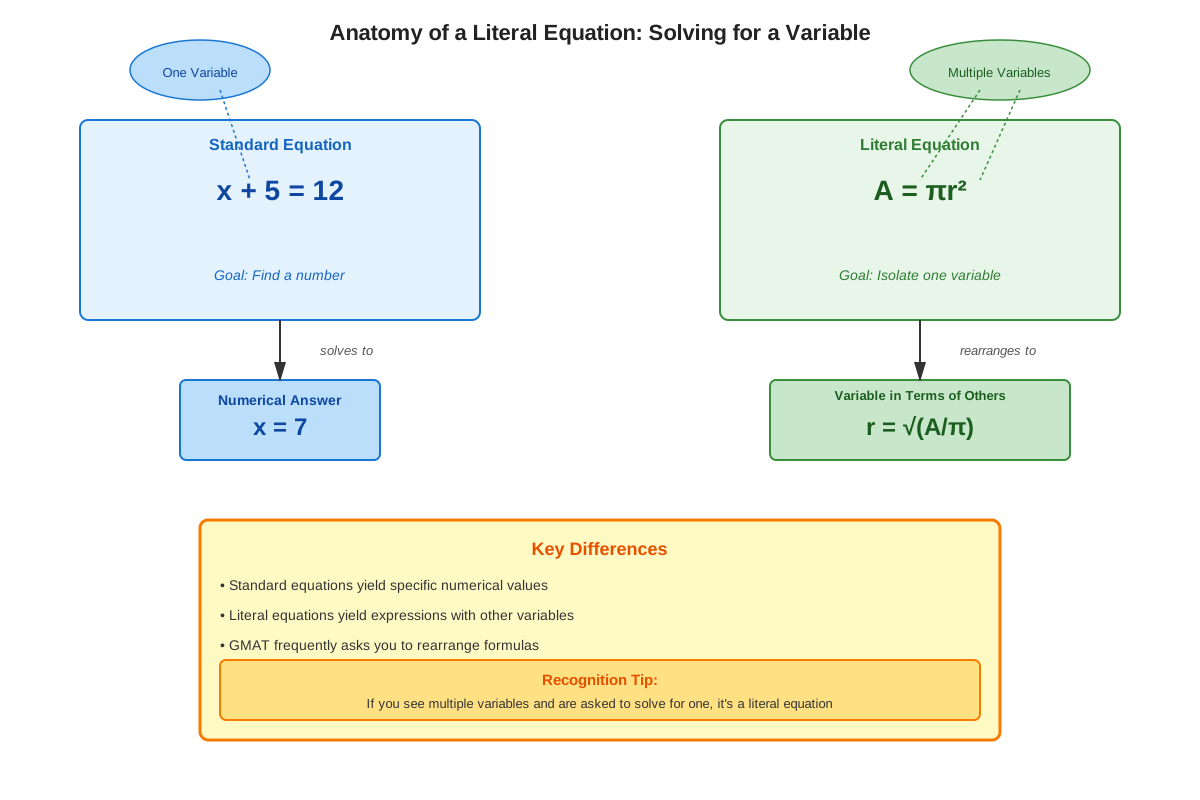
Literal equations are algebraic equations in which the variables represent known quantities or parameters, and the goal is to solve for one variable in terms of the others rather than finding a specific numerical value. Unlike traditional algebraic equations where you solve for a numerical answer (e.g., x = 5), literal equations require you to manipulate the equation to isolate a particular variable while leaving other variables in the expression. For example, solving the formula for the area of a rectangle A = lw for width w yields w = A/l. This type of algebraic manipulation is fundamental to the GMAT Quantitative Reasoning section and appears frequently in both Problem Solving and Data Sufficiency questions.
Understanding GMAT literal equations is essential because they test your ability to think abstractly about mathematical relationships and demonstrate fluency with algebraic manipulation. The GMAT frequently presents formulas from geometry, physics, finance, or business contexts and asks you to rearrange them to solve for a specific variable. These questions assess not just computational skills but also conceptual understanding of how variables relate to one another within equations. Mastery of literal equations enables you to work efficiently with complex formulas and recognize equivalent forms of expressions—a critical skill when evaluating answer choices or determining data sufficiency.
Within the broader landscape of GMAT Quantitative Reasoning, literal equations serve as a bridge between basic algebraic manipulation and more advanced problem-solving scenarios. They connect directly to topics such as linear equations, systems of equations, functions, and word problems. The ability to rearrange formulas is also crucial when working with rate problems, work problems, and geometric formulas. Furthermore, literal equations develop the algebraic reasoning skills necessary for tackling Data Sufficiency questions, where understanding the relationship between variables often matters more than calculating specific values.
Learning Objectives
- [ ] Identify literal equations in various mathematical and real-world contexts
- [ ] Explain the purpose and structure of literal equations and how they differ from standard algebraic equations
- [ ] Apply literal equations to GMAT questions by isolating specified variables
- [ ] Manipulate complex literal equations involving multiple operations and variables
- [ ] Recognize equivalent forms of literal equations and determine when two expressions are algebraically identical
- [ ] Evaluate Data Sufficiency questions involving literal equations to determine what information is necessary to solve for a variable
Prerequisites
- Basic algebraic manipulation: Understanding how to add, subtract, multiply, and divide both sides of an equation by the same quantity is essential for rearranging literal equations
- Order of operations (PEMDAS): Knowing the correct sequence for performing mathematical operations ensures accurate manipulation when isolating variables
- Properties of equality: Familiarity with reflexive, symmetric, and transitive properties allows for valid transformations of equations
- Fraction operations: Many literal equations require multiplying or dividing by fractional expressions, making fraction fluency critical
- Exponent rules: Understanding how to manipulate expressions with powers and roots is necessary for more complex literal equations
Why This Topic Matters
Literal equations represent a high-yield topic for GMAT preparation because they appear across multiple question types and difficulty levels. In real-world applications, literal equations are fundamental to fields such as engineering, economics, finance, and science, where professionals must manipulate formulas to solve for unknown parameters. Business analysts regularly rearrange financial formulas to isolate variables like interest rates, time periods, or principal amounts. Scientists and engineers constantly reformulate equations to express one quantity in terms of others based on what information is available.
On the GMAT, literal equations appear in approximately 10-15% of Quantitative Reasoning questions, making them a moderately frequent but highly important topic. They most commonly appear in Problem Solving questions that present a formula and ask you to solve for a specific variable, often in the context of geometry, rate problems, or business scenarios. Data Sufficiency questions frequently test whether you understand what information is needed to determine a particular variable's value, requiring you to mentally manipulate literal equations without necessarily solving them completely.
The GMAT presents literal equations in several characteristic ways: geometric formulas requiring rearrangement (such as solving for the radius given surface area of a sphere), rate-time-distance problems where you must isolate one of the three variables, financial formulas involving interest or profit calculations, and work-rate problems where you solve for individual rates or time. Questions may also present a formula in one form and ask you to identify an equivalent expression among the answer choices, testing your ability to recognize algebraically identical expressions.
Core Concepts
Definition and Structure of Literal Equations
A literal equation is an equation that contains two or more variables, where the objective is to solve for one variable in terms of the remaining variables rather than finding a specific numerical value. The term "literal" refers to the use of letters (variables) to represent quantities. For example, the equation 2x + 3y = 12 becomes a literal equation when you solve for x in terms of y: x = (12 - 3y)/2. The key distinction is that the solution contains variables rather than being a single number.
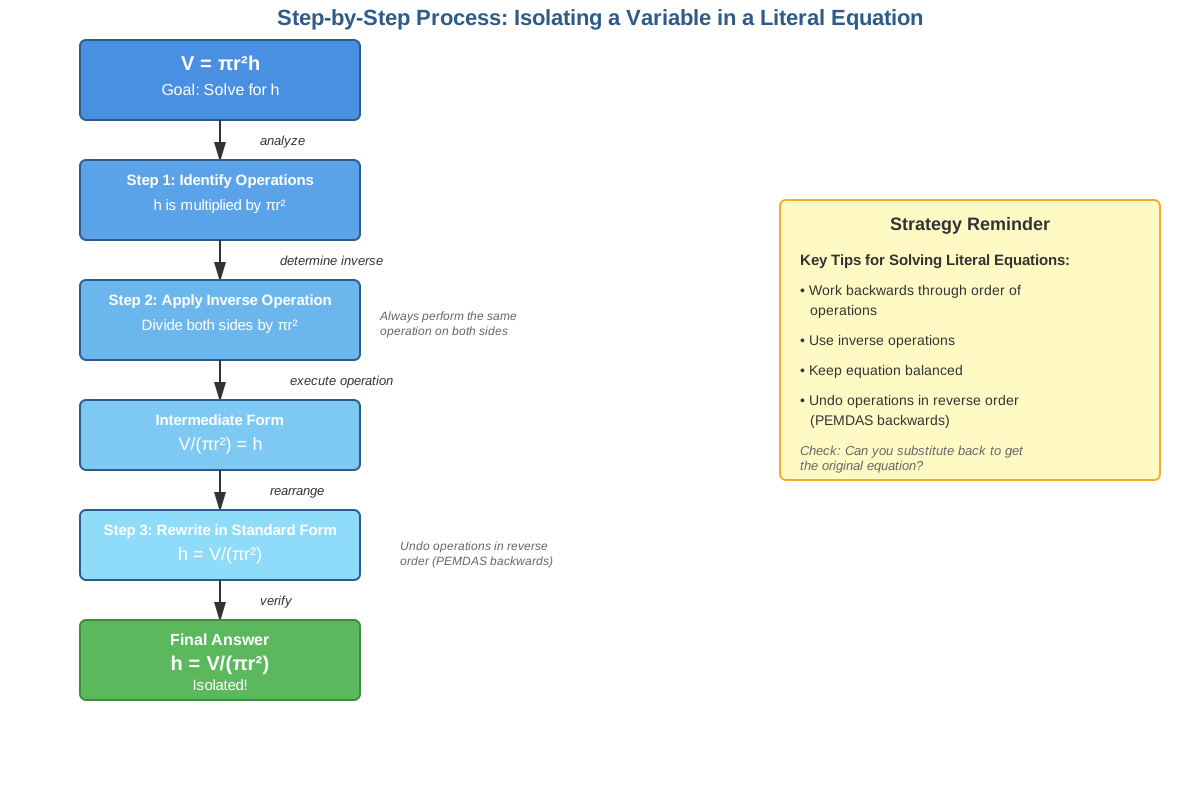
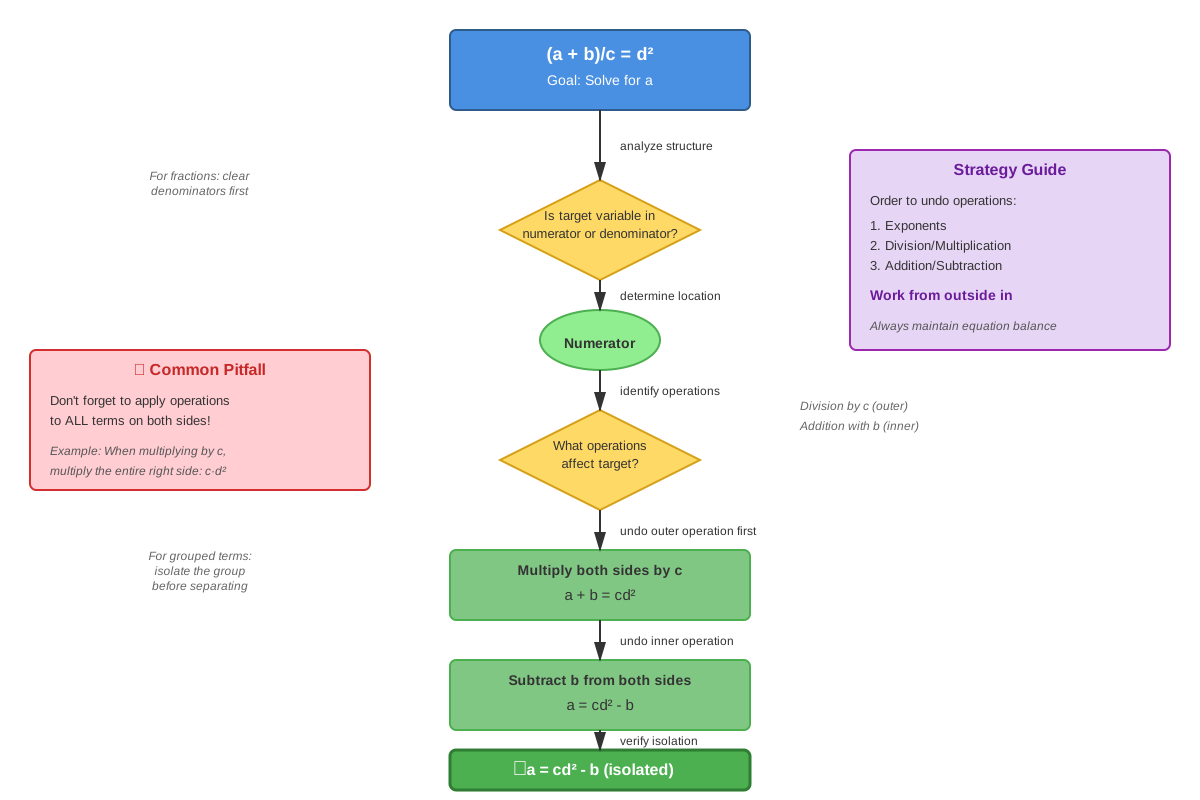
Literal equations follow all the same algebraic rules as numerical equations. The fundamental principle is maintaining equality: whatever operation you perform on one side of the equation must be performed on the other side. This includes addition, subtraction, multiplication, division, raising to powers, and taking roots. The goal is to isolate the desired variable on one side of the equation while moving all other terms to the opposite side.
Basic Manipulation Techniques
The process of solving literal equations involves a systematic approach to isolating the target variable. The general strategy mirrors solving numerical equations but requires careful attention to maintaining variables in the expression:
- Identify the target variable you need to isolate
- Eliminate addition/subtraction terms involving other variables by performing inverse operations
- Eliminate multiplication/division by performing inverse operations
- Handle exponents or roots by applying inverse operations (squaring/taking square roots, etc.)
- Simplify the resulting expression to its most reduced form
Consider the formula for the perimeter of a rectangle: P = 2l + 2w. To solve for length l:
P = 2l + 2w
P - 2w = 2l          (subtract 2w from both sides)
(P - 2w)/2 = l       (divide both sides by 2)
l = (P - 2w)/2       (final answer)
Alternatively, this could be written as l = P/2 - w, demonstrating that literal equations may have multiple equivalent forms.
Working with Fractions in Literal Equations
Many GMAT literal equations involve fractional expressions, requiring proficiency with fraction manipulation. When a variable appears in a denominator, the standard approach is to multiply both sides by that denominator to clear the fraction. For example, solving the equation v = d/t for time t:
v = d/t
vt = d               (multiply both sides by t)
t = d/v              (divide both sides by v)
When multiple fractions appear, finding a common denominator or multiplying by the least common multiple of all denominators can simplify the process. Consider solving 1/a + 1/b = 1/c for variable a:
1/a + 1/b = 1/c
1/a = 1/c - 1/b      (subtract 1/b from both sides)
1/a = (b - c)/(bc)   (find common denominator on right side)
a = bc/(b - c)       (take reciprocal of both sides)
Complex Literal Equations with Multiple Operations
Advanced literal equations may involve variables appearing multiple times, variables within exponents, or nested operations. The key is to work systematically, treating groups of terms as single units when necessary. For the equation A = P(1 + rt), solving for rate r:
A = P(1 + rt)
A/P = 1 + rt         (divide both sides by P)
A/P - 1 = rt         (subtract 1 from both sides)
(A/P - 1)/t = r      (divide both sides by t)
r = (A - P)/(Pt)     (alternative form after simplification)
When a variable appears in an exponent, logarithms may be necessary, though this is less common on the GMAT. More typically, you'll encounter square roots or squared terms, requiring you to square both sides or take square roots while being mindful of positive and negative solutions.
Recognizing Equivalent Forms
A crucial GMAT skill is recognizing when two literal equations are equivalent despite appearing different. This often involves algebraic manipulation to transform one expression into another. For example, these expressions for solving A = πr² for r are equivalent:
- r = √(A/π)
- r = (1/√π)√A
- r = √A/√π
The GMAT may present answer choices in different forms to test whether you can identify equivalent expressions. Developing fluency with algebraic manipulation helps you quickly recognize these relationships.
Application to Common GMAT Formulas
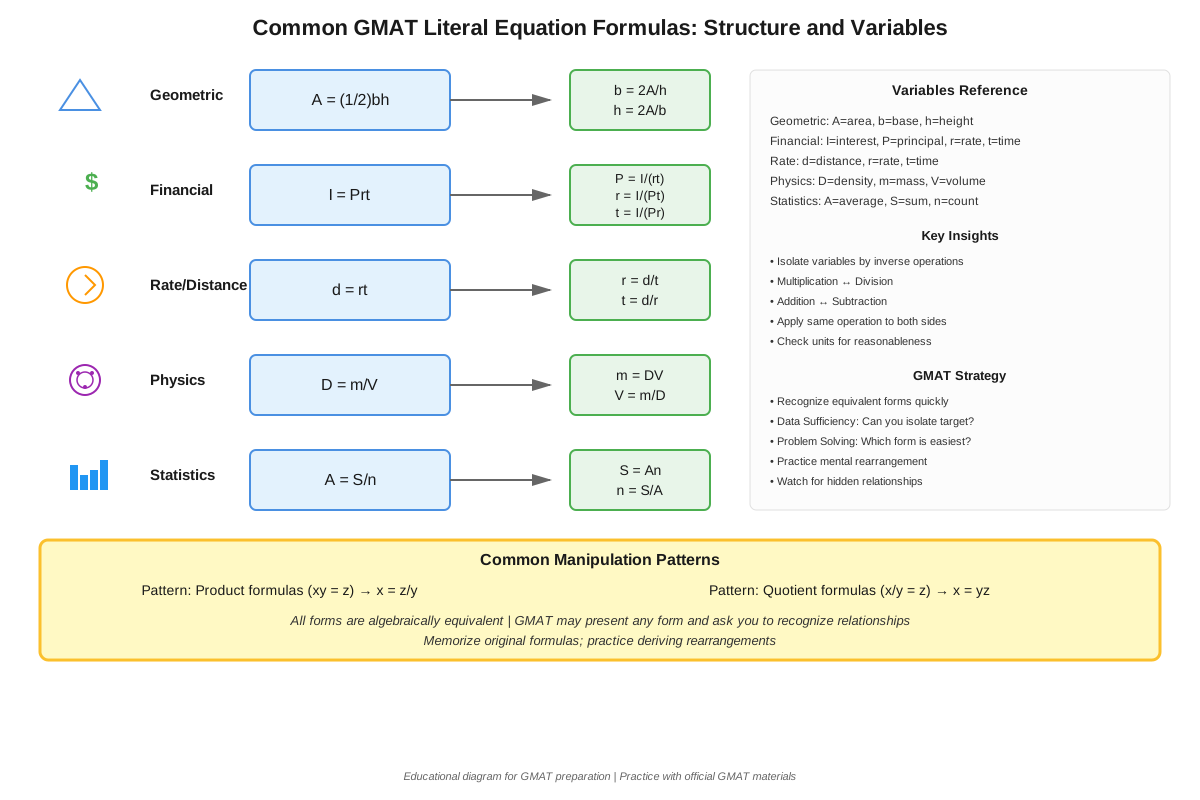
The GMAT frequently tests literal equations using standard formulas from geometry, physics, and business:
| Formula Type | Original Formula | Common Rearrangements |
|---|---|---|
| Distance | d = rt | r = d/t, t = d/r |
| Area of Circle | A = πr² | r = √(A/π) |
| Simple Interest | I = Prt | r = I/(Pt), t = I/(Pr), P = I/(rt) |
| Volume of Cylinder | V = πr²h | h = V/(πr²), r = √(V/(πh)) |
| Slope | m = (y₂-y₁)/(x₂-x₁) | y₂ = m(x₂-x₁) + y₁ |
Familiarity with these common formulas and their rearrangements accelerates problem-solving on test day.
Concept Relationships
Literal equations serve as a foundational skill that connects to numerous other algebraic concepts. At the most basic level, literal equations build directly upon basic equation solving, extending the techniques used for numerical equations to situations involving multiple variables. The same principles of maintaining equality and performing inverse operations apply, but the added complexity of retaining variables in the solution requires more sophisticated algebraic thinking.
The relationship flows as follows: Basic algebraic manipulation → Solving linear equations → Literal equations → Systems of equations and Functions. Once you master literal equations, you can more easily work with systems where you might solve one equation for a variable and substitute into another. Similarly, understanding functions as relationships between variables becomes more intuitive when you're comfortable expressing one variable in terms of another.
Literal equations also connect strongly to word problems and applied mathematics. Many word problems require you to first set up a literal equation representing the relationship described, then manipulate it to solve for the desired quantity. Rate problems, work problems, and mixture problems all rely heavily on literal equation manipulation. The connection extends to Data Sufficiency questions, where understanding literal equations helps you determine what information is sufficient to find a particular variable's value without actually solving for it.
Within geometry, literal equations enable you to work flexibly with geometric formulas, solving for any dimension given information about others. This connects to coordinate geometry, where manipulating equations of lines and curves often requires literal equation techniques. The ability to rearrange formulas also supports optimization problems where you might need to express one quantity in terms of another to find maximum or minimum values.
Quick check — test yourself on Literal equations so far.
Try Flashcards →High-Yield Facts
⭐ A literal equation contains two or more variables and is solved for one variable in terms of the others, not for a specific numerical value
⭐ Whatever operation you perform on one side of a literal equation must be performed on the other side to maintain equality
⭐ To isolate a variable that appears in a denominator, multiply both sides of the equation by that denominator
⭐ When solving for a variable that appears multiple times in an equation, first collect all terms containing that variable on one side
⭐ Two literal equations are equivalent if one can be transformed into the other through valid algebraic operations
- The order of operations (PEMDAS) applies when manipulating literal equations just as it does with numerical equations
- When a variable is squared, taking the square root of both sides yields both positive and negative solutions in general, though context may limit to one
- Literal equations can often be expressed in multiple equivalent forms; the "simplest" form depends on context
- Multiplying or dividing both sides by an expression containing variables is valid as long as that expression is not equal to zero
- Common GMAT formulas (distance, area, volume, interest) frequently appear in questions requiring literal equation manipulation
- Recognizing the structure of a literal equation helps determine what information is sufficient to solve for a particular variable
- When simplifying literal equations, factoring can often reveal equivalent forms more clearly
- Literal equations with fractional expressions often benefit from multiplying through by the least common denominator
- The GMAT rarely requires logarithms for literal equations but frequently tests square roots and squared terms
- Understanding literal equations enables quick verification of answer choices by substituting back into the original equation
Common Misconceptions
Misconception: You can only solve equations when you have specific numbers for all but one variable.
Correction: Literal equations are specifically designed to express one variable in terms of others without requiring numerical values. The solution is an algebraic expression, not a number.
Misconception: When solving for a variable, you must eliminate it from the right side and move it to the left side of the equation.
Correction: The target variable can be isolated on either side of the equation. The convention of writing "x = ..." is stylistic; "... = x" is equally valid mathematically.
Misconception: If a variable appears twice in an equation, you cannot solve for it.
Correction: When a variable appears multiple times, you can factor it out or collect like terms. For example, in ax + bx = c, factor to get x(a + b) = c, then x = c/(a + b).
Misconception: Multiplying both sides by a variable is always safe.
Correction: While algebraically valid, multiplying by a variable that could equal zero may introduce extraneous solutions or mask the fact that no solution exists for certain values. Always consider domain restrictions.
Misconception: There is only one correct form for the answer to a literal equation problem.
Correction: Literal equations often have multiple equivalent forms. For example, (a-b)/c, a/c - b/c, and -(b-a)/c are all equivalent expressions. The GMAT may present any valid form as the correct answer.
Misconception: You need to simplify literal equations to a single fraction.
Correction: While combining terms can be helpful, sometimes the clearest form keeps terms separated. The "best" form depends on what makes the relationship most transparent or matches the answer choices.
Misconception: Taking the square root of both sides always gives a single answer.
Correction: Mathematically, √(x²) = |x|, which means both positive and negative values. However, in practical GMAT contexts (like geometric dimensions), only positive values may be meaningful.
Worked Examples
Example 1: Geometric Formula Manipulation
Problem: The surface area of a cylinder is given by the formula S = 2πr² + 2πrh, where r is the radius and h is the height. If a cylinder has a surface area of 150π square units and a radius of 5 units, what is the height?
Solution:
First, recognize that we need to solve the literal equation for h, then substitute the given values.
Step 1: Solve for h in terms of S and r
S = 2πr² + 2πrh
S - 2πr² = 2πrh          (subtract 2πr² from both sides)
(S - 2πr²)/(2πr) = h     (divide both sides by 2πr)
h = (S - 2πr²)/(2πr)     (final literal equation)
Step 2: Substitute the given values S = 150π and r = 5
h = (150π - 2π(5²))/(2π(5))
h = (150π - 2π(25))/(10π)
h = (150π - 50π)/(10π)
h = 100π/(10π)
h = 10Answer: The height is 10 units.
Connection to Learning Objectives: This example demonstrates identifying a literal equation (the surface area formula), explaining its structure (sum of two terms involving r and h), and applying it to find a specific value by first solving for the target variable.
Example 2: Rate Problem with Multiple Variables
Problem: The formula for the time it takes for two people working together to complete a job is given by T = 1/(1/a + 1/b), where a is the time for the first person alone and b is the time for the second person alone. If two workers together complete a job in 6 hours, and one worker alone would take 10 hours, how long would the other worker take alone?
Solution:
We need to solve the literal equation for b, then substitute known values.
Step 1: Solve for b in terms of T and a
T = 1/(1/a + 1/b)
1/T = 1/a + 1/b          (take reciprocal of both sides)
1/T - 1/a = 1/b          (subtract 1/a from both sides)
(a - T)/(Ta) = 1/b       (find common denominator)
b = Ta/(a - T)           (take reciprocal of both sides)
Step 2: Substitute T = 6 and a = 10
b = (6)(10)/(10 - 6)
b = 60/4
b = 15Answer: The other worker would take 15 hours alone.
Verification: Check by substituting back: T = 1/(1/10 + 1/15) = 1/(3/30 + 2/30) = 1/(5/30) = 30/5 = 6 ✓
Connection to Learning Objectives: This example shows how to manipulate complex literal equations involving fractions, recognize equivalent forms, and apply the technique to a practical GMAT-style work problem.
Exam Strategy
When approaching GMAT questions involving literal equations, begin by carefully identifying what variable you need to solve for and what information is given. Read the question stem thoroughly to understand whether you need to find a numerical answer (requiring substitution after rearranging) or simply identify the correct rearranged form among answer choices.
Trigger words and phrases that signal literal equation questions include: "solve for," "express in terms of," "what is the value of [variable] when," "rearrange the formula," "which of the following is equivalent to," and "if the formula is solved for [variable]." In Data Sufficiency questions, watch for phrases like "what is needed to determine" or "is the information sufficient to find," which often require you to mentally manipulate literal equations to assess sufficiency.
For Problem Solving questions, follow this systematic approach:
- Write down the given formula clearly
- Identify the target variable you need to isolate
- Perform algebraic operations step-by-step, showing your work
- Simplify the resulting expression
- If numerical values are given, substitute them only after rearranging
- Check your answer by substituting back into the original equation if time permits
For Data Sufficiency questions, the strategy differs:
- Determine what variable you need to find
- Identify what other variables appear in the relevant formula
- Assess whether each statement provides enough information to determine all other variables
- Remember that you don't need to actually solve—just determine whether solving is possible
Process-of-elimination tips: When answer choices show different rearrangements of a formula, you can eliminate options by testing with simple numerical values. Choose easy numbers for all variables except the target variable, calculate what the target variable should equal, then check which answer choice yields that value. This technique is particularly powerful when algebraic manipulation seems complex.
Time allocation: Literal equation questions typically require 1.5-2 minutes. If you find yourself spending more than 2.5 minutes on algebraic manipulation, consider using the number-substitution strategy to test answer choices instead. The GMAT rewards efficiency, and sometimes testing is faster than deriving.
Exam Tip: If you need to solve for a variable that appears in a denominator, your first move should almost always be to multiply both sides by that denominator. This immediately simplifies the equation structure.
Exam Tip: When answer choices are in different forms, look for the form that matches the structure of what you derived. Don't waste time trying to prove two expressions are equivalent if you can identify the correct form directly.
Memory Techniques
ISOLATE - A mnemonic for the systematic approach to solving literal equations:
- Identify the target variable
- Subtract/add to move terms without the target variable
- Operate with multiplication/division to clear coefficients
- Look for opportunities to factor if the variable appears multiple times
- Apply inverse operations for exponents or roots
- Test your answer by substitution if time allows
- Express in simplest form
"Flip and Multiply" - When a variable is in a denominator and isolated (like v = d/t), remember you can "flip" both sides to get 1/v = t/d, then multiply to isolate: t = d/v. This visualization helps when working with reciprocal relationships.
"Same to Both" - A simple reminder that whatever you do to one side of an equation, you must do to the other. Visualize a balance scale that must remain level—any weight added to one side must be added to the other.
The "Fraction Buster" technique: When you see fractions with variables in denominators, visualize "busting" them by multiplying through by all denominators. This mental image helps you remember to clear fractions early in the solution process.
Color-coding mental strategy: When working through complex literal equations, mentally assign colors to different variables. The target variable is "red" (stop and isolate), given variables are "green" (go ahead and keep them), and variables to eliminate are "yellow" (caution, move them away). This mental categorization helps maintain focus during manipulation.
Summary
Literal equations are algebraic equations containing multiple variables where the goal is to solve for one variable in terms of the others rather than finding a specific numerical value. This fundamental algebraic skill appears frequently on the GMAT in both Problem Solving and Data Sufficiency questions, often embedded within geometry, rate, work, and business contexts. The key to mastering literal equations is systematic application of inverse operations while maintaining equality on both sides of the equation. Common techniques include clearing fractions by multiplying by denominators, collecting like terms when a variable appears multiple times, and recognizing equivalent forms of expressions. Success requires both procedural fluency with algebraic manipulation and conceptual understanding of variable relationships. The ability to work flexibly with literal equations enables efficient problem-solving across numerous GMAT question types and serves as a foundation for more advanced algebraic reasoning.
Key Takeaways
- Literal equations solve for one variable in terms of others, producing an algebraic expression rather than a numerical answer
- Apply the same algebraic rules as numerical equations: whatever operation is performed on one side must be performed on the other
- Clear fractions by multiplying both sides by the denominator(s) containing variables
- When a variable appears multiple times, factor it out or collect like terms before isolating
- Recognize that literal equations can have multiple equivalent forms—the GMAT may present any valid algebraic rearrangement
- For Data Sufficiency questions, determine what variables must be known to solve for the target variable without actually solving
- Common GMAT formulas (distance, area, volume, interest) frequently require literal equation manipulation
Related Topics
Systems of Equations: Building on literal equation skills, systems involve solving multiple equations simultaneously, often requiring you to solve one equation for a variable and substitute into another—a direct application of literal equation techniques.
Functions and Function Notation: Understanding functions as relationships between variables becomes more intuitive with literal equation mastery, as functions essentially express one variable (the output) in terms of another (the input).
Word Problems and Applied Mathematics: Most GMAT word problems require translating verbal descriptions into equations, then manipulating those equations to solve for desired quantities—a process that relies heavily on literal equation skills.
Quadratic Equations and Formulas: Advanced formula manipulation, including the quadratic formula and completing the square, extends literal equation techniques to more complex polynomial relationships.
Coordinate Geometry: Manipulating equations of lines, circles, and parabolas to solve for specific coordinates or parameters requires fluent literal equation skills.
Practice CTA
Now that you've mastered the core concepts of literal equations, it's time to reinforce your learning through active practice. Attempt the practice questions to apply these techniques to GMAT-style problems, and use the flashcards to cement the key formulas and manipulation strategies in your memory. Remember, proficiency with literal equations develops through repeated application—each problem you solve strengthens your algebraic intuition and speeds up your problem-solving process. The investment you make in practicing this high-yield topic will pay dividends across multiple question types on test day. You've got this!
Sign up free to keep reading
Create a free AnvayaPrep account to finish this GMAT guide on Literal equations — plus flashcards and practice questions.