Overview
Multi-step equations form the backbone of algebraic problem-solving on the GMAT Quantitative Reasoning section. These equations require students to perform multiple operations—such as combining like terms, distributing, and isolating variables—in a systematic sequence to arrive at a solution. Unlike simple one-step equations where a single operation reveals the answer, GMAT multi-step equations demand strategic thinking, careful manipulation of algebraic expressions, and a solid understanding of the order of operations applied in reverse.
Mastering multi-step equations is essential for GMAT success because they appear not only as standalone algebra problems but also embedded within word problems, data sufficiency questions, and complex quantitative comparisons. The ability to efficiently solve these equations directly impacts performance on approximately 20-25% of GMAT Quantitative questions. Students who can quickly recognize the structure of multi-step equations and apply systematic solution strategies gain a significant competitive advantage in time management and accuracy.
Within the broader landscape of Quantitative Reasoning, multi-step equations serve as a bridge between basic arithmetic operations and advanced algebraic concepts such as systems of equations, quadratic equations, and function analysis. They reinforce fundamental properties of equality, distributive laws, and inverse operations while preparing students for more complex mathematical modeling. The skills developed through multi-step equation practice—logical sequencing, algebraic manipulation, and verification of solutions—transfer directly to virtually every other algebraic topic tested on the GMAT.
Learning Objectives
- [ ] Identify multi-step equations in various formats and contexts
- [ ] Explain the logical sequence of operations required to solve multi-step equations
- [ ] Apply multi-step equation solving techniques to GMAT questions
- [ ] Determine the most efficient solution path for complex multi-step equations
- [ ] Verify solutions by substitution and identify extraneous solutions
- [ ] Translate word problems into multi-step equations and solve them systematically
Prerequisites
- Basic arithmetic operations: Addition, subtraction, multiplication, and division form the foundation for all algebraic manipulations in multi-step equations
- Order of operations (PEMDAS): Understanding the sequence of operations is essential because solving equations requires applying these operations in reverse
- Properties of equality: Knowledge that performing the same operation on both sides of an equation maintains equality is fundamental to all equation-solving
- Combining like terms: The ability to simplify expressions by adding or subtracting similar terms streamlines the solution process
- Distributive property: Expanding expressions like a(b + c) = ab + ac is frequently required before isolating variables
- Fraction operations: Many GMAT equations involve fractional coefficients or require finding common denominators
Why This Topic Matters
Multi-step equations represent one of the most practical mathematical skills tested on the GMAT because they model real-world problem-solving scenarios that business professionals encounter regularly. Whether calculating break-even points, determining optimal pricing strategies, or analyzing financial projections, the ability to set up and solve multi-step equations translates directly to quantitative business analysis. This connection between abstract algebra and concrete applications makes the topic particularly relevant for MBA candidates.
On the GMAT specifically, multi-step equations appear in approximately 20-25% of Quantitative Reasoning questions across multiple question types. They surface most frequently in Problem Solving questions (direct equation-solving), Data Sufficiency questions (determining whether given information is sufficient to solve an equation), and word problems involving rates, work, mixtures, and age relationships. The test makers deliberately embed multi-step equations within complex scenarios to assess both algebraic proficiency and logical reasoning under time pressure.
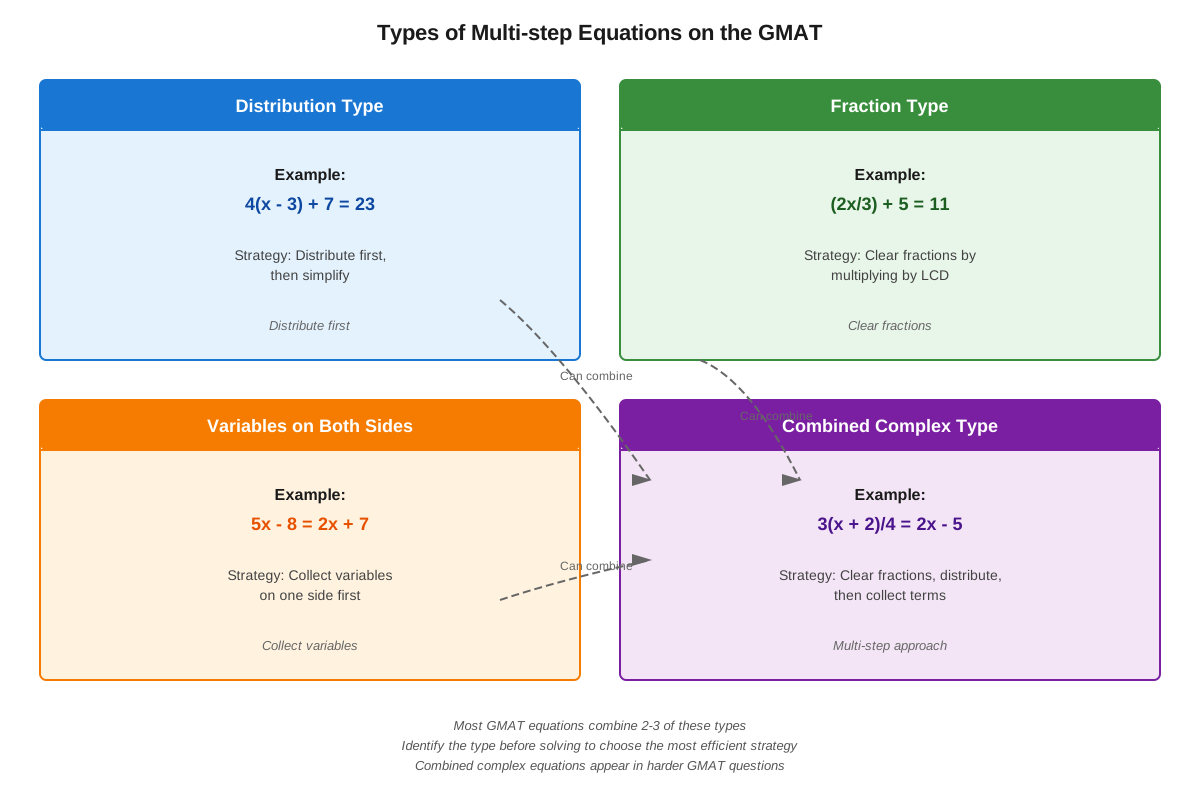
Common GMAT presentations of multi-step equations include: equations with variables on both sides requiring consolidation; equations with parentheses and distribution requirements; equations involving fractions that need clearing through multiplication; equations nested within word problems about consecutive integers, percent changes, or proportional relationships; and equations where the solution process reveals whether data is sufficient without requiring complete calculation. Recognizing these patterns enables students to quickly categorize problems and select appropriate solution strategies, significantly improving both speed and accuracy on test day.
Core Concepts
Definition and Structure of Multi-Step Equations
A multi-step equation is an algebraic equation that requires two or more distinct operations to isolate the variable and determine its value. Unlike simple equations such as x + 5 = 12 (which requires only one subtraction), multi-step equations combine multiple operations, terms, or both sides containing variables. The fundamental structure typically involves: coefficients (numbers multiplying variables), constants (standalone numbers), variables (unknown quantities represented by letters), and various operations (addition, subtraction, multiplication, division) connecting these elements.
The complexity of multi-step equations on the GMAT ranges from relatively straightforward problems like 3x + 7 = 22 (requiring two steps: subtract 7, then divide by 3) to more intricate equations such as 2(x - 4) + 5x = 3x + 10 (requiring distribution, combining like terms, consolidating variables, and solving). Understanding this spectrum helps students gauge problem difficulty and allocate time appropriately.
Systematic Solution Process
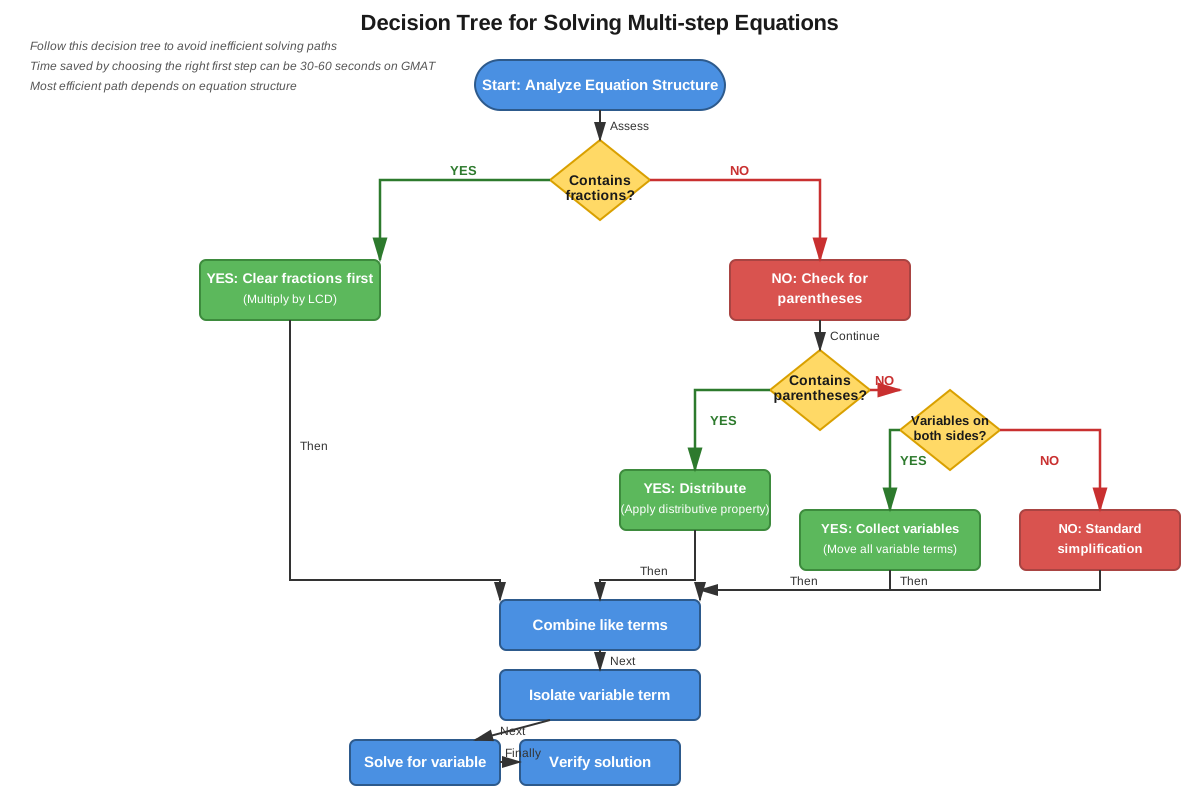
Solving multi-step equations effectively requires following a consistent, logical sequence:
- Simplify both sides independently: Remove parentheses using the distributive property, combine like terms, and simplify any fractions or complex expressions before attempting to isolate the variable
- Consolidate variables to one side: Add or subtract variable terms to move all variables to one side of the equation (conventionally the left side)
- Consolidate constants to the opposite side: Add or subtract constant terms to move all numbers without variables to the other side
- Isolate the variable: Use multiplication or division to eliminate the coefficient of the variable
- Verify the solution: Substitute the answer back into the original equation to confirm it satisfies the equality
This systematic approach minimizes errors and ensures students don't skip critical steps that could lead to incorrect solutions.
Equations with Variables on Both Sides
A particularly common GMAT format involves equations where variables appear on both sides of the equal sign, such as 5x - 8 = 2x + 7. The solution strategy involves:
Step 1: Decide which side to consolidate variables (choose the side with the larger coefficient to avoid negative coefficients when possible)
Step 2: Subtract the smaller variable term from both sides: 5x - 8 - 2x = 2x + 7 - 2x, simplifying to 3x - 8 = 7
Step 3: Add or subtract constants to isolate the variable term: 3x - 8 + 8 = 7 + 8, giving 3x = 15
Step 4: Divide by the coefficient: x = 5
This pattern appears frequently in GMAT word problems involving two quantities that start at different values and change at different rates until they become equal.
Equations Requiring Distribution
When equations contain parentheses, the distributive property must be applied before other operations. For example, in 4(2x - 3) = 5x + 9:
Step 1: Distribute the 4: 8x - 12 = 5x + 9
Step 2: Consolidate variables: 8x - 5x - 12 = 9, giving 3x - 12 = 9
Step 3: Add 12 to both sides: 3x = 21
Step 4: Divide by 3: x = 7
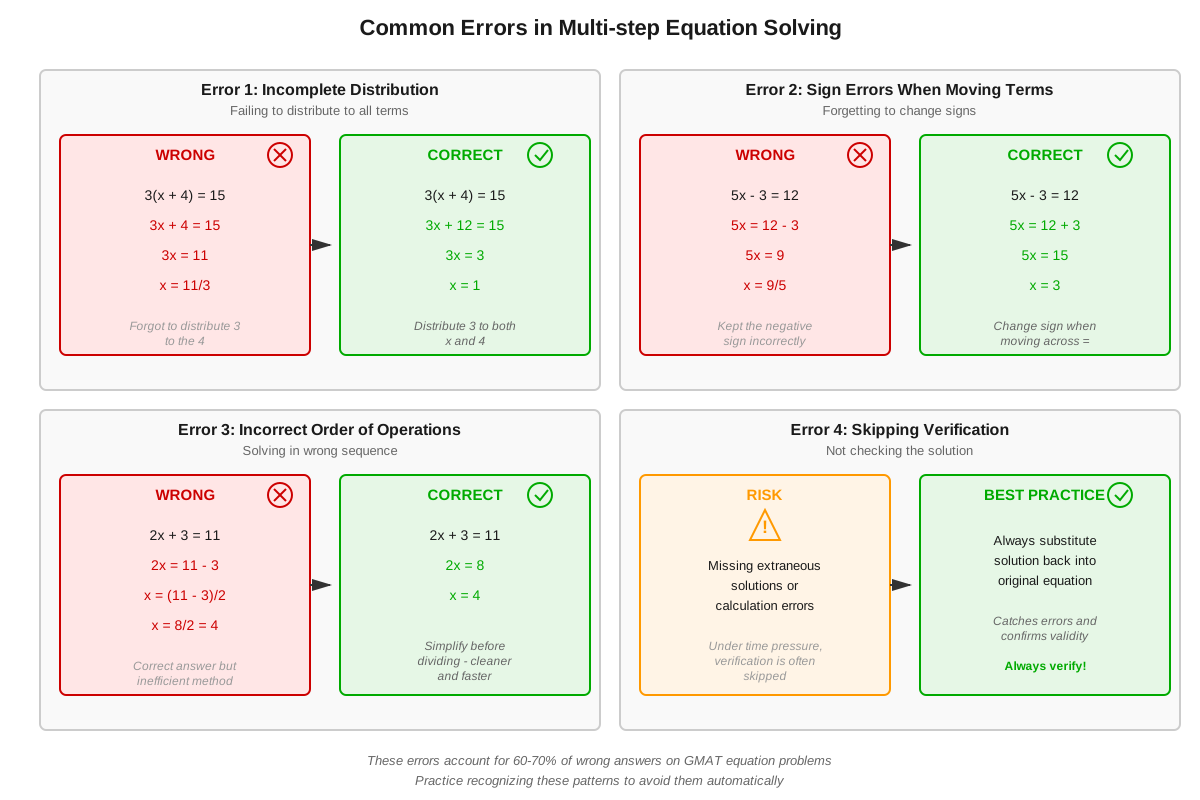
A common error involves distributing only to the first term inside parentheses; students must remember that distribution applies to every term within the parentheses.
Equations with Fractions
Equations containing fractions can be solved using two approaches:
Method 1 (Working with fractions): Perform operations while maintaining fractional form, being careful with fraction arithmetic
Method 2 (Clearing fractions): Multiply every term by the least common denominator (LCD) to eliminate fractions entirely
For example, with (x/3) + 5 = (2x/5) - 1:
Using Method 2: The LCD of 3 and 5 is 15. Multiply every term by 15:
15(x/3) + 15(5) = 15(2x/5) - 15(1)
This simplifies to: 5x + 75 = 6x - 15
Then solve: 75 + 15 = 6x - 5x, giving x = 90
Clearing fractions typically proves faster and reduces arithmetic errors on the GMAT.
Special Cases and Solution Types
Multi-step equations can yield three types of results:
| Solution Type | Characteristic | Example | Interpretation |
|---|---|---|---|
| Unique solution | One specific value satisfies the equation | 2x + 3 = 7 → x = 2 | Most common on GMAT |
| Infinite solutions | All values satisfy the equation | 2(x + 3) = 2x + 6 → 0 = 0 | Indicates an identity |
| No solution | No value satisfies the equation | x + 5 = x + 3 → 5 = 3 | Indicates a contradiction |
Recognizing these patterns quickly is particularly valuable in Data Sufficiency questions where determining the nature of the solution (rather than finding it) may be sufficient.
Strategic Simplification Techniques
Efficient GMAT test-takers employ several strategic shortcuts:
Combining operations: When possible, perform multiple steps simultaneously (e.g., subtracting a variable term and a constant in one step)
Choosing sides strategically: Always move variables to the side with the larger coefficient to avoid working with negative coefficients
Mental math optimization: Recognize when coefficients allow for easy mental calculation rather than written work
Estimation before solving: For Problem Solving questions with numerical answer choices, estimate the approximate solution range to eliminate obviously incorrect answers before solving completely
Concept Relationships
Multi-step equations build directly upon foundational arithmetic and algebraic principles while serving as prerequisites for more advanced topics. The relationship flow follows this pattern:
Basic arithmetic operations → Properties of equality → One-step equations → Multi-step equations → Systems of equations and Quadratic equations
Within multi-step equations themselves, concepts interconnect hierarchically. The ability to combine like terms enables simplification of both sides, which then allows for consolidation of variables, ultimately leading to isolation of the variable. Each step depends on the successful completion of previous steps, making the process inherently sequential.
Multi-step equations also connect laterally to other GMAT topics. They appear embedded within word problems (requiring translation from verbal to algebraic form), ratio and proportion problems (where equations express relationships between quantities), percent problems (where equations model percent increase/decrease), and work and rate problems (where equations represent combined work or distance-rate-time relationships). This interconnectedness means that mastering multi-step equations simultaneously strengthens performance across multiple Quantitative Reasoning domains.
The verification step in solving multi-step equations reinforces the concept of function evaluation, where substituting a value and calculating the result determines whether that value satisfies the equation. This connection becomes explicit in more advanced problems involving functions and their properties.
Quick check — test yourself on Multi-step equations so far.
Try Flashcards →High-Yield Facts
⭐ Multi-step equations require performing operations in the reverse order of PEMDAS: Division/multiplication before addition/subtraction when solving
⭐ Always perform the same operation on both sides of the equation to maintain equality: This is the fundamental principle underlying all equation-solving
⭐ Combining like terms before attempting to isolate variables reduces errors and simplifies calculations: Simplification should always precede isolation
⭐ When variables appear on both sides, subtract the smaller variable term from both sides to consolidate: This minimizes working with negative coefficients
⭐ Multiplying every term by the LCD eliminates fractions and typically speeds up solution time: This technique is particularly valuable under GMAT time pressure
- Distributing negative signs requires changing the sign of every term inside parentheses: -(3x - 5) = -3x + 5, not -3x - 5
- Verification by substitution catches calculation errors and is especially important for complex equations
- Equations that simplify to a false statement (like 5 = 3) have no solution; those that simplify to a true statement (like 7 = 7) have infinite solutions
- When solving for a variable that appears multiple times, all instances must be consolidated before isolation is possible
- The coefficient of the variable after consolidation determines the final division or multiplication step needed for isolation
Common Misconceptions
Misconception: Only the term immediately next to the equal sign needs to be moved when isolating the variable.
Correction: All terms not containing the variable must be moved to the opposite side through inverse operations. If the equation is 3x + 7 - 2 = 18, both +7 and -2 must be addressed, giving 3x + 5 = 18, then 3x = 13.
Misconception: When distributing a negative sign or negative number, only the first term inside parentheses changes sign.
Correction: Distribution applies to every term inside parentheses. For -2(x - 4), the result is -2x + 8, not -2x - 4. Both terms must be multiplied by -2.
Misconception: Dividing both sides by the variable eliminates it from the equation.
Correction: Dividing by a variable (rather than its coefficient) is mathematically invalid in most contexts and can introduce extraneous solutions or lose valid solutions. Always divide by the numerical coefficient, not the variable itself.
Misconception: Fractions in equations must be converted to decimals before solving.
Correction: Converting fractions to decimals often introduces rounding errors and complicates calculations. Either work with fractions throughout or clear them by multiplying by the LCD—both approaches are superior to decimal conversion.
Misconception: If an equation simplifies to 0 = 0, there is no solution.
Correction: When an equation simplifies to a true statement like 0 = 0 or 5 = 5, it means the equation has infinitely many solutions (it's an identity). No solution occurs only when simplification yields a false statement like 3 = 7.
Misconception: The order of operations for solving equations is the same as for evaluating expressions.
Correction: Solving equations requires applying operations in reverse order compared to evaluation. When solving, address addition/subtraction before multiplication/division, opposite to PEMDAS order.
Worked Examples
Example 1: Multi-Step Equation with Distribution and Variables on Both Sides
Problem: Solve for x: 3(2x - 5) + 4 = 5x + 2
Solution:
Step 1 - Distribute: Apply the distributive property to eliminate parentheses
- 3(2x - 5) = 6x - 15
- Equation becomes: 6x - 15 + 4 = 5x + 2
Step 2 - Combine like terms on the left side: Simplify constants
- 6x - 15 + 4 = 6x - 11
- Equation becomes: 6x - 11 = 5x + 2
Step 3 - Consolidate variables: Subtract 5x from both sides
- 6x - 11 - 5x = 5x + 2 - 5x
- x - 11 = 2
Step 4 - Isolate the variable: Add 11 to both sides
- x - 11 + 11 = 2 + 11
- x = 13
Step 5 - Verify: Substitute x = 13 into the original equation
- Left side: 3(2(13) - 5) + 4 = 3(26 - 5) + 4 = 3(21) + 4 = 63 + 4 = 67
- Right side: 5(13) + 2 = 65 + 2 = 67
- Both sides equal 67 ✓
Connection to learning objectives: This example demonstrates identification of a multi-step equation (objective 1), explanation of the systematic solution process (objective 2), and application of techniques including distribution and variable consolidation (objective 3).
Example 2: Equation with Fractions
Problem: Solve for x: (x/4) + 3 = (x/2) - 5
Solution:
Step 1 - Identify the LCD: The denominators are 4 and 2; LCD = 4
Step 2 - Multiply every term by the LCD: Eliminate all fractions
- 4(x/4) + 4(3) = 4(x/2) - 4(5)
- x + 12 = 2x - 20
Step 3 - Consolidate variables: Subtract x from both sides
- x + 12 - x = 2x - 20 - x
- 12 = x - 20
Step 4 - Isolate the variable: Add 20 to both sides
- 12 + 20 = x - 20 + 20
- 32 = x
Step 5 - Verify: Substitute x = 32 into the original equation
- Left side: (32/4) + 3 = 8 + 3 = 11
- Right side: (32/2) - 5 = 16 - 5 = 11
- Both sides equal 11 ✓
Alternative approach: This problem could also be solved by working with fractions throughout, but clearing fractions first significantly reduces the chance of arithmetic errors and speeds up calculation—a critical advantage on the GMAT.
Connection to learning objectives: This example illustrates determining the most efficient solution path (objective 4) by choosing to clear fractions, and demonstrates verification of solutions (objective 5).
Exam Strategy
When approaching GMAT questions involving multi-step equations, implement this strategic framework:
Initial Assessment (5-10 seconds): Quickly scan the equation to identify its structure. Note whether it contains parentheses (requiring distribution), fractions (potentially requiring clearing), or variables on both sides (requiring consolidation). This preview determines your solution approach and estimated time investment.
Trigger Words and Phrases: Watch for these verbal cues in word problems that signal multi-step equations: "after adding/subtracting," "combined with," "the sum/difference of," "more/less than," "increased/decreased by," "twice/three times as much," and "consecutive integers." These phrases typically indicate that multiple operations will be needed to model and solve the problem.
Process of Elimination Strategies:
- Before solving completely, estimate the approximate magnitude of the solution. If x appears with a coefficient of 3 and equals something around 30, x should be approximately 10. Eliminate answer choices that are orders of magnitude different.
- For Data Sufficiency questions, determine whether you need to solve completely or just establish that a unique solution exists. Often, setting up the equation is sufficient without calculating the final answer.
- If answer choices are widely spaced, round aggressively during calculations to save time.
- When answer choices include both positive and negative values, quickly determine the sign of the solution before calculating its magnitude.
Time Allocation: Allocate 1.5-2 minutes for straightforward multi-step equations and up to 2.5 minutes for complex problems embedded in word problems. If you haven't made significant progress after 90 seconds, mark the question for review and move on—the GMAT rewards efficient time management over perfect completion.
Common Traps: GMAT test makers frequently include answer choices representing common errors: the result before the final step, the negative of the correct answer, the result of distributing incorrectly, or the value obtained by forgetting to combine like terms. Always verify your answer matches the original equation rather than simply selecting the result of your calculations.
Memory Techniques
SADMEP Mnemonic: Remember the solving sequence as "SADMEP" (reverse of PEMDAS):
- Simplify both sides
- Add/subtract to consolidate variables
- Do the same for constants
- Multiply or divide to isolate
- Evaluate by substitution
- Prove your answer is correct
"Same Side, Same Sign" Rule: When moving terms across the equal sign, remember they change signs. Terms that are added become subtracted; terms that are subtracted become added. Visualize the equal sign as a mirror that flips the operation.
"Clear the Clutter" Visualization: Think of solving equations as cleaning a room—first remove the big obstacles (parentheses, fractions), then organize similar items together (combine like terms), then separate different types of items (variables on one side, constants on the other), and finally isolate what you're looking for.
Fraction LCD Acronym - "MELT":
- Multiply every term
- Eliminate denominators
- Leave no fractions behind
- Then solve normally
Distribution Reminder - "DANE":
- Distribute to all terms
- Apply to every element inside
- Never skip the second term
- Expand completely before proceeding
Summary
Multi-step equations represent a foundational algebraic skill that appears throughout the GMAT Quantitative Reasoning section, requiring systematic application of multiple operations to isolate variables and determine their values. Success with these equations depends on following a consistent solution process: simplifying both sides independently, consolidating variables to one side, moving constants to the opposite side, isolating the variable through inverse operations, and verifying the solution through substitution. The most common GMAT formats include equations with variables on both sides, equations requiring distribution of parentheses, and equations containing fractions that benefit from clearing denominators by multiplying by the LCD. Students must recognize that solving equations involves applying operations in reverse order compared to evaluating expressions, and that maintaining equality by performing identical operations on both sides is the fundamental principle underlying all algebraic manipulation. Mastery of multi-step equations not only enables direct problem-solving but also provides the foundation for more complex algebraic topics including systems of equations, quadratic equations, and function analysis—making this topic essential for achieving competitive GMAT scores.
Key Takeaways
- Multi-step equations require a systematic approach: simplify, consolidate variables, isolate constants, divide/multiply to solve, and always verify by substitution
- Performing the same operation on both sides of an equation maintains equality—this principle underlies every step in the solution process
- Clear fractions by multiplying every term by the LCD to reduce arithmetic errors and speed up calculations
- When variables appear on both sides, subtract the smaller variable term from both sides to avoid negative coefficients
- Distribution must be applied to every term inside parentheses, and negative signs distributed require changing all signs within
- Verification through substitution catches calculation errors and confirms the solution satisfies the original equation
- Recognize the three solution types: unique solution (one value), infinite solutions (identity), and no solution (contradiction)
Related Topics
Systems of Linear Equations: Building on single multi-step equations, systems involve solving two or more equations simultaneously using substitution or elimination methods. Mastering multi-step equations provides the algebraic manipulation skills essential for systems.
Quadratic Equations: These second-degree equations (containing x²) require factoring, completing the square, or the quadratic formula—all of which build upon the systematic solving approach learned with multi-step linear equations.
Inequalities: Multi-step inequalities follow nearly identical solution processes to equations, with the critical addition of reversing inequality signs when multiplying or dividing by negative numbers.
Word Problem Translation: Many GMAT word problems require translating verbal descriptions into multi-step equations before solving, making equation-solving proficiency essential for success across diverse problem types.
Absolute Value Equations: These equations involve expressions within absolute value symbols and often require setting up and solving multiple multi-step equations to account for both positive and negative cases.
Practice CTA
Now that you've mastered the core concepts, solution strategies, and exam techniques for multi-step equations, it's time to solidify your understanding through active practice. Attempt the practice questions designed specifically for this topic, focusing on applying the systematic solution process and verification techniques you've learned. Use the flashcards to reinforce high-yield facts and common patterns until recognizing equation structures becomes automatic. Remember: algebraic proficiency comes from deliberate practice, and each problem you solve strengthens the neural pathways that will serve you on test day. Your investment in mastering multi-step equations will pay dividends across the entire GMAT Quantitative section—start practicing now to transform knowledge into skill!
Sign up free to keep reading
Create a free AnvayaPrep account to finish this GMAT guide on Multi-step equations — plus flashcards and practice questions.