Overview
Estimation is one of the most powerful and frequently tested skills in GMAT Quantitative Reasoning. Rather than performing lengthy calculations that consume precious test time, estimation allows test-takers to quickly approximate values and eliminate incorrect answer choices with confidence. This strategic approach is particularly valuable on the GMAT, where time management often determines success as much as mathematical knowledge. The ability to estimate effectively transforms complex arithmetic, algebraic, and data interpretation problems into manageable tasks that can be solved in under two minutes.
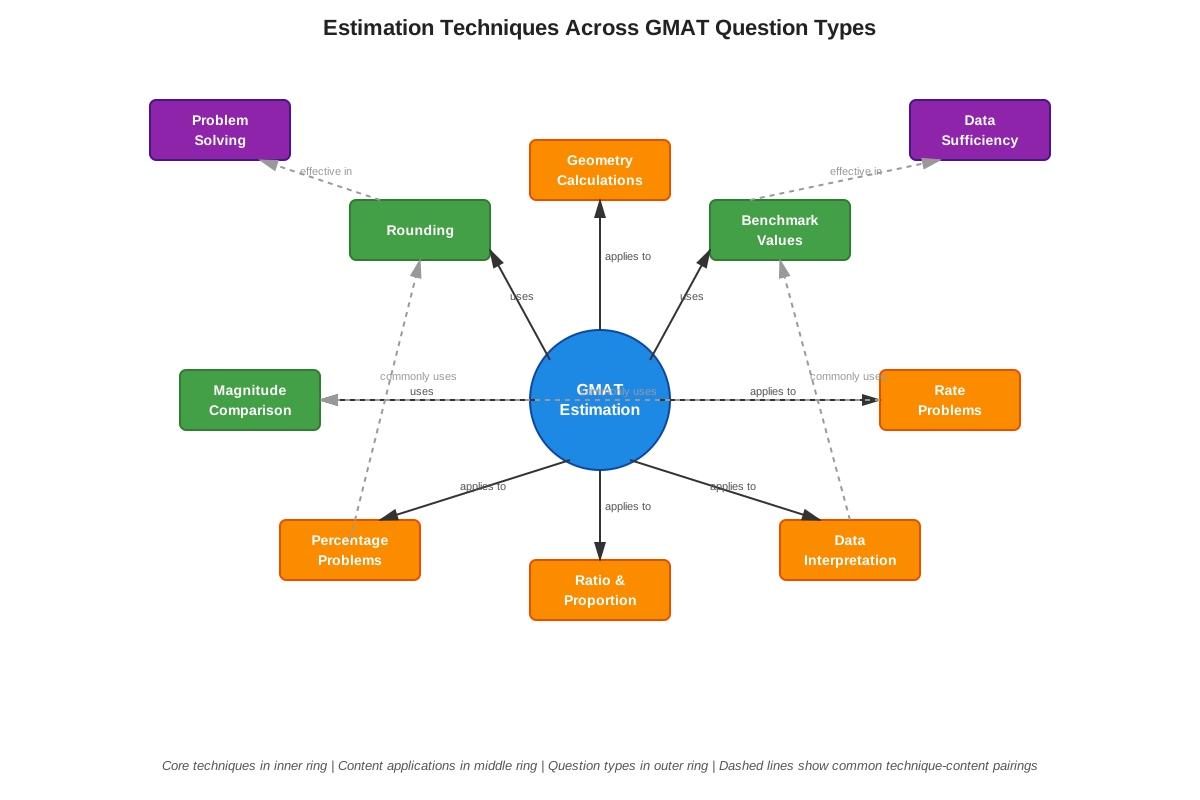
On the GMAT, GMAT estimation techniques appear across multiple question types, including Problem Solving, Data Sufficiency, and Integrated Reasoning questions. The test designers deliberately create answer choices that are sufficiently spread apart to reward estimation skills, recognizing that business professionals need to make quick, accurate judgments based on approximate values rather than precise calculations. Mastering estimation not only improves accuracy and speed but also reduces calculation errors that occur when working with complex numbers under time pressure.
Estimation connects fundamentally to nearly every topic in GMAT Quantitative Reasoning, from basic arithmetic operations and percentages to ratios, rates, and even geometry. It serves as a meta-skill that enhances performance across the entire quantitative section. Understanding when and how to estimate—and when precision is actually required—represents a critical strategic competency that distinguishes high-scoring test-takers from those who struggle with time management and computational complexity.
Learning Objectives
- [ ] Identify situations where estimation is appropriate and advantageous on GMAT questions
- [ ] Explain the principles and techniques underlying effective estimation strategies
- [ ] Apply estimation to GMAT questions across multiple content areas and question types
- [ ] Determine the appropriate level of precision needed based on answer choice spacing
- [ ] Execute rounding strategies that maintain accuracy while simplifying calculations
- [ ] Combine estimation with process of elimination to maximize efficiency
- [ ] Recognize when exact calculation is necessary versus when approximation suffices
Prerequisites
- Basic arithmetic operations: Estimation builds upon fundamental addition, subtraction, multiplication, and division skills, as these operations form the basis of all approximation techniques.
- Place value understanding: Recognizing the relative magnitude of digits in different positions is essential for effective rounding and magnitude estimation.
- Fraction and decimal operations: Many estimation scenarios involve converting between fractions, decimals, and percentages, requiring fluency with these representations.
- Order of operations: Knowing which calculations to perform first ensures that estimation maintains mathematical validity.
- Percentage concepts: Estimating percentage increases, decreases, and relationships is a high-frequency GMAT skill that requires baseline percentage knowledge.
Why This Topic Matters
Estimation represents a critical real-world skill that extends far beyond standardized testing. Business professionals regularly make decisions based on approximate calculations—whether projecting quarterly revenue, estimating market size, or evaluating investment returns. The ability to quickly assess whether a number is reasonable, to spot calculation errors, and to make informed decisions without perfect information defines effective quantitative reasoning in professional contexts.
On the GMAT specifically, estimation appears in approximately 40-50% of Quantitative Reasoning questions, either as the primary solution method or as a verification technique. Problem Solving questions frequently feature answer choices deliberately spaced to reward estimation, while Data Sufficiency questions often require test-takers to determine whether approximate information is sufficient to answer a question. The Integrated Reasoning section, particularly in Multi-Source Reasoning and Table Analysis questions, heavily rewards the ability to estimate relationships and trends without performing exhaustive calculations.
Common GMAT question patterns that benefit from estimation include: percentage calculations with non-round numbers (e.g., "23% of 487"), ratio and proportion problems with complex values, rate and work problems requiring multiple steps, compound interest calculations, and data interpretation questions asking for approximate comparisons. Questions may explicitly ask for approximations ("Which of the following is closest to...") or implicitly reward estimation through answer choice design. Recognizing these patterns allows test-takers to allocate time strategically and avoid the trap of over-calculating when approximation suffices.
Core Concepts
Fundamental Principles of Estimation
Estimation is the process of finding an approximate value that is close enough to the exact answer to serve a specific purpose—in the GMAT context, to identify the correct answer choice or eliminate incorrect options. Effective estimation balances two competing priorities: simplifying calculations to save time while maintaining sufficient accuracy to distinguish between answer choices. The key insight is that GMAT answer choices are typically separated by enough margin that perfect precision is unnecessary.
The foundation of estimation rests on understanding significant figures and order of magnitude. Significant figures refer to the digits that carry meaningful information about a number's precision, while order of magnitude refers to the scale or size of a number (typically expressed as powers of 10). For GMAT purposes, maintaining accuracy in the first two or three significant figures usually suffices, as answer choices rarely differ by less than 5-10% of the correct value.
Strategic Rounding Techniques
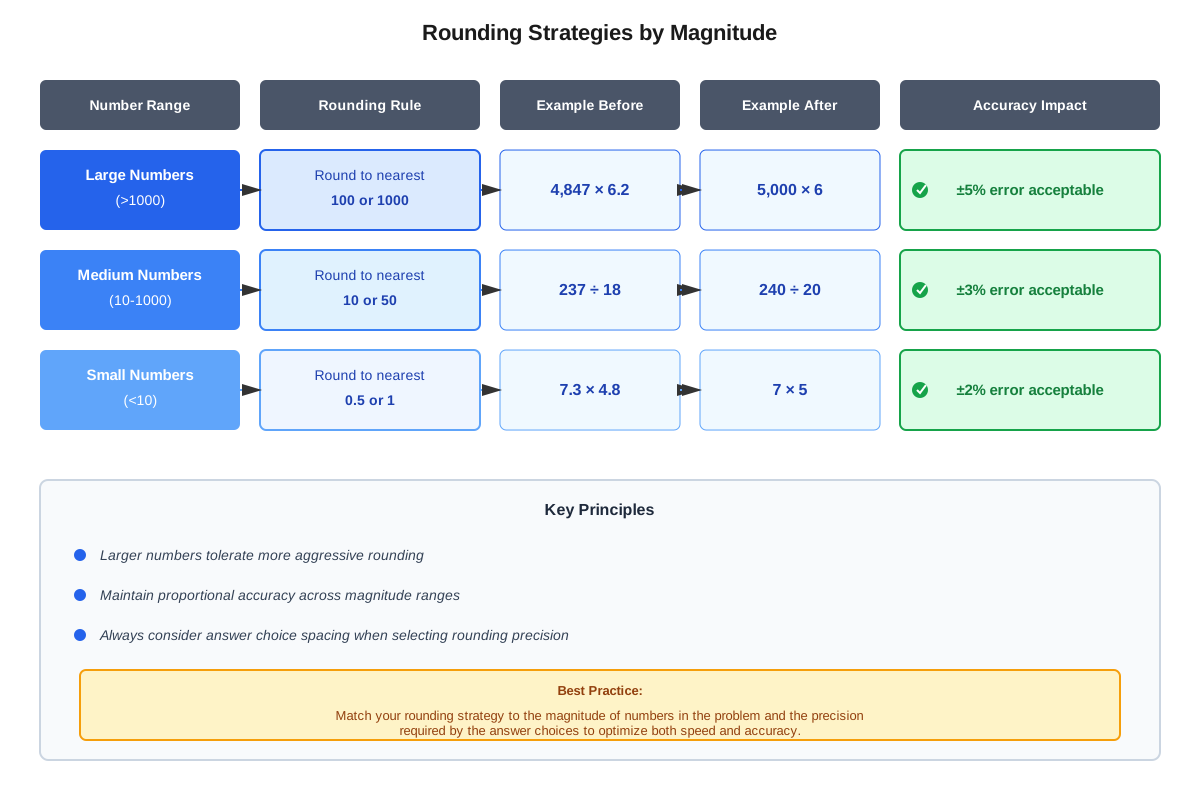
Rounding forms the cornerstone of estimation strategy. The GMAT rewards test-takers who can round numbers intelligently to simplify calculations while preserving accuracy. Several rounding approaches prove particularly valuable:
Compatible number rounding involves adjusting numbers to values that work well together mathematically. For example, when calculating 48 × 23, rounding to 50 × 20 = 1,000 provides a quick estimate. The exact answer (1,104) falls close enough to the estimate that answer choices can be evaluated effectively.
Compensating rounding maintains balance by rounding some numbers up and others down. When multiplying 52 × 48, rounding to 50 × 50 = 2,500 provides an excellent estimate because the upward and downward adjustments roughly cancel out. The exact answer (2,496) demonstrates how compensating rounding can yield remarkable accuracy.
Benchmark rounding uses familiar reference points like 25%, 50%, 75%, or common fractions (1/3, 1/4, 1/5) to simplify percentage and fraction calculations. Converting 23% to "approximately 25%" or 0.48 to "approximately 0.5" dramatically simplifies mental math.
Magnitude Estimation
Understanding the scale of answers before calculating prevents catastrophic errors and guides rounding decisions. Magnitude estimation involves determining whether an answer should be in the tens, hundreds, thousands, or another range before worrying about precise values.
For multiplication, count the total digits in the factors to estimate the result's magnitude. Multiplying a 2-digit number by a 3-digit number yields a 4- or 5-digit result. For division, compare the number of digits in the dividend and divisor. Dividing a 4-digit number by a 2-digit number yields a 2- or 3-digit quotient.
Scientific notation provides a powerful tool for magnitude estimation. Expressing numbers as values between 1 and 10 multiplied by powers of 10 (e.g., 4,500 = 4.5 × 10³) makes multiplication and division of large or small numbers manageable through simple exponent arithmetic.
Percentage Estimation Strategies
Percentage problems appear frequently on the GMAT and respond exceptionally well to estimation. Several techniques streamline percentage calculations:
The 10% method leverages the ease of calculating 10% (moving the decimal point one place left) as a building block. To find 23% of 480, first calculate 10% (48), then double it for 20% (96), then add half of 10% for the additional 3% (approximately 14), yielding roughly 110.
The 1% method works similarly for smaller percentages or when greater precision is needed. Finding 1% by moving the decimal two places left, then multiplying, often proves faster than traditional percentage calculations.
Fraction equivalents for common percentages accelerate estimation: 25% = 1/4, 50% = 1/2, 33.3% ≈ 1/3, 20% = 1/5, 12.5% = 1/8. Converting "23% of 480" to "approximately 1/4 of 480 = 120" provides a quick, accurate estimate.
Estimation in Complex Operations
Multi-step problems require strategic decisions about when and how to estimate. The general principle: estimate early in the calculation process, but maintain awareness of how errors compound.
For compound calculations (operations within operations), estimate the innermost operations first, then work outward. When calculating (487 × 23) / 51, estimate as (500 × 20) / 50 = 10,000 / 50 = 200. The exact answer (approximately 219) falls close enough for answer choice evaluation.
For sequential operations, consider whether errors accumulate or cancel. When adding multiple estimated values, errors tend to cancel out through the law of large numbers. When multiplying estimates, errors compound multiplicatively, requiring more conservative rounding.
Answer Choice Analysis
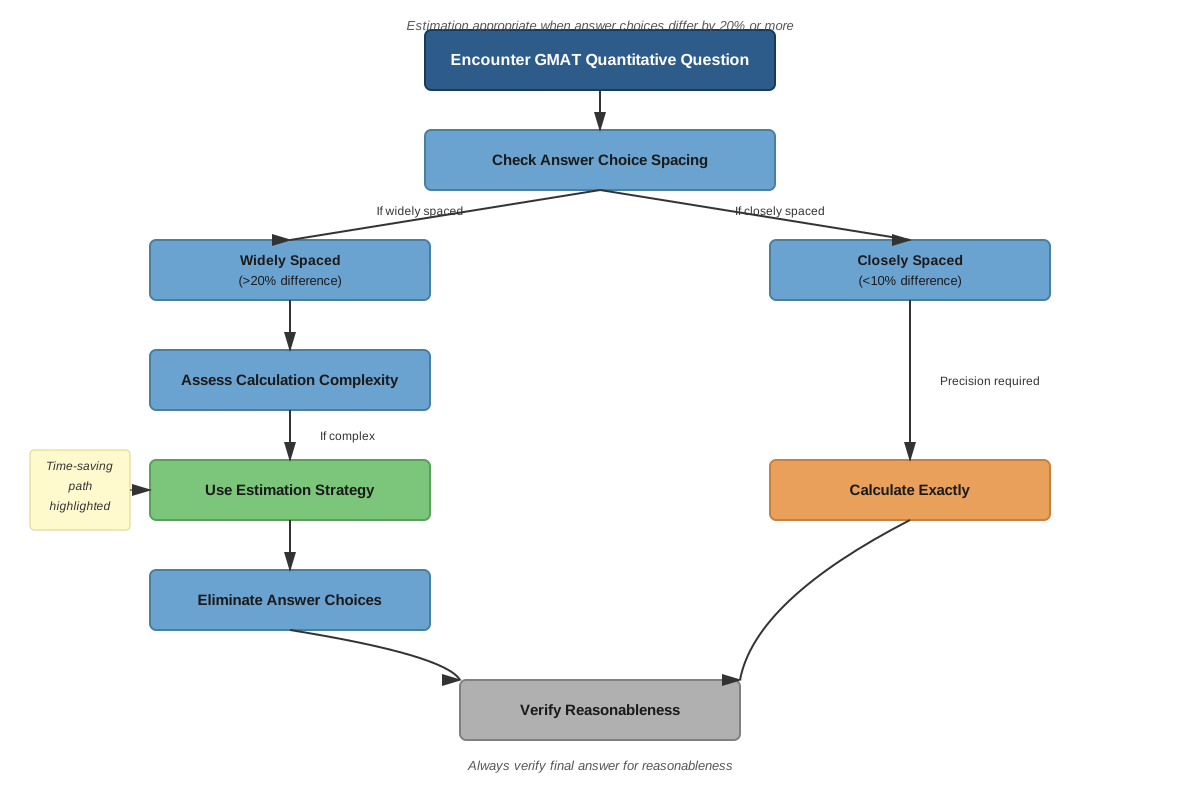
The spacing and structure of answer choices provide critical information about the appropriate estimation strategy. When answer choices differ by 50% or more, aggressive rounding is safe. When choices cluster closely (differing by 10% or less), more precision is required—or exact calculation may be necessary.
| Answer Choice Spacing | Estimation Approach | Example |
|---|---|---|
| Widely spaced (>50% difference) | Aggressive rounding to nearest 10, 50, or 100 | Choices: 100, 250, 500, 1000, 2000 |
| Moderately spaced (20-50% difference) | Round to nearest 5 or 10 | Choices: 120, 150, 180, 210, 240 |
| Closely spaced (10-20% difference) | Conservative rounding or partial calculation | Choices: 145, 160, 175, 190, 205 |
| Very close (<10% difference) | Exact calculation likely required | Choices: 156, 162, 168, 174, 180 |
Verification Through Estimation
Even when performing exact calculations, estimation serves as a powerful verification tool. Before finalizing an answer, estimate what the result should be approximately. If the calculated answer differs dramatically from the estimate, a calculation error likely occurred. This "sanity check" catches errors like misplaced decimal points, sign errors, or order-of-magnitude mistakes.
Concept Relationships
Estimation functions as a meta-skill that enhances performance across all GMAT Quantitative Reasoning topics. The relationship flows bidirectionally: strong foundational skills enable better estimation, while estimation practice reinforces understanding of mathematical relationships.
Arithmetic operations → Estimation → Time efficiency: Mastery of basic arithmetic enables quick mental estimation, which directly translates to time savings on the exam. This saved time can be reallocated to more challenging questions, improving overall performance.
Estimation ↔ Number properties: Understanding factors, multiples, and divisibility rules enhances estimation accuracy. Recognizing that 48 is close to 50 (a highly divisible number) makes 48 × 23 easier to estimate than treating 48 as an arbitrary value.
Percentages and ratios → Estimation → Data interpretation: Estimation skills developed through percentage and ratio problems directly transfer to Integrated Reasoning questions requiring quick data analysis and comparison.
Estimation → Answer choice elimination → Strategic guessing: When time pressure prevents complete problem solving, estimation enables informed elimination of unreasonable answer choices, dramatically improving guessing odds.
Magnitude estimation → Error detection → Accuracy improvement: The habit of estimating expected magnitude before calculating creates a self-checking mechanism that catches errors before answer submission.
Quick check — test yourself on Estimation so far.
Try Flashcards →High-Yield Facts
⭐ Answer choices on GMAT Problem Solving questions are typically spaced to reward estimation rather than require exact calculation.
⭐ Rounding one number up and another down (compensating rounding) often yields more accurate estimates than rounding all numbers in the same direction.
⭐ When answer choices differ by 20% or more, aggressive estimation is safe and time-efficient.
⭐ Converting percentages to fraction equivalents (25% = 1/4, 33% ≈ 1/3, 20% = 1/5) accelerates mental calculation.
⭐ Magnitude estimation (determining whether an answer should be in the tens, hundreds, or thousands) should precede detailed calculation.
- Multiplying two 2-digit numbers yields a 3- or 4-digit result; this magnitude check catches decimal point errors.
- The 10% method (calculate 10%, then scale) provides a fast, accurate approach for most percentage problems.
- When estimating products, count total significant figures to determine result precision: multiplying numbers with 2 significant figures each yields approximately 2 significant figures.
- Estimation errors compound in multiplication and division but often cancel in addition and subtraction.
- Questions asking "Which is closest to..." or "Approximately how many..." explicitly signal that estimation is the intended solution method.
- Scientific notation (expressing numbers as a × 10^n) simplifies estimation for very large or very small numbers.
- Benchmark values (25, 50, 75, 100, 500, 1000) serve as excellent rounding targets because they're easy to manipulate mentally.
- When Data Sufficiency questions provide approximate values, they're testing whether estimation suffices to determine sufficiency.
Common Misconceptions
Misconception: Estimation is less accurate than exact calculation and should only be used as a last resort when time runs out.
Correction: On the GMAT, estimation is often the intended solution method and can be both faster and more accurate than exact calculation, which introduces opportunities for arithmetic errors under time pressure. The test rewards strategic estimation.
Misconception: Always round to the nearest 10 or 100 regardless of the context.
Correction: Effective rounding depends on answer choice spacing and the specific calculation. Sometimes rounding to 5s, 25s, or other values provides better accuracy. The goal is simplifying calculation while maintaining sufficient precision to distinguish between answer choices.
Misconception: Estimation cannot be used for Data Sufficiency questions since they require determining exact sufficiency.
Correction: Data Sufficiency questions frequently test whether approximate information suffices to answer a question. Estimation helps determine whether statements provide enough information to narrow the answer to a specific range, which often constitutes sufficiency.
Misconception: When estimating percentages, always convert to decimals first.
Correction: Converting to fraction equivalents (25% = 1/4) or using the 10% method often proves faster and less error-prone than decimal conversion, especially for mental math.
Misconception: If an estimated answer doesn't exactly match an answer choice, the estimation approach was wrong.
Correction: Estimates should fall closest to the correct answer choice, not match exactly. If an estimate of 180 yields answer choices of 150, 175, 200, 225, and 250, selecting 175 or 200 (whichever is closer) is appropriate. The estimate successfully narrowed the options.
Misconception: Estimation only applies to arithmetic problems, not to algebra or geometry.
Correction: Estimation applies across all GMAT Quantitative topics. Algebraic expressions can be estimated by substituting simple values, and geometric measurements can be approximated using benchmark angles and lengths.
Misconception: Rounding all numbers up or all numbers down doesn't matter as long as the calculation is simplified.
Correction: Directional bias in rounding (all up or all down) can significantly skew results, especially in multiplication and division. Compensating rounding (some up, some down) maintains better accuracy.
Worked Examples
Example 1: Percentage Estimation with Complex Numbers
Problem: A company's revenue increased from $487,000 to $623,000. Approximately what was the percentage increase?
Solution:
Step 1: Identify that this requires calculating percentage change: (New - Old) / Old × 100%
Step 2: Recognize that exact calculation would be time-consuming: (623,000 - 487,000) / 487,000 × 100%
Step 3: Round to compatible numbers:
- Old revenue: $487,000 ≈ $500,000
- New revenue: $623,000 ≈ $625,000
Step 4: Calculate the increase: $625,000 - $500,000 = $125,000
Step 5: Calculate percentage: $125,000 / $500,000 = 125/500 = 1/4 = 25%
Step 6: Verify reasonableness: The actual increase ($136,000) is about 28% of the original value, so 25% is a reasonable estimate.
Answer: Approximately 25% (if answer choices are 20%, 25%, 30%, 35%, 40%, select 25% or 30% depending on which is offered)
Connection to Learning Objectives: This example demonstrates applying estimation to GMAT questions by using compatible number rounding and fraction equivalents to transform a complex percentage calculation into simple mental math.
Example 2: Multi-Step Estimation with Operations
Problem: If 52 workers can complete a project in 23 days working 8 hours per day, approximately how many days would it take 38 workers working 10 hours per day to complete the same project?
Solution:
Step 1: Recognize this as a work-rate problem requiring the relationship: (Workers₁ × Hours₁ × Days₁) = (Workers₂ × Hours₂ × Days₂)
Step 2: Set up the equation: 52 × 8 × 23 = 38 × 10 × Days₂
Step 3: Estimate the left side using rounding:
- 52 ≈ 50
- 23 ≈ 25 (rounding up to compensate for rounding 52 down)
- 50 × 8 × 25 = 50 × 200 = 10,000
Step 4: Estimate the right side coefficient:
- 38 ≈ 40
- 40 × 10 = 400
Step 5: Solve for Days₂: 10,000 = 400 × Days₂, so Days₂ = 10,000 / 400 = 25
Step 6: Verify reasonableness: Fewer workers but more hours per day should yield a result somewhat close to the original 23 days. 25 days is reasonable.
Answer: Approximately 25 days (exact calculation yields approximately 24.3 days)
Connection to Learning Objectives: This example illustrates identifying when estimation is appropriate (complex multi-step calculation with likely well-spaced answer choices), explaining the compensating rounding technique, and applying estimation to a work-rate problem.
Exam Strategy
When approaching GMAT questions, develop a systematic estimation protocol:
Step 1: Scan answer choices first. Before calculating anything, examine how the answer choices are spaced. Wide spacing (choices differ by 50%+) signals aggressive estimation. Close spacing suggests more precision or exact calculation may be needed.
Step 2: Identify trigger words. Phrases like "approximately," "closest to," "about," or "roughly" explicitly indicate that estimation is the intended approach. Questions asking for exact values rarely use these terms.
Step 3: Determine magnitude before precision. Ask: "Should my answer be in the tens, hundreds, thousands?" This prevents decimal point errors and guides rounding decisions.
Step 4: Round strategically based on the operation:
- For addition/subtraction: Round to the same place value
- For multiplication: Use compatible numbers or compensating rounding
- For division: Round to create easy divisibility
- For percentages: Convert to fraction equivalents when possible
Step 5: Calculate with rounded numbers, maintaining awareness of whether your estimate should be slightly high or low based on rounding direction.
Step 6: Match to answer choices. Select the choice closest to your estimate. If two choices are equidistant, recalculate with slightly more precision.
Step 7: Verify reasonableness. Does the answer make logical sense? Is the magnitude correct? This final check catches errors.
Time allocation: Estimation should save time, not consume it. If estimation takes longer than 30 seconds, consider whether exact calculation might be faster. Typically, estimation should reduce problem-solving time to 60-90 seconds for problems that would otherwise require 2+ minutes.
Process of elimination: Use estimation to eliminate obviously incorrect answers first. If choices are 100, 200, 300, 400, 500 and your estimate is 280, immediately eliminate 100, 400, and 500. Then decide between 200 and 300 with slightly more precision if needed.
Data Sufficiency considerations: For DS questions, estimate whether the provided information could narrow the answer to a specific value or range. Often, knowing that a value must be "between 50 and 60" is sufficient to answer "yes" or "no" to the question posed.
Memory Techniques
RACE mnemonic for estimation process:
- Round strategically based on answer choice spacing
- Approximate the magnitude first
- Calculate with simplified numbers
- Evaluate answer choices and verify reasonableness
"Friendly Numbers" visualization: Picture numbers as having "friends" they want to be near—48 wants to be 50, 23 wants to be 25, 0.49 wants to be 0.5. When numbers are near their friends, calculations become easier.
Percentage fraction equivalents (memorize these cold):
- 10% = 1/10
- 12.5% = 1/8
- 20% = 1/5
- 25% = 1/4
- 33.3% = 1/3
- 50% = 1/2
- 66.7% = 2/3
- 75% = 3/4
"Compensate to Calculate" rule: When rounding for multiplication or division, round one number up and another down to maintain balance. Visualize a seesaw staying level.
Magnitude counting: For multiplication, use your fingers to count total digits. Two 2-digit numbers (4 fingers total) yield a 3- or 4-digit answer. This physical memory aid prevents magnitude errors.
The "10% Ladder" technique: Visualize climbing a ladder where each rung represents 10% of a value. To find 23%, climb two full rungs (20%) plus a partial third rung (3%). This creates a mental model for percentage estimation.
Summary
Estimation represents a critical strategic skill for GMAT success, enabling test-takers to solve complex quantitative problems quickly and accurately without performing exhaustive calculations. The core principle involves rounding numbers to compatible values that simplify mental math while maintaining sufficient precision to distinguish between answer choices. Effective estimation requires understanding when approximation is appropriate (determined by answer choice spacing and question wording), selecting appropriate rounding strategies (compensating rounding, benchmark values, or magnitude-based rounding), and verifying that results fall within reasonable ranges. The GMAT deliberately rewards estimation through answer choice design, making this skill essential for time management and accuracy. Mastery involves recognizing estimation opportunities across problem types, executing mental math efficiently using techniques like the 10% method and fraction equivalents for percentages, and developing the judgment to know when exact calculation is necessary versus when approximation suffices. Students who internalize estimation as a primary problem-solving approach rather than a backup strategy consistently achieve higher scores and better time management on the Quantitative Reasoning section.
Key Takeaways
- Estimation is a primary solution method on the GMAT, not a fallback strategy—answer choices are designed to reward approximation over exact calculation.
- Answer choice spacing determines estimation aggressiveness: wide spacing (>50% difference) permits aggressive rounding, while close spacing (<20% difference) requires more precision.
- Compensating rounding (rounding some numbers up, others down) maintains accuracy better than directional rounding (all up or all down).
- Converting percentages to fraction equivalents (25% = 1/4, 33% ≈ 1/3, 20% = 1/5) and using the 10% method dramatically accelerate percentage calculations.
- Magnitude estimation (determining whether an answer should be in tens, hundreds, or thousands) should precede detailed calculation and serves as a powerful error-checking mechanism.
- Estimation applies across all GMAT Quantitative topics—arithmetic, algebra, geometry, and data interpretation—making it a high-leverage skill for overall score improvement.
- The systematic approach of analyzing answer choices first, rounding strategically, calculating with simplified numbers, and verifying reasonableness maximizes both speed and accuracy.
Related Topics
Percentages and Percent Change: Estimation techniques learned here directly enhance percentage problem-solving speed, particularly for complex percentage increase/decrease calculations and compound percentage problems.
Ratios and Proportions: Estimation enables quick evaluation of ratio relationships and proportional reasoning without cross-multiplication, building on the compatible number concepts developed in this topic.
Rates and Work Problems: Multi-step rate problems benefit enormously from estimation, as exact calculation often proves unnecessarily time-consuming given answer choice spacing.
Data Interpretation (Tables and Graphs): Integrated Reasoning questions require rapid estimation of trends, comparisons, and approximate values from visual data—skills that transfer directly from quantitative estimation practice.
Scientific Notation and Exponents: For problems involving very large or very small numbers, combining estimation with scientific notation creates powerful shortcuts for magnitude-based reasoning.
Mental Math Strategies: Estimation forms one component of a broader mental math toolkit that includes techniques for rapid multiplication, division, and fraction operations without paper.
Practice CTA
Now that you understand the principles and techniques of estimation, it's time to put these skills into practice. The practice questions and flashcards accompanying this guide are specifically designed to build your estimation speed and accuracy across various GMAT question types. Focus on developing the habit of analyzing answer choices first and selecting appropriate rounding strategies before calculating. With deliberate practice, estimation will become an automatic response that saves you valuable time and improves your accuracy on test day. Remember: every minute saved through efficient estimation can be invested in more challenging problems where your effort yields greater returns. Start practicing now to transform estimation from a concept you understand into a skill you execute instinctively under pressure!
Sign up free to keep reading
Create a free AnvayaPrep account to finish this GMAT guide on Estimation — plus flashcards and practice questions.