Overview
Fractions represent one of the most fundamental and frequently tested concepts in GMAT Quantitative Reasoning. A fraction expresses a part-to-whole relationship, written as one number (the numerator) divided by another (the denominator). While fractions may seem elementary, the GMAT tests them at a sophisticated level, embedding them within complex word problems, algebraic expressions, ratio questions, and data sufficiency scenarios. Mastery of fractions is not merely about performing basic arithmetic operations—it requires understanding their properties, recognizing equivalent forms, and manipulating them efficiently under time pressure.
The importance of GMAT fractions cannot be overstated. Approximately 15-20% of Quantitative Reasoning questions directly involve fraction manipulation, and many more incorporate fractions indirectly through percentages, ratios, rates, and probability calculations. Students who struggle with fractions often find themselves unable to solve problems in multiple content areas, as fractions serve as a bridge between arithmetic and algebra. The GMAT specifically designs questions to test whether candidates can move fluidly between fractions, decimals, and percentages, and whether they can recognize when converting between these forms provides strategic advantages.
Within the broader Quantitative Reasoning framework, fractions connect to virtually every other arithmetic concept. They form the foundation for understanding ratios and proportions, serve as the basis for percentage calculations, appear in rate problems (distance/time, work/time), and are essential for probability and statistics questions. Additionally, algebraic fractions—where variables appear in numerators or denominators—frequently appear in problem-solving and data sufficiency questions. A solid command of fraction operations, simplification techniques, and conceptual understanding enables students to approach these interconnected topics with confidence and efficiency.
Learning Objectives
- [ ] Identify fractions in various forms including proper, improper, and mixed numbers
- [ ] Explain the conceptual meaning of fractions as parts of a whole and as division operations
- [ ] Apply fractions to GMAT questions involving arithmetic operations and word problems
- [ ] Convert between fractions, decimals, and percentages with accuracy and speed
- [ ] Simplify complex fractions and perform operations with algebraic fractions
- [ ] Recognize equivalent fractions and use this knowledge strategically in problem-solving
- [ ] Compare and order fractions using multiple methods including cross-multiplication and common denominators
Prerequisites
- Basic arithmetic operations (addition, subtraction, multiplication, division): Essential for performing calculations with fractions and understanding the relationship between numerators and denominators
- Understanding of divisibility rules: Necessary for simplifying fractions and finding common denominators efficiently
- Prime factorization: Critical for reducing fractions to lowest terms and finding least common multiples
- Order of operations (PEMDAS): Required when fractions appear in complex expressions with multiple operations
- Basic algebraic manipulation: Needed when variables appear in fraction problems
Why This Topic Matters
Fractions appear throughout everyday life—from cooking measurements and financial calculations to time management and data interpretation. In professional contexts, understanding fractions is essential for analyzing financial ratios, interpreting statistical data, calculating proportions in business scenarios, and making data-driven decisions. The ability to work confidently with fractions demonstrates quantitative literacy that extends far beyond the GMAT.
On the GMAT specifically, fractions appear in approximately 15-20% of Quantitative Reasoning questions directly, with additional indirect appearances in 30-40% of questions through related concepts. The exam tests fractions through multiple question formats: pure computation problems, word problems requiring fraction setup, data sufficiency questions where understanding fraction properties determines sufficiency, and complex multi-step problems where fractions interact with other mathematical concepts. Problem-solving questions might ask candidates to calculate work rates, combine ingredients in specific ratios, or determine probabilities. Data sufficiency questions often test whether students understand that knowing a fraction of a quantity requires knowing the total to find the actual value.
Common question types include: comparing fractions without converting to decimals, simplifying complex nested fractions, solving equations with fractional coefficients, calculating fractional changes in word problems, determining what fraction of a task remains incomplete, and working with reciprocals in rate problems. The GMAT particularly favors questions that test conceptual understanding over rote calculation, rewarding students who recognize patterns and apply strategic thinking rather than simply performing mechanical operations.
Core Concepts
Definition and Components of Fractions
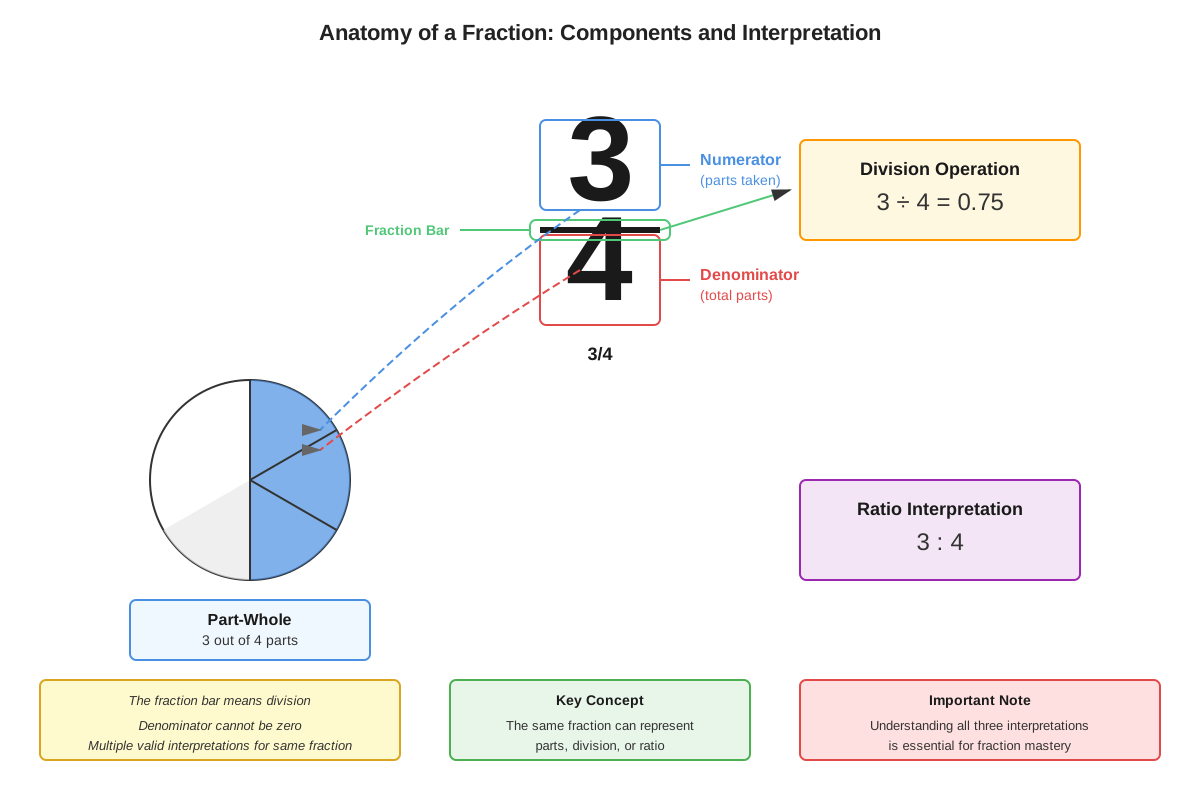
A fraction consists of two integers separated by a horizontal or diagonal line: the numerator (top number) represents the number of parts being considered, while the denominator (bottom number) represents the total number of equal parts in the whole. The fraction 3/4 means "3 parts out of 4 equal parts" or equivalently "3 divided by 4." The denominator can never be zero, as division by zero is undefined.
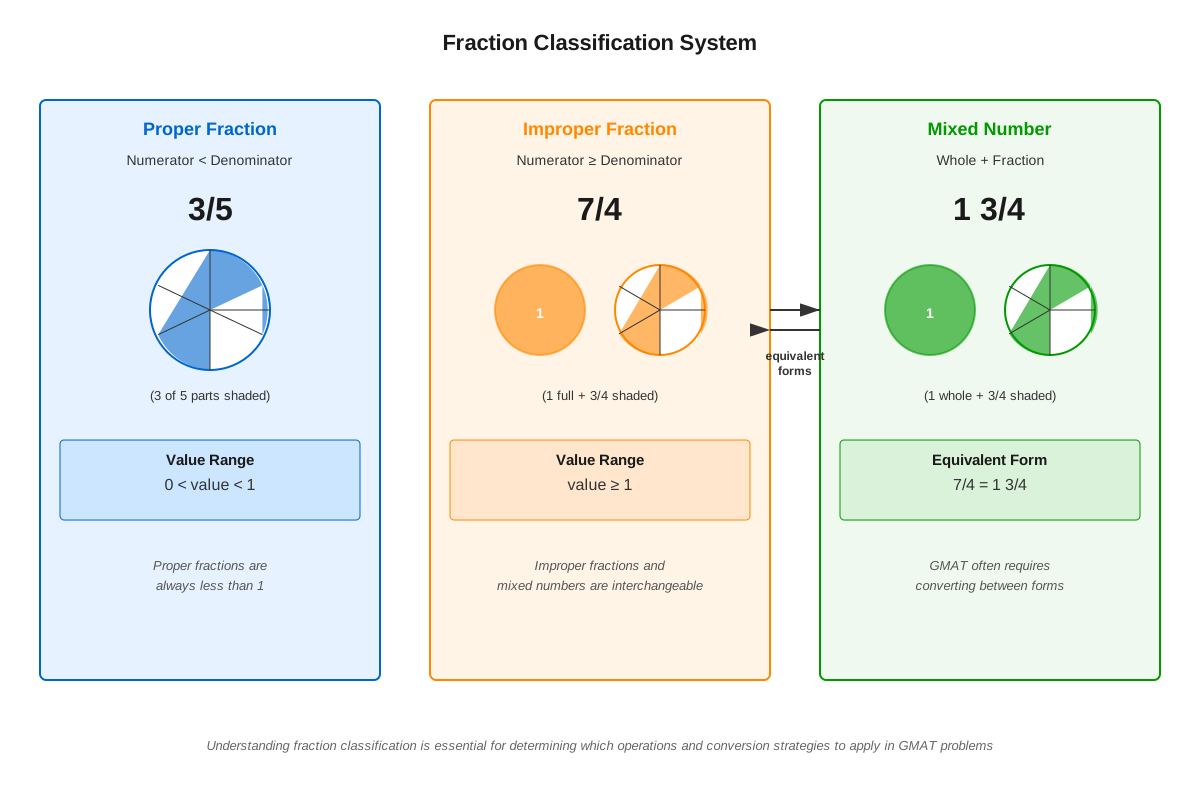
Fractions can be classified into three categories:
- Proper fractions: Numerator is less than denominator (e.g., 2/5, 7/9), resulting in values less than 1
- Improper fractions: Numerator is greater than or equal to denominator (e.g., 7/4, 9/9), resulting in values greater than or equal to 1
- Mixed numbers: Combination of a whole number and a proper fraction (e.g., 2 1/3, 5 3/8)
Equivalent Fractions and Simplification
Equivalent fractions represent the same value despite having different numerators and denominators. They are created by multiplying or dividing both the numerator and denominator by the same non-zero number. For example, 2/3 = 4/6 = 6/9 = 8/12. This principle is fundamental to fraction operations and comparison.
To simplify or reduce a fraction to lowest terms, divide both numerator and denominator by their greatest common factor (GCF). For example, to simplify 24/36:
- Find the GCF of 24 and 36, which is 12
- Divide both by 12: 24÷12 = 2 and 36÷12 = 3
- Result: 24/36 = 2/3
The GMAT often requires recognizing when fractions are equivalent or when simplification will make calculations easier. A fraction is in simplest form when the numerator and denominator share no common factors other than 1.
Converting Between Forms
Converting between improper fractions and mixed numbers:
- Improper to mixed: Divide numerator by denominator; the quotient becomes the whole number, the remainder becomes the new numerator, and the denominator stays the same. Example: 17/5 = 3 2/5 (since 17÷5 = 3 remainder 2)
- Mixed to improper: Multiply the whole number by the denominator, add the numerator, and place the result over the original denominator. Example: 3 2/5 = (3×5 + 2)/5 = 17/5
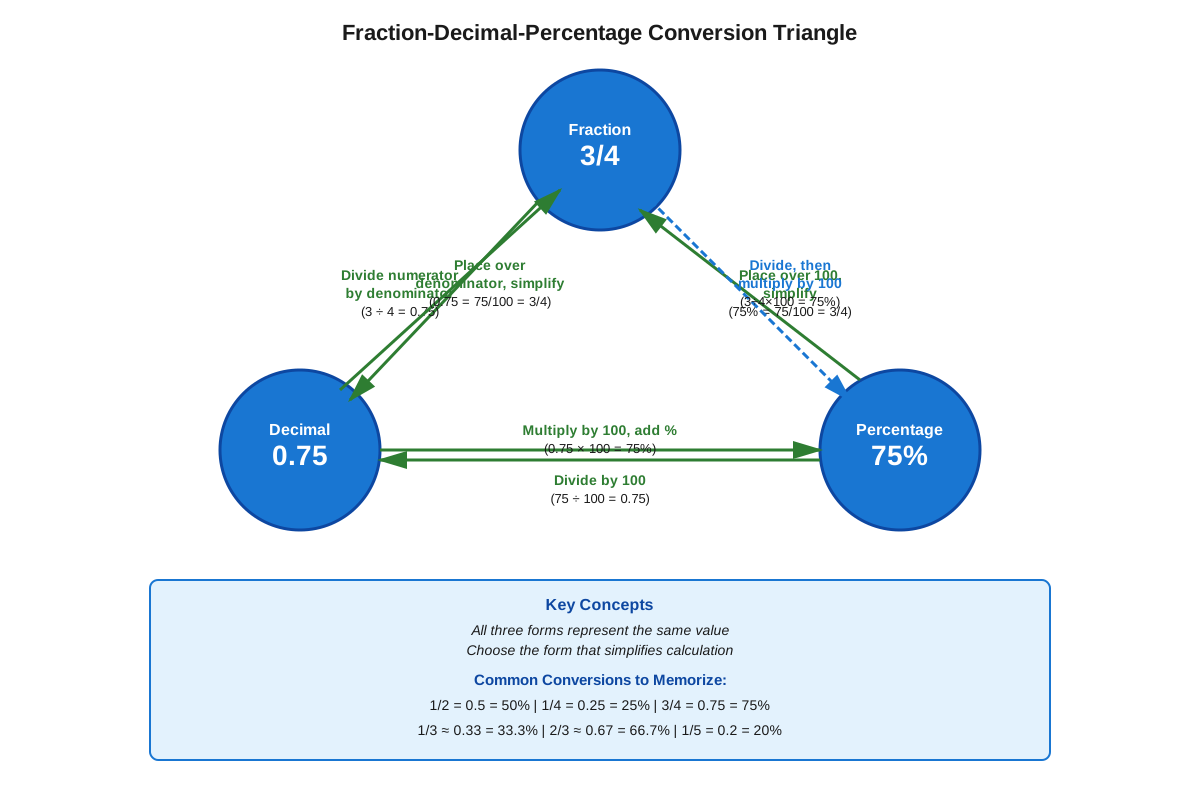
Converting fractions to decimals: Divide the numerator by the denominator. Example: 3/8 = 0.375
Converting decimals to fractions: Place the decimal digits over the appropriate power of 10 and simplify. Example: 0.375 = 375/1000 = 3/8
Addition and Subtraction of Fractions
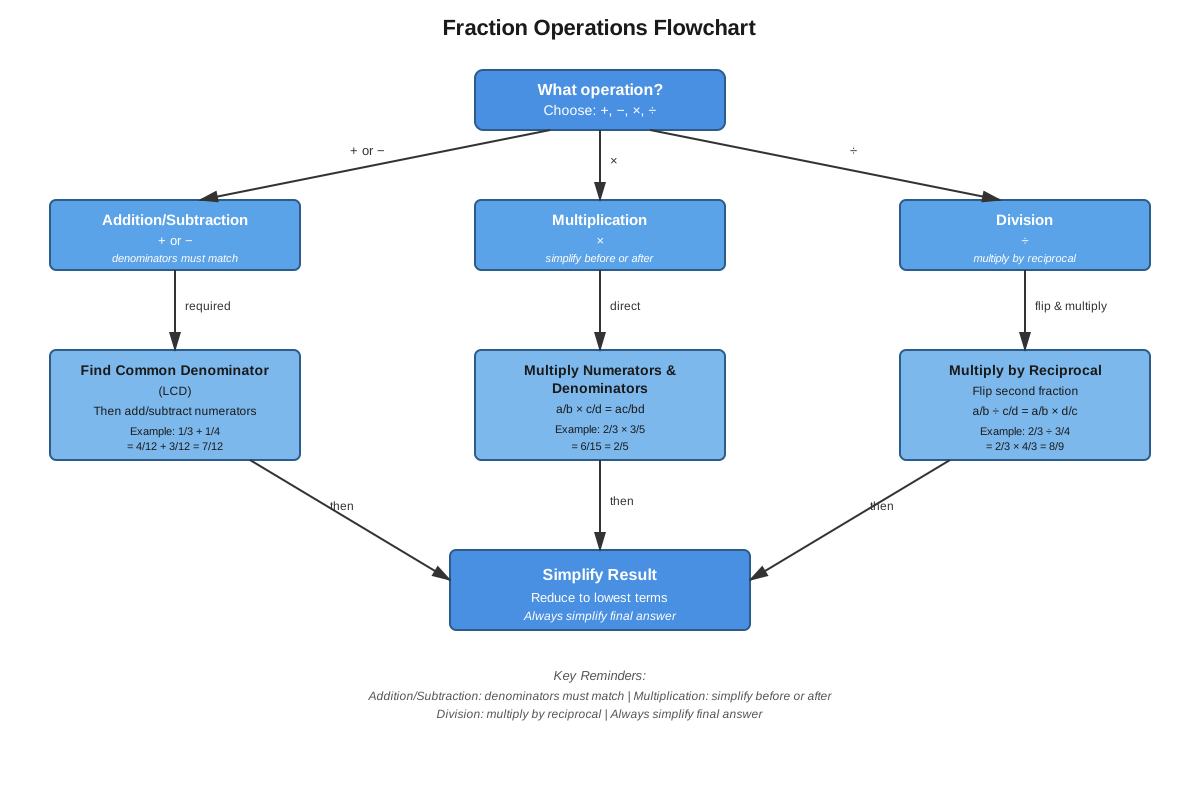
To add or subtract fractions, they must have a common denominator. The process involves:
- Find the least common denominator (LCD): the smallest number that is a multiple of all denominators
- Convert each fraction to an equivalent fraction with the LCD
- Add or subtract the numerators while keeping the denominator the same
- Simplify the result if possible
Example: 2/3 + 3/4
- LCD of 3 and 4 is 12
- 2/3 = 8/12 and 3/4 = 9/12
- 8/12 + 9/12 = 17/12 = 1 5/12
For mixed numbers, either convert to improper fractions first or add/subtract the whole numbers and fractions separately.
Multiplication of Fractions
Multiplying fractions is straightforward: multiply the numerators together and multiply the denominators together, then simplify.
a/b × c/d = (a×c)/(b×d)Example: 2/3 × 4/5 = 8/15
Cross-cancellation is a time-saving technique: before multiplying, cancel common factors between any numerator and any denominator. Example:
- 4/9 × 3/8: Cancel the 4 and 8 (divide both by 4), and cancel the 3 and 9 (divide both by 3)
- Result: 1/3 × 1/2 = 1/6
When multiplying mixed numbers, convert to improper fractions first.
Division of Fractions
To divide fractions, multiply by the reciprocal (multiplicative inverse) of the divisor. The reciprocal of a/b is b/a.
a/b ÷ c/d = a/b × d/c = (a×d)/(b×c)Example: 2/3 ÷ 4/5 = 2/3 × 5/4 = 10/12 = 5/6
Remember the phrase "keep, change, flip": keep the first fraction, change division to multiplication, flip the second fraction.
Comparing Fractions
Several methods exist for comparing fractions:
| Method | When to Use | Example |
|---|---|---|
| Common denominator | Any fractions | 2/3 vs 3/4: Convert to 8/12 vs 9/12 |
| Cross-multiplication | Two fractions only | 2/3 vs 3/4: 2×4=8, 3×3=9, so 2/3 < 3/4 |
| Convert to decimals | When calculator available | 2/3=0.667, 3/4=0.75 |
| Benchmark comparison | Quick estimation | Both near 1, but 3/4 is closer |
Cross-multiplication for comparing a/b and c/d: Calculate a×d and b×c. If a×d > b×c, then a/b > c/d.
Complex Fractions
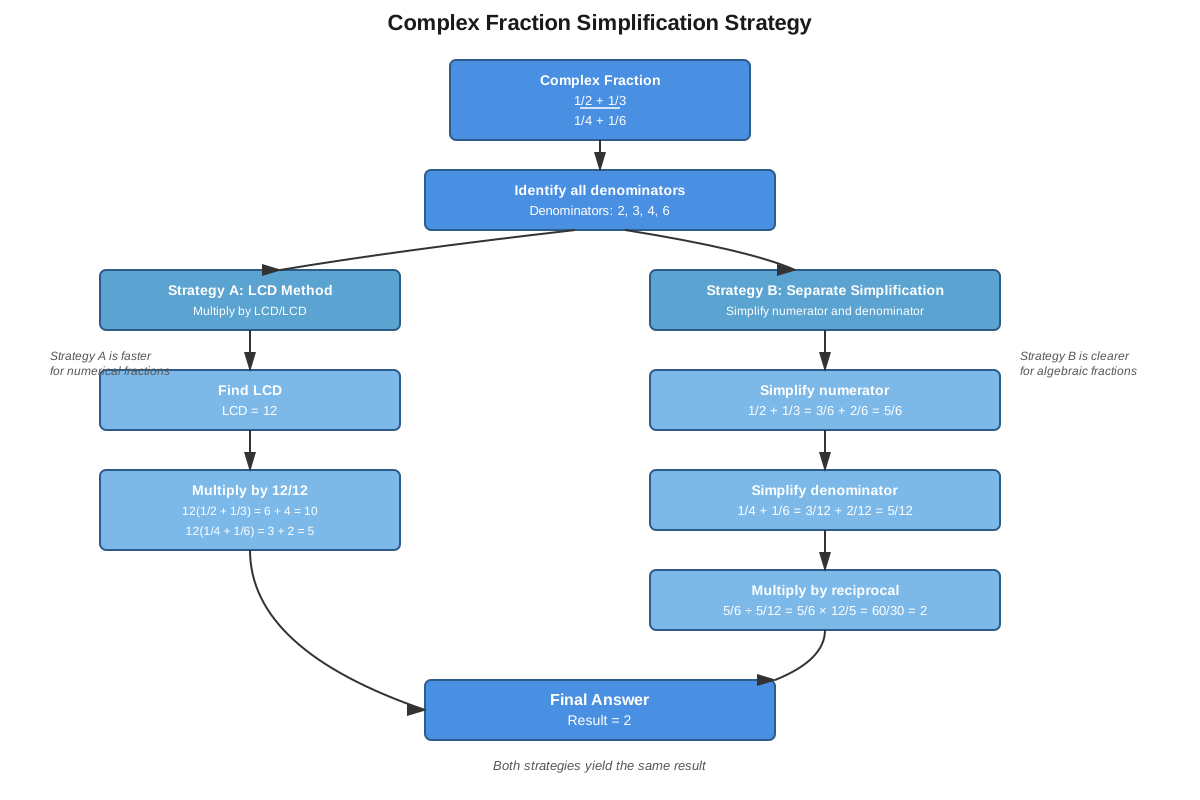
A complex fraction has a fraction in its numerator, denominator, or both. To simplify:
Method 1: Multiply both numerator and denominator by the LCD of all fractions involved
Method 2: Simplify the numerator and denominator separately, then divide
Example: Simplify (2/3)/(4/5)
- This is equivalent to 2/3 ÷ 4/5
- Result: 2/3 × 5/4 = 10/12 = 5/6
Concept Relationships
The concepts within fractions build upon each other in a logical progression. Understanding the definition and components of fractions provides the foundation for recognizing equivalent fractions, which in turn enables simplification. The ability to find equivalent fractions is essential for addition and subtraction, as these operations require common denominators. Multiplication concepts lead directly to understanding division through the reciprocal relationship. All these operational skills combine when working with complex fractions and comparing fractions.
Fractions connect extensively to prerequisite topics: divisibility rules and prime factorization enable efficient simplification and finding common denominators; basic arithmetic operations provide the computational foundation; order of operations governs how fractions interact in complex expressions.
Looking forward, fraction mastery enables progression to related topics: fractions form the conceptual basis for ratios and proportions (which are essentially comparisons of fractions), percentages (fractions with denominator 100), rates (fractions expressing relationships between different units), and probability (fractions representing favorable outcomes over total outcomes). Additionally, algebraic fractions extend these concepts by introducing variables, requiring the same operational rules applied in more abstract contexts.
The relationship map flows as follows:
Basic fraction understanding → Equivalent fractions and simplification → Addition/subtraction with common denominators → Multiplication and division → Complex fractions → Application in ratios, rates, percentages, and probability
Quick check — test yourself on Fractions so far.
Try Flashcards →High-Yield Facts
⭐ Any number divided by itself equals 1: a/a = 1 for any non-zero value a
⭐ Multiplying by a fraction less than 1 decreases the value: If 0 < a/b < 1, then (a/b) × c < c
⭐ Dividing by a fraction less than 1 increases the value: If 0 < a/b < 1, then c ÷ (a/b) > c
⭐ The reciprocal of a proper fraction is an improper fraction: If a/b < 1, then b/a > 1
⭐ To compare fractions with the same numerator, the fraction with the smaller denominator is larger: 3/4 > 3/5
- When adding/subtracting fractions, the denominator never changes in the final step—only numerators are added or subtracted
- A fraction equals zero only when its numerator equals zero (and denominator is non-zero)
- Multiplying any number by its reciprocal always equals 1: (a/b) × (b/a) = 1
- The product of two proper fractions is always less than either factor
- Converting a fraction to a decimal may result in a terminating decimal (like 1/4 = 0.25) or a repeating decimal (like 1/3 = 0.333...)
- When both numerator and denominator of a fraction are multiplied by the same negative number, the fraction's value remains unchanged
- The fraction a/b can be interpreted as "a divided by b" or as "a parts out of b total parts"
- In a fraction, increasing the numerator increases the value; increasing the denominator decreases the value
- The LCD of two numbers is always less than or equal to their product
- Fractions between 0 and 1 become smaller as you multiply them together repeatedly
Common Misconceptions
Misconception: When adding fractions, add the numerators and add the denominators (e.g., 1/2 + 1/3 = 2/5)
Correction: Fractions must have a common denominator before adding. The correct calculation is 1/2 + 1/3 = 3/6 + 2/6 = 5/6. Adding denominators violates the fundamental principle that fractions represent parts of a whole—you cannot combine parts of different-sized wholes without first making them the same size.
Misconception: A larger denominator always means a larger fraction
Correction: For positive fractions with the same numerator, a larger denominator actually means a smaller fraction. For example, 1/5 < 1/3 because dividing something into more pieces makes each piece smaller. The relationship between denominator size and fraction value depends on the numerator.
Misconception: You can cancel terms across addition or subtraction (e.g., (x+3)/(x+5) = 3/5)
Correction: Cancellation only works with multiplication and division, never with addition or subtraction. The expression (x+3)/(x+5) cannot be simplified by canceling the x terms. Cancellation requires common factors in the entire numerator and entire denominator.
Misconception: The reciprocal of a negative fraction is positive
Correction: The reciprocal of a negative fraction remains negative. The reciprocal of -2/3 is -3/2, not 3/2. Taking the reciprocal flips the numerator and denominator but does not change the sign.
Misconception: When dividing fractions, you flip both fractions
Correction: Only the second fraction (the divisor) is flipped when dividing. The operation a/b ÷ c/d becomes a/b × d/c, not b/a × d/c. The first fraction remains unchanged while you multiply by the reciprocal of the second.
Misconception: Mixed numbers can be multiplied by just multiplying the whole numbers and fractions separately
Correction: Mixed numbers must be converted to improper fractions before multiplying. For example, 2 1/2 × 3 1/3 ≠ 6 1/6. The correct approach is to convert: 5/2 × 10/3 = 50/6 = 8 1/3.
Misconception: A fraction in simplest form must have a numerator smaller than 10
Correction: A fraction is in simplest form when the numerator and denominator share no common factors other than 1, regardless of their size. The fraction 23/47 is in simplest form even though both numbers are large, because 23 and 47 are both prime and share no common factors.
Worked Examples
Example 1: Multi-Step Fraction Problem
Problem: A recipe calls for 2 2/3 cups of flour. If Sarah wants to make 1 1/2 times the recipe, how many cups of flour does she need? Express your answer as a mixed number in simplest form.
Solution:
Step 1: Convert mixed numbers to improper fractions
- 2 2/3 = (2×3 + 2)/3 = 8/3
- 1 1/2 = (1×2 + 1)/2 = 3/2
Step 2: Multiply the fractions
- 8/3 × 3/2
Step 3: Apply cross-cancellation before multiplying
- The 3 in the numerator and the 3 in the denominator cancel
- Result: 8/1 × 1/2 = 8/2 = 4
Step 4: Simplify
- 8/2 = 4/1 = 4
Answer: Sarah needs 4 cups of flour.
Connection to learning objectives: This problem requires identifying fractions in mixed number form, converting between forms, applying multiplication operations, and simplifying the result—demonstrating comprehensive fraction mastery essential for GMAT word problems.
Example 2: Comparing Fractions with Different Denominators
Problem: Arrange the following fractions in order from least to greatest: 5/8, 7/12, 2/3, 3/5
Solution:
Method 1: Common Denominator Approach
Step 1: Find the LCD of 8, 12, 3, and 5
- Prime factorizations: 8 = 2³, 12 = 2²×3, 3 = 3, 5 = 5
- LCD = 2³ × 3 × 5 = 120
Step 2: Convert each fraction to equivalent fraction with denominator 120
- 5/8 = 75/120 (multiply by 15/15)
- 7/12 = 70/120 (multiply by 10/10)
- 2/3 = 80/120 (multiply by 40/40)
- 3/5 = 72/120 (multiply by 24/24)
Step 3: Compare numerators
- 70/120 < 72/120 < 75/120 < 80/120
Answer: 7/12 < 3/5 < 5/8 < 2/3
Method 2: Convert to Decimals (Alternative)
- 5/8 = 0.625
- 7/12 ≈ 0.583
- 2/3 ≈ 0.667
- 3/5 = 0.6
Same ordering: 7/12 < 3/5 < 5/8 < 2/3
Connection to learning objectives: This problem demonstrates multiple methods for comparing fractions, a critical skill for GMAT data sufficiency and problem-solving questions. It also reinforces finding common denominators and converting between fractions and decimals.
Example 3: Complex Fraction Simplification
Problem: Simplify the complex fraction: (3/4 + 1/6) / (5/8 - 1/4)
Solution:
Step 1: Simplify the numerator (3/4 + 1/6)
- LCD of 4 and 6 is 12
- 3/4 = 9/12 and 1/6 = 2/12
- 9/12 + 2/12 = 11/12
Step 2: Simplify the denominator (5/8 - 1/4)
- LCD of 8 and 4 is 8
- 5/8 = 5/8 and 1/4 = 2/8
- 5/8 - 2/8 = 3/8
Step 3: Divide the simplified numerator by the simplified denominator
- (11/12) ÷ (3/8)
- (11/12) × (8/3)
Step 4: Multiply and simplify
- Cross-cancel: 12 and 8 share a factor of 4
- (11/3) × (2/1) = 22/3
Step 5: Convert to mixed number if desired
- 22/3 = 7 1/3
Answer: 22/3 or 7 1/3
Connection to learning objectives: This problem integrates multiple fraction operations—addition, subtraction, and division—within a complex fraction structure, demonstrating the type of multi-step reasoning the GMAT frequently tests.
Exam Strategy
When approaching GMAT fraction questions, begin by identifying what form the answer choices are in—fractions, decimals, or mixed numbers. This often indicates the most efficient solution path. If answer choices are fractions in simplest form, avoid converting to decimals and work with fractions throughout. If answer choices are decimals, converting fractions early may save time.
Trigger words and phrases to watch for include: "what fraction," "part of," "ratio of," "divided by," "per," "out of," "of the total," and "remains." These phrases signal that fraction setup or manipulation will be required. In word problems, "of" typically means multiplication (e.g., "1/3 of 60" means 1/3 × 60).
For data sufficiency questions involving fractions, remember that knowing a fraction of an unknown quantity is insufficient to determine the actual value unless you also know the total. For example, knowing that someone completed 2/3 of a task doesn't tell you how much work was done unless you know the total amount of work. Conversely, if you know both a fraction and the actual value it represents, you can determine the total.
Process of elimination strategies:
- Eliminate answers that are clearly too large or too small by estimating
- If multiplying two proper fractions, eliminate any answer greater than either factor
- If dividing by a proper fraction, eliminate any answer smaller than the dividend
- Check whether the answer should be greater than or less than 1 based on the operation
Time allocation: Simple fraction operations should take 30-45 seconds. Complex multi-step problems may require 1.5-2 minutes. If a problem requires finding a common denominator for three or more fractions with large denominators, consider whether converting to decimals might be faster, especially if a calculator is available (though not on the GMAT Quantitative section).
Strategic shortcuts:
- Recognize common fraction-decimal equivalents (1/2=0.5, 1/4=0.25, 1/5=0.2, 1/8=0.125, 1/3≈0.33, 2/3≈0.67)
- Use cross-cancellation before multiplying to avoid working with large numbers
- When comparing fractions, if one fraction is clearly closer to 0, 1/2, or 1, use benchmark comparison rather than finding common denominators
- For complex fractions, simplify the numerator and denominator separately before dividing
Memory Techniques
KCF for Division: "Keep, Change, Flip" reminds you to keep the first fraction unchanged, change division to multiplication, and flip (take the reciprocal of) the second fraction.
LCD Finder: "Prime Time" - remember to use prime factorization to find the LCD efficiently. Take the highest power of each prime that appears in any denominator.
Fraction Comparison Rhyme: "Same top, smaller bottom, fraction's bigger" - when numerators are equal, the fraction with the smaller denominator is larger.
MADSPM for Operations:
- Multiply straight across (numerators together, denominators together)
- Add/subtract needs common denominators
- Divide means multiply by reciprocal
- Simplify by finding GCF
- Proper fractions are less than 1
- Mixed numbers need conversion for multiplication/division
Visualization Strategy: Picture fractions as pizza slices. 1/4 is one slice of a pizza cut into 4 pieces. This visualization helps with comparing fractions (more slices means smaller pieces if the pizza is the same size) and understanding operations (adding 1/4 + 1/4 means combining two slices from the same pizza).
Reciprocal Reminder: "Flip it to divide it" - whenever you see division with fractions, immediately think "reciprocal."
Benchmark Anchors: Memorize that 1/2 = 0.5, and use this as a reference point. Fractions like 3/7 or 4/9 are slightly more than 1/2, while 2/5 or 3/8 are slightly less. This enables quick estimation without calculation.
Summary
Fractions represent parts of a whole and are fundamental to GMAT Quantitative Reasoning success. Mastery requires understanding fraction components (numerator and denominator), recognizing equivalent fractions, and performing all four basic operations accurately. Addition and subtraction require common denominators, while multiplication involves multiplying straight across (with cross-cancellation as a shortcut), and division requires multiplying by the reciprocal. Converting between improper fractions, mixed numbers, and decimals enables flexibility in problem-solving. Comparing fractions can be accomplished through common denominators, cross-multiplication, or decimal conversion. Complex fractions are simplified by treating them as division problems. The GMAT tests fractions both directly through computational problems and indirectly through applications in ratios, rates, percentages, and word problems. Strategic approaches include recognizing when to convert between forms, using estimation to eliminate answer choices, and applying shortcuts like cross-cancellation. Understanding that fractions less than 1 decrease values when multiplying and increase values when dividing is crucial for both calculation and conceptual questions.
Key Takeaways
- Fractions require common denominators for addition and subtraction, but not for multiplication and division
- Multiplying by a fraction less than 1 decreases the value; dividing by a fraction less than 1 increases the value
- Division of fractions is accomplished by multiplying by the reciprocal (flip the second fraction)
- Equivalent fractions are created by multiplying or dividing both numerator and denominator by the same non-zero number
- Cross-cancellation before multiplying fractions saves time and reduces the need for simplification afterward
- The GMAT frequently tests conceptual understanding of fractions rather than pure computation
- Converting between fractions, decimals, and mixed numbers provides strategic flexibility in problem-solving
Related Topics
Ratios and Proportions: Ratios are comparisons of two quantities expressed as fractions. Mastering fractions enables understanding of ratio relationships, proportion solving, and scale problems that frequently appear on the GMAT.
Percentages: Percentages are fractions with denominator 100. Fraction proficiency directly translates to percentage calculations, including percent increase/decrease, compound interest, and percentage-based word problems.
Rates and Work Problems: Rates express relationships between different units (distance/time, work/time) as fractions. Understanding fraction operations is essential for solving combined rate problems and work problems involving multiple workers.
Probability: Probability is expressed as a fraction of favorable outcomes over total outcomes. Fraction manipulation skills are necessary for calculating compound probabilities and conditional probabilities.
Algebraic Fractions: These extend fraction concepts by including variables in numerators and denominators, requiring the same operational rules applied in more abstract contexts, including rational expressions and equations.
Practice CTA
Now that you've mastered the core concepts of fractions, it's time to solidify your understanding through practice. Attempt the practice questions to test your ability to identify, explain, and apply fractions in various GMAT-style scenarios. Use the flashcards to reinforce high-yield facts and common patterns. Remember, fraction mastery is not just about getting the right answer—it's about developing the speed and strategic thinking necessary to excel under GMAT time pressure. Each practice problem you solve builds the pattern recognition and confidence you need for test day success. Start practicing now to transform your fraction skills from competent to exceptional!
Sign up free to keep reading
Create a free AnvayaPrep account to finish this GMAT guide on Fractions — plus flashcards and practice questions.