Overview
Multiples form a foundational pillar of arithmetic reasoning on the GMAT Quantitative section. A multiple of a number is the product of that number and any integer. For example, the multiples of 5 are 5, 10, 15, 20, and so on—each obtained by multiplying 5 by consecutive integers (1, 2, 3, 4, etc.). While this concept appears deceptively simple, the GMAT tests multiples in sophisticated ways that require deep understanding and quick pattern recognition. Questions involving multiples frequently appear in Problem Solving and Data Sufficiency formats, often disguised within word problems, number properties questions, or combined with other arithmetic concepts like factors, divisibility, and remainders.
Understanding multiples is crucial because they serve as the building blocks for more complex quantitative topics tested on the GMAT. Multiples connect directly to divisibility rules, least common multiples (LCM), greatest common factors (GCF), and prime factorization—all high-frequency GMAT topics. The ability to quickly identify whether one number is a multiple of another, or to determine how many multiples exist within a given range, can save valuable time on test day and unlock solutions to problems that initially appear complex.
The GMAT particularly favors questions that test multiples in combination with other concepts, such as consecutive integers, sets, sequences, and algebraic expressions. Test-makers design questions that require students to move beyond rote memorization and apply conceptual understanding to novel situations. Mastering GMAT multiples means developing both computational fluency and strategic thinking—recognizing patterns, eliminating impossible answer choices, and leveraging properties of multiples to simplify complex calculations. This topic typically accounts for 3-5 questions per GMAT exam, making it a high-yield area for focused study.
Learning Objectives
- [ ] Identify multiples of any given integer
- [ ] Explain the mathematical properties and characteristics of multiples
- [ ] Apply multiples concepts to solve GMAT Problem Solving questions
- [ ] Determine the number of multiples within a specified range
- [ ] Recognize when GMAT questions test multiples in disguised or combined formats
- [ ] Utilize multiples to eliminate incorrect answer choices efficiently
- [ ] Connect multiples to related concepts like divisibility, factors, and LCM
Prerequisites
- Basic multiplication and division: Essential for computing multiples and determining divisibility relationships between numbers
- Integer properties: Understanding positive and negative integers, zero, and how operations affect them is necessary since multiples are defined using integer multiplication
- Number line concepts: Helps visualize the spacing and distribution of multiples along the number line
- Basic algebraic notation: Required to understand and manipulate expressions involving multiples, such as 3n or 5k where n and k are integers
Why This Topic Matters
Multiples appear throughout real-world applications in scheduling, measurement, pattern recognition, and resource allocation. When coordinating events that occur at regular intervals, determining when they coincide requires understanding common multiples. In manufacturing and inventory management, ordering quantities in multiples of package sizes optimizes costs. These practical applications translate directly to GMAT word problems that test whether students can extract mathematical relationships from real-world scenarios.
On the GMAT specifically, multiples questions appear in approximately 8-12% of Quantitative Reasoning sections, making them a high-frequency topic. They most commonly appear in three formats: (1) direct identification questions asking whether specific numbers are multiples of given values, (2) range-counting problems requiring calculation of how many multiples exist between two boundaries, and (3) combined concept questions where multiples interact with divisibility, remainders, or algebraic expressions. Data Sufficiency questions particularly favor multiples because they allow test-makers to create scenarios where understanding the properties of multiples determines sufficiency without requiring full calculation.
The GMAT tests multiples in increasingly sophisticated ways at higher difficulty levels. Basic questions might ask for the 15th multiple of 7, while advanced questions embed multiples within complex word problems involving sets, sequences, or number properties. Questions might ask about multiples of algebraic expressions (like "multiples of x + 2"), multiples common to two or more numbers, or the relationship between multiples and remainders when dividing. Recognizing these patterns and understanding the underlying properties enables efficient problem-solving and accurate answer selection under time pressure.
Core Concepts
Definition and Basic Properties
A multiple of a number n is any value that can be expressed as n × k, where k is an integer. This means multiples result from multiplying the original number by whole numbers (including negative integers and zero). For example, the multiples of 4 include: ..., -12, -8, -4, 0, 4, 8, 12, 16, 20, ...
Key properties of multiples include:
- Every integer is a multiple of itself (n = n × 1)
- Every integer is a multiple of 1 (n = 1 × n)
- Zero is a multiple of every integer (0 = n × 0)
- Multiples extend infinitely in both positive and negative directions
- The set of multiples of any non-zero integer is infinite
Positive Multiples and Standard Notation
While multiples technically include negative values and zero, GMAT questions typically focus on positive multiples unless otherwise specified. When asked to "list the multiples of 6," the expected response is 6, 12, 18, 24, 30, ... rather than including negative values. This convention simplifies problem-solving and aligns with practical applications.
Multiples are often expressed algebraically using variables. The general form for multiples of n is:
Multiples of n: n, 2n, 3n, 4n, 5n, ...This notation proves particularly useful in GMAT questions involving algebraic expressions or when determining whether an expression represents a multiple of a specific value.
Identifying Multiples Through Divisibility
A number M is a multiple of n if and only if M is divisible by n with no remainder. This bidirectional relationship connects multiples to divisibility:
- If M = n × k (M is a multiple of n), then M ÷ n = k with remainder 0
- If M ÷ n yields an integer quotient with no remainder, then M is a multiple of n
This relationship enables quick identification of multiples using divisibility tests. For instance, to determine if 156 is a multiple of 12, divide: 156 ÷ 12 = 13 with no remainder, confirming that 156 is indeed a multiple of 12.
Counting Multiples in a Range
A frequent GMAT question type asks: "How many multiples of n exist between values a and b?" The formula for counting multiples in a range [a, b] is:
Number of multiples = (Largest multiple in range ÷ n) - (Smallest multiple in range ÷ n) + 1Alternatively, use this step-by-step approach:
- Find the smallest multiple of n that is ≥ a
- Find the largest multiple of n that is ≤ b
- Divide both by n to get their positions in the sequence
- Subtract and add 1: (position of largest - position of smallest) + 1
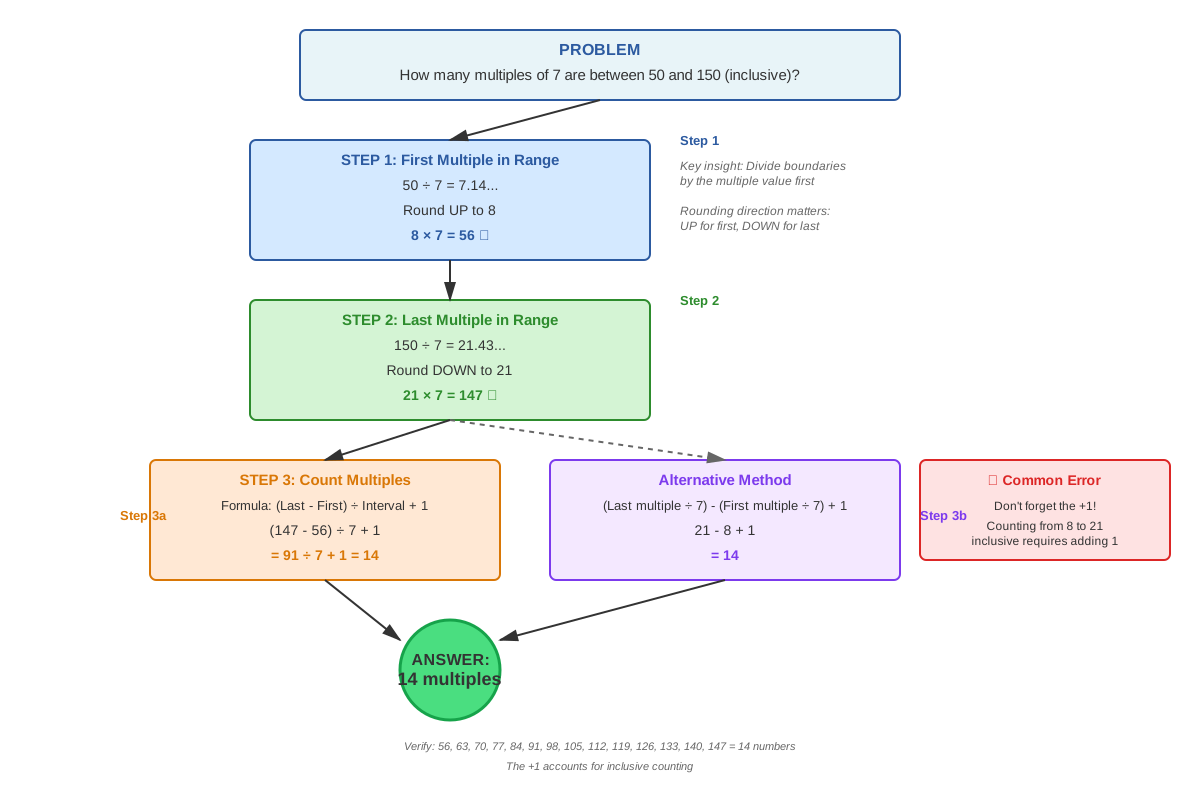
Example: How many multiples of 7 are between 50 and 150?
- Smallest multiple ≥ 50: 56 (7 × 8)
- Largest multiple ≤ 150: 147 (7 × 21)
- Count: 21 - 8 + 1 = 14 multiples
Common Multiples and Least Common Multiple (LCM)
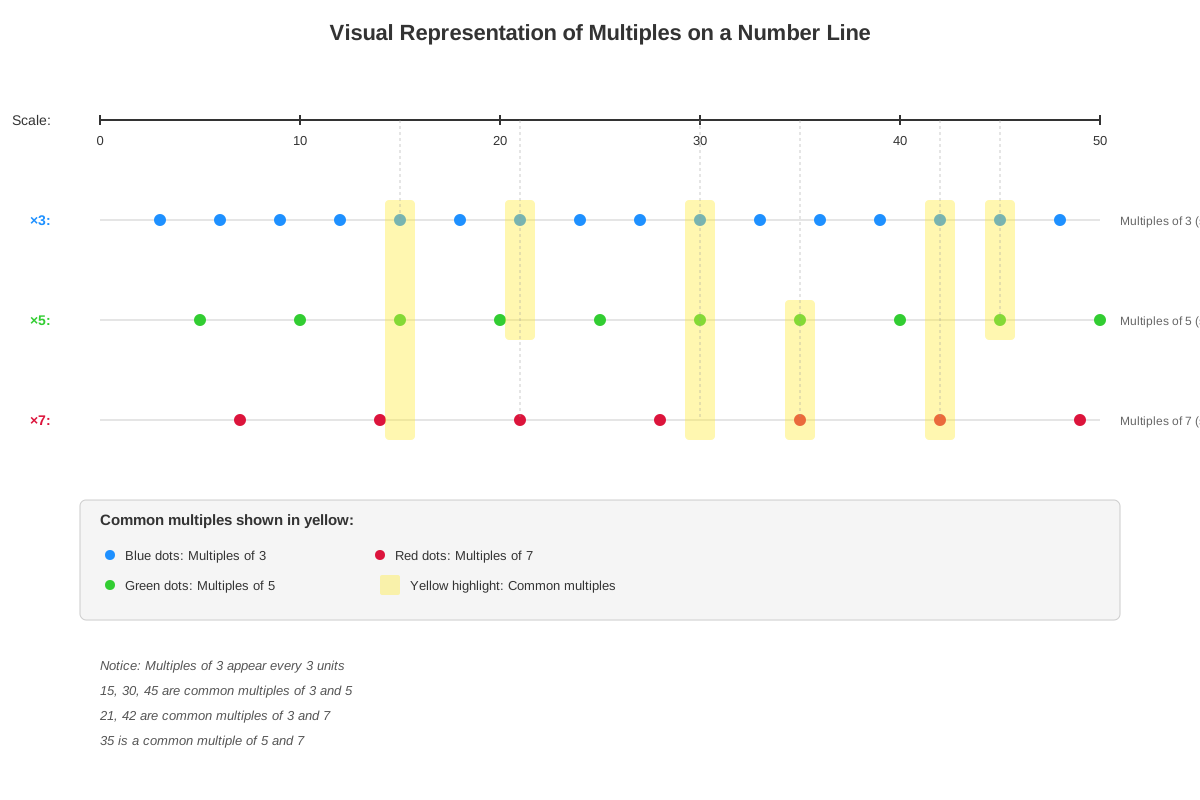
A common multiple of two or more numbers is a value that is a multiple of all the given numbers. For example, 24 is a common multiple of 6 and 8 because 24 = 6 × 4 and 24 = 8 × 3.
The Least Common Multiple (LCM) is the smallest positive common multiple of two or more numbers. The LCM represents the first point where the multiples of different numbers coincide. Finding the LCM is essential for problems involving synchronization, pattern repetition, or combining quantities.
| Numbers | Multiples | LCM |
|---|---|---|
| 4 and 6 | 4: 4, 8, 12, 16, 20, 24... 6: 6, 12, 18, 24, 30... | 12 |
| 5 and 7 | 5: 5, 10, 15, 20, 25, 30, 35... 7: 7, 14, 21, 28, 35... | 35 |
| 3, 4, and 6 | 3: 3, 6, 9, 12, 15, 18, 24... 4: 4, 8, 12, 16, 20, 24... 6: 6, 12, 18, 24... | 12 |
Properties of Multiples in Operations
Understanding how multiples behave under arithmetic operations helps solve complex GMAT problems:
Addition and Subtraction:
- The sum of two multiples of n is also a multiple of n
- The difference between two multiples of n is also a multiple of n
- Example: If 15 and 27 are both multiples of 3, then 15 + 27 = 42 and 27 - 15 = 12 are also multiples of 3
Multiplication:
- If M is a multiple of n, then k × M is also a multiple of n for any integer k
- The product of a multiple of n and any integer is a multiple of n
- Example: If 20 is a multiple of 5, then 20 × 7 = 140 is also a multiple of 5
Division:
- If M is a multiple of n, then M ÷ k may or may not be a multiple of n (depends on k)
- Example: 30 is a multiple of 6, but 30 ÷ 5 = 6 (still a multiple of 6), while 30 ÷ 4 = 7.5 (not a multiple of 6)
Multiples and Algebraic Expressions
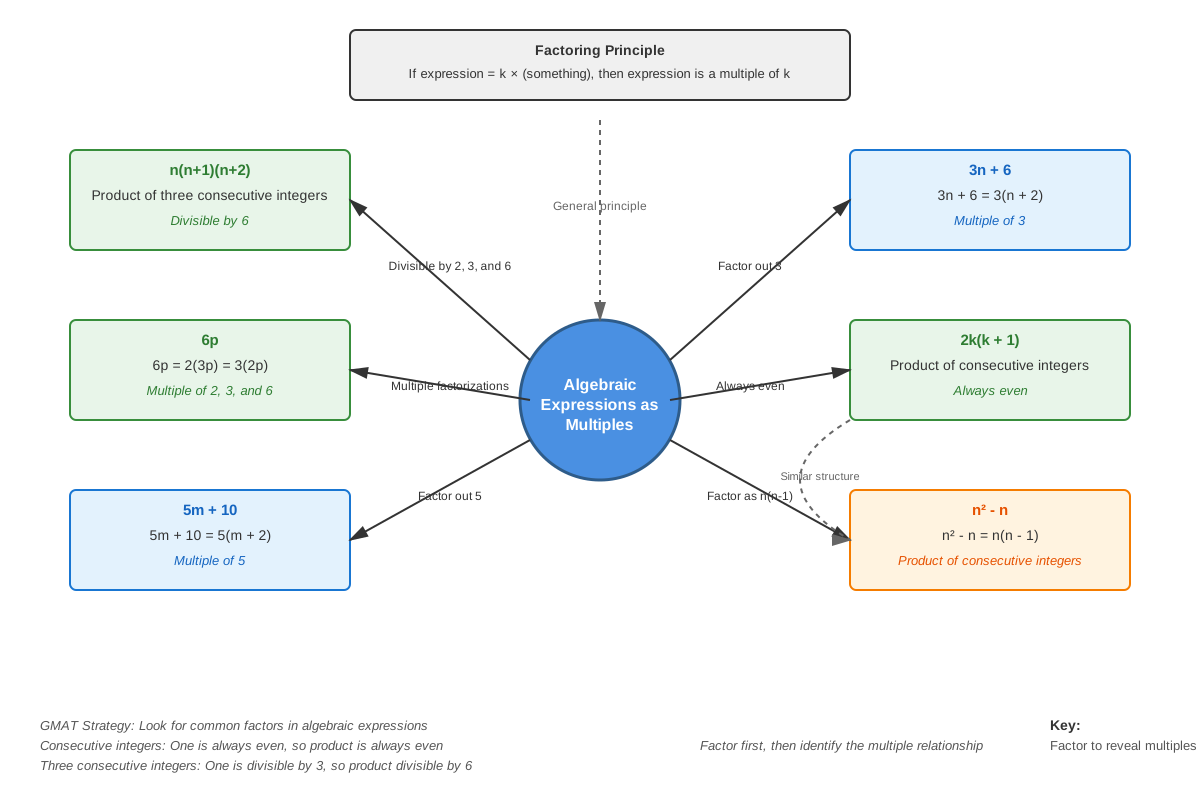
GMAT questions frequently present multiples in algebraic form. Recognizing these patterns is crucial:
- 3n represents all multiples of 3 (where n is any integer)
- 2k + 1 represents odd numbers (multiples of 1 with remainder 1 when divided by 2)
- 4m represents multiples of 4
- 6p + 3 represents multiples of 3 that leave remainder 3 when divided by 6 (equivalent to 3(2p + 1))
When determining if an expression is a multiple of a value, factor the expression and check if the desired value is a factor.
Concept Relationships
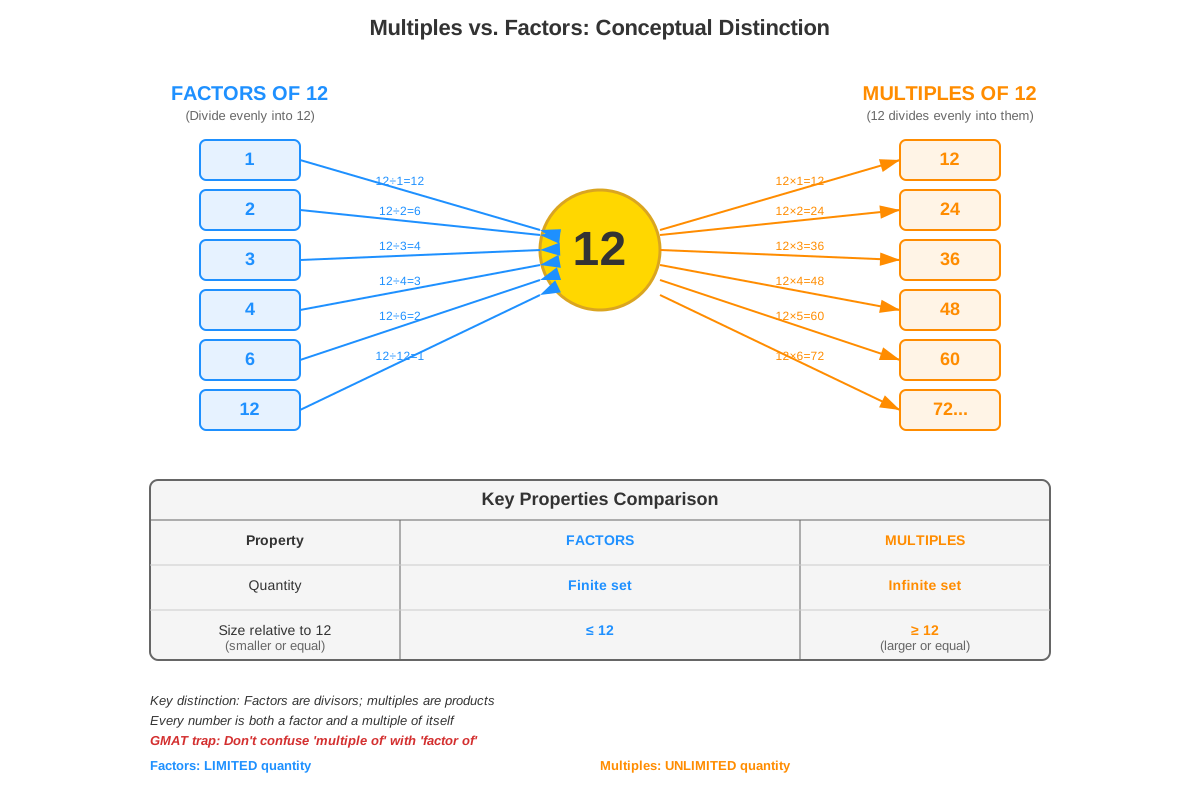
The concept of multiples sits at the center of a web of interconnected arithmetic topics. Multiples and factors represent inverse relationships: if M is a multiple of n, then n is a factor of M. This bidirectional connection means that understanding one concept reinforces the other. For example, knowing that 36 is a multiple of 9 is equivalent to knowing that 9 is a factor of 36.
Divisibility serves as the practical test for identifying multiples. The statement "M is a multiple of n" is logically equivalent to "M is divisible by n" or "n divides M evenly." This relationship enables the use of divisibility rules (shortcuts for testing divisibility by 2, 3, 4, 5, 6, 8, 9, and 10) to quickly identify multiples without performing full division.
The concept flow progresses as follows:
Basic Multiples → Common Multiples → Least Common Multiple (LCM) → Applications in word problems
Understanding individual multiples enables recognition of common multiples (values that are multiples of two or more numbers), which leads to finding the LCM (the smallest such common multiple). The LCM then becomes a tool for solving synchronization problems, fraction operations, and pattern-matching questions.
Multiples also connect forward to more advanced topics:
- Prime Factorization: Breaking numbers into prime factors provides the most efficient method for finding LCM
- Remainders: Understanding multiples clarifies remainder patterns (a number that is "3 more than a multiple of 5" can be expressed as 5k + 3)
- Sequences and Series: Arithmetic sequences often involve multiples (the sequence 7, 14, 21, 28... consists of multiples of 7)
- Number Properties: Even numbers are multiples of 2; numbers divisible by 3 are multiples of 3
High-Yield Facts
⭐ Zero is a multiple of every integer because 0 = n × 0 for any value of n
⭐ Every positive integer has infinitely many multiples, extending without bound in the positive direction
⭐ The smallest positive multiple of any integer n is n itself (n = n × 1)
⭐ If a and b are both multiples of n, then a + b and a - b are also multiples of n
⭐ To count multiples of n between a and b (inclusive): find the largest and smallest multiples in the range, divide each by n, subtract, and add 1
- The LCM of two numbers is equal to their product divided by their GCF: LCM(a,b) = (a × b) / GCF(a,b)
- If two numbers are coprime (share no common factors except 1), their LCM equals their product
- Every multiple of n is also a multiple of every factor of n (if 24 is a multiple of 12, it's also a multiple of 6, 4, 3, and 2)
- Consecutive multiples of n are always separated by exactly n units on the number line
- The sum of k consecutive multiples of n equals n times the sum of k consecutive integers
- If M is a multiple of both a and b, then M is a multiple of LCM(a,b)
- Negative multiples follow the same patterns as positive multiples but extend in the negative direction
Quick check — test yourself on Multiples so far.
Try Flashcards →Common Misconceptions
Misconception: Zero is not a multiple of any number because "you can't multiply something to get zero."
Correction: Zero is a multiple of every integer because 0 = n × 0 for any value of n. This is a tested concept on the GMAT, particularly in Data Sufficiency questions where students must consider whether zero satisfies given conditions.
Misconception: The number 1 has no multiples except itself.
Correction: Every integer is a multiple of 1 because any number n can be expressed as 1 × n. The multiples of 1 include all integers: ..., -2, -1, 0, 1, 2, 3, ...
Misconception: When counting multiples in a range, simply divide the range by the number (e.g., there are 100 ÷ 5 = 20 multiples of 5 between 1 and 100).
Correction: This shortcut only works when the range starts at the multiple itself and includes the endpoint. The correct method requires finding the actual first and last multiples in the range, then calculating positions. Between 1 and 100 inclusive, there are indeed 20 multiples of 5 (5, 10, 15, ..., 100), but between 3 and 100, there are only 19 multiples of 5 (5, 10, 15, ..., 100).
Misconception: If a number is a multiple of 6, it must be a multiple of 12.
Correction: A multiple of 6 is only a multiple of 12 if it's also a multiple of 2 beyond what's required for 6. For example, 18 is a multiple of 6 but not of 12. A number is a multiple of 12 only if it's a multiple of both 3 and 4 (or equivalently, both 6 and 2 with the 2 being "extra").
Misconception: The LCM of two numbers is always larger than both numbers.
Correction: The LCM equals the larger number when one number is a multiple of the other. For example, LCM(4, 12) = 12, not some larger value. The LCM is the smallest number that is a multiple of both inputs, which may be one of the inputs themselves.
Misconception: Multiples only include positive numbers.
Correction: Mathematically, multiples include all products of a number with any integer, including negative integers and zero. However, GMAT questions typically focus on positive multiples unless explicitly stated otherwise. Always read the question carefully to determine the intended domain.
Misconception: If M is a multiple of n, then M ÷ 2 is a multiple of n ÷ 2.
Correction: This is only true if both M and n are even. For example, 21 is a multiple of 7, but 21 ÷ 2 = 10.5 is not a multiple of 7 ÷ 2 = 3.5 (and neither is even an integer). Division doesn't preserve the multiple relationship unless specific conditions are met.
Worked Examples
Example 1: Counting Multiples in a Range
Question: How many positive integers less than 200 are multiples of 4 but not multiples of 6?
Solution:
Step 1: Find the total number of multiples of 4 less than 200.
- Multiples of 4: 4, 8, 12, 16, ..., 196
- The largest multiple of 4 less than 200 is 196 = 4 × 49
- Therefore, there are 49 multiples of 4 less than 200
Step 2: Identify which multiples of 4 are also multiples of 6.
- A number is a multiple of both 4 and 6 if and only if it's a multiple of LCM(4, 6)
- LCM(4, 6) = 12 (since 4 = 2² and 6 = 2 × 3, LCM = 2² × 3 = 12)
- So we need to count multiples of 12 less than 200
Step 3: Count multiples of 12 less than 200.
- Multiples of 12: 12, 24, 36, ..., 192
- The largest multiple of 12 less than 200 is 192 = 12 × 16
- Therefore, there are 16 multiples of 12 less than 200
Step 4: Apply the exclusion principle.
- Multiples of 4 but not 6 = (Multiples of 4) - (Multiples of both 4 and 6)
- Answer: 49 - 16 = 33
Connection to Learning Objectives: This problem requires identifying multiples (of 4, 6, and 12), explaining the relationship between multiples and LCM, and applying these concepts to solve a complex counting problem typical of GMAT questions.
Example 2: Algebraic Multiples in Data Sufficiency
Question: If n is a positive integer, is 3n + 5 a multiple of 4?
(1) n is a multiple of 4
(2) n + 1 is odd
Solution:
Analyzing Statement (1): n is a multiple of 4
- If n is a multiple of 4, we can write n = 4k for some integer k
- Substituting: 3n + 5 = 3(4k) + 5 = 12k + 5
- For 12k + 5 to be a multiple of 4, we need 12k + 5 = 4m for some integer m
- This means 12k + 5 ≡ 0 (mod 4)
- Since 12k ≡ 0 (mod 4) and 5 ≡ 1 (mod 4), we have 12k + 5 ≡ 1 (mod 4)
- Therefore, 3n + 5 is NOT a multiple of 4 when n is a multiple of 4
- Statement (1) is SUFFICIENT to answer "no"
Analyzing Statement (2): n + 1 is odd
- If n + 1 is odd, then n must be even (since odd - 1 = even)
- But this doesn't tell us enough about n's relationship to 4
- If n = 2: 3(2) + 5 = 11 (not a multiple of 4)
- If n = 6: 3(6) + 5 = 23 (not a multiple of 4)
- If n = 10: 3(10) + 5 = 35 (not a multiple of 4)
- However, we need to check if there's any even n where 3n + 5 IS a multiple of 4
- For 3n + 5 to be a multiple of 4: 3n + 5 ≡ 0 (mod 4), so 3n ≡ -5 ≡ 3 (mod 4)
- This means n ≡ 1 (mod 4), so n could be 1, 5, 9, 13, ... (all odd)
- Since statement (2) tells us n is even, 3n + 5 cannot be a multiple of 4
- Statement (2) is SUFFICIENT to answer "no"
Answer: D (Each statement alone is sufficient)
Connection to Learning Objectives: This problem demonstrates applying multiples to GMAT Data Sufficiency questions, requiring understanding of algebraic expressions involving multiples and the ability to test specific cases systematically.
Exam Strategy
When approaching GMAT questions involving multiples, begin by identifying the trigger words: "multiple," "divisible by," "evenly divides," or phrases like "every nth term." These signals indicate that multiple-based reasoning will be central to the solution. Immediately clarify whether the question concerns positive multiples only or includes zero and negative values—this distinction frequently appears in Data Sufficiency questions.
For counting problems (e.g., "How many multiples of 7 are between 100 and 300?"), resist the urge to list all multiples manually. Instead, use the systematic approach: find the first multiple in the range, find the last multiple in the range, determine their positions in the sequence, and calculate the count. This method saves significant time and reduces arithmetic errors.
Exam Tip: When a question asks about multiples of two different numbers (like "multiples of both 6 and 8"), immediately think LCM. The common multiples are exactly the multiples of the LCM.
In Data Sufficiency questions, multiples create powerful sufficiency scenarios. Remember that knowing a number is a multiple of n tells you it's also a multiple of every factor of n. Conversely, if you need to determine whether something is a multiple of n, checking if it's a multiple of all of n's prime factors is equivalent. Use this to evaluate statements efficiently.
Process of elimination becomes particularly effective with multiples questions. If answer choices are numbers, quickly test divisibility using divisibility rules rather than performing full division. For example, to check if 2,346 is a multiple of 3, sum the digits (2+3+4+6=15); since 15 is divisible by 3, so is 2,346.
Time allocation for multiples questions should average 2 minutes for straightforward problems and up to 2.5 minutes for complex Data Sufficiency or word problems. If you find yourself listing more than 10-15 multiples manually, stop and reconsider your approach—there's likely a more efficient method using formulas or properties.
Watch for combined concept questions where multiples interact with:
- Remainders: "What is the remainder when a multiple of 7 is divided by 5?"
- Consecutive integers: "Three consecutive multiples of 4 sum to 84"
- Sets: "How many integers in set S are multiples of both 3 and 5?"
These require integrating multiple concepts simultaneously, so practice identifying which properties of multiples apply to each component of the problem.
Memory Techniques
Mnemonic for Multiple Properties - "ZIPS":
- Zero is a multiple of everything
- Infinite multiples exist for any non-zero integer
- Product of a multiple and any integer is also a multiple
- Sum and difference of multiples are multiples
Visualization Strategy: Picture multiples as evenly spaced markers on a number line. Multiples of 5 appear at 0, 5, 10, 15, 20... like fence posts at regular intervals. This mental image helps with counting problems and understanding why consecutive multiples differ by exactly n.
LCM Quick Check - "FLIP":
- Factors: List prime factors of each number
- Largest power: Take the highest power of each prime that appears
- Include all: Don't forget any prime that appears in either number
- Product: Multiply these together for the LCM
Acronym for Common Multiples - "SMALL":
- Smallest common multiple is the LCM
- Multiples of LCM are all common multiples
- All common multiples are divisible by LCM
- LCM divides every common multiple
- LCM × any integer gives another common multiple
Counting Formula Memory Aid: Think "Last minus First plus One" (LFO). When counting multiples in a range, find the position of the Last multiple, subtract the position of the First multiple, then add One to include both endpoints.
Summary
Multiples represent one of the most fundamental yet frequently tested concepts in GMAT Quantitative Reasoning. A multiple of n is any value expressible as n × k where k is an integer, creating an infinite sequence extending in both directions from zero. The GMAT tests multiples through direct identification, range counting, common multiples, and sophisticated combinations with divisibility, factors, and algebraic expressions. Mastery requires understanding that multiples and divisibility are equivalent concepts (M is a multiple of n if and only if n divides M evenly), recognizing that operations on multiples follow predictable patterns (sums and differences of multiples remain multiples), and efficiently applying counting formulas rather than manual enumeration. The Least Common Multiple (LCM) serves as the bridge between individual multiples and common multiples, representing the smallest value that is a multiple of two or more numbers. Success on GMAT multiples questions demands both conceptual understanding—knowing why properties hold—and procedural fluency—executing calculations accurately under time pressure. Students must recognize trigger words, apply systematic approaches to counting problems, leverage properties for elimination strategies, and integrate multiples with related concepts like remainders and prime factorization.
Key Takeaways
- Multiples are products: Any number M is a multiple of n if M = n × k for some integer k; this relationship is equivalent to saying n divides M evenly with no remainder
- Zero is special: Zero is a multiple of every integer, a fact frequently tested in Data Sufficiency questions where students must consider all possible values
- Counting requires precision: To count multiples of n in range [a, b], find the first and last multiples in the range, divide by n to get positions, subtract, and add 1—never simply divide the range by n
- Operations preserve multiples: The sum or difference of two multiples of n is always a multiple of n; the product of a multiple of n and any integer is a multiple of n
- LCM connects common multiples: Common multiples of two or more numbers are exactly the multiples of their LCM; this insight simplifies many GMAT problems involving synchronization or pattern matching
- Algebraic expressions follow patterns: Expressions like 3n represent all multiples of 3; recognizing these patterns enables quick identification of multiple relationships in algebraic contexts
- Efficiency trumps enumeration: GMAT rewards systematic approaches using formulas and properties over manual listing; practice recognizing when to apply shortcuts versus when to calculate directly
Related Topics
Factors and Divisibility: The inverse relationship to multiples, where factors divide evenly into numbers. Mastering multiples provides the foundation for understanding factor pairs, prime factorization, and divisibility rules—all essential for advanced number properties questions.
Greatest Common Factor (GCF): While multiples look at products extending upward, GCF examines the largest factor shared by numbers. The relationship GCF(a,b) × LCM(a,b) = a × b connects these concepts and appears in optimization problems.
Prime Numbers and Prime Factorization: Breaking numbers into prime factors provides the most efficient method for finding LCM and understanding multiple relationships. This topic builds directly on multiples mastery.
Remainders and Modular Arithmetic: Understanding what happens when division isn't exact—the complement to perfect divisibility. Multiples represent the case where remainders equal zero, making this a natural progression.
Sequences and Series: Arithmetic sequences often consist of multiples (e.g., 5, 10, 15, 20...), and understanding multiples enables quick identification of sequence patterns and sum calculations.
Practice CTA
Now that you've mastered the core concepts of multiples, it's time to solidify your understanding through active practice. Attempt the practice questions designed specifically for this topic, focusing on applying the strategies and formulas you've learned. Pay special attention to Data Sufficiency questions, where multiples concepts frequently determine sufficiency without requiring full calculations. Use the flashcards to reinforce high-yield facts and properties until they become automatic. Remember: GMAT success comes not just from knowing concepts but from recognizing patterns quickly and executing solutions efficiently under time pressure. Each practice problem you solve builds the pattern recognition and strategic thinking that will serve you on test day. You've built a strong foundation—now strengthen it through deliberate practice!
Sign up free to keep reading
Create a free AnvayaPrep account to finish this GMAT guide on Multiples — plus flashcards and practice questions.