Overview
Quadrilaterals represent one of the most frequently tested geometric shapes on the GMAT Quantitative Reasoning section. A quadrilateral is any four-sided polygon, and understanding the properties, classifications, and relationships among different types of quadrilaterals is essential for solving a wide range of geometry problems. The GMAT tests quadrilaterals not only in pure geometry questions but also integrates them into coordinate geometry, data sufficiency problems, and word problems involving area, perimeter, and optimization.
Mastery of GMAT quadrilaterals requires more than memorizing formulas—it demands the ability to recognize special properties, apply theorems efficiently, and make logical deductions from limited information. Questions often present incomplete information and ask test-takers to determine what additional data would be sufficient to solve a problem, making quadrilaterals a perfect vehicle for testing analytical reasoning. The topic appears in approximately 15-20% of geometry questions, which themselves constitute roughly 10-15% of the Quantitative section.
Within the broader Quantitative Reasoning framework, quadrilaterals connect directly to concepts of angles, triangles, coordinate geometry, and area calculations. Many complex GMAT problems require decomposing quadrilaterals into triangles or recognizing how quadrilaterals fit within coordinate planes. Understanding quadrilaterals also builds the foundation for three-dimensional geometry problems involving prisms and pyramids, where faces are often quadrilateral shapes.
Learning Objectives
- [ ] Identify different types of quadrilaterals based on their properties
- [ ] Explain the defining characteristics and theorems related to each quadrilateral type
- [ ] Apply quadrilateral properties to solve GMAT questions efficiently
- [ ] Calculate areas and perimeters of various quadrilaterals using appropriate formulas
- [ ] Recognize when to decompose quadrilaterals into simpler shapes for problem-solving
- [ ] Determine sufficiency of information in Data Sufficiency questions involving quadrilaterals
- [ ] Apply coordinate geometry principles to quadrilaterals on the coordinate plane
Prerequisites
- Basic angle relationships: Understanding supplementary, complementary, and vertical angles is essential since quadrilateral interior angles sum to 360°
- Triangle properties: Many quadrilateral problems require decomposing shapes into triangles or applying triangle theorems
- Area and perimeter fundamentals: Basic understanding of how to calculate these measurements for simple shapes
- Coordinate geometry basics: Plotting points and calculating distances on the coordinate plane helps solve quadrilateral problems in coordinate systems
- Algebraic manipulation: Setting up and solving equations is necessary when working with unknown side lengths or angles
Why This Topic Matters
Quadrilaterals appear throughout real-world applications in architecture, engineering, urban planning, and design. From rectangular building foundations to trapezoidal roof structures and rhombus-shaped tile patterns, understanding these shapes enables practical problem-solving in numerous professional contexts. The mathematical principles governing quadrilaterals also underpin computer graphics, game design, and geographic information systems.
On the GMAT specifically, quadrilateral questions appear in approximately 2-4 questions per exam, making them a high-yield topic for focused study. These questions typically appear as Problem Solving questions requiring area or perimeter calculations, Data Sufficiency questions testing understanding of what information determines a quadrilateral's properties, and integrated reasoning questions where quadrilaterals appear within charts or diagrams. The GMAT particularly favors questions about special quadrilaterals (rectangles, squares, parallelograms, trapezoids, and rhombuses) rather than irregular four-sided figures.
Common question formats include: determining whether given information is sufficient to calculate area; finding missing angles or side lengths using properties of special quadrilaterals; calculating perimeters when diagonal lengths are provided; and optimization problems asking for maximum or minimum areas given certain constraints. The exam also frequently combines quadrilaterals with coordinate geometry, asking test-takers to determine if four given points form a specific type of quadrilateral or to calculate areas using coordinate methods.
Core Concepts
Definition and Classification of Quadrilaterals
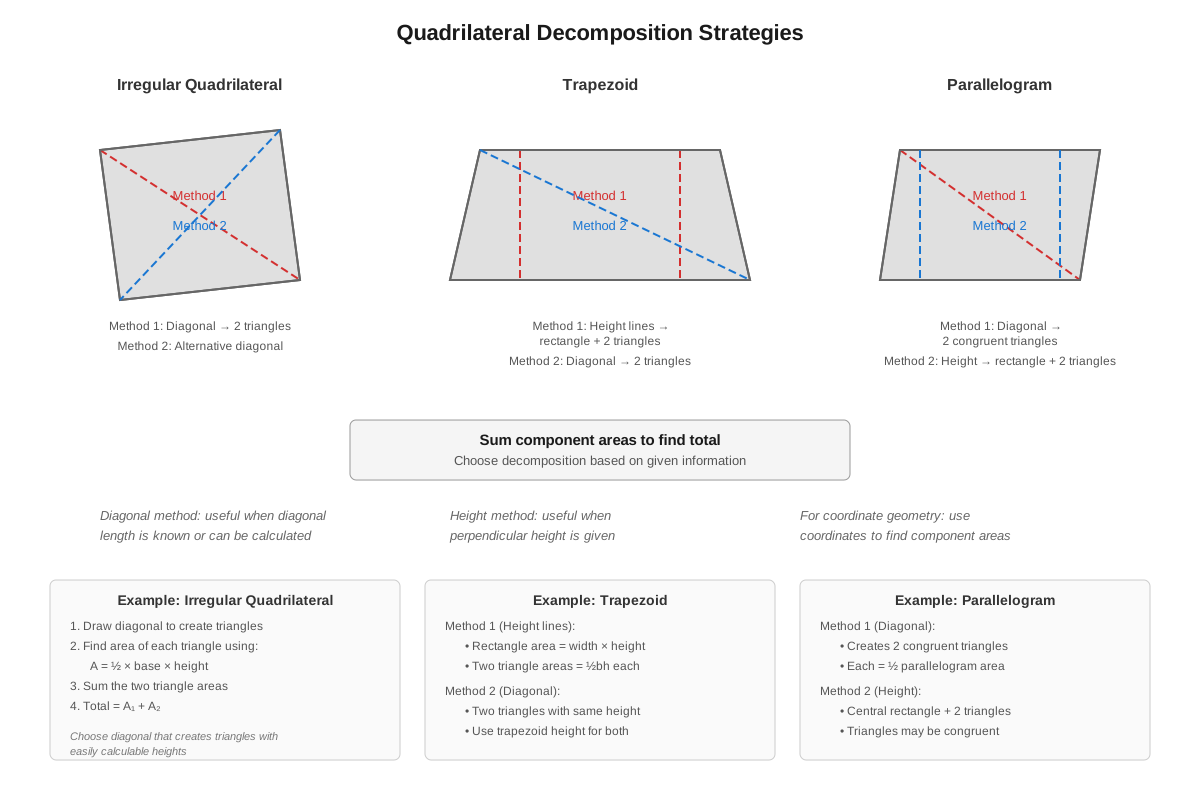
A quadrilateral is a closed two-dimensional polygon with exactly four sides, four vertices, and four interior angles. The sum of all interior angles in any quadrilateral always equals 360°, regardless of the shape's regularity or symmetry. This fundamental property derives from the fact that any quadrilateral can be divided into two triangles, each contributing 180° to the total angle sum.
Quadrilaterals are classified into several categories based on their properties:
- General quadrilaterals: Four-sided figures with no special properties
- Trapezoids: Quadrilaterals with at least one pair of parallel sides
- Parallelograms: Quadrilaterals with two pairs of parallel sides
- Rectangles: Parallelograms with four right angles
- Rhombuses: Parallelograms with four equal sides
- Squares: Quadrilaterals that are both rectangles and rhombuses (four equal sides and four right angles)
- Kites: Quadrilaterals with two pairs of adjacent equal sides
Trapezoids
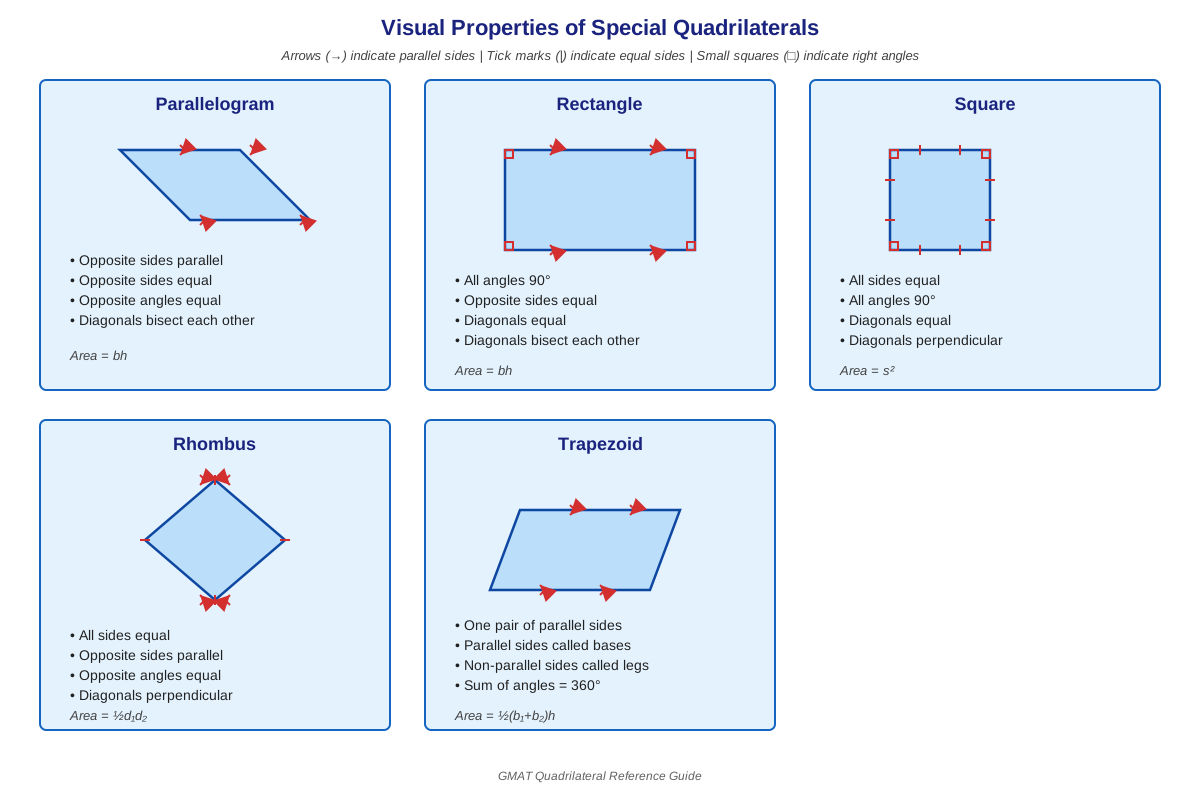
A trapezoid (called a trapezium in some countries) is defined as a quadrilateral with at least one pair of parallel sides. The parallel sides are called bases, while the non-parallel sides are called legs. An isosceles trapezoid is a special type where the legs are equal in length and the base angles are equal.
Key properties of trapezoids:
- The median (or midsegment) of a trapezoid is parallel to both bases and has length equal to the average of the two base lengths: median = (base₁ + base₂)/2
- In an isosceles trapezoid, the diagonals are equal in length
- The area formula for any trapezoid is: Area = ½ × (base₁ + base₂) × height, where height is the perpendicular distance between the parallel sides
Parallelograms
A parallelogram is a quadrilateral where both pairs of opposite sides are parallel. This single defining property generates numerous other characteristics that make parallelograms particularly important for GMAT problems.
Essential properties of parallelograms:
- Opposite sides are equal in length
- Opposite angles are equal in measure
- Consecutive angles are supplementary (sum to 180°)
- Diagonals bisect each other (cut each other in half at their intersection point)
- Each diagonal divides the parallelogram into two congruent triangles
- Area = base × height, where height is perpendicular to the base
- Alternative area formula: Area = side₁ × side₂ × sin(θ), where θ is the angle between the two sides
The diagonal properties are particularly useful in GMAT problems. If you know the coordinates of three vertices of a parallelogram, you can find the fourth vertex by using the fact that diagonals bisect each other—the midpoint of one diagonal equals the midpoint of the other diagonal.
Rectangles
A rectangle is a parallelogram with four right angles (90° angles). Because rectangles are special parallelograms, they inherit all parallelogram properties while adding additional characteristics.
Distinctive properties of rectangles:
- All four angles equal 90°
- Opposite sides are equal and parallel
- Diagonals are equal in length
- Diagonals bisect each other
- Area = length × width
- Perimeter = 2(length + width)
- Diagonal length can be found using the Pythagorean theorem: d² = l² + w²
Rectangles frequently appear in GMAT coordinate geometry problems because their sides align with the x and y axes, making calculations straightforward. They also appear in optimization problems asking for maximum area given a fixed perimeter, or vice versa.
Rhombuses
A rhombus (plural: rhombi or rhombuses) is a parallelogram with four equal sides. Like rectangles, rhombuses are special parallelograms with additional properties.
Key characteristics of rhombuses:
- All four sides are equal in length
- Opposite angles are equal
- Diagonals are perpendicular to each other
- Diagonals bisect the vertex angles
- Diagonals bisect each other
- Area = base × height (like any parallelogram)
- Area = ½ × d₁ × d₂, where d₁ and d₂ are the diagonal lengths
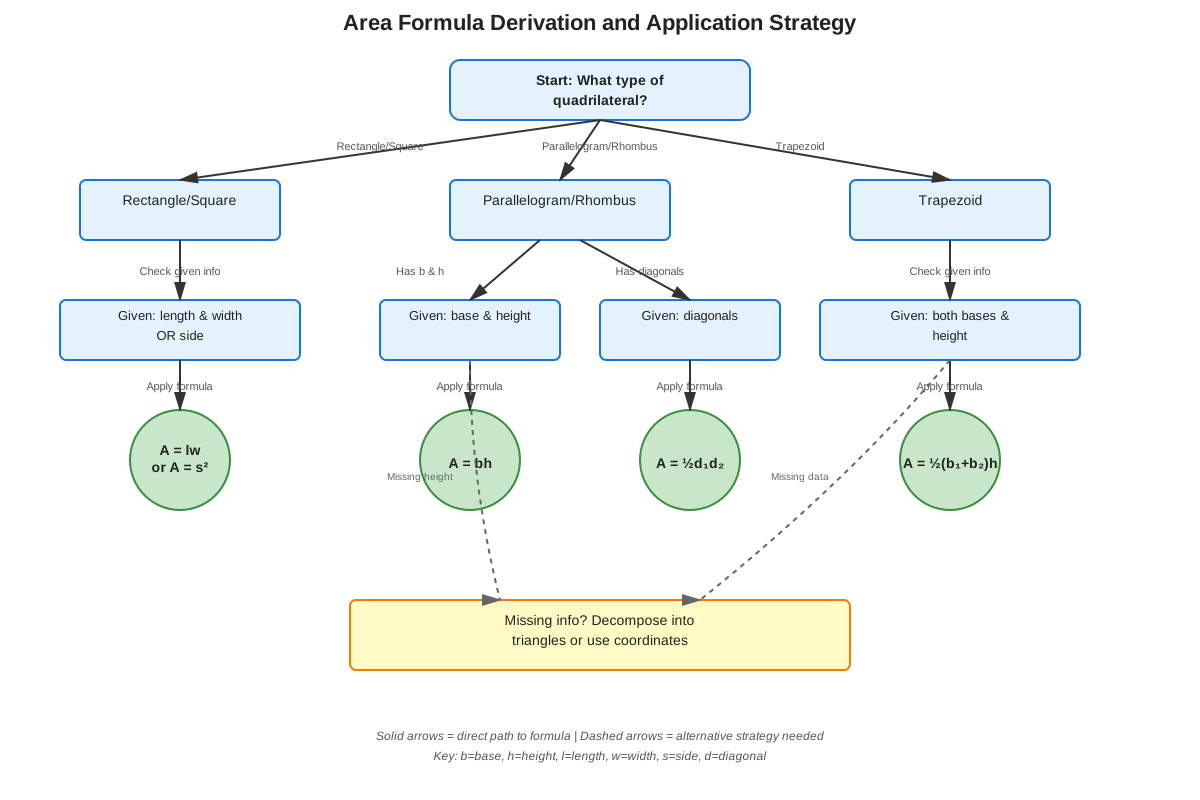
The diagonal-based area formula is particularly useful on the GMAT when diagonal lengths are easier to determine than the height. The perpendicularity of diagonals also creates four right triangles within the rhombus, enabling Pythagorean theorem applications.
Squares
A square is simultaneously a rectangle and a rhombus—it has four equal sides and four right angles. This makes squares the most regular and symmetric of all quadrilaterals.
Properties of squares:
- All sides are equal in length
- All angles equal 90°
- Diagonals are equal in length
- Diagonals are perpendicular
- Diagonals bisect each other at 90°
- Diagonals bisect the vertex angles (creating 45° angles)
- Area = side²
- Area = ½ × d², where d is the diagonal length
- Perimeter = 4 × side
- Diagonal length: d = side × √2
The relationship between side length and diagonal length (d = s√2) is frequently tested on the GMAT and should be memorized. This relationship derives from applying the Pythagorean theorem to the right triangle formed by two sides and a diagonal.
Kites
A kite is a quadrilateral with two pairs of consecutive (adjacent) equal sides. While less commonly tested than other special quadrilaterals, kites occasionally appear in GMAT problems.
Properties of kites:
- Two pairs of consecutive sides are equal
- One pair of opposite angles (where unequal sides meet) are equal
- Diagonals are perpendicular
- One diagonal bisects the other
- Area = ½ × d₁ × d₂, where d₁ and d₂ are the diagonal lengths
Comparison Table of Special Quadrilaterals
| Property | Trapezoid | Parallelogram | Rectangle | Rhombus | Square |
|---|---|---|---|---|---|
| Parallel sides | 1 pair | 2 pairs | 2 pairs | 2 pairs | 2 pairs |
| Equal opposite sides | No | Yes | Yes | Yes | Yes |
| All sides equal | No | No | No | Yes | Yes |
| Right angles | No | No | Yes | No | Yes |
| Equal diagonals | Only isosceles | No | Yes | No | Yes |
| Perpendicular diagonals | No | No | No | Yes | Yes |
| Diagonals bisect each other | No | Yes | Yes | Yes | Yes |
Concept Relationships
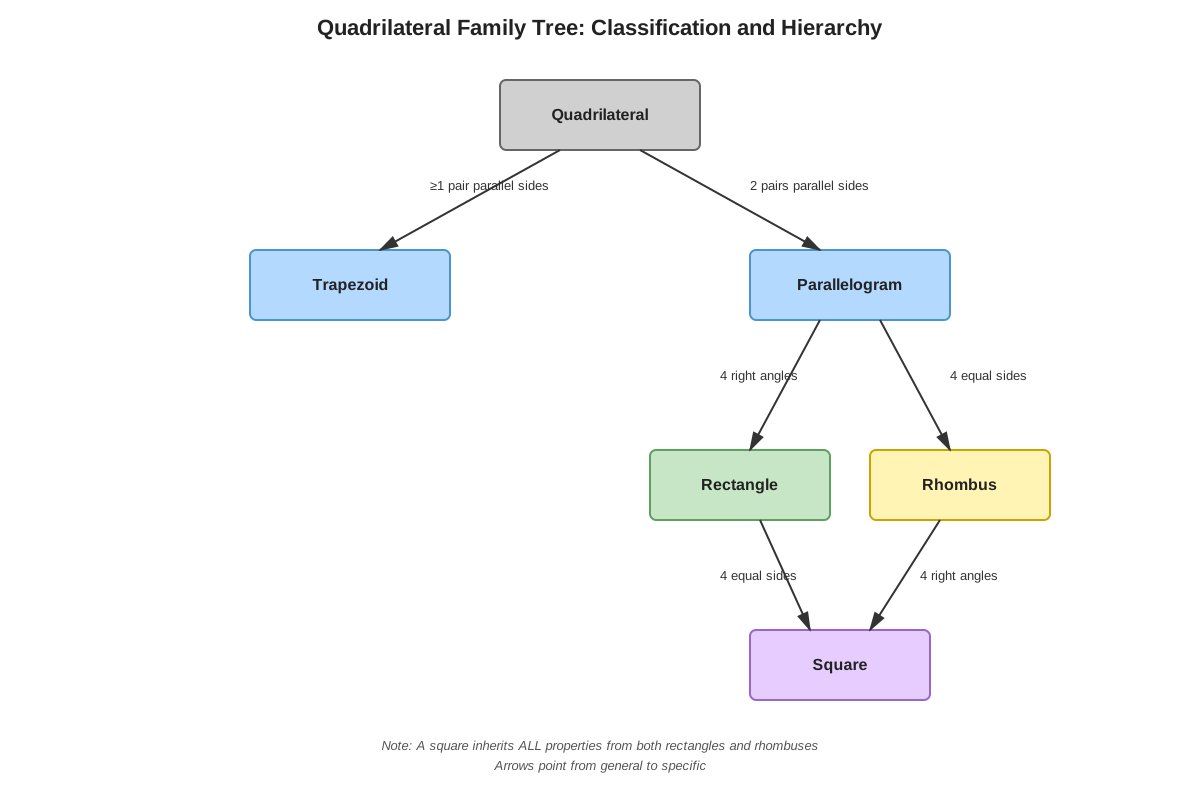
The hierarchy of quadrilaterals forms a nested structure where each special type inherits properties from more general categories. At the broadest level, all shapes discussed are quadrilaterals (four-sided polygons with interior angles summing to 360°).
Trapezoids represent the first level of specialization, requiring only one pair of parallel sides. Parallelograms are more specialized, requiring two pairs of parallel sides—this additional constraint generates the property that opposite sides are equal and diagonals bisect each other.
From parallelograms, the hierarchy branches into two paths: rectangles (adding the constraint of right angles) and rhombuses (adding the constraint of equal sides). These two paths converge at squares, which satisfy both constraints simultaneously. This relationship can be expressed as: Quadrilaterals → Trapezoids → Parallelograms → {Rectangles, Rhombuses} → Squares.
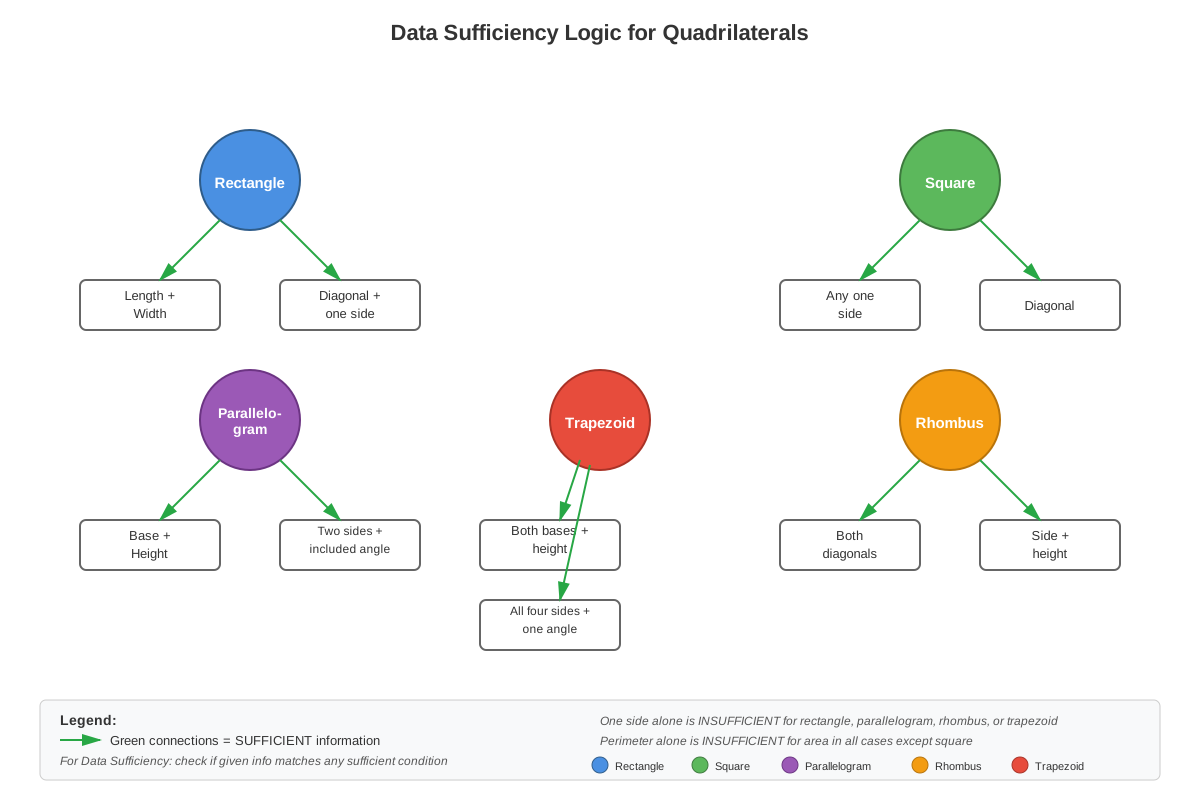
Understanding this hierarchy is crucial for GMAT Data Sufficiency questions. If you know a shape is a square, you automatically know it's also a rectangle, rhombus, parallelogram, trapezoid, and quadrilateral—and possesses all properties of each category. Conversely, knowing something is a parallelogram doesn't tell you whether it's a rectangle, rhombus, or neither.
The concept also connects to triangle properties because any quadrilateral can be divided into two triangles by drawing a diagonal. This decomposition strategy is essential for deriving the 360° angle sum and for solving complex area problems. Additionally, quadrilaterals in coordinate geometry require applying distance formulas, slope calculations, and midpoint formulas—connecting this topic to algebraic methods.
Quick check — test yourself on Quadrilaterals so far.
Try Flashcards →High-Yield Facts
⭐ The sum of interior angles in any quadrilateral equals 360°, regardless of shape or regularity.
⭐ In a parallelogram, opposite sides are equal and parallel, opposite angles are equal, and diagonals bisect each other.
⭐ The area of a trapezoid is ½ × (base₁ + base₂) × height, where the bases are the parallel sides.
⭐ A square's diagonal equals its side length multiplied by √2: d = s√2.
⭐ In any parallelogram (including rectangles, rhombuses, and squares), consecutive angles are supplementary (sum to 180°).
- The diagonals of a rhombus are perpendicular and bisect the vertex angles.
- A rectangle's diagonals are equal in length and bisect each other but are not perpendicular (unless it's a square).
- The median of a trapezoid (line connecting midpoints of the legs) is parallel to the bases and equals the average of the base lengths.
- In an isosceles trapezoid, the legs are equal, base angles are equal, and diagonals are equal.
- The area of a rhombus can be calculated as ½ × d₁ × d₂, where d₁ and d₂ are diagonal lengths.
- Any quadrilateral can be divided into two triangles, which is useful for calculating areas when standard formulas don't apply.
- In coordinate geometry, if the diagonals of a quadrilateral bisect each other, the shape is a parallelogram.
- A quadrilateral with perpendicular diagonals that bisect each other is a rhombus.
- The perimeter of any quadrilateral is simply the sum of all four side lengths.
- For a parallelogram, Area = base × height = side₁ × side₂ × sin(angle between them).
Common Misconceptions
Misconception: All quadrilaterals with four equal sides are squares.
Correction: A rhombus has four equal sides but doesn't have right angles. Only when a quadrilateral has both four equal sides AND four right angles is it a square.
Misconception: The diagonals of a rectangle are perpendicular.
Correction: Rectangle diagonals are equal in length and bisect each other, but they are only perpendicular if the rectangle is also a square. In a non-square rectangle, the diagonals intersect at an angle other than 90°.
Misconception: A trapezoid must have exactly one pair of parallel sides.
Correction: The definition states "at least one pair" of parallel sides. Technically, a parallelogram satisfies the definition of a trapezoid (though it's more specifically classified as a parallelogram). Some definitions specify "exactly one pair" to exclude parallelograms, but GMAT problems typically use the "at least one pair" definition.
Misconception: The height of a parallelogram is the same as the length of its slanted side.
Correction: The height must be measured perpendicular to the base. The slanted side (unless the parallelogram is a rectangle) is longer than the height. Using the side length instead of the perpendicular height will result in an incorrect area calculation.
Misconception: If a quadrilateral has equal diagonals, it must be a rectangle.
Correction: While rectangles do have equal diagonals, isosceles trapezoids also have equal diagonals but are not rectangles. Equal diagonals alone are insufficient to determine that a shape is a rectangle—you also need to know about the angles or parallel sides.
Misconception: The area of a quadrilateral can always be found by multiplying length times width.
Correction: This formula only works for rectangles. For other quadrilaterals, you need specific formulas (like the trapezoid area formula) or must decompose the shape into triangles and sum their areas.
Misconception: In a rhombus, all angles are equal.
Correction: In a rhombus, only opposite angles are equal to each other. The four angles are not all equal unless the rhombus is also a square. A typical rhombus has two acute angles and two obtuse angles.
Worked Examples
Example 1: Data Sufficiency with Parallelogram Properties
Question: In parallelogram ABCD, what is the length of diagonal AC?
(1) The length of side AB is 8 and the length of side BC is 6.
(2) Angle ABC measures 60°.
Solution:
First, recall that in a parallelogram, we cannot directly determine diagonal length from side lengths alone—we also need angle information. Let's analyze each statement.
Statement (1): Knowing AB = 8 and BC = 6 tells us the dimensions of the parallelogram, but without knowing any angles, we cannot determine the diagonal length. Different parallelograms can have the same side lengths but different angles, resulting in different diagonal lengths. Statement (1) alone is INSUFFICIENT.
Statement (2): Knowing only that angle ABC = 60° without any side length information means we cannot calculate a specific diagonal length. We would know the shape's angles (since consecutive angles in a parallelogram are supplementary, angle BCD = 120°, and opposite angles are equal), but without dimensions, we cannot find the diagonal. Statement (2) alone is INSUFFICIENT.
Statements (1) and (2) together: With both side lengths (AB = 8, BC = 6) and the included angle (angle ABC = 60°), we can use the law of cosines to find diagonal AC. In triangle ABC:
AC² = AB² + BC² - 2(AB)(BC)cos(ABC)
AC² = 8² + 6² - 2(8)(6)cos(60°)
AC² = 64 + 36 - 96(0.5)
AC² = 100 - 48
AC² = 52
AC = √52 = 2√13
Together, the statements are SUFFICIENT.
Answer: C (Both statements together are sufficient, but neither alone is sufficient)
This example demonstrates how GMAT questions test understanding of what information is necessary to determine properties of quadrilaterals, particularly in Data Sufficiency format.
Example 2: Area Calculation with Trapezoid
Question: Trapezoid PQRS has parallel sides PQ and RS. If PQ = 12, RS = 20, and the height of the trapezoid is 8, what is the area of the trapezoid?
Solution:
This is a straightforward application of the trapezoid area formula. We're given both parallel sides (the bases) and the perpendicular height.
Using the formula: Area = ½ × (base₁ + base₂) × height
Area = ½ × (12 + 20) × 8
Area = ½ × 32 × 8
Area = ½ × 256
Area = 128
Answer: 128 square units
Extension: If the problem instead asked for the perimeter, we would need the lengths of the two legs (non-parallel sides), which aren't provided. This illustrates an important distinction: area calculations for trapezoids require only the bases and height, while perimeter requires all four side lengths.
Alternative approach: We could also solve this by decomposing the trapezoid into simpler shapes. Drawing a perpendicular from Q to RS creates a rectangle with dimensions 12 × 8 (area = 96) and two right triangles on the sides. The triangles together have a combined base of 20 - 12 = 8 and height of 8, giving combined area = ½ × 8 × 8 = 32. Total area = 96 + 32 = 128, confirming our answer.
Exam Strategy
When approaching GMAT quadrilaterals questions, begin by identifying the specific type of quadrilateral involved. Look for keywords like "rectangle," "square," "parallelogram," or "trapezoid" in the problem statement. If the problem simply says "quadrilateral" without specification, you can only use the general property that angles sum to 360°.
Trigger words and phrases to watch for:
- "Opposite sides are parallel" → indicates at least a parallelogram
- "All sides are equal" → indicates rhombus or square
- "Right angles" or "perpendicular sides" → indicates rectangle or square
- "Diagonals bisect each other" → indicates parallelogram or more specific type
- "Diagonals are perpendicular" → indicates rhombus, square, or kite
- "One pair of parallel sides" → indicates trapezoid
For Data Sufficiency questions, create a mental checklist of what information determines a quadrilateral's properties:
- To find area, you typically need dimensions (side lengths or diagonal lengths) plus either angles or height
- To prove a quadrilateral is a specific type, you need enough properties to distinguish it from similar types
- Remember that knowing a shape is a more specific type (like square) automatically tells you it has all properties of more general types (rectangle, rhombus, parallelogram)
Process of elimination strategies:
- If a problem involves diagonal properties, eliminate answer choices that don't account for whether diagonals are equal, perpendicular, or bisecting
- For area problems, eliminate answers that use incorrect formulas (like using side length instead of height for parallelograms)
- In coordinate geometry problems, eliminate answers that don't properly apply distance or slope formulas
Time allocation: Straightforward area or perimeter calculations should take 60-90 seconds. Problems requiring multiple steps (like finding a missing side before calculating area) should take 2-2.5 minutes. Data Sufficiency questions about quadrilaterals typically require 90-120 seconds—spend time carefully analyzing what each statement tells you rather than rushing to calculate.
Quick decision framework:
- Identify the quadrilateral type (15 seconds)
- Recall relevant properties and formulas (15 seconds)
- Determine what's given and what's needed (30 seconds)
- Execute calculations or logical analysis (60-90 seconds)
- Verify answer makes sense (15 seconds)
Exam Tip: When a problem provides diagonal lengths for a rhombus or kite, immediately think of the formula Area = ½ × d₁ × d₂. This is often faster than trying to find the height and base.
Memory Techniques
PORD Mnemonic for Parallelogram Properties:
- Parallel opposite sides
- Opposite sides and angles are equal
- Reciprocal angles are supplementary (consecutive angles)
- Diagonals bisect each other
"SQUARE = RECT + RHOM": Remember that a square has ALL properties of both rectangles and rhombuses. If you forget square properties, combine what you know about rectangles and rhombuses.
Diagonal Perpendicularity Visualization: Picture a rhombus as a "pushed" square—the diagonals remain perpendicular but become unequal. Picture a rectangle as a "stretched" square—the diagonals remain equal but lose perpendicularity. Only the square maintains both properties.
Trapezoid Area = "Average Base Times Height": Instead of memorizing ½(b₁ + b₂)h, remember you're finding the average of the two bases, then multiplying by height—like finding the area of a rectangle whose width is the average of the trapezoid's bases.
"360 for 4": Four-sided figures have interior angles summing to 360°. This rhymes and creates an association between the number of sides and the angle sum.
Hierarchy Pyramid Visualization: Picture a pyramid with "Quadrilateral" at the top (most general), "Parallelogram" in the middle, and "Square" at the bottom (most specific). Each level down adds more constraints and properties.
Coordinate Geometry Diagonal Check: To verify if a quadrilateral is a parallelogram using coordinates, remember "MEME"—Midpoint Equals Midpoint Everywhere. If the midpoint of one diagonal equals the midpoint of the other, the diagonals bisect each other, confirming a parallelogram.
Summary
Quadrilaterals form a hierarchical family of four-sided polygons, each type defined by specific properties regarding sides, angles, and diagonals. All quadrilaterals share the fundamental property that interior angles sum to 360°, but special quadrilaterals—trapezoids, parallelograms, rectangles, rhombuses, and squares—possess additional characteristics that enable efficient problem-solving. Trapezoids have at least one pair of parallel sides, while parallelograms have two pairs, generating properties like equal opposite sides and bisecting diagonals. Rectangles add right angles to parallelogram properties, while rhombuses add equal sides. Squares represent the intersection of rectangles and rhombuses, possessing all properties of both. Understanding these relationships and the specific formulas for area and perimeter of each type is essential for GMAT success. The exam frequently tests whether given information is sufficient to determine properties or measurements, requiring deep understanding of what defines each quadrilateral type. Mastery involves not just memorizing formulas but recognizing when to decompose complex shapes, apply coordinate geometry methods, or use diagonal properties to solve problems efficiently.
Key Takeaways
- All quadrilaterals have interior angles summing to 360°, and this property alone applies to irregular four-sided figures
- Parallelograms have opposite sides equal and parallel, opposite angles equal, consecutive angles supplementary, and diagonals that bisect each other
- Rectangles are parallelograms with four right angles and equal diagonals; rhombuses are parallelograms with four equal sides and perpendicular diagonals
- Squares possess all properties of both rectangles and rhombuses, with the key relationship d = s√2 between diagonal and side length
- Trapezoid area equals ½ × (base₁ + base₂) × height, while parallelogram area equals base × height or ½ × d₁ × d₂ for rhombuses
- Data Sufficiency questions require understanding what information uniquely determines a quadrilateral's type or measurements
- Decomposing quadrilaterals into triangles is a powerful strategy when standard formulas don't directly apply
Related Topics
Triangles and Triangle Properties: Understanding triangles is foundational because quadrilaterals can be decomposed into triangles, and many quadrilateral properties derive from triangle theorems. Mastering quadrilaterals enables solving more complex problems involving triangular components.
Coordinate Geometry: Quadrilaterals frequently appear on the coordinate plane, requiring application of distance formulas, slope calculations, and midpoint formulas. Strong quadrilateral knowledge combined with coordinate geometry skills enables solving sophisticated problems about shapes defined by coordinate points.
Circles and Inscribed Figures: Advanced problems involve quadrilaterals inscribed in or circumscribed around circles, requiring integration of quadrilateral properties with circle theorems.
Three-Dimensional Geometry: Understanding quadrilaterals is essential for analyzing three-dimensional shapes like rectangular prisms, pyramids, and other polyhedra where faces are quadrilaterals.
Optimization Problems: Many GMAT word problems ask for maximum or minimum areas or perimeters of quadrilaterals given certain constraints, connecting geometric understanding with algebraic problem-solving.
Practice CTA
Now that you've mastered the core concepts of quadrilaterals, it's time to solidify your understanding through active practice. Attempt the practice questions to apply these principles to GMAT-style problems, and use the flashcards to reinforce key properties and formulas. Remember, the difference between understanding quadrilaterals conceptually and achieving mastery on test day lies in deliberate practice. Each problem you solve strengthens your pattern recognition and builds the confidence needed to tackle any quadrilateral question the GMAT presents. You've built a strong foundation—now put it to work!
Sign up free to keep reading
Create a free AnvayaPrep account to finish this GMAT guide on Quadrilaterals — plus flashcards and practice questions.