Overview
Analogy reasoning is a critical thinking pattern that appears frequently in GMAT Critical Reasoning questions, where test-takers must evaluate arguments that draw parallels between two different situations, scenarios, or cases. This reasoning type involves comparing a known situation (the source) with a new or less familiar situation (the target) to draw conclusions, make predictions, or justify decisions. On the GMAT, GMAT analogy reasoning questions test your ability to identify when an argument relies on analogical thinking, evaluate whether the comparison is valid, and recognize what factors would strengthen or weaken such comparisons.
Understanding analogy reasoning is essential for GMAT success because it appears across multiple question types within Critical Reasoning, including Strengthen, Weaken, Assumption, Evaluate, and Flaw questions. When an argument uses analogical reasoning, it assumes that because two situations share certain characteristics, they will share other characteristics as well. The validity of such arguments depends entirely on the relevance and extent of the similarities between the compared situations. Test-takers who can quickly identify analogical reasoning patterns and assess the strength of comparisons gain a significant advantage in both accuracy and timing.
Within the broader Verbal Reasoning framework, analogy reasoning connects closely to assumption identification, causal reasoning, and argument structure analysis. Like causal arguments, analogical arguments make predictive claims based on limited evidence. However, while causal reasoning focuses on cause-and-effect relationships within a single context, analogical reasoning transfers conclusions from one context to another. Mastering this topic strengthens overall critical thinking skills and provides a systematic approach to evaluating comparative arguments across business, scientific, and social contexts—all common GMAT themes.
Learning Objectives
- [ ] Identify Analogy reasoning in GMAT Critical Reasoning passages
- [ ] Explain Analogy reasoning and its underlying logical structure
- [ ] Apply Analogy reasoning to GMAT questions across multiple question types
- [ ] Evaluate the strength of analogical arguments by assessing relevant similarities and differences
- [ ] Recognize common flaws in analogical reasoning that weaken arguments
- [ ] Distinguish between strong and weak analogies based on the scope and relevance of comparisons
- [ ] Predict which answer choices will strengthen or weaken arguments based on analogy reasoning
Prerequisites
- Basic argument structure: Understanding premises, conclusions, and how evidence supports claims is essential because analogical arguments follow standard argument patterns while adding a comparative dimension.
- Assumption identification: Recognizing unstated assumptions helps identify what analogical arguments take for granted about the similarity between compared situations.
- Strengthen and Weaken question types: Familiarity with these question formats is necessary because analogy reasoning frequently appears in questions asking how to support or undermine comparative arguments.
- Logical reasoning fundamentals: Basic understanding of valid and invalid reasoning patterns provides the foundation for evaluating whether analogical comparisons are logically sound.
Why This Topic Matters
Analogy reasoning appears in approximately 15-20% of GMAT Critical Reasoning questions, making it one of the most frequently tested reasoning patterns. Business schools value this skill because managers, consultants, and entrepreneurs constantly make decisions by comparing current situations to past experiences or by applying lessons from one market, product, or organization to another. The ability to recognize when analogies are valid and when they break down is fundamental to sound business judgment.
In real-world applications, professionals use analogical reasoning to forecast market trends based on historical patterns, apply successful strategies from one division to another, evaluate new business opportunities by comparing them to existing ventures, and learn from case studies. However, poor analogical reasoning leads to costly mistakes when decision-makers assume that superficial similarities guarantee deeper parallels. The GMAT tests whether candidates can think critically about such comparisons rather than accepting them at face value.
On the exam, analogy reasoning typically appears in arguments that: (1) propose implementing a policy or strategy because it worked elsewhere, (2) predict outcomes based on similar past situations, (3) justify decisions by citing comparable cases, or (4) draw conclusions about one group based on observations of another group. Questions may ask test-takers to identify assumptions underlying the comparison, find evidence that would strengthen or weaken the analogy, recognize flaws in the reasoning, or evaluate what information would help assess the argument's validity.
Core Concepts
Definition and Structure of Analogy Reasoning
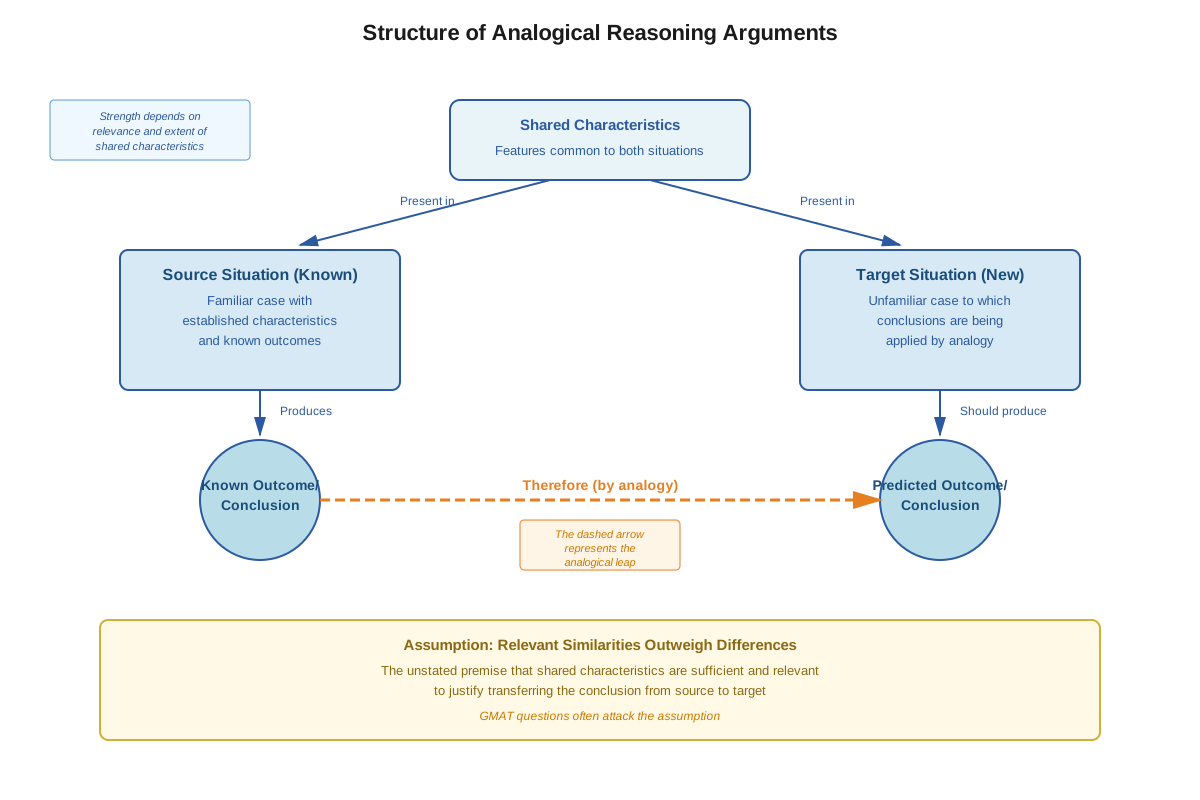
Analogy reasoning is a form of inductive reasoning that draws conclusions about one situation (the target) based on its similarity to another situation (the source). The logical structure follows this pattern: Situation A has characteristics X, Y, and Z, and also has characteristic Q. Situation B has characteristics X, Y, and Z. Therefore, Situation B probably also has characteristic Q. The strength of this reasoning depends on whether the shared characteristics (X, Y, Z) are relevant to the characteristic being predicted (Q).
In GMAT arguments, the source analog is typically a past case, different location, or comparable scenario that provides the basis for comparison. The target analog is the current situation about which the argument draws conclusions. The analogical inference is the conclusion that what was true in the source will be true in the target. For example: "Company A increased profits by implementing flexible work schedules. Company B should implement flexible work schedules to increase profits." Here, Company A is the source, Company B is the target, and the inference is that flexible schedules will increase Company B's profits.
Critical Elements for Valid Analogies
The validity of analogical reasoning depends on several critical factors that GMAT questions frequently test:
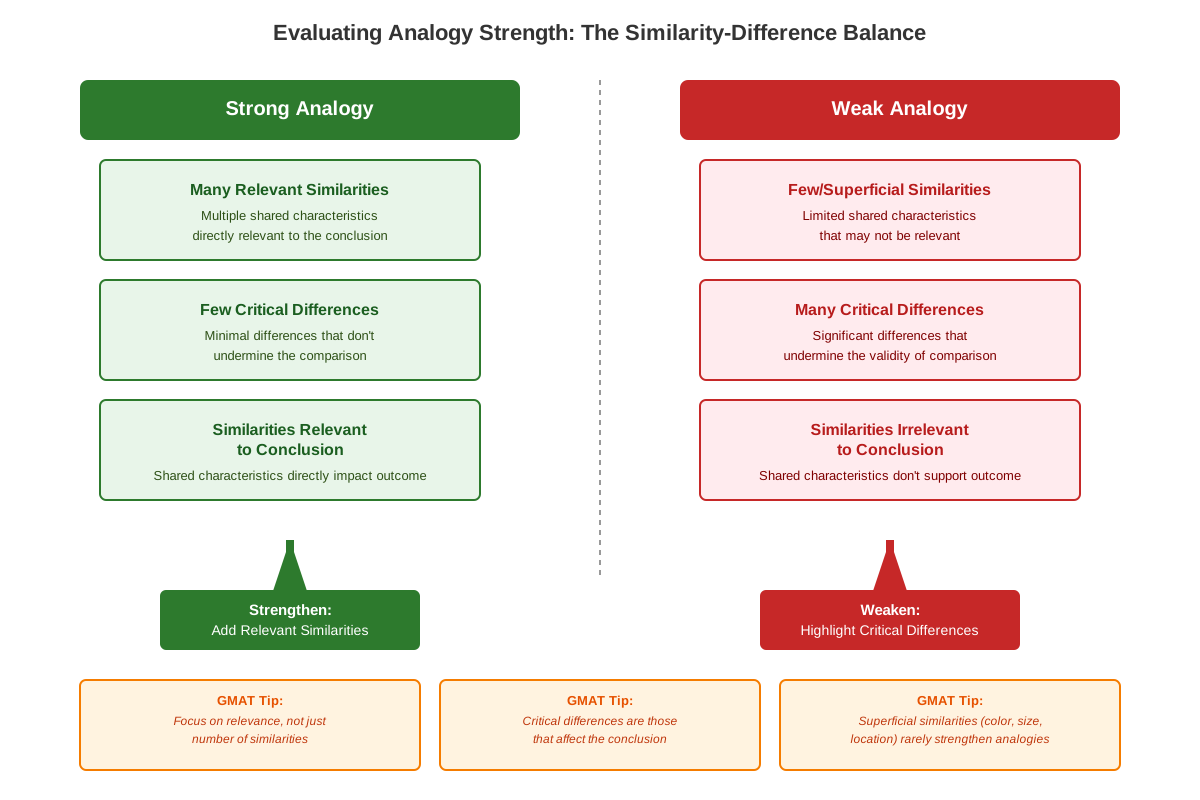
Relevant similarities: The compared situations must share characteristics that are actually relevant to the conclusion being drawn. If an argument claims that a marketing strategy successful in Japan will work in Brazil because both countries have large populations, the analogy is weak—population size may be irrelevant to marketing strategy effectiveness. However, if the argument cites similar consumer preferences, media consumption patterns, and economic conditions, the analogy becomes stronger.
Absence of relevant differences: Even when situations share important similarities, significant differences can invalidate the comparison. A policy that worked in a small company may fail in a large corporation due to scale differences. A medical treatment effective in one demographic group may not work in another due to genetic or lifestyle differences. Strong GMAT answer choices often identify previously unmentioned differences that undermine analogical arguments.
Sufficient number of similarities: Generally, the more relevant characteristics two situations share, the stronger the analogy. An argument comparing two situations based on a single shared trait is weaker than one identifying multiple relevant parallels. However, quantity alone doesn't guarantee validity—ten irrelevant similarities don't outweigh one critical difference.
How Analogy Reasoning Appears in GMAT Questions
| Question Type | How Analogy Reasoning Appears | What to Look For |
|---|---|---|
| Strengthen | Answer choices provide additional similarities between compared situations | Evidence that makes the comparison more valid |
| Weaken | Answer choices highlight relevant differences or show the comparison is flawed | Evidence that the situations differ in important ways |
| Assumption | The argument assumes certain similarities exist or that differences don't matter | Unstated beliefs about what makes the comparison valid |
| Evaluate | Questions ask what information would help determine if the analogy is sound | Factors that would reveal relevant similarities or differences |
| Flaw | The argument's flaw is that it assumes similarity in one respect guarantees similarity in another | Recognition that the comparison may be invalid |
Common Patterns in Analogical Arguments
GMAT analogical arguments typically follow recognizable patterns. The policy implementation pattern argues that because a policy worked in Location/Organization A, it will work in Location/Organization B. The prediction pattern claims that because Event X led to Outcome Y in the past, a similar event will lead to a similar outcome now. The comparative evaluation pattern assesses one thing by comparing it to another, assuming the comparison is valid.
Understanding these patterns helps identify analogy reasoning quickly. Trigger phrases include: "similarly," "likewise," "just as," "in the same way," "by analogy," "comparable to," "parallels the situation," and "worked elsewhere." When an argument cites what happened in a different time, place, or context to support a conclusion about the current situation, analogical reasoning is almost certainly at play.
The Assumption Underlying All Analogies
Every analogical argument contains a fundamental assumption: the similarities between the compared situations are more relevant than the differences. This assumption is what makes the argument vulnerable. Strong answer choices in Weaken questions often succeed by showing that a critical difference exists. Strong answer choices in Strengthen questions often succeed by eliminating potential differences or establishing additional relevant similarities.
For example, if an argument claims "City X reduced traffic congestion by implementing congestion pricing, so City Y should do the same," the argument assumes that the cities are similar in ways that matter for this policy's effectiveness—perhaps similar public transportation infrastructure, commuter patterns, economic conditions, and political feasibility. Any significant difference in these areas could undermine the analogy.
Concept Relationships
Analogy reasoning connects directly to assumption identification because every analogical argument rests on unstated assumptions about the validity of the comparison. When evaluating an analogy, test-takers must identify what the argument assumes about similarities and differences between the compared situations. This skill transfers directly to Assumption questions where the correct answer often articulates what the analogical argument takes for granted.
The relationship to strengthen and weaken reasoning is bidirectional. Understanding analogy reasoning improves performance on Strengthen/Weaken questions involving comparisons, while practice with Strengthen/Weaken questions develops the ability to evaluate analogical arguments. Evidence that strengthens an analogy typically establishes additional relevant similarities or eliminates potential differences. Evidence that weakens an analogy typically highlights relevant differences or shows that apparent similarities are superficial.
Causal reasoning and analogy reasoning often appear together in GMAT arguments. An argument might use an analogy to support a causal claim: "In Country A, increased education spending caused economic growth. Country B should increase education spending to achieve economic growth." Here, the argument uses analogical reasoning (comparing the countries) to support a causal claim (education spending causes growth). Evaluating such arguments requires assessing both whether the causal relationship exists in the source case and whether the comparison between situations is valid.
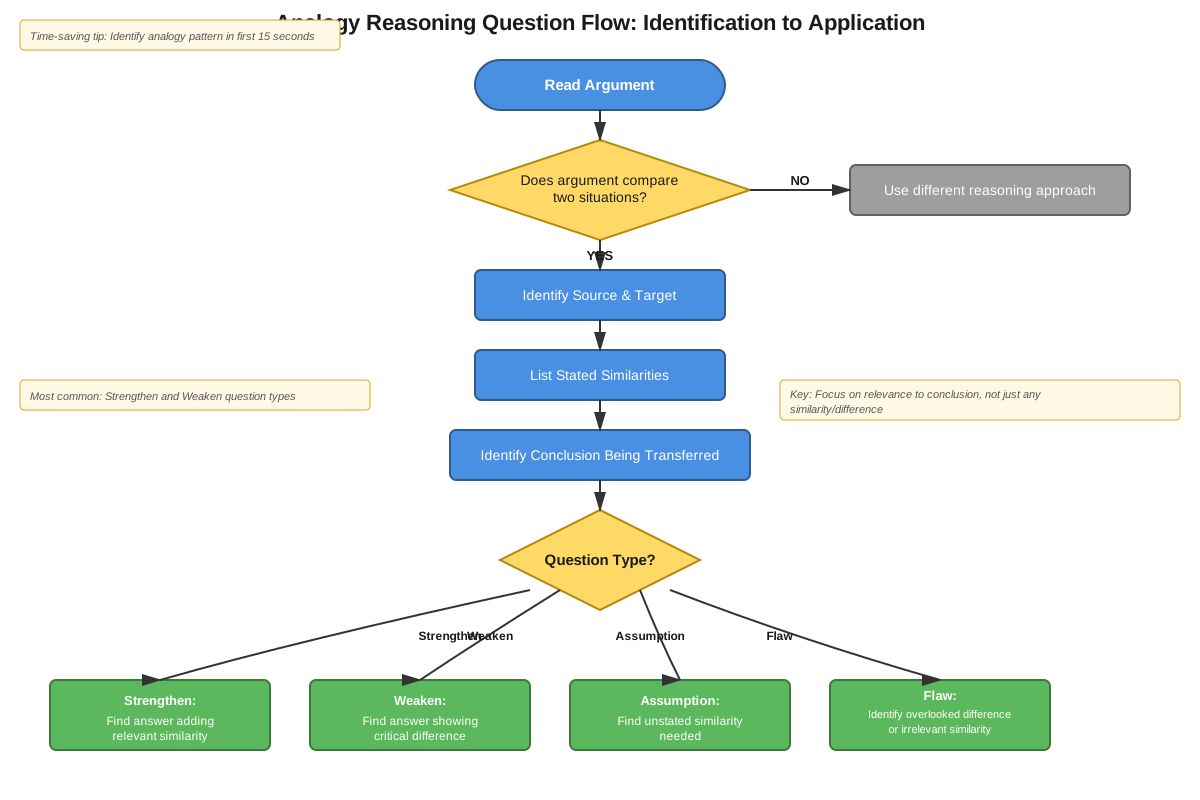
The conceptual flow follows this pattern: Identify analogical structure → Determine what characteristics are being compared → Assess relevance of similarities → Consider potential differences → Evaluate strength of inference → Apply to answer choices. This systematic approach ensures thorough analysis of analogical arguments under time pressure.
High-Yield Facts
⭐ Analogy reasoning draws conclusions about one situation based on its similarity to another situation, assuming that shared characteristics in some respects indicate shared characteristics in other respects.
⭐ The strength of an analogical argument depends on whether the similarities between compared situations are relevant to the conclusion being drawn.
⭐ Relevant differences between compared situations weaken analogical arguments, even when significant similarities exist.
⭐ Every analogical argument assumes that the compared situations are similar in ways that matter for the conclusion.
⭐ Answer choices that strengthen analogies typically establish additional relevant similarities or eliminate potential differences; answer choices that weaken analogies typically highlight relevant differences.
- Analogical reasoning is inductive, not deductive—even strong analogies provide probable rather than certain conclusions.
- The number of similarities matters less than their relevance to the specific conclusion being drawn.
- Superficial or coincidental similarities do not support valid analogical inferences.
- Temporal analogies (comparing past to present) can be weakened by showing that circumstances have changed in relevant ways.
- Geographic analogies (comparing different locations) can be weakened by showing cultural, economic, or structural differences.
- Analogies between different scales (small to large, or vice versa) are particularly vulnerable to scope-related differences.
- Strong analogies in GMAT arguments typically involve multiple relevant similarities and explicitly address potential differences.
- Weak analogies often rely on a single shared characteristic or ignore obvious differences between compared situations.
Quick check — test yourself on Analogy reasoning so far.
Try Flashcards →Common Misconceptions
Misconception: If two situations share any similarities, an analogy between them is valid. → Correction: Only relevant similarities support analogical reasoning. Two situations might share many characteristics that are irrelevant to the conclusion being drawn. For example, two companies being founded in the same year doesn't mean a strategy that worked for one will work for the other.
Misconception: Finding any difference between compared situations automatically invalidates an analogy. → Correction: Only relevant differences weaken analogies. Two situations will always differ in some ways; the question is whether those differences matter for the specific conclusion. A marketing strategy might work in two cities despite different climates if climate is irrelevant to the strategy's effectiveness.
Misconception: Analogical arguments are inherently weak or flawed. → Correction: Analogies can be strong or weak depending on the relevance and extent of similarities. Well-constructed analogies with multiple relevant similarities and no significant relevant differences provide reasonable support for conclusions. The GMAT tests the ability to distinguish strong from weak analogies, not to reject all analogical reasoning.
Misconception: The correct answer in Strengthen questions must prove the analogy is perfect. → Correction: Strengthen questions ask for evidence that makes the argument better, not perfect. An answer choice that establishes one additional relevant similarity or eliminates one potential difference strengthens the analogy even if other vulnerabilities remain.
Misconception: Analogies only appear in questions explicitly asking about comparisons. → Correction: Analogical reasoning can be embedded in arguments without obvious comparative language. An argument might cite a case study, historical example, or different context without using words like "similarly" or "likewise." Recognizing the underlying analogical structure requires attention to the logical pattern, not just trigger words.
Misconception: Evaluating analogies requires specialized knowledge about the compared situations. → Correction: GMAT questions are designed to be answerable based solely on the information provided and logical reasoning. The test assesses critical thinking about comparisons, not background knowledge about specific industries, locations, or historical events mentioned in passages.
Worked Examples
Example 1: Weaken Question with Analogy Reasoning
Argument: "Five years ago, Techville implemented a tax incentive program for technology companies, and the city's economy grew by 15% over the following three years. Businessburg should implement a similar tax incentive program for technology companies to achieve comparable economic growth."
Question: Which of the following, if true, most weakens the argument?
Answer Choices:
(A) Techville's population increased by 10% during the same period.
(B) Businessburg's current tax rates are already lower than Techville's rates were before the incentive program.
(C) At the time Techville implemented its program, the technology sector was experiencing rapid national growth, but the sector has since matured and growth has slowed.
(D) Some technology companies in Techville have since relocated to other cities.
(E) Businessburg's economy has been stable for the past decade.
Analysis:
First, identify the analogical reasoning structure. The argument compares Techville (source) to Businessburg (target), noting that a tax incentive program led to economic growth in Techville, and concluding that the same program will produce similar results in Businessburg. The argument assumes that the two cities are similar in relevant ways and that conditions haven't changed significantly.
Next, evaluate each answer choice for relevant differences or changed circumstances:
(A) This provides additional information about Techville but doesn't establish a relevant difference between the cities or explain why the comparison might be invalid. Population growth might have contributed to economic growth, but this doesn't directly weaken the analogy.
(B) This suggests a difference between the cities, but it's unclear whether this difference is relevant. Lower existing tax rates might make incentives more or less effective—the relationship isn't specified, so this doesn't clearly weaken the argument.
(C) This is the correct answer. It identifies a critical temporal difference: the circumstances that made the program successful in Techville (rapid technology sector growth) no longer exist. This directly weakens the analogy by showing that even if the cities are similar, the changed external conditions mean the program is unlikely to produce similar results. The analogy fails because the relevant context has changed.
(D) This might suggest the program's effects weren't permanent, but it doesn't directly address whether the program would work in Businessburg. Some companies relocating doesn't necessarily mean the program failed or that it wouldn't work elsewhere.
(E) This describes Businessburg's current situation but doesn't establish a relevant difference that would make the tax incentive program ineffective. Economic stability doesn't clearly relate to whether tax incentives would promote growth.
Key Takeaway: This example demonstrates how temporal analogies can be weakened by showing that circumstances have changed in ways relevant to the conclusion. The correct answer doesn't need to prove the program will definitely fail—it just needs to provide strong evidence that the comparison is less valid than the argument assumes.
Example 2: Strengthen Question with Analogy Reasoning
Argument: "Riverside Hospital reduced patient readmission rates by 20% after implementing a comprehensive discharge planning program that included follow-up phone calls and home visits. Metropolitan Hospital should implement a similar program to reduce its readmission rates."
Question: Which of the following, if true, most strengthens the argument?
Answer Choices:
(A) Metropolitan Hospital's readmission rates are currently higher than Riverside Hospital's rates were before implementing the program.
(B) Both hospitals serve similar patient populations in terms of age, income levels, and types of medical conditions treated.
(C) The discharge planning program at Riverside Hospital was expensive to implement.
(D) Several other hospitals have implemented discharge planning programs with varying results.
(E) Metropolitan Hospital's staff members are interested in reducing readmission rates.
Analysis:
The argument uses analogical reasoning, comparing Riverside Hospital (source) to Metropolitan Hospital (target) and concluding that what worked at Riverside will work at Metropolitan. To strengthen this analogy, we need evidence that establishes relevant similarities or eliminates potential differences.
Evaluating each choice:
(A) This tells us about the severity of Metropolitan's problem but doesn't establish that the hospitals are similar in ways that would make the program effective at Metropolitan. The program's effectiveness depends on hospital and patient characteristics, not just the current readmission rate.
(B) This is the correct answer. It establishes that the hospitals serve similar patient populations, which is highly relevant to whether a patient care program would be similarly effective. If the hospitals treat similar patients, the program that reduced readmissions at Riverside is more likely to work at Metropolitan. This directly strengthens the analogy by confirming a critical relevant similarity.
(C) This provides information about the program but doesn't strengthen the argument that it will work at Metropolitan. Cost is a practical consideration but doesn't address whether the analogy is valid.
(D) This actually weakens rather than strengthens the argument by suggesting that similar programs have produced "varying results"—implying that success isn't guaranteed even with similar programs.
(E) Staff interest is positive but doesn't establish that the hospitals are similar in ways that would make the program effective. Motivation doesn't guarantee that the same program will produce the same results.
Key Takeaway: This example shows how strengthening an analogy requires establishing relevant similarities between the compared situations. The correct answer identifies a similarity (patient populations) that directly relates to why the program might be effective, making the comparison more valid.
Exam Strategy
When approaching GMAT questions involving analogy reasoning, follow this systematic process:
Step 1: Identify the analogical structure. Look for arguments that cite what happened in a different time, place, organization, or context to support a conclusion about the current situation. Watch for trigger phrases like "similarly," "likewise," "worked elsewhere," or "in the same way." Even without explicit comparative language, recognize when an argument uses one case to predict or justify something about another case.
Step 2: Clearly distinguish the source and target. Identify which situation provides the basis for comparison (source) and which situation is the subject of the conclusion (target). Understanding this distinction helps evaluate whether evidence strengthens or weakens the analogy.
Step 3: Identify what characteristic is being transferred. Determine what specific outcome, feature, or result from the source situation the argument claims will also occur in the target situation. This is what the analogical inference predicts.
Step 4: Consider what makes the comparison valid or invalid. Ask yourself: What would need to be true for this comparison to work? What similarities would be relevant? What differences might matter? This mental exercise prepares you to evaluate answer choices efficiently.
Step 5: Apply question-specific strategies:
For Weaken questions, prioritize answer choices that:
- Highlight relevant differences between the compared situations
- Show that circumstances have changed in important ways
- Demonstrate that apparent similarities are superficial
- Reveal that the source situation had unique characteristics not present in the target
For Strengthen questions, prioritize answer choices that:
- Establish additional relevant similarities
- Eliminate potential differences
- Show that the comparison is more valid than initially apparent
- Confirm that key conditions are similar in both situations
For Assumption questions, look for answer choices that:
- State that the situations are similar in a specific relevant way
- Assert that a particular difference doesn't exist or doesn't matter
- Bridge the gap between the compared situations
Exam Tip: In Strengthen/Weaken questions with analogies, the correct answer often addresses a factor that seems obvious once you see it but wasn't explicitly mentioned in the argument. Train yourself to think: "What could be different between these situations that would matter for this conclusion?"
Time allocation: Spend 10-15 seconds identifying the analogical structure, 20-30 seconds considering what would strengthen or weaken the comparison, and 45-60 seconds evaluating answer choices. Don't get caught up in overthinking whether every possible difference matters—focus on differences clearly relevant to the specific conclusion.
Process of elimination: Eliminate answer choices that discuss irrelevant similarities or differences, provide information about only one of the compared situations without establishing comparison, or address practical considerations (like cost or difficulty) rather than the validity of the analogy itself.
Memory Techniques
SIMILAR Acronym for evaluating analogies:
- Source and target clearly identified
- Inference being drawn is specific
- Multiple relevant similarities exist
- Important differences are absent
- Logical connection between similarities and conclusion
- Assumptions about comparison are reasonable
- Relevance of shared characteristics to conclusion
Visualization Strategy: Picture the source and target situations as two circles in a Venn diagram. The overlapping section represents similarities, while the non-overlapping sections represent differences. Strong analogies have large overlaps in areas relevant to the conclusion and small non-overlapping sections in those areas. Weak analogies have small relevant overlaps or large relevant differences.
The "Would This Work?" Test: When evaluating an analogy, mentally ask: "If I were actually making this decision in real life, would I be convinced by this comparison?" This intuitive check often reveals whether the analogy feels strong or whether obvious differences come to mind.
Trigger Phrase Recognition: Memorize common analogy indicators: "similarly," "likewise," "just as," "in the same way," "by analogy," "comparable situation," "worked elsewhere," "parallel case," "precedent," "historical example." When you see these phrases, immediately activate your analogy evaluation framework.
Summary
Analogy reasoning is a high-frequency GMAT Critical Reasoning pattern where arguments draw conclusions about one situation based on its similarity to another. The validity of such arguments depends entirely on whether the compared situations share characteristics relevant to the conclusion and lack significant relevant differences. Strong analogies involve multiple relevant similarities and address potential differences, while weak analogies rely on superficial similarities or ignore important differences. Every analogical argument assumes that the comparison is valid—that similarities outweigh differences in ways that matter for the conclusion. GMAT questions test the ability to identify analogical reasoning, evaluate its strength, and recognize what evidence would strengthen or weaken the comparison. Success requires systematically identifying the source and target of comparison, determining what characteristic is being transferred, assessing the relevance of similarities and differences, and applying this analysis to answer choices. Mastering analogy reasoning improves performance across multiple Critical Reasoning question types and strengthens overall logical reasoning skills essential for business school success.
Key Takeaways
- Analogy reasoning compares a source situation to a target situation, inferring that what was true in the source will be true in the target based on shared characteristics.
- The strength of an analogy depends on relevant similarities and the absence of relevant differences—not just any similarities or differences, but those that matter for the specific conclusion.
- Every analogical argument assumes the comparison is valid; identifying this assumption is key to evaluating the argument and predicting correct answer choices.
- Strengthen answers typically establish additional relevant similarities or eliminate potential differences; Weaken answers typically highlight relevant differences or show circumstances have changed.
- Recognizing analogical reasoning quickly through trigger phrases and structural patterns saves valuable time and enables systematic evaluation.
- Temporal and geographic analogies are particularly common on the GMAT and are often vulnerable to changed circumstances or contextual differences.
- Evaluating analogies requires focusing on relevance—many similarities and differences exist between any two situations, but only those relevant to the conclusion matter for the argument's validity.
Related Topics
Causal Reasoning: Understanding cause-and-effect arguments complements analogy reasoning because arguments often use analogies to support causal claims. Mastering both patterns enables evaluation of complex arguments that combine comparative and causal elements.
Assumption Questions: Since every analogy rests on assumptions about the validity of the comparison, strengthening analogy reasoning skills directly improves performance on Assumption questions where the correct answer articulates what the argument takes for granted.
Evaluate the Argument Questions: These questions often involve analogies and ask what information would help determine whether the comparison is valid. Understanding analogy reasoning provides the framework for identifying what additional information matters.
Parallel Reasoning Questions: While less common on the GMAT than other standardized tests, these questions require identifying arguments with similar logical structures, a skill closely related to recognizing and evaluating analogical patterns.
Scope and Degree Issues: Many weak analogies fail because of scope mismatches (comparing situations at different scales) or degree differences (assuming similar but not identical characteristics). Understanding these concepts enhances analogy evaluation.
Practice CTA
Now that you understand the structure and evaluation of analogy reasoning, it's time to apply these concepts to actual GMAT questions. Work through the practice questions and flashcards to reinforce your ability to identify analogical arguments, assess their strength, and predict correct answer choices. Pay special attention to questions where you initially struggle—these reveal opportunities to refine your systematic approach. Remember, analogy reasoning appears in 15-20% of Critical Reasoning questions, making this one of the highest-yield topics for your study time. With focused practice, you'll develop the pattern recognition and evaluation skills that separate good scores from great scores. You've built the foundation—now strengthen it through application!
Sign up free to keep reading
Create a free AnvayaPrep account to finish this GMAT guide on Analogy reasoning — plus flashcards and practice questions.