Overview
Scope is one of the most critical yet frequently misunderstood concepts in GMAT Critical Reasoning. It refers to the boundaries, limitations, and specific focus of an argument—essentially defining what the argument is and is not addressing. Understanding GMAT scope is fundamental because the test makers deliberately craft incorrect answer choices that fall outside the argument's scope, making them tempting but ultimately irrelevant to the question at hand.
On the GMAT, approximately 30-40% of Critical Reasoning questions test your ability to recognize scope violations. Whether you're strengthening an argument, identifying an assumption, or finding a flaw, staying within the argument's scope is paramount. An answer choice might be factually true, logically sound, and even interesting—but if it addresses a different subject, time period, population, or context than what the argument discusses, it's wrong. The GMAT exploits this by creating "out-of-scope" trap answers that seem plausible to test-takers who haven't mastered scope recognition.
Within Verbal Reasoning, scope serves as a foundational filter for evaluating all Critical Reasoning answer choices. It connects intimately with assumption identification (assumptions must stay within scope), argument structure analysis (conclusions must be supported by premises within the same scope), and logical reasoning (valid inferences cannot exceed the argument's boundaries). Mastering scope transforms your approach from evaluating five answer choices equally to immediately eliminating 2-3 options that violate scope boundaries, dramatically improving both accuracy and timing.
Learning Objectives
- [ ] Identify scope boundaries in GMAT Critical Reasoning arguments
- [ ] Explain scope and articulate why specific elements fall within or outside an argument's scope
- [ ] Apply scope analysis to eliminate incorrect GMAT answer choices systematically
- [ ] Distinguish between scope violations and legitimate scope expansions in strengthen/weaken questions
- [ ] Recognize common scope shift patterns used in trap answers
- [ ] Evaluate whether new information introduced in answer choices maintains scope consistency
Prerequisites
- Basic argument structure: Understanding premises, conclusions, and evidence is essential because scope defines the boundaries within which these elements operate
- Logical reasoning fundamentals: Recognizing valid and invalid reasoning patterns helps distinguish between legitimate scope and scope violations
- Reading comprehension skills: Accurate scope identification requires careful attention to the specific language, qualifiers, and limitations in arguments
Why This Topic Matters
In professional contexts, scope awareness prevents costly errors in business analysis, legal reasoning, and scientific research. When executives evaluate market research, they must recognize whether data about one demographic applies to their target market. When researchers draw conclusions, they must limit claims to the populations and conditions they actually studied. This same precision is exactly what the GMAT tests.
On the GMAT, scope appears in virtually every Critical Reasoning question type. Assumption questions require identifying unstated connections within the argument's scope. Strengthen and weaken questions demand recognizing which new information is relevant to the specific claim being made. Inference questions test whether conclusions stay within the boundaries of what the passage actually states. Evaluation questions ask what additional information would be relevant—meaning what falls within the scope of assessing the argument. Studies of GMAT question patterns reveal that approximately 60% of incorrect answer choices in Critical Reasoning involve some form of scope violation.
Common scope manifestations on the GMAT include: arguments about Company A where wrong answers discuss Company B; arguments about short-term effects where wrong answers address long-term consequences; arguments about one specific cause where wrong answers introduce different causes; and arguments about whether something should be done where wrong answers discuss whether it can be done. The test makers know that under time pressure, test-takers often select answers that "sound good" without verifying scope alignment.
Core Concepts
Defining Scope in Arguments
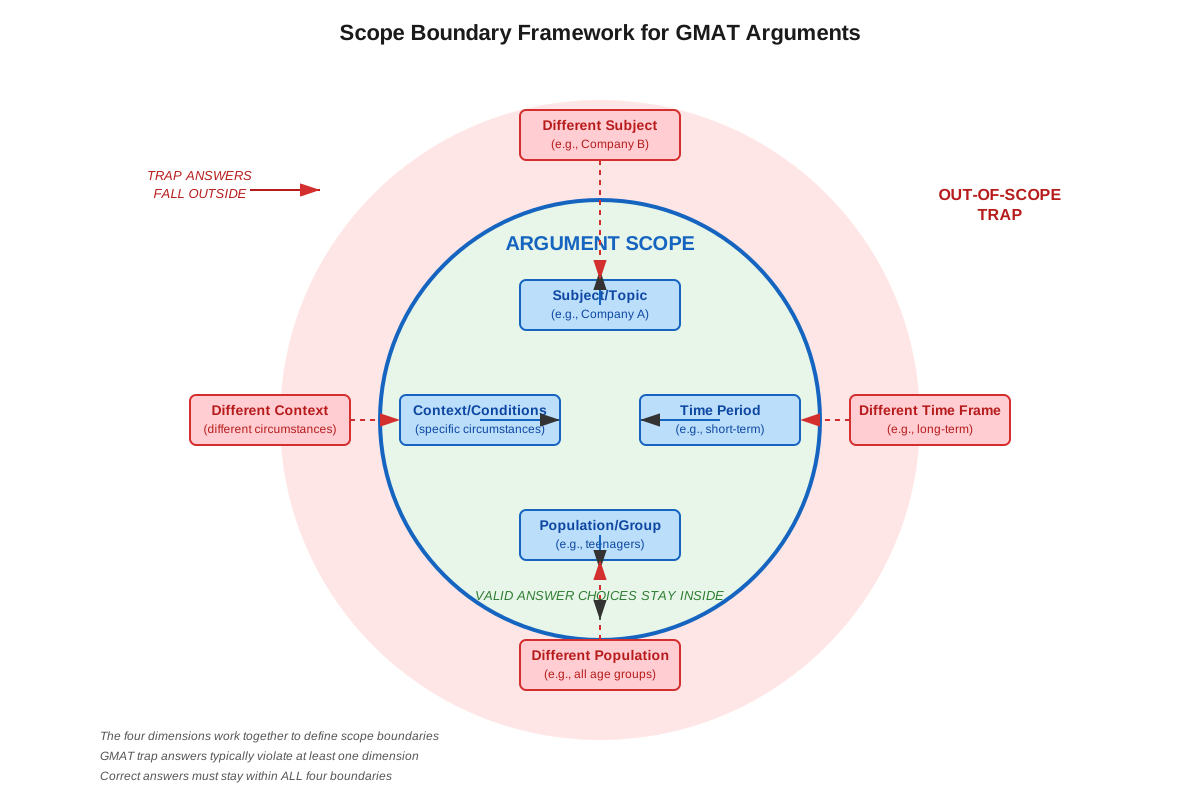
Scope represents the specific boundaries of what an argument addresses—the particular subject matter, time frame, population, conditions, and context that the argument explicitly or implicitly limits itself to. Think of scope as a fence around an argument: everything inside the fence is relevant and fair game for evaluation, while everything outside is irrelevant regardless of its truth value.
Every GMAT argument has multiple scope dimensions:
- Subject scope: The specific topic, entity, or phenomenon being discussed (e.g., electric vehicles, not all vehicles)
- Temporal scope: The time period relevant to the argument (e.g., next quarter, not next decade)
- Population scope: The group being discussed (e.g., teenagers, not all people)
- Geographic scope: The location relevant to the argument (e.g., urban areas, not rural)
- Conditional scope: The circumstances under which claims apply (e.g., during economic downturns)
Identifying Scope Boundaries
To identify an argument's scope, systematically examine what the argument specifically discusses versus what it doesn't address. Look for:
Explicit scope markers: Words and phrases that directly limit the argument's reach, such as "in this region," "during the past year," "among college students," "regarding customer satisfaction," or "concerning environmental impact." These markers explicitly define boundaries.
Implicit scope limitations: Even without explicit markers, arguments have implicit scope based on what they actually discuss. If an argument presents evidence about online sales and draws a conclusion about online sales, the scope implicitly excludes retail store sales even if not explicitly stated.
Qualifier words: Terms like "some," "many," "most," "all," "never," "always," "typically," and "often" define scope intensity. An argument claiming "most employees prefer flexible schedules" has a different scope than one claiming "all employees prefer flexible schedules."
Scope Violations in Answer Choices
The GMAT creates wrong answers through several scope violation patterns:
Subject shift: The argument discusses X, but the answer choice discusses Y. Example: Argument about smartphone battery life; wrong answer about smartphone screen quality.
Temporal shift: The argument addresses one time period, but the answer choice addresses a different period. Example: Argument about current sales trends; wrong answer about future market predictions.
Population shift: The argument concerns one group, but the answer choice concerns a different group. Example: Argument about experienced employees; wrong answer about new hires.
Degree shift: The argument makes a limited claim, but the answer choice makes an extreme claim (or vice versa). Example: Argument that something is "often effective"; wrong answer requiring it to be "always effective."
Comparison shift: The argument discusses one thing in isolation, but the answer choice introduces comparisons to other things. Example: Argument about whether Policy A is beneficial; wrong answer about whether Policy A is better than Policy B.
Scope in Different Question Types
| Question Type | Scope Requirement | Common Scope Trap |
|---|---|---|
| Assumption | Must connect elements already in the argument's scope | Introduces entirely new concepts not mentioned |
| Strengthen | Must make the existing conclusion more likely within stated scope | Supports a different conclusion or different aspect |
| Weaken | Must make the existing conclusion less likely within stated scope | Attacks a different conclusion or irrelevant aspect |
| Inference | Must be provable from information given without scope expansion | Goes beyond what can be concluded from passage |
| Evaluate | Must be relevant to assessing the specific argument made | Tests something tangential to the actual argument |
Legitimate Scope Expansion vs. Scope Violation
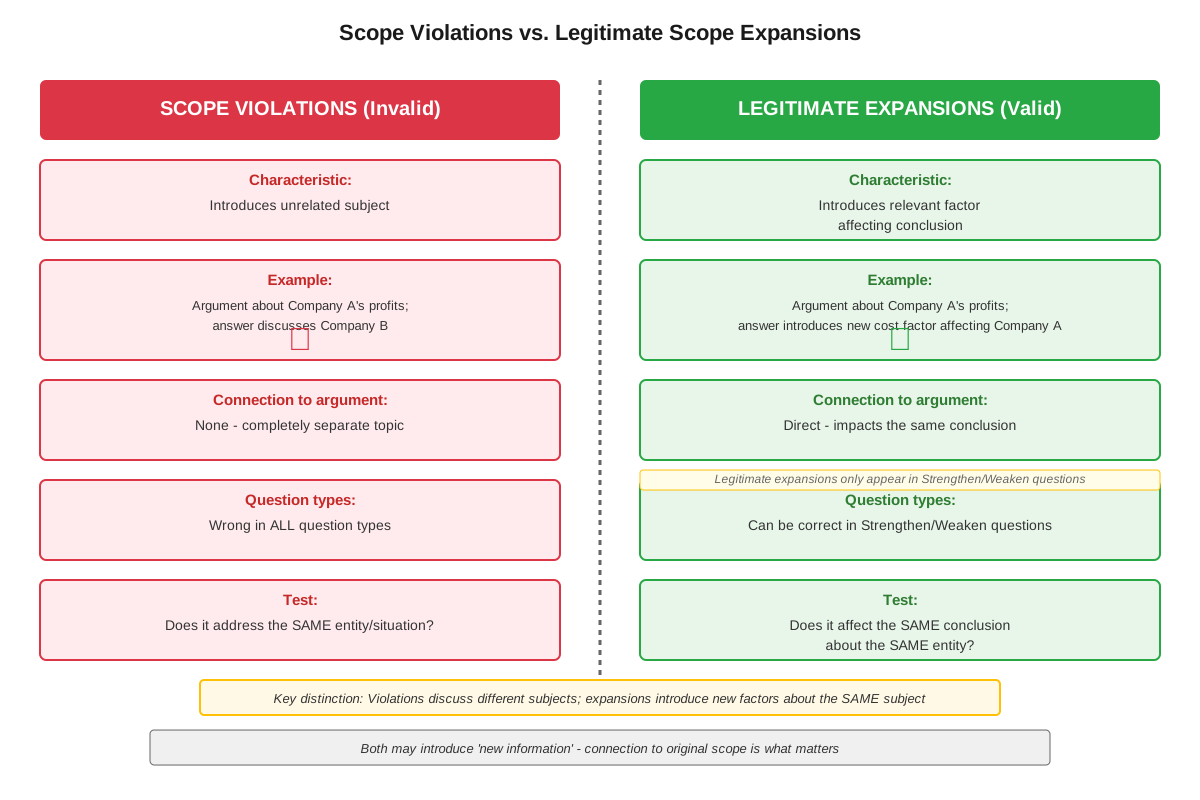
Understanding when scope can legitimately expand is crucial for strengthen/weaken questions. A legitimate scope expansion introduces new information that directly impacts the relationship between the argument's existing premises and conclusion. A scope violation introduces information about a fundamentally different subject, population, or question.
Consider this argument: "Company X's profits increased after implementing flexible work schedules. Therefore, flexible schedules caused the profit increase."
Legitimate scope expansion (weakening): "Company X also launched a major new product line at the same time flexible schedules were implemented." This stays within scope because it addresses alternative explanations for Company X's profit increase—the exact causal relationship the argument claims.
Scope violation: "Company Y saw no profit increase after implementing flexible schedules." This violates scope because the argument makes a claim specifically about Company X, not about flexible schedules generally or other companies.
Recognizing Scope Through Conclusion Analysis
The argument's conclusion is the primary scope determinant. Every element of a correct answer must be relevant to making that specific conclusion more or less likely, more or less justified, or more or less complete. When evaluating answer choices, constantly ask: "Does this directly affect the likelihood or validity of this specific conclusion about this specific subject?"
If an argument concludes "The city should build a new subway line," the scope includes: costs and benefits of building that subway line, the city's transportation needs, feasibility of subway construction, and alternatives to building the subway. The scope excludes: subway systems in other cities (unless used for direct comparison), other infrastructure projects unrelated to transportation, and the city's non-transportation issues.
Concept Relationships
Scope serves as the foundation for all Critical Reasoning analysis. The relationship flow works as follows:
Scope identification → Argument structure analysis: Understanding scope allows accurate identification of what the premises actually support and what the conclusion actually claims. Without scope awareness, test-takers often misidentify the conclusion or misunderstand the premises.
Scope boundaries → Assumption recognition: Assumptions must bridge gaps within the argument's scope. They cannot introduce entirely new subjects or populations. Scope defines the playing field within which assumptions operate.
Scope consistency → Answer choice evaluation: Once scope is identified, it becomes the primary filter for eliminating wrong answers. This creates the relationship: Scope mastery → Faster elimination → Better time management.
Scope violations → Trap answer recognition: Understanding common scope violation patterns connects directly to recognizing the test maker's strategy. The relationship is: Scope violation patterns → Trap answer patterns → Improved accuracy.
Within the topic itself, the concepts connect as: Defining scope (what it is) → Identifying scope boundaries (how to find it) → Recognizing scope violations (how to use it) → Question-type-specific scope application (when to apply it). Each concept builds on the previous, creating a systematic approach to scope analysis.
High-Yield Facts
⭐ Scope defines what an argument is specifically addressing in terms of subject, time, population, geography, and conditions
⭐ Approximately 60% of wrong answers in GMAT Critical Reasoning involve scope violations
⭐ An answer choice can be factually true and logically sound but still wrong if it falls outside the argument's scope
⭐ The conclusion determines the primary scope boundaries—everything must relate to that specific claim
⭐ Assumptions must connect elements already within the argument's scope, not introduce entirely new concepts
- Subject shifts (discussing X when the argument is about Y) are the most common scope violation
- Temporal shifts often appear in arguments about current situations where wrong answers discuss future scenarios
- Population shifts frequently occur when arguments discuss specific groups but wrong answers discuss different groups
- Comparison shifts introduce relative evaluations when arguments make absolute claims
- Legitimate scope expansions in strengthen/weaken questions introduce new information about the existing relationship between premises and conclusion
- Qualifier words ("some," "most," "all") define scope intensity and must be matched in correct answers
- Geographic scope violations often appear subtle, such as discussing national trends when the argument addresses local situations
- Degree shifts make extreme claims when arguments make moderate claims, or vice versa
- Conditional scope defines circumstances under which claims apply—wrong answers often ignore these conditions
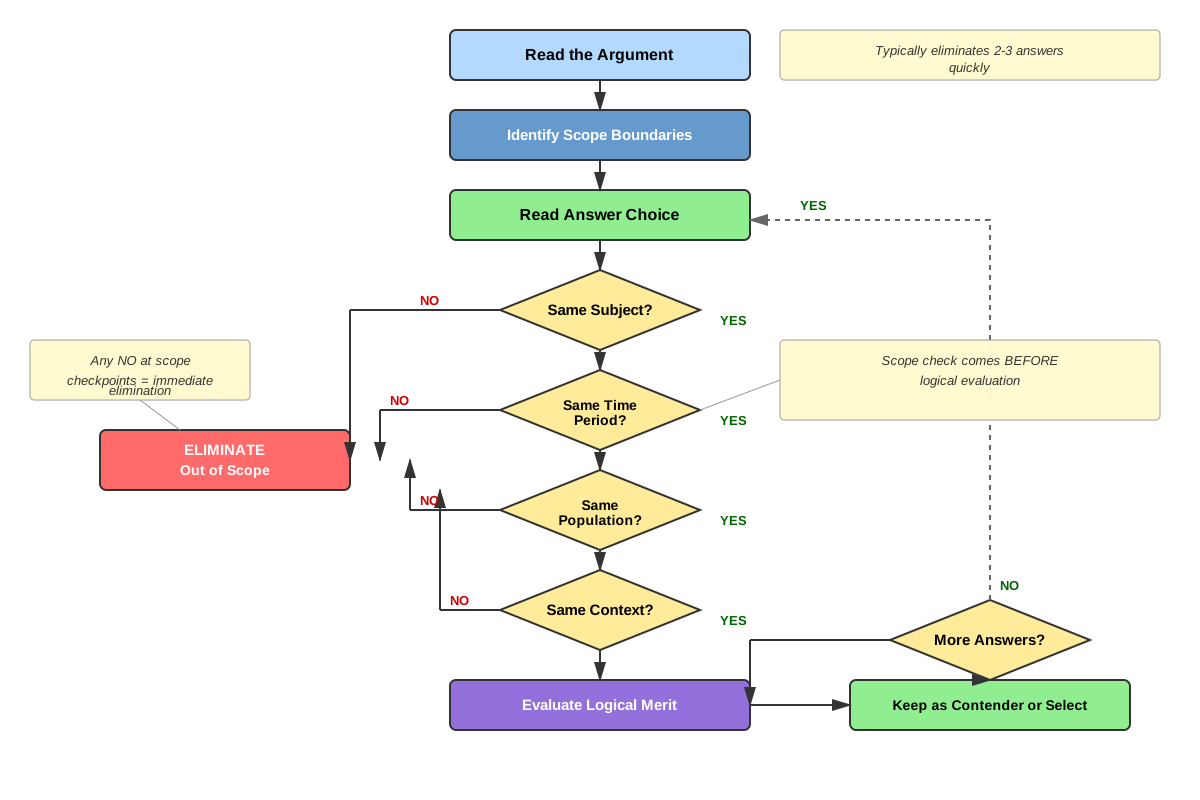
- Scope recognition should be the first filter applied to answer choices, before evaluating logical validity
Quick check — test yourself on Scope so far.
Try Flashcards →Common Misconceptions
Misconception: If an answer choice is factually true, it must be correct. → Correction: Truth is necessary but insufficient. An answer must be both true AND within the argument's scope. A true statement about a different subject, time period, or population is still wrong.
Misconception: Strengthen and weaken questions allow unlimited scope expansion since they introduce new information. → Correction: New information must be relevant to the specific conclusion about the specific subject. Introducing information about different subjects, populations, or questions violates scope even in strengthen/weaken questions.
Misconception: If an argument doesn't explicitly state limitations, it has unlimited scope. → Correction: Arguments have implicit scope based on what they actually discuss. An argument about online sales implicitly excludes in-store sales even without explicitly stating this limitation.
Misconception: Scope violations are always obvious and dramatic. → Correction: The GMAT creates subtle scope shifts that seem closely related to the argument. A shift from "customer satisfaction" to "customer loyalty" or from "short-term profits" to "long-term sustainability" can be a scope violation depending on the conclusion.
Misconception: Assumptions can introduce new concepts to fill gaps in arguments. → Correction: Assumptions must connect concepts already present in the argument's scope. An assumption that introduces an entirely new subject or population is incorrect—it's a scope violation disguised as an assumption.
Misconception: If two things are related in reality, discussing one when the argument discusses the other is acceptable. → Correction: Real-world relationships don't override scope boundaries on the GMAT. Even if employee satisfaction and productivity are related in reality, an argument about satisfaction has a different scope than one about productivity.
Misconception: Longer, more detailed answer choices are more likely to be correct. → Correction: The GMAT often creates long, detailed answer choices that violate scope. Length and detail don't indicate correctness—scope alignment does.
Worked Examples
Example 1: Assumption Question
Argument: "TechCorp's customer satisfaction ratings have increased by 15% since implementing its new customer service training program last quarter. Therefore, the training program has been effective in improving customer satisfaction."
Question: Which of the following is an assumption required by the argument?
Answer Choices:
(A) TechCorp's competitors have not implemented similar training programs
(B) No other factors that could increase customer satisfaction changed during the same period
(C) The training program will continue to improve customer satisfaction in future quarters
(D) Customer satisfaction ratings accurately reflect the quality of customer service
(E) TechCorp's employees were dissatisfied with the previous training program
Analysis:
First, identify the scope: The argument specifically addresses TechCorp's customer satisfaction increase and attributes it to the training program implemented last quarter.
Evaluate each choice for scope:
(A) Scope violation: The argument makes no claims about competitors. Whether competitors implemented similar programs is irrelevant to whether TechCorp's program caused TechCorp's improvement. This is a subject shift from TechCorp to competitors.
(B) Within scope: This addresses alternative explanations for TechCorp's satisfaction increase during the specific time period discussed. The argument assumes no other factors caused the increase—this is necessary for the causal claim. This stays within the scope of TechCorp's satisfaction during last quarter.
(C) Scope violation: This is a temporal shift. The argument concludes the program "has been effective" (past tense, about last quarter), not that it will continue to be effective. Future effectiveness is outside the scope.
(D) Scope violation: This is subtle but represents a subject shift. The argument uses satisfaction ratings as evidence and draws a conclusion about satisfaction. It doesn't need to assume the ratings are accurate—it's already using them as the measure. This would only be necessary if the conclusion were about something other than what the ratings measure.
(E) Scope violation: Employee satisfaction with training is a different subject than customer satisfaction. This is a subject shift. The argument doesn't require anything about employee opinions.
Correct Answer: (B)
Key Takeaway: The assumption must connect elements already in the argument (training program → satisfaction increase) without introducing new subjects (competitors, future periods, employee opinions).
Example 2: Weaken Question
Argument: "City planners propose building a light rail system to reduce traffic congestion in downtown Riverside. Studies show that cities with light rail systems have 20% less traffic congestion than cities without them. Therefore, building a light rail system will reduce traffic congestion in downtown Riverside."
Question: Which of the following, if true, most weakens the argument?
Answer Choices:
(A) Light rail systems are expensive to build and maintain
(B) Cities that built light rail systems already had lower congestion before construction began
(C) Some residents of Riverside prefer driving to using public transportation
(D) Light rail systems in other cities have increased property values near stations
(E) Traffic congestion in suburban areas of Riverside has been increasing
Analysis:
Scope identification: The argument claims that building light rail will reduce traffic congestion specifically in downtown Riverside, based on a correlation between light rail and lower congestion in other cities.
Evaluate each choice:
(A) Scope violation: Cost is outside the scope. The argument addresses whether light rail will reduce congestion, not whether it's financially feasible. This is a subject shift from effectiveness to cost.
(B) Within scope and weakens: This attacks the causal reasoning by suggesting the correlation doesn't prove causation—cities with light rail might have had less congestion for other reasons. This directly addresses whether building light rail will cause the reduction in Riverside. This is a legitimate scope expansion that introduces relevant information about the premise-conclusion relationship.
(C) Scope violation: This is too weak and potentially a degree shift. "Some residents prefer driving" doesn't significantly impact whether the system will reduce congestion overall. The argument doesn't claim everyone will use light rail, just that it will reduce congestion.
(D) Scope violation: Property values are a different subject than traffic congestion. This is a clear subject shift. Even if true, it doesn't affect whether light rail reduces congestion.
(E) Scope violation: This is a geographic shift. The argument specifically addresses downtown Riverside, not suburban areas. Suburban congestion is outside the scope.
Correct Answer: (B)
Key Takeaway: Weakeners must address the specific causal claim about the specific subject (downtown Riverside congestion). Information about costs, property values, or different geographic areas violates scope.
Exam Strategy
Step 1: Read the conclusion first to establish scope boundaries. Underline or mentally note the specific claim being made, including all qualifiers and limitations.
Step 2: Identify scope dimensions as you read the full argument. Ask: What specific subject? What time period? What population? What conditions? What degree of claim (some, most, all)?
Step 3: Before reading answer choices, predict the scope boundaries. Think: "The correct answer must address [specific subject] regarding [specific aspect] for [specific population/time/condition]."
Step 4: Apply scope as your first filter. As you read each answer choice, immediately ask: "Does this address the same subject, population, time period, and question as the argument?" Eliminate scope violations before evaluating logical validity.
Trigger words for scope violations:
- Comparison words when the argument makes no comparison: "better than," "worse than," "more effective than," "compared to"
- Temporal shifts: "in the future," "eventually," "in the past," "historically" when the argument discusses present
- Absolute terms when the argument uses qualified language: "always," "never," "all," "none" when the argument says "often," "sometimes," "many," "some"
- New subjects: Any noun in an answer choice that doesn't appear in the argument deserves scrutiny
Process of elimination strategy: On difficult questions, eliminating 2-3 scope violations often leaves you choosing between 2-3 remaining choices, dramatically improving odds even if you must guess.
Time allocation: Spend 5-10 seconds identifying scope before reading answer choices. This investment saves 20-30 seconds by allowing rapid elimination of scope violations, resulting in net time savings.
Exam Tip: If you're stuck between two answer choices, re-read the conclusion and ask which answer directly addresses that specific claim. The answer that stays closest to the conclusion's exact scope is usually correct.
Memory Techniques
SCOPE Acronym for Scope Dimensions:
- Subject: What specific thing is being discussed?
- Conditions: Under what circumstances?
- Outcome: What specific result or claim?
- Population: What specific group?
- Era: What time period?
The Fence Visualization: Picture a fence around the argument. Everything inside the fence is fair game; everything outside is irrelevant. When evaluating answer choices, visualize whether they're inside or outside the fence.
The Spotlight Metaphor: Think of the argument as a spotlight illuminating a specific area of a stage. Correct answers must stay within the lit area. Wrong answers discuss things in the shadows outside the spotlight.
The "Same Same Same" Mantra: When evaluating answer choices, repeat: "Same subject? Same population? Same time? Same question?" If any answer is "no," eliminate the choice.
Color Coding Practice: When practicing, use different colors to mark different scope dimensions in arguments (blue for subject, green for population, red for time period). This trains your brain to automatically identify scope elements.
Summary
Scope represents the specific boundaries of what a GMAT Critical Reasoning argument addresses, including its subject matter, time frame, population, geographic area, conditions, and degree of claim. Mastering scope is essential because the majority of wrong answers violate scope by discussing different subjects, populations, time periods, or questions than what the argument actually addresses. The conclusion determines primary scope boundaries, and all answer choices must be evaluated against whether they stay within these boundaries. While strengthen and weaken questions allow introduction of new information, this information must be relevant to the specific conclusion about the specific subject—it cannot shift to fundamentally different topics. Scope violations can be obvious (discussing Company B when the argument is about Company A) or subtle (discussing long-term effects when the argument addresses short-term results). Effective scope analysis involves identifying scope dimensions while reading the argument, using scope as the first filter when evaluating answer choices, and recognizing common scope violation patterns. An answer choice can be factually true and logically sound but still incorrect if it falls outside the argument's scope, making scope recognition the single most powerful tool for eliminating wrong answers efficiently.
Key Takeaways
- Scope defines the specific boundaries of what an argument addresses and serves as the primary filter for eliminating wrong answers in Critical Reasoning
- The conclusion determines scope boundaries—every correct answer must directly relate to that specific claim about that specific subject
- Approximately 60% of GMAT Critical Reasoning wrong answers involve scope violations, making scope recognition the highest-yield skill to develop
- Truth and logical validity are necessary but insufficient—answers must also stay within the argument's scope to be correct
- Common scope violations include subject shifts, temporal shifts, population shifts, comparison shifts, and degree shifts
- Assumptions must connect elements already within the argument's scope and cannot introduce entirely new concepts or populations
- Applying scope as your first filter before evaluating logical validity saves time and dramatically improves accuracy
Related Topics
Assumptions in Critical Reasoning: Understanding scope is prerequisite to identifying valid assumptions, as assumptions must bridge gaps within the argument's existing scope rather than introducing new subjects. Mastering scope enables you to quickly eliminate assumption answer choices that violate scope boundaries.
Strengthen and Weaken Questions: These question types require distinguishing between legitimate scope expansions (new information about the existing relationship) and scope violations (information about different subjects). Scope mastery is essential for this distinction.
Inference Questions: These questions test whether conclusions stay within the boundaries of what the passage states. Scope skills directly transfer to recognizing when inferences exceed what can be proven from the given information.
Argument Structure: Understanding how premises support conclusions requires recognizing whether the support stays within consistent scope boundaries. Scope analysis enhances your ability to diagram and evaluate argument structure.
Practice CTA
Now that you understand scope and its critical role in GMAT Critical Reasoning, it's time to apply these concepts to practice questions. Focus on identifying scope boundaries before evaluating answer choices, and track how many wrong answers you can eliminate purely through scope analysis. Use the flashcards to reinforce scope violation patterns and trigger words. Remember: scope mastery is the single highest-yield skill for improving Critical Reasoning accuracy and speed. Every practice question is an opportunity to strengthen your scope recognition abilities. Start practicing now, and watch your accuracy soar as you systematically eliminate scope violations!
Sign up free to keep reading
Create a free AnvayaPrep account to finish this GMAT guide on Scope — plus flashcards and practice questions.