Overview
The elimination strategy is one of the most powerful and universally applicable techniques for tackling GMAT Verbal Reasoning questions, particularly within the Critical Reasoning section. Rather than searching for the "perfect" answer immediately, this strategic approach systematically removes incorrect answer choices to increase the probability of selecting the correct response. On the GMAT, where time pressure is intense and answer choices are deliberately crafted to appear plausible, the ability to efficiently eliminate wrong answers often proves more valuable than attempting to identify the right answer through direct analysis alone.
The GMAT elimination strategy operates on a fundamental principle: it is frequently easier to identify what is definitively wrong than to confirm what is absolutely right. This approach leverages the multiple-choice format of the exam, where four incorrect answers (distractors) accompany each correct response. By systematically removing even two or three clearly incorrect options, test-takers dramatically improve their odds and reduce cognitive load, allowing for more focused analysis of remaining choices. This technique proves especially valuable when facing difficult questions where the correct answer may not immediately stand out or when time constraints demand efficient decision-making.
Within the broader context of Verbal Reasoning, the elimination strategy serves as a meta-skill that enhances performance across all question types—Critical Reasoning, Reading Comprehension, and Sentence Correction. It complements content-specific knowledge by providing a systematic framework for decision-making under uncertainty. When combined with strong analytical skills and content mastery, elimination becomes a force multiplier that can elevate scores from the 70th percentile to the 90th percentile or higher. This strategy is particularly crucial for Critical Reasoning questions, where subtle distinctions between answer choices often determine success.
Learning Objectives
- [ ] Identify elimination strategy as a systematic approach to removing incorrect answer choices
- [ ] Explain elimination strategy principles and the rationale behind prioritizing wrong-answer identification
- [ ] Apply elimination strategy to GMAT Critical Reasoning questions with accuracy and efficiency
- [ ] Recognize common wrong-answer patterns and traps in GMAT answer choices
- [ ] Develop a personalized elimination workflow that maximizes speed without sacrificing accuracy
- [ ] Integrate elimination strategy with question-type-specific approaches for optimal performance
Prerequisites
- Basic understanding of GMAT question structure: Familiarity with how GMAT presents questions and answer choices is essential for recognizing patterns that signal incorrect options.
- Fundamental logical reasoning skills: The ability to identify premises, conclusions, and assumptions enables effective evaluation of answer choice relevance and validity.
- Reading comprehension proficiency: Accurate interpretation of argument structure and question stems is necessary before elimination can be applied effectively.
- Time management awareness: Understanding the time constraints of the GMAT (approximately 2 minutes per Verbal question) provides context for why efficient elimination is crucial.
Why This Topic Matters
The elimination strategy represents a critical skill that directly impacts GMAT performance across all Verbal Reasoning question types. Research on standardized testing consistently demonstrates that strategic test-takers who employ systematic elimination techniques score significantly higher than those who rely solely on content knowledge. For the GMAT specifically, where the adaptive algorithm adjusts difficulty based on performance, the ability to answer challenging questions correctly through elimination can elevate a test-taker into higher scoring brackets.
On the GMAT Verbal section, approximately 36 questions must be completed in 65 minutes, creating intense time pressure. Critical Reasoning questions, which constitute roughly one-third of the Verbal section (about 12 questions), are particularly well-suited to elimination strategies. These questions present arguments with logical structures that can be systematically analyzed, and wrong answers typically contain identifiable flaws such as scope mismatches, reversed logic, or irrelevant information. Test-makers deliberately craft attractive wrong answers (distractors) that appear correct to hasty readers, making elimination skills essential for avoiding these traps.
The elimination strategy appears most prominently in several question types: Strengthen/Weaken questions (where wrong answers often have no impact or impact the wrong conclusion), Assumption questions (where incorrect choices may be true but not necessary), Inference questions (where wrong answers go beyond what can be concluded), and Evaluate questions (where incorrect options don't help assess the argument). Mastering elimination for these high-frequency question types can directly improve scores by 50-100 points on the 200-800 scale, making it one of the highest-yield study investments for GMAT preparation.
Core Concepts
The Fundamental Principle of Elimination
The elimination strategy is built on a counterintuitive but powerful insight: identifying incorrect answers is often cognitively easier and more reliable than confirming correct answers. This occurs because wrong answers typically contain at least one clear, identifiable flaw—such as being out of scope, containing extreme language, reversing the logic, or addressing the wrong element of the argument. In contrast, correct answers may require subtle reasoning or may not perfectly match initial expectations, leading to hesitation or second-guessing.
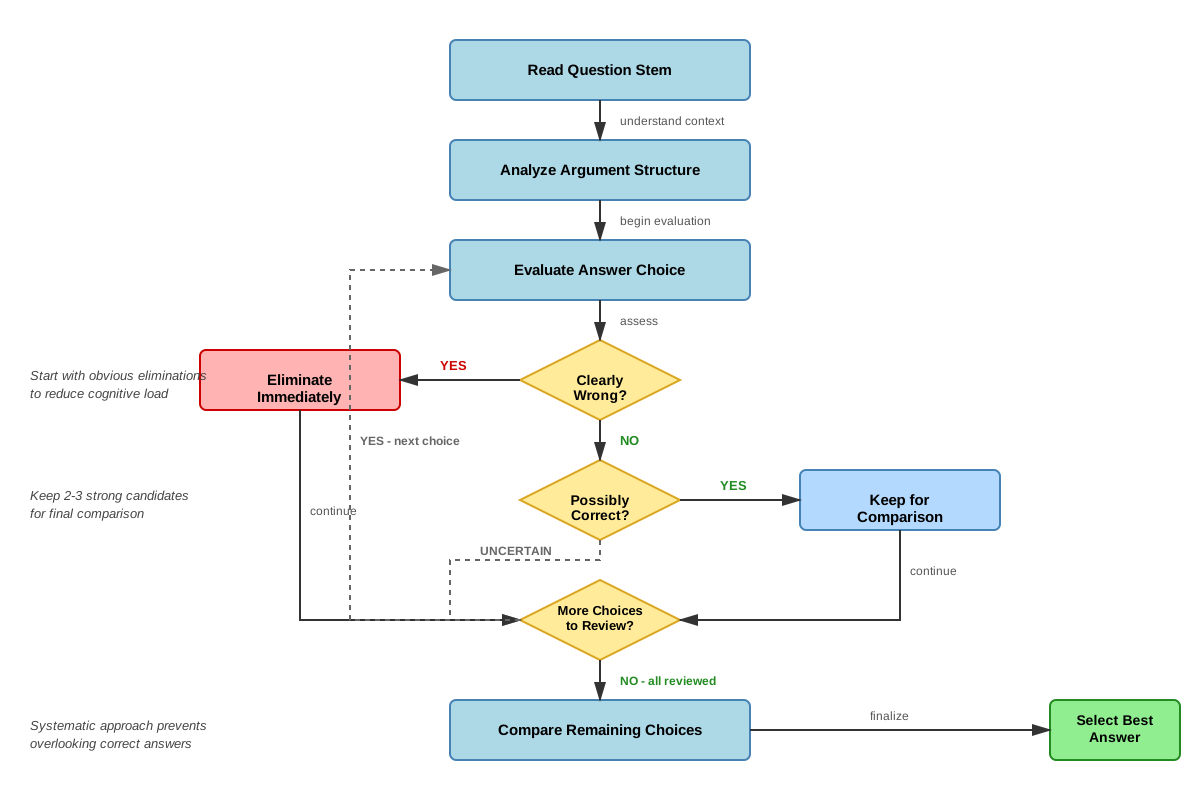
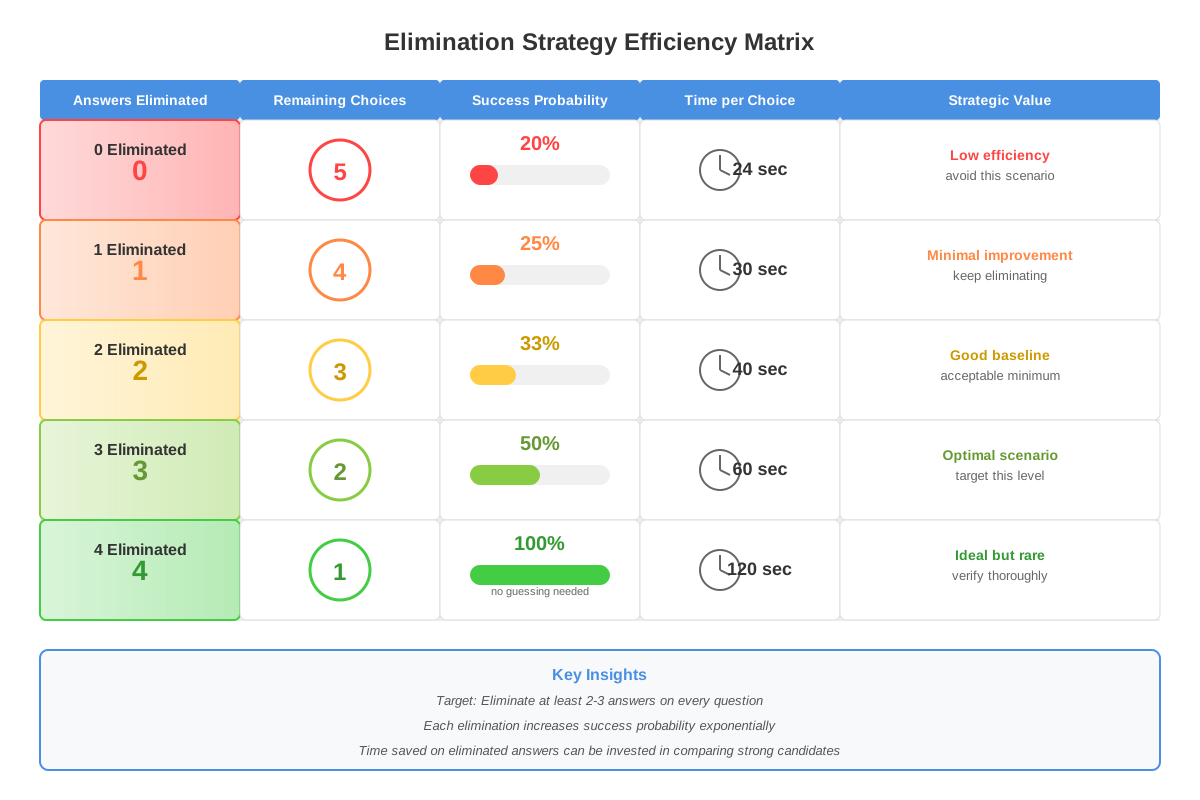
The strategy operates through a process of systematic reduction. Rather than reading all five answer choices and attempting to select the best one through direct comparison, skilled test-takers evaluate each choice individually against specific criteria, actively seeking reasons to eliminate. This approach transforms the task from "Which answer is correct?" to "Why is this answer wrong?"—a question that often has more obvious answers. By removing even two clearly incorrect options, the probability of guessing correctly increases from 20% to 33%, and eliminating three wrong answers creates a 50-50 choice, dramatically improving outcomes even when certainty is impossible.
The Three-Pass Elimination System
Effective elimination follows a structured, multi-pass approach that balances speed with thoroughness:
First Pass - Quick Elimination (30-45 seconds): During the initial read-through of answer choices, immediately eliminate options with obvious flaws. These include answers that are clearly out of scope (discussing elements not mentioned in the argument), contain extreme or absolute language when the argument is moderate, or directly contradict information stated in the passage. This pass should be rapid and decisive, removing 1-3 answers without deep analysis.
Second Pass - Detailed Analysis (45-60 seconds): For remaining answer choices, conduct more careful evaluation. Apply question-type-specific criteria (e.g., for Strengthen questions, ask "Does this answer actually make the conclusion more likely?"). Look for subtle flaws such as reversed causation, scope mismatches between the answer and the conclusion, or answers that address premises rather than the conclusion. This pass typically eliminates 1-2 additional answers.
Third Pass - Final Selection (15-30 seconds): If multiple answers remain, compare them directly, looking for the distinguishing factor. Often, one answer will be "better" rather than "perfect"—it may not be ideal, but it has fewer flaws than alternatives. Trust the elimination process: if you've removed three answers for valid reasons, one of the remaining two must be correct, even if neither seems perfect.
Common Wrong Answer Patterns
GMAT test-makers employ predictable patterns when constructing incorrect answer choices. Recognizing these patterns accelerates elimination:
| Wrong Answer Type | Description | Example Context |
|---|---|---|
| Out of Scope | Introduces concepts, factors, or entities not discussed in the argument | An argument about employee productivity that includes an answer about customer satisfaction |
| Reversed Logic | Inverts the causal relationship or logical connection | Strengthening the opposite conclusion or weakening when asked to strengthen |
| Extreme Language | Uses absolute terms (always, never, only, must) when the argument is qualified | "This is the ONLY factor" when the argument suggests it's "a contributing factor" |
| Irrelevant Comparison | Compares elements that don't affect the argument's conclusion | Comparing two products when the argument concerns only one |
| Premise Restatement | Simply repeats information already stated without adding value | For Assumption questions, stating something already explicit in the argument |
| Shell Game | Uses similar language to the passage but shifts meaning subtly | Changing "most employees" to "all employees" or "correlation" to "causation" |
Scope Matching Technique
One of the most powerful elimination tools involves scope matching—ensuring that answer choices address the same subject, timeframe, and degree as the argument's conclusion. Many wrong answers fail this test by being too broad (addressing a general category when the conclusion is specific), too narrow (focusing on one subset when the conclusion is broader), or misaligned in timeframe (discussing past when the conclusion predicts future).
To apply scope matching:
- Identify the precise conclusion of the argument (what is being claimed?)
- Note the scope parameters: Who/what is it about? When does it apply? How strong is the claim?
- For each answer choice, ask: "Does this match the conclusion's scope exactly?"
- Eliminate any answer that addresses a different subject, timeframe, or degree
The "Why Does This Matter?" Test
For Strengthen, Weaken, and Assumption questions, apply the relevance test: even if an answer choice is true, does it actually impact the argument's conclusion? Many attractive wrong answers present factually plausible statements that simply don't affect the logical connection between premises and conclusion.
To apply this test:
- Assume the answer choice is true
- Ask: "Does this make the conclusion more likely, less likely, or have no effect?"
- If the answer is "no effect," eliminate immediately
- Be especially alert for answers that affect premises rather than the conclusion—these are typically wrong
Strategic Guessing After Elimination
When elimination reduces choices to two or three options but certainty remains elusive, strategic guessing principles apply:
- Favor moderate language over extreme language: GMAT correct answers rarely use absolutes
- Choose answers that address the conclusion directly: Answers focused on premises are often wrong
- Select the answer with fewer assumptions: The correct answer typically requires less additional reasoning
- Trust your elimination: If you eliminated three answers for valid reasons, don't second-guess and reconsider them
Concept Relationships
The elimination strategy functions as a meta-cognitive framework that integrates with and enhances other Critical Reasoning skills. The relationship flows as follows:
Argument Analysis → Elimination Strategy → Answer Selection
Strong argument analysis (identifying premises, conclusions, and assumptions) provides the foundation for effective elimination. Without understanding what the argument actually claims, test-takers cannot accurately assess whether answer choices are in scope or relevant. The elimination strategy then applies this understanding systematically to remove wrong answers, ultimately leading to confident answer selection.
Within the elimination process itself, concepts are hierarchical:
Quick Elimination (obvious flaws) → Detailed Analysis (subtle flaws) → Strategic Comparison (distinguishing between remaining options)
The three-pass system moves from broad to narrow, from fast to careful, ensuring efficiency while maintaining accuracy. Each pass builds on the previous one, progressively refining the answer set.
The elimination strategy also connects to question-type-specific approaches. For example:
- Strengthen/Weaken questions: Elimination focuses on identifying answers with no impact or reversed impact
- Assumption questions: Elimination targets answers that are either already stated (not assumptions) or not necessary (the Negation Test helps here)
- Inference questions: Elimination removes answers that go beyond what can be concluded or contradict the passage
These question-specific applications represent specialized implementations of the general elimination framework, demonstrating how the strategy adapts to different logical tasks while maintaining core principles.
High-Yield Facts
⭐ The elimination strategy is most effective when applied systematically in multiple passes rather than attempting to eliminate all wrong answers simultaneously.
⭐ Approximately 60-70% of GMAT wrong answers can be eliminated quickly (within 10-15 seconds) due to obvious scope mismatches or logical flaws.
⭐ Out-of-scope answers represent the single most common wrong answer type on GMAT Critical Reasoning questions.
⭐ Extreme or absolute language (always, never, only, must, cannot) appears disproportionately in wrong answers compared to correct answers.
⭐ For Strengthen and Weaken questions, answers that affect premises rather than conclusions are almost always incorrect.
- Wrong answers frequently use language from the passage but shift the meaning subtly (the "shell game" trap).
- Eliminating even two wrong answers increases guessing probability from 20% to 33%, a 65% improvement in odds.
- The correct answer on GMAT Critical Reasoning questions is often "the least wrong" rather than "obviously perfect."
- Reversed logic answers (strengthening when asked to weaken, or vice versa) appear in approximately 40% of Strengthen/Weaken questions.
- Answers that introduce new comparisons not discussed in the original argument are typically incorrect unless the question specifically asks about comparisons.
- For Assumption questions, if an answer choice is explicitly stated in the argument, it cannot be an assumption and should be eliminated immediately.
- Time spent on effective elimination (90-120 seconds per question) yields higher accuracy than rushing to select an answer (30-45 seconds).
Quick check — test yourself on Elimination strategy so far.
Try Flashcards →Common Misconceptions
Misconception: The elimination strategy is only useful when you don't know the answer.
Correction: Elimination should be applied to every question, even when an answer seems obvious. This prevents falling for attractive wrong answers and confirms the initial instinct through systematic verification. Top scorers use elimination universally, not as a backup plan.
Misconception: You should read all five answer choices before eliminating any.
Correction: Effective elimination occurs during the first read-through of answer choices. As soon as a clear flaw is identified in an answer, it should be eliminated immediately (mentally or by crossing out). This prevents cognitive overload and saves time by avoiding repeated re-reading of obviously wrong answers.
Misconception: If you can't find anything wrong with an answer, it must be correct.
Correction: The inability to identify a flaw doesn't confirm correctness. Some wrong answers are designed to be plausible and difficult to eliminate. Instead, compare remaining answers directly and select the one with the fewest problems or the strongest support for the conclusion, even if it's not perfect.
Misconception: Extreme language (always, never, must) automatically makes an answer wrong.
Correction: While extreme language appears more frequently in wrong answers, it doesn't guarantee incorrectness. Some arguments do make absolute claims, and the correct answer must match that scope. Always evaluate extreme language in context: Does it match the argument's scope and strength? If yes, it may be correct.
Misconception: The longest or most complex answer is usually correct because it's most detailed.
Correction: Answer length has no correlation with correctness on the GMAT. Test-makers deliberately vary answer length to prevent pattern-based guessing. Some correct answers are concise; others are detailed. Focus on logical validity and scope matching, not length or complexity.
Misconception: If an answer choice is factually true, it can't be wrong.
Correction: Many wrong answers present factually accurate statements that are simply irrelevant to the argument's conclusion. Truth and relevance are separate criteria. An answer must both be true (or plausible) AND impact the argument's logic to be correct. Always apply the "Why does this matter?" test.
Misconception: You should eliminate answers that seem too obvious or simple.
Correction: The GMAT does not penalize straightforward thinking. Sometimes the correct answer is relatively simple and direct. Avoid overthinking or seeking complexity where none exists. If an answer directly addresses the question and has no logical flaws, it's likely correct regardless of perceived simplicity.
Worked Examples
Example 1: Strengthen Question
Argument:
"Company X's new marketing campaign increased brand awareness by 40% in the target demographic. Therefore, Company X will see increased sales in the next quarter."
Question: Which of the following, if true, most strengthens the argument?
Answer Choices:
(A) Company X's competitors have not launched new marketing campaigns recently.
(B) Increased brand awareness in the target demographic has historically correlated with increased sales for Company X.
(C) The marketing campaign cost less than previous campaigns.
(D) Company X's target demographic has grown by 15% in the past year.
(E) Brand awareness is an important factor in consumer decision-making.
Elimination Process:
First Pass - Quick Elimination:
- (C) Eliminate: The cost of the campaign is irrelevant to whether increased brand awareness will lead to increased sales. This is out of scope—it might matter for profitability, but not for the causal link in the argument.
- (E) Eliminate: This is too general and doesn't specifically connect brand awareness to sales for Company X. It's a premise booster (supporting something already implied) rather than a conclusion strengthener.
Second Pass - Detailed Analysis:
- (A) Consider: This might seem relevant, but it doesn't directly strengthen the link between brand awareness and sales. Even if competitors aren't advertising, that doesn't mean brand awareness will translate to sales. This addresses competitive context but not the causal mechanism. Eliminate.
- (D) Consider: A growing demographic might seem positive, but it doesn't strengthen the specific claim that increased brand awareness will lead to increased sales. The argument is about the effect of awareness, not demographic size. Eliminate.
Third Pass - Final Selection:
- (B) Correct: This directly strengthens the argument by establishing a historical pattern that supports the causal link between brand awareness and sales specifically for Company X. It provides evidence that the premise (increased awareness) reliably leads to the conclusion (increased sales).
Key Takeaway: The elimination process removed answers that were out of scope (C), too general (E), addressed the wrong element (A - competitive context rather than the causal link), or were irrelevant to the specific claim (D). The correct answer directly addresses the gap between premise and conclusion.
Example 2: Assumption Question
Argument:
"The city's new bike-sharing program has reduced traffic congestion in the downtown area. This is evident from the fact that average commute times have decreased by 12% since the program launched six months ago."
Question: The argument depends on which of the following assumptions?
Answer Choices:
(A) The bike-sharing program is the primary cause of reduced commute times.
(B) Traffic congestion and commute times are related.
(C) No other factors that could reduce commute times were introduced during the same period.
(D) The bike-sharing program will continue to reduce traffic congestion in the future.
(E) Twelve percent represents a significant decrease in commute times.
Elimination Process:
First Pass - Quick Elimination:
- (D) Eliminate: The argument makes a claim about what has happened (past/present), not what will happen (future). This is a scope mismatch in timeframe.
- (E) Eliminate: Whether 12% is "significant" is a value judgment not necessary for the argument's logic. The argument treats the decrease as evidence regardless of whether we label it "significant."
Second Pass - Detailed Analysis:
- (A) Consider: The word "primary" is too strong. The argument only needs the bike-sharing program to be a contributing cause, not the main cause. Apply the Negation Test: "The bike-sharing program is NOT the primary cause." The argument could still work if it's a secondary cause. Eliminate.
- (B) Consider: This seems like it might be assumed, but actually, the argument already treats them as related by using commute times as evidence for congestion. This is more of a premise than an assumption. However, let's hold this for comparison.
- (C) Consider: Apply the Negation Test: "Other factors that could reduce commute times WERE introduced during the same period." If true, this destroys the argument because we couldn't attribute the reduced commute times to the bike-sharing program. This seems necessary.
Third Pass - Final Selection:
Between (B) and (C):
- (B): While this connection is assumed, it's so fundamental to the argument's structure that it's almost explicitly stated. The argument wouldn't make sense at all without this connection.
- (C) Correct: This is a classic "no alternative cause" assumption. The argument jumps from correlation (program launched, times decreased) to causation (program caused the decrease). This jump requires assuming no other causes were present.
Key Takeaway: Assumption questions require identifying what must be true for the argument to work but isn't explicitly stated. The elimination process removed future-focused answers (D), value judgments (E), overly strong requirements (A), and near-explicit premises (B), leaving the necessary causal assumption (C).
Exam Strategy
Approaching GMAT Questions with Elimination
When facing any Critical Reasoning question, implement this systematic approach:
- Read the question stem first (5-10 seconds): Knowing what you're looking for (strengthen, weaken, assumption, etc.) focuses your reading and primes your brain for relevant information.
- Analyze the argument (30-45 seconds): Identify the conclusion, premises, and any logical gaps. This analysis provides the criteria for elimination.
- Predict the answer type (10-15 seconds): Before reading choices, briefly consider what kind of answer would work. This isn't about predicting the exact answer but understanding the logical role it should play.
- Apply three-pass elimination (90-120 seconds total): Execute the systematic elimination process described in Core Concepts, moving from obvious flaws to subtle distinctions.
- Select and move forward (5-10 seconds): Once elimination leaves one clear choice (or you've narrowed to two and made a strategic guess), select it confidently and move to the next question without second-guessing.
Trigger Words and Phrases
Certain words in answer choices should trigger immediate scrutiny:
Red Flag Words (often in wrong answers):
- Absolute terms: always, never, only, must, cannot, all, none
- Extreme comparisons: best, worst, most important, primary
- Scope shifters: everyone, everything, everywhere, nowhere
Green Light Phrases (often in correct answers):
- Qualified language: may, could, might, suggests, tends to
- Moderate terms: some, many, often, typically, generally
- Scope-appropriate specificity: matches the argument's subject and timeframe exactly
Question-Specific Triggers:
- For Strengthen/Weaken: Watch for answers that affect premises instead of conclusions
- For Assumptions: Look for "if true" or "must be true" language that signals necessity
- For Inference: Be alert to answers that go beyond what's stated (too strong) or contradict the passage
Time Allocation Wisdom
The elimination strategy requires time investment upfront but saves time overall by preventing the need to re-read and reconsider:
- Allocate 2 minutes per Critical Reasoning question as a baseline
- Spend 45-60 seconds on argument analysis before looking at answers—this investment pays dividends in faster, more accurate elimination
- Don't rush the first pass of elimination—10-15 seconds per answer choice for initial evaluation is time well spent
- If you're down to two answers after 90 seconds, spend only 20-30 more seconds deciding—extended deliberation rarely improves accuracy and costs valuable time
- Practice the three-pass system until it becomes automatic—speed comes from systematic process, not from rushing
Exam Tip: If you find yourself re-reading answer choices multiple times, you likely didn't analyze the argument thoroughly enough initially. Invest more time in understanding the argument's structure before evaluating answers.
Memory Techniques
The SCOPE Mnemonic
Remember the most common reasons to eliminate answers with SCOPE:
- Subject mismatch: Answer discusses different entities than the conclusion
- Conclusion ignored: Answer affects premises but not the conclusion
- Out of bounds: Answer introduces concepts not mentioned in the argument
- Premise restatement: Answer repeats what's already stated (for Assumption questions)
- Extreme language: Absolute terms that don't match the argument's qualified claims
The Three-Pass Visualization
Visualize elimination as a funnel with three filters:
- Wide mesh (First Pass): Catches large, obvious debris (clearly wrong answers)
- Medium mesh (Second Pass): Catches smaller particles (subtly flawed answers)
- Fine mesh (Third Pass): Separates the final particles (distinguishes between remaining options)
This image reinforces the progressive refinement nature of effective elimination.
The "RED" Quick Check
Before selecting an answer, perform the RED check:
- Relevant: Does this answer actually address the conclusion?
- Evidence: Does this answer impact the logical connection in the argument?
- Direct: Does this answer directly accomplish what the question asks?
If any answer is "no," reconsider your selection.
The Assumption Negation Acronym: "NADA"
For Assumption questions, remember NADA (Negate And Destroy Argument):
- Negate the answer choice
- Assess the impact on the argument
- Does it destroy the argument?
- Answer is correct if yes, wrong if no
This acronym helps recall the Negation Test, one of the most powerful tools for Assumption questions.
Summary
The elimination strategy represents a systematic, multi-pass approach to answering GMAT Critical Reasoning questions by progressively removing incorrect answer choices rather than attempting to identify the correct answer directly. This strategy leverages the fundamental insight that wrong answers typically contain identifiable flaws—such as scope mismatches, extreme language, reversed logic, or irrelevance—that are easier to detect than the subtle correctness of right answers. By applying a three-pass system (quick elimination of obvious flaws, detailed analysis of subtle issues, and strategic comparison of remaining options), test-takers can efficiently narrow answer choices and make confident selections even under time pressure. The strategy integrates with question-type-specific approaches and requires strong argument analysis as a foundation. Common wrong answer patterns include out-of-scope responses, premise restatements, and answers that fail the relevance test. Mastering elimination requires recognizing these patterns, applying scope-matching techniques, and trusting the systematic process even when perfect certainty is elusive. This approach transforms the GMAT from a test of finding right answers to a test of systematically removing wrong ones—a subtle but powerful shift that significantly improves accuracy and efficiency.
Key Takeaways
- The elimination strategy is most effective when applied systematically in three passes: quick elimination, detailed analysis, and final comparison.
- Out-of-scope answers represent the most common wrong answer type and should be the first target for elimination in any question.
- Effective elimination requires thorough argument analysis first—understanding the conclusion, premises, and logical gaps provides the criteria for evaluating answer choices.
- Wrong answers often fail the relevance test: even if factually true, they don't impact the argument's conclusion and should be eliminated.
- Extreme or absolute language appears disproportionately in wrong answers, but context matters—always check if the extreme language matches the argument's scope.
- Strategic guessing after elimination (choosing between two remaining answers) should favor moderate language, conclusion-focused answers, and options requiring fewer additional assumptions.
- The elimination strategy is not a backup plan for difficult questions but a primary approach that should be applied universally to maximize accuracy and efficiency across all Critical Reasoning questions.
Related Topics
Question-Type-Specific Strategies: After mastering general elimination, study how elimination principles adapt to specific question types (Strengthen, Weaken, Assumption, Inference, Evaluate, Boldface, Paradox). Each type has unique wrong answer patterns and elimination criteria.
Argument Structure Analysis: Deeper understanding of how to identify conclusions, premises, assumptions, and logical gaps enhances elimination effectiveness by providing clearer criteria for evaluating answer choices.
Logical Fallacies: Recognizing common logical fallacies (false causation, false dichotomy, appeal to authority, etc.) accelerates elimination because many wrong answers exploit these fallacies or require identifying them.
Scope and Precision in Language: Advanced study of how GMAT uses subtle language shifts (quantifiers, modifiers, scope words) to create wrong answers helps identify the "shell game" trap and other sophisticated distractors.
Time Management and Pacing: Integrating elimination strategy with overall Verbal section pacing ensures that the time invested in systematic elimination doesn't compromise performance on other questions.
Practice CTA
Now that you've mastered the elimination strategy framework, it's time to put these principles into action. Attempt the practice questions associated with this topic, applying the three-pass elimination system to each question. Pay special attention to identifying wrong answer patterns and practicing scope-matching techniques. Use the flashcards to reinforce recognition of common elimination triggers and wrong answer types. Remember: elimination is a skill that improves dramatically with deliberate practice. Each question you analyze strengthens your pattern recognition and speeds up your elimination process. Your goal isn't just to get questions right, but to get them right efficiently and confidently through systematic elimination. Start practicing now, and watch your Critical Reasoning accuracy soar!
Sign up free to keep reading
Create a free AnvayaPrep account to finish this GMAT guide on Elimination strategy — plus flashcards and practice questions.