Overview
In GMAT Critical Reasoning, understanding premises forms the foundation for analyzing arguments effectively. Premises are the supporting statements, facts, or evidence that an author provides to justify a conclusion. They represent the "why" behind an argument's main claim, serving as the building blocks upon which logical reasoning rests. On the GMAT, the ability to quickly and accurately identify premises separates high scorers from average performers, as nearly every Critical Reasoning question requires students to understand the argument's structure before evaluating its validity, strengthening it, weakening it, or identifying assumptions.
Mastering premises is essential because they appear in virtually every Critical Reasoning question type on the GMAT. Whether facing Strengthen, Weaken, Assumption, Evaluate, or Inference questions, students must first distinguish between what the author is trying to prove (the conclusion) and what evidence the author offers (the premises). This distinction enables test-takers to analyze argument structure systematically rather than relying on intuition or content knowledge. The GMAT specifically tests logical reasoning skills, not subject matter expertise, making the identification of premises a transferable skill across all argument topics.
Within the broader context of Verbal Reasoning, premises connect directly to conclusions, assumptions, and logical structure. Together, these elements form the complete argument framework that Critical Reasoning questions test. Understanding premises also enhances Reading Comprehension performance, as recognizing supporting evidence versus main claims helps students navigate complex passages more efficiently. The relationship between premises and conclusions mirrors the relationship between supporting details and main ideas in longer passages, creating a unified approach to GMAT Verbal Reasoning.
Learning Objectives
- [ ] Identify premises in GMAT Critical Reasoning arguments
- [ ] Explain the role and function of premises within logical arguments
- [ ] Apply understanding of premises to answer GMAT Critical Reasoning questions accurately
- [ ] Distinguish between premises and conclusions in complex argument structures
- [ ] Recognize premise indicators and signal words that mark supporting evidence
- [ ] Evaluate the relevance and strength of premises in supporting conclusions
- [ ] Analyze multi-premise arguments and determine which premises are most critical
Prerequisites
- Basic sentence structure and grammar: Understanding subject-verb relationships helps identify complete thoughts that can serve as premises or conclusions
- Logical connectors and transition words: Familiarity with words like "because," "since," and "therefore" aids in recognizing argument structure
- Reading comprehension fundamentals: The ability to identify main ideas versus supporting details translates directly to distinguishing conclusions from premises
- Basic understanding of arguments: Recognizing that arguments consist of claims supported by evidence provides the conceptual framework for premise identification
Why This Topic Matters
Understanding premises has real-world applications far beyond standardized testing. In business settings, professionals must evaluate proposals by examining the evidence supporting recommendations. Legal reasoning depends on identifying which facts support which claims. Scientific thinking requires distinguishing between data (premises) and interpretations (conclusions). Medical decision-making involves weighing evidence before reaching diagnostic conclusions. The skill of premise identification thus represents a fundamental component of critical thinking applicable across professional and personal contexts.
On the GMAT specifically, premises appear in approximately 12-14 Critical Reasoning questions per exam, representing roughly one-third of the Verbal section. Every single Critical Reasoning question contains at least one premise, and many contain multiple premises that must be evaluated. Question types that explicitly test premise understanding include Strengthen questions (which add new premises), Weaken questions (which undermine premise-conclusion connections), and Assumption questions (which identify unstated premises). Even Inference questions require students to work from stated premises to reach valid conclusions.
The GMAT presents premises in various formats: as statistical data, expert testimony, historical facts, survey results, experimental findings, or general observations. Test-makers deliberately embed premises within complex sentence structures, use multiple premises to support single conclusions, or present premises that appear conclusion-like. This variety ensures that students must actively analyze argument structure rather than passively recognize patterns. High-performing test-takers develop systematic approaches to premise identification that work regardless of content domain or sentence complexity.
Core Concepts
Definition and Function of Premises
Premises are statements offered as evidence, reasons, or support for a conclusion within an argument. They represent the factual or logical foundation upon which an author builds a claim. In formal logic, premises are propositions assumed to be true for the purpose of the argument, whether or not they are actually true in reality. The GMAT tests the ability to identify these supporting statements and understand their role in argument structure, not the ability to verify their truth.
The primary function of premises is to provide justification for accepting a conclusion. Without premises, a conclusion stands as mere assertion without support. Strong arguments feature premises that are relevant, sufficient, and credible. Weak arguments may contain premises that are irrelevant to the conclusion, insufficient to support it fully, or questionable in their accuracy. On the GMAT, recognizing premises allows test-takers to evaluate argument quality and identify logical gaps.
Premise Indicators
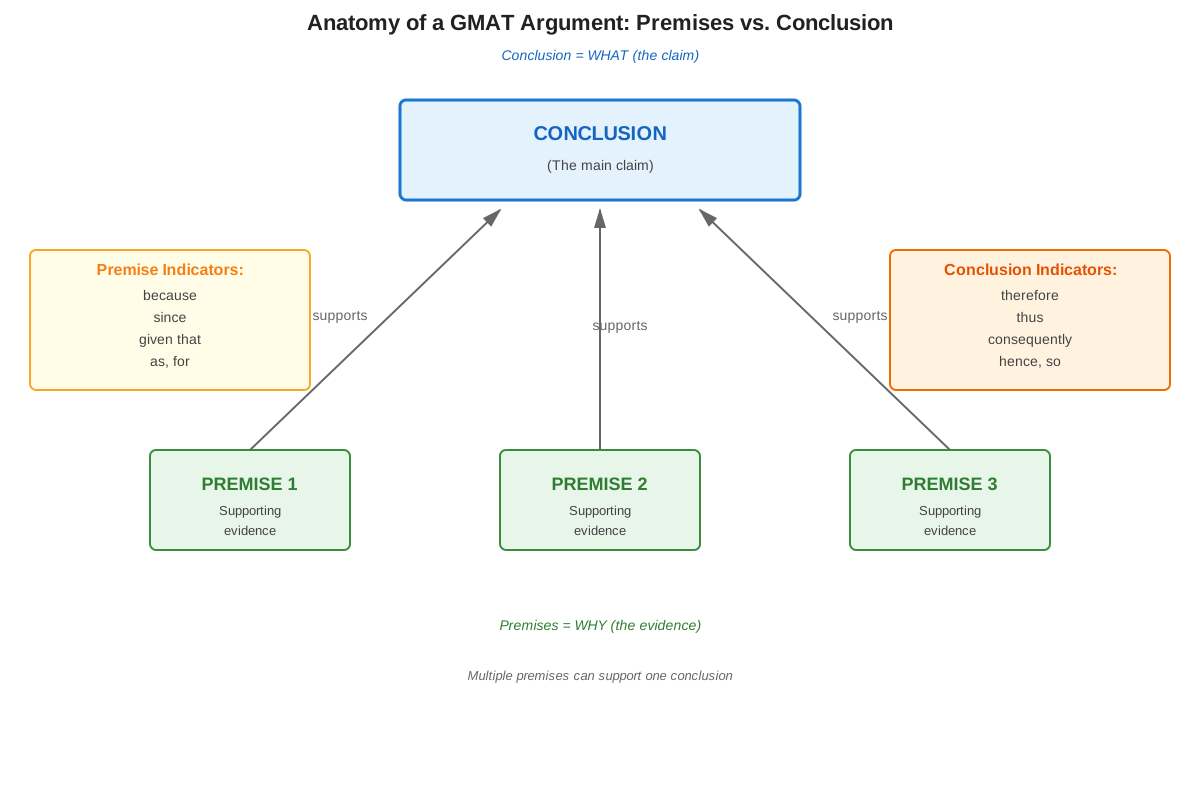
Premise indicators are words and phrases that signal the presence of supporting evidence. Recognizing these indicators accelerates premise identification and improves accuracy under time pressure. Common premise indicators include:
- Because: "The company will succeed because it has strong leadership"
- Since: "Since sales increased 20%, the marketing campaign was effective"
- For: "The policy should change, for current regulations are outdated"
- As: "As research demonstrates, exercise improves cognition"
- Given that: "Given that costs have risen, prices must increase"
- The reason is that: "Profits fell; the reason is that competition intensified"
- As indicated by: "Demand is growing, as indicated by recent surveys"
- For the reason that: "We should expand for the reason that market conditions are favorable"
- May be inferred from: "Success may be inferred from customer satisfaction scores"
- As shown by: "Quality improved, as shown by defect rates"
Not every premise includes an indicator word. Many premises appear as standalone statements that provide context or evidence without explicit markers. Skilled test-takers identify these unmarked premises by asking: "What evidence does the author provide?" and "What facts support the main claim?"
Types of Premises
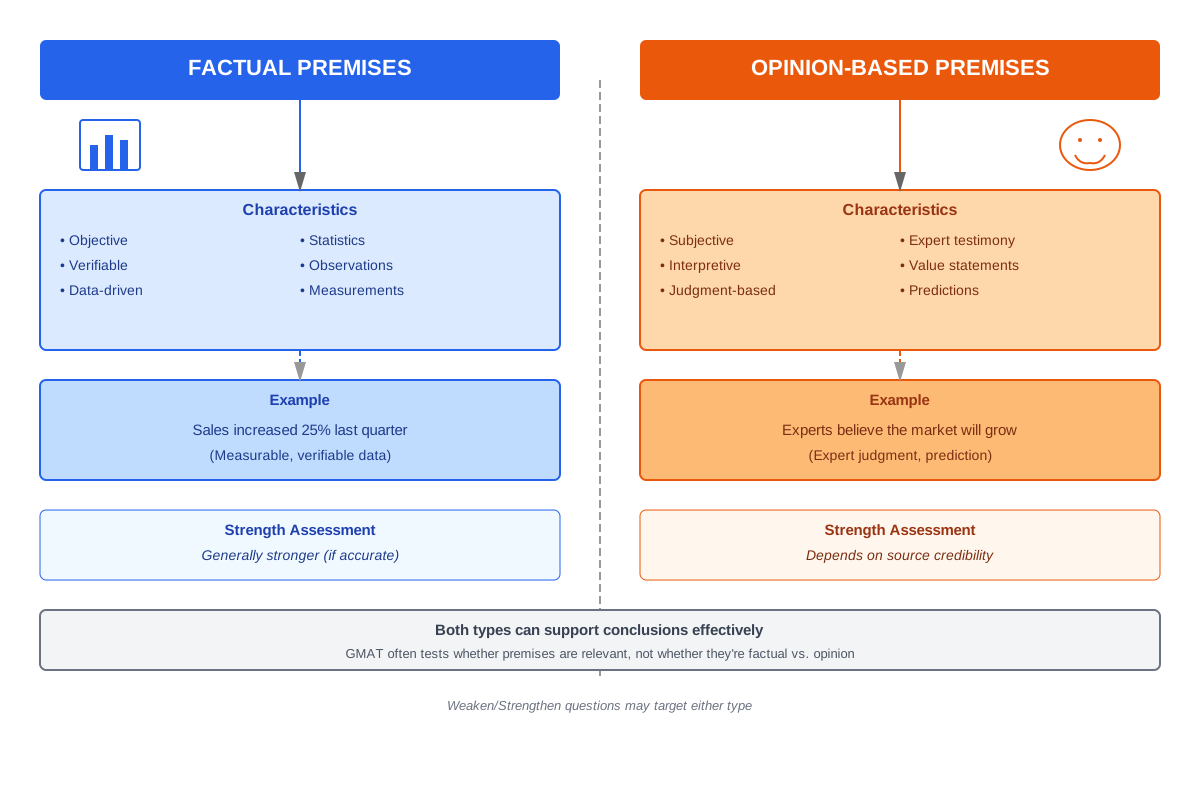
GMAT arguments employ various premise types, each serving different evidential functions:
Factual Premises present data, statistics, or observable information:
- "Company revenues increased 15% last quarter"
- "The study included 500 participants"
- "Temperatures have risen 2 degrees over the past decade"
Causal Premises establish cause-and-effect relationships:
- "Implementing the new system reduced processing time"
- "Higher education levels lead to increased earning potential"
- "The medication caused adverse reactions in 10% of patients"
Comparative Premises draw parallels or contrasts:
- "Similar policies succeeded in neighboring countries"
- "This approach outperformed traditional methods"
- "Unlike previous models, this design incorporates user feedback"
Testimonial Premises cite expert opinion or authority:
- "Leading economists predict continued growth"
- "Industry analysts recommend this strategy"
- "Research scientists have confirmed the hypothesis"
Conditional Premises establish if-then relationships:
- "If demand increases, prices will rise"
- "Provided that funding continues, the project will complete on schedule"
- "Unless regulations change, compliance costs will remain high"
Distinguishing Premises from Conclusions
The most critical skill in premise identification is distinguishing premises from conclusions. While premises provide support, conclusions represent the main claim or point the author wants the reader to accept. Several strategies facilitate this distinction:
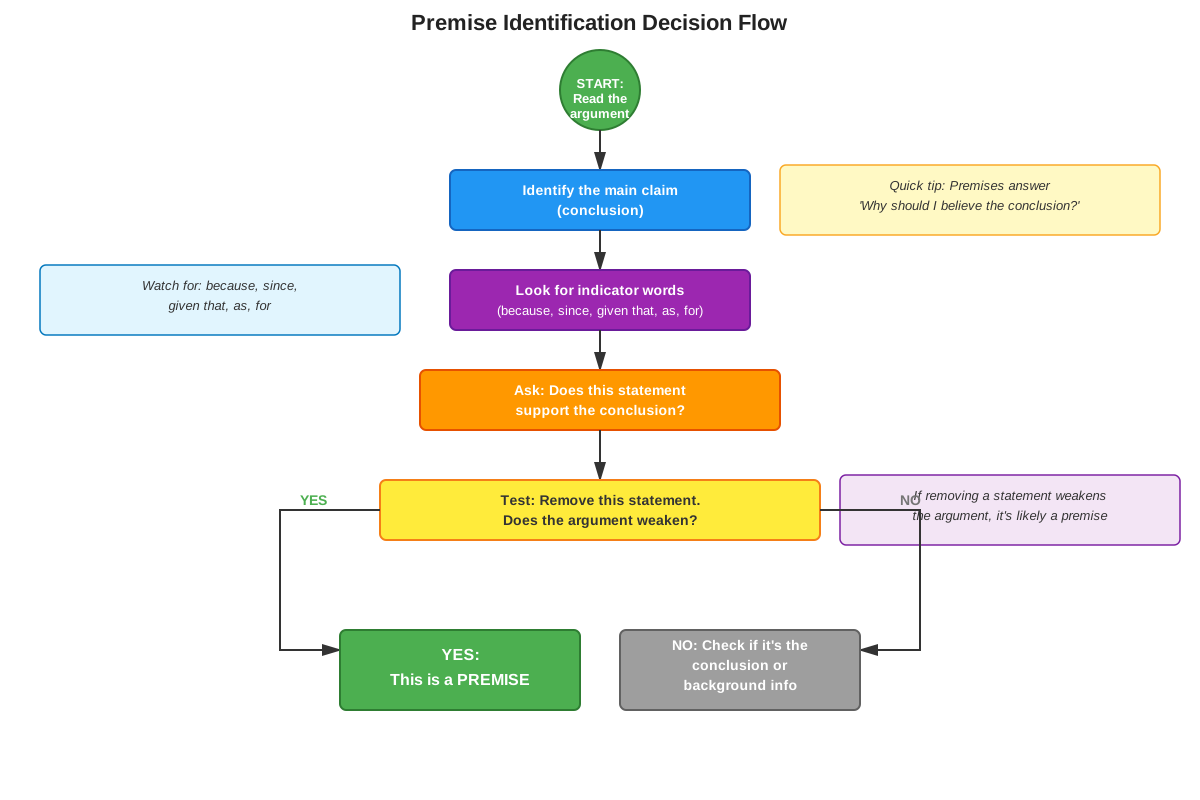
The "Why" Test: Ask "Why should I believe this statement?" If the answer appears elsewhere in the argument, the statement is likely a conclusion. If the statement itself provides the answer, it's likely a premise.
The "Therefore" Test: Try inserting "therefore" before each statement. If it sounds natural and represents the argument's main point, it's the conclusion. Premises typically sound awkward with "therefore" preceding them.
Conclusion Indicators: Watch for words like "therefore," "thus," "consequently," "hence," "so," "it follows that," and "as a result." These signal conclusions rather than premises.
Structural Position: While not definitive, conclusions often appear at the beginning or end of arguments. However, GMAT arguments deliberately vary structure to test true comprehension rather than pattern recognition.
Multiple Premises and Argument Structure
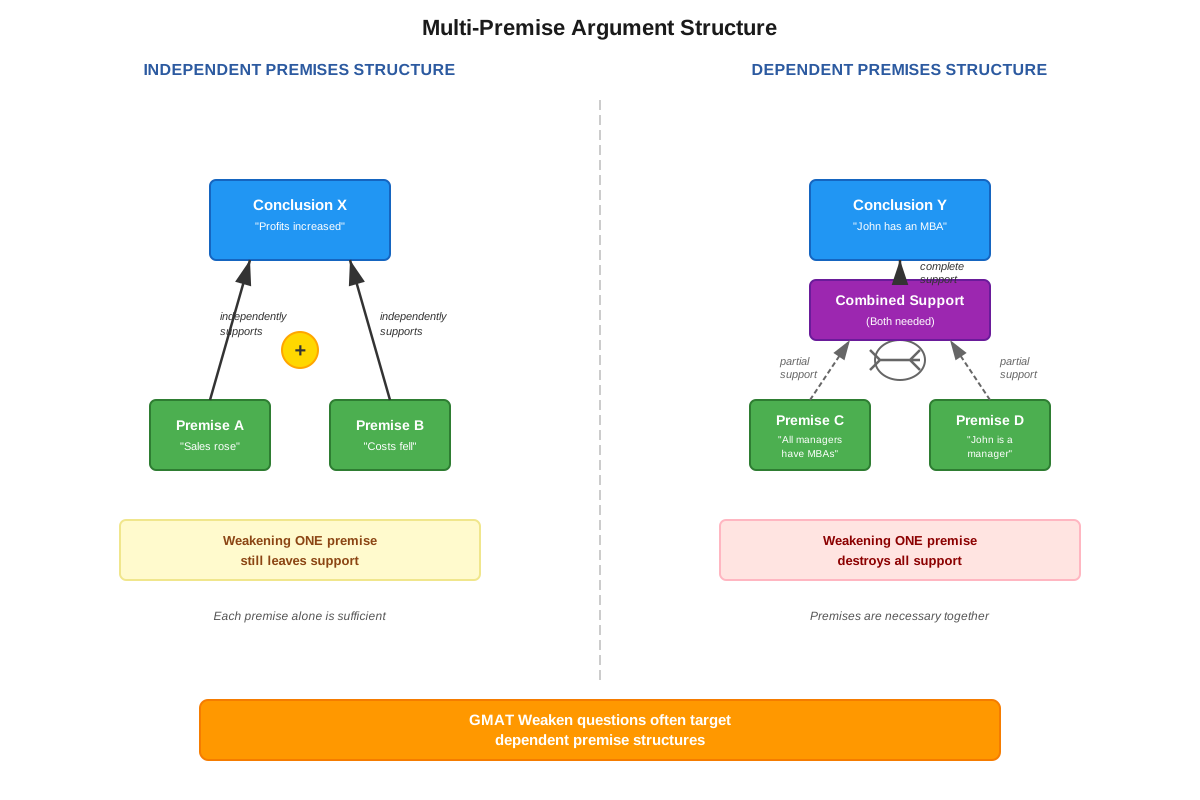
Many GMAT arguments contain multiple premises working together to support a conclusion. Understanding how premises interact strengthens argument analysis:
Independent Premises: Each premise separately supports the conclusion. If one premise were removed, the others would still provide some support.
- Premise 1: "Customer satisfaction scores increased 25%"
- Premise 2: "Employee retention improved significantly"
- Conclusion: "The management changes were successful"
Dependent Premises: Premises work together, and removing one would eliminate the support entirely.
- Premise 1: "All effective managers communicate clearly"
- Premise 2: "Sarah communicates clearly"
- Conclusion: "Sarah is an effective manager"
Premise Chains: One premise supports an intermediate conclusion, which then serves as a premise for the final conclusion.
- Premise: "Sales increased in all regions"
- Intermediate Conclusion/Premise: "The product has broad appeal"
- Final Conclusion: "We should expand production"
Recognizing these structures helps test-takers understand argument complexity and identify which premises are most critical to the conclusion's validity.
Implicit vs. Explicit Premises
Explicit premises are directly stated in the argument text. These are the most straightforward to identify, though they may be embedded in complex sentences or scattered throughout the passage.
Implicit premises (also called assumptions) are unstated but necessary for the argument to work. While this guide focuses on explicit premises, understanding that arguments often rely on unstated premises helps explain why GMAT questions frequently ask about assumptions. The gap between stated premises and conclusions often reveals what the author must be assuming.
For example:
- Stated Premise: "This medication reduced symptoms in clinical trials"
- Conclusion: "This medication will help patients in general practice"
- Implicit Premise: "Clinical trial conditions are similar enough to general practice conditions"
Concept Relationships
Premises form the foundational layer of argument analysis, connecting directly to multiple Critical Reasoning concepts. The relationship flows as follows:
Premises → Support → Conclusions: This represents the most fundamental relationship. Premises provide the evidence or reasons that justify accepting the conclusion. Without this connection, no argument exists—only disconnected statements.
Premises + Assumptions → Complete Support → Conclusions: Assumptions act as unstated premises that bridge gaps between explicit premises and conclusions. Identifying stated premises helps reveal what additional premises (assumptions) must be true for the argument to succeed.
Premises ← Evaluated by → Strengthen/Weaken Questions: These question types add new information that either reinforces the connection between premises and conclusion (strengthen) or undermines it (weaken). Understanding the original premises is essential for evaluating whether new information helps or hurts the argument.
Premises → Analyzed for → Logical Flaws: Many GMAT arguments contain logical flaws in how premises connect to conclusions. Identifying premises allows test-takers to spot gaps, irrelevant evidence, or insufficient support.
Premises → Foundation for → Inference Questions: Valid inferences must be supported by stated premises. These questions test whether students can recognize what must be true based on the given premises, without adding outside assumptions.
The relationship to prerequisite knowledge includes:
- Reading Comprehension skills enable identification of main ideas (conclusions) versus supporting details (premises)
- Grammar knowledge helps parse complex sentences to extract individual premise statements
- Logical connectors signal relationships between premises and conclusions
High-Yield Facts
⭐ Premises are statements that provide evidence, reasons, or support for a conclusion within an argument
⭐ Common premise indicators include "because," "since," "for," "as," and "given that"
⭐ Not all premises include indicator words; many appear as standalone factual statements
⭐ Every Critical Reasoning question on the GMAT contains at least one premise
⭐ Distinguishing premises from conclusions is the first step in analyzing any GMAT argument
- Premises can be factual, causal, comparative, testimonial, or conditional in nature
- Multiple premises may work independently or dependently to support a single conclusion
- The "why" test helps distinguish premises (which provide reasons) from conclusions (which need reasons)
- Premises may appear before, after, or interspersed with the conclusion in GMAT arguments
- Strong premises are relevant, sufficient, and credible; weak premises lack these qualities
- Premise identification enables effective analysis for Strengthen, Weaken, Assumption, and Evaluate questions
- GMAT arguments deliberately embed premises in complex sentence structures to test analytical skills
- Recognizing premise types helps predict what kinds of information might strengthen or weaken arguments
- The relationship between premises and conclusions reveals logical gaps that assumptions must fill
- Practicing premise identification improves speed and accuracy across all Critical Reasoning question types
Quick check — test yourself on Premises so far.
Try Flashcards →Common Misconceptions
Misconception: Premises are always true statements.
Correction: Premises are statements offered as evidence, regardless of their actual truth. The GMAT tests logical reasoning, not factual verification. Test-takers should accept premises as given for the purpose of analyzing the argument, even if they seem questionable in reality.
Misconception: The first sentence of an argument is always the conclusion.
Correction: GMAT arguments deliberately vary structure. Conclusions may appear at the beginning, middle, or end of passages. Some arguments present the conclusion first, then provide supporting premises. Others build premises before stating the conclusion. Rely on logical function and indicator words, not position.
Misconception: Longer statements are conclusions, while shorter statements are premises.
Correction: Length does not determine function. A single-word statement could be a conclusion if it represents the main claim, while a lengthy sentence could be a premise if it provides supporting evidence. Focus on what role each statement plays in the argument's logical structure.
Misconception: Every sentence in a GMAT argument is either a premise or a conclusion.
Correction: Arguments may include background information, context, or counterarguments that function as neither premises nor conclusions. These elements provide setup or acknowledge opposing views but don't directly support the main claim. Skilled test-takers distinguish between structural elements and focus on the core argument.
Misconception: Premises must directly relate to the conclusion's topic.
Correction: While strong premises should be relevant, GMAT arguments sometimes include premises that seem tangentially related or even irrelevant. Part of critical reasoning involves evaluating whether premises actually support the conclusion. Weak arguments may contain premises that don't effectively justify the conclusion, and recognizing this weakness is often the key to answering the question correctly.
Misconception: If a statement contains data or statistics, it must be a premise.
Correction: While factual information often serves as premises, conclusions can also incorporate data. For example: "Therefore, the 15% increase demonstrates success" uses data within a conclusion. Determine function by asking whether the statement provides support or represents the claim being supported.
Misconception: Premise indicators always appear immediately before the premise.
Correction: Indicator words may appear at the beginning, middle, or end of premise statements. "The policy will succeed because funding is adequate" places the indicator between conclusion and premise. "Because funding is adequate, the policy will succeed" places it before the premise. Flexible recognition is essential.
Worked Examples
Example 1: Basic Premise Identification
Argument: "TechCorp's new software should increase productivity significantly. The software automates repetitive tasks that currently consume 30% of employees' time. Additionally, beta testing showed that users completed projects 25% faster when using the software. Similar automation tools have proven successful in comparable industries."
Analysis:
Step 1: Identify the conclusion by asking "What is the main claim?"
- The conclusion is: "TechCorp's new software should increase productivity significantly"
- This represents what the author wants us to believe
Step 2: Identify premise indicators
- No explicit indicator precedes the conclusion
- The subsequent sentences provide supporting evidence
Step 3: Extract each premise
- Premise 1: "The software automates repetitive tasks that currently consume 30% of employees' time"
- Type: Factual premise describing software functionality
- Premise 2: "Beta testing showed that users completed projects 25% faster when using the software"
- Type: Factual/causal premise providing empirical evidence
- Premise 3: "Similar automation tools have proven successful in comparable industries"
- Type: Comparative premise drawing parallels to other contexts
Step 4: Evaluate premise relationships
- These premises work independently—each separately supports the conclusion
- Premise 1 establishes potential for improvement
- Premise 2 provides direct evidence of actual improvement
- Premise 3 suggests the pattern holds across contexts
Application to GMAT questions: Understanding these premises allows test-takers to:
- Strengthen: Identify what additional evidence would reinforce the conclusion (e.g., "TechCorp's employees perform similar tasks to those in the beta test")
- Weaken: Recognize what would undermine the premises (e.g., "Beta test participants received extensive training unavailable to TechCorp employees")
- Assumption: Spot gaps between premises and conclusion (e.g., the assumption that TechCorp's environment resembles beta test conditions)
Example 2: Complex Argument with Multiple Premises
Argument: "City planners should prioritize expanding public transportation over building new highways. Traffic congestion has increased 40% over the past five years, and this trend will continue as the population grows. Studies demonstrate that cities with extensive public transit systems experience less congestion than those relying primarily on highways. Furthermore, public transportation produces 45% fewer emissions per passenger mile than private vehicles. Since the city has committed to reducing carbon emissions by 30% within ten years, expanding public transit aligns with this environmental goal."
Analysis:
Step 1: Identify the conclusion
- Main claim: "City planners should prioritize expanding public transportation over building new highways"
- This is a recommendation/policy conclusion
Step 2: Map all premises with their indicators
Premise 1: "Traffic congestion has increased 40% over the past five years"
- Type: Factual premise establishing a problem
- No explicit indicator; provides context
Premise 2: "This trend will continue as the population grows"
- Type: Predictive/causal premise
- Indicator: implicit causal connection ("as")
Premise 3: "Studies demonstrate that cities with extensive public transit systems experience less congestion than those relying primarily on highways"
- Type: Comparative/testimonial premise
- Indicator: "Studies demonstrate that"
Premise 4: "Public transportation produces 45% fewer emissions per passenger mile than private vehicles"
- Type: Factual/comparative premise
- Indicator: implicit in statement structure
Premise 5: "The city has committed to reducing carbon emissions by 30% within ten years"
- Type: Factual premise about policy context
- Indicator: "Since" (appears before this premise in the sentence)
Step 3: Analyze premise structure
- Premises 1-3 form one line of reasoning: congestion problem → public transit reduces congestion → therefore public transit is preferable
- Premises 4-5 form a second line: emission reduction goal + public transit reduces emissions → therefore public transit helps achieve goal
- These independent lines converge to support the conclusion
Step 4: Identify the logical flow
- Problem identification (Premises 1-2) → Solution effectiveness (Premise 3) → Additional benefit (Premise 4) → Alignment with goals (Premise 5) → Conclusion
Application to GMAT questions:
- Assumption question: The argument assumes that reducing congestion and emissions are the primary criteria for transportation decisions (not cost, construction time, or other factors)
- Weaken question: Information showing that public transit expansion would be prohibitively expensive or take too long to implement would undermine the conclusion
- Strengthen question: Evidence that public transit expansion can be completed quickly and affordably would reinforce the conclusion
- Evaluate question: Determining whether the city has sufficient funding for public transit expansion would help evaluate the argument
Exam Strategy
Systematic Approach to Premise Identification
Step 1: Read the entire argument first (15-20 seconds)
- Gain overall understanding before analyzing structure
- Resist the urge to identify premises while reading initially
Step 2: Identify the conclusion (5-10 seconds)
- Ask: "What is the author's main point or claim?"
- Look for conclusion indicators: therefore, thus, consequently, should, must
- Apply the "why" test: the statement that needs support is the conclusion
Step 3: Identify all premises (10-15 seconds)
- Ask: "What evidence or reasons does the author provide?"
- Look for premise indicators: because, since, for, as, given that
- Note unmarked premises that provide factual support
Step 4: Map the argument structure (5-10 seconds)
- Determine whether premises work independently or dependently
- Identify any premise chains or intermediate conclusions
- Recognize the logical flow from evidence to claim
Exam Tip: On the GMAT, spend 30-40 seconds analyzing argument structure before reading the question. This investment pays dividends across all question types, as understanding premises and conclusions enables faster, more accurate answer selection.
Trigger Words and Phrases
Premise Triggers (indicate supporting evidence follows):
- "Because," "since," "for," "as"
- "Given that," "seeing that," "in light of"
- "As indicated by," "as shown by," "as evidenced by"
- "The reason is," "for the reason that"
- "May be inferred from," "may be deduced from"
Conclusion Triggers (indicate main claim follows):
- "Therefore," "thus," "hence," "consequently"
- "So," "accordingly," "as a result"
- "It follows that," "we can conclude that"
- "This shows that," "this demonstrates that"
- "Should," "must," "ought to" (in recommendation arguments)
Neutral Connectors (require context to determine function):
- "And," "also," "furthermore," "moreover" (may connect premises or add to conclusion)
- "However," "but," "although" (may introduce counterarguments or qualifications)
Question-Type Specific Strategies
For Strengthen/Weaken Questions:
- Identify all premises first
- Determine which premise-conclusion connection is weakest
- Predict what information would reinforce or undermine that connection
- Eliminate answers that address irrelevant premises or introduce new conclusions
For Assumption Questions:
- Map stated premises clearly
- Identify the logical gap between premises and conclusion
- Recognize that assumptions function as unstated premises
- Test answer choices by negating them—if negation destroys the argument, it's a necessary assumption
For Inference Questions:
- Treat premises as facts
- Eliminate answers that go beyond what premises support
- Avoid bringing in outside knowledge
- Select answers that must be true based solely on stated premises
Time Management
- Argument analysis: 30-40 seconds
- Question reading: 5-10 seconds
- Answer evaluation: 45-60 seconds
- Total per question: 90-110 seconds (1.5-2 minutes)
Investing time upfront in premise identification accelerates answer evaluation, as test-takers can quickly eliminate choices that misunderstand argument structure.
Memory Techniques
The PREMISE Acronym
Provide evidence
Reasons supporting claims
Evidence offered
Material for conclusions
Information backing arguments
Support for main points
Explanations justifying claims
This acronym reinforces that premises serve a supporting function in arguments.
The "Because Test" Visualization
Visualize premises as pillars supporting a roof (the conclusion). Ask: "Can I insert 'because' before this statement and have it explain the conclusion?" If yes, it's a premise. If the statement itself needs explanation, it's the conclusion.
         CONCLUSION (roof)
              /|\
             / | \
            /  |  \
    Premise Premise Premise (pillars)
The Traffic Light System
- Green (Go): Premise indicators like "because," "since," "for"—these signal supporting evidence ahead
- Red (Stop): Conclusion indicators like "therefore," "thus," "hence"—these signal the main claim
- Yellow (Caution): Neutral connectors that require context analysis
The Question Chain
When identifying premises, ask this sequence:
- What is the main claim? (Find conclusion)
- Why should I believe it? (Find premises)
- How do the reasons connect? (Analyze structure)
- What's missing? (Identify assumptions)
This chain creates a systematic approach that becomes automatic with practice.
The SUPPORT Mnemonic for Premise Types
Statistical (factual data)
Universal principles (general rules)
Parallels (comparative examples)
Predictions (causal claims)
Opinions (expert testimony)
Research (study results)
Trends (patterns over time)
Recognizing premise types helps predict what information might strengthen or weaken arguments.
Summary
Premises form the evidentiary foundation of GMAT Critical Reasoning arguments, providing the reasons, facts, and support that justify conclusions. Mastering premise identification requires recognizing indicator words like "because," "since," and "given that," while also identifying unmarked premises that provide factual support. The ability to distinguish premises from conclusions—using techniques like the "why test" and recognizing conclusion indicators—enables systematic argument analysis essential for high GMAT performance. Premises appear in various types (factual, causal, comparative, testimonial, conditional) and may work independently or dependently to support conclusions. Understanding how premises connect to conclusions, assumptions, and logical structure allows test-takers to approach Strengthen, Weaken, Assumption, Evaluate, and Inference questions strategically. The GMAT deliberately embeds premises in complex structures and varies their position within arguments, testing true analytical skill rather than pattern recognition. Success requires systematic analysis: identify the conclusion first, extract all premises, map their relationships, and recognize logical gaps. This foundational skill appears in every Critical Reasoning question and significantly impacts Verbal Reasoning performance.
Key Takeaways
- Premises are supporting statements that provide evidence, reasons, or justification for a conclusion—they answer "why" the conclusion should be accepted
- Premise indicators like "because," "since," "for," and "as" signal supporting evidence, though many premises appear without explicit markers
- Distinguishing premises from conclusions is the critical first step in analyzing any GMAT argument—use the "why test" and look for conclusion indicators
- Multiple premises may work independently (each separately supports the conclusion) or dependently (work together as necessary components) to build an argument
- Every Critical Reasoning question type requires premise identification—Strengthen/Weaken questions modify premise-conclusion connections, Assumption questions identify unstated premises, and Inference questions draw conclusions from stated premises
- Systematic analysis (identify conclusion → extract premises → map relationships → recognize gaps) improves both speed and accuracy under exam time pressure
- Strong premises are relevant, sufficient, and credible; recognizing weak or irrelevant premises helps identify argument flaws and predict correct answers
Related Topics
Conclusions: Understanding premises naturally leads to mastering conclusion identification, as these two elements form the core of argument structure. Conclusions represent what premises support, and distinguishing between them is fundamental to all Critical Reasoning questions.
Assumptions: Assumptions function as unstated premises that bridge gaps between explicit premises and conclusions. After mastering premise identification, students can more easily recognize what additional premises must be true for arguments to succeed.
Argument Structure: This broader topic encompasses how premises, conclusions, assumptions, and counterarguments fit together. Mastering premises provides the foundation for analyzing complete argument architecture.
Strengthen and Weaken Questions: These question types test the ability to evaluate how new information affects premise-conclusion relationships. Understanding premises enables students to predict what would reinforce or undermine arguments.
Logical Flaws: Many GMAT arguments contain flaws in how premises connect to conclusions—insufficient evidence, irrelevant premises, or causal reasoning errors. Premise identification skills allow students to spot these weaknesses systematically.
Practice CTA
Now that you understand how to identify, explain, and apply premises in GMAT Critical Reasoning arguments, it's time to reinforce these skills through active practice. Attempt the practice questions associated with this topic, focusing on systematically identifying premises before evaluating answer choices. Use the flashcards to drill premise indicators and common argument structures until recognition becomes automatic. Remember: premise identification is a skill that improves dramatically with deliberate practice. Each argument you analyze strengthens your ability to quickly distinguish supporting evidence from main claims, building the foundation for excellence across all Critical Reasoning question types. Your investment in mastering this fundamental skill will pay dividends throughout the Verbal Reasoning section and beyond.
Sign up free to keep reading
Create a free AnvayaPrep account to finish this GMAT guide on Premises — plus flashcards and practice questions.