Overview
In GMAT Critical Reasoning, the ability to identify and analyze conclusions forms the foundation of logical reasoning skills tested throughout the Verbal section. A conclusion represents the main point or claim that an argument is trying to establish—the destination toward which all evidence, premises, and reasoning are directed. Understanding conclusions is not merely an isolated skill; it is the cornerstone upon which nearly every Critical Reasoning question type depends, from Strengthen and Weaken questions to Assumption and Evaluate questions.
GMAT conclusions appear in various forms and positions within argument passages, and recognizing them quickly and accurately separates high scorers from average performers. The GMAT deliberately crafts arguments where conclusions may be embedded mid-passage, disguised with subtle language, or presented without obvious indicator words. This strategic complexity means that students must develop both pattern recognition skills and deep analytical capabilities to consistently identify what the author is actually trying to prove versus what evidence supports that claim.
Mastering conclusions connects directly to broader Verbal Reasoning competencies, particularly the ability to deconstruct arguments into their component parts (premises, assumptions, and conclusions), evaluate logical validity, and recognize argument structure. This skill extends beyond Critical Reasoning into Reading Comprehension, where identifying an author's main point or purpose requires the same analytical framework. Furthermore, understanding conclusions enables students to approach Sentence Correction and integrated reasoning tasks with enhanced logical awareness, making this topic a high-leverage investment of study time.
Learning Objectives
- [ ] Identify conclusions in GMAT Critical Reasoning passages with 95%+ accuracy
- [ ] Explain the role and function of conclusions within argument structures
- [ ] Apply conclusion-identification skills to solve GMAT questions across multiple question types
- [ ] Distinguish between conclusions and premises in complex, multi-layered arguments
- [ ] Recognize conclusion indicator words and phrases in various contexts
- [ ] Analyze arguments where conclusions appear in non-standard positions (beginning, middle, or implied)
- [ ] Evaluate the strength and scope of conclusions relative to supporting evidence
Prerequisites
- Basic logical reasoning: Understanding the difference between a claim and supporting evidence is essential for distinguishing conclusions from premises
- Reading comprehension fundamentals: The ability to identify main ideas and supporting details in passages transfers directly to conclusion identification
- Argument structure awareness: Recognizing that arguments contain distinct components (claims, evidence, assumptions) provides the framework for isolating conclusions
- Familiarity with GMAT format: Understanding how Critical Reasoning questions are structured helps contextualize why conclusion identification matters
Why This Topic Matters
In real-world contexts, the ability to identify conclusions underpins critical thinking across professional and academic domains. Business executives must discern the main recommendations in reports, lawyers must identify the central claims in legal arguments, and researchers must recognize the primary findings in scientific papers. This skill enables individuals to cut through supporting details and focus on what someone is actually arguing or proposing.
On the GMAT specifically, conclusion-related content appears with remarkable frequency. Approximately 35-40% of Critical Reasoning questions either directly ask students to identify conclusions or require conclusion identification as a prerequisite step for answering the question. Question types that depend on conclusion mastery include:
- Inference questions: Require understanding what the argument has established versus what can be further concluded
- Strengthen/Weaken questions: Demand identification of the conclusion to determine what needs support or challenge
- Assumption questions: Necessitate knowing the conclusion to find the logical gap between evidence and claim
- Evaluate questions: Require understanding what's being concluded to assess what information would matter
- Boldface questions: Often ask students to identify the role of statements, including whether they serve as conclusions
Common manifestations in GMAT passages include arguments about business decisions, scientific findings, policy recommendations, historical interpretations, and causal relationships. The GMAT frequently presents conclusions using subtle language, positions them unexpectedly within passages, or embeds multiple sub-conclusions that support a main conclusion, testing whether students can navigate this complexity under time pressure.
Core Concepts
What Is a Conclusion?
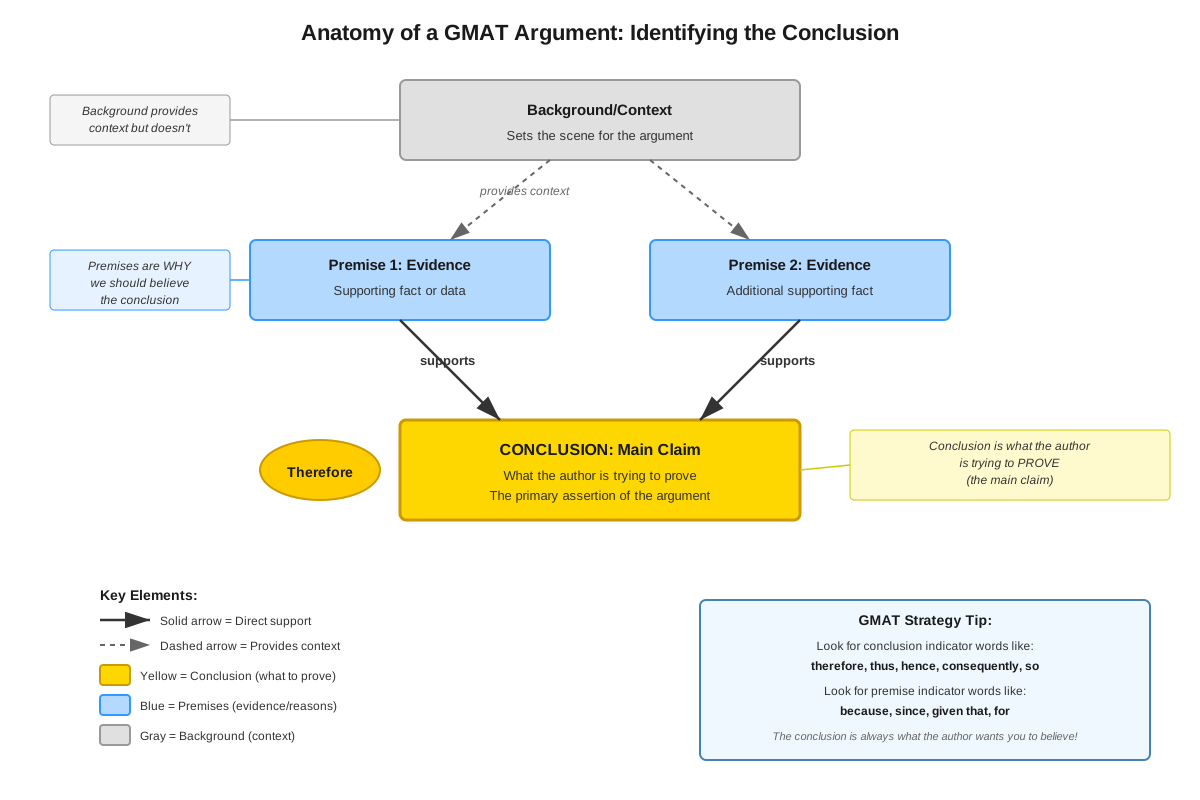
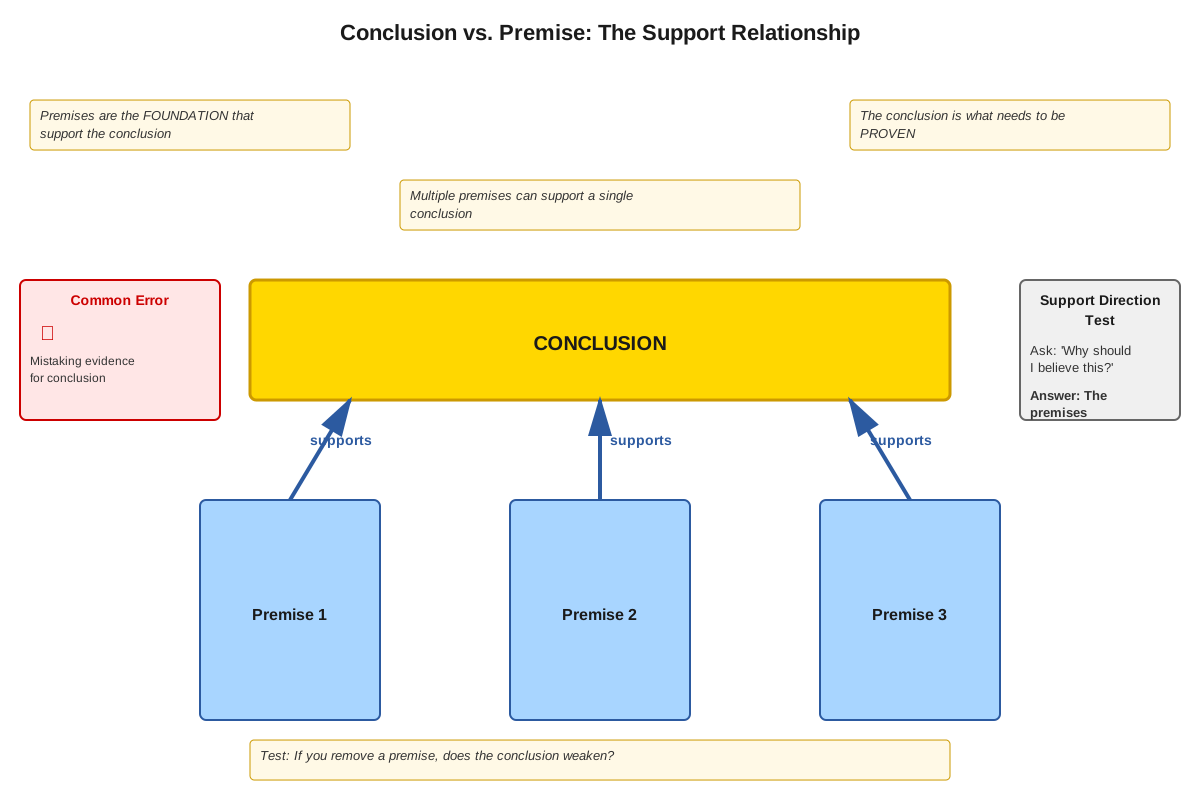
A conclusion is the main claim, assertion, or point that an argument attempts to establish or prove. It represents the author's position—what they want the reader to accept as true or valid based on the evidence presented. Unlike premises (which provide support) or assumptions (which are unstated but necessary), the conclusion is the destination of the argument's logical journey.
Key characteristics of conclusions include:
- Assertive nature: Conclusions make definitive claims rather than merely presenting facts
- Supported status: Conclusions are supported by other statements (premises) rather than supporting other claims
- Author's position: Conclusions reflect what the author believes or wants to prove
- Logical endpoint: All reasoning in the argument flows toward establishing the conclusion
Conclusion Indicator Words
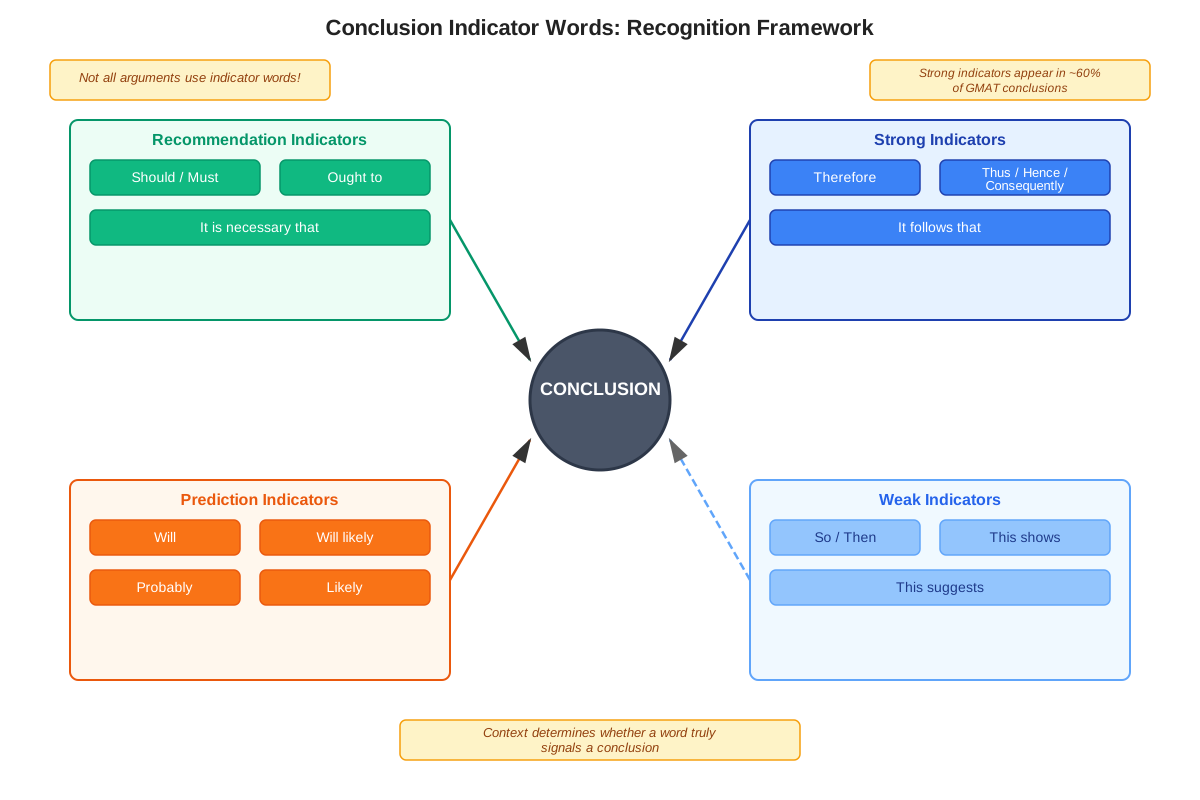
The GMAT frequently uses conclusion indicator words to signal when a conclusion is being presented. Recognizing these linguistic markers dramatically improves identification speed and accuracy:
Strong indicators:
- Therefore
- Thus
- Hence
- Consequently
- As a result
- It follows that
- We can conclude that
- This proves that
- This shows that
- This demonstrates that
Moderate indicators:
- So
- Accordingly
- For this reason
- Clearly
- Obviously
- Evidently
- Indeed
Subtle indicators:
- Should (when making recommendations)
- Must (when drawing necessary conclusions)
- Will (when making predictions)
Exam Tip: Not all conclusions are preceded by indicator words. The GMAT deliberately includes arguments where conclusions appear without markers, testing deeper analytical skills.
Conclusion Positions in Arguments
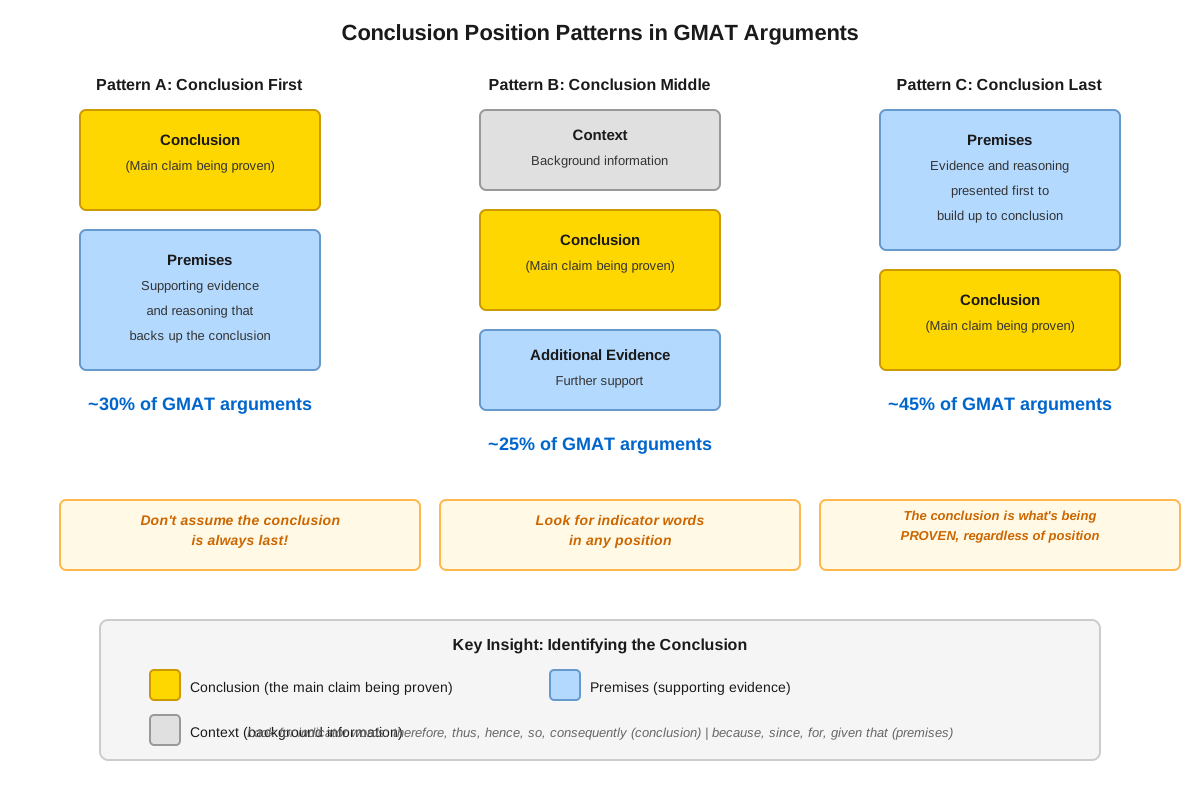
Unlike traditional academic writing where conclusions typically appear at the end, GMAT arguments strategically place conclusions in various positions:
| Position | Frequency | Characteristics | Example Structure |
|---|---|---|---|
| End | 40% | Most natural; follows premises logically | Premise 1. Premise 2. Therefore, Conclusion. |
| Beginning | 30% | Conclusion stated first, then supported | Conclusion. This is because Premise 1 and Premise 2. |
| Middle | 25% | Embedded between premises | Premise 1. Therefore, Conclusion. Furthermore, Premise 2. |
| Implied | 5% | Not explicitly stated; must be inferred | Premise 1. Premise 2. [Unstated conclusion] |
The Conclusion Test
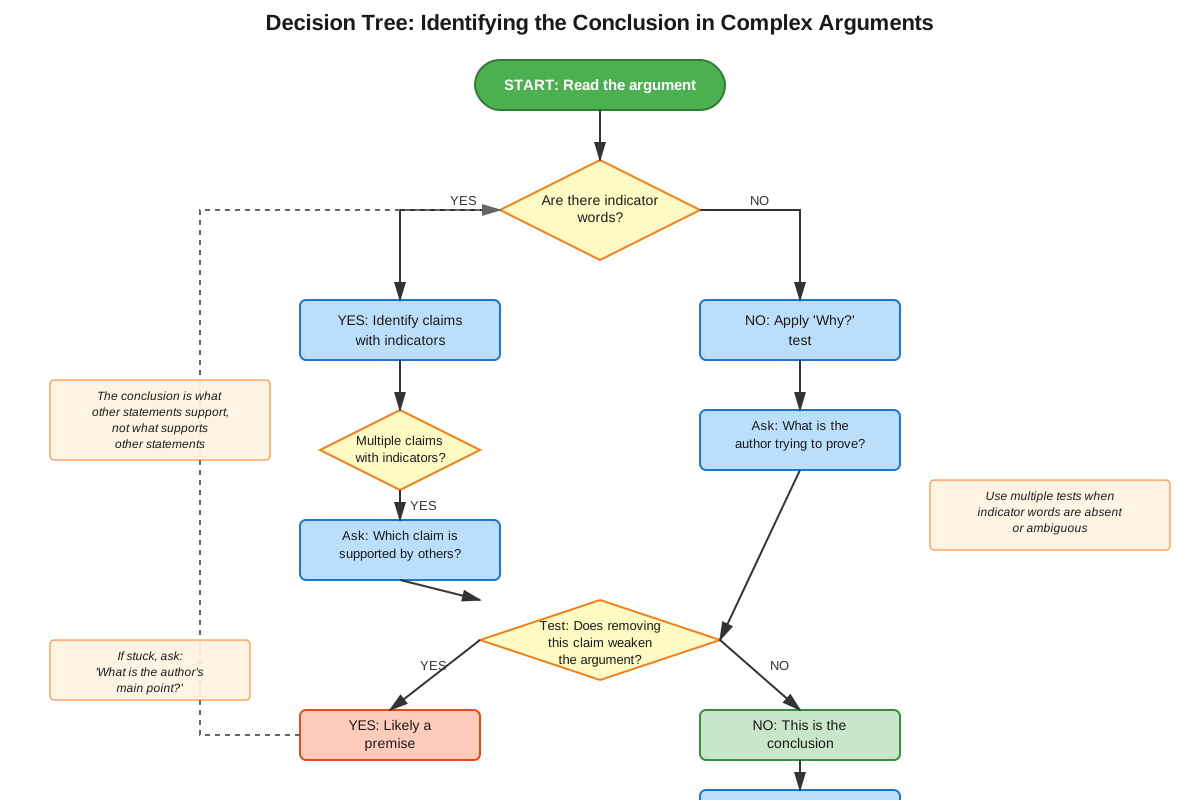
To verify whether a statement is the conclusion, apply the "Why?" test:
- Identify the potential conclusion
- Ask "Why should I believe this?"
- If other statements in the argument answer this question, you've found the conclusion
- If the statement answers "why" about another claim, it's a premise, not the conclusion
Example Application:
"Company profits increased 20% last quarter. The new marketing strategy was implemented three months ago. Therefore, the marketing strategy caused the profit increase."
- Test the last statement: "Why should I believe the marketing strategy caused the increase?"
- Answer: Because profits increased after implementation
- Conclusion confirmed: "The marketing strategy caused the profit increase"
Main Conclusions vs. Sub-Conclusions
Complex GMAT arguments often contain multiple layers of conclusions:
- Main conclusion: The ultimate point the argument establishes
- Sub-conclusion (or intermediate conclusion): A claim that serves as both a conclusion (supported by some premises) and a premise (supporting the main conclusion)
Example:
"Studies show exercise reduces stress hormones [Premise]. Lower stress hormones improve sleep quality [Premise]. Therefore, exercise improves sleep [Sub-conclusion]. Since better sleep enhances cognitive performance [Premise], companies should provide gym memberships to employees [Main conclusion]."
The sub-conclusion about exercise improving sleep is supported by earlier premises but itself supports the main conclusion about gym memberships.
Distinguishing Conclusions from Premises
The fundamental distinction between conclusions and premises determines argument structure:
Conclusions:
- What the argument is trying to prove
- Supported by other statements
- Represent the author's position or claim
- Answer the question "What is the point?"
Premises:
- What provides support or evidence
- Support other statements (conclusions)
- May be facts, observations, or accepted claims
- Answer the question "Why should I believe the conclusion?"
Premise indicator words (which signal NOT conclusions):
- Because
- Since
- Given that
- For
- As
- Due to
- In light of
- Considering that
Scope and Strength of Conclusions
GMAT conclusions vary in their scope (breadth of application) and strength (degree of certainty):
Scope variations:
- Universal: "All companies benefit from flexible work policies"
- Particular: "Many companies benefit from flexible work policies"
- Specific: "Tech companies in urban areas benefit from flexible work policies"
Strength variations:
- Absolute: "This policy will definitely increase productivity"
- Probable: "This policy will likely increase productivity"
- Possible: "This policy may increase productivity"
Exam Tip: Pay careful attention to qualifying words (all, some, most, might, must, will) as they define the conclusion's scope and strength—critical for Strengthen/Weaken questions.
Concept Relationships
The concepts within conclusion analysis form an interconnected system where each element reinforces the others. Conclusion identification serves as the foundation, enabling students to apply the "Why?" test to distinguish conclusions from premises. Once identified, understanding conclusion indicator words accelerates recognition, while awareness of conclusion positions prevents students from assuming conclusions always appear at the end.
The relationship flows as follows:
Conclusion Definition → enables → Conclusion vs. Premise Distinction → supported by → Indicator Words Recognition → enhanced by → Position Awareness → leads to → Scope and Strength Analysis → enables → Main vs. Sub-Conclusion Differentiation
This topic connects to prerequisite knowledge of basic logical reasoning by building upon the fundamental understanding that arguments contain claims and evidence. The skill of identifying main ideas in reading comprehension directly transfers to conclusion identification, as both require distinguishing primary assertions from supporting details.
Looking forward, mastering conclusions enables progression to:
- Assumption identification: Cannot find assumptions without knowing the conclusion
- Argument evaluation: Strengthening or weakening requires knowing what's being concluded
- Inference questions: Understanding stated conclusions helps determine what can be further inferred
- Argument structure analysis: Recognizing how premises, assumptions, and conclusions interact
High-Yield Facts
⭐ The conclusion is what the argument is trying to prove, not what proves it—this fundamental distinction separates conclusions from premises in every argument.
⭐ Approximately 30% of GMAT conclusions appear at the beginning of arguments, not the end—never assume the last sentence is the conclusion.
⭐ "Therefore," "thus," and "hence" are the strongest conclusion indicators and appear in roughly 60% of arguments with explicit markers.
⭐ The "Why?" test is the most reliable method for identifying conclusions—if other statements answer "why should I believe this?", you've found the conclusion.
⭐ Conclusion scope and strength directly impact correct answers in Strengthen/Weaken questions—a conclusion about "some" cannot be weakened by evidence about "all."
- Conclusions can be implied rather than explicitly stated, though this occurs in less than 5% of GMAT arguments.
- Sub-conclusions function as both conclusions (for earlier premises) and premises (for the main conclusion), creating layered argument structures.
- Premise indicators ("because," "since," "given that") signal that what follows is NOT the conclusion but rather supporting evidence.
- The conclusion represents the author's opinion or claim, while premises may include objective facts or widely accepted statements.
- In arguments with multiple sentences, the conclusion is typically the statement that would make the least sense standing alone without context.
- Conclusions about causation ("X causes Y") are among the most common on the GMAT and most vulnerable to alternative explanations.
- The GMAT rarely uses the word "conclusion" in the argument itself—it appears in the question stem, not the passage.
- Recognizing conclusions quickly (within 10-15 seconds) is essential for effective time management on Critical Reasoning questions.
- Conclusions can be recommendations ("should do X"), predictions ("will happen"), explanations ("is caused by"), or evaluations ("is better than").
- The strength of a conclusion must match the strength of its premises—strong conclusions require strong evidence, making this a common point of logical vulnerability.
Quick check — test yourself on Conclusions so far.
Try Flashcards →Common Misconceptions
Misconception: The conclusion always appears in the last sentence of an argument.
Correction: Conclusions appear in various positions—beginning (30%), middle (25%), or end (40%). The GMAT deliberately places conclusions in unexpected positions to test analytical skills rather than pattern recognition. Always use the "Why?" test rather than relying on position.
Misconception: Any sentence with "therefore" or "thus" is automatically the main conclusion.
Correction: While these are strong conclusion indicators, they can also introduce sub-conclusions or intermediate steps in reasoning. Always verify by checking whether other statements in the argument support this claim and whether this claim supports something else.
Misconception: The longest or most complex sentence in an argument is usually the conclusion.
Correction: Conclusions are often concise and direct, while premises may contain detailed evidence, statistics, or explanations. Complexity and length correlate more with premises than conclusions. Focus on logical function, not sentence structure.
Misconception: Facts and statistics cannot be conclusions.
Correction: While raw data typically serves as premises, interpretations of data or claims about what data demonstrates can absolutely be conclusions. For example: "Sales increased 30%" (premise) vs. "The data shows our strategy is working" (conclusion based on the sales data).
Misconception: Every argument has only one conclusion.
Correction: Complex arguments often contain sub-conclusions that support a main conclusion. Identifying the hierarchy—which conclusion is ultimate and which are intermediate—is essential for questions asking about argument structure or the role of specific statements.
Misconception: If a statement seems obvious or uncontroversial, it cannot be the conclusion.
Correction: The conclusion is determined by logical function within the argument, not by how debatable it seems. Even seemingly obvious claims can be conclusions if the argument's purpose is to establish them through evidence. The GMAT tests logical structure, not philosophical controversy.
Misconception: Conclusions must be explicitly stated in the passage.
Correction: While rare (approximately 5% of cases), some GMAT arguments present only premises and expect readers to infer the unstated conclusion. This typically occurs in Inference questions where the task is to identify what must be true based on the premises.
Worked Examples
Example 1: Standard Argument with Conclusion Indicators
Passage:
"The Riverside City Council recently implemented a ban on single-use plastic bags at grocery stores. In the six months since the ban took effect, the amount of plastic waste collected from the Riverside River has decreased by 40%. Additionally, surveys show that 78% of residents now regularly use reusable bags for shopping. Therefore, the plastic bag ban has been effective in reducing environmental pollution in Riverside."
Question: Which of the following is the main conclusion of the argument?
Step 1: Identify conclusion indicators
The word "Therefore" in the final sentence is a strong conclusion indicator, suggesting the last sentence is likely the conclusion.
Step 2: Apply the "Why?" test
Ask: "Why should I believe the plastic bag ban has been effective?"
Answer: Because plastic waste decreased 40% and 78% of residents use reusable bags.
These statements support the final claim, confirming it as the conclusion.
Step 3: Verify no other conclusions exist
Check if any other statement is being argued for:
- "Plastic waste decreased 40%" is presented as fact (premise)
- "78% use reusable bags" is presented as survey data (premise)
- Neither statement is argued for; both support the final claim
Answer: The main conclusion is "the plastic bag ban has been effective in reducing environmental pollution in Riverside."
Connection to Learning Objectives: This example demonstrates identifying conclusions using indicator words (Objective 1), explaining how the conclusion functions as the claim being established (Objective 2), and applying this skill to a typical GMAT-style argument (Objective 3).
Example 2: Conclusion at the Beginning with Sub-Conclusion
Passage:
"Companies should invest more heavily in employee training programs. Recent studies indicate that comprehensive training increases employee productivity by an average of 23%. This productivity boost leads to higher profit margins, as demonstrated by firms that increased training budgets by 15% and subsequently saw profits rise by 8%. Furthermore, well-trained employees report 35% higher job satisfaction, which reduces costly turnover rates."
Question: Identify the main conclusion and any sub-conclusions in this argument.
Step 1: Identify potential conclusions
The first sentence contains "should," indicating a recommendation (common conclusion type). The third sentence contains "leads to," suggesting a causal claim that might be a sub-conclusion.
Step 2: Apply the "Why?" test to the first sentence
Ask: "Why should companies invest more in training?"
Answer: Because training increases productivity (sentence 2), which leads to higher profits (sentence 3), and because training increases satisfaction and reduces turnover (sentence 4).
All other statements support this claim, confirming it as the main conclusion.
Step 3: Identify sub-conclusions
The claim "This productivity boost leads to higher profit margins" is supported by the example of firms with increased training budgets (making it a conclusion) but also supports the main conclusion about investing in training (making it a premise for the main conclusion).
This is a sub-conclusion.
Step 4: Map the argument structure
- Main Conclusion: "Companies should invest more heavily in employee training programs"
- Sub-Conclusion: "Productivity boost leads to higher profit margins"
- Premises: Training increases productivity 23%; firms with more training saw 8% profit increase; training increases satisfaction 35%; satisfaction reduces turnover
Answer:
- Main conclusion: Companies should invest more heavily in employee training programs (appears at the beginning)
- Sub-conclusion: The productivity boost leads to higher profit margins
- Structure: The argument presents its main conclusion first, then provides layered support through a sub-conclusion and multiple premises
Connection to Learning Objectives: This example demonstrates identifying conclusions in non-standard positions (Objective 6), distinguishing between main and sub-conclusions in complex arguments (Objective 4), and analyzing argument structure (Objective 2).
Exam Strategy
Systematic Approach to Conclusion Questions
When facing any Critical Reasoning question, follow this four-step process for conclusion identification:
- Read the question stem first (5 seconds): Determine if you need to identify the conclusion explicitly or if conclusion identification is a prerequisite for another task
- Scan for indicator words (10 seconds): Look for "therefore," "thus," "hence," "should," "must," or "will"
- Apply the "Why?" test (15 seconds): Test potential conclusions by asking what supports them
- Verify scope and strength (10 seconds): Ensure you understand exactly what is being concluded and how strongly
Trigger Words and Phrases
Conclusion triggers to watch for:
- Recommendation language: "should," "ought to," "must," "need to"
- Causal claims: "causes," "leads to," "results in," "is responsible for"
- Predictive statements: "will," "is likely to," "probably"
- Evaluative judgments: "is better," "is more effective," "is superior"
- Explanatory claims: "explains why," "accounts for," "is due to"
Premise triggers that signal NOT the conclusion:
- "Because," "since," "given that," "as," "for"
- "Studies show," "research indicates," "data reveals"
- "According to," "based on," "in light of"
Process of Elimination Tips
When answer choices present different statements as potential conclusions:
- Eliminate statements that are purely factual premises: If a statement presents data, statistics, or observations without interpretation, it's likely a premise
- Eliminate statements that support other statements: If statement A supports statement B, then A is a premise and B might be the conclusion
- Eliminate statements with premise indicators: Any statement beginning with "because" or "since" cannot be the main conclusion
- Choose the statement that answers "What's the point?": The conclusion should capture the argument's ultimate purpose
Time Allocation
For a typical 2-minute Critical Reasoning question:
- Conclusion identification: 30-40 seconds maximum
- Reading the argument: 45-60 seconds
- Analyzing answer choices: 40-50 seconds
- Final verification: 10-15 seconds
Exam Tip: If you cannot identify the conclusion within 40 seconds, use the "Why?" test on the first and last sentences—one of these is the conclusion in approximately 70% of arguments.
Common Question Stem Variations
Recognize these question types that require conclusion identification:
- Direct: "Which of the following is the main conclusion?"
- Indirect: "The argument is structured to lead to which conclusion?"
- Boldface: "The statement in boldface plays which role?" (may be identifying the conclusion)
- Prerequisite: Strengthen, Weaken, Assumption, and Evaluate questions all require knowing the conclusion first
Memory Techniques
The POINT Mnemonic
Remember what makes a statement the conclusion using POINT:
- Position of being proven (not proving)
- Opinion or claim of the author
- Indicators often present (therefore, thus, hence)
- Not a fact alone (interpretation or claim)
- Tested by asking "Why?" (other statements answer)
The Conclusion Location Visualization
Visualize arguments as buildings with three possible structures:
- Foundation-up (conclusion at end): Premises are the foundation, conclusion is the roof
- Roof-down (conclusion at beginning): Conclusion is stated, then supported by pillars below
- Middle-floor (conclusion in middle): Conclusion is sandwiched between supporting structures
This spatial metaphor helps remember that conclusions can appear anywhere in the logical structure.
The "Why-Because" Chain
Create a mental chain by asking "Why?" and answering "Because":
- Conclusion: [Statement you're testing]
- Why should I believe it?
- Because: [If other statements answer this, you've found the conclusion]
Practice this chain until it becomes automatic, taking less than 10 seconds per argument.
Indicator Word Categories
Group indicator words by strength using the acronym TSH (Therefore-So-Hence):
- Tier 1 (Strongest): Therefore, Thus, Hence
- Sier 2 (Moderate): So, Should, Shows
- Hier 3 (Subtle): Hidden in recommendations, predictions, evaluations
Summary
Mastering conclusion identification is fundamental to GMAT Critical Reasoning success, as conclusions represent the central claim that arguments attempt to establish through evidence and reasoning. A conclusion is distinguished from premises by its role as what is being proven rather than what provides proof, and this distinction can be reliably determined through the "Why?" test—asking what other statements support. While conclusion indicator words like "therefore," "thus," and "hence" frequently signal conclusions, the GMAT strategically places conclusions in various positions (beginning, middle, or end) and occasionally omits indicator words entirely, requiring deeper analytical skills. Complex arguments may contain sub-conclusions that serve dual roles, both being supported by some premises while supporting the main conclusion. Understanding the scope (breadth) and strength (certainty) of conclusions is essential for evaluating arguments and selecting correct answers in Strengthen, Weaken, Assumption, and Evaluate questions. Efficient conclusion identification—achievable within 30-40 seconds through systematic application of recognition strategies—forms the foundation for all subsequent Critical Reasoning analysis.
Key Takeaways
- The conclusion is what the argument proves, not what proves it—this fundamental distinction is tested in every Critical Reasoning question type
- Use the "Why?" test as the most reliable identification method—if other statements answer "why should I believe this?", you've found the conclusion
- Never assume position determines function—conclusions appear at the beginning (30%), middle (25%), or end (40%) of arguments
- Master conclusion indicator words ("therefore," "thus," "hence," "should") while recognizing that 40% of arguments lack explicit indicators
- Distinguish main conclusions from sub-conclusions in complex arguments by identifying which claim is ultimate versus intermediate
- Pay careful attention to scope and strength qualifiers (all/some, will/might) as they define exactly what is being concluded
- Conclusion identification is a prerequisite skill—you cannot effectively strengthen, weaken, find assumptions, or evaluate arguments without first knowing what's being concluded
Related Topics
Premises and Evidence: Understanding how premises function to support conclusions completes the argument structure picture. Mastering conclusions enables students to distinguish supporting evidence from the claims being supported, essential for all argument-based questions.
Assumptions: Once conclusions are identified, finding the unstated assumptions that bridge premises to conclusions becomes possible. Assumption questions are among the most common on the GMAT and directly depend on conclusion identification skills.
Strengthen and Weaken Questions: These question types require identifying the conclusion first, then determining what additional evidence would support or undermine it. Conclusion mastery is the prerequisite for these high-frequency question types.
Argument Structure and Boldface Questions: Analyzing how arguments are constructed and identifying the roles of specific statements builds directly on the ability to distinguish conclusions from other argument components.
Inference Questions: While inference questions ask what can be concluded beyond what's stated, understanding stated conclusions helps determine what additional conclusions are warranted versus unwarranted.
Practice CTA
Now that you understand the fundamental principles of identifying and analyzing conclusions in GMAT Critical Reasoning, it's time to cement this knowledge through active practice. Attempt the practice questions designed specifically for this topic, focusing on applying the "Why?" test and recognizing conclusion indicators in various argument structures. Use the flashcards to reinforce your recognition of indicator words and common conclusion patterns until identification becomes automatic. Remember: conclusion identification is not just another skill—it's the foundation upon which all Critical Reasoning success is built. Every minute invested in mastering this topic pays dividends across multiple question types. You've built the framework; now strengthen it through deliberate practice!
Sign up free to keep reading
Create a free AnvayaPrep account to finish this GMAT guide on Conclusions — plus flashcards and practice questions.