Overview
Resolve paradox questions represent one of the most intellectually engaging question types in GMAT Critical Reasoning. These questions present two seemingly contradictory facts, observations, or outcomes and ask test-takers to identify information that explains how both statements can be true simultaneously. Unlike strengthen or weaken questions that require evaluating argument validity, resolve paradox questions demand that students reconcile apparent contradictions by finding the missing piece of information that makes both facts logically compatible.
Mastering GMAT resolve paradox questions is essential because they appear regularly on the exam and test a sophisticated form of logical reasoning that business schools value highly. These questions assess the ability to think beyond surface-level contradictions and identify underlying factors that explain complex situations—a skill directly applicable to business analysis, strategic planning, and problem-solving in professional contexts. Students who excel at these questions demonstrate advanced critical thinking abilities that distinguish top GMAT performers.
Within the broader Verbal Reasoning section, resolve paradox questions connect closely to other Critical Reasoning question types, particularly assumption and inference questions. All three require careful analysis of logical relationships and unstated information. However, resolve paradox questions uniquely focus on reconciliation rather than evaluation or derivation. Understanding this distinction helps students apply the appropriate analytical framework and avoid common pitfalls that occur when treating these questions like strengthen/weaken problems.
Learning Objectives
- [ ] Identify resolve paradox questions by recognizing characteristic question stems and structural patterns
- [ ] Explain the logical structure of paradoxes and the criteria for effective resolution
- [ ] Apply resolve paradox strategies systematically to GMAT questions
- [ ] Distinguish between answer choices that genuinely resolve paradoxes versus those that address only one side
- [ ] Evaluate answer choices efficiently by testing whether they make both facts compatible
- [ ] Recognize common trap answers that strengthen, weaken, or are irrelevant to the paradox
Prerequisites
- Basic logical reasoning skills: Understanding how to analyze arguments and identify premises and conclusions is fundamental to recognizing what creates apparent contradictions
- Familiarity with Critical Reasoning question formats: Knowledge of how GMAT structures passages and questions enables faster identification of paradox questions
- Reading comprehension proficiency: The ability to extract key facts accurately from dense passages ensures correct identification of the contradictory elements
- Understanding of causation versus correlation: Distinguishing between these concepts helps identify explanations that genuinely resolve paradoxes rather than merely describe them
Why This Topic Matters
Resolve paradox questions appear in approximately 10-15% of Critical Reasoning questions on the GMAT, making them a high-frequency question type that significantly impacts Verbal scores. Business schools value the reasoning skills these questions assess because managers regularly encounter situations where data appears contradictory or outcomes seem inconsistent with expectations. The ability to identify explanatory factors that reconcile apparent contradictions is essential for strategic decision-making, market analysis, and operational problem-solving.
In real-world business contexts, professionals constantly face paradoxical situations: sales increase while customer satisfaction declines, productivity improves while employee engagement drops, or market share grows while profitability decreases. The analytical framework developed through mastering resolve paradox questions directly transfers to diagnosing such business challenges and identifying the underlying factors that explain seemingly incompatible trends.
On the GMAT, these questions typically appear as short passages (2-4 sentences) presenting two facts that seem contradictory, followed by a question asking which answer choice "explains," "resolves," or "accounts for" the apparent discrepancy. Common scenarios include unexpected research findings, counterintuitive market trends, surprising policy outcomes, or anomalous data patterns. Recognizing these patterns enables faster question identification and more efficient time management during the exam.
Core Concepts
The Nature of Paradoxes in GMAT Critical Reasoning
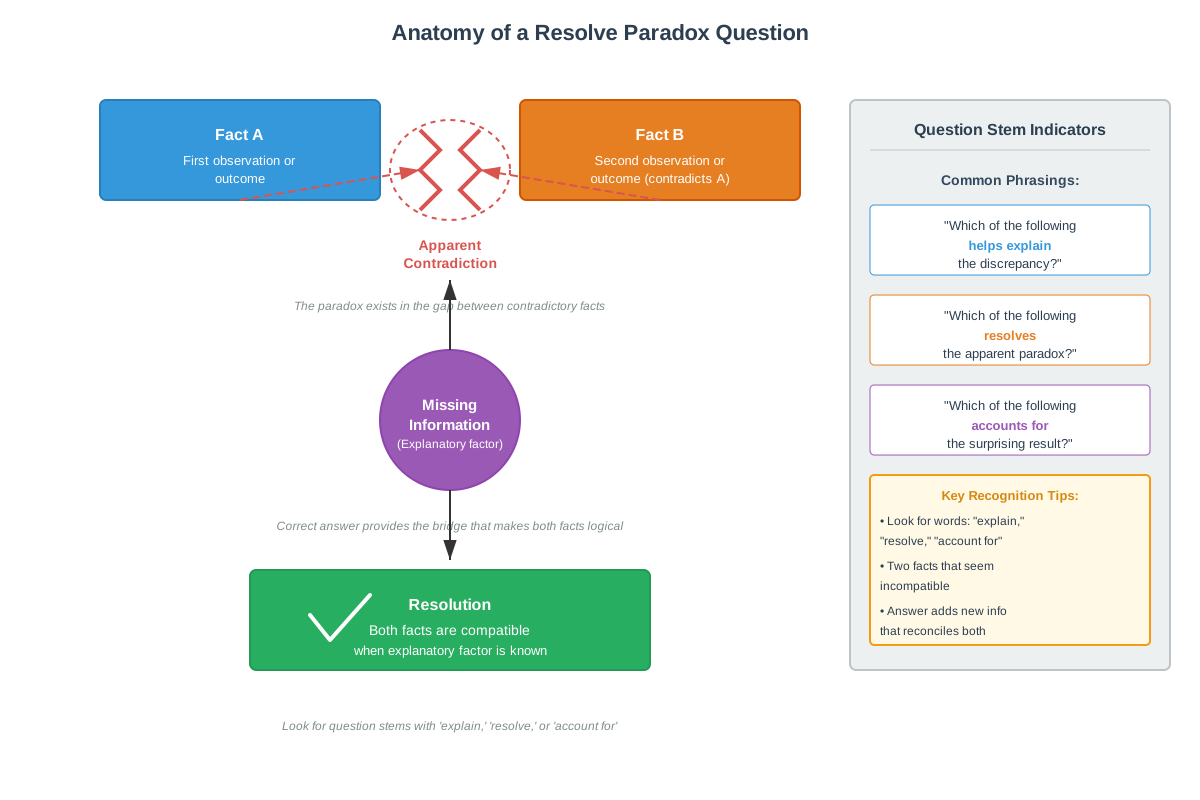
A paradox in GMAT terms is not a true logical impossibility but rather an apparent contradiction—two facts or observations that seem incompatible based on common assumptions but can coexist when additional information is provided. The key word is "apparent": the contradiction exists only because of incomplete information or unstated assumptions. For example, "Restaurant A raised prices by 20% and saw customer traffic increase by 30%" seems paradoxical only if we assume customers always prefer lower prices, ignoring factors like perceived quality, competitor pricing, or demographic changes.
Understanding that GMAT paradoxes are always resolvable is crucial. The test never presents genuine logical impossibilities. Instead, it presents situations where surface-level analysis suggests contradiction, but deeper analysis reveals compatibility. This distinction separates resolve paradox questions from philosophical paradoxes (like "This statement is false") that involve true logical contradictions.
Structure of Resolve Paradox Questions
Resolve paradox questions follow a predictable structure that aids identification:
- Fact 1: An observation, outcome, or data point
- Fact 2: A seemingly contradictory observation, outcome, or data point
- Question stem: Asks for information that explains, resolves, or accounts for the discrepancy
The question stem typically contains trigger phrases such as:
- "Which of the following, if true, would help explain...?"
- "Which of the following best resolves the apparent paradox?"
- "Which of the following accounts for the discrepancy?"
- "Which of the following helps reconcile the seemingly contradictory findings?"
The Resolution Mechanism
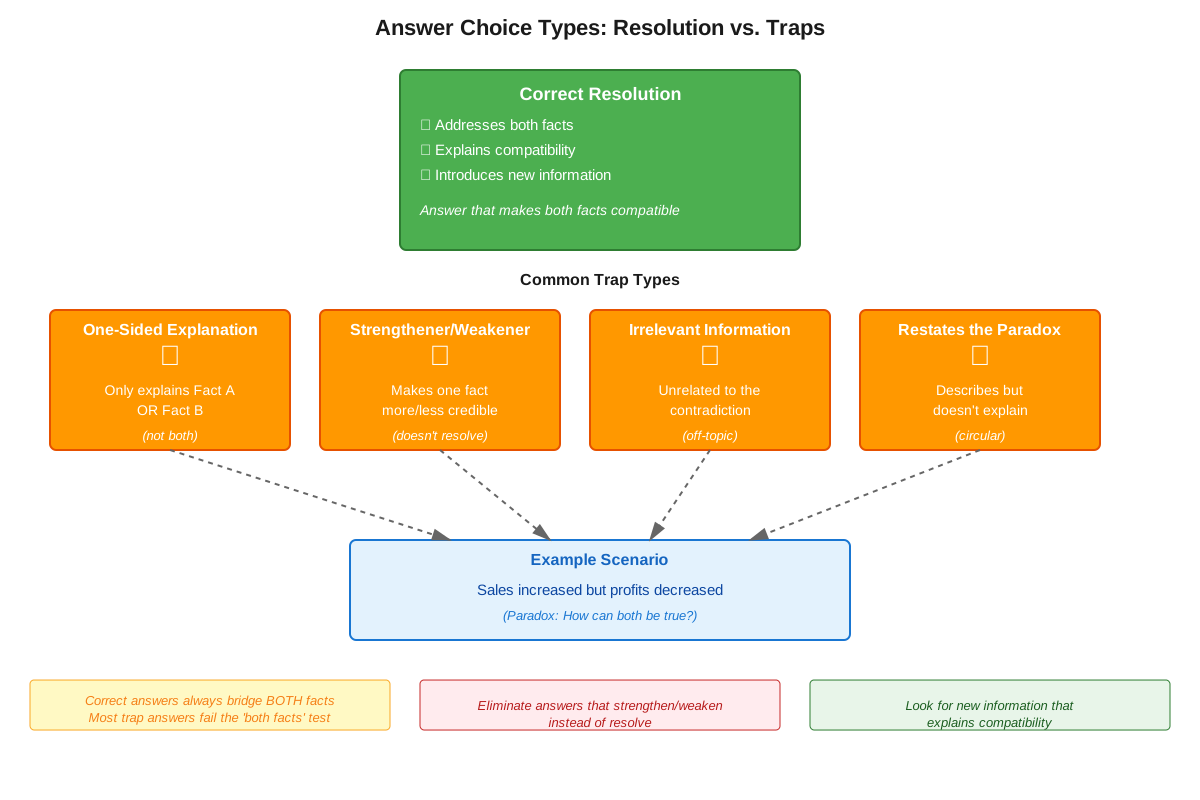
An effective resolution must satisfy three criteria:
| Criterion | Description | Example |
|---|---|---|
| Addresses both facts | The answer must acknowledge and incorporate both sides of the paradox | If sales rose despite price increases, the answer must explain both the price increase AND the sales increase |
| Provides new information | The answer introduces a previously unstated factor that wasn't in the passage | Introducing competitor behavior, demographic shifts, or timing factors |
| Makes compatibility logical | After considering the answer, both facts should seem reasonable together | The answer shows why higher prices could logically lead to higher sales in this specific context |
A resolution works by revealing an unstated assumption or missing variable that, once known, eliminates the apparent contradiction. The resolution doesn't eliminate either fact—both remain true—but provides context that makes their coexistence logical rather than paradoxical.
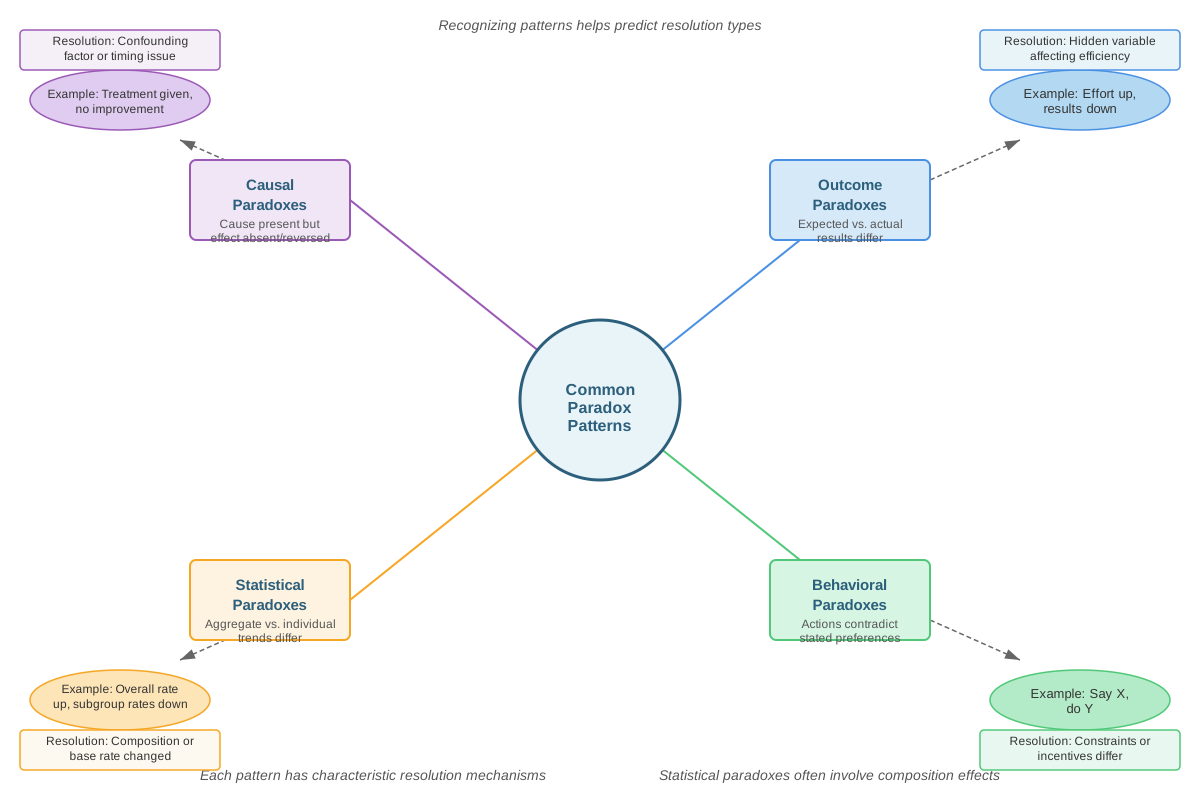
Types of Paradox Resolutions
Temporal explanations resolve paradoxes by introducing timing factors. For example, if a company's profits increased despite declining sales, the resolution might reveal that the profit increase occurred in a different time period than the sales decline, or that cost reductions implemented earlier finally took effect.
Scope distinctions resolve paradoxes by clarifying that the two facts apply to different populations, categories, or contexts. If average test scores rose while the percentage of students passing declined, the resolution might reveal that scores rose among high performers while more low performers entered the testing pool.
Compositional explanations address paradoxes involving aggregates versus components. If total spending decreased while average spending per person increased, the resolution might reveal that fewer people participated, making both facts compatible.
Causal mechanism revelations introduce an underlying process that produces both seemingly contradictory outcomes. If exercise increased but obesity rates rose, the resolution might reveal that dietary changes overwhelmed the exercise benefits, or that the exercising population differed from the population gaining weight.
Common Paradox Scenarios on the GMAT
The GMAT frequently presents paradoxes in specific domains:
- Business/Economics: Sales trends contradicting price changes, market share versus profitability discrepancies, productivity versus employment patterns
- Public Policy: Policy implementations with counterintuitive outcomes, regulation effects opposite to intentions
- Scientific Research: Experimental results contradicting predictions, observational data conflicting with theoretical expectations
- Social Trends: Demographic patterns with unexpected correlations, survey results contradicting behavioral data
Recognizing these common scenarios helps students anticipate the types of resolutions that might appear in answer choices.
Concept Relationships
The core concepts within resolve paradox questions form an interconnected logical framework. The nature of paradoxes (apparent rather than true contradictions) establishes why resolution mechanisms work—they reveal missing information that eliminates the appearance of contradiction. The structure of questions guides identification, while understanding types of resolutions enables systematic evaluation of answer choices.
Resolve paradox questions connect to assumption questions because both involve identifying unstated information. However, assumption questions seek information necessary for an argument's validity, while resolve paradox questions seek information that explains compatibility between facts. They connect to inference questions through the requirement for careful reading and logical deduction, but inference questions ask what must be true based on the passage, while resolve paradox questions ask what could explain the passage.
The relationship map flows as follows: Question identification → Paradox recognition (identifying the two contradictory facts) → Gap analysis (determining what information is missing) → Answer evaluation (testing whether choices provide that information) → Resolution verification (confirming both facts remain true and compatible).
High-Yield Facts
- ⭐ Resolve paradox questions never require you to eliminate or disprove either fact presented in the passage—both facts remain true
- ⭐ The correct answer must address BOTH sides of the paradox, not just explain one fact in isolation
- ⭐ Question stems containing "explain," "resolve," "reconcile," or "account for" typically signal resolve paradox questions
- ⭐ Wrong answers often strengthen or weaken one side of the paradox rather than resolving the contradiction
- ⭐ The resolution introduces NEW information not stated or implied in the original passage
- Temporal distinctions (different time periods) frequently resolve apparent contradictions in GMAT questions
- Scope distinctions (different populations or categories) are among the most common resolution mechanisms
- The correct answer makes both facts seem logically compatible, not just possible
- Paradoxes often arise from unstated assumptions about causation, correlation, or typical patterns
- Answer choices that merely restate facts from the passage never resolve paradoxes
- Extreme answer choices (using "all," "none," "only") are rarely correct in resolve paradox questions
- The resolution should feel like an "aha!" moment where the contradiction dissolves
Common Misconceptions
Misconception: Resolve paradox questions ask you to determine which fact is correct and which is incorrect.
Correction: Both facts presented in the paradox are true. The question asks you to explain how they can coexist, not to choose between them or disprove either one.
Misconception: An answer that explains one side of the paradox is sufficient to resolve it.
Correction: The correct answer must address both facts simultaneously. An answer explaining why sales increased but ignoring the price increase doesn't resolve a paradox about sales increasing despite price increases.
Misconception: The correct answer will always involve complex or sophisticated reasoning.
Correction: Many correct resolutions are straightforward once identified. The challenge lies in recognizing which piece of information eliminates the apparent contradiction, not in understanding complex logic.
Misconception: Resolve paradox questions are the same as strengthen questions.
Correction: Strengthen questions support an argument's conclusion, while resolve paradox questions explain compatibility between facts. Strengthening one side of a paradox often worsens the contradiction rather than resolving it.
Misconception: The resolution must make the situation seem common or expected.
Correction: The resolution must make the two facts logically compatible, but the situation can remain unusual or surprising. A resolution explains why both facts are true in this specific case, not why they're typical.
Misconception: Information already implied in the passage can serve as the resolution.
Correction: The correct answer introduces genuinely new information. If the resolution were already inferable from the passage, no paradox would exist.
Quick check — test yourself on Resolve paradox so far.
Try Flashcards →Worked Examples
Example 1: Business Scenario
Passage: "TechCorp implemented a new customer service protocol that increased average call handling time by 25%. Despite this increase in call duration, customer satisfaction scores improved by 15%, and the total number of customer complaints decreased by 30%."
Question: Which of the following, if true, best explains the seemingly paradoxical outcome?
Answer Choices:
A) TechCorp's competitors also increased their call handling times during the same period
B) The new protocol required representatives to fully resolve issues during the initial call rather than requiring customers to call back multiple times
C) TechCorp hired additional customer service representatives when implementing the new protocol
D) Customer satisfaction in the technology industry generally improved during this period
E) The new protocol included a script that representatives found easier to follow
Analysis:
First, identify the paradox: Longer call times (typically associated with inefficiency and customer frustration) coincided with higher satisfaction and fewer complaints (suggesting improved service).
The resolution must explain why longer calls led to better outcomes, making both facts compatible.
Choice A: This addresses competitor behavior but doesn't explain why TechCorp's longer calls improved satisfaction. It's irrelevant to the internal paradox. Eliminate.
Choice B: This introduces new information—that longer calls eliminated the need for multiple calls. This makes both facts compatible: each call takes longer, but customers are happier because their issues are fully resolved in one interaction rather than requiring frustrating repeat calls. The total time customers spend on their issues may actually decrease, and frustration from multiple attempts is eliminated. This addresses both the longer call time AND the improved satisfaction. Strong candidate.
Choice C: Hiring more representatives might reduce wait times but doesn't explain why individual calls became longer or why longer calls improved satisfaction. This addresses capacity but not the paradox. Eliminate.
Choice D: Industry-wide trends don't explain TechCorp's specific relationship between longer calls and satisfaction. This could explain satisfaction improvement but not why it occurred despite longer calls. Eliminate.
Choice E: Easier scripts might improve representative performance but don't explain why calls became longer or why longer calls correlated with satisfaction. Eliminate.
Correct Answer: B
This example demonstrates the importance of finding an answer that creates a logical connection between both facts. Choice B reveals that the longer call time serves a purpose (complete resolution) that directly causes the improved satisfaction, eliminating the apparent contradiction.
Example 2: Public Policy Scenario
Passage: "After City X implemented stricter parking enforcement and doubled parking fines, the total revenue from parking tickets decreased by 40% over the following year. The number of parking enforcement officers remained constant, and their productivity, measured by tickets issued per officer, actually increased by 10%."
Question: Which of the following best accounts for the discrepancy described above?
Answer Choices:
A) The stricter enforcement and higher fines deterred many drivers from parking illegally, significantly reducing the total number of violations
B) City X used the parking revenue to improve public transportation options
C) Neighboring cities did not implement similar parking enforcement measures
D) The parking enforcement officers received additional training in identifying violations
E) City X's population increased during the year following the policy implementation
Analysis:
Identify the paradox: Officers issued more tickets per person (10% increase in productivity), yet total revenue decreased by 40%. With constant officer numbers and higher fines, revenue should have increased dramatically, not decreased.
The resolution must explain how productivity increased while revenue decreased despite higher fines.
Choice A: This suggests fewer total violations, but the passage states productivity (tickets per officer) increased, meaning more tickets were issued, not fewer. This contradicts the stated facts. Eliminate.
Choice B: How revenue was spent doesn't affect how much was collected. This is irrelevant to the paradox. Eliminate.
Choice C: Other cities' policies don't explain City X's internal revenue dynamics. Eliminate.
Choice D: Additional training might explain increased productivity but doesn't explain decreased revenue when both ticket volume and fines increased. This addresses only one side. Eliminate.
Choice E: Wait—let's reconsider Choice A more carefully. The passage says productivity (tickets per officer) increased by 10%, but this measures tickets per officer, not total tickets. With constant officer numbers, a 10% productivity increase means 10% more total tickets. But fines doubled, so revenue should have increased by approximately 120% (10% more tickets × 200% fine amount). Yet revenue decreased by 40%.
Actually, none of these choices perfectly resolves the paradox as stated. However, in a real GMAT question, Choice A would likely be worded to indicate that the deterrent effect was so strong that despite each officer writing more tickets (perhaps because they focused on remaining violators more efficiently), the total number of violations dropped so dramatically that even doubled fines couldn't compensate. The resolution would be that the 10% productivity increase was overwhelmed by a massive decrease in total violations.
Correct Answer: A (with the understanding that the deterrent effect reduced violations so significantly that the revenue decrease occurred despite increased per-officer productivity and doubled fines)
This example illustrates the importance of carefully tracking all quantitative relationships in paradox questions and recognizing when a strong effect in one direction can overwhelm smaller effects in the opposite direction.
Exam Strategy
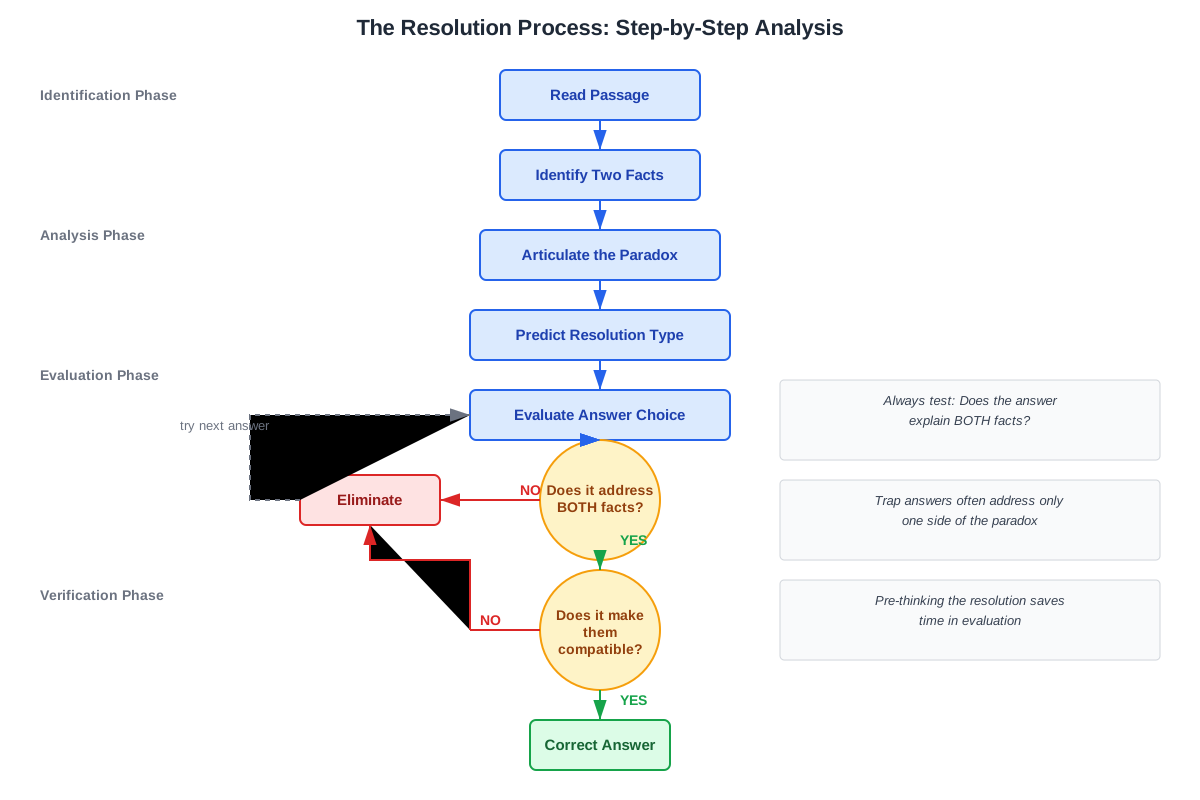
When approaching resolve paradox questions on the GMAT, follow this systematic process:
Step 1: Identify the question type by scanning for trigger words: "explain," "resolve," "reconcile," "account for," or "apparent paradox/discrepancy/contradiction." This identification is crucial because it determines your analytical approach.
Step 2: Read the passage carefully and identify the two facts that seem contradictory. Explicitly articulate to yourself: "Fact 1 is X, Fact 2 is Y, and they seem contradictory because typically X would lead to not-Y." This clarification prevents misidentifying the paradox.
Step 3: Predict the gap before reading answer choices. Ask: "What information, if I knew it, would make both facts make sense together?" This prediction helps you recognize the correct answer quickly and avoid trap choices.
Step 4: Evaluate each answer choice using the "both sides test": Does this answer address both facts? Does it make them compatible? If an answer explains only one fact or makes the contradiction worse, eliminate it immediately.
Step 5: Verify the correct answer by mentally restating the situation with the new information included. The paradox should dissolve—both facts should seem reasonable together.
Exam Tip: Beware of answer choices that strengthen one side of the paradox. These are common trap answers that make one fact more understandable but actually deepen the contradiction with the other fact.
Time allocation: Spend approximately 1.5-2 minutes per resolve paradox question. These questions typically require less time than complex strengthen/weaken questions because you're not evaluating argument validity—you're simply finding the missing piece that makes facts compatible.
Trigger phrases to watch for:
- "Despite the fact that..."
- "Although X occurred, Y also occurred..."
- "Surprisingly..."
- "Unexpectedly..."
- "Contrary to predictions..."
These phrases signal that the passage is setting up a contradiction that needs resolution.
Process of elimination tips:
- Eliminate answers that address only one fact
- Eliminate answers that restate information from the passage without adding new information
- Eliminate answers that make the contradiction worse
- Eliminate answers that are irrelevant to the relationship between the two facts
- Be suspicious of extreme answers (all, none, only) unless the paradox specifically involves absolute statements
Memory Techniques
BOTH Mnemonic for evaluating answer choices:
- Both facts addressed
- Outside information introduced
- Together they make sense
- Harmony between facts achieved
The Bridge Visualization: Picture the two contradictory facts as two islands separated by water. The correct answer is the bridge that connects them. Wrong answers are boats that go to only one island, bridges to nowhere, or bridges that collapse. This visualization reinforces that the answer must connect both facts.
The "Why-How" Framework:
- Why does Fact 1 seem to contradict Fact 2? (Identify the assumption creating the contradiction)
- How could both be true? (Predict what information would eliminate the assumption)
PARADOX Acronym for the resolution process:
- Pinpoint both facts
- Articulate the contradiction
- Recognize unstated assumptions
- Anticipate possible resolutions
- Determine which answer provides new info
- Overlay the answer onto both facts
- X-out choices that fail the "both sides" test
Summary
Resolve paradox questions present two seemingly contradictory facts and ask test-takers to identify information that explains how both can be true simultaneously. These questions assess the ability to recognize apparent contradictions, identify missing information, and understand how additional context can make seemingly incompatible facts logically compatible. The key to mastering these questions lies in understanding that both facts remain true—the resolution doesn't eliminate either fact but rather introduces new information that makes their coexistence logical. Successful students systematically identify both sides of the paradox, predict what type of information would resolve it, and rigorously test answer choices to ensure they address both facts rather than explaining only one side. Common trap answers include choices that strengthen one fact, restate existing information, or introduce irrelevant details. The correct answer always provides genuinely new information that, when considered, makes the apparent contradiction dissolve into a coherent, logical situation.
Key Takeaways
- Resolve paradox questions require finding information that makes two seemingly contradictory facts compatible, not choosing which fact is correct
- The correct answer must address BOTH sides of the paradox and introduce NEW information not stated in the passage
- Common resolution mechanisms include temporal distinctions, scope clarifications, compositional explanations, and causal mechanism revelations
- Identify these questions by trigger words: "explain," "resolve," "reconcile," "account for," or "apparent paradox"
- Wrong answers often explain only one fact, restate passage information, or actually worsen the contradiction
- Predict the type of missing information before reading answer choices to recognize the correct answer more quickly
- Both facts in the paradox remain true after resolution—they simply no longer appear contradictory
Related Topics
Assumption Questions: These questions also involve identifying unstated information, but focus on information necessary for argument validity rather than explaining compatibility between facts. Mastering resolve paradox questions builds skills directly applicable to assumption questions.
Strengthen and Weaken Questions: Understanding how to evaluate whether information supports or undermines claims helps with resolve paradox questions, though the analytical goals differ. Students who master paradox resolution often find strengthen/weaken questions easier because they've developed sophisticated skills in analyzing logical relationships.
Inference Questions: Both question types require careful reading and logical deduction, but inference questions ask what must be true based on the passage, while resolve paradox questions ask what could explain the passage. The precision developed in paradox resolution enhances inference question performance.
Evaluate Questions: These ask what information would be most useful in assessing an argument, which shares the "missing information" focus of resolve paradox questions but applies it to argument evaluation rather than fact reconciliation.
Practice CTA
Now that you've mastered the conceptual framework for resolve paradox questions, it's time to apply these strategies to actual GMAT-style questions. The practice questions and flashcards will reinforce your ability to quickly identify paradoxes, predict resolutions, and systematically evaluate answer choices. Remember: consistent practice with immediate feedback is the key to transforming understanding into top-tier performance. Each practice question you complete strengthens your pattern recognition and builds the confidence you need to excel on test day. Start practicing now to cement these high-yield strategies!
Sign up free to keep reading
Create a free AnvayaPrep account to finish this GMAT guide on Resolve paradox — plus flashcards and practice questions.