Overview
Weaken questions represent one of the most frequently tested question types in GMAT Critical Reasoning, appearing in approximately 20-25% of all Critical Reasoning questions. These questions assess a test-taker's ability to identify information that undermines or casts doubt on an argument's conclusion. Mastering GMAT weaken questions requires understanding the logical structure of arguments, recognizing unstated assumptions, and evaluating how new information affects the strength of reasoning.
In a weaken question, students must select an answer choice that, if true, would make the argument's conclusion less likely to be valid or would reduce confidence in the reasoning presented. This differs fundamentally from strengthen questions (which support the argument) or assumption questions (which identify necessary premises). The skill of weakening arguments extends beyond test-taking—it develops critical thinking abilities essential for business decision-making, policy analysis, and strategic planning.
Within the broader Verbal Reasoning section, weaken questions connect intimately with other Critical Reasoning question types. They require the same foundational skill of argument analysis—identifying premises, conclusions, and assumptions—but apply this analysis in a specific direction. Understanding how to weaken arguments also enhances performance on strengthen, evaluate, and assumption questions, as all these question types revolve around the relationship between evidence and conclusions. The ability to identify logical vulnerabilities in reasoning represents a cornerstone skill for achieving a competitive GMAT score.
Learning Objectives
- [ ] Identify Weaken questions from their question stems and structural cues
- [ ] Explain the logical mechanism by which information weakens an argument
- [ ] Apply Weaken strategies systematically to GMAT questions
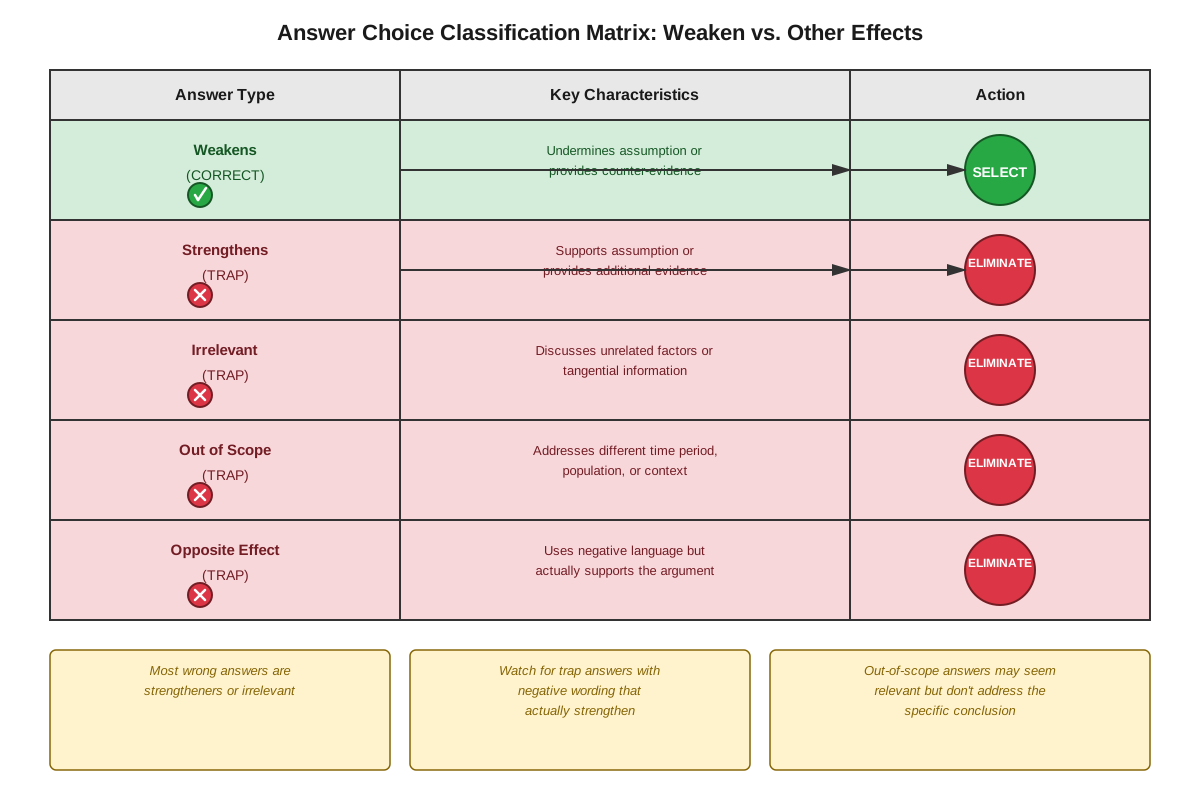
- [ ] Distinguish between answer choices that weaken, strengthen, or are irrelevant to the argument
- [ ] Recognize common argument structures vulnerable to weakening
- [ ] Identify the assumptions underlying arguments that weaken answer choices typically attack
- [ ] Evaluate the relative strength of multiple weakening answer choices
Prerequisites
- Argument Structure Analysis: Understanding how to identify premises, conclusions, and the logical flow of arguments is essential because weaken questions require pinpointing exactly what claim needs to be undermined.
- Assumption Recognition: Recognizing unstated assumptions that bridge premises to conclusions is crucial because most effective weakening answer choices exploit these gaps in reasoning.
- Logical Reasoning Fundamentals: Basic understanding of cause-and-effect relationships, correlation versus causation, and conditional logic provides the foundation for evaluating how new information affects argument strength.
- Reading Comprehension: The ability to extract main ideas and understand author intent quickly is necessary because weaken questions require accurate comprehension before evaluation.
Why This Topic Matters
Weaken questions test a fundamental business and analytical skill: the ability to identify flaws, risks, and counterarguments in proposed plans, strategies, or conclusions. In real-world applications, executives must evaluate business proposals by considering what could go wrong, analysts must identify weaknesses in market research, and consultants must anticipate objections to their recommendations. The cognitive skill of constructive criticism—finding legitimate weaknesses without dismissing ideas entirely—proves invaluable across professional contexts.
On the GMAT specifically, weaken questions appear with high frequency, typically constituting 4-6 questions out of the approximately 18 Critical Reasoning questions in the Verbal section. This represents roughly 10-15% of the entire Verbal Reasoning score. Given their prevalence and the fact that they test a distinct skill set, mastering weaken questions can significantly impact overall performance. Business schools value this skill because it demonstrates the analytical rigor necessary for case-based learning and strategic decision-making in MBA programs.
Weaken questions commonly appear in several formats: business scenarios involving marketing strategies, scientific studies with causal claims, policy proposals with predicted outcomes, and historical explanations. The GMAT frequently tests arguments involving surveys, statistical data, causal relationships, analogies between situations, and predictions about future outcomes. Recognizing these common argument patterns enables test-takers to anticipate vulnerabilities and evaluate answer choices more efficiently.
Core Concepts
Understanding the Weaken Task
The fundamental task in a weaken question is to identify information that reduces the likelihood that the argument's conclusion follows logically from its premises. This does not require proving the conclusion false or finding a fatal flaw that completely destroys the argument. Instead, the correct answer introduces reasonable doubt, presents a counterexample, reveals an overlooked factor, or exposes a questionable assumption. The standard is "makes the conclusion less likely to be true" rather than "proves the conclusion false."
Weaken questions can be identified through characteristic question stems such as:
- "Which of the following, if true, most seriously weakens the argument?"
- "Which of the following casts the most doubt on the conclusion above?"
- "Which of the following, if true, would most undermine the author's claim?"
- "Which of the following, if true, provides the strongest grounds for questioning the prediction?"
Argument Structure and Vulnerability Points
Every argument contains potential vulnerability points where weakening information can be introduced. The most common vulnerability points include:
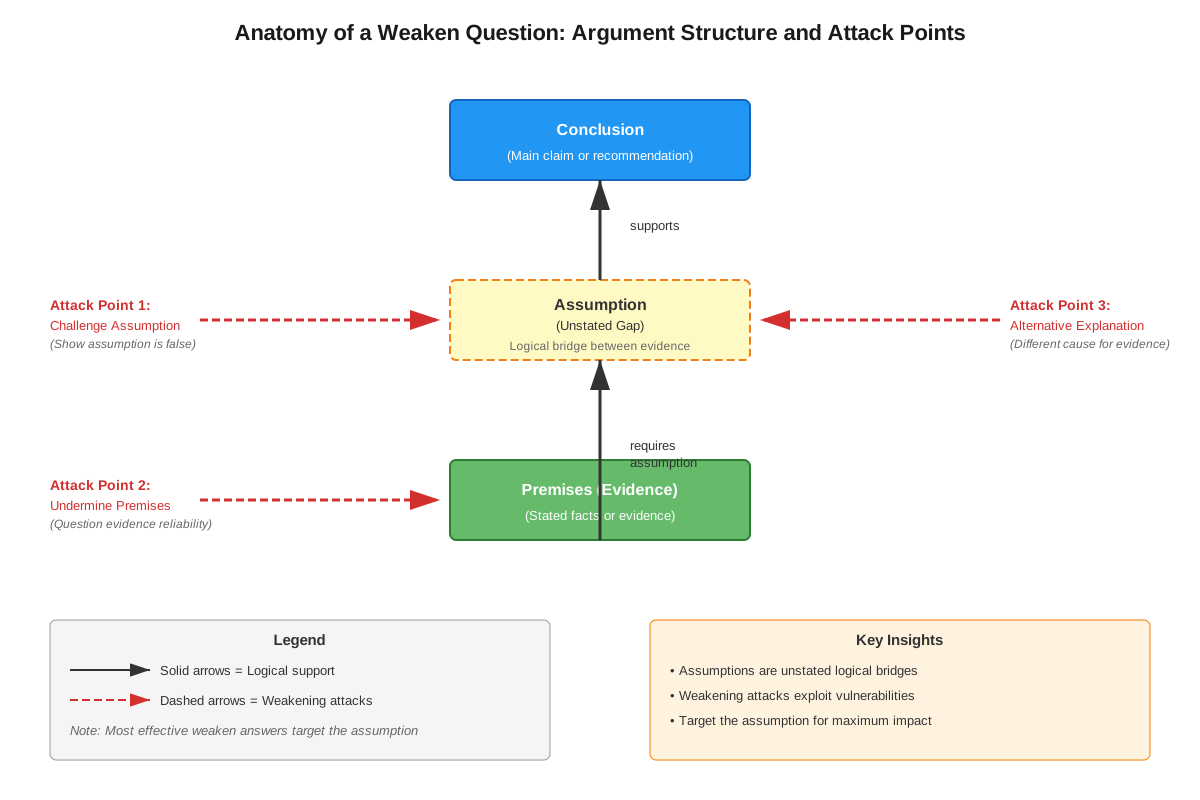
Unstated Assumptions: The gap between premises and conclusion represents the primary target for weakening. If an argument assumes X must be true for the conclusion to follow, showing that X might not be true weakens the argument significantly.
Causal Claims: When arguments assert that A causes B, they become vulnerable to alternative explanations (C might cause both A and B), reverse causation (B might cause A), or correlation without causation (A and B might coincide without causal relationship).
Representativeness: Arguments based on samples, surveys, or specific examples assume these are representative of the broader population or situation. Showing the sample is biased or atypical weakens such arguments.
Analogies and Comparisons: When arguments draw parallels between situations, they assume relevant similarity. Highlighting important differences weakens the analogy.
Predictions and Plans: Arguments projecting future outcomes assume conditions will remain stable or change in predictable ways. Introducing factors that could disrupt these assumptions weakens the prediction.
The Mechanism of Weakening
Weakening operates through several logical mechanisms:
- Attacking Assumptions: Introducing information that contradicts or casts doubt on an unstated assumption necessary for the argument's logic
- Providing Alternative Explanations: Offering plausible alternative causes or explanations that compete with the argument's conclusion
- Introducing Counterexamples: Presenting cases where the premises hold but the conclusion does not follow
- Revealing Overlooked Factors: Highlighting relevant considerations the argument failed to address that change the evaluation
- Questioning Data Quality: Challenging the reliability, relevance, or interpretation of evidence used in the premises
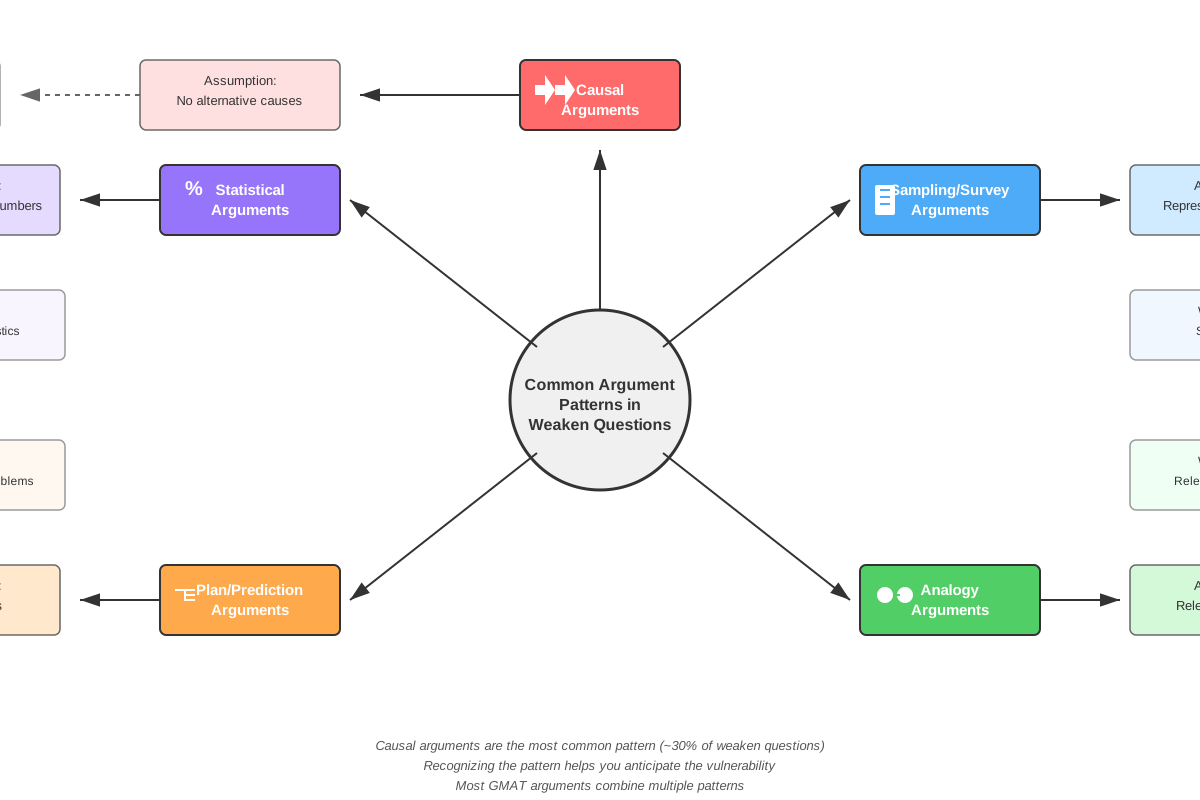
Common Argument Patterns and Their Weaknesses
| Argument Pattern | Typical Assumption | How to Weaken |
|---|---|---|
| Causal Claim (A causes B) | No alternative causes; direction of causation is correct | Show alternative cause; demonstrate reverse causation; prove correlation only |
| Plan/Prediction | Conditions will remain stable; no unintended consequences | Introduce changing conditions; reveal negative side effects |
| Survey/Study | Sample is representative; respondents are honest/accurate | Show sample bias; demonstrate response unreliability |
| Analogy (X is like Y) | Situations are relevantly similar | Highlight crucial differences between situations |
| Statistical Correlation | Correlation implies causation; data is accurate | Separate correlation from causation; question data collection |
Scope and Relevance in Weakening
Effective weakening answer choices must be relevant to the specific conclusion drawn and must operate within the scope of the argument. An answer choice might present true information that weakens some related claim, but if it doesn't address the actual conclusion, it's incorrect. For example, if an argument concludes "Plan X will increase profits," an answer showing Plan X has environmental costs might be true but doesn't weaken the profit claim unless it explains how those costs reduce profits.
The scope principle also means that extreme weakening isn't necessary. The correct answer need only introduce reasonable doubt, not prove the conclusion false. Test-takers often incorrectly eliminate moderate weakening answer choices while searching for a "knockout blow" that completely destroys the argument.
Degree of Weakening
Not all weakening answer choices weaken equally. GMAT questions often include multiple answer choices that weaken the argument to some degree, requiring test-takers to identify which weakens most. Factors affecting weakening strength include:
- Directness: How directly the information addresses the conclusion versus peripheral issues
- Magnitude: The size of the effect or the proportion of cases affected
- Certainty: Whether the information definitely applies or only possibly applies
- Relevance: How central the information is to the argument's core logic
Concept Relationships
The concepts within weaken questions form an interconnected logical framework. Argument structure analysis serves as the foundation, enabling identification of vulnerability points where weakening can occur. These vulnerability points typically involve unstated assumptions, which represent the logical gaps between premises and conclusions. Understanding common argument patterns allows rapid recognition of typical weakening mechanisms that apply to each pattern.
The relationship flows: Argument Structure → Vulnerability Points → Assumptions → Weakening Mechanisms → Answer Evaluation
Weaken questions connect to other Critical Reasoning question types through shared foundational skills. Assumption questions identify what must be true for an argument to work; weaken questions often attack these same assumptions. Strengthen questions represent the mirror image—information that supports rather than undermines the argument. Evaluate questions ask what information would help determine argument strength, essentially asking what could either weaken or strengthen. Flaw questions identify the logical error in reasoning, which often suggests how the argument could be weakened.
The progression of mastery moves from identifying arguments and their components (prerequisite skills) → recognizing assumptions and logical gaps → understanding how information affects argument strength → applying this understanding to select weakening answer choices → distinguishing degrees of weakening among multiple candidates.
High-Yield Facts
⭐ Weaken questions appear in approximately 20-25% of GMAT Critical Reasoning questions, making them one of the most frequently tested question types.
⭐ The correct answer in a weaken question does not need to prove the conclusion false; it only needs to make the conclusion less likely or introduce reasonable doubt.
⭐ Most effective weakening answer choices attack unstated assumptions that bridge the gap between premises and conclusion.
⭐ Causal arguments are particularly vulnerable to weakening through alternative explanations, reverse causation, or demonstrating mere correlation.
⭐ Answer choices that are outside the scope of the argument's conclusion cannot weaken the argument, even if they present negative information.
- Weaken question stems typically include phrases like "most seriously weakens," "casts doubt on," "undermines," or "calls into question."
- Arguments based on surveys or samples are vulnerable to weakening by showing the sample is unrepresentative or biased.
- Plans and predictions can be weakened by introducing factors that would prevent the predicted outcome or cause unintended consequences.
- Analogies are weakened by highlighting relevant differences between the compared situations.
- Statistical arguments can be weakened by questioning data collection methods, sample size, or interpretation of results.
- Answer choices that strengthen the argument are common trap answers in weaken questions.
- Irrelevant answer choices often discuss related topics but don't address the specific conclusion drawn.
- The correct weakening answer choice must be assumed to be true—test-takers should not question its validity.
- Extreme or absolute answer choices are not automatically wrong in weaken questions, unlike in some other question types.
Quick check — test yourself on Weaken so far.
Try Flashcards →Common Misconceptions
Misconception: The correct answer must completely destroy the argument or prove the conclusion false.
Correction: Weakening requires only introducing reasonable doubt or making the conclusion less likely. Even modest weakening that clearly affects the argument's strength can be correct if it's the strongest option available.
Misconception: Any negative information related to the topic weakens the argument.
Correction: Only information that specifically addresses the conclusion and its logical support weakens the argument. Negative information outside the argument's scope is irrelevant, regardless of how damaging it might seem in a broader context.
Misconception: If an answer choice presents information the argument already considered, it cannot weaken the argument.
Correction: Answer choices can weaken by providing new details about factors the argument mentioned, showing those factors have different implications than the argument assumed.
Misconception: Weakening answer choices must introduce entirely new concepts not mentioned in the argument.
Correction: Effective weakening often involves information directly related to concepts in the argument, showing they work differently than the argument assumes or revealing overlooked aspects of mentioned factors.
Misconception: The longest or most complex answer choice is usually correct because it provides the most information.
Correction: Answer length and complexity have no correlation with correctness. Simple, direct statements often provide the most effective weakening, while complex answer choices may introduce irrelevant details.
Misconception: If you can imagine a scenario where the answer choice doesn't weaken the argument, it must be wrong.
Correction: The correct answer weakens the argument as stated, assuming the answer choice is true. Inventing additional assumptions or scenarios to neutralize the weakening effect is not appropriate—evaluate the answer choice at face value.
Misconception: Weaken questions always involve finding flaws in the argument's logic.
Correction: While some weakening answer choices exploit logical flaws, others introduce new factual information that, while not revealing a logical error, makes the conclusion less likely to be true given this additional context.
Worked Examples
Example 1: Causal Argument
Argument:
"Over the past five years, City X has experienced both a 30% increase in the number of police officers and a 25% decrease in violent crime. Therefore, the increase in police officers caused the decrease in violent crime."
Question: Which of the following, if true, most seriously weakens the argument?
Answer Choices:
A) City X's population decreased by 28% over the same five-year period due to economic factors.
B) Police officers in City X received improved training during this period.
C) Neighboring City Y increased police officers by 35% but saw no decrease in violent crime.
D) Property crime in City X remained constant during this period.
E) The cost of hiring additional police officers strained City X's budget.
Analysis:
First, identify the argument structure:
- Premise: Police officers increased 30%; violent crime decreased 25%
- Conclusion: The police increase caused the crime decrease
- Assumption: No alternative explanation for the crime decrease; the correlation indicates causation
This is a classic causal argument vulnerable to alternative explanations.
Evaluating answer choices:
(A) This provides a strong alternative explanation. If the population decreased by 28%, we would expect crime to decrease proportionally, independent of police presence. This directly challenges the causal claim by suggesting the crime decrease would have occurred anyway. This weakens significantly.
(B) This actually strengthens the argument by providing additional reason why police might be more effective, supporting the causal relationship.
(C) This is tempting but doesn't directly weaken. Different cities have different conditions; City Y's experience doesn't prove City X's police increase didn't cause its crime decrease. This is too indirect.
(D) This is irrelevant to the conclusion about violent crime. The argument doesn't claim police affected all crime types.
(E) This discusses a consequence of the policy but doesn't address whether police caused the crime decrease. Budget strain is outside the scope of the causal claim.
Correct Answer: A
This example demonstrates attacking a causal argument by providing an alternative explanation that accounts for the observed correlation without requiring the proposed causal relationship.
Example 2: Plan/Prediction Argument
Argument:
"TechCorp's customer satisfaction ratings have declined over the past year. To reverse this trend, TechCorp plans to implement a new customer service training program for all employees. Since similar training programs have improved satisfaction ratings at other companies, TechCorp's plan will successfully increase its customer satisfaction ratings."
Question: Which of the following, if true, most seriously weakens the prediction?
Answer Choices:
A) The training program will cost significantly more than TechCorp initially budgeted.
B) Customer satisfaction declined primarily because TechCorp recently increased prices by 40% while competitors maintained stable pricing.
C) Some employees at TechCorp have expressed skepticism about the value of training programs.
D) The companies where similar training programs succeeded had higher initial satisfaction ratings than TechCorp currently has.
E) TechCorp's competitors are also planning to implement customer service training programs.
Analysis:
Argument structure:
- Premise: Satisfaction has declined; training worked elsewhere
- Conclusion: Training will increase TechCorp's satisfaction
- Assumptions: Training addresses the cause of TechCorp's decline; TechCorp's situation is comparable to other companies; no other factors will prevent success
This prediction argument assumes the solution matches the problem and conditions are favorable.
Evaluating answer choices:
(A) Cost concerns don't address whether the training will work—only whether it's expensive. This doesn't weaken the effectiveness prediction.
(B) This strongly weakens by revealing the root cause of dissatisfaction is pricing, not service quality. If customers are unhappy about prices, training employees won't address their actual concern. The solution doesn't match the problem. This is a powerful weakener.
(C) Employee skepticism might affect implementation but doesn't directly indicate the training won't work if properly implemented. This is weak and indirect.
(D) This suggests a relevant difference but doesn't clearly explain why starting from a lower baseline would prevent improvement. The logic isn't sufficiently direct.
(E) Competitors also training might affect TechCorp's relative position but doesn't indicate TechCorp won't improve in absolute terms. The conclusion is about increasing ratings, not outperforming competitors.
Correct Answer: B
This example illustrates weakening a plan by showing it doesn't address the actual cause of the problem it aims to solve—a common and powerful weakening strategy.
Exam Strategy
Systematic Approach to Weaken Questions
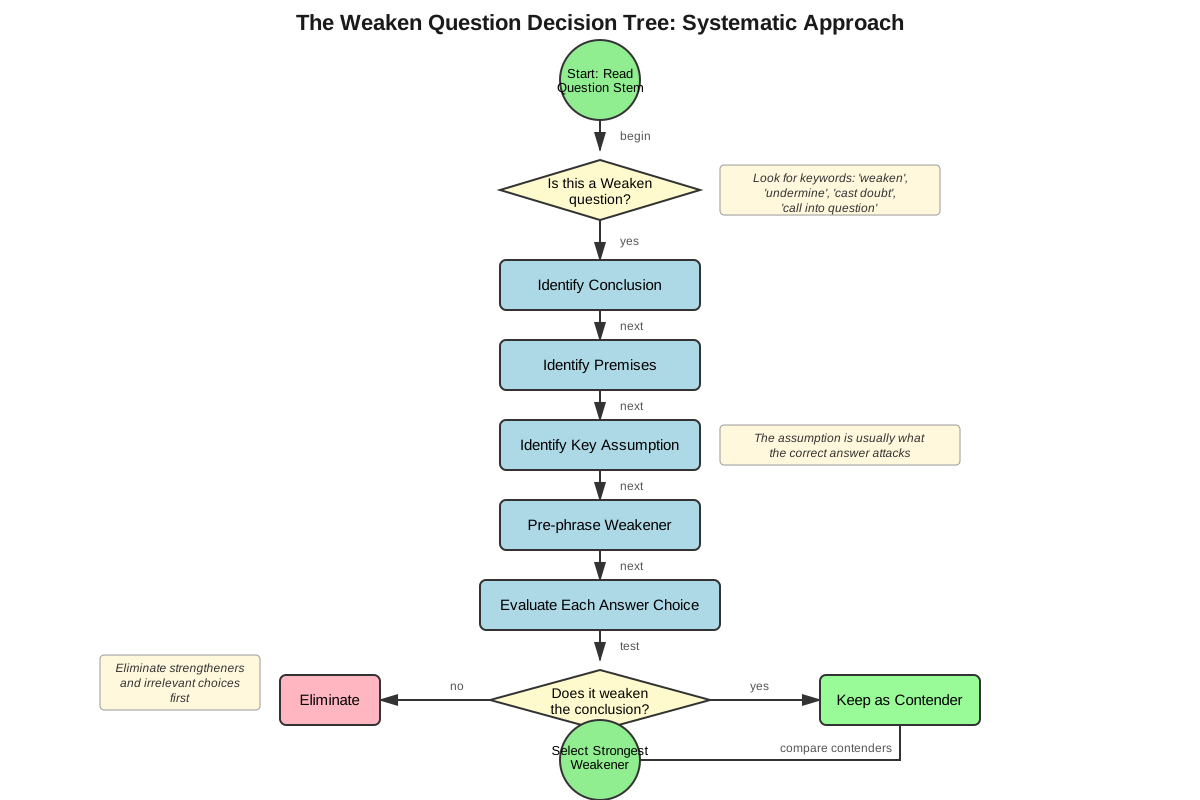
- Identify the question type immediately by reading the question stem first. Look for trigger words: "weaken," "undermine," "cast doubt," "call into question."
- Analyze the argument structure before looking at answer choices:
- Locate the conclusion (often signaled by "therefore," "thus," "consequently")
- Identify the premises (evidence supporting the conclusion)
- Recognize the argument type (causal, plan, analogy, statistical, etc.)
- Identify the assumption(s) bridging premises to conclusion. Ask: "What must be true for this conclusion to follow?" The gap between evidence and conclusion is where weakening typically occurs.
- Predict the type of weakening before reviewing answer choices. Consider: alternative explanations, overlooked factors, questionable assumptions, or relevant differences.
- Evaluate each answer choice by asking: "If this were true, would it make the conclusion less likely?" Use process of elimination systematically.
Trigger Words and Phrases
In question stems, watch for:
- "Weaken," "weakens," "most seriously weakens"
- "Undermine," "undermines"
- "Cast doubt," "casts doubt"
- "Call into question," "calls into question"
- "Challenge," "challenges"
- "Argue against"
- "Provide grounds for questioning"
In arguments, identify vulnerability signals:
- Causal language: "causes," "leads to," "results in," "because of"
- Predictive language: "will," "is expected to," "should"
- Comparative language: "similar to," "like," "as in"
- Statistical language: "survey shows," "study found," "data indicates"
Process of Elimination Tips
Eliminate answer choices that:
- Strengthen the argument (common trap)
- Are completely irrelevant to the conclusion
- Address a different conclusion than the one stated
- Are outside the scope of the argument
- Merely restate information already in the argument without adding new implications
Keep answer choices that:
- Directly address the conclusion
- Attack unstated assumptions
- Provide alternative explanations
- Introduce relevant overlooked factors
- Show the evidence doesn't support the conclusion as strongly as claimed
Time Allocation
Allocate approximately 2 minutes per Critical Reasoning question:
- 15-20 seconds: Read question stem, identify question type
- 30-40 seconds: Read and analyze argument, identify conclusion and assumptions
- 10-15 seconds: Predict weakening approach
- 45-60 seconds: Evaluate answer choices, eliminate and select
- 5-10 seconds: Confirm selection addresses the conclusion
If stuck between two answer choices, ask: "Which one more directly addresses the specific conclusion drawn?" and "Which one introduces more significant doubt?" The correct answer typically operates more directly on the argument's core logic.
Exam Tip: Don't overthink or add assumptions to answer choices. Evaluate them at face value, assuming they're true, and assess their direct impact on the argument as written.
Memory Techniques
WEAKEN Acronym
What's the conclusion?
Evidence provided?
Assumptions made?
Key vulnerability?
Eliminate strengtheners and irrelevant choices
Narrow to the choice that most directly weakens
The "Alternative Explanation" Visualization
For causal arguments, visualize the argument as: A → B (A causes B)
Weakening strategies:
- C → B: Alternative cause (C, not A, causes B)
- B → A: Reverse causation (B actually causes A)
- A ≈ B: Mere correlation (A and B coincide without causation)
- A → X → B: Broken chain (A doesn't reliably lead to B)
The "Scope Circle" Technique
Mentally draw a circle around the argument's conclusion. Any answer choice that operates outside this circle—no matter how negative or relevant to the general topic—cannot weaken the argument. Only information that enters the scope circle and directly affects the conclusion counts.
Common Vulnerability Patterns: CASP
Causal claims → Alternative explanations
Analogies → Relevant differences
Samples/surveys → Representativeness issues
Plans/predictions → Changing conditions or unintended consequences
The "If True" Reminder
Remember that answer choices should be evaluated assuming they are true. Create a mental habit: Before evaluating each answer choice, silently say "If this is true..." This prevents the common error of questioning the answer choice's validity rather than assessing its impact on the argument.
Summary
Weaken questions test the ability to identify information that reduces confidence in an argument's conclusion by introducing doubt, providing alternative explanations, or exposing questionable assumptions. Success requires systematic argument analysis: identifying the conclusion, recognizing the premises, and pinpointing the logical gaps where assumptions bridge evidence to conclusion. The most effective weakening answer choices typically attack these unstated assumptions, offer plausible alternative explanations for causal claims, reveal that samples or analogies are not representative or comparable, or introduce factors that would prevent predicted outcomes. The correct answer need not destroy the argument completely—introducing reasonable doubt suffices. Test-takers must distinguish between answer choices that weaken, strengthen, or remain irrelevant to the specific conclusion drawn, evaluating each option's direct impact on the argument's logical strength. Mastering weaken questions requires recognizing common argument patterns (causal, predictive, analogical, statistical), understanding their typical vulnerabilities, and applying systematic evaluation strategies while avoiding common traps such as selecting strengthening answer choices or information outside the argument's scope.
Key Takeaways
- Weaken questions constitute 20-25% of GMAT Critical Reasoning questions and require identifying information that makes the conclusion less likely, not necessarily false
- The most effective weakening answer choices attack unstated assumptions that bridge the gap between premises and conclusion
- Causal arguments are particularly vulnerable to alternative explanations, reverse causation, or demonstrations of mere correlation
- Answer choices must be within the scope of the argument's specific conclusion to weaken effectively—related negative information that doesn't address the conclusion is irrelevant
- Systematic approach: identify the conclusion, recognize premises, pinpoint assumptions, predict weakening type, then evaluate answer choices
- Common weakening strategies include providing alternative explanations, showing samples are unrepresentative, highlighting relevant differences in analogies, and introducing factors that prevent predicted outcomes
- Avoid trap answers that strengthen the argument or discuss related topics without addressing the specific conclusion drawn
Related Topics
Strengthen Questions: The mirror image of weaken questions, requiring identification of information that supports rather than undermines the argument. Mastering weaken questions provides the foundation for strengthen questions, as both require understanding argument structure and assumptions.
Assumption Questions: These questions ask test-takers to identify unstated premises necessary for the argument's logic. Since weaken questions often attack these same assumptions, understanding assumption questions enhances weakening skills.
Evaluate Questions: These questions ask what information would help determine argument strength—essentially what could weaken or strengthen. Mastery of weaken questions directly supports evaluate question performance.
Flaw Questions: These identify logical errors in reasoning. Understanding common flaws helps predict how arguments can be weakened, as flaws represent vulnerabilities.
Cause and Effect Reasoning: A deeper exploration of causal logic, including necessary and sufficient conditions, helps identify vulnerabilities in causal arguments—the most common type in weaken questions.
Practice CTA
Now that you've mastered the conceptual framework for weaken questions, it's time to apply these strategies to actual GMAT-style practice questions. The practice questions and flashcards will reinforce your ability to quickly identify argument structures, recognize assumptions, and select the most effective weakening answer choices under timed conditions. Remember: understanding the theory is essential, but developing the pattern recognition and decision-making speed necessary for test day requires deliberate practice. Challenge yourself to apply the systematic approach outlined in this guide, and track which types of arguments and weakening strategies you find most challenging. Consistent practice with immediate feedback will transform these strategies from conscious techniques into automatic skills, enabling you to tackle weaken questions with confidence and efficiency on test day. You've built the foundation—now strengthen it through application!
Sign up free to keep reading
Create a free AnvayaPrep account to finish this GMAT guide on Weaken — plus flashcards and practice questions.