Overview
Avoiding repetition is a critical stylistic principle in GRE Analytical Writing that directly impacts the clarity, sophistication, and persuasiveness of essay responses. On the GRE, test-takers must compose two essays—an "Analyze an Issue" task and an "Analyze an Argument" task—within strict time constraints. Graders evaluate these essays not only for logical reasoning and content quality but also for writing style, including vocabulary range, sentence variety, and the ability to express ideas without unnecessary redundancy. Essays that repeatedly use the same words, phrases, or sentence structures signal limited vocabulary and weak writing skills, potentially lowering scores even when the underlying arguments are sound.
The principle of avoiding repetition extends beyond simply not using the same word twice. It encompasses strategic use of synonyms, varied sentence structures, pronoun references, and transitional devices that maintain coherence while demonstrating linguistic flexibility. This skill is particularly important because GRE essays require sustained discussion of a single topic or argument, creating natural pressure toward repetitive language. Writers must discuss the same concepts multiple times throughout their essays while keeping the prose fresh and engaging.
Within the broader context of Analytical Writing Style, avoiding repetition works in concert with other stylistic elements such as sentence variety, precise word choice, and appropriate tone. While clarity remains paramount—writers should never sacrifice clear communication for the sake of variety—the ability to express similar ideas through different linguistic means demonstrates the command of language that distinguishes high-scoring essays (5.0-6.0) from merely adequate ones (3.0-4.0). This topic connects directly to vocabulary development, syntactic flexibility, and the overall goal of producing polished, professional academic prose under timed conditions.
Learning Objectives
- [ ] Identify when avoiding repetition is being tested in GRE essay scoring
- [ ] Explain the core rule or strategy behind avoiding repetition in analytical writing
- [ ] Apply avoiding repetition techniques to GRE-style essay questions accurately
- [ ] Generate appropriate synonyms and alternative phrasings for commonly repeated terms in essay contexts
- [ ] Recognize when repetition is acceptable or even necessary for clarity and emphasis
- [ ] Evaluate sample essay passages for repetitive elements and suggest improvements
- [ ] Integrate varied sentence structures to reduce structural repetition while maintaining coherence
Prerequisites
- Basic vocabulary knowledge: Understanding common academic vocabulary provides the foundation for selecting appropriate synonyms and alternative expressions
- Sentence structure fundamentals: Familiarity with different sentence types (simple, compound, complex, compound-complex) enables structural variation
- Essay organization principles: Knowledge of standard essay structure helps identify where repetition is most likely to occur and most problematic
- Pronoun usage rules: Correct pronoun reference allows writers to avoid repeating nouns while maintaining clarity
Why This Topic Matters
In professional and academic writing, the ability to express ideas without excessive repetition demonstrates intellectual sophistication and linguistic competence. Readers—whether professors, colleagues, or GRE graders—perceive repetitive writing as monotonous, unsophisticated, and potentially indicative of limited thinking. Conversely, varied expression maintains reader engagement and suggests a writer who possesses both depth of vocabulary and flexibility of thought.
On the GRE specifically, avoiding repetition appears as a significant component of the scoring rubric for both Analytical Writing tasks. The official scoring guide for scores of 5.0 and 6.0 explicitly mentions "facility with language," "effective vocabulary," and "sentence variety"—all of which relate directly to avoiding repetition. Statistical analysis of scored GRE essays reveals that higher-scoring essays consistently demonstrate greater lexical diversity (the ratio of unique words to total words) and more varied sentence structures. Essays scoring 4.0 or below frequently exhibit repetitive vocabulary and monotonous sentence patterns.
This topic appears throughout GRE essays in several predictable ways. First, writers naturally tend to repeat key terms from the prompt itself, particularly abstract concepts like "education," "technology," "government," or "society." Second, transitional phrases and logical connectors often become repetitive ("In addition," "Furthermore," "Also" appearing multiple times). Third, when discussing examples or evidence, writers may repeatedly use the same verbs ("shows," "demonstrates," "proves") or the same sentence structures ("This example shows... Another example shows..."). Recognizing these patterns allows test-takers to proactively vary their language.
Core Concepts
Understanding Lexical Repetition
Lexical repetition refers to the unnecessary reuse of the same words or phrases within a piece of writing. While some repetition is inevitable and even desirable for coherence—particularly with key terms that lack clear synonyms—excessive lexical repetition creates a monotonous reading experience and suggests vocabulary limitations. On the GRE, lexical repetition most commonly occurs with:
- Prompt keywords: Terms directly from the essay prompt that writers feel obligated to repeat
- Abstract concepts: Words like "important," "significant," "beneficial," or "problematic"
- Transition words: Overuse of "however," "therefore," "in addition," or "for example"
- Verbs of attribution: Repeated use of "says," "states," "shows," or "demonstrates"
The solution involves building a mental repertoire of synonyms and near-synonyms for common academic terms. However, writers must exercise judgment—not all synonyms are equally appropriate in all contexts, and clarity should never be sacrificed for variety.
Synonym Selection and Contextual Appropriateness
Effective synonym use requires understanding both denotation (literal meaning) and connotation (associated implications). Consider the word "important":
| Original Word | Synonyms | Contextual Notes |
|---|---|---|
| Important | Significant, crucial, vital, essential, pivotal, consequential | "Crucial" and "vital" suggest greater urgency than "significant" |
| Show | Demonstrate, illustrate, reveal, indicate, suggest, establish | "Suggest" implies less certainty than "demonstrate" |
| Problem | Issue, challenge, difficulty, obstacle, concern, complication | "Challenge" has more positive connotations than "problem" |
| Good | Beneficial, advantageous, positive, favorable, constructive | "Advantageous" emphasizes practical benefits |
When selecting synonyms, consider:
- Register appropriateness: Academic writing requires formal vocabulary; avoid colloquialisms
- Precision: Choose the word that most accurately conveys the intended meaning
- Collocational patterns: Some words naturally pair with others ("pose a challenge" vs. "pose a benefit")
- Frequency balance: Don't replace one repeated word with another that then becomes repetitive
Structural Repetition and Sentence Variety
Structural repetition occurs when multiple sentences follow the same grammatical pattern, creating monotony even when vocabulary varies. Common patterns that become repetitive include:
- Subject-verb-object sequences: "Technology improves communication. Technology enhances productivity. Technology transforms education."
- Subordinate clause placement: Beginning every sentence with "Because..." or "Although..."
- Sentence length uniformity: All sentences approximately the same length
- Parallel structure overuse: While parallelism is valuable for emphasis, excessive use creates sing-song rhythm
To achieve sentence variety:
- Vary sentence openings: Begin with subjects, prepositional phrases, adverbs, subordinate clauses, or participial phrases
- Mix sentence types: Alternate between simple, compound, complex, and compound-complex structures
- Adjust sentence length: Combine short, punchy sentences with longer, more elaborate ones
- Use different grammatical subjects: Instead of repeating the same subject, restructure sentences to foreground different elements
Example of structural repetition:
Technology has changed education. Technology has improved access to information. Technology has enabled distance learning. Technology has created new challenges.
Revised for variety:
Technology has fundamentally transformed education. Through improved access to information, students can now research topics independently. Distance learning has become viable, enabling education across geographical boundaries. However, these advances have also created new challenges for educators.
Pronoun Reference as a Repetition-Avoidance Strategy
Strategic pronoun use allows writers to refer back to previously mentioned nouns without repeating them. This technique is particularly valuable in GRE essays where the same concepts must be discussed throughout multiple paragraphs.
Effective pronoun strategies include:
- Simple pronoun substitution: Replace repeated nouns with "it," "they," "this," or "these"
- Demonstrative pronouns with summary nouns: "This approach," "these benefits," "such policies"
- Relative clauses: "The policy, which was implemented in 2020, has shown..."
Critical caveat: Pronoun reference must remain unambiguous. If multiple nouns could serve as the antecedent, repetition of the noun is preferable to confusion.
Acceptable and Strategic Repetition
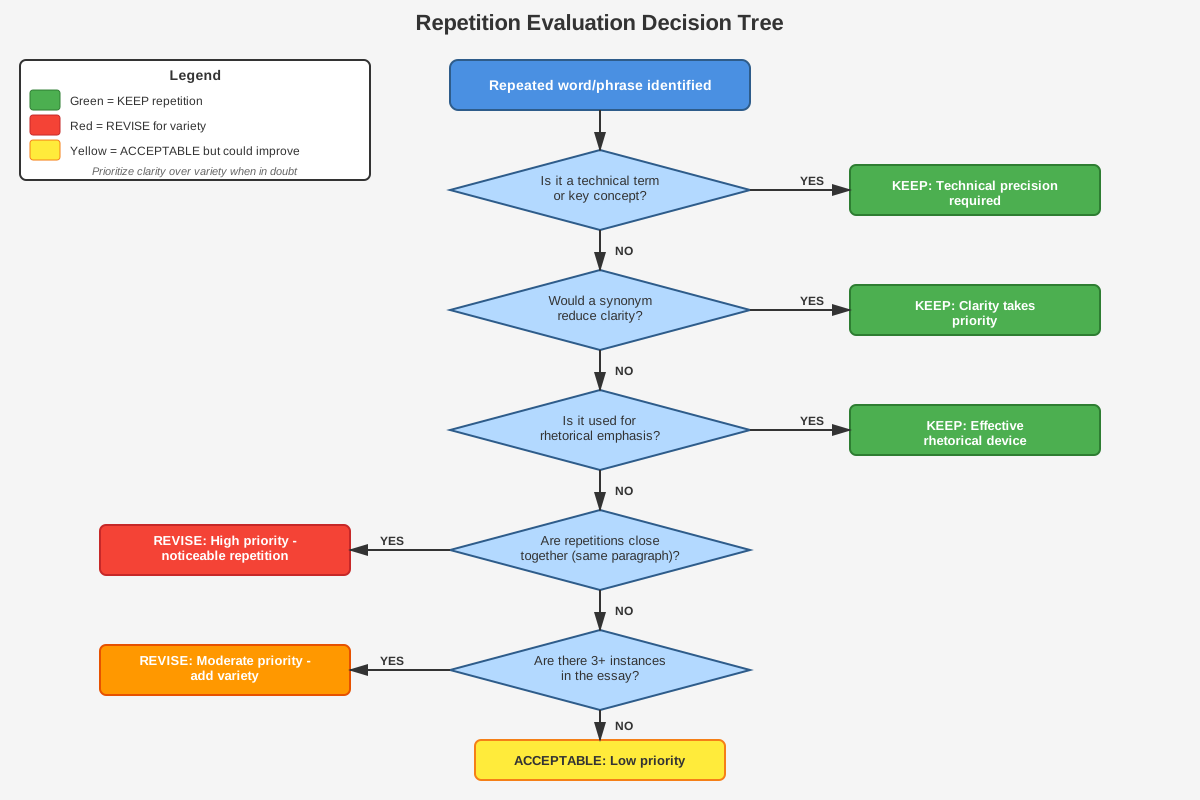
Not all repetition is problematic. GRE avoiding repetition does not mean eliminating all repeated words. Acceptable repetition includes:
- Technical terms without clear synonyms: If discussing "photosynthesis" or "democracy," forced synonym substitution may create confusion
- Deliberate repetition for emphasis: Repeating a key phrase for rhetorical effect
- Repetition for clarity: When pronoun reference would be ambiguous
- Parallel structure for comparison: "Some argue X; others argue Y" benefits from structural repetition
The key distinction lies between functional repetition (serving a clear purpose) and lazy repetition (resulting from vocabulary limitations or inattention).
Paraphrasing and Conceptual Restatement
Beyond word-level synonym substitution, effective writers can express the same idea through entirely different constructions. This skill—paraphrasing—demonstrates sophisticated command of language.
Original statement: "Education is important for economic development."
Paraphrase options:
- "Economic growth depends significantly on educational investment."
- "A nation's prosperity correlates strongly with the quality of its educational system."
- "Developing human capital through schooling drives economic advancement."
Each paraphrase maintains the core meaning while using different vocabulary, sentence structure, and emphasis. This technique is particularly valuable when discussing the same point across multiple paragraphs or when summarizing arguments in conclusions.
Concept Relationships
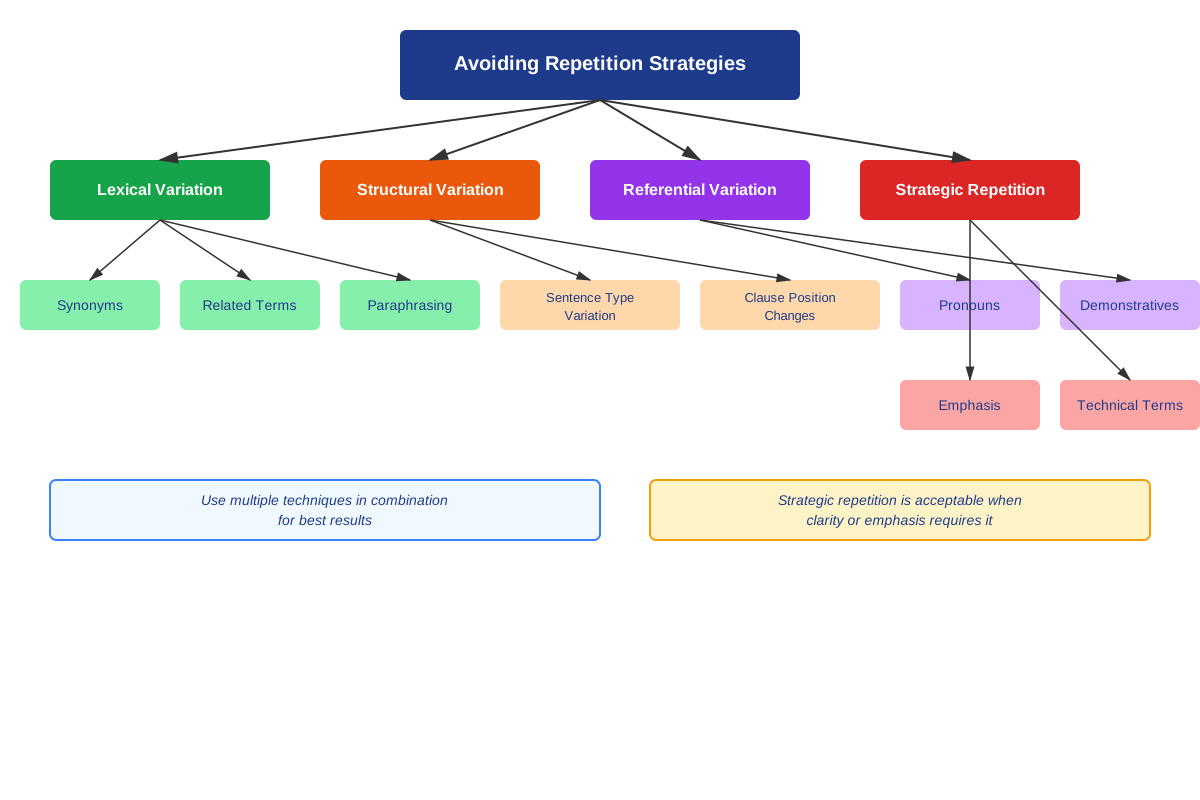
The concepts within avoiding repetition form an interconnected system. Lexical repetition (word-level) and structural repetition (sentence-level) represent two dimensions of the same problem, requiring different but complementary solutions. Synonym selection addresses lexical repetition but requires understanding of contextual appropriateness to avoid creating new problems through imprecise word choice. Pronoun reference serves as a bridge strategy, reducing lexical repetition while maintaining clarity, but must be balanced against the principle of acceptable repetition when clarity demands it.
These concepts connect to prerequisite knowledge in several ways. Sentence structure fundamentals enable recognition and correction of structural repetition. Basic vocabulary knowledge provides the raw material for synonym selection. Essay organization principles help writers anticipate where repetition is most likely to occur—particularly in topic sentences, transitions between paragraphs, and conclusions that summarize earlier points.
Relationship map:
Lexical Repetition → addressed by → Synonym Selection → requires → Contextual Appropriateness
Structural Repetition → addressed by → Sentence Variety → builds on → Sentence Structure Fundamentals
Both types of repetition → can be reduced through → Pronoun Reference → must balance with → Acceptable Repetition
All strategies → culminate in → Paraphrasing and Conceptual Restatement
High-Yield Facts
⭐ The GRE scoring rubric explicitly rewards "facility with language" and "effective vocabulary," both directly related to avoiding repetition
⭐ Higher-scoring essays (5.0-6.0) demonstrate significantly greater lexical diversity than lower-scoring essays (3.0-4.0)
⭐ Repeating exact phrases from the prompt without variation signals weak paraphrasing skills and limits scores
⭐ Structural repetition (same sentence patterns) is as problematic as lexical repetition (same words)
⭐ Strategic pronoun use reduces repetition while maintaining coherence, but ambiguous pronouns harm clarity
- Synonym selection must consider both denotation (literal meaning) and connotation (implied associations)
- Transition words and phrases are among the most commonly repeated elements in GRE essays
- Not all repetition is problematic; technical terms and deliberate emphasis may require repeated words
- Paraphrasing the same idea through different sentence structures demonstrates sophisticated writing
- Varying sentence length and opening patterns creates rhythm and maintains reader engagement
- Collocation (which words naturally pair together) affects synonym appropriateness
- Overusing a thesaurus without understanding context can create awkward or imprecise language
Quick check — test yourself on Avoiding repetition so far.
Try Flashcards →Common Misconceptions
Misconception: Using a thesaurus to replace every repeated word automatically improves writing quality.
Correction: Indiscriminate synonym substitution can create imprecise language, awkward phrasing, or inappropriate register. Synonyms must be contextually appropriate and maintain the intended meaning. Sometimes repeating a word is clearer than forcing an ill-fitting synonym.
Misconception: All repetition is bad and should be eliminated from GRE essays.
Correction: Strategic repetition serves important functions, including emphasizing key points, maintaining clarity when pronouns would be ambiguous, and using parallel structure for rhetorical effect. The goal is avoiding unnecessary or lazy repetition, not eliminating all repeated words.
Misconception: Varying vocabulary is more important than clarity in GRE essays.
Correction: Clarity always takes precedence over variety. If choosing between a repeated word that communicates clearly and a synonym that might confuse readers, the clear option is superior. GRE graders prioritize clear communication of ideas.
Misconception: Pronouns can always substitute for repeated nouns without problems.
Correction: Pronouns require clear antecedents. When multiple nouns could serve as the referent, or when several sentences separate the pronoun from its antecedent, repeating the noun or using a demonstrative pronoun with a summary noun ("this policy," "these challenges") is preferable.
Misconception: Sentence variety means making every sentence as different as possible from the previous one.
Correction: Effective sentence variety involves strategic mixing of structures, lengths, and patterns to create rhythm and emphasis. Some structural similarity aids coherence, particularly within paragraphs discussing related points. The goal is avoiding monotonous patterns, not maximizing difference.
Misconception: Sophisticated vocabulary always means using longer, more complex words.
Correction: Sophistication comes from precise, contextually appropriate word choice, not word length. "Use" is often better than "utilize," and "help" may be clearer than "facilitate." Effective writers choose words that accurately convey meaning while maintaining appropriate academic register.
Worked Examples
Example 1: Revising for Lexical Variety
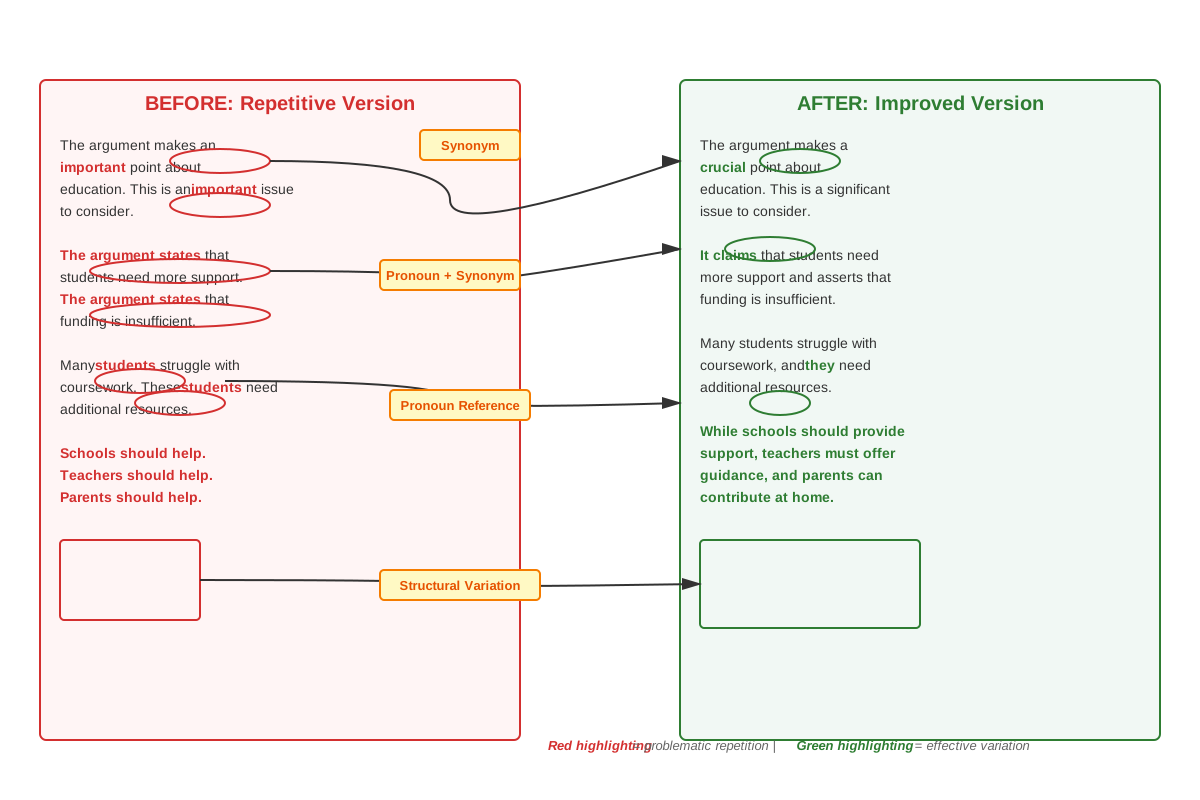
Original passage (with repetitive elements highlighted conceptually):
Education is important for society. Education helps people develop skills. When people have education, they can get better jobs. Education also helps people understand the world. Without education, people cannot participate fully in society. Therefore, governments should invest in education.
Analysis of problems:
- "Education" appears 6 times in 6 sentences
- "People" appears 4 times
- "Helps" appears twice in similar constructions
- Sentence structures are monotonously similar (mostly subject-verb-object)
- No variety in sentence length or complexity
Revised passage:
Education plays a vital role in societal development. Through formal schooling, individuals acquire essential skills that enhance their employability and career prospects. Beyond economic benefits, learning fosters critical thinking and broadens understanding of complex global issues. Without access to quality instruction, citizens cannot participate fully in democratic processes or contribute meaningfully to their communities. Consequently, governments should prioritize educational investment as a foundation for national progress.
Improvements demonstrated:
- "Education" reduced to 1 use; replaced with "schooling," "learning," "instruction," and "educational investment"
- "People" replaced with "individuals," "citizens," and implied subjects
- "Helps" replaced with "enhance," "fosters," and "contribute"
- Sentence structures varied: simple, complex, and compound-complex
- Sentence length varies from 8 to 20 words
- More sophisticated vocabulary throughout ("vital role," "democratic processes," "prioritize")
Example 2: Addressing Structural Repetition
Original passage (with structural repetition):
Technology has improved communication. Technology has increased productivity. Technology has transformed education. Technology has created new challenges. Technology will continue to shape our future.
Analysis of problems:
- All five sentences follow identical subject-verb-object structure
- All sentences begin with "Technology has/will"
- Uniform sentence length (5-7 words)
- Monotonous rhythm despite varied vocabulary
Revised passage:
Technology has revolutionized communication across the globe. Productivity gains in numerous industries can be attributed to technological innovation. In education, digital tools have transformed both teaching methods and learning outcomes. However, these advances have not come without complications; new challenges in privacy, security, and digital equity have emerged. As technological development accelerates, its influence on society will only intensify.
Improvements demonstrated:
- Varied sentence openings: subject, noun phrase, prepositional phrase, subordinate clause
- Mixed sentence structures: simple, complex, compound-complex
- Sentence length varies from 8 to 16 words
- "Technology" appears only twice; other references use "technological innovation," "digital tools," "these advances," and "technological development"
- Transitional logic ("However") breaks monotony
- More sophisticated vocabulary and phrasing
Connection to learning objectives: These examples demonstrate the application of avoiding repetition principles to GRE-style essay writing, showing how to identify repetitive elements and systematically revise for variety while maintaining clarity and coherence.
Exam Strategy
Approaching GRE Essays with Repetition Awareness
During planning (2-3 minutes):
- Note key terms from the prompt that you'll need to discuss repeatedly
- Brainstorm 2-3 synonyms or alternative phrasings for each key term
- Plan varied examples that allow different vocabulary and structures
During writing (25-30 minutes):
- After completing each paragraph, quickly scan for repeated words
- When you notice yourself about to repeat a word, pause and substitute
- Vary your sentence openings consciously—if the last sentence began with the subject, try starting the next with a transition or subordinate clause
- Use pronouns strategically, but ensure antecedents are clear
During revision (3-5 minutes):
- Scan specifically for your personal repetition patterns (most writers have predictable habits)
- Check transition words—these are commonly over-repeated
- Verify that your introduction and conclusion don't use identical phrasing
- Ensure varied sentence lengths by reading aloud mentally
Trigger Words and Phrases to Watch
Exam Tip: These words and phrases commonly become repetitive in GRE essays. Prepare alternatives in advance.
High-repetition triggers:
- Important/importance: significant, crucial, vital, essential, consequential, pivotal
- Show/shows: demonstrate, illustrate, reveal, indicate, suggest, establish, reflect
- However: nevertheless, nonetheless, conversely, on the other hand, in contrast
- For example: for instance, to illustrate, consider the case of, as demonstrated by
- In addition: furthermore, moreover, additionally, beyond this, also
- People: individuals, citizens, persons, members of society, the public
- Society: community, culture, civilization, the public sphere, collective life
Process-of-Elimination Tips
While avoiding repetition primarily affects essay writing rather than multiple-choice questions, understanding this principle helps in the Analytical Writing section:
- If you've used a word twice in one paragraph, actively seek an alternative for the third use
- If three consecutive sentences begin with the same structure, revise the third
- If your conclusion repeats exact phrases from your introduction, paraphrase one or both
- If you notice yourself writing "This shows..." for the third time, use a different verb or restructure entirely
Time Allocation Advice
- Don't sacrifice content for variety: If you're running short on time, focus on completing your argument rather than perfecting word choice
- Build variety during drafting, not just revision: Thinking about variation while writing is more efficient than extensive revision
- Prioritize high-visibility repetition: Repetition in topic sentences, opening sentences, and conclusions is most noticeable to graders
- Use the last 2-3 minutes for a targeted repetition scan: Focus on the most common culprits (transition words, prompt keywords, common verbs)
Memory Techniques
The VIPER Mnemonic for Avoiding Repetition
Vocabulary - Build synonym banks for common academic terms
Introduce variety in sentence structure and length
Pronouns - Use strategic pronoun reference to avoid noun repetition
Eliminate unnecessary repetition while keeping functional repetition
Replace and rephrase - Paraphrase ideas rather than repeating exact constructions
The "Three-Strike Rule" Visualization
Imagine a baseball umpire calling strikes. The first use of a word is fine (strike one). The second use in close proximity is acceptable if necessary (strike two). The third use in the same paragraph or nearby sentences is "out"—you must find an alternative. This mental image helps writers self-monitor during drafting.
Synonym Clusters for High-Frequency Terms
Create mental "synonym clusters" organized by common GRE essay topics:
IMPORTANCE cluster: important → significant → crucial → vital → essential → pivotal
EVIDENCE cluster: shows → demonstrates → illustrates → reveals → indicates → suggests
TRANSITION cluster: however → nevertheless → nonetheless → conversely → in contrast
CAUSATION cluster: because → since → as → due to → owing to → given that
Visualize these as spokes radiating from a central concept, allowing quick mental access to alternatives.
The "Sentence Starter Rotation" Technique
Memorize five different sentence-opening patterns and consciously rotate through them:
- Subject-first: "Technology transforms education."
- Transition-first: "However, challenges remain."
- Subordinate clause-first: "Although benefits are clear, drawbacks exist."
- Prepositional phrase-first: "In modern society, education is essential."
- Participial phrase-first: "Recognizing these challenges, policymakers must act."
Mentally check off each pattern as you use it, ensuring variety.
Summary
Avoiding repetition is a fundamental principle of effective GRE Analytical Writing that distinguishes sophisticated, high-scoring essays from adequate but unremarkable ones. This skill encompasses both lexical repetition (overusing the same words) and structural repetition (relying on monotonous sentence patterns). Successful test-takers develop strategies for varying their language through synonym selection, pronoun reference, sentence structure variation, and paraphrasing while maintaining clarity and coherence. The key is balancing variety with precision—never sacrificing clear communication for the sake of linguistic diversity. Strategic repetition for emphasis or clarity remains acceptable, but lazy repetition resulting from limited vocabulary or inattention harms essay scores. By building synonym banks for high-frequency academic terms, consciously varying sentence openings and structures, and using revision time to identify and correct repetitive patterns, test-takers can demonstrate the "facility with language" that GRE graders reward with scores of 5.0 and above.
Key Takeaways
- Avoiding repetition directly impacts GRE Analytical Writing scores through the "facility with language" and "sentence variety" criteria in the scoring rubric
- Both lexical repetition (words) and structural repetition (sentence patterns) must be addressed for sophisticated writing
- Synonym selection requires contextual judgment—not all synonyms are equally appropriate in all situations
- Strategic pronoun use reduces repetition while maintaining coherence, but clarity always takes precedence over variety
- Not all repetition is problematic—technical terms, deliberate emphasis, and parallel structure may require repeated words
- Sentence variety involves varying openings, structures, and lengths to create rhythm and maintain reader engagement
- Preparation is key—building synonym banks and practicing paraphrasing before test day enables efficient application under time pressure
Related Topics
Sentence Variety and Complexity: Building on avoiding repetition, this topic explores advanced techniques for creating sophisticated sentence structures that demonstrate grammatical range. Mastering repetition avoidance provides the foundation for this more advanced stylistic work.
Precise Word Choice and Diction: While avoiding repetition focuses on variety, precise word choice emphasizes accuracy and appropriateness. These complementary skills together create polished academic prose.
Coherence and Cohesion: Understanding how to maintain logical flow while varying language connects directly to avoiding repetition—writers must balance variety with clear connections between ideas.
Transitions and Logical Connectors: Since transition words are commonly over-repeated, studying the full range of transitional devices enables both variety and improved logical flow.
Paraphrasing and Summarizing: These skills extend the principles of avoiding repetition to larger textual units, essential for the "Analyze an Argument" task where test-takers must discuss the given argument without simply repeating it.
Practice CTA
Now that you understand the principles and strategies for avoiding repetition in GRE Analytical Writing, it's time to apply these concepts through deliberate practice. Work through the practice questions to identify repetitive elements in sample passages and revise them for variety. Use the flashcards to build your synonym banks for high-frequency academic terms. Remember, avoiding repetition is a skill that improves with conscious practice—each essay you write is an opportunity to strengthen your command of varied, sophisticated language. The investment you make now in developing this skill will pay dividends not only on test day but throughout your academic and professional career. Start practicing today, and watch your writing transform from adequate to exceptional!
Sign up free to keep reading
Create a free AnvayaPrep account to finish this GRE guide on Avoiding repetition — plus flashcards and practice questions.