Overview
Avoiding vague language is a critical skill for achieving a high score on the GRE Analytical Writing section. Vague language weakens arguments, obscures meaning, and signals to graders that a writer lacks precision and clarity in their thinking. On the GRE, where essays are evaluated on how well they communicate complex ideas, every word must earn its place. Vague terms like "things," "stuff," "good," "bad," "a lot," and "very" fail to convey specific meaning and leave readers uncertain about what the writer actually intends to communicate.
The GRE Analytical Writing section consists of two tasks: the "Analyze an Issue" and "Analyze an Argument" essays. Both require writers to construct sophisticated, nuanced responses that demonstrate critical thinking and precise communication. Graders—both human and algorithmic—specifically look for clarity, specificity, and the effective use of language to convey complex ideas. GRE avoiding vague language directly impacts scores across multiple evaluation criteria, including "clarity of expression," "development of ideas," and "facility with language." Writers who consistently use precise, concrete language demonstrate the analytical sophistication that distinguishes high-scoring essays from mediocre ones.
Within the broader context of Analytical Writing Style, avoiding vague language works in concert with other essential skills such as varying sentence structure, using appropriate transitions, and maintaining formal academic tone. While these elements address different aspects of writing quality, they all serve the same ultimate goal: communicating ideas with maximum clarity and persuasiveness. Precision in word choice forms the foundation upon which all other stylistic elements build—without it, even well-structured arguments with sophisticated transitions will fail to convince readers or demonstrate mastery of written English.
Learning Objectives
- [ ] Identify when avoiding vague language is being tested in GRE essay prompts and sample responses
- [ ] Explain the core rule or strategy behind avoiding vague language in analytical writing
- [ ] Apply avoiding vague language to GRE-style questions accurately by revising weak passages
- [ ] Distinguish between vague and precise language in comparative examples
- [ ] Generate specific alternatives to common vague terms within 30 seconds during timed writing
- [ ] Evaluate essay excerpts to identify and quantify instances of vague language
- [ ] Integrate precise vocabulary naturally while maintaining appropriate academic tone
Prerequisites
- Basic grammar and sentence structure: Understanding subject-verb agreement and sentence components enables writers to focus on word choice rather than fundamental construction issues
- Academic vocabulary foundation: A working vocabulary of at least 3,000-5,000 words provides the raw material needed to select precise alternatives to vague terms
- Understanding of essay structure: Knowledge of how to organize paragraphs and arguments allows writers to focus on refining language rather than determining what to say
- Familiarity with GRE essay tasks: Understanding the "Analyze an Issue" and "Analyze an Argument" formats ensures that language precision serves the specific requirements of each task
Why This Topic Matters
In professional and academic contexts, precise language distinguishes expert communication from amateur writing. Scientists, lawyers, business analysts, and academics all rely on specific terminology and concrete examples to convey complex ideas without ambiguity. Graduate programs expect students to write research papers, grant proposals, and technical reports where vague language could lead to misunderstanding, wasted resources, or rejected submissions. The ability to express ideas with precision directly correlates with professional success across virtually all fields requiring advanced degrees.
On the GRE specifically, avoiding vague language appears as a scoring criterion in every single Analytical Writing essay. According to ETS scoring guidelines, essays receiving scores of 5 or 6 (out of 6) consistently demonstrate "facility in the use of language" and "precise word choice," while essays scoring 3 or below frequently exhibit "imprecise or vague language" and "limited vocabulary." Statistical analysis of scored essays reveals that vague language appears approximately 3-4 times more frequently in essays scoring below 4.0 compared to those scoring above 5.0. This makes avoiding vague language one of the highest-yield areas for score improvement, as it affects both the "language use" and "development of ideas" scoring dimensions.
Common manifestations of this topic on the GRE include: essay prompts that require writers to discuss abstract concepts (where the temptation to use vague language is strongest), sample essays in the scoring guide that explicitly demonstrate the difference between vague and precise language, and the algorithmic scoring system (e-rater) which specifically flags overuse of vague qualifiers and general terms. Test-takers who master this skill gain an immediate advantage because precise language simultaneously strengthens argument development, demonstrates vocabulary range, and signals analytical sophistication—three separate scoring criteria improved through a single skill.
Core Concepts
What Constitutes Vague Language
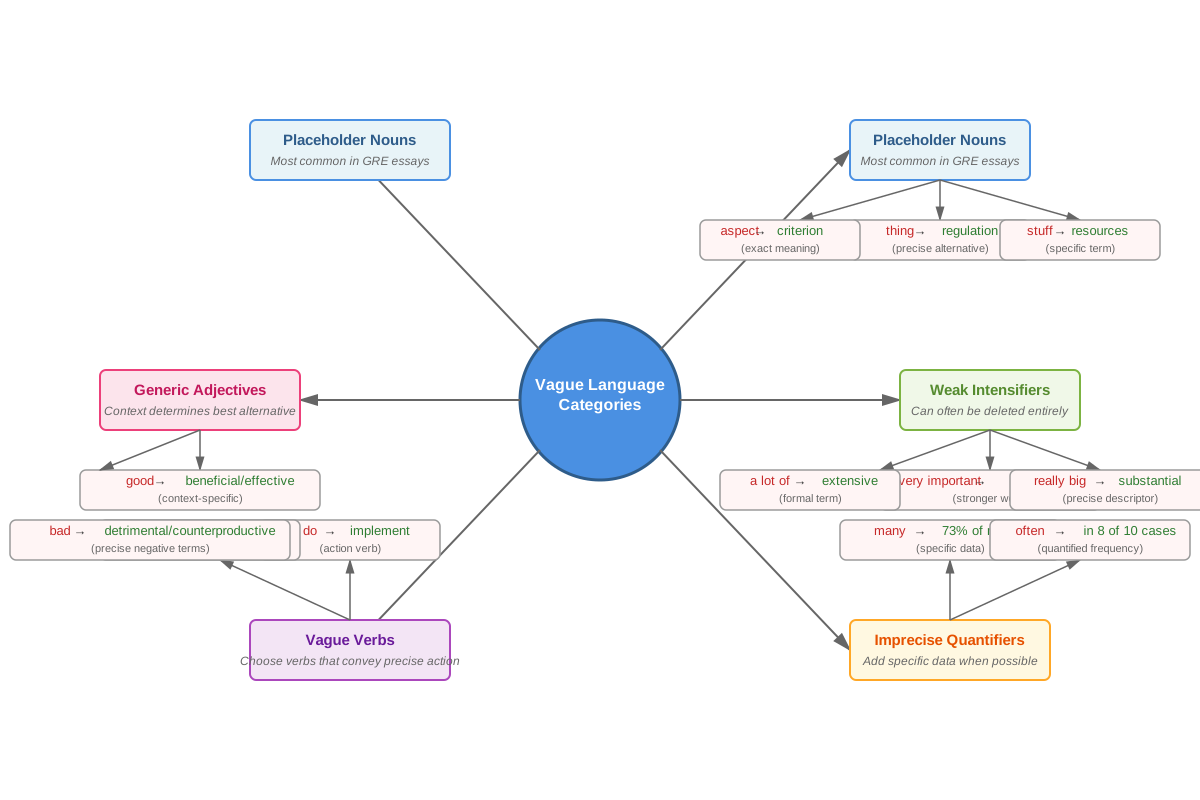
Vague language refers to words and phrases that lack specificity, fail to convey precise meaning, or could apply to an overly broad range of situations. These terms force readers to guess at the writer's intended meaning rather than communicating ideas directly. Common categories of vague language include:
- Generic nouns: things, stuff, items, aspects, factors, elements
- Weak intensifiers: very, really, quite, pretty, somewhat, rather
- Imprecise quantifiers: a lot, many, some, few, several, numerous
- Vague adjectives: good, bad, nice, interesting, important, significant
- Unclear verbs: do, make, get, have, go, come
- Hedge phrases: kind of, sort of, in a way, to some extent
The fundamental problem with vague language is that it creates semantic ambiguity—the reader cannot determine exactly what the writer means. For example, "The policy had many good effects" leaves readers uncertain about the number of effects (three? thirty?), which effects specifically, and what made them "good" (economically beneficial? ethically sound? politically popular?). This ambiguity undermines the writer's credibility and weakens the persuasive force of any argument.
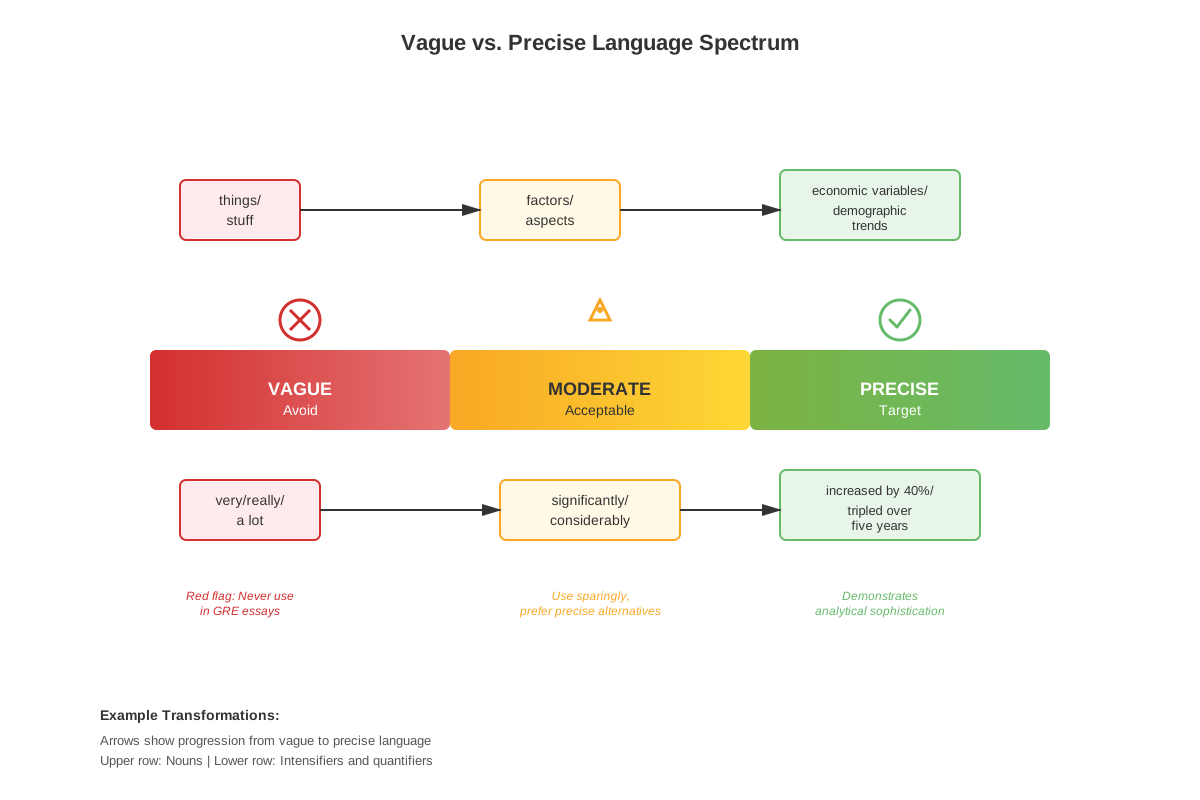
The Specificity Spectrum
Language exists on a continuum from extremely vague to highly specific. Understanding this spectrum helps writers recognize when their language needs refinement:
| Vague | Moderately Specific | Highly Specific |
|---|---|---|
| The company did well | The company increased profits | The company increased quarterly profits by 23% |
| Many people attended | Hundreds of people attended | 347 people attended |
| The policy was bad | The policy was economically harmful | The policy increased unemployment by 2.3 percentage points |
| Things improved | Conditions improved | Air quality improved, with particulate matter decreasing by 40% |
| He was very smart | He demonstrated exceptional analytical ability | He scored in the 99th percentile on standardized reasoning tests |
The goal in GRE writing is not always to reach the rightmost column—sometimes moderate specificity suffices—but rather to avoid remaining in the leftmost column where meaning becomes unclear.
Strategies for Achieving Precision
Strategy 1: Replace Generic Nouns with Specific Terms
Instead of using catch-all words like "things" or "factors," identify exactly what category of item you're discussing. Ask yourself: "What specific type of thing am I referring to?"
- Vague: "Several things contributed to the problem"
- Precise: "Several economic policies contributed to the recession"
- More precise: "Three specific fiscal policies—reduced infrastructure spending, increased payroll taxes, and tightened credit requirements—contributed to the 2008 recession"
Strategy 2: Quantify When Possible
Replace vague quantifiers with specific numbers, percentages, or comparative terms. Even approximate quantification improves clarity.
- Vague: "A lot of students struggle with mathematics"
- Better: "Many students struggle with mathematics"
- Precise: "Approximately 40% of high school students score below proficiency in mathematics"
- Also precise: "Nearly half of high school students struggle with mathematics"
Strategy 3: Use Concrete Examples
Abstract discussions benefit enormously from specific illustrations. Rather than discussing concepts in purely general terms, ground them in particular instances.
- Vague: "Technology has changed how people communicate"
- Precise: "Smartphones and social media platforms like Twitter and Instagram have shifted communication from lengthy phone conversations and letters to brief text messages and image sharing"
Strategy 4: Choose Descriptive Verbs
Strong, specific verbs eliminate the need for additional modifiers and convey action more vividly than generic verbs.
- Vague: "The CEO made the company better"
- Precise: "The CEO restructured the company's operations"
- More precise: "The CEO streamlined operations by consolidating three departments and eliminating redundant management positions"
Strategy 5: Replace Weak Intensifiers with Precise Modifiers
Words like "very" and "really" rarely add meaningful information. Instead, choose adjectives that inherently convey the intended degree.
- Vague: "The results were very bad"
- Precise: "The results were disastrous" or "catastrophic" or "disappointing"
- Vague: "She was really smart"
- Precise: "She demonstrated exceptional analytical reasoning" or "She possessed remarkable problem-solving abilities"
Context-Appropriate Precision
Precision must be calibrated to the rhetorical situation. In GRE essays, writers should aim for functional precision—enough specificity to convey clear meaning without overwhelming readers with unnecessary detail. The 30-minute time constraint means writers cannot research exact statistics, so reasonable approximations and illustrative examples serve better than vague generalities.
For instance, when discussing historical events, "the early 20th century" provides adequate precision, while "things that happened a long time ago" remains too vague. Similarly, "numerous studies" works better than "some research" but doesn't require citing "347 peer-reviewed articles published between 2015 and 2023."
Common Vague Phrases and Their Precise Alternatives
Developing a mental library of precise alternatives accelerates revision during timed writing:
- "In today's society" → "In contemporary America" or "In 21st-century democracies"
- "Since the beginning of time" → "Throughout human history" or "For millennia"
- "It is important to note that" → Delete entirely or "Significantly," or "Crucially,"
- "There are many reasons why" → "Three primary factors explain why" or "This occurs because"
- "This shows that" → "This demonstrates that" or "This reveals that" or "This indicates that"
Concept Relationships
The skill of avoiding vague language connects intimately with several other Analytical Writing competencies. Precise word choice serves as the foundation for effective argument development—writers cannot construct convincing arguments without clearly defining their terms and providing specific evidence. This relationship flows in one direction: vague language undermines argument quality, but precise language alone doesn't guarantee strong arguments (which also require logical reasoning and appropriate evidence).
Avoiding vague language also enables sophisticated vocabulary use. As writers eliminate generic terms, they naturally incorporate more varied and advanced vocabulary, which directly impacts the "facility with language" scoring criterion. This represents a bidirectional relationship: building vocabulary provides more precise alternatives, while the practice of seeking precision motivates vocabulary expansion.
The relationship to concision is more complex. While both skills aim to improve writing quality, they sometimes create tension—adding specificity may require additional words, while extreme concision might sacrifice necessary detail. The optimal balance involves using the minimum words necessary to convey precise meaning, eliminating vague padding while retaining specific detail.
Textual relationship map:
Precise Word Choice → Enables → Clear Argument Development
                    → Demonstrates → Vocabulary Range
                    → Balances with → Concision
                    → Supports → Academic Tone
                    → Requires → Critical Thinking
Avoiding vague language also connects to prerequisite knowledge of grammar and sentence structure. Writers must understand how different parts of speech function to effectively replace vague terms with precise alternatives in grammatically correct ways. For example, replacing the vague verb phrase "made better" with the precise verb "improved" requires understanding that both function as transitive verbs taking direct objects.
High-Yield Facts
⭐ Essays scoring 5-6 on the GRE use specific examples and precise terminology consistently throughout, while essays scoring 3 or below rely heavily on vague generalities
⭐ The e-rater scoring algorithm specifically flags overuse of weak intensifiers ("very," "really") and generic nouns ("things," "stuff") as indicators of lower writing quality
⭐ Replacing just 5-7 instances of vague language in a GRE essay can improve the score by half a point or more
⭐ Quantification (using numbers, percentages, or comparative terms) is one of the fastest ways to transform vague statements into precise ones
⭐ The most commonly overused vague words on GRE essays are: "things," "good," "bad," "a lot," "very," and "important"
- Vague language appears most frequently in introductory and concluding paragraphs, where writers often resort to broad generalities
- Using specific proper nouns (names of people, places, organizations, or events) immediately increases perceived precision
- Academic writing conventions favor precision over colloquial vagueness, making this skill essential for demonstrating graduate-level writing ability
- The phrase "for example" followed by a specific instance is one of the most effective precision-enhancing techniques
- Vague language often masks unclear thinking—forcing yourself to be specific clarifies your own understanding of the topic
- Time pressure on the GRE makes writers more likely to default to vague language, making conscious attention to precision essential
- Replacing vague adjectives with precise ones drawn from a strong vocabulary demonstrates both language facility and analytical sophistication
Quick check — test yourself on Avoiding vague language so far.
Try Flashcards →Common Misconceptions
Misconception: Using complex vocabulary automatically makes writing more precise → Correction: Precision comes from specificity and clarity, not complexity. A simple, specific term like "doubled" is more precise than a complex but vague term like "substantially augmented." Choose words that convey exact meaning, regardless of their complexity level.
Misconception: Avoiding vague language means including extensive statistical data and citations → Correction: On the GRE, where research isn't possible, precision means using specific examples, clear categories, and reasonable approximations rather than vague generalities. "Approximately half" is precise enough; you don't need "47.3%" to avoid vagueness.
Misconception: Hedge phrases like "it could be argued that" make writing more academic → Correction: While appropriate hedging demonstrates nuance, excessive hedging with phrases like "sort of," "kind of," and "in a way" creates vagueness. Academic writing uses precise qualifiers ("possibly," "likely," "in certain contexts") rather than vague ones.
Misconception: Longer sentences are automatically more precise than shorter ones → Correction: Precision relates to word choice, not sentence length. A short sentence with specific terms ("The policy reduced unemployment by 2%") is more precise than a long sentence with vague language ("The policy did a lot of good things for many people in terms of their employment situation").
Misconception: Avoiding vague language means never using general terms → Correction: General terms serve important functions in topic sentences and transitions. The key is supporting general claims with specific details and examples. "Technology affects education" works as a topic sentence if followed by specific examples of how particular technologies influence specific educational outcomes.
Misconception: Native English speakers don't need to worry about vague language → Correction: Native speakers often overuse vague colloquialisms ("stuff," "things," "a lot") precisely because these terms feel natural in casual speech. Conscious attention to precision is necessary regardless of language background.
Misconception: The GRE rewards using the same precise vocabulary repeatedly → Correction: While precision is essential, repetition signals limited vocabulary. Use varied precise terms: instead of repeating "increased" five times, alternate with "rose," "grew," "expanded," "climbed," and "surged" as appropriate to context.
Worked Examples
Example 1: Revising a Vague Paragraph
Original vague version:
"Education is very important in today's society. Many people think that schools should do more to help students learn things. There are a lot of ways that education could be better. Teachers should make classes more interesting and teach students important skills. This would be good for society because educated people can do more things and contribute to making the world better."
Analysis of problems:
- "very important" - weak intensifier with vague adjective
- "today's society" - temporal cliche lacking specificity
- "Many people" - vague quantifier
- "things" - generic noun (appears twice)
- "a lot of ways" - vague quantifier
- "could be better" - vague improvement without specifics
- "more interesting" - vague adjective
- "important skills" - vague descriptor
- "good for society" - vague benefit
- "do more things" - extremely vague
- "making the world better" - vague outcome
Revised precise version:
"Education serves as a fundamental determinant of economic mobility and civic engagement in contemporary democracies. Educational researchers and policy analysts increasingly argue that schools should expand their focus beyond traditional academic content to include practical competencies. Three specific reforms could enhance educational outcomes: integrating project-based learning to increase student engagement, teaching critical thinking and data literacy explicitly across disciplines, and providing career-focused technical training. These changes would benefit society by producing graduates better equipped to navigate complex information environments, adapt to evolving job markets, and participate meaningfully in democratic processes."
Key improvements:
- Replaced "very important" with "fundamental determinant"
- Specified "contemporary democracies" instead of "today's society"
- Identified specific groups: "educational researchers and policy analysts"
- Replaced "things" with "practical competencies" and "traditional academic content"
- Quantified "a lot of ways" as "three specific reforms"
- Listed concrete reforms instead of vague "better"
- Specified "project-based learning" instead of "more interesting"
- Named particular skills: "critical thinking and data literacy"
- Detailed specific benefits instead of vague "good for society"
Example 2: Strengthening an Argument Analysis
Original vague version:
"The argument has some problems with its logic. The author makes several assumptions that might not be true. There isn't enough evidence to support the conclusion. The reasoning could be better, and more information would help make the argument stronger. Overall, the argument is not very convincing because of these issues."
Analysis of problems:
- "some problems" - vague quantifier
- "several assumptions" - vague quantifier
- "might not be true" - vague qualification
- "isn't enough evidence" - vague assessment
- "could be better" - vague improvement
- "more information" - vague addition
- "not very convincing" - weak intensifier with vague adjective
- "these issues" - vague reference
Revised precise version:
"The argument contains three critical logical flaws that undermine its conclusion. First, the author assumes that correlation between social media use and reported anxiety necessarily indicates causation, ignoring alternative explanations such as reverse causation or confounding variables like pre-existing mental health conditions. Second, the evidence relies exclusively on self-reported survey data from a single university, which may not represent broader populations and suffers from potential response bias. Third, the reasoning commits a hasty generalization fallacy by extrapolating from a six-month study to claims about long-term effects spanning years or decades. To strengthen this argument, the author would need longitudinal data tracking the same individuals over multiple years, control groups with limited social media access, and objective measures of anxiety beyond self-reporting. Without addressing these specific weaknesses, the argument fails to establish its causal claim convincingly."
Key improvements:
- Quantified "some problems" as "three critical logical flaws"
- Specified each assumption with concrete examples
- Named particular logical fallacies: "hasty generalization"
- Identified specific evidence problems: "self-reported survey data from a single university"
- Listed precise improvements needed: "longitudinal data," "control groups," "objective measures"
- Replaced vague "not very convincing" with "fails to establish its causal claim convincingly"
- Eliminated vague references by specifying what each pronoun refers to
Exam Strategy
When approaching GRE Analytical Writing tasks, implement a two-pass strategy for avoiding vague language. During the initial drafting phase (first 20-22 minutes), focus on getting ideas down without obsessing over every word choice—but remain conscious of obvious vague terms like "things" and "stuff," replacing them immediately when better alternatives come to mind. During the revision phase (final 5-8 minutes), systematically scan for vague language using this prioritized checklist:
Priority 1 - Highest Impact Revisions (check first):
- Generic nouns: "things," "stuff," "aspects," "factors"
- Vague quantifiers in key claims: "many," "a lot," "some"
- Weak intensifiers: "very," "really," "quite"
Priority 2 - Medium Impact Revisions (if time permits):
- Vague adjectives: "good," "bad," "important," "interesting"
- Unclear verbs: "do," "make," "get"
- Hedge phrases: "kind of," "sort of"
Priority 3 - Lower Impact Refinements (only with extra time):
- Temporal cliches: "in today's society," "since the beginning of time"
- Vague transitions: "also," "in addition" (replace with more specific logical connectors)
Trigger words to watch for that signal vague language in prompts or your own writing:
- Any sentence containing "things" or "stuff"
- Phrases beginning with "There are many..." or "There are several..."
- Sentences with multiple instances of "very," "really," or "quite"
- Claims lacking any specific examples or quantification
- Paragraphs without proper nouns (names, places, specific concepts)
Process-of-elimination for revision:
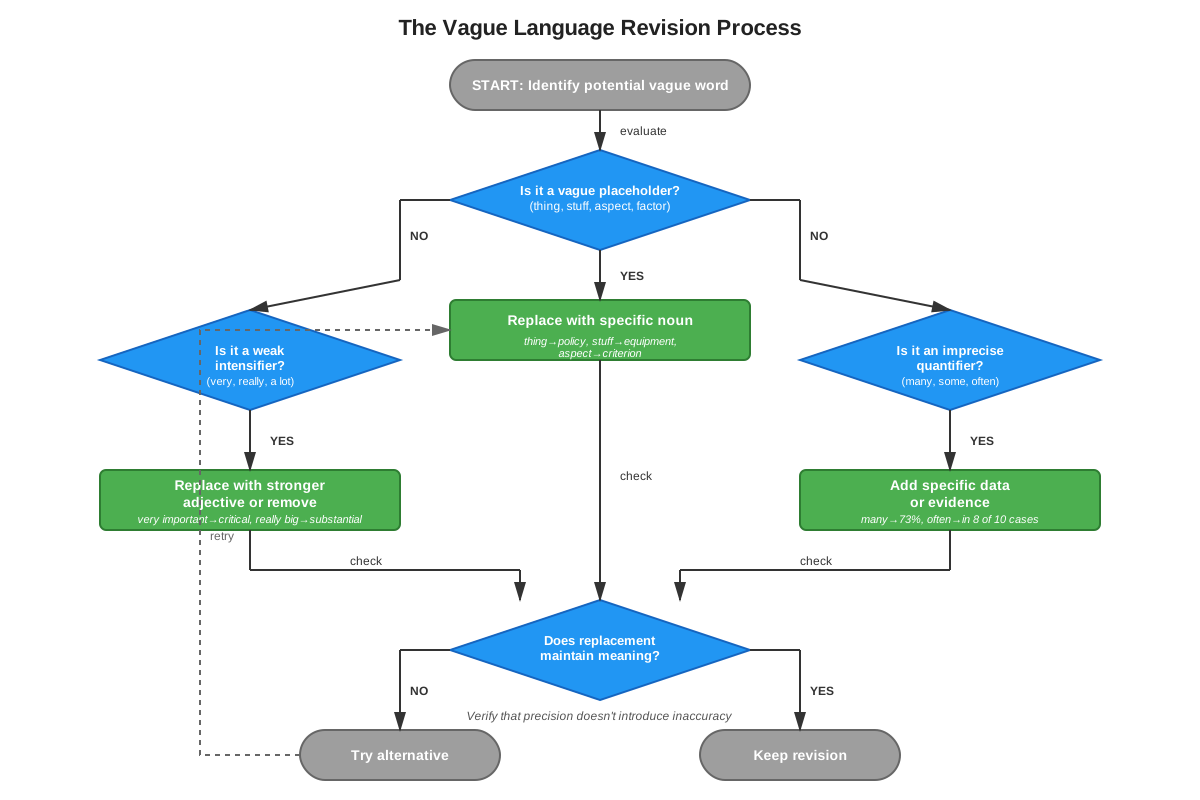
When you identify vague language but struggle to find a precise alternative quickly, use this decision tree:
- Can I quantify this? (Use numbers or comparative terms)
- Can I provide a specific example? (Name a particular instance)
- Can I categorize this more narrowly? (Replace "things" with the specific type)
- Can I delete this entirely? (Some vague intensifiers add nothing)
- If none of the above work quickly, move on—don't sacrifice time for marginal improvements
Time allocation advice:
Reserve at least 5 minutes for revision focused specifically on language precision. This investment typically yields higher returns than spending those same 5 minutes generating additional content, because precision improves multiple scoring dimensions simultaneously. Set a mental alarm at the 22-minute mark to begin your systematic vague-language scan.
Exam Tip: The e-rater algorithm weights vocabulary diversity and precision heavily. Replacing just 5-7 vague terms with precise alternatives can shift your score from a 4.0 to a 4.5 or from a 4.5 to a 5.0.
Memory Techniques
The SPECIFIC Mnemonic for remembering categories of vague language to avoid:
- Stuff and things (generic nouns)
- Pretty, quite, rather (weak intensifiers)
- Elements, aspects, factors (vague abstract nouns)
- Could, might, maybe (when overused as hedges)
- Important, interesting, significant (vague adjectives)
- Few, many, several (vague quantifiers)
- In today's society (temporal cliches)
- Come, go, get, make, do (unclear verbs)
Visualization Strategy: Picture a fog when you encounter vague language—it obscures meaning just as fog obscures vision. When revising, imagine "clearing the fog" by replacing each vague term with a precise one. This mental image helps maintain focus on clarity during timed writing.
The Three-Question Precision Test: Before finalizing any sentence, mentally ask:
- What exactly? (Replace generic nouns with specific categories)
- How many? (Replace vague quantifiers with numbers or comparisons)
- Which one? (Add specific examples or proper nouns)
If you can't answer at least one of these questions for each sentence, it likely contains vague language.
The Replacement Habit: Create mental pairs of vague-to-precise alternatives that you can deploy automatically:
- "things" → "factors/policies/technologies/challenges" (context-dependent)
- "a lot" → "numerous/substantial/significant/considerable"
- "very good" → "excellent/exceptional/outstanding/superior"
- "very bad" → "detrimental/harmful/problematic/disastrous"
- "many people" → "researchers/critics/economists/citizens" (specify the group)
Practicing these automatic replacements during preparation makes them accessible under time pressure.
Summary
Avoiding vague language represents one of the highest-yield skills for improving GRE Analytical Writing scores because it simultaneously strengthens argument development, demonstrates vocabulary range, and signals analytical sophistication. Vague language—including generic nouns like "things," weak intensifiers like "very," imprecise quantifiers like "many," and unclear verbs like "make"—forces readers to guess at meaning rather than communicating ideas directly. The GRE scoring rubric explicitly rewards precision, with essays scoring 5-6 consistently using specific examples and precise terminology while lower-scoring essays rely on vague generalities. Effective strategies for achieving precision include replacing generic nouns with specific categories, quantifying claims with numbers or comparative terms, providing concrete examples, choosing descriptive verbs, and eliminating weak intensifiers in favor of inherently precise adjectives. During the exam, writers should implement a two-pass approach: drafting with awareness of obvious vague terms, then systematically revising during the final 5-8 minutes to eliminate remaining imprecision. The e-rater algorithm specifically flags vague language as an indicator of lower writing quality, making this skill essential for both human and computer scoring.
Key Takeaways
- Vague language undermines credibility and weakens arguments by forcing readers to guess at intended meaning rather than communicating ideas directly
- The five most common categories of vague language are generic nouns, weak intensifiers, imprecise quantifiers, vague adjectives, and unclear verbs
- Quantification is the fastest precision technique: replacing "many" with "approximately 40%" or "nearly half" immediately clarifies meaning
- Reserve 5-8 minutes for systematic revision focused on identifying and replacing vague terms, prioritizing generic nouns and vague quantifiers first
- Specific examples and proper nouns (names of people, places, organizations, events) instantly increase perceived precision and demonstrate analytical depth
- Precision calibrates to context: aim for functional precision that clearly conveys meaning without overwhelming readers with unnecessary detail
- Replacing 5-7 instances of vague language in a single essay can improve scores by half a point or more by affecting multiple scoring criteria simultaneously
Related Topics
Concision and Wordiness: After mastering precision, learn to express precise ideas efficiently by eliminating redundancy and unnecessary words. Precision without concision can lead to verbose writing, while concision without precision produces unclear brevity.
Vocabulary Development for GRE Writing: Building a robust vocabulary of precise terms provides the raw material needed to avoid vague language. Focus on learning synonyms with subtle distinctions in meaning rather than simple word lists.
Logical Reasoning and Argument Structure: Precise language serves strong arguments, but strong arguments require sound logical reasoning. Understanding logical fallacies and argument construction ensures that precise language conveys valid reasoning.
Transitions and Coherence: Once individual sentences achieve precision, connecting them with specific, logical transitions (rather than vague connectors like "also") creates coherent, sophisticated essays.
Academic Tone and Formality: Avoiding vague language contributes to academic tone by eliminating colloquialisms and casual expressions, but additional elements like appropriate register and objective stance complete the professional voice expected in graduate-level writing.
Practice CTA
Now that you understand the principles and strategies for avoiding vague language, it's time to apply this knowledge through deliberate practice. Complete the practice questions to test your ability to identify vague language in sample passages and generate precise alternatives under time pressure. Use the flashcards to reinforce your memory of common vague terms and their precise replacements, building the automatic recognition skills you'll need during the actual exam. Remember: precision in language reflects precision in thinking, and mastering this skill will not only improve your GRE score but also enhance your effectiveness as a graduate student and professional. Every instance of vague language you eliminate makes your writing stronger, clearer, and more convincing—start practicing today to make precision your default writing mode.
Sign up free to keep reading
Create a free AnvayaPrep account to finish this GRE guide on Avoiding vague language — plus flashcards and practice questions.