Overview
Writing under time pressure is one of the most critical skills tested in the GRE Analytical Writing section. Unlike traditional academic writing where students may have days or weeks to refine their work, the GRE requires test-takers to produce coherent, well-structured essays in exactly 30 minutes per task. This constraint fundamentally changes the writing process, demanding a strategic approach that balances quality with efficiency.
The ability to write effectively under time constraints is essential for GRE success because it directly impacts both the Issue and Argument tasks. Test-takers must quickly analyze prompts, generate ideas, organize thoughts, compose clear prose, and review their work—all within a strictly limited timeframe. This skill separates high-scoring candidates from those who struggle, as even brilliant ideas poorly executed due to time mismanagement will receive lower scores. The ETS scoring rubric explicitly evaluates how well writers can develop and support their positions within the given constraints.
GRE writing under time pressure connects to virtually every aspect of Analytical Writing style. Effective time management enables proper essay structure, clear argumentation, varied sentence construction, and appropriate vocabulary use. Without mastering this foundational skill, test-takers cannot fully demonstrate their analytical and compositional abilities, regardless of their underlying writing talent. This topic serves as the framework within which all other Analytical Writing strategies must operate.
Learning Objectives
- [ ] Identify when Writing under time pressure is being tested
- [ ] Explain the core rule or strategy behind Writing under time pressure
- [ ] Apply Writing under time pressure to GRE-style questions accurately
- [ ] Develop a personalized time allocation strategy for the 30-minute writing window
- [ ] Execute pre-writing, drafting, and revision phases within strict time constraints
- [ ] Recognize and avoid common time-management pitfalls during the writing process
- [ ] Implement emergency strategies when running behind schedule
Prerequisites
- Basic essay structure: Understanding introductions, body paragraphs, and conclusions is essential because time-pressured writing requires quickly deploying these organizational elements
- Typing proficiency: Reasonable keyboard speed (30+ words per minute) is necessary because slow typing consumes valuable composition time
- Analytical reasoning skills: The ability to identify arguments, evidence, and logical relationships is required because time pressure demands rapid analysis
- Fundamental grammar and mechanics: Core writing conventions must be automatic because there's insufficient time to deliberate over basic rules
Why This Topic Matters
In professional and academic contexts, the ability to produce quality written work under deadlines is invaluable. Graduate programs require students to write timed essay exams, respond to time-sensitive research questions, and meet publication deadlines. Business professionals must draft reports, proposals, and communications within tight timeframes. The GRE's timed writing tasks simulate these real-world pressures, assessing whether candidates possess the composure and strategic thinking necessary for success in demanding environments.
On the GRE, writing under time pressure appears in 100% of Analytical Writing questions—it is not merely one topic among many but rather the fundamental condition under which all writing is evaluated. The Issue task and Argument task each provide exactly 30 minutes, with no flexibility or extensions. ETS research indicates that time management difficulties are among the primary reasons test-takers score below their potential, with many candidates failing to complete conclusions or rushing through critical analysis.
Common manifestations of time pressure challenges include incomplete essays (missing conclusions or underdeveloped body paragraphs), superficial analysis (failing to explore complexities due to rushing), organizational problems (poor structure resulting from inadequate planning), and mechanical errors (increased typos and grammatical mistakes from hurried composition). Recognizing these patterns helps test-takers proactively address time management before test day.
Core Concepts
The 30-Minute Framework
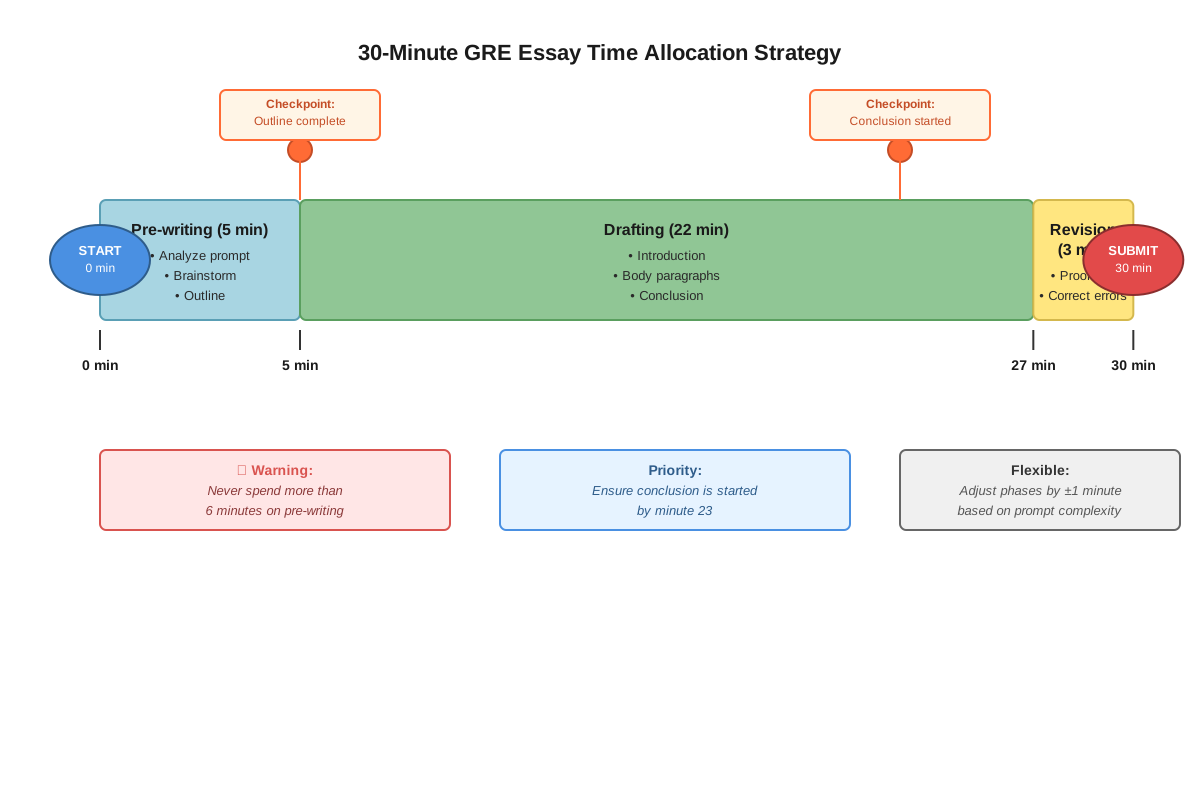
The GRE provides exactly 30 minutes for each Analytical Writing task, creating a rigid constraint that demands strategic time allocation. Successful test-takers divide this period into distinct phases rather than treating it as undifferentiated writing time. The standard framework allocates approximately:
- 5 minutes: Reading, analyzing, and planning
- 20 minutes: Drafting the essay
- 5 minutes: Reviewing and editing
This distribution ensures adequate attention to each critical phase while maintaining flexibility for individual writing styles. Some writers may prefer 4-6-20 or 6-18-6 splits, but the principle remains constant: deliberate time allocation prevents the common pitfall of spending too long on any single phase.
Pre-Writing Phase: Strategic Planning
The planning phase, though brief, dramatically impacts overall essay quality. During these initial 5 minutes, effective writers:
- Analyze the prompt thoroughly: Identify the specific task requirements, noting whether the prompt asks for evaluation, argumentation, or analysis
- Generate ideas rapidly: Brainstorm 3-5 main points without self-censoring or organizing
- Select the strongest arguments: Choose 2-3 points that can be developed most fully
- Create a structural outline: Sketch a basic roadmap with introduction, body paragraph topics, and conclusion
This investment prevents mid-essay confusion and writer's block. Test-takers who skip planning often produce disorganized essays that meander or repeat ideas, ultimately wasting more time than they saved.
Drafting Phase: Efficient Composition
The drafting phase constitutes the bulk of available time and requires disciplined execution. Key strategies include:
Writing linearly: Compose from introduction through conclusion in order, avoiding the temptation to jump between sections. This maintains logical flow and prevents orphaned paragraphs.
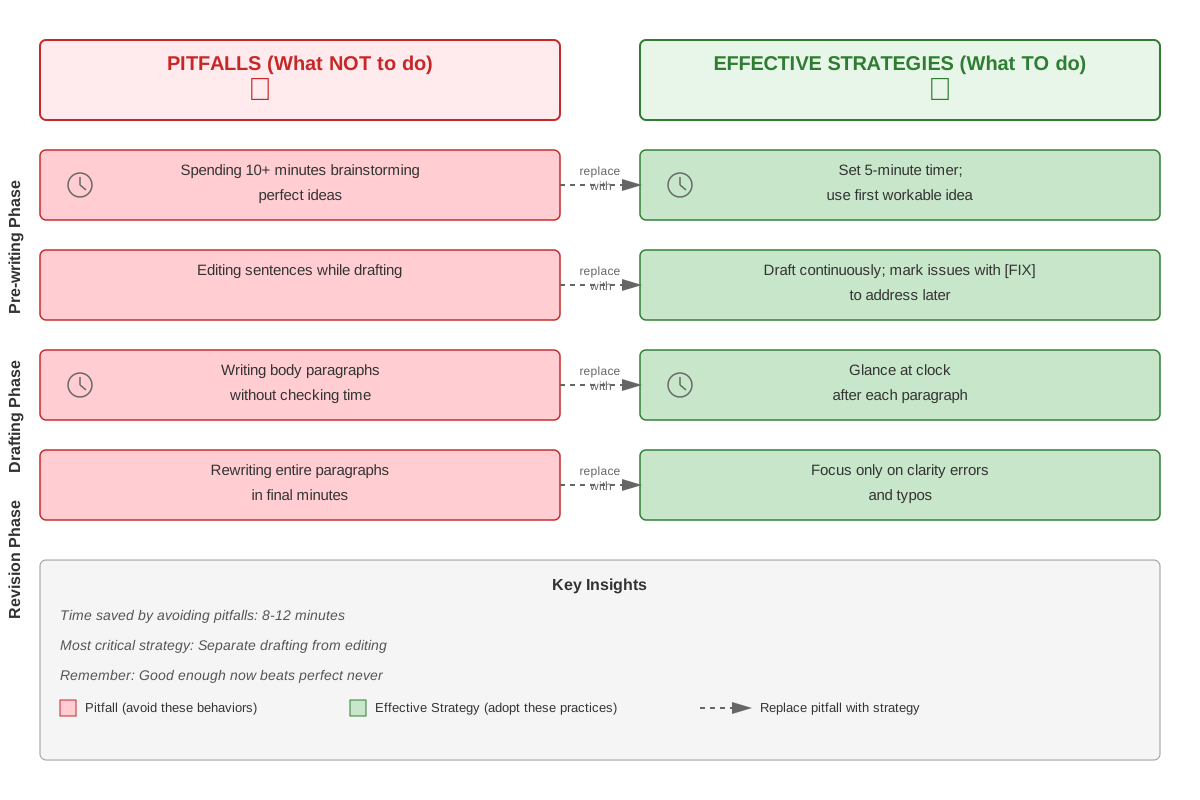
Accepting imperfection: Resist the urge to perfect each sentence before moving forward. The goal is producing a complete draft, not polished prose. Minor awkwardness can be addressed during revision.
Maintaining momentum: If stuck on a particular point, insert a brief placeholder (e.g., "[example here]") and continue writing. Returning later with fresh perspective often resolves the difficulty quickly.
Monitoring time: Glance at the timer every 5-7 minutes to ensure adequate progress. By minute 15, the introduction and first body paragraph should be complete; by minute 20, all body paragraphs should be drafted.
Revision Phase: Strategic Refinement
The final 5 minutes focus on high-impact improvements rather than comprehensive editing. Priorities include:
- Completeness check: Ensure the essay has a clear introduction, developed body paragraphs, and a conclusion
- Clarity review: Identify and revise confusing sentences or unclear transitions
- Error correction: Fix obvious typos, grammatical errors, and spelling mistakes
- Strengthening the conclusion: Add final thoughts or reinforce the thesis if time permits
This phase is not about perfection but about elevating the essay from good to strong. Test-takers should focus on changes that improve overall coherence and readability rather than minor stylistic tweaks.
Cognitive Load Management
Writing under time pressure creates significant cognitive demands, requiring simultaneous attention to content generation, organization, language production, and time monitoring. Effective writers reduce this load through:
Automaticity: Practicing until structural elements (thesis statements, topic sentences, transitions) become automatic, freeing mental resources for analysis and argumentation
Chunking: Treating each paragraph as a discrete unit with its own mini-goal, making the overall task feel more manageable
External memory aids: Using the outline as an external reference point, reducing the need to hold the entire essay structure in working memory
Adaptive Strategies for Time Shortfalls
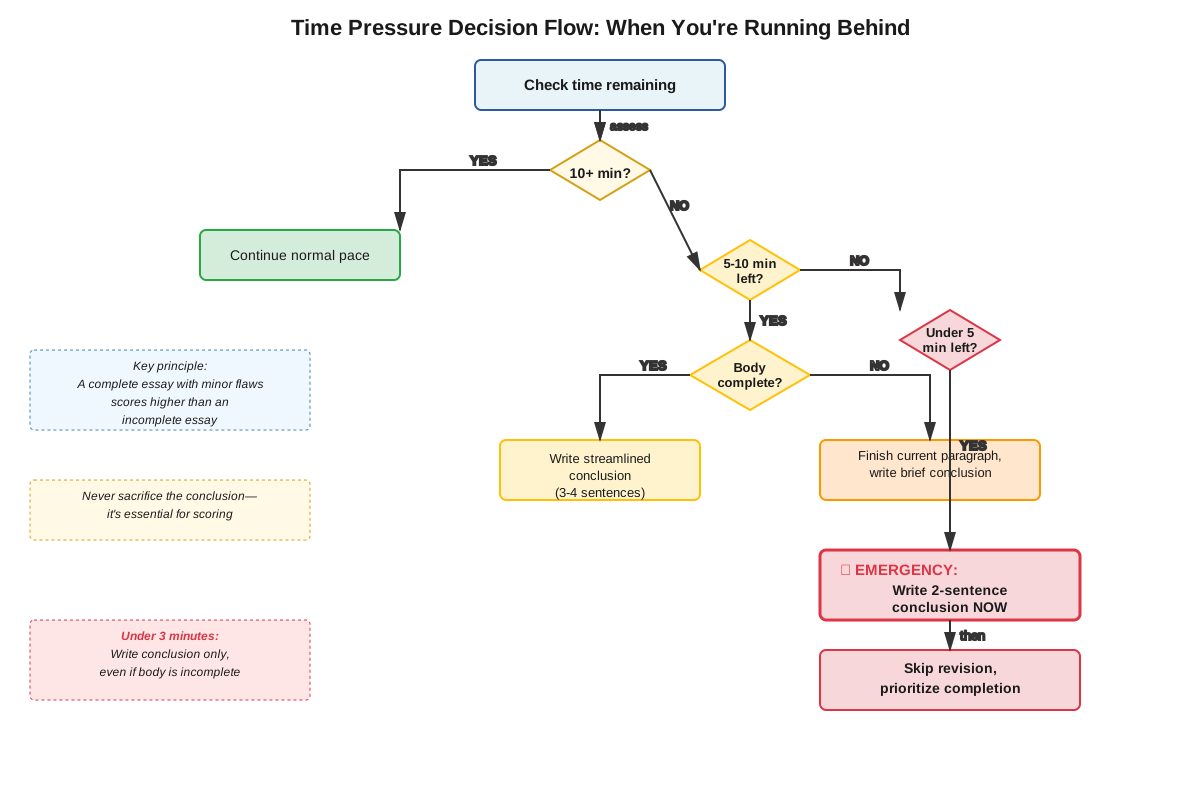
Even with careful planning, test-takers may find themselves behind schedule. Emergency strategies include:
| Time Remaining | Situation | Strategy |
|---|---|---|
| 5 minutes | One body paragraph incomplete | Write a strong topic sentence and 2-3 supporting sentences; skip detailed examples |
| 3 minutes | No conclusion written | Compose 2-3 sentences restating the thesis and main points |
| 1 minute | Multiple sections incomplete | Write a one-sentence conclusion; accept the incomplete essay |
These contingencies prevent panic and ensure test-takers produce the best possible essay given the circumstances.
Concept Relationships
The concepts within writing under time pressure form an interconnected system where each phase enables the next. Strategic planning → creates the foundation for → efficient drafting → which produces material for → targeted revision. Cognitive load management supports all three phases by reducing mental strain and maintaining focus.
This topic connects to prerequisite knowledge in several ways. Basic essay structure provides the template that time-pressured planning adapts; typing proficiency determines how much content can be produced during the drafting phase; analytical reasoning skills accelerate the planning phase by enabling rapid prompt analysis.
The relationship map flows as follows:
Time allocation strategy → Pre-writing phase → Outline creation → Drafting phase → Complete draft → Revision phase → Polished essay
With Cognitive load management supporting all phases and Adaptive strategies serving as backup plans when the primary sequence encounters obstacles.
High-Yield Facts
⭐ The GRE provides exactly 30 minutes per Analytical Writing task with no extensions or flexibility
⭐ Effective time allocation typically follows a 5-20-5 pattern: planning, drafting, and revision
⭐ Skipping the planning phase usually results in disorganized essays that waste more time than they save
⭐ A complete essay with minor flaws scores higher than an incomplete essay with perfect prose
⭐ The revision phase should prioritize completeness, clarity, and obvious errors over stylistic perfection
- Writing linearly from introduction to conclusion maintains logical flow and prevents structural problems
- Monitoring time every 5-7 minutes during drafting ensures adequate progress toward completion
- Accepting imperfection during the drafting phase preserves momentum and prevents perfectionism paralysis
- Cognitive load management through automaticity and chunking reduces mental strain during timed writing
- Emergency strategies for time shortfalls should focus on producing a complete essay rather than perfect sections
- Practicing timed writing builds both speed and the ability to estimate time requirements accurately
Quick check — test yourself on Writing under time pressure so far.
Try Flashcards →Common Misconceptions
Misconception: More planning time always produces better essays → Correction: Excessive planning (beyond 6-7 minutes) reduces drafting time and often results in incomplete essays. The optimal planning phase is brief but focused, generating just enough structure to guide efficient drafting.
Misconception: Good writers don't need to outline under time pressure → Correction: Even experienced writers benefit from brief outlines during timed tasks. The outline serves as an external memory aid and prevents mid-essay confusion about what to write next, actually saving time overall.
Misconception: Revision should focus on improving vocabulary and sentence variety → Correction: During the 5-minute revision window, priority must go to completeness, clarity, and obvious errors. Stylistic improvements are valuable only after ensuring the essay is complete and comprehensible.
Misconception: Typing speed is the primary determinant of success in timed writing → Correction: While adequate typing proficiency is necessary, strategic time management and efficient planning matter more. A slower typist with excellent organization outperforms a fast typist who writes without direction.
Misconception: Running out of time means the essay will receive a failing score → Correction: An incomplete essay can still score in the mid-range (3-4 out of 6) if the completed portions demonstrate strong analysis and writing quality. The key is maximizing the quality of what is written rather than panicking.
Misconception: Experienced writers can skip the revision phase to allow more drafting time → Correction: Even strong writers produce typos and unclear sentences under time pressure. The revision phase catches errors that would otherwise lower the score and ensures the essay presents ideas as clearly as possible.
Worked Examples
Example 1: Issue Task Time Management
Prompt: "The best way to teach is to praise positive actions and ignore negative ones."
Time: 0:00-0:05 (Planning Phase)
Minute 0-2: Prompt Analysis
- Task: Take a position on this teaching philosophy claim
- Key terms: "best way," "praise positive actions," "ignore negative ones"
- Initial reaction: Too absolute; ignoring negative actions seems problematic
Minute 2-4: Idea Generation
- Positive reinforcement can be effective
- Ignoring negative behavior may allow problems to escalate
- Different contexts require different approaches (young children vs. adults)
- Safety issues cannot be ignored
- Balance between positive and negative feedback matters
Minute 4-5: Outline Creation
- Thesis: While positive reinforcement is valuable, completely ignoring negative actions is neither practical nor effective; the best teaching balances both approaches
- Body 1: Benefits of positive reinforcement (motivation, confidence)
- Body 2: Dangers of ignoring negative actions (safety, missed learning opportunities)
- Body 3: Context-dependent approach (age, subject matter, severity)
- Conclusion: Restate nuanced position
Time: 0:05-0:25 (Drafting Phase)
Minute 5-8: Introduction
Write thesis and brief context (3-4 sentences establishing the debate)
Minute 8-14: Body Paragraph 1
Topic sentence about positive reinforcement benefits, 2 examples (classroom motivation, sports coaching), explanation of psychological mechanisms
Minute 14-20: Body Paragraph 2
Topic sentence about problems with ignoring negative actions, examples (safety violations, academic dishonesty), consequences of inaction
Minute 20-24: Body Paragraph 3
Topic sentence about context-dependence, examples showing when each approach works best
Minute 24-25: Conclusion
Brief restatement of thesis and main points (2-3 sentences)
Time: 0:25-0:30 (Revision Phase)
Minute 25-27: Completeness and clarity check
- Verify all paragraphs have topic sentences
- Check that examples clearly support points
- Ensure transitions connect ideas
Minute 27-30: Error correction
- Fix obvious typos
- Correct any subject-verb agreement errors
- Verify conclusion restates thesis
Result: Complete essay with clear structure, developed arguments, and minimal errors—likely score of 4-5.
Example 2: Recovering from Time Pressure
Situation: Test-taker realizes at minute 22 that only the introduction and one body paragraph are complete, with two more body paragraphs and a conclusion still needed.
Emergency Strategy Execution:
Minute 22-23: Rapid assessment
- Accept that the original three-body-paragraph plan is no longer feasible
- Decide to write one strong additional body paragraph instead of two weak ones
- Plan a brief but complete conclusion
Minute 23-27: Focused drafting
- Write second body paragraph with clear topic sentence and 3-4 supporting sentences
- Include one concrete example rather than multiple examples
- Ensure the paragraph directly supports the thesis
Minute 27-29: Conclusion
- Write 2-3 sentences restating the thesis and summarizing the two main points covered
- Add one sentence about broader implications if time permits
Minute 29-30: Quick review
- Scan for obvious typos in the most recently written sections
- Verify the conclusion connects back to the introduction
Result: Two-body-paragraph essay that is complete and coherent, likely scoring 3-4 rather than the 2-3 an incomplete essay would receive. The strategic decision to prioritize completeness over the original plan salvaged a difficult situation.
Exam Strategy
When approaching GRE Analytical Writing tasks, implement these time-pressure strategies:
Before starting: Take 10-15 seconds to acknowledge the time constraint and commit to the time allocation plan. This brief mental preparation reduces anxiety and activates strategic thinking.
Trigger words for time checks: Set mental markers at "halfway" (15 minutes) and "final phase" (25 minutes). At 15 minutes, verify that the introduction and at least one complete body paragraph exist. At 25 minutes, begin the revision phase regardless of drafting status.
Process-of-elimination for planning: When generating ideas, quickly eliminate points that would require extensive explanation or examples you cannot readily produce. Choose arguments that can be developed efficiently with accessible examples.
Time allocation adjustments: If naturally fast at planning but slower at drafting, consider a 4-21-5 split. If revision is particularly important for catching errors, try 5-19-6. The key is self-awareness about personal writing patterns.
Exam Tip: The GRE word processor includes a timer that counts down from 30:00. Use this actively rather than ignoring it. Glancing at the timer every few minutes prevents the common mistake of losing track of time until it's too late.
Paragraph-level time budgeting: Allocate approximately 5-6 minutes per body paragraph during drafting. If a paragraph is taking longer, either simplify the point or move on and return if time permits.
Strategic incompleteness: If forced to choose between a complete essay with simpler analysis or an incomplete essay with sophisticated analysis, always choose completeness. Scorers cannot evaluate arguments that were never written.
Memory Techniques
5-20-5 Mnemonic: "Plan Draft Revise" = "Perfect Discipline Rewards" to remember the three phases and their approximate time allocations.
PACE acronym for drafting phase:
- Progress over perfection
- Accept imperfection
- Continuous forward movement
- Evaluate time regularly
Visualization strategy: Picture the 30-minute period as a three-room house. Spend time in the Planning Room (small but essential), move to the Drafting Room (largest space where most work happens), and finish in the Revision Room (quick final touches). This spatial metaphor helps maintain awareness of which phase is current.
The "Complete > Perfect" mantra: Repeat this phrase when tempted to over-revise during drafting or spend too long on a single sentence. A complete essay with minor flaws always outscores an incomplete essay with perfect prose.
Finger-tap time check: Associate checking the timer with a physical gesture (tapping the desk twice). This creates a habit loop that makes time monitoring automatic rather than requiring conscious effort.
Summary
Writing under time pressure is the foundational skill for GRE Analytical Writing success, requiring test-takers to produce complete, coherent essays in exactly 30 minutes per task. Effective time management follows a strategic framework: 5 minutes for planning (analyzing the prompt, generating ideas, and creating an outline), 20 minutes for drafting (composing linearly while accepting imperfection and maintaining momentum), and 5 minutes for revision (ensuring completeness, improving clarity, and correcting obvious errors). Success depends on cognitive load management through automaticity and chunking, regular time monitoring to ensure adequate progress, and adaptive strategies for recovering when behind schedule. The cardinal rule is that completeness trumps perfection—a finished essay with minor flaws scores significantly higher than an incomplete essay with polished sections. Mastery requires practice under timed conditions to build both speed and the ability to accurately estimate time requirements for each phase.
Key Takeaways
- The GRE provides exactly 30 minutes per writing task, making time management essential for demonstrating analytical and compositional abilities
- Effective time allocation typically follows a 5-20-5 pattern: planning, drafting, and revision phases
- Strategic planning (5 minutes) prevents disorganization and writer's block, ultimately saving time during drafting
- Drafting requires accepting imperfection, writing linearly, and maintaining momentum rather than perfecting each sentence
- Revision should prioritize completeness, clarity, and obvious errors over stylistic improvements
- A complete essay with minor flaws always scores higher than an incomplete essay with perfect prose
- Regular time monitoring (every 5-7 minutes) and adaptive strategies prevent time-pressure disasters
Related Topics
Essay Structure and Organization: Mastering time-pressured writing enables effective deployment of structural elements (introductions, body paragraphs, conclusions) within strict constraints. Strong organizational skills make the drafting phase more efficient.
Argument Analysis Techniques: Time management skills allow adequate attention to identifying assumptions, evaluating evidence, and developing counterarguments in the Argument task without rushing through critical analysis.
Vocabulary and Word Choice: Efficient time management creates space during revision to improve word choice and vary sentence structure, elevating essay quality beyond basic competence.
Issue Task Strategies: Understanding time pressure helps test-takers balance depth of analysis with breadth of coverage when developing positions on Issue prompts.
Practice CTA
Now that you understand the strategies for writing under time pressure, it's time to put these concepts into practice. Attempt the practice questions and flashcards to reinforce your time management skills and build the automaticity necessary for test-day success. Remember: time-pressured writing is a skill that improves dramatically with deliberate practice. Each timed essay you write strengthens your ability to plan efficiently, draft confidently, and revise strategically. Your investment in mastering this foundational skill will pay dividends across both Analytical Writing tasks and contribute significantly to your overall GRE score.
Sign up free to keep reading
Create a free AnvayaPrep account to finish this GRE guide on Writing under time pressure — plus flashcards and practice questions.