Overview
The revision strategy is a critical component of achieving a high score on the GRE Analytical Writing section. While many test-takers focus exclusively on generating ideas and drafting their essays, the ability to systematically revise and refine written work separates average scores from exceptional ones. Revision is not merely proofreading for typos; it encompasses a comprehensive approach to evaluating and improving argument structure, clarity of expression, logical coherence, and stylistic sophistication. On the GRE, where time constraints are severe and essays must demonstrate analytical depth within 30 minutes, having a structured revision approach becomes essential.
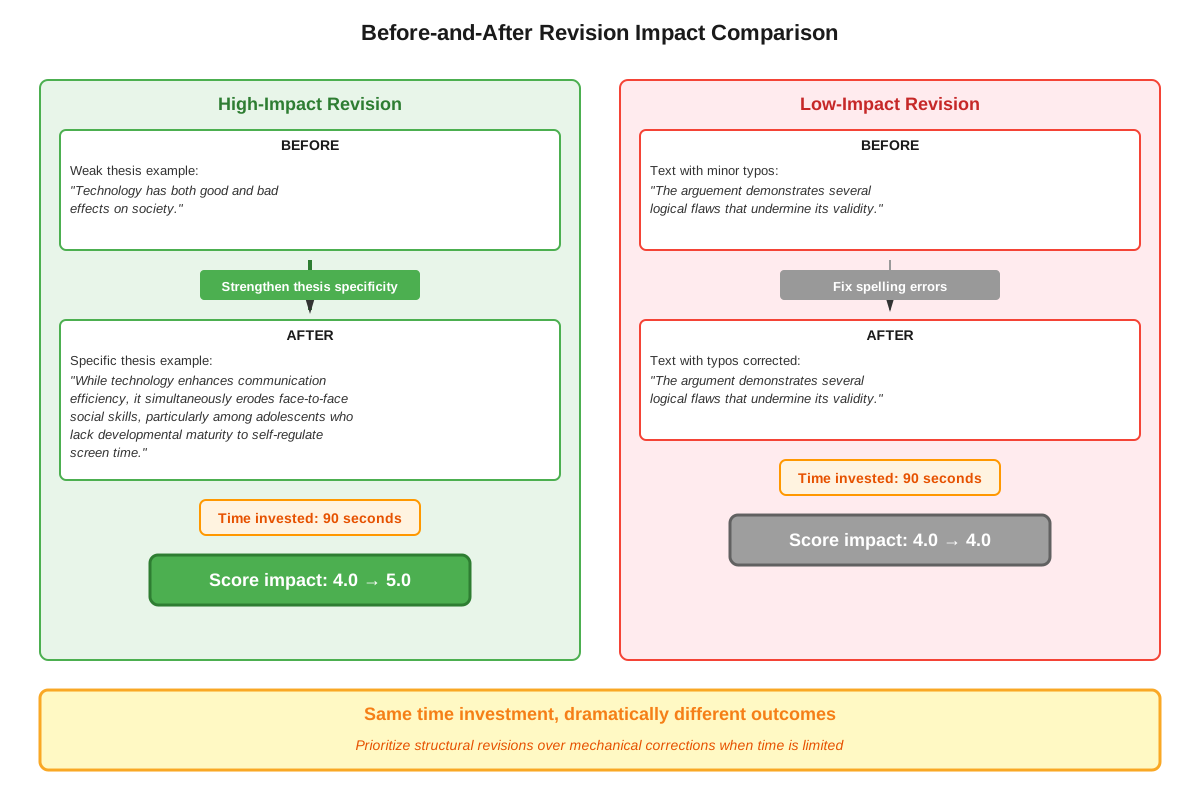
The GRE revision strategy specifically addresses the unique demands of timed analytical writing. Unlike academic writing where multiple drafts over days or weeks are possible, GRE essays require rapid yet effective revision within the final 3-5 minutes of each task. This compressed timeline demands that test-takers develop automatic revision protocols that quickly identify and correct the most impactful issues. Effective revision on the GRE focuses on high-yield improvements: strengthening thesis statements, ensuring logical transitions between paragraphs, eliminating ambiguous pronoun references, and verifying that examples directly support claims. These targeted improvements can elevate an essay from a score of 4.0 to 5.0 or higher.
Within the broader context of Analytical Writing Style, revision strategy represents the final quality control stage that integrates all other stylistic elements. It builds upon foundational skills like sentence variety, precise word choice, and coherent paragraph structure, serving as the mechanism through which these elements are refined and polished. Revision strategy also connects directly to time management, critical thinking, and self-editing skills—competencies that extend beyond the GRE into graduate-level academic work and professional communication.
Learning Objectives
- [ ] Identify when Revision strategy is being tested
- [ ] Explain the core rule or strategy behind Revision strategy
- [ ] Apply Revision strategy to GRE-style questions accurately
- [ ] Develop a systematic 3-5 minute revision protocol for timed essay conditions
- [ ] Distinguish between high-impact and low-impact revision priorities under time pressure
- [ ] Evaluate sample essays to identify specific revision opportunities that would improve scores
- [ ] Implement multi-level revision techniques addressing structure, logic, clarity, and mechanics
Prerequisites
- Basic essay structure: Understanding of introduction, body paragraphs, and conclusion organization is essential because revision strategy requires evaluating whether these components function effectively together
- Thesis statement construction: Familiarity with crafting clear, arguable thesis statements is necessary because revision often involves strengthening or clarifying the central claim
- Paragraph coherence principles: Knowledge of topic sentences, supporting evidence, and transitions is required because revision assesses whether paragraphs achieve their intended purpose
- Sentence-level grammar: Competence in identifying common grammatical errors enables efficient mechanical revision without consuming excessive time
- GRE essay task requirements: Understanding the specific demands of Issue and Argument tasks ensures revision efforts align with scoring criteria
Why This Topic Matters
Revision strategy directly impacts GRE Analytical Writing scores in measurable ways. According to ETS scoring guidelines, essays at the 5.0-6.0 level demonstrate "facility with language" and "control of the conventions of standard written English," qualities that are refined through effective revision. Research on GRE scoring patterns indicates that essays with clear organizational structure, minimal ambiguity, and precise language consistently score higher than those with comparable ideas but weaker execution—differences that revision addresses.
In real-world graduate education, the revision skills developed for the GRE translate directly to academic writing demands. Graduate students must produce research papers, literature reviews, and dissertations that undergo multiple revision cycles. The ability to self-edit efficiently, identify logical gaps, and refine arguments without external feedback becomes increasingly valuable in advanced academic contexts. Professional contexts similarly reward strong revision skills: grant proposals, technical reports, and policy briefs all require the ability to critically evaluate and improve one's own writing.
On the GRE specifically, revision strategy appears as an implicit requirement in every Analytical Writing task. While no question explicitly asks "revise this essay," the scoring rubric evaluates the final product's quality—a quality achievable only through effective revision. The Issue task, which asks test-takers to develop a position on a broad claim, requires revision to ensure that examples genuinely support the thesis and that counterarguments are addressed. The Argument task, which requires analyzing logical flaws in a given argument, demands revision to verify that the critique remains focused on reasoning rather than devolving into opinion. Approximately 100% of high-scoring essays demonstrate evidence of thoughtful revision in their final form.
Core Concepts
The Revision Hierarchy: Strategic Prioritization
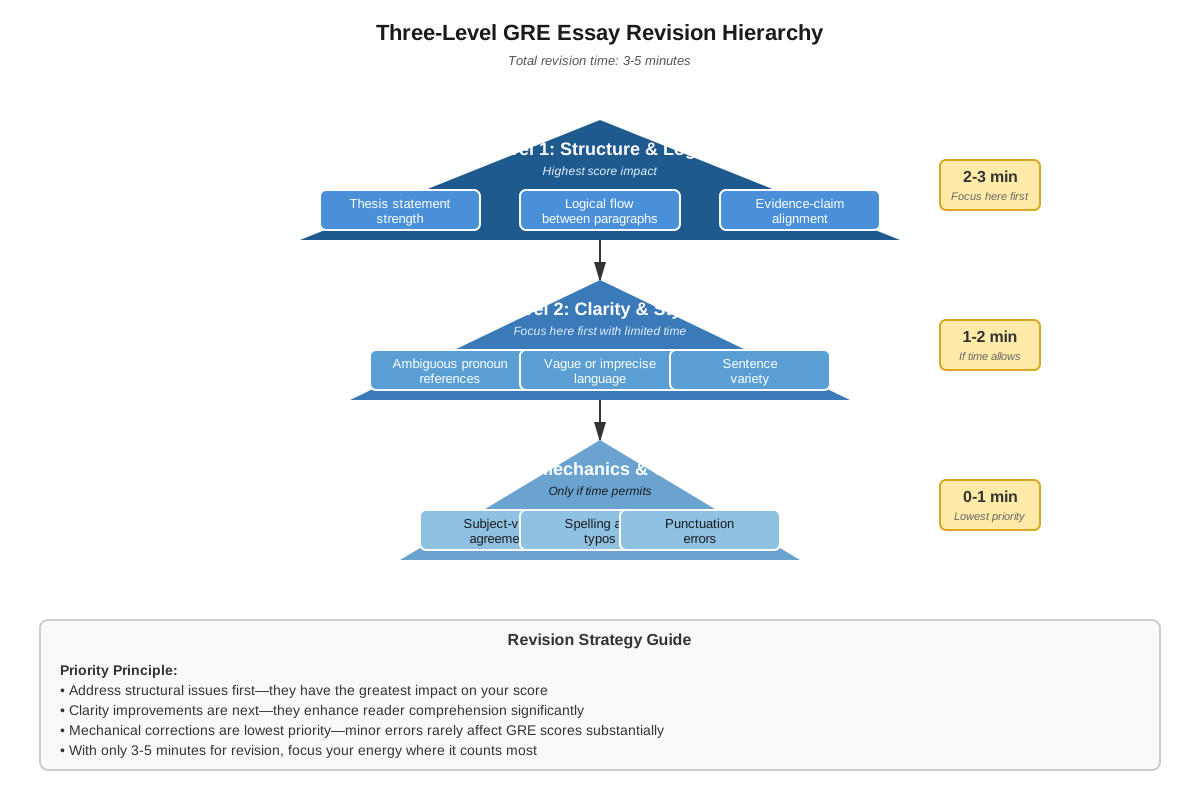
The foundation of effective revision strategy lies in understanding that not all revisions carry equal weight. Under GRE time constraints, test-takers must prioritize changes that most significantly impact scores. The revision hierarchy organizes potential improvements into four tiers:
Tier 1: Structural and Logical Issues (highest priority)
- Thesis clarity and positioning
- Paragraph organization and sequence
- Logical coherence between claims and evidence
- Completeness of argument (addressing the prompt fully)
Tier 2: Clarity and Precision Issues (high priority)
- Ambiguous pronoun references
- Vague or imprecise language
- Unclear transitions between ideas
- Sentence-level logical connections
Tier 3: Stylistic Refinements (medium priority)
- Sentence variety and sophistication
- Word choice elevation
- Elimination of redundancy
- Tone consistency
Tier 4: Mechanical Corrections (lower priority)
- Spelling errors
- Minor punctuation issues
- Formatting inconsistencies
This hierarchy reflects GRE scoring priorities: essays with strong arguments but minor typos score higher than essays with perfect grammar but weak reasoning. Effective revision allocates the limited available time accordingly, addressing Tier 1 issues first and moving to lower tiers only if time permits.
The Three-Pass Revision Method
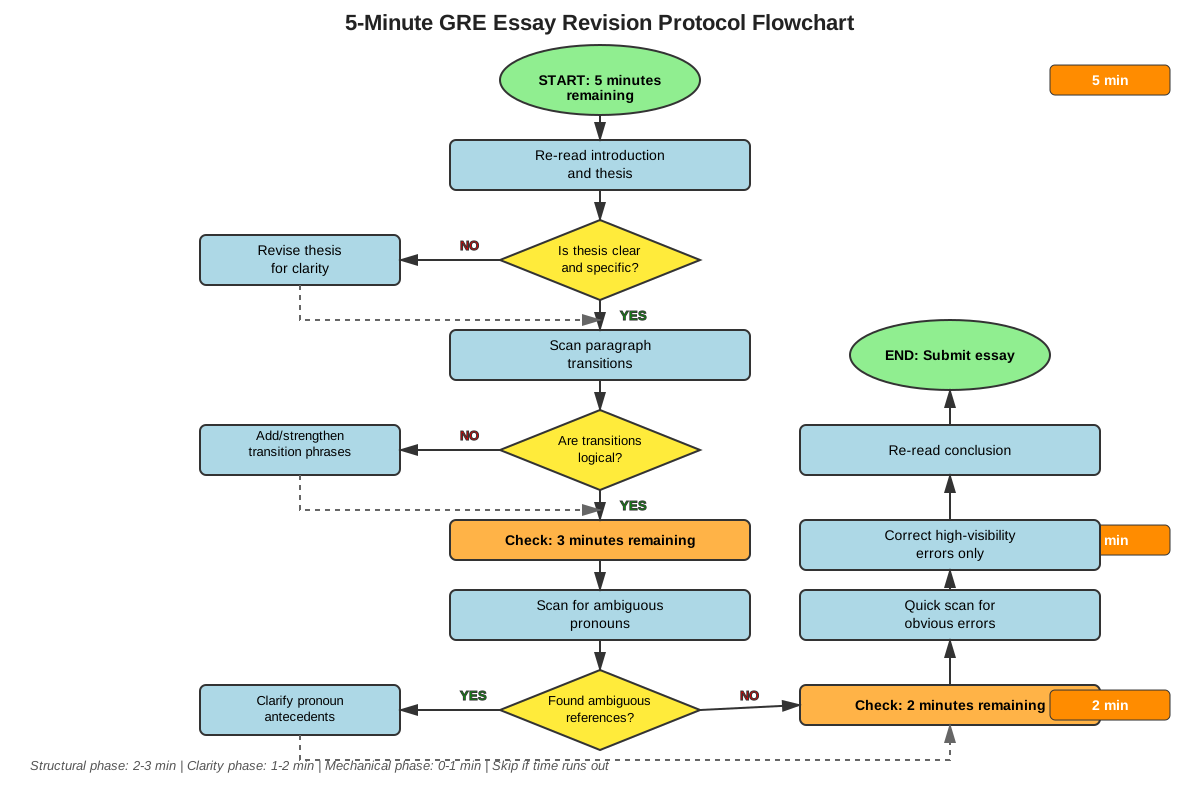
The GRE revision strategy employs a systematic three-pass approach, with each pass targeting specific elements:
Pass 1: Macro-Level Structure (60-90 seconds)
Read the entire essay quickly to assess:
- Does the introduction clearly state the thesis?
- Does each body paragraph have a clear purpose that advances the thesis?
- Does the conclusion synthesize the argument without merely repeating the introduction?
- Are there any missing logical steps or unsupported claims?
During this pass, identify any paragraphs that need reordering, any major gaps in reasoning, or any instances where the essay drifts from the prompt. Make structural notes in margins if using paper, or use brief bracketed comments if typing.
Pass 2: Paragraph-Level Coherence (90-120 seconds)
Examine each paragraph individually:
- Does the topic sentence clearly introduce the paragraph's main idea?
- Do all sentences within the paragraph relate to that main idea?
- Are transitions between sentences smooth and logical?
- Does the paragraph's evidence or examples directly support the thesis?
- Are there any ambiguous pronouns (it, this, they) that lack clear antecedents?
This pass focuses on ensuring that readers can follow the argument without confusion. Look particularly for sentences that seem disconnected from surrounding content or examples that don't clearly illustrate the intended point.
Pass 3: Sentence-Level Precision (60-90 seconds)
Review individual sentences for clarity and correctness:
- Are there any grammatically incomplete sentences?
- Can any wordy constructions be tightened?
- Are there any obviously misspelled words (especially in the thesis or topic sentences)?
- Do subjects and verbs agree?
- Are there any unintentional sentence fragments or run-ons?
This final pass catches the most visible errors while refining expression. Focus on sentences in prominent positions (thesis statement, topic sentences, conclusion) where errors are most noticeable to graders.
Diagnostic Reading Techniques
Effective revision requires reading one's own work with fresh perspective—a challenging task immediately after drafting. Several techniques help achieve this critical distance:
The Reverse-Order Technique: Read paragraphs in reverse sequence (conclusion first, then final body paragraph, etc.). This disrupts the mental narrative created during drafting, making logical gaps and unclear references more apparent.
The Question Method: After each paragraph, ask "So what?" and "How does this support my thesis?" If the answer isn't immediately clear, the paragraph needs revision for relevance or clarity.
The Outsider Perspective: Read as if encountering the essay for the first time, without access to the thoughts that occurred during drafting. Any sentence that requires "insider knowledge" to understand needs clarification.
The Pronoun Audit: Circle every pronoun (it, this, that, they, these, those) and verify that its antecedent is unambiguous. Ambiguous pronouns are among the most common clarity issues in GRE essays.
Common Revision Targets in GRE Essays
Certain issues appear frequently in GRE essays and should be priority targets during revision:
| Issue Type | Example Problem | Revision Solution |
|---|---|---|
| Weak thesis | "There are many perspectives on this issue." | "While economic growth provides measurable benefits, prioritizing environmental sustainability yields greater long-term societal value." |
| Vague transitions | "Also, another point is..." | "Beyond economic considerations, social factors further support this position." |
| Unsupported claims | "Everyone knows that technology improves education." | "Studies by the Educational Testing Service demonstrate that adaptive learning technologies improve student outcomes by an average of 15%." |
| Ambiguous pronouns | "The government and corporations must work together. They should prioritize transparency." | "The government and corporations must work together. Both entities should prioritize transparency." |
| Paragraph drift | A paragraph beginning with education that ends discussing healthcare | Refocus the paragraph on education or split into two distinct paragraphs |
| Conclusion repetition | Restating the introduction verbatim | Synthesize how the body paragraphs collectively support the thesis |
Time-Efficient Revision Tactics
Given the severe time constraints, certain tactical approaches maximize revision efficiency:
The Critical Sentence Focus: If time is extremely limited (under 3 minutes), revise only the thesis statement, each topic sentence, and the concluding sentence. These sentences carry disproportionate weight in graders' assessments.
The Deletion Strategy: Removing problematic content is often faster and more effective than attempting to fix it. If a sentence or example doesn't clearly support the argument, delete it rather than spending precious seconds trying to salvage it.
The Substitution Method: Keep a mental list of stronger alternatives for common weak constructions:
- Replace "very" + adjective with a single stronger adjective (very big → enormous)
- Replace "thing" or "stuff" with specific nouns
- Replace "good" or "bad" with precise evaluative terms (effective, detrimental, beneficial)
The Transition Upgrade: Quickly scan for weak transitions ("Also," "Another thing," "In addition") and upgrade to more sophisticated connectors ("Furthermore," "Conversely," "Consequently," "Building on this foundation").
Concept Relationships
The revision strategy concepts form an integrated system where each element supports the others. The revision hierarchy establishes priorities that guide the three-pass method, ensuring that limited time is allocated to high-impact improvements first. Within each pass, diagnostic reading techniques enable identification of issues, while common revision targets provide specific patterns to watch for. Time-efficient tactics then offer practical methods for implementing corrections quickly.
This topic connects to prerequisite knowledge in several ways: thesis statement construction skills determine what constitutes an effective thesis during revision; paragraph coherence principles provide the standards against which paragraphs are evaluated during Pass 2; sentence-level grammar knowledge enables rapid identification and correction of mechanical issues during Pass 3.
Revision strategy also relates forward to broader Analytical Writing competencies. Strong revision skills enhance argument development by ensuring that logical connections are explicit. They improve evidence integration by verifying that examples genuinely support claims. They refine stylistic sophistication by eliminating awkward constructions and elevating word choice.
The relationship map flows as follows:
Time Management → allocates revision time → Revision Hierarchy → prioritizes issues → Three-Pass Method → systematically addresses issues → Diagnostic Techniques → identify specific problems → Revision Targets → provide correction patterns → Time-Efficient Tactics → implement changes rapidly → Improved Essay Quality → increases GRE score
High-Yield Facts
⭐ The final 3-5 minutes of each GRE essay task should be reserved exclusively for revision, not continued drafting.
⭐ Structural and logical issues (Tier 1) have approximately 3-4 times the score impact of mechanical errors (Tier 4).
⭐ Ambiguous pronoun references are the single most common clarity issue in GRE essays and should be priority targets during revision.
⭐ The thesis statement, topic sentences, and conclusion carry disproportionate weight in scoring; if time is limited, revise these sentences first.
⭐ Deleting weak or irrelevant content is often more effective than attempting to fix it under time pressure.
- Reading paragraphs in reverse order helps identify logical gaps and unclear transitions that forward reading misses.
- Every example or piece of evidence should be followed by explicit analysis connecting it to the thesis; revision should verify these connections exist.
- Weak transitions like "also" and "another thing" signal opportunities for quick upgrades to more sophisticated connectors.
- The "So what?" test applied to each paragraph reveals whether the paragraph's relevance to the thesis is sufficiently clear.
- Graders spend approximately 2-3 minutes per essay; revision should focus on elements visible in a quick read (structure, topic sentences, clarity).
- Sentence variety is assessed holistically; revision should ensure that not all sentences follow the same subject-verb-object pattern.
- The conclusion should synthesize how body paragraphs collectively support the thesis, not merely restate the introduction.
Quick check — test yourself on Revision strategy so far.
Try Flashcards →Common Misconceptions
Misconception: Revision means proofreading for spelling and grammar errors.
Correction: While mechanical corrections are part of revision, the most impactful revisions address structural organization, logical coherence, and clarity of argument. Grammatically perfect essays with weak reasoning score lower than logically strong essays with minor typos.
Misconception: Effective revision requires reading the entire essay multiple times slowly and carefully.
Correction: Under GRE time constraints, effective revision uses targeted passes that each focus on specific elements (structure, coherence, mechanics). Three focused passes of 60-120 seconds each are more effective than one slow, comprehensive read.
Misconception: If there's no time for thorough revision, it's better to keep drafting new content.
Correction: Even 2-3 minutes of focused revision on the thesis and topic sentences yields greater score improvement than adding an additional body paragraph without time to integrate it properly. Quality of existing content outweighs quantity.
Misconception: Revision should make the essay longer by adding more examples and details.
Correction: Effective revision often makes essays shorter by removing tangential content, redundant phrases, and weak examples. Concise, focused essays score higher than longer essays with diluted arguments.
Misconception: The best revision strategy is to fix every error encountered in the order they appear.
Correction: Strategic revision follows the revision hierarchy, addressing high-impact structural and logical issues first, then moving to clarity, style, and finally mechanics. Fixing errors in order of appearance wastes time on low-impact changes while potentially missing critical structural problems.
Misconception: Revision is only necessary for weak writers; strong writers produce good first drafts.
Correction: All high-scoring GRE essays demonstrate evidence of revision. Even experienced writers benefit from systematic review to catch ambiguities, strengthen transitions, and ensure logical completeness. The difference is that skilled writers have internalized efficient revision protocols.
Misconception: Using sophisticated vocabulary during revision always improves the essay.
Correction: Substituting complex words for simple ones can backfire if the complex words are used imprecisely or create awkward constructions. Revision should prioritize clarity and precision over vocabulary sophistication; use advanced terms only when they express the intended meaning more accurately.
Worked Examples
Example 1: Revising an Issue Essay Introduction
Original Draft:
"The issue of whether success requires taking risks is complicated. Some people think you need to take risks to succeed, while others think you can succeed without taking risks. Both sides have good points. In this essay, I will discuss both perspectives and explain my view that taking risks is usually necessary for success."
Revision Process:
Pass 1 (Macro-Level): The introduction lacks a clear, arguable thesis. The phrase "usually necessary" is vague. The essay telegraphs a structure ("I will discuss both perspectives") rather than presenting a compelling argument.
Pass 2 (Paragraph-Level): The opening sentence is generic and could apply to almost any issue. The acknowledgment of "both sides" doesn't add value. The thesis needs to be more specific and assertive.
Pass 3 (Sentence-Level): "Complicated" is vague. "Good points" is imprecise. "Usually necessary" hedges unnecessarily.
Revised Version:
"Meaningful success—whether in entrepreneurship, scientific discovery, or social reform—requires calculated risk-taking. While incremental progress is possible through cautious approaches, breakthrough achievements consistently emerge from decisions that embrace uncertainty and potential failure. Although risk-taking does not guarantee success, the historical record demonstrates that individuals who avoid risk systematically limit their potential impact."
Improvements Made:
- Replaced vague opening with specific claim defining "meaningful success"
- Eliminated unnecessary acknowledgment of opposing view (can be addressed in body)
- Strengthened thesis from "usually necessary" to "requires," with nuance added through "calculated"
- Added specificity through examples (entrepreneurship, scientific discovery, social reform)
- Improved sophistication through parallel structure and precise vocabulary
- Maintained clear position while acknowledging complexity ("does not guarantee")
Example 2: Revising an Argument Essay Body Paragraph
Original Draft:
"The argument assumes that the new traffic light will reduce accidents. However, this might not be true. There could be other factors that cause accidents at that intersection. For example, maybe the road is poorly designed or drivers are distracted. The argument doesn't consider these possibilities. This makes the argument weak because it doesn't prove that the traffic light is the solution."
Revision Process:
Pass 1 (Macro-Level): The paragraph identifies a relevant flaw (assuming causation) but doesn't develop it sufficiently. The conclusion ("makes the argument weak") is vague.
Pass 2 (Paragraph-Level): The topic sentence is weak and doesn't clearly state the logical flaw. The examples are mentioned but not analyzed. The connection between alternative explanations and the argument's weakness needs strengthening. Transitions are basic ("However," "For example").
Pass 3 (Sentence-Level): "This might not be true" is imprecise. "Other factors" is vague. "Doesn't prove" mischaracterizes the issue (arguments provide evidence, not proof).
Revised Version:
"The argument commits a causal fallacy by assuming that installing a traffic light will necessarily reduce accidents without considering alternative explanations for the intersection's high accident rate. Road design factors—such as inadequate sight lines, confusing lane markings, or poor lighting—could be the primary contributors to accidents. Similarly, the intersection's location near a commercial district might correlate with higher rates of distracted driving or pedestrian traffic. Without investigating and ruling out these alternative causes, the city cannot reasonably conclude that a traffic light addresses the root problem. The argument would be strengthened by presenting data showing that similar intersections with comparable characteristics experienced accident reductions specifically attributable to traffic light installation."
Improvements Made:
- Strengthened topic sentence by naming the specific logical flaw (causal fallacy)
- Developed examples with specific details (sight lines, lane markings, lighting)
- Added analysis connecting examples to the flaw (alternative causes)
- Replaced vague conclusion with specific explanation of the weakness
- Added constructive suggestion for strengthening the argument (showing ETS that the critique is analytical, not merely negative)
- Improved transitions and sentence variety
- Eliminated imprecise language ("might not be true," "doesn't prove")
Exam Strategy
Recognizing When Revision Strategy Is Being Tested
While the GRE doesn't explicitly test revision strategy through multiple-choice questions, every Analytical Writing task implicitly tests it through the scoring rubric. Graders evaluate the final product's quality, which reflects revision effectiveness. Key indicators that strong revision was applied include:
- Clear, specific thesis statements (not vague or generic)
- Smooth, logical transitions between paragraphs
- Consistent focus on the prompt throughout
- Absence of ambiguous pronouns or unclear references
- Varied sentence structures
- Precise, appropriate vocabulary
When reviewing practice essays or sample responses, look for these markers to identify whether effective revision occurred.
Trigger Words and Phrases for Revision Priorities
During the revision process, certain words and phrases in your own writing should trigger immediate attention:
High-Priority Triggers (address first):
- "This" or "it" at the beginning of a sentence (check for clear antecedent)
- "Things," "stuff," "aspects" (replace with specific nouns)
- "Also," "another thing," "in addition" (upgrade transitions)
- "Good," "bad," "very" (replace with precise terms)
- "Everyone knows," "it is obvious" (unsupported claims)
- "I will discuss," "this essay will" (meta-commentary to eliminate)
Medium-Priority Triggers:
- Repeated sentence openings (vary structure)
- Passive voice constructions (consider active alternatives)
- Long sentences without internal punctuation (check for run-ons)
- Multiple short, choppy sentences in sequence (consider combining)
Process-of-Elimination for Revision Decisions
When time is limited and you must choose which revisions to implement, use this decision tree:
- Does this change affect the thesis or a topic sentence? → If yes, prioritize it
- Does this change clarify a logical connection? → If yes, prioritize it
- Does this change eliminate ambiguity? → If yes, prioritize it
- Does this change improve style or word choice? → If time permits, implement it
- Does this change fix a minor mechanical error? → If time remains after higher priorities, fix it
When choosing between two potential revisions of equal priority, select the one that requires fewer changes to implement (efficiency principle).
Time Allocation Framework
For a 30-minute GRE essay task, allocate time as follows:
- Minutes 1-2: Analyze prompt and plan (Issue) or identify flaws (Argument)
- Minutes 3-25: Draft the essay
- Minutes 26-30: Systematic revision (4-5 minutes)
Within the revision period:
- Minute 26-27: Pass 1 (Macro-level structure)
- Minute 27-28.5: Pass 2 (Paragraph-level coherence)
- Minute 28.5-30: Pass 3 (Sentence-level precision)
If drafting runs long and only 2-3 minutes remain for revision, collapse to a single pass focusing exclusively on thesis, topic sentences, and obvious ambiguities.
Exam Tip: Set a mental alarm at the 25-minute mark. Regardless of where you are in drafting, begin wrapping up to preserve revision time. An essay with a slightly shorter final body paragraph but strong revision will outscore a longer essay with no revision.
Strategic Revision Under Extreme Time Pressure
If only 60-90 seconds remain for revision:
- Read and revise the thesis statement only (15-20 seconds)
- Scan each body paragraph and revise its topic sentence (30-40 seconds)
- Read the conclusion's final sentence and ensure it reinforces the thesis (10-15 seconds)
- Scan for any obvious repeated words in close proximity and eliminate redundancy (10-15 seconds)
This minimal protocol addresses the highest-visibility elements that most influence graders' impressions.
Memory Techniques
The STAR Revision Mnemonic
Remember revision priorities with STAR:
- Structure: Is the organization logical and clear?
- Transitions: Are connections between ideas explicit?
- Ambiguity: Are all references and pronouns clear?
- Relevance: Does every sentence support the thesis?
During revision, mentally check each STAR element in order.
The Three C's of Effective Revision
Clarity, Coherence, Correctness—in that order of priority. Visualize three concentric circles with Clarity at the center (most important), Coherence in the middle ring, and Correctness in the outer ring. Work from the center outward.
The Traffic Light Visualization
Imagine your essay as a road with traffic signals:
- Green lights (thesis, topic sentences, conclusion): Must be clear and bright—drivers (graders) rely on these for direction
- Yellow lights (transitions): Must be visible and appropriately placed—they guide drivers through changes
- Red lights (ambiguities, errors): Must be eliminated—they stop readers' comprehension flow
During revision, check that green lights shine clearly, yellow lights guide smoothly, and red lights are removed.
The EDIT Acronym for Quick Fixes
When time is extremely limited, remember EDIT:
- Eliminate: Remove weak or irrelevant content
- Define: Replace vague terms with specific ones
- Integrate: Strengthen transitions between ideas
- Tighten: Cut wordiness and redundancy
The Pronoun Circle Technique
Visualize drawing a circle around every pronoun in your essay. For each circled word, draw an arrow to its antecedent. If you can't draw a clear arrow, the pronoun needs revision. This mental visualization helps systematically catch ambiguous references.
Summary
Revision strategy represents the critical final stage of GRE Analytical Writing that transforms good essays into high-scoring ones. Effective revision under time constraints requires strategic prioritization through the revision hierarchy, focusing first on structural and logical issues, then clarity and precision, then style, and finally mechanics. The three-pass method—addressing macro-level structure, paragraph-level coherence, and sentence-level precision in sequence—provides a systematic approach that maximizes efficiency. Diagnostic reading techniques like reverse-order reading and the pronoun audit help identify issues that forward reading misses. Common revision targets include weak thesis statements, vague transitions, unsupported claims, and ambiguous pronouns. Time-efficient tactics such as the critical sentence focus and deletion strategy enable meaningful improvements even when only 2-3 minutes remain. Successful revision requires allocating 3-5 minutes at the end of each essay task and following a disciplined protocol that addresses high-impact issues first, ensuring that limited time yields maximum score improvement.
Key Takeaways
- Reserve the final 3-5 minutes of each GRE essay exclusively for systematic revision using the three-pass method
- Prioritize structural and logical revisions over mechanical corrections; thesis clarity and paragraph coherence impact scores more than spelling or punctuation
- Focus revision attention on high-visibility elements: thesis statement, topic sentences, and conclusion, as these disproportionately influence graders' assessments
- Eliminate ambiguous pronouns systematically by verifying that every "it," "this," "that," and "they" has a clear, unambiguous antecedent
- Use the revision hierarchy to allocate limited time strategically: structure and logic first, then clarity, then style, then mechanics
- Deletion is often more effective than attempted fixes; remove weak content rather than spending precious seconds trying to salvage it
- Apply diagnostic reading techniques like reverse-order reading and the "So what?" test to identify issues that forward reading misses
Related Topics
Thesis Statement Development: Mastering revision strategy naturally leads to deeper understanding of what constitutes an effective thesis, as revision often involves strengthening or clarifying the central claim. Strong thesis construction reduces the revision burden by establishing clear direction from the outset.
Transition Techniques: Revision frequently identifies weak transitions as a key improvement area. Studying advanced transition strategies provides the tools to upgrade basic connectors ("also," "another") to sophisticated ones ("furthermore," "conversely") during revision.
Argument Analysis: For the Argument task specifically, revision strategy connects to deeper understanding of logical fallacies and reasoning patterns. Recognizing common flaws during revision reinforces analytical skills applicable to the entire task.
Time Management for Analytical Writing: Effective revision depends on disciplined time allocation. Studying comprehensive time management strategies ensures that revision time is protected and used efficiently.
Self-Editing Techniques: Beyond GRE-specific revision, broader self-editing skills enhance the ability to critically evaluate one's own writing—a competency valuable throughout graduate education and professional life.
Practice CTA
Now that you understand the systematic approach to revision strategy, it's time to apply these techniques to actual GRE essay tasks. Complete the practice questions to implement the three-pass method under timed conditions, and use the flashcards to reinforce key revision priorities and common targets. Remember: revision is a skill that improves with deliberate practice. Each essay you revise systematically strengthens your ability to identify and correct issues quickly, building the automatic protocols that will serve you on test day. Your investment in mastering revision strategy will pay dividends not only on the GRE but throughout your graduate studies and beyond. Start practicing now—your future high score awaits!
Sign up free to keep reading
Create a free AnvayaPrep account to finish this GRE guide on Revision strategy — plus flashcards and practice questions.