Overview
Argument mapping is a foundational skill in LSAT logical reasoning that involves visually or mentally diagramming the structure of an argument to identify its components and their relationships. This technique requires students to break down complex passages into their constituent parts—premises, conclusions, assumptions, and supporting or opposing evidence—and understand how these elements work together to form a coherent line of reasoning. Mastering argument mapping is essential because the LSAT Logical Reasoning section, which comprises approximately 50% of your total score, tests your ability to analyze, evaluate, and manipulate arguments in various ways.
The importance of lsat argument mapping cannot be overstated. Every Logical Reasoning question presents an argument or set of statements that must be understood structurally before it can be evaluated. Whether you're identifying assumptions, strengthening or weakening arguments, finding flaws, or determining main conclusions, you must first map the argument's architecture. This skill transforms abstract reasoning into a concrete, systematic process that reduces errors and increases speed—two critical factors for LSAT success.
Within the broader context of argument fundamentals, argument mapping serves as the bridge between simply reading an argument and critically analyzing it. It builds upon basic skills like identifying conclusions and premises, while providing the foundation for more advanced tasks such as recognizing argument patterns, spotting logical fallacies, and predicting what information would affect an argument's validity. Students who develop strong argument mapping skills find that nearly every Logical Reasoning question type becomes more manageable and that their accuracy improves significantly across the section.
Learning Objectives
- [ ] Identify how Argument mapping appears in LSAT questions
- [ ] Explain the reasoning pattern behind Argument mapping
- [ ] Apply Argument mapping to solve LSAT-style problems accurately
- [ ] Construct visual or mental diagrams that accurately represent argument structure
- [ ] Distinguish between different types of support relationships within complex arguments
- [ ] Recognize when multiple conclusions or sub-conclusions are present in a single passage
- [ ] Evaluate the strength of connections between premises and conclusions through mapping
Prerequisites
- Basic argument structure: Understanding what constitutes a premise and conclusion is essential because argument mapping builds directly on the ability to identify these fundamental components.
- Indicator words: Familiarity with conclusion indicators (therefore, thus, hence) and premise indicators (because, since, for) enables quick identification of argument components during the mapping process.
- Reading comprehension: The ability to understand complex sentences and extract their logical content is necessary before one can map relationships between ideas.
- Basic logical relationships: Understanding concepts like support, opposition, and causation helps in determining how to connect argument components in a map.
Why This Topic Matters
Argument mapping represents one of the highest-yield skills for LSAT preparation because it applies to virtually every Logical Reasoning question type. Research on LSAT performance consistently shows that students who can quickly and accurately map arguments score significantly higher than those who rely on intuitive reading alone. This skill transforms the often overwhelming task of analyzing dense, abstract arguments into a manageable, step-by-step process.
On the LSAT, argument mapping appears in multiple question types with high frequency. Assumption questions (both necessary and sufficient) require mapping to identify gaps between premises and conclusions. Strengthen and Weaken questions demand understanding of how new information would affect existing argument structures. Flaw questions test your ability to map an argument and then identify structural weaknesses. Method of Reasoning and Parallel Reasoning questions explicitly ask you to understand and replicate argument structures. Even Main Point questions benefit from mapping, as complex passages may contain multiple claims that need to be organized hierarchically.
Statistically, Logical Reasoning questions appear in two sections of the LSAT, with approximately 24-26 questions per section. Of these, roughly 60-70% directly benefit from argument mapping skills. This means that mastering this single technique can impact your performance on 30-35 questions per test—a difference that can move your score by 10 or more points. Common manifestations include passages with multiple premises supporting a single conclusion, arguments with intermediate conclusions that serve as premises for main conclusions, and complex causal chains where each link must be understood to evaluate the argument's validity.
Core Concepts
The Basic Structure of Argument Maps
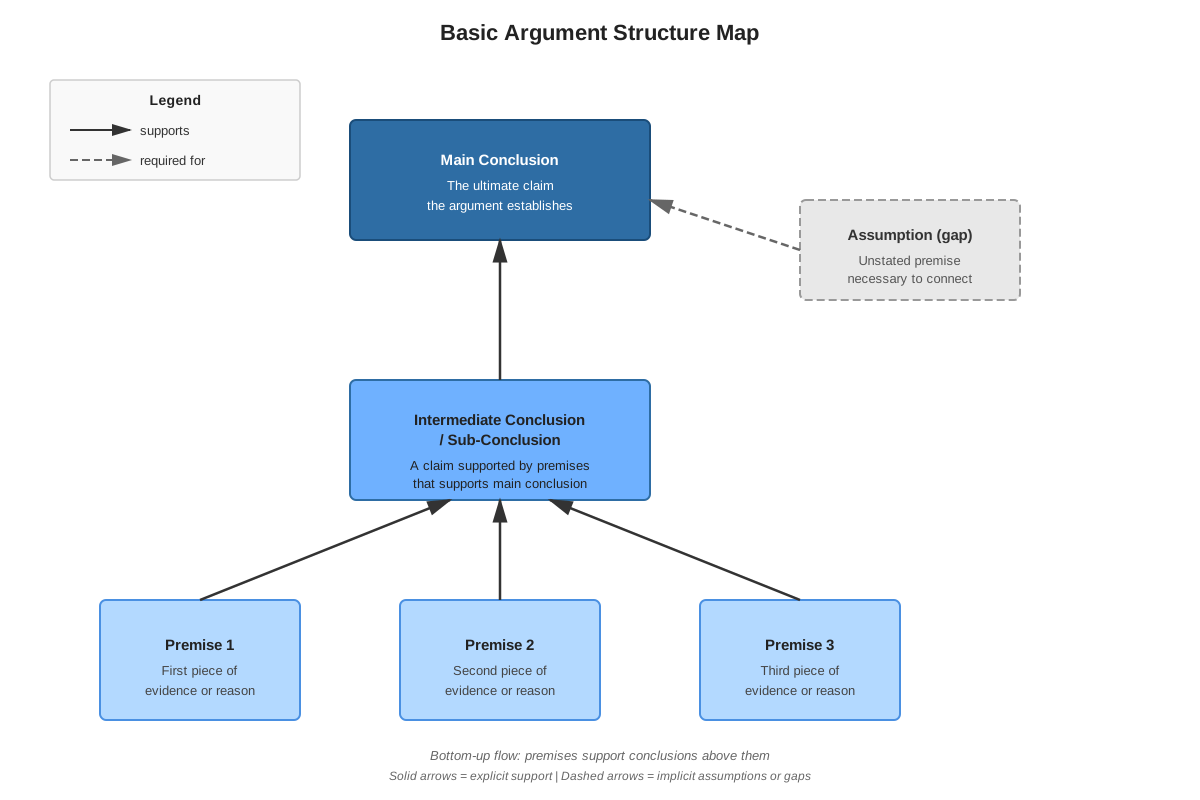
An argument map is a visual or mental representation that shows how the components of an argument relate to one another. At its most basic level, an argument map identifies the conclusion (the claim being argued for) and the premises (the evidence or reasons supporting that conclusion), then illustrates the support relationship between them. The standard notation uses arrows pointing from premises toward the conclusion they support, creating a flow diagram of logical reasoning.
The fundamental principle underlying all argument mapping is that arguments have structure—they are not merely collections of statements but organized systems where some claims provide support for others. Understanding this structure is crucial because the LSAT tests not just whether you understand what an argument says, but how it works. A well-constructed map reveals the argument's logical skeleton, making it easier to identify vulnerabilities, assumptions, and the impact of new information.
Types of Support Relationships
Arguments can employ different types of support structures, and recognizing these patterns is essential for accurate mapping:
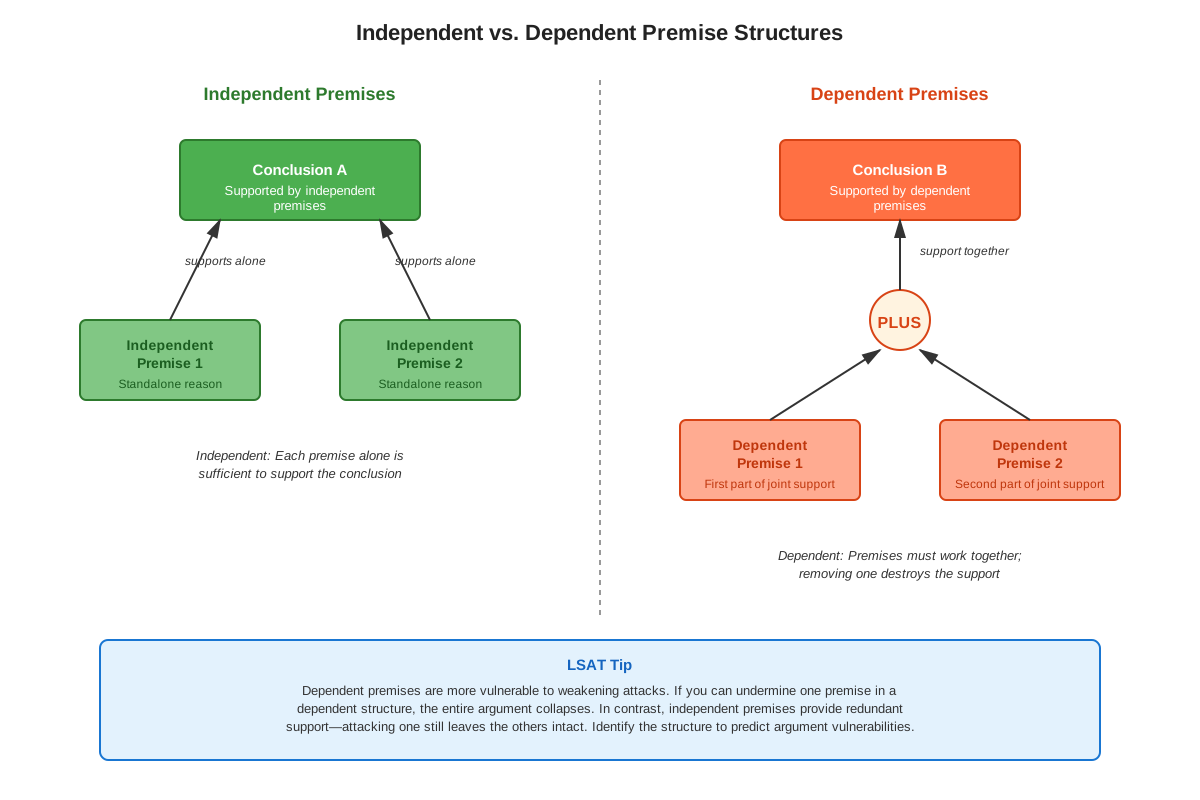
Independent Support occurs when multiple premises each provide separate, standalone support for a conclusion. If one premise were removed, the others would still provide some support. For example:
- Premise 1: The company's profits increased 20% last year.
- Premise 2: Customer satisfaction ratings reached an all-time high.
- Conclusion: The company is performing well.
In a map, these premises would be shown with separate arrows pointing to the conclusion, indicating that each provides independent evidence.
Dependent Support (also called joint support or linked support) occurs when premises must work together to support a conclusion—neither premise alone would provide meaningful support. For example:
- Premise 1: All mammals are warm-blooded.
- Premise 2: Whales are mammals.
- Conclusion: Whales are warm-blooded.
These premises must be mapped together, often shown with a bracket or line connecting them before a single arrow points to the conclusion, indicating their interdependence.
Serial Support (also called chain reasoning) involves intermediate conclusions that serve as premises for further conclusions, creating a chain of reasoning. For example:
- Premise: Sales have declined for three consecutive quarters.
- Intermediate Conclusion: The company is losing market share.
- Final Conclusion: The CEO should be replaced.
This structure maps as a vertical chain, with arrows connecting each level of reasoning.
Identifying Conclusions and Sub-Conclusions
One of the most challenging aspects of argument mapping is distinguishing between main conclusions and sub-conclusions (intermediate conclusions). The main conclusion is the ultimate claim the argument seeks to establish, while sub-conclusions are claims that are both supported by some premises and used to support further claims.
To identify the main conclusion, ask: "What is the author's ultimate point?" or "What claim is everything else in the argument working to establish?" Sub-conclusions can be identified by noting that they have both premise indicators before them and conclusion indicators after them—they are both supported and supporting.
Consider this example:
"Because the new policy has reduced wait times by 40%, patient satisfaction has improved significantly. Therefore, the hospital should expand the policy to all departments."
Here, "patient satisfaction has improved significantly" is a sub-conclusion (supported by the wait time data) that serves as a premise for the main conclusion (the hospital should expand the policy).
Mapping Complex Arguments
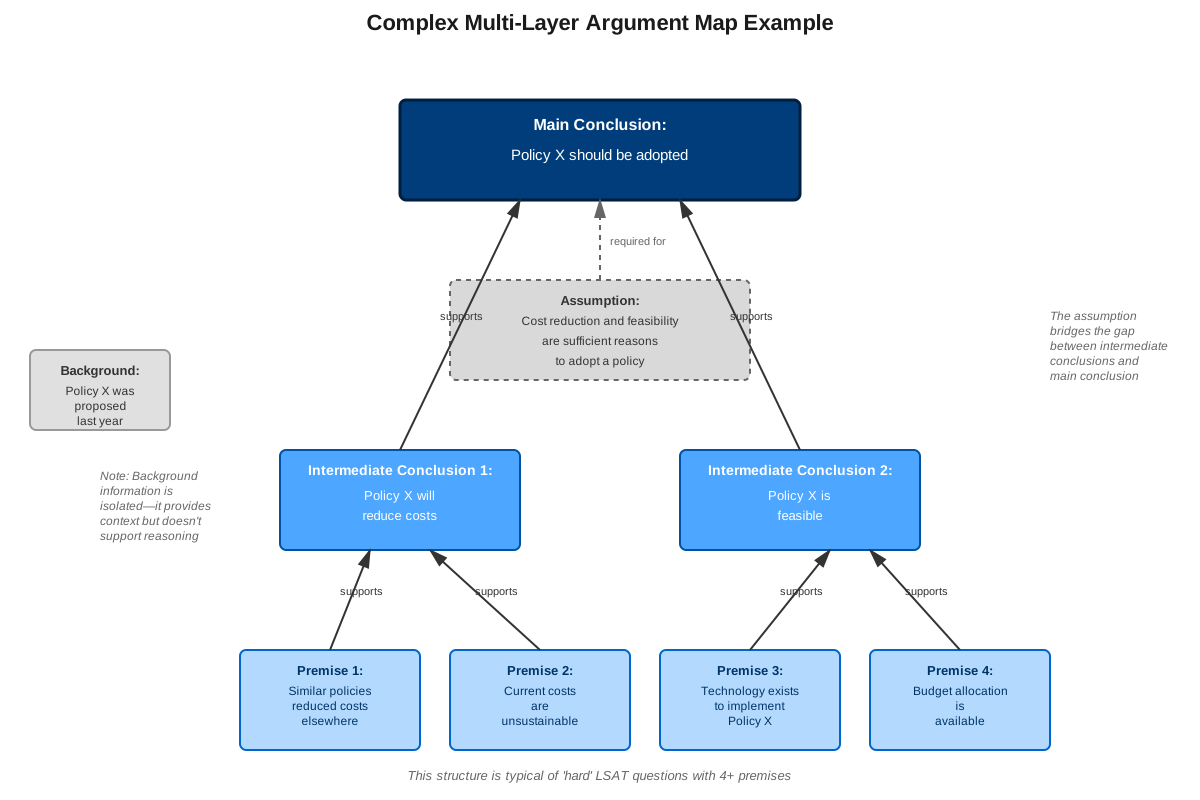
Real LSAT arguments often contain multiple layers of reasoning, counterarguments, background information, and qualifications. Effective mapping requires distinguishing between:
Premises: Claims offered as evidence or reasons
Conclusions: Claims being argued for
Background/Context: Information that sets the stage but doesn't directly support the conclusion
Counterarguments: Opposing views that the argument may acknowledge
Rebuttals: Responses to counterarguments
A comprehensive map might look like this in text form:
[Background: Context setting]
    ↓
[Premise 1] + [Premise 2] (dependent support)
    ↓
[Sub-conclusion]
    ↓
[Premise 3] (independent support) → [Main Conclusion] ← [Premise 4] (independent support)
    ↑
[Rebuttal to counterargument]
The Role of Assumptions in Argument Maps
Assumptions are unstated premises that are necessary for an argument to work. In argument mapping, assumptions represent gaps or bridges between stated premises and conclusions. Identifying these gaps is crucial for many LSAT question types. When mapping, look for logical leaps—places where the conclusion doesn't follow directly from the stated premises without additional information.
For example:
- Premise: This medication reduced symptoms in 80% of trial participants.
- Conclusion: This medication will be effective for most patients.
- Assumption (gap): The trial participants are representative of the general patient population.
In a map, assumptions can be shown as dotted lines or brackets indicating the unstated connection that must hold for the argument to succeed.
Practical Mapping Techniques
For LSAT purposes, argument mapping is typically done mentally or with minimal notation due to time constraints. Effective techniques include:
- Bracket Method: Use brackets to group dependent premises, with a single arrow to the conclusion
- Numbering System: Number each claim (P1, P2, C) and write the structure (P1 + P2 → C)
- Vertical Notation: Write premises above conclusions with arrows showing flow
- Mental Visualization: For simple arguments, visualize the structure without writing
The key is developing a consistent system that works quickly and reliably under test conditions.
Concept Relationships
Argument mapping serves as the central hub connecting multiple logical reasoning concepts. The relationship flows as follows:
Identifying Premises and Conclusions → Argument Mapping → Evaluating Argument Strength
Without the ability to identify basic argument components, mapping is impossible. Once mapping is mastered, it enables evaluation of argument quality, identification of assumptions, and recognition of logical flaws.
Argument Mapping → Assumption Identification: The gaps revealed in an argument map are precisely where assumptions exist. Mapping makes these gaps visible and concrete.
Argument Mapping → Strengthen/Weaken Analysis: Understanding argument structure through mapping shows exactly where new information would have impact. Information that fills gaps or supports key premises strengthens; information that undermines premises or reveals new gaps weakens.
Argument Mapping → Flaw Recognition: Many logical flaws are structural problems that become apparent when an argument is mapped. For example, circular reasoning shows up as a loop in the map, and false dichotomies reveal themselves as unsupported leaps.
Argument Mapping ↔ Argument Patterns: Mapping helps identify recurring patterns (causal arguments, analogical reasoning, conditional logic), while recognizing these patterns makes mapping faster and more accurate.
The relationship to prerequisite topics is foundational: indicator words guide the mapping process, basic argument structure provides the components to map, and reading comprehension ensures accurate interpretation of what should be mapped.
High-Yield Facts
⭐ Every LSAT Logical Reasoning argument has a structure that can be mapped, even if that structure is flawed or incomplete.
⭐ The main conclusion is the claim that everything else in the argument works to support; it is never used to support another claim.
⭐ Sub-conclusions have both premise indicators before them and conclusion indicators after them, serving dual roles in the argument.
⭐ Dependent premises must work together to support a conclusion; removing one eliminates the support entirely.
⭐ Independent premises each provide separate support; removing one still leaves other support intact.
- Assumptions appear as gaps between premises and conclusions in an argument map and represent unstated necessary conditions for the argument to work.
- Background information and context do not directly support the conclusion and should be distinguished from actual premises when mapping.
- Counterarguments acknowledged in a passage are not premises of the main argument but opposing views that may be rebutted.
- Serial support creates chains of reasoning where intermediate conclusions serve as premises for further conclusions, requiring vertical mapping.
- The strength of an argument depends not just on the truth of its premises but on the quality of the support relationship between premises and conclusion.
- Complex arguments may have multiple independent lines of reasoning all supporting the same conclusion, creating a convergent structure.
- Recognizing argument structure through mapping is faster and more reliable than trying to evaluate arguments through intuition alone.
Quick check — test yourself on Argument mapping so far.
Try Flashcards →Common Misconceptions
Misconception: The longest sentence or the last sentence in a passage is always the main conclusion.
Correction: Conclusions can appear anywhere in an argument—beginning, middle, or end. The main conclusion is identified by its logical role (what is being argued for), not its position. Always look for conclusion indicators and ask what claim everything else supports.
Misconception: Every sentence in an argument is either a premise or a conclusion.
Correction: Arguments often contain background information, context, counterarguments, examples, and elaborations that are neither premises nor conclusions. These elements provide context but don't directly participate in the support structure. Effective mapping requires distinguishing supporting evidence from supplementary information.
Misconception: If two premises appear together, they must be dependent (linked) premises.
Correction: Proximity doesn't determine the type of support relationship. Two premises can appear consecutively but provide independent support. Test whether each premise alone would still provide some support for the conclusion; if yes, they're independent. Only when premises must work together to provide any support are they dependent.
Misconception: Mapping arguments takes too much time to be practical during the actual LSAT.
Correction: While detailed visual maps may be time-consuming, mental mapping and minimal notation (numbering, arrows, brackets) can be done in seconds with practice. The time invested in mapping is recovered through increased accuracy and faster answer elimination. Most high-scoring test-takers map arguments mentally as they read.
Misconception: An argument can have only one conclusion.
Correction: Arguments frequently contain multiple conclusions at different levels—sub-conclusions that support main conclusions. Recognizing this hierarchical structure is essential for understanding complex arguments. The key is identifying which conclusion is ultimate (the main conclusion) and which are intermediate steps in the reasoning.
Misconception: Assumptions are the same as unstated premises and can be anything not explicitly mentioned.
Correction: Assumptions are specifically the unstated premises that are necessary for the argument to work—they bridge gaps between stated premises and conclusions. Not every unstated claim is an assumption; only those required for the logical connection to hold qualify. Assumptions are revealed by gaps in the argument map.
Worked Examples
Example 1: Mapping a Multi-Premise Argument
Passage: "The city's new recycling program has been highly successful. Participation rates have increased by 35% since the program launched. Additionally, the amount of waste sent to landfills has decreased by 20%. Furthermore, a recent survey showed that 78% of residents support the program. Therefore, the city should expand the program to include composting."
Step 1: Identify the conclusion
Look for conclusion indicators. "Therefore" signals that "the city should expand the program to include composting" is the main conclusion.
Step 2: Identify the premises
- Premise 1: Participation rates have increased by 35%
- Premise 2: Waste to landfills has decreased by 20%
- Premise 3: 78% of residents support the program
- Background: "The city's new recycling program has been highly successful" (this is a characterization, not evidence)
Step 3: Determine support relationships
Each premise provides independent evidence for the conclusion. If any single premise were removed, the others would still provide some support. None of these premises must work together to be meaningful.
Step 4: Create the map
[Background: Program characterized as successful]

[P1: 35% participation increase] ──→
                                    [C: City should expand to composting]
[P2: 20% waste reduction] ────────→

[P3: 78% resident support] ───────→
Step 5: Identify assumptions (gaps)
The argument assumes that:
- Success in recycling predicts success in composting
- The metrics of success (participation, waste reduction, support) are relevant to the expansion decision
- There are no significant obstacles to expansion (cost, infrastructure, etc.)
Application to LSAT questions: This structure would be vulnerable to weakening questions that introduce differences between recycling and composting, or that reveal hidden costs. Assumption questions would focus on the gap between recycling success and composting viability.
Example 2: Mapping Serial Support with Sub-Conclusions
Passage: "Recent studies show that regular meditation reduces cortisol levels in the bloodstream. Since elevated cortisol is associated with increased stress and anxiety, meditation must reduce stress and anxiety. Given that chronic stress is a major contributor to heart disease, people concerned about cardiovascular health should practice meditation regularly."
Step 1: Identify all conclusions
- "meditation must reduce stress and anxiety" (has "since" before it and leads to further reasoning)
- "people concerned about cardiovascular health should practice meditation regularly" (ultimate claim)
The first is a sub-conclusion; the second is the main conclusion.
Step 2: Identify premises
- Premise 1: Studies show meditation reduces cortisol levels
- Premise 2: Elevated cortisol is associated with stress and anxiety
- Premise 3: Chronic stress is a major contributor to heart disease
Step 3: Map the chain of reasoning
[P1: Meditation reduces cortisol] + [P2: Cortisol associated with stress/anxiety]
                    ↓ (dependent support)
        [Sub-C: Meditation reduces stress and anxiety]
                    ↓
        [P3: Chronic stress contributes to heart disease]
                    ↓
        [Main C: People concerned about cardiovascular health should meditate]
Step 4: Identify support types and assumptions
- P1 and P2 are dependent premises—they must work together to support the sub-conclusion
- The sub-conclusion serves as a premise for the main conclusion
- Key assumption: Reducing stress through meditation will reduce heart disease risk (gap between stress reduction and cardiovascular benefit)
- Additional assumption: The association between cortisol and stress is causal, not merely correlational
Application to LSAT questions: This serial structure is common in Method of Reasoning questions. Strengthen questions might provide evidence that meditation's stress reduction translates to cardiovascular benefits. Flaw questions might identify the correlation/causation issue or the gap between stress reduction and heart disease prevention.
Exam Strategy
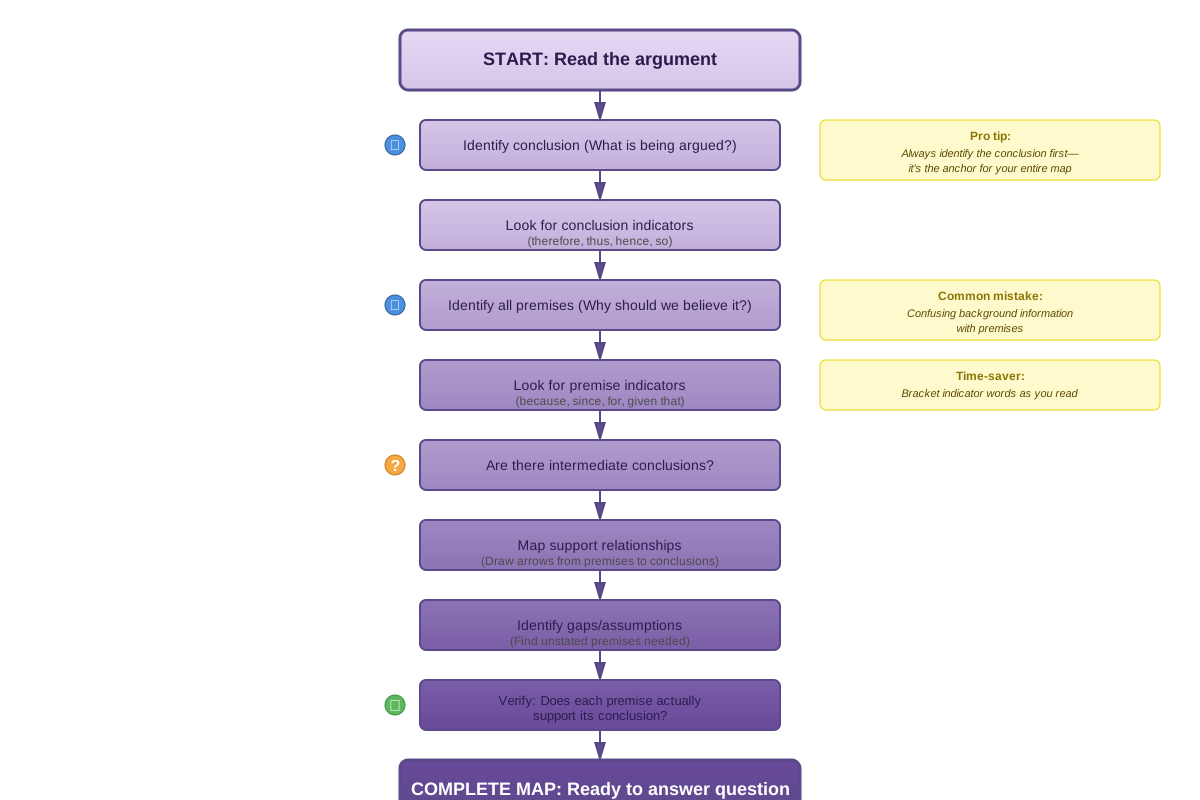
When approaching LSAT Logical Reasoning questions that require argument mapping, follow this systematic process:
Step 1: Read actively for structure (not just content). As you read, mentally note "this is evidence" or "this is the point being made." Don't just absorb information passively; actively categorize each sentence's role.
Step 2: Identify the conclusion first. Before mapping anything else, determine what claim the argument is ultimately trying to establish. Look for conclusion indicators (therefore, thus, hence, so, consequently) and ask "What is the author's main point?" Circle or underline the conclusion.
Step 3: Locate all premises. Find every piece of evidence offered in support. Look for premise indicators (because, since, for, given that, as indicated by). Number the premises if helpful (P1, P2, P3).
Step 4: Determine support relationships. Ask: "Do these premises need each other to work, or does each provide independent support?" Test by imagining each premise alone—would it still support the conclusion?
Step 5: Identify gaps and assumptions. Look for logical leaps between premises and conclusion. What must be true for this argument to work? These gaps are where assumptions live and where the argument is most vulnerable.
Exam Tip: For time efficiency, develop a shorthand notation system. Use arrows (→), plus signs (+) for dependent premises, and numbers (P1, P2, C) to quickly sketch structure. Most arguments can be mapped in 10-15 seconds with practice.
Trigger words and phrases to watch for:
- Conclusion indicators: therefore, thus, hence, so, consequently, it follows that, which means that, accordingly, as a result
- Premise indicators: because, since, for, given that, as, as indicated by, for the reason that, in that
- Sub-conclusion indicators: phrases that have both types of indicators nearby
- Contrast indicators: however, but, yet, although, despite (often signal counterarguments or complications)
Process-of-elimination tips specific to argument mapping:
For Assumption questions: Map the argument, identify the gap, and eliminate answers that don't bridge that specific gap. The correct answer will connect a premise to the conclusion in a way that's necessary for the argument.
For Strengthen/Weaken questions: Map the argument to identify its vulnerable points (assumptions, causal claims, generalizations). Eliminate answers that affect irrelevant parts of the argument or that don't impact the connection between premises and conclusion.
For Flaw questions: Map the argument to visualize its structure. Many flaws are structural (circular reasoning, false dichotomy, unwarranted assumption). Eliminate answers that describe flaws not present in your map.
For Method of Reasoning questions: Map both the argument structure and the answer choices' descriptions. Eliminate answers that mischaracterize the support relationships you've mapped.
Time allocation advice: Spend 20-30 seconds reading and mentally mapping the argument, then 30-40 seconds on the question stem and answer choices. The time invested in mapping pays dividends in accuracy and faster elimination. Don't rush the mapping phase—errors here cascade into wrong answers.
Memory Techniques
MAPS - Remember the four key elements to identify when mapping:
- Main conclusion
- Assumptions (gaps)
- Premises (all supporting evidence)
- Support type (independent, dependent, or serial)
"Arrows Flow Upward" - Visualize argument maps as water flowing uphill: premises are at the bottom (foundation), and they flow up through support relationships to reach the conclusion at the top. This prevents the common error of drawing arrows from conclusions to premises.
The "Plus Test" for Dependent Premises - When determining if premises are dependent or independent, imagine a plus sign between them. If you need to add them together to get meaningful support (like 2 + 2 = 4), they're dependent. If each works alone (like two separate $5 bills both being money), they're independent.
"Sub-Conclusions Wear Two Hats" - Remember that sub-conclusions have a dual role: they wear a "conclusion hat" (supported by some premises) and a "premise hat" (supporting further conclusions). Visualize them literally wearing two hats to remember they serve both functions.
The "Therefore/Because Sandwich" - Sub-conclusions are sandwiched between "because" (or similar premise indicators) and "therefore" (or similar conclusion indicators). If you can make a sentence with "because [something], [claim], therefore [something else]," the middle claim is a sub-conclusion.
"GAPS" for Finding Assumptions - Look for these common gaps:
- Generalizations (from specific to general)
- Analogies (assuming similarity)
- Predictions (assuming future like past)
- Scope shifts (terms in conclusion not in premises)
Summary
Argument mapping is the systematic process of identifying and diagramming the structural relationships within logical arguments, forming the foundation for success on LSAT Logical Reasoning questions. This technique requires distinguishing between conclusions (claims being argued for), premises (supporting evidence), and assumptions (unstated necessary connections), then understanding how these elements relate through independent support (separate lines of evidence), dependent support (premises that must work together), or serial support (chains of reasoning with intermediate conclusions). Mastering argument mapping transforms abstract reasoning into a concrete, visual process that reveals an argument's logical skeleton, making vulnerabilities, gaps, and the impact of new information immediately apparent. The skill applies to virtually every Logical Reasoning question type—from identifying assumptions and evaluating argument strength to recognizing flaws and understanding reasoning methods. Success requires active reading that categorizes each sentence's structural role, systematic identification of support relationships, and recognition of gaps where assumptions bridge premises to conclusions. With practice, mapping becomes a rapid mental process that significantly improves both accuracy and speed, making it one of the highest-yield techniques for LSAT preparation.
Key Takeaways
- Argument mapping reveals the logical structure of arguments by identifying premises, conclusions, and their support relationships, making it essential for analyzing LSAT Logical Reasoning questions effectively.
- The main conclusion is the ultimate claim being argued for and is never used to support another claim; sub-conclusions serve dual roles as both supported claims and supporting premises.
- Support relationships come in three types: independent (premises provide separate support), dependent (premises must work together), and serial (chains of reasoning with intermediate conclusions).
- Assumptions are unstated premises that bridge gaps between stated premises and conclusions; these gaps become visible through argument mapping and represent points of vulnerability.
- Effective mapping requires distinguishing between structural elements (premises and conclusions) and non-structural elements (background, context, counterarguments, and elaborations).
- Mental mapping with minimal notation is practical and time-efficient for the LSAT when developed through consistent practice, typically requiring only 10-20 seconds per argument.
- Mastering argument mapping improves performance across all Logical Reasoning question types, potentially impacting 30-35 questions per test and significantly raising overall scores.
Related Topics
Identifying Assumptions: Building directly on argument mapping, this topic focuses specifically on recognizing unstated premises that are necessary for arguments to work. Mastering mapping makes assumption identification systematic rather than intuitive.
Strengthening and Weakening Arguments: This topic applies argument mapping skills to evaluate how new information affects argument validity. Understanding structure through mapping shows exactly where new evidence would have impact.
Logical Fallacies and Flaws: Many common logical errors are structural problems that become apparent through mapping. This topic catalogs specific flaw types and their characteristics within argument structures.
Conditional Reasoning: A specialized form of argument structure involving if-then relationships. Mapping conditional arguments requires additional notation for sufficient and necessary conditions.
Causal Reasoning: Arguments that claim one thing causes another have specific structural features and vulnerabilities. Mapping causal arguments reveals the causal chain and points where alternative explanations might apply.
Parallel Reasoning: This question type explicitly tests your ability to map argument structure and find another argument with an identical logical form, making mapping skills directly applicable.
Practice CTA
Now that you understand the principles and techniques of argument mapping, it's time to put these skills into practice. Work through the practice questions and flashcards designed for this topic, applying the systematic mapping process to each argument you encounter. Remember that mapping is a skill that improves dramatically with deliberate practice—your first attempts may feel slow, but with repetition, the process becomes rapid and automatic. Focus on accuracy first, then build speed. Each practice question is an opportunity to refine your ability to see argument structure clearly, and this clarity will translate directly into points on test day. You've learned a technique that will serve you throughout the LSAT and beyond—now make it yours through consistent application.
Sign up free to keep reading
Create a free AnvayaPrep account to finish this LSAT guide on Argument mapping — plus flashcards and practice questions.