Overview
Argument parts questions represent one of the most fundamental and frequently tested question types in LSAT Logical Reasoning. These questions require test-takers to identify the specific role that a particular statement plays within an argument's structure. Rather than evaluating whether an argument is strong or weak, argument parts questions assess whether students can dissect an argument into its component pieces and understand how each piece functions within the whole.
Mastering argument parts is essential for LSAT success because these questions appear regularly on every administration of the exam, typically accounting for 3-5 questions per test. More importantly, the analytical skills developed through studying argument parts form the foundation for virtually every other Logical Reasoning question type. Understanding how to identify premises, conclusions, background information, counterarguments, and intermediate conclusions creates a framework that enhances performance across all argument fundamentals topics.
The ability to recognize LSAT argument parts connects directly to higher-level reasoning skills tested throughout the exam. When students can quickly and accurately identify what role each statement plays, they can more effectively evaluate argument structure, identify flaws, strengthen or weaken arguments, and draw valid inferences. This topic serves as a gateway skill—without it, students struggle with more complex question types, but with it, they gain a powerful analytical lens through which to view all LSAT arguments.
Learning Objectives
- [ ] Identify how Argument parts appears in LSAT questions
- [ ] Explain the reasoning pattern behind Argument parts
- [ ] Apply Argument parts to solve LSAT-style problems accurately
- [ ] Distinguish between different types of argument components (premises, conclusions, background, counterarguments, concessions)
- [ ] Recognize the structural indicators and language patterns that signal different argument parts
- [ ] Evaluate answer choices by matching functional descriptions to actual statement roles
- [ ] Analyze complex arguments containing multiple layers of support and intermediate conclusions
Prerequisites
- Basic argument structure: Understanding what constitutes an argument (claim supported by reasons) is necessary because argument parts questions require identifying components within that structure
- Conclusion identification: The ability to locate an argument's main point is essential since all other parts are defined in relation to the conclusion
- Premise recognition: Knowing what evidence looks like enables students to distinguish supporting statements from other argument components
- Indicator word familiarity: Recognizing words like "therefore," "because," "however," and "although" helps signal the function of different statements
Why This Topic Matters
In real-world contexts, the ability to identify argument parts translates directly to critical thinking skills used in legal practice, business analysis, academic research, and everyday decision-making. Lawyers must dissect opposing counsel's arguments to identify weak points; business leaders must understand which claims are supported and which are merely asserted; researchers must distinguish between hypotheses, evidence, and conclusions. The LSAT tests this skill because it predicts success in law school, where students constantly analyze complex arguments in case law and legal scholarship.
On the LSAT, argument parts questions appear with remarkable consistency. Test-takers can expect to encounter 3-5 of these questions per exam, distributed across both Logical Reasoning sections. These questions typically present arguments of moderate length (3-5 sentences) and ask students to identify the role of a specific statement, which is usually highlighted or referenced in the question stem. The question stems follow predictable patterns: "The claim that X plays which one of the following roles in the argument?" or "The statement that Y serves which function in the argument above?"
Common manifestations include identifying main conclusions versus intermediate conclusions, distinguishing premises from background information, recognizing counterarguments that the author addresses, identifying concessions the author makes, and spotting illustrative examples versus evidential support. The LSAT frequently tests whether students can differentiate between a statement the author is arguing FOR versus a statement the author is arguing AGAINST, making careful reading essential.
Core Concepts
The Main Conclusion
The main conclusion represents the primary claim or position that the argument seeks to establish. It is the statement that all other parts of the argument work to support. On the LSAT, identifying the main conclusion is crucial because every other argument part is defined by its relationship to this central claim.
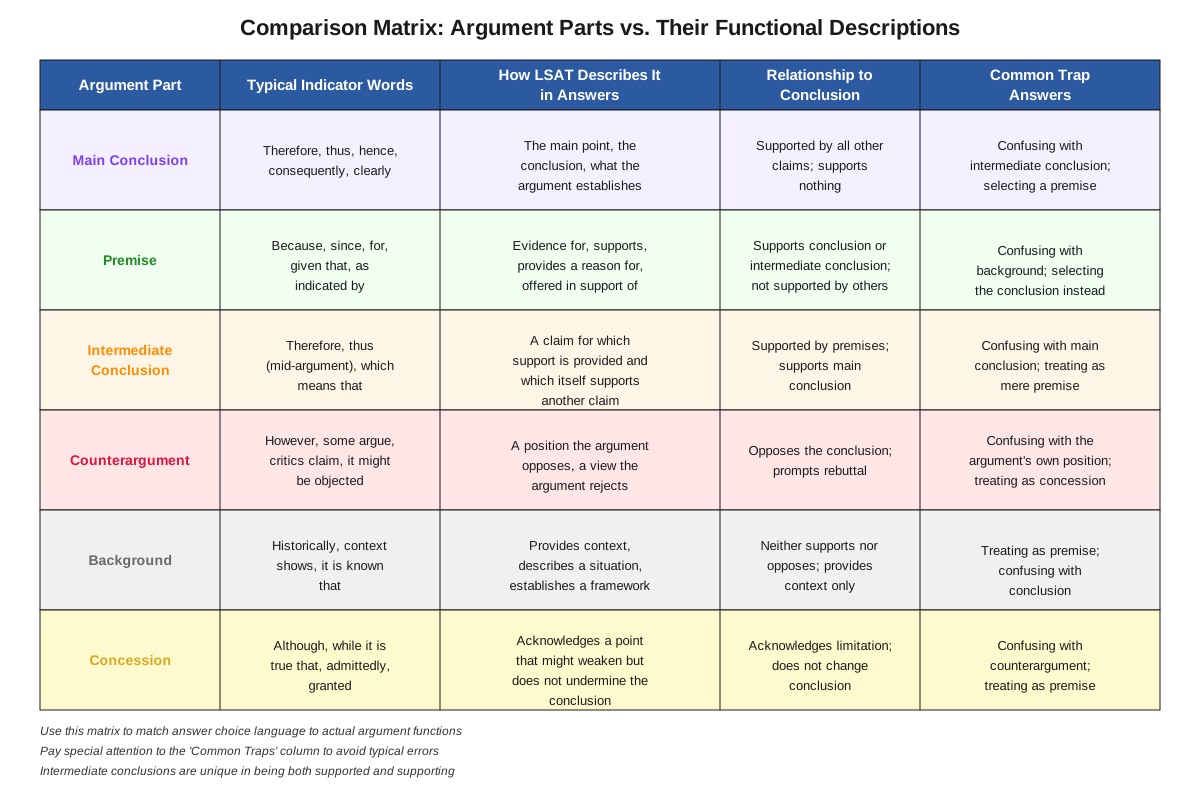
Main conclusions often appear at the beginning or end of arguments, though they can appear anywhere. They are frequently introduced by conclusion indicators such as "therefore," "thus," "hence," "so," "consequently," and "it follows that." However, the LSAT deliberately creates arguments where conclusions appear without indicators, requiring students to identify them through logical analysis rather than keyword recognition alone.
To identify a main conclusion, apply the "why test": if you can ask "why should I believe this?" and the argument provides reasons, you've found the conclusion. Conversely, if a statement provides the reason for believing something else, it's a premise, not the conclusion.
Premises and Evidence
Premises are statements offered as reasons to believe the conclusion. They provide the evidential foundation upon which the argument rests. Premises can take many forms: factual claims, statistical data, expert testimony, analogies, or general principles. The key characteristic is that premises support rather than require support.
Premise indicators include "because," "since," "for," "given that," "as indicated by," and "for the reason that." However, like conclusions, premises don't always appear with explicit indicators. Students must recognize them by their functional role: they answer the question "why should I believe the conclusion?"
The LSAT distinguishes between different types of premises. Direct evidence provides straightforward support for the conclusion. Background premises establish context or definitions necessary for the argument to make sense. Subsidiary premises support intermediate conclusions, which in turn support the main conclusion.
Intermediate Conclusions
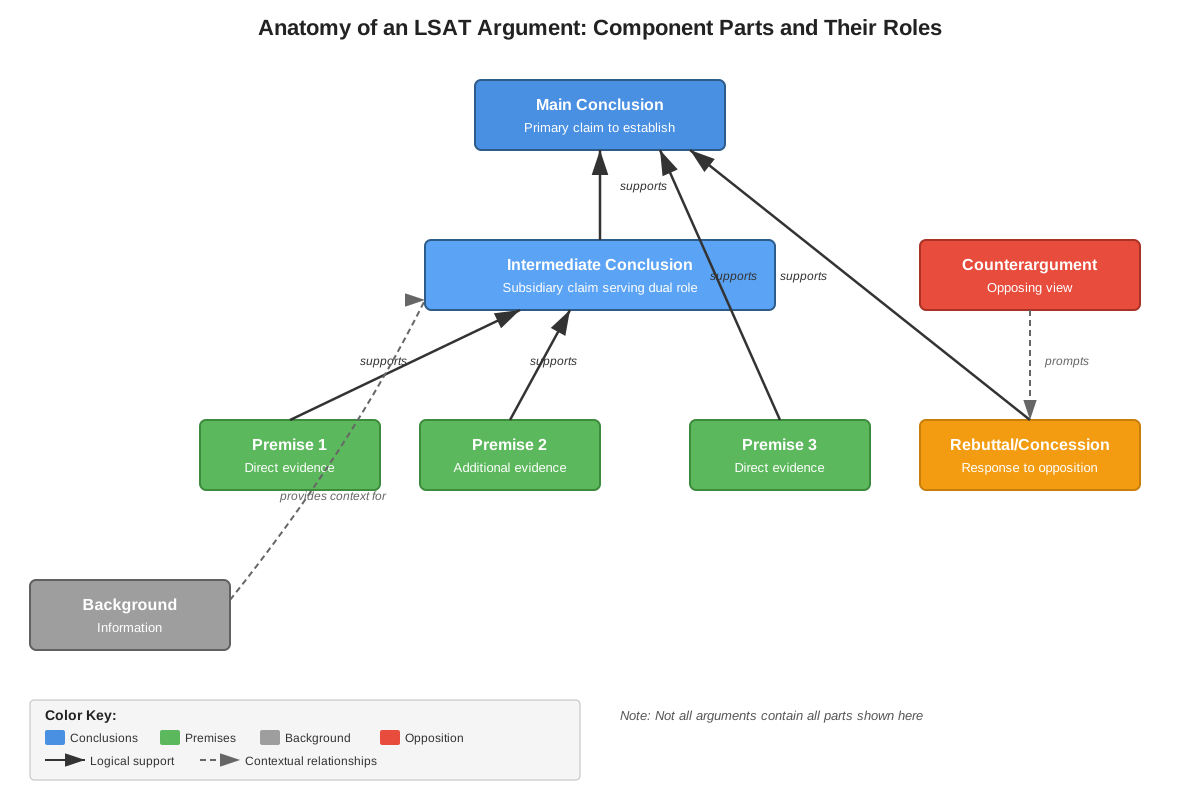
An intermediate conclusion (also called a subsidiary conclusion) is a statement that functions both as a conclusion and as a premise. It is supported by some evidence in the argument, but it also serves to support the main conclusion. This dual role makes intermediate conclusions particularly challenging to identify and a favorite testing point for the LSAT.
Consider this structure: Evidence → Intermediate Conclusion → Main Conclusion. The intermediate conclusion is derived from the evidence but exists primarily to support the ultimate claim. For example: "Studies show coffee consumption correlates with alertness (evidence). Therefore, coffee likely contains stimulants (intermediate conclusion). Thus, coffee should be consumed before important tasks (main conclusion)."
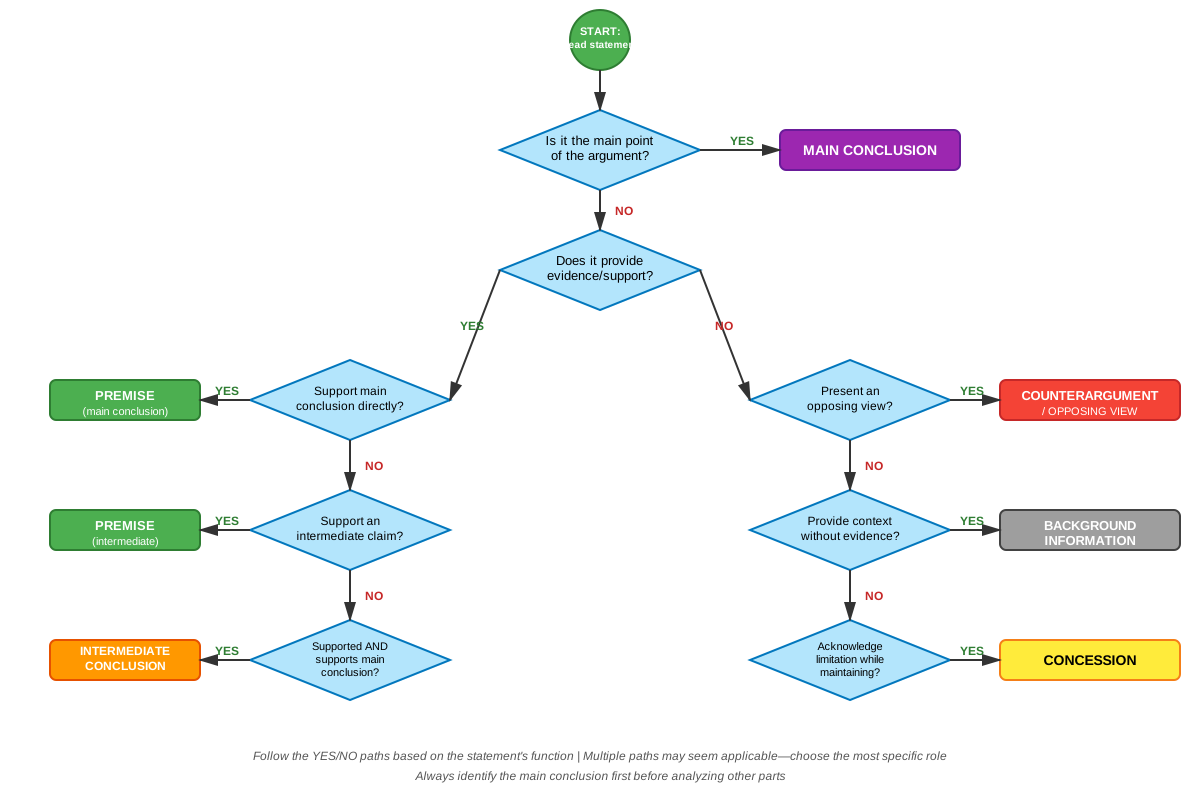
Recognizing intermediate conclusions requires asking two questions: (1) Is this statement supported by other statements in the argument? (2) Does this statement support another claim? If both answers are yes, you've identified an intermediate conclusion.
Counterarguments and Opposing Views
A counterargument is a position that opposes or contradicts the author's conclusion. The LSAT frequently includes counterarguments that the author then attempts to refute or address. Identifying these is crucial because students must distinguish between what the author believes and what the author is arguing against.
Counterarguments are often introduced with phrases like "some argue that," "critics contend that," "it might be objected that," or "opponents claim that." The key is recognizing that the author presents these views not to endorse them but to acknowledge and respond to them.
The LST tests whether students can identify a statement as "a position that the argument opposes" or "a view that the argument seeks to refute." Misidentifying a counterargument as the author's conclusion is a common error that leads to incorrect answers.
Concessions
A concession is a point that the author acknowledges or admits, often to appear reasonable or to address potential objections. Unlike counterarguments, concessions are claims the author accepts as true, even though they might seem to weaken the author's position. Authors make concessions strategically, often following them with stronger points that outweigh the conceded issue.
Concessions typically appear with language like "admittedly," "granted," "although," "while it is true that," or "despite the fact that." For example: "Although the policy may increase costs (concession), it will save lives (main point)." The author accepts the cost increase but argues the benefit outweighs this drawback.
Background Information and Context
Background information provides context, definitions, or general facts that help the reader understand the argument but don't directly support the conclusion. This information is neither evidence nor conclusion; it sets the stage for the argument to follow.
For example, in an argument about university funding, a statement like "State University has 20,000 students" might be background information that helps readers understand the scale of the institution, even though it doesn't directly support any particular conclusion about funding decisions.
The LSAT tests whether students can distinguish background information from actual premises. Background information doesn't answer "why should I believe the conclusion?" but rather "what do I need to know to understand this argument?"
Illustrations and Examples
Illustrations and examples demonstrate or clarify a point rather than prove it. While they may make an argument more vivid or understandable, they function differently from evidence. An example shows what something looks like in practice; evidence provides reasons to believe a claim is true.
Consider: "Many species exhibit altruistic behavior. For instance, dolphins have been observed helping injured members of their pod." The example about dolphins illustrates altruistic behavior but doesn't prove that many species exhibit it. The LSAT tests whether students recognize this functional difference.
Principles and General Rules
Principles are general rules or standards that an argument applies to a specific situation. They often appear as broad statements that the argument then uses to draw conclusions about particular cases. For example: "Actions that harm others without consent are wrong (principle). This policy harms citizens without their consent (application). Therefore, this policy is wrong (conclusion)."
Identifying principles is important because they function as a special type of premise—one that provides a general framework for reasoning rather than specific factual support.
Concept Relationships
The relationships among argument parts create a hierarchical structure that flows logically from evidence to conclusion. At the foundation lie premises and evidence, which provide the basic support for claims. These premises may support intermediate conclusions, which serve as stepping stones in the reasoning process. Intermediate conclusions, in turn, support the main conclusion, which represents the argument's ultimate claim.
Background information sits outside this support structure, providing context that enables understanding without directly supporting the conclusion. Counterarguments also stand apart from the author's reasoning chain—they represent opposing views that the author acknowledges and typically refutes. Concessions occupy a middle ground: the author accepts them as true but argues they don't undermine the main conclusion.
Illustrations and examples attach to claims they clarify, functioning as explanatory rather than evidential elements. Principles typically appear as major premises in arguments that apply general rules to specific cases.
The relationship map flows as follows:
Background Information → sets context for → Premises → support → Intermediate Conclusions → support → Main Conclusion
Counterarguments → are refuted by → Author's Reasoning
Concessions → are acknowledged but outweighed by → Stronger Considerations
Principles → provide framework for → Application to Specific Cases
Understanding these relationships enables students to see arguments as structured wholes rather than collections of disconnected statements. This holistic view is essential for correctly identifying the role any particular statement plays.
High-Yield Facts
⭐ The main conclusion is the statement that all other parts of the argument work to support; it can appear anywhere in the argument, not just at the end
⭐ Intermediate conclusions both receive support from some statements and provide support to other statements, serving a dual role
⭐ Counterarguments represent positions the author opposes, not positions the author endorses; they are often introduced with phrases like "critics argue" or "some contend"
⭐ Premises answer the question "why should I believe the conclusion?" while background information answers "what context do I need?"
⭐ Concessions are points the author admits or acknowledges, typically introduced by words like "although," "admittedly," or "granted"
- Conclusion indicators include "therefore," "thus," "hence," "so," "consequently," and "it follows that," but conclusions can appear without any indicators
- Premise indicators include "because," "since," "for," "given that," and "as indicated by," but premises can also appear without explicit markers
- Examples and illustrations demonstrate or clarify points but don't provide evidential support for conclusions
- The "why test" helps identify conclusions: if you can ask "why?" and the argument provides reasons, you've found a conclusion
- Principles are general rules or standards that arguments apply to specific situations, functioning as a special type of premise
Quick check — test yourself on Argument parts so far.
Try Flashcards →Common Misconceptions
Misconception: The conclusion always appears at the end of an argument → Correction: Conclusions can appear anywhere—at the beginning, middle, or end. The LSAT deliberately places conclusions in various positions to test whether students identify them by function rather than location. Always identify the conclusion by asking what claim the argument seeks to establish, regardless of where it appears.
Misconception: Any statement with "therefore" or "thus" must be the main conclusion → Correction: Indicator words can introduce intermediate conclusions as well as main conclusions. A statement following "therefore" might support yet another claim, making it an intermediate rather than main conclusion. Always check whether the statement in question supports something else in the argument.
Misconception: If the author mentions a view, the author must agree with it → Correction: Authors frequently present counterarguments or opposing positions that they then refute. The LSAT specifically tests whether students can distinguish between views the author endorses and views the author opposes. Pay attention to phrases like "critics argue" or "some contend" that signal opposing views.
Misconception: Background information and premises are the same thing → Correction: Background information provides context but doesn't support the conclusion, while premises directly support the conclusion. Background information answers "what do I need to know?" while premises answer "why should I believe the conclusion?" This distinction is frequently tested.
Misconception: Concessions weaken the author's argument and should be avoided → Correction: Concessions are strategic rhetorical moves where authors acknowledge potential weaknesses or opposing points to appear reasonable, then argue that stronger considerations outweigh these concerns. Identifying concessions correctly means recognizing that the author accepts them as true but doesn't see them as fatal to the argument.
Misconception: Examples and evidence serve the same function → Correction: Examples illustrate or clarify claims, making them more concrete or understandable, while evidence provides reasons to believe claims are true. An example of altruistic behavior shows what altruism looks like; evidence for altruism proves it exists. The LSAT tests this functional difference regularly.
Misconception: Every statement in an argument must be either a premise or a conclusion → Correction: Arguments contain many types of statements: premises, conclusions, background information, counterarguments, concessions, illustrations, and more. Recognizing this diversity is essential for correctly identifying argument parts.
Worked Examples
Example 1: Identifying an Intermediate Conclusion
Argument: "Recent studies have shown that regular exercise reduces stress hormones in the bloodstream. Since reduced stress hormones lead to better sleep quality, people who exercise regularly likely sleep better than those who don't. Therefore, doctors should recommend regular exercise to patients complaining of insomnia."
Question: The claim that people who exercise regularly likely sleep better than those who don't plays which role in the argument?
Analysis:
Step 1: Identify the main conclusion. Ask "what is the argument's ultimate point?" The argument seeks to establish that doctors should recommend exercise to insomnia patients. This is the main conclusion because it's the final claim that everything else supports.
Step 2: Identify what supports the main conclusion. The claim about exercisers sleeping better directly supports the recommendation that doctors prescribe exercise for insomnia. This makes it function as a premise for the main conclusion.
Step 3: Identify what supports the claim in question. The statement about exercise reducing stress hormones, combined with the claim that reduced stress hormones improve sleep, supports the conclusion that exercisers sleep better. This means the claim in question receives support from other statements.
Step 4: Apply the dual-function test. The claim that exercisers sleep better is (1) supported by evidence about stress hormones and sleep quality, and (2) supports the main conclusion about doctor recommendations. This dual role—being both a conclusion and a premise—identifies it as an intermediate conclusion.
Answer: The statement serves as an intermediate conclusion, supported by evidence about stress hormones and sleep, which in turn supports the main conclusion about medical recommendations.
Connection to Learning Objectives: This example demonstrates how to identify argument parts by analyzing the support relationships between statements, illustrating the reasoning pattern where claims can serve multiple functions within an argument's structure.
Example 2: Distinguishing Counterarguments from Author's Position
Argument: "Some economists argue that raising the minimum wage will lead to increased unemployment, as businesses will hire fewer workers to offset higher labor costs. However, this analysis ignores the fact that higher wages increase consumer spending power, which stimulates demand for goods and services. When demand increases, businesses need more workers to meet that demand. Therefore, raising the minimum wage will likely not increase unemployment and may even reduce it."
Question: The claim that raising the minimum wage will lead to increased unemployment plays which role in the argument?
Analysis:
Step 1: Identify the main conclusion. The argument's ultimate claim is that raising the minimum wage will likely not increase unemployment and may reduce it. This is what the author seeks to establish.
Step 2: Determine the author's position. The author argues AGAINST the claim that minimum wage increases cause unemployment. The conclusion explicitly contradicts this claim.
Step 3: Identify the source of the claim in question. The statement is attributed to "some economists," not to the author. This attribution signals that it represents an opposing view.
Step 4: Analyze how the author treats this claim. The author introduces this claim with "some economists argue" and then uses "However" to signal disagreement. The author provides reasons why this claim is wrong (it ignores increased consumer spending).
Step 5: Classify the role. The claim represents a position that the author opposes and attempts to refute. It's not the author's conclusion, premise, or concession—it's a counterargument that the author argues against.
Answer: The statement serves as a counterargument or opposing position that the author seeks to refute, not as a claim the author endorses.
Connection to Learning Objectives: This example illustrates how to identify argument parts by recognizing attribution signals and the author's stance toward different claims, demonstrating the critical skill of distinguishing what an author argues FOR versus what an author argues AGAINST.
Exam Strategy
When approaching argument parts questions on the LSAT, begin by reading the question stem carefully to identify which statement's role you need to determine. The LSAT typically highlights or quotes the specific statement in question, making it easy to locate. Before looking at answer choices, analyze the argument's structure independently.
Trigger words and phrases to watch for:
- Question stems: "plays which one of the following roles," "serves which function," "figures in the argument in which one of the following ways"
- Conclusion indicators: "therefore," "thus," "hence," "so," "consequently," "it follows that"
- Premise indicators: "because," "since," "for," "given that," "as indicated by"
- Counterargument signals: "critics argue," "some contend," "it might be objected," "opponents claim"
- Concession markers: "although," "admittedly," "granted," "while it is true that," "despite"
- Attribution phrases: "some believe," "many think," "it is often said" (often signal views the author will oppose)
Process-of-elimination strategy:
First, determine whether the statement in question is something the author agrees with or opposes. This immediately eliminates roughly half of the answer choices. If the author opposes it, eliminate answers describing it as a conclusion, premise, or support for the author's view. If the author endorses it, eliminate answers describing it as an opposing view or counterargument.
Second, apply the support tests. Ask: (1) Does anything in the argument support this statement? (2) Does this statement support anything else? If yes to both, it's likely an intermediate conclusion. If yes only to (2), it's a premise or main conclusion. If yes only to (1), it's the main conclusion. If no to both, it's likely background information, an example, or a counterargument.
Third, check for the main conclusion. If the statement in question is the main conclusion, it should be the ultimate point of the argument, with everything else supporting it. If another statement seems more central or final, the statement in question plays a different role.
Time allocation: Argument parts questions should take approximately 1:00-1:30 minutes. They're generally more straightforward than other question types once you've mastered the concepts. If you find yourself spending more than 2 minutes, you may be overthinking. Return to the basic support relationships: what supports what?
Exam Tip: When answer choices describe a statement as "a conclusion for which support is provided," this typically indicates an intermediate conclusion. When they describe it as "the main conclusion," it should be the argument's ultimate point. This subtle language difference is crucial for selecting correct answers.
Memory Techniques
PICS Mnemonic for the four most common argument parts:
- Premises (support the conclusion)
- Intermediate conclusions (both supported and supporting)
- Conclusion (main point, receives support)
- Supporting evidence (provides reasons)
The Support Chain Visualization: Picture arguments as chains where each link connects to the next. Premises are the first links, intermediate conclusions are middle links (connected on both sides), and the main conclusion is the final link (connected only on one side). Counterarguments are broken links that the author tries to remove.
The "Why-Because" Test:
- If you can ask "WHY?" and the argument answers → you've found a conclusion
- If you can ask "BECAUSE?" and the statement answers → you've found a premise
- If you can do both → you've found an intermediate conclusion
The Attribution Rule: "If someone else said it, the author probably opposes it." When arguments attribute claims to "critics," "opponents," or "some people," these are usually counterarguments the author will refute.
CABS Acronym for statement types that aren't premises or conclusions:
- Counterarguments (opposing views)
- Admissions/concessions (points the author grants)
- Background (contextual information)
- Samples/examples (illustrations)
Summary
Argument parts questions test the fundamental skill of identifying the role each statement plays within an argument's structure. Success requires understanding that arguments consist of multiple components: premises that provide support, conclusions that receive support, intermediate conclusions that both receive and provide support, counterarguments that the author opposes, concessions that the author acknowledges, and background information that provides context. The key to mastering these questions lies in analyzing support relationships—determining what supports what—rather than relying solely on indicator words. Students must distinguish between what an author argues FOR versus what an author argues AGAINST, recognize that conclusions can appear anywhere in an argument, and understand that statements can serve dual functions. By applying systematic analysis techniques like the "why test" and support chain analysis, test-takers can accurately identify argument parts and select correct answers efficiently. This foundational skill enhances performance across all Logical Reasoning question types.
Key Takeaways
- Argument parts questions require identifying the specific role a statement plays within an argument's structure, not evaluating whether the argument is strong or weak
- The main conclusion is the ultimate claim the argument seeks to establish; all other parts are defined by their relationship to this central point
- Intermediate conclusions serve a dual function: they receive support from some statements and provide support to others
- Counterarguments represent positions the author opposes and typically refutes, not positions the author endorses
- Premises support conclusions by answering "why should I believe this?" while background information provides context without directly supporting the conclusion
- Success depends on analyzing support relationships (what supports what) rather than relying solely on indicator words
- The ability to identify argument parts forms the foundation for virtually all other Logical Reasoning question types
Related Topics
Argument Structure: Building on argument parts, this topic examines how components fit together to create complete arguments, including parallel reasoning and argument patterns. Mastering argument parts enables students to see these larger structural patterns.
Assumption Questions: Understanding argument parts is essential for assumption questions because identifying what's missing from an argument requires first understanding what's present. The gap between premises and conclusion becomes visible only when you can identify each clearly.
Strengthen and Weaken Questions: These questions require understanding which parts of an argument are premises and which is the conclusion, since strengthening evidence supports the conclusion while weakening evidence undermines it. Argument parts mastery makes these questions significantly easier.
Flaw Questions: Identifying logical flaws requires understanding argument structure. Students must recognize what role each statement plays to determine whether the reasoning connecting premises to conclusion is valid.
Method of Reasoning Questions: These questions ask how an argument proceeds or what technique it employs. Understanding argument parts provides the vocabulary and analytical framework for describing argumentative methods.
Practice CTA
Now that you've mastered the core concepts of argument parts, it's time to put your knowledge into practice. Work through the practice questions to reinforce your ability to identify conclusions, premises, intermediate conclusions, counterarguments, and other argument components. Use the flashcards to drill the key distinctions and trigger words that signal different argument parts. Remember: recognizing argument parts is a skill that improves dramatically with practice. Each question you analyze strengthens your ability to dissect arguments quickly and accurately—a skill that will serve you throughout the LSAT and beyond. You've built the foundation; now build the mastery through deliberate practice.
Sign up free to keep reading
Create a free AnvayaPrep account to finish this LSAT guide on Argument parts — plus flashcards and practice questions.