Overview
Argument scope is one of the most critical yet frequently misunderstood concepts in LSAT Logical Reasoning. It refers to the breadth and limitations of a conclusion—what the argument actually claims versus what it does not claim. Understanding argument scope means recognizing the precise boundaries of an author's reasoning: which subjects, time periods, degrees of certainty, and qualifications are included in the conclusion, and which fall outside those boundaries. Many LSAT questions hinge on whether test-takers can accurately identify when an answer choice goes beyond what the argument establishes, introduces irrelevant information, or fails to address the argument's actual claim.
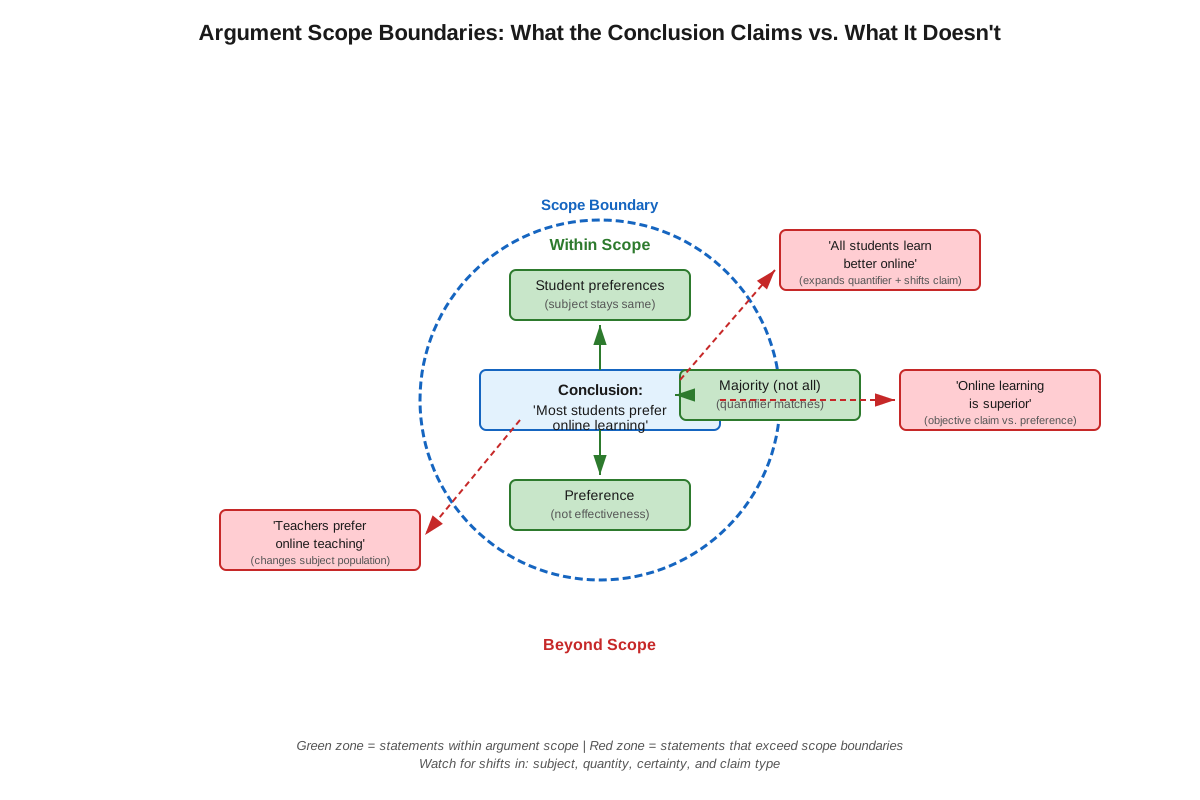
Mastering lsat argument scope is essential because scope errors represent one of the most common traps in wrong answer choices across multiple question types. Whether evaluating a strengthening question, identifying a flaw, or selecting an assumption, students must constantly assess whether the reasoning and answer choices remain within the argument's established boundaries. An argument claiming "most students prefer online learning" has a fundamentally different scope than one claiming "all students learn better online" or "online learning is superior in every educational context." The LSAT rewards precision in distinguishing these differences.
Within argument fundamentals, scope serves as a foundational lens through which all other concepts operate. It connects directly to premise-conclusion relationships, assumption identification, and logical validity. Before assessing whether an argument is strong or weak, students must first understand exactly what that argument is attempting to prove. Scope analysis provides this crucial first step, making it indispensable for achieving high scores in the Logical Reasoning sections.
Learning Objectives
- [ ] Identify how Argument scope appears in LSAT questions
- [ ] Explain the reasoning pattern behind Argument scope
- [ ] Apply Argument scope to solve LSAT-style problems accurately
- [ ] Distinguish between arguments with broad versus narrow scope
- [ ] Recognize when answer choices introduce scope shifts that make them incorrect
- [ ] Evaluate whether evidence provided matches the scope of the conclusion drawn
- [ ] Identify common scope indicators and qualifying language in LSAT arguments
Prerequisites
- Basic argument structure: Understanding premises and conclusions is essential because scope analysis requires identifying what the conclusion actually claims before assessing its boundaries.
- Conditional reasoning fundamentals: Recognizing sufficient and necessary conditions helps distinguish between absolute claims and qualified statements, which directly impacts scope.
- Reading comprehension skills: The ability to parse complex sentences and identify subtle qualifiers is necessary for detecting scope limitations in argument language.
- Logical validity concepts: Understanding what makes an argument valid versus invalid provides the foundation for recognizing when conclusions exceed the scope of their supporting evidence.
Why This Topic Matters
Argument scope appears in virtually every Logical Reasoning section on the LSAT, making it one of the highest-yield topics for test preparation. Research on LSAT question patterns reveals that scope-related issues appear in approximately 40-50% of all Logical Reasoning questions, either as the primary concept being tested or as a secondary consideration in eliminating wrong answers. This frequency makes scope mastery non-negotiable for achieving competitive scores.
In real-world applications, scope analysis is fundamental to critical thinking in legal practice, policy analysis, and academic research. Lawyers must constantly assess whether evidence supports the specific claims being made in court, whether precedents apply to current cases, and whether arguments remain within established legal boundaries. The LSAT tests this skill because it directly predicts success in law school and legal practice.
On the exam, scope issues manifest across multiple question types: Strengthen/Weaken questions often include wrong answers that address issues outside the argument's scope; Assumption questions frequently test whether students can identify the scope gap between premises and conclusion; Flaw questions commonly feature scope shifts as the logical error; Inference questions require selecting conclusions that don't exceed the scope of the given information; and Parallel Reasoning questions demand matching the scope characteristics of the original argument. Understanding scope provides a unified framework for approaching all these question types systematically.
Core Concepts
Defining Argument Scope
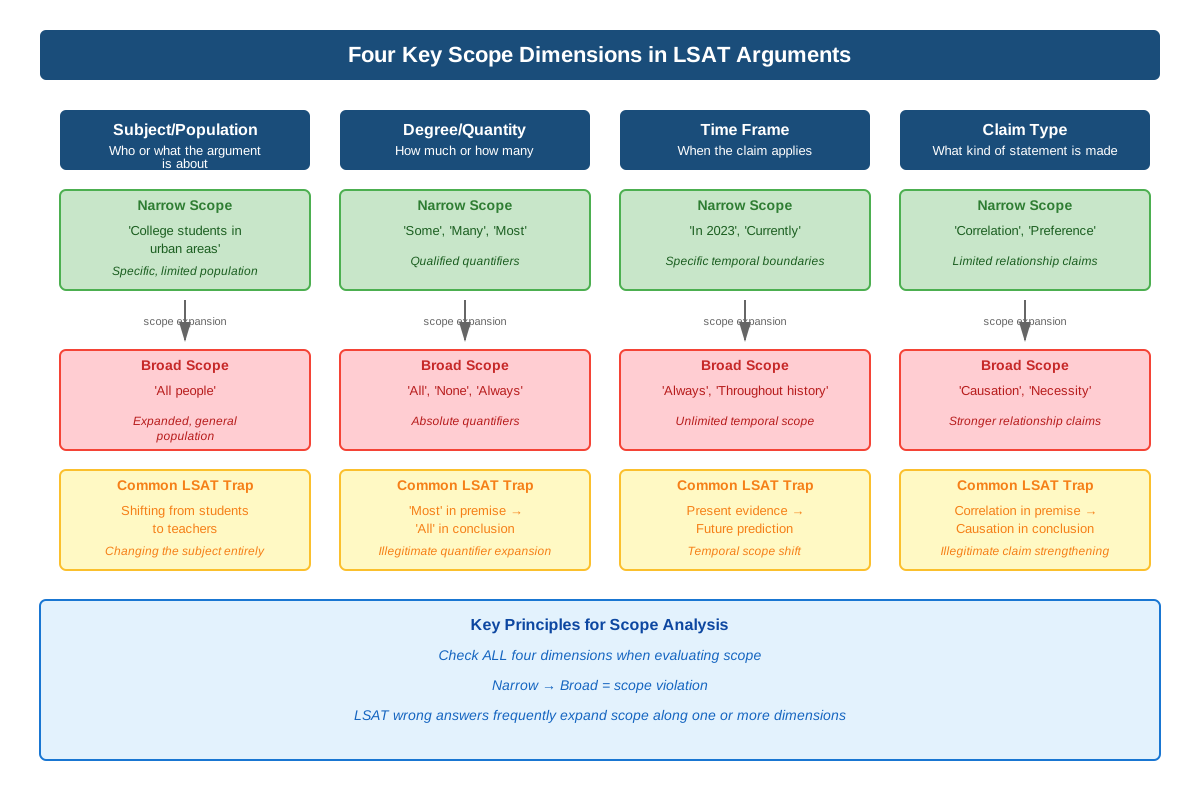
Argument scope refers to the specific boundaries and limitations of what an argument claims. It encompasses several dimensions: the subject matter addressed, the degree of certainty expressed, the time frame referenced, the population or group discussed, and any qualifying conditions stated. An argument's scope is determined by the language used in its conclusion and the extent to which its premises support that specific conclusion.
Consider the difference between these conclusions:
- "This policy will reduce crime" (broad scope: all crime)
- "This policy will reduce violent crime" (narrower subject scope)
- "This policy may reduce violent crime" (adds uncertainty qualifier)
- "This policy will reduce violent crime in urban areas" (adds geographic limitation)
Each modification changes the argument's scope, and consequently, what evidence would be relevant and sufficient to support it.
Scope Indicators and Qualifying Language
The LSAT uses specific linguistic markers to establish scope. Quantifiers like "all," "most," "some," "many," "few," and "none" define how broadly a claim applies. Modal verbs such as "must," "will," "should," "may," "might," and "could" indicate degrees of certainty. Temporal markers including "always," "never," "sometimes," "currently," "historically," and "in the future" establish time-based boundaries.
Limiting phrases are particularly important: "in this context," "under these conditions," "for this purpose," "in most cases," and "generally speaking" all narrow an argument's scope. Conversely, the absence of qualifiers often signals broader scope. An unqualified statement like "Exercise improves health" makes a more sweeping claim than "Regular cardiovascular exercise generally improves heart health in adults."
Scope Shifts and Scope Creep
A scope shift occurs when an argument's conclusion makes claims beyond what its premises establish. This represents one of the most common logical flaws on the LSAT. For example:
Premises: Studies show that students who eat breakfast score higher on morning tests.
Conclusion: Therefore, eating breakfast causes improved academic performance overall.
The scope shift here involves multiple dimensions: from correlation to causation, from morning tests to all academic performance, and from a specific measured outcome to a broader concept. Recognizing these shifts is crucial for flaw identification and for eliminating answer choices that commit similar errors.
Scope creep in answer choices occurs when an option that seems relevant actually addresses a broader or narrower issue than the argument discusses. An argument about "reducing traffic congestion" has different scope than one about "improving transportation efficiency" or "reducing vehicle emissions"—these are related but distinct claims.
Matching Evidence to Scope
A well-constructed argument maintains scope consistency between its premises and conclusion. The evidence provided should be sufficient and relevant for the specific claim made. When evaluating arguments, assess three key relationships:
- Subject matter alignment: Do the premises discuss the same topic as the conclusion?
- Degree of certainty match: If the conclusion claims something "will definitely" occur, do the premises support that level of certainty, or only that it "might" occur?
- Population/context correspondence: If the conclusion is about "teenagers," do the premises provide evidence about teenagers specifically, or about people generally?
| Scope Dimension | Narrow Example | Broad Example | Scope Mismatch Risk |
|---|---|---|---|
| Subject | "reduces anxiety" | "improves mental health" | High - mental health includes many conditions beyond anxiety |
| Quantifier | "some students" | "all students" | High - universal claims require universal evidence |
| Certainty | "may help" | "will solve" | Medium - definitive conclusions need stronger support |
| Time | "in the short term" | "permanently" | High - temporary effects don't establish lasting ones |
| Context | "in laboratory settings" | "in real-world conditions" | High - controlled environments differ from natural ones |
Scope in Different Question Types
Assumption questions frequently test scope by requiring students to identify what must be true to bridge a scope gap. If premises discuss "economic benefits" but the conclusion claims "overall advantages," the assumption must connect economic benefits to overall advantages—staying within both scopes.
Strengthen/Weaken questions demand scope precision because wrong answers often address related but out-of-scope issues. An argument about whether a policy will reduce unemployment can only be strengthened by evidence about unemployment specifically, not about general economic health (unless explicitly connected).
Flaw questions commonly feature scope shifts as the error. The correct answer must accurately describe both what the argument does (the premises' scope) and what it concludes (the conclusion's scope), identifying the mismatch.
Inference questions require selecting conclusions that don't exceed the scope of the given statements. If the passage states "most mammals are warm-blooded," you cannot infer "all mammals are warm-blooded" or "only mammals are warm-blooded"—both exceed the scope.
Absolute versus Qualified Claims
Understanding the distinction between absolute and qualified claims is essential for scope analysis. Absolute claims use language like "all," "none," "always," "never," "must," and "will definitely." These claims have broad scope and require strong, comprehensive evidence. They're also easier to weaken—a single counterexample can disprove an absolute claim.
Qualified claims use language like "most," "many," "some," "often," "generally," "may," and "tends to." These claims have narrower scope and require less comprehensive evidence. They're harder to weaken because they already acknowledge exceptions.
The LSAT frequently tests whether students recognize that evidence supporting a qualified claim doesn't necessarily support the corresponding absolute claim, and vice versa. Evidence that "some lawyers work long hours" doesn't support "most lawyers work long hours," even though both statements could be true—the evidence's scope doesn't match the broader claim's scope.
Concept Relationships
Argument scope serves as a foundational concept that connects to virtually every other element of logical reasoning. The relationship flows as follows:
Argument Structure → Scope Analysis → Assumption Identification → Argument Evaluation
Understanding basic argument structure (premises and conclusions) enables scope analysis, which reveals what the argument claims and what it doesn't. This scope analysis then illuminates the assumptions required to bridge any gaps between premises and conclusion. Finally, recognizing scope allows for proper evaluation of whether the argument succeeds or fails.
Scope connects directly to conditional reasoning because conditional statements have inherent scope limitations. "If A, then B" makes no claims about what happens when A is absent—that falls outside its scope. Confusing sufficient and necessary conditions often involves scope errors.
The relationship to causal reasoning is particularly important. Causal claims ("X causes Y") have specific scope that differs from correlational claims ("X and Y occur together"). Many LSAT arguments commit scope shifts by moving from correlation to causation without justification.
Scope analysis also underlies formal logic applications. When translating arguments into logical notation, scope determines which quantifiers to use and which logical operators apply. A scope error in translation produces an invalid logical form.
Within the broader context of argument fundamentals, scope acts as a quality control mechanism: Premise Identification → Conclusion Identification → Scope Analysis → Validity Assessment → Strength Evaluation. Each step depends on accurate scope understanding.
High-Yield Facts
⭐ Scope errors represent the most common reason for wrong answers across all Logical Reasoning question types.
⭐ Qualifying language (most, some, may, generally) narrows an argument's scope and makes it easier to support but harder to attack.
⭐ A scope shift occurs when a conclusion makes claims beyond what the premises establish, representing a fundamental logical flaw.
⭐ Evidence that is relevant to a related topic is still incorrect if it falls outside the argument's specific scope.
⭐ Absolute claims (all, none, always, never) have broader scope and require more comprehensive evidence than qualified claims.
- Scope encompasses subject matter, degree of certainty, time frame, population, and contextual limitations.
- Answer choices that introduce new topics, even related ones, typically fall outside the argument's scope.
- An argument about correlation has narrower scope than one claiming causation.
- Temporal scope matters: evidence about past trends doesn't necessarily support claims about future outcomes.
- Geographic or demographic scope limitations in premises must be respected in conclusions.
- The absence of qualifying language often indicates broader scope than the evidence supports.
- Scope consistency between premises and conclusion is necessary (though not sufficient) for argument validity.
- In strengthen/weaken questions, the correct answer must address the specific claim made, not a related but distinct issue.
- Inference questions require selecting conclusions that don't exceed the scope of the given information.
- Recognizing scope requires careful attention to every word in the conclusion, especially modifiers and qualifiers.
Quick check — test yourself on Argument scope so far.
Try Flashcards →Common Misconceptions
Misconception: If an answer choice is factually true and related to the argument's topic, it must be correct.
Correction: An answer can be true and relevant to the general subject area while still falling outside the argument's specific scope. The argument might discuss "employee satisfaction" while an answer addresses "employee productivity"—related but distinct scopes.
Misconception: Broader conclusions are stronger because they claim more.
Correction: Broader conclusions are actually harder to support because they require more comprehensive evidence. An argument claiming "this policy will reduce all crime" needs much stronger evidence than one claiming "this policy will reduce property crime in urban areas."
Misconception: If premises support a qualified claim, they also support the corresponding absolute claim.
Correction: Evidence that "most X are Y" does not support "all X are Y." The scope of "most" is narrower than "all," and the evidence's scope must match the conclusion's scope.
Misconception: Scope only matters for the conclusion, not for the premises.
Correction: Both premises and conclusions have scope, and they must align. If premises discuss one population or context, the conclusion cannot make claims about a different population or context without additional justification.
Misconception: Related concepts have the same scope.
Correction: Closely related concepts often have different scopes. "Happiness," "life satisfaction," and "well-being" are related but not identical. An argument about one cannot automatically draw conclusions about the others without establishing the connection.
Misconception: Scope shifts are always obvious and dramatic.
Correction: The LSAT often features subtle scope shifts involving small changes in degree, certainty, or specificity. Moving from "may help" to "will solve" or from "reduces" to "eliminates" represents a scope shift even though the subject matter remains the same.
Misconception: If an answer choice stays within the argument's topic area, it respects the argument's scope.
Correction: Staying within the general topic is necessary but not sufficient. An argument about "the effectiveness of online education for adult learners" has different scope than one about "the cost-effectiveness of online education" or "online education for all age groups," even though all involve online education.
Worked Examples
Example 1: Identifying Scope in a Flaw Question
Argument: "A recent study found that people who drink green tea daily have lower rates of heart disease than those who don't. Therefore, drinking green tea prevents heart disease."
Question: Which of the following describes a flaw in the argument's reasoning?
Analysis:
First, identify the argument's scope. The premises establish a correlation between daily green tea consumption and lower heart disease rates. The conclusion claims that green tea prevents heart disease—a causal claim.
The scope shift occurs in two dimensions:
- Correlation to causation: The premises only establish that two things occur together, while the conclusion claims one causes the other.
- "Lower rates" to "prevents": The premises show reduced incidence, while "prevents" suggests complete protection or elimination.
The correct answer must identify this scope shift. It might state: "The argument treats evidence of a correlation as though it established a causal relationship" or "The argument concludes that something prevents a condition based merely on evidence that it is associated with reduced rates of that condition."
Wrong answer scope traps:
- "The argument fails to consider whether green tea has other health benefits" (outside scope—the argument only claims prevention of heart disease)
- "The argument doesn't address whether other beverages might also reduce heart disease" (outside scope—the argument makes no comparative claims)
- "The argument assumes all types of green tea are equally effective" (outside scope—the argument doesn't distinguish between types)
Connection to learning objectives: This example demonstrates how to identify scope shifts (correlation vs. causation) and recognize when answer choices introduce out-of-scope considerations.
Example 2: Scope in a Strengthen Question
Argument: "City officials claim that the new traffic light timing system will reduce commute times for most drivers. However, the system was only tested during off-peak hours. Therefore, the officials' claim is not well-supported."
Question: Which of the following, if true, most strengthens the argument?
Analysis:
Identify the scope of the conclusion: The argument claims the officials' assertion about reducing commute times "for most drivers" is not well-supported because testing occurred only during off-peak hours.
The scope gap involves the difference between off-peak conditions (when testing occurred) and the conditions experienced by "most drivers" (presumably including peak hours). To strengthen this argument, we need evidence that off-peak conditions differ significantly from the conditions most drivers experience, making the test results unrepresentative.
Strong answer (within scope): "Most drivers commute during peak hours when traffic patterns differ substantially from off-peak patterns."
This stays within scope by:
- Addressing "most drivers" (matching the conclusion's scope)
- Connecting off-peak testing to the claim about commute times
- Establishing that the test conditions don't represent typical conditions
Wrong answer scope traps:
- "The new system is more expensive than the old system" (outside scope—the argument is about whether the claim is well-supported, not about cost)
- "Some drivers have complained about the new system" (outside scope—addresses driver satisfaction, not whether the testing supports the specific claim about commute times)
- "Traffic lights in other cities have not reduced commute times" (outside scope—the argument is about whether this specific claim is well-supported by this specific testing, not about general effectiveness)
- "The system might increase commute times during peak hours" (tempting but wrong scope—this would weaken the officials' claim directly, but the argument's conclusion is about whether the claim is well-supported by the testing, not about whether the claim is true)
Connection to learning objectives: This example shows how to apply scope analysis to eliminate wrong answers that address related but distinct issues, and how to identify answers that precisely match the argument's scope.
Exam Strategy
Approaching Scope Questions
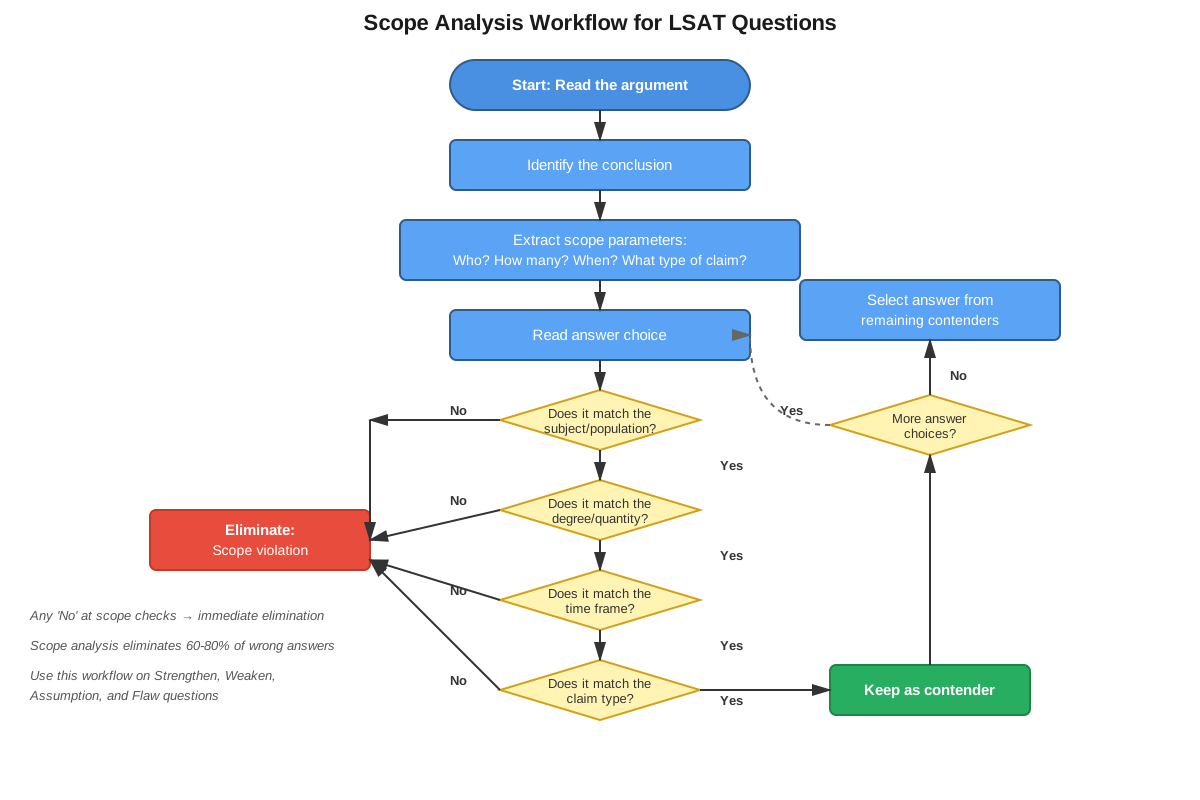
When encountering any Logical Reasoning question, implement this systematic scope analysis:
- Read the conclusion first and identify its exact scope: What specifically is being claimed? Note all qualifiers, quantifiers, and limiting language.
- Identify scope indicators: Circle or mentally note words like "all," "most," "some," "may," "will," "always," "in this context," etc.
- Check premise-conclusion scope alignment: Do the premises discuss the same subject, population, time frame, and degree as the conclusion?
- Predict scope-based wrong answers: Before reading answer choices, anticipate common scope traps (too broad, too narrow, different subject).
- Eliminate out-of-scope answers first: This often removes 2-3 options immediately, improving odds significantly.
Trigger Words and Phrases
Scope-narrowing language (makes claims easier to support):
- "most," "many," "some," "often," "generally," "typically," "tends to"
- "may," "might," "could," "can," "possibly"
- "in many cases," "under certain conditions," "in this context"
Scope-broadening language (makes claims harder to support):
- "all," "every," "none," "always," "never"
- "must," "will," "cannot," "definitely"
- "in all cases," "without exception," "universally"
Scope-shift red flags:
- Moving from correlation words ("associated with," "linked to") to causation words ("causes," "produces," "leads to")
- Changing from specific to general or vice versa
- Introducing new subjects in the conclusion not mentioned in premises
- Shifting time frames (past evidence → future claims)
Process of Elimination Strategy
Exam Tip: In strengthen/weaken questions, immediately eliminate any answer choice that addresses a different aspect of the topic than what the conclusion specifically claims. Even if the answer would strengthen/weaken a related argument, it's wrong if it doesn't match the scope.
For assumption questions, eliminate answers that:
- Introduce entirely new concepts not bridging the existing scope gap
- Are broader than necessary to connect premises to conclusion
- Address issues the argument doesn't depend on
For flaw questions, eliminate answers that:
- Describe errors the argument doesn't commit
- Reference scope issues not present in the argument
- Mischaracterize the scope of either premises or conclusion
Time Allocation
Scope analysis should take 10-15 seconds during the initial argument reading. This upfront investment saves time by enabling rapid elimination of wrong answers. If you find yourself spending more than 30 seconds evaluating a single answer choice, you likely haven't clearly identified the argument's scope—return to the conclusion and re-establish boundaries before continuing.
Memory Techniques
The SCOPE Acronym
Subject matter: What topic is actually being discussed?
Certainty level: How definite is the claim (must, may, might)?
Object/Population: Who or what does this apply to?
Period/Time frame: When does this claim apply?
Extent/Degree: How much or how broadly does this claim apply?
Visualization Strategy
Picture argument scope as a spotlight on a stage. The conclusion illuminates a specific area (the scope). Premises must provide evidence within that lit area. Answer choices that discuss things outside the spotlight—even if they're on the same stage (related topic)—fall outside scope. This mental image helps quickly identify when answers drift into darkness (out of scope).
The Qualifier Check
Before selecting any answer, perform the "exact words" test: Could you defend your answer choice using only the exact words from the argument, without adding interpretation? If you need to assume the argument "really means" something broader or different, you're likely exceeding its scope.
Scope Boundary Markers
Think of qualifying language as fence posts marking boundaries. When you see "most," "some," "may," or "in this context," mentally place a fence post. The argument cannot make claims beyond these markers without additional support. This visualization makes scope violations more obvious.
Summary
Argument scope represents the specific boundaries and limitations of what an argument claims, encompassing the subject matter, degree of certainty, time frame, population, and qualifying conditions expressed in the conclusion. Mastering scope analysis is essential for LSAT success because scope-related issues appear in approximately 40-50% of Logical Reasoning questions, either as the primary concept tested or as the basis for eliminating wrong answers. The key to scope mastery lies in precise attention to qualifying language, recognition of scope shifts between premises and conclusions, and systematic elimination of answer choices that introduce out-of-scope considerations. Students must distinguish between absolute and qualified claims, understand that related concepts often have different scopes, and recognize that evidence supporting one claim doesn't automatically support broader or narrower versions of that claim. Effective scope analysis requires identifying the exact boundaries of the conclusion first, then ensuring that premises provide adequate support within those boundaries, and finally verifying that answer choices address the specific claim made rather than related but distinct issues.
Key Takeaways
- Argument scope defines the precise boundaries of what an argument claims, including subject matter, certainty level, population, time frame, and degree—every word in the conclusion matters.
- Scope errors are the most common trap in wrong answer choices across all question types; eliminating out-of-scope answers first dramatically improves accuracy and speed.
- Qualifying language narrows scope: "most," "some," "may," and "generally" create more limited claims that require less comprehensive evidence than absolute claims using "all," "must," or "always."
- Scope shifts between premises and conclusion represent fundamental logical flaws, particularly when arguments move from correlation to causation or from specific evidence to general conclusions.
- Related concepts don't necessarily share the same scope; "employee satisfaction," "employee productivity," and "employee retention" are distinct claims requiring different evidence.
- Evidence must match the conclusion's scope in subject, certainty, population, and time frame; relevant evidence that falls outside these boundaries cannot support the argument.
- Systematic scope analysis—identifying conclusion scope, checking premise alignment, and eliminating out-of-scope answers—provides a reliable framework for approaching all Logical Reasoning questions.
Related Topics
Assumption Identification: Mastering scope enables recognition of assumption questions that test scope gaps between premises and conclusions. Understanding what falls within versus outside an argument's scope reveals what must be assumed to bridge those gaps.
Causal Reasoning: Scope analysis is crucial for causal arguments because causal claims have specific scope requirements. Distinguishing between correlation and causation involves recognizing scope shifts, and evaluating causal arguments requires assessing whether evidence matches the causal claim's scope.
Formal Logic and Conditional Reasoning: Conditional statements have inherent scope limitations that must be respected. Understanding scope prevents common errors like confusing sufficient and necessary conditions or making unwarranted inferences from conditional statements.
Strengthen and Weaken Questions: Advanced work with these question types builds directly on scope mastery, requiring students to identify not just whether evidence is relevant, but whether it addresses the precise scope of the argument's conclusion.
Flaw Recognition: Many logical flaws involve scope violations. Deeper study of flaw types reveals how scope shifts, overgeneralizations, and unwarranted assumptions all represent different manifestations of scope errors.
Practice CTA
Now that you understand the fundamental principles of argument scope, it's time to apply this knowledge through deliberate practice. Attempt the practice questions focusing specifically on identifying scope boundaries, recognizing scope shifts, and eliminating out-of-scope answer choices. Use the flashcards to reinforce scope indicators and qualifying language until recognizing these markers becomes automatic. Remember: scope analysis is a skill that improves dramatically with practice. Each question you analyze strengthens your ability to spot scope issues quickly and accurately, building the foundation for excellence across all Logical Reasoning question types. Your investment in mastering this high-yield concept will pay dividends throughout your LSAT preparation and beyond.
Sign up free to keep reading
Create a free AnvayaPrep account to finish this LSAT guide on Argument scope — plus flashcards and practice questions.