Overview
Argument validity is one of the most fundamental and frequently tested concepts in LSAT Logical Reasoning. Understanding validity forms the bedrock upon which nearly all other logical reasoning skills are built. On the LSAT, recognizing whether an argument's conclusion follows necessarily from its premises is essential for tackling question types including Flaw questions, Strengthen/Weaken questions, Assumption questions, and Must Be True questions. The concept of validity distinguishes between arguments where the conclusion is guaranteed by the premises versus those where the conclusion merely seems plausible or probable.
The LSAT tests argument validity both directly and indirectly across approximately 50-60% of all Logical Reasoning questions. While some questions explicitly ask test-takers to identify whether reasoning is valid, most questions require an implicit understanding of validity to recognize logical gaps, identify necessary assumptions, or evaluate argument strength. Mastering lsat argument validity enables students to quickly distinguish between sound reasoning and flawed reasoning, a skill that directly translates to higher scores across multiple question types.
Within the broader framework of argument fundamentals, validity serves as the bridge between understanding argument structure (premises and conclusions) and evaluating argument quality. Once students can identify the components of an argument, the next critical step is determining whether those components connect logically. This topic integrates with assumption identification, formal logic, conditional reasoning, and causal reasoning—all of which depend on understanding when conclusions follow necessarily from their supporting evidence versus when logical gaps exist.
Learning Objectives
- [ ] Identify how Argument validity appears in LSAT questions
- [ ] Explain the reasoning pattern behind Argument validity
- [ ] Apply Argument validity to solve LSAT-style problems accurately
- [ ] Distinguish between valid and invalid arguments regardless of premise truth
- [ ] Recognize the relationship between validity, soundness, and argument strength
- [ ] Evaluate arguments by testing whether alternative scenarios could make premises true while the conclusion remains false
Prerequisites
- Basic argument structure: Understanding premises and conclusions is essential because validity concerns the relationship between these components
- Indicator words: Recognizing conclusion and premise indicators helps identify what the argument claims versus what evidence supports it
- Logical relationships: Familiarity with "if-then" statements and basic logical connections enables recognition of when conclusions follow necessarily
- Reading comprehension: The ability to parse complex sentences and identify main claims is foundational to evaluating logical relationships
Why This Topic Matters
Understanding argument validity has profound real-world applications beyond standardized testing. Legal reasoning, scientific methodology, policy analysis, and everyday decision-making all require the ability to distinguish between conclusions that follow necessarily from evidence versus those that represent logical leaps. Lawyers must construct valid arguments to persuade judges; scientists must ensure their conclusions follow from experimental data; citizens must evaluate political claims for logical coherence.
On the LSAT specifically, validity concepts appear in approximately 25-30 questions per test across both Logical Reasoning sections. The concept manifests most directly in:
- Flaw questions (15-20% of LR): Identifying when conclusions don't follow from premises
- Assumption questions (20-25% of LR): Finding missing links that would make arguments valid
- Strengthen/Weaken questions (20-25% of LR): Evaluating what would make conclusions follow more or less necessarily
- Must Be True questions (10-15% of LR): Identifying what conclusions validly follow from given information
- Parallel Reasoning questions (5-10% of LR): Matching argument structures based on validity patterns
The LSAT frequently disguises validity issues within complex language, making arguments appear stronger than they logically are. Test-makers exploit common reasoning patterns that feel intuitively correct but contain logical gaps. Students who master validity can cut through rhetorical flourishes to identify the logical skeleton of arguments, dramatically improving accuracy and speed.
Core Concepts
Defining Argument Validity
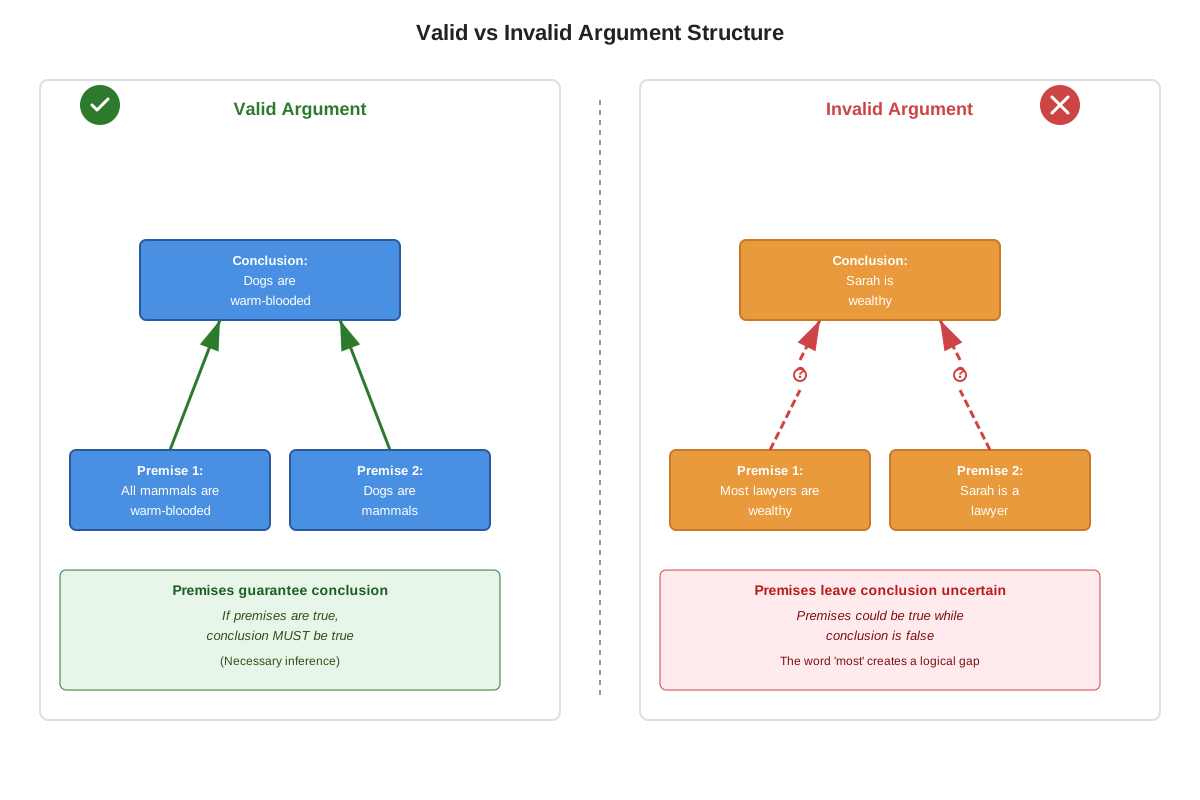
Argument validity refers to a specific logical relationship between an argument's premises and conclusion: an argument is valid if and only if it is impossible for all the premises to be true while the conclusion is false. This definition is precise and technical. Validity concerns the logical structure of an argument, not whether the premises are actually true in reality. A valid argument guarantees that if the premises are true, then the conclusion must be true.
Consider this valid argument:
- Premise 1: All mammals are reptiles
- Premise 2: All reptiles are plants
- Conclusion: Therefore, all mammals are plants
Despite containing obviously false premises, this argument is valid because the conclusion follows necessarily from the premises. If we lived in a bizarre world where those premises were true, the conclusion would have to be true as well. The logical form is what matters for validity.
Validity vs. Soundness vs. Strength
The LSAT requires distinguishing between three related but distinct concepts:
| Concept | Definition | Requirements | LSAT Relevance |
|---|---|---|---|
| Validity | Conclusion follows necessarily from premises | Correct logical structure | Tested directly and indirectly |
| Soundness | Valid argument with true premises | Validity + true premises | Rarely tested explicitly |
| Strength | Conclusion is well-supported but not guaranteed | Good evidence, probable conclusion | Tested in inductive reasoning questions |
Most LSAT arguments are invalid but appear strong because they contain true premises and plausible conclusions. The test challenges students to recognize that plausibility doesn't equal validity. An argument can have true premises, a true conclusion, and still be invalid if the conclusion doesn't follow necessarily.
The Logical Gap
Invalid arguments contain logical gaps—missing connections between premises and conclusions. Identifying these gaps is central to LSAT success. The gap represents information that would need to be true for the conclusion to follow necessarily from the stated premises.
Example of an argument with a logical gap:
- Premise: Sarah scored in the 99th percentile on the LSAT
- Conclusion: Sarah will be admitted to Harvard Law School
The gap: The argument assumes that scoring in the 99th percentile guarantees admission, ignoring other factors like GPA, personal statements, and recommendation letters. The premise could be true while the conclusion is false, making the argument invalid.
Testing for Validity: The Counterexample Method
The most reliable method for testing validity involves searching for counterexamples—scenarios where all premises are true but the conclusion is false. If such a scenario is possible, the argument is invalid. If no such scenario can exist, the argument is valid.
Steps for applying the counterexample method:
- Assume all premises are true
- Imagine the conclusion is false
- Determine whether this combination is logically possible
- If possible, the argument is invalid; if impossible, the argument is valid
This method works because validity means the truth of premises guarantees the truth of the conclusion. Finding even one scenario that breaks this guarantee proves invalidity.
Formal vs. Informal Validity
Formal validity depends on logical form and can be evaluated using symbolic logic. Arguments with forms like modus ponens (If P then Q; P; therefore Q) are formally valid regardless of content.
Informal validity appears in natural language arguments where validity depends on meaning rather than pure form. The LSAT primarily tests informal validity, requiring students to understand both logical structure and content meaning.
Example of formal validity:
- If it rains, the streets are wet
- It is raining
- Therefore, the streets are wet
This argument is valid by virtue of its form (modus ponens), which can be represented symbolically.
Common Invalid Argument Patterns
The LSAT repeatedly uses certain invalid patterns that test-takers must recognize instantly:
Affirming the Consequent:
- If P, then Q
- Q is true
- Therefore, P is true
(Invalid because Q could be true for other reasons)
Denying the Antecedent:
- If P, then Q
- P is false
- Therefore, Q is false
(Invalid because Q could still be true through other means)
Correlation-Causation Confusion:
- X and Y occur together
- Therefore, X causes Y
(Invalid because correlation doesn't establish causal direction or rule out common causes)
Part-to-Whole Fallacy:
- Each part has property X
- Therefore, the whole has property X
(Invalid because properties don't always transfer from parts to wholes)
Necessary vs. Sufficient Conditions
Understanding the distinction between necessary and sufficient conditions is crucial for evaluating validity. A sufficient condition guarantees an outcome; a necessary condition is required for an outcome but doesn't guarantee it.
Arguments often fail validity by confusing these:
- Premise: Having a law degree is necessary to practice law
- Conclusion: Having a law degree means you can practice law
This is invalid because necessary conditions don't guarantee outcomes—you also need to pass the bar exam, maintain ethical standards, etc.
Concept Relationships
The concepts within argument validity form an interconnected system. Validity serves as the central concept, with the logical gap representing the absence of validity. The counterexample method provides the practical tool for testing validity, while understanding necessary and sufficient conditions enables recognition of specific validity patterns. Common invalid patterns represent frequently tested applications of validity principles.
These concepts connect to prerequisite knowledge: understanding argument structure (premises and conclusions) is necessary before evaluating whether conclusions follow from premises. The ability to identify logical relationships enables recognition of when connections are necessary versus merely probable.
Argument validity connects forward to more advanced topics: assumption questions require identifying what would make invalid arguments valid; formal logic applies validity principles to categorical and conditional statements; causal reasoning represents a specific domain where validity issues frequently arise; parallel reasoning requires matching validity patterns across different content.
Relationship map:
Argument Structure → Validity Assessment → Logical Gap Identification → Assumption Recognition → Argument Evaluation
High-Yield Facts
⭐ Validity concerns logical structure, not truth: An argument can be valid with false premises and a false conclusion, or invalid with true premises and a true conclusion
⭐ An argument is valid if and only if it's impossible for all premises to be true while the conclusion is false: This is the technical definition that grounds all validity assessment
⭐ Most LSAT arguments are invalid: The test primarily presents flawed reasoning that test-takers must identify and analyze
⭐ The counterexample method is the most reliable validity test: If you can imagine premises being true while the conclusion is false, the argument is invalid
⭐ Logical gaps represent missing information needed for validity: Identifying gaps is essential for assumption questions and flaw questions
- Valid arguments can have any combination of true/false premises and true/false conclusions except true premises with a false conclusion
- Soundness requires both validity and true premises, but the LSAT rarely tests soundness explicitly
- Strength applies to inductive arguments where conclusions are probable but not guaranteed
- Affirming the consequent and denying the antecedent are the most common formally invalid patterns on the LSAT
- Necessary conditions are required but not sufficient; sufficient conditions guarantee but aren't required
- Validity is preserved across parallel reasoning—arguments with the same logical form have the same validity status
- The LSAT uses complex language to disguise simple validity issues, making invalid arguments appear stronger than they are
- Conditional statements (if-then) are the most common context for testing validity on the LSAT
- An argument can feel persuasive or have a plausible conclusion while still being invalid
- Recognizing validity patterns enables faster question solving across multiple question types
Quick check — test yourself on Argument validity so far.
Try Flashcards →Common Misconceptions
Misconception: If an argument has true premises and a true conclusion, it must be valid → Correction: Validity requires that the conclusion follows necessarily from the premises, not merely that both happen to be true. An argument can have true premises and a true conclusion while still being invalid if the logical connection is missing.
Misconception: Invalid arguments are always bad arguments → Correction: Invalid arguments can still be strong or persuasive in everyday reasoning. The LSAT tests formal validity, but many real-world arguments are inductively strong without being deductively valid. The key is recognizing when the LSAT is testing validity versus strength.
Misconception: If you can't think of a counterexample, the argument must be valid → Correction: Failure to imagine a counterexample might reflect limited creativity rather than actual validity. The question is whether a counterexample is logically possible, not whether you can immediately think of one. Some invalid arguments require careful analysis to identify counterexamples.
Misconception: Validity means the argument is convincing or well-reasoned → Correction: Validity is a technical logical property about the relationship between premises and conclusion. An argument with absurd premises can be valid, while a persuasive argument with excellent evidence can be invalid. Don't confuse rhetorical effectiveness with logical validity.
Misconception: Adding more premises always makes an argument more valid → Correction: An argument is either valid or invalid—there are no degrees of validity. Adding premises might make an invalid argument valid by filling logical gaps, but it doesn't make a valid argument "more valid." The concept of "more valid" is incoherent in formal logic.
Misconception: If the conclusion is possible given the premises, the argument is valid → Correction: Validity requires that the conclusion be necessary, not merely possible. An argument is valid only if the conclusion must be true whenever the premises are true. Possibility is a much weaker standard than necessity.
Worked Examples
Example 1: Identifying Validity in a Flaw Question
Question Stem: "The reasoning in the argument is flawed because it..."
Argument: "Every successful entrepreneur has failed multiple times before achieving success. Jennifer has failed at three business ventures. Therefore, Jennifer will eventually become a successful entrepreneur."
Analysis Process:
Step 1: Identify the argument structure
- Premise 1: All successful entrepreneurs have experienced multiple failures
- Premise 2: Jennifer has experienced multiple failures
- Conclusion: Jennifer will become a successful entrepreneur
Step 2: Test for validity using the counterexample method
- Assume both premises are true
- Ask: Could Jennifer have multiple failures and never become successful?
- Yes—many people fail repeatedly without ever succeeding
Step 3: Identify the logical gap
- The argument treats a necessary condition (failure) as if it were sufficient
- Having failures is necessary for entrepreneurial success (according to the premise), but not sufficient
- The argument commits the fallacy of affirming the consequent
Step 4: Connect to the question
- The flaw is treating a necessary condition as sufficient for the conclusion
- Correct answer would state: "treats a condition necessary for entrepreneurial success as if it were sufficient for such success"
Key Takeaway: This argument is invalid because the premises could be true (all successful entrepreneurs fail; Jennifer failed) while the conclusion is false (Jennifer never succeeds). The logical gap involves confusing necessary and sufficient conditions.
Example 2: Applying Validity to an Assumption Question
Question Stem: "Which one of the following is an assumption required by the argument?"
Argument: "The new traffic light at the intersection has reduced accidents by 40%. Therefore, installing traffic lights at other dangerous intersections will reduce accidents throughout the city."
Analysis Process:
Step 1: Identify the current validity status
- Premise: One traffic light reduced accidents at one intersection
- Conclusion: Traffic lights will reduce accidents at other intersections
- Current status: Invalid—the conclusion doesn't follow necessarily
Step 2: Identify the logical gap
- The argument assumes that what worked at one intersection will work at others
- Missing: Information about whether other intersections are similar enough for the same effect
Step 3: Determine what would make the argument valid
- Need: The other intersections are relevantly similar to the first intersection
- Or: The factors that made the traffic light effective at the first intersection are present at other intersections
Step 4: Evaluate answer choices using the negation technique
- Correct assumption, when negated, would make the argument fall apart
- If other intersections are fundamentally different in ways that affect traffic light effectiveness, the conclusion doesn't follow
Correct Assumption: "The conditions at other dangerous intersections are sufficiently similar to those at the intersection where the traffic light was installed."
Key Takeaway: Assumption questions often require identifying what information would bridge the logical gap and make an invalid argument valid. The correct assumption, when added to the premises, makes the conclusion follow necessarily.
Exam Strategy
Approaching Validity Questions
When encountering any Logical Reasoning question, immediately assess the argument's validity as your first analytical step. This assessment guides your approach to every question type:
For Flaw Questions: The flaw is almost always a validity issue—identify where the conclusion doesn't follow from the premises. Look for the logical gap between what's stated and what's concluded.
For Assumption Questions: The correct answer bridges the validity gap. Use the negation technique: if negating an answer choice makes the argument fall apart, you've found the assumption that was making the invalid argument appear valid.
For Strengthen/Weaken Questions: Strengthening answers move arguments closer to validity by providing missing links; weakening answers highlight or expand the logical gap.
Trigger Words and Phrases
Watch for these linguistic signals that often indicate validity issues:
- "Therefore," "thus," "consequently": Mark conclusions that may not follow necessarily
- "Must," "will," "always," "never": Absolute conclusions that require absolute support
- "Some," "many," "most": Quantifiers that often don't support absolute conclusions
- "Probably," "likely," "suggests": Indicate inductive rather than deductive reasoning
- "Because," "since," "given that": Mark premises that may not fully support conclusions
Process of Elimination Tips
Eliminate answers that:
- Discuss premise truth rather than logical structure (validity is about structure, not truth)
- Introduce irrelevant new concepts not connected to the argument's logical gap
- Describe the argument's content rather than its logical form
- Confuse necessary and sufficient conditions
- Treat inductive strength as if it were deductive validity
Favor answers that:
- Identify specific logical gaps between premises and conclusion
- Use precise logical terminology (necessary, sufficient, assumes, requires)
- Address the relationship between premises and conclusion rather than external factors
- Match the scope and strength of the argument's conclusion
Time Allocation
Spend 15-20 seconds identifying the argument's validity status before reading answer choices. This upfront investment saves time by providing a clear target for what you're looking for. If you can't quickly determine whether an argument is valid, use the counterexample method: spend 10 seconds trying to imagine premises being true while the conclusion is false.
For difficult questions, don't get stuck trying to prove validity definitively. If you can generate even one plausible counterexample, treat the argument as invalid and look for answers that identify or address the logical gap.
Memory Techniques
The VALID Acronym
Verify the structure (identify premises and conclusion)
Assume premises are true
Look for gaps (what's missing?)
Imagine counterexamples (can premises be true with conclusion false?)
Determine validity status (valid only if no counterexample possible)
The Traffic Light Visualization
Imagine validity as a traffic light system:
- Green light (Valid): The logical path from premises to conclusion is clear and necessary—you must reach the conclusion
- Yellow light (Strong but Invalid): The path is plausible and probable but not guaranteed—you might reach the conclusion
- Red light (Weak and Invalid): The path has major gaps—you probably won't reach the conclusion
The Bridge Metaphor
Visualize arguments as bridges from premises (one shore) to conclusions (opposite shore). Valid arguments are complete bridges where you can walk directly across. Invalid arguments have gaps in the bridge—assumptions are the missing planks needed to complete the crossing.
The Necessary vs. Sufficient Mnemonic
SUFFicient = So Unquestionably Follows From (if you have it, the result follows)
NECEssary = Needed Every Case Essential (required but doesn't guarantee)
Summary
Argument validity represents the foundational concept in LSAT Logical Reasoning, distinguishing between conclusions that follow necessarily from premises versus those that merely seem plausible. A valid argument is one where it's impossible for all premises to be true while the conclusion is false—validity concerns logical structure rather than factual truth. The LSAT primarily tests invalid arguments, requiring students to identify logical gaps, recognize common fallacy patterns, and determine what assumptions would make arguments valid. Mastering validity requires understanding the distinction between necessary and sufficient conditions, applying the counterexample method to test logical relationships, and recognizing that persuasive arguments with true premises can still be invalid. This concept appears across 50-60% of Logical Reasoning questions, making it essential for LSAT success. Students must develop the ability to quickly assess validity status, identify specific logical gaps, and apply this understanding across multiple question types including Flaw, Assumption, Strengthen/Weaken, and Must Be True questions.
Key Takeaways
- Validity is about logical structure, not truth—an argument can be valid with false premises or invalid with true premises
- An argument is valid if and only if it's impossible for premises to be true while the conclusion is false
- The counterexample method is the most reliable way to test validity: if you can imagine true premises with a false conclusion, the argument is invalid
- Most LSAT arguments are invalid, containing logical gaps that assumption questions ask you to identify and fill
- Understanding necessary versus sufficient conditions is crucial for recognizing common validity errors
- Validity assessment should be your first analytical step for every Logical Reasoning question
- Common invalid patterns (affirming the consequent, denying the antecedent, correlation-causation) appear repeatedly on the LSAT
Related Topics
Formal Logic and Conditional Reasoning: Building on validity concepts, formal logic explores how to diagram and manipulate conditional statements systematically, enabling faster recognition of valid and invalid inference patterns.
Assumption Identification: This advanced skill directly applies validity understanding by requiring students to identify the precise missing information that would transform invalid arguments into valid ones.
Causal Reasoning: A specific domain where validity issues frequently arise, causal arguments require understanding when evidence sufficiently supports causal conclusions versus when alternative explanations remain possible.
Parallel Reasoning: This question type tests whether students can recognize that arguments with the same logical form have the same validity status, requiring abstract pattern matching skills.
Sufficient and Necessary Assumptions: This advanced distinction builds on basic validity by categorizing assumptions into those that guarantee validity (sufficient) versus those merely required for validity (necessary).
Practice CTA
Now that you understand the fundamental principles of argument validity, it's time to cement this knowledge through active practice. Attempt the practice questions designed for this topic, focusing on applying the counterexample method and identifying logical gaps in real LSAT-style arguments. Use the flashcards to reinforce key distinctions between validity, soundness, and strength, and to memorize common invalid patterns. Remember: understanding validity intellectually is just the first step—developing the instinct to spot validity issues quickly under timed conditions requires deliberate practice. Every question you work through builds the pattern recognition skills that will serve you throughout the Logical Reasoning sections. You've built the foundation; now construct mastery through application!
Sign up free to keep reading
Create a free AnvayaPrep account to finish this LSAT guide on Argument validity — plus flashcards and practice questions.