Overview
In LSAT Logical Reasoning, the distinction between claims versus facts represents a foundational skill that underlies nearly every argument analysis task. This concept addresses the critical difference between statements that are presented as objective, verifiable truths and statements that represent assertions, opinions, or positions that require support. Understanding this distinction enables test-takers to properly identify the structure of arguments, recognize what needs evidence versus what serves as evidence, and evaluate the logical relationships between different components of reasoning.
The LSAT claims versus facts distinction appears throughout the Logical Reasoning section, affecting how students approach assumption questions, strengthen/weaken questions, flaw questions, and method of reasoning questions. When an argument presents certain statements as established facts while advancing others as claims requiring support, recognizing this difference determines whether a test-taker can accurately identify premises versus conclusions, evaluate evidential relationships, and spot logical gaps. This skill directly impacts performance on approximately 40-50% of Logical Reasoning questions, making it one of the highest-yield topics in argument fundamentals.
Within the broader landscape of logical reasoning, the claims versus facts distinction connects intimately with premise-conclusion identification, evidence evaluation, and assumption recognition. While some statements in LSAT arguments function as background information or established facts that require no further justification, others represent the author's position or interpretation that demands evidential support. Mastering this distinction enables students to move beyond surface-level reading and engage with the logical architecture of arguments, understanding not just what is said but how different statements function within the reasoning structure.
Learning Objectives
- [ ] Identify how Claims versus facts appears in LSAT questions
- [ ] Explain the reasoning pattern behind Claims versus facts
- [ ] Apply Claims versus facts to solve LSAT-style problems accurately
- [ ] Distinguish between factual premises and unsupported claims within complex arguments
- [ ] Recognize when the LSAT treats a statement as an established fact versus a contestable claim
- [ ] Evaluate whether an argument inappropriately treats a claim as if it were an established fact
- [ ] Identify when answer choices confuse claims with facts or vice versa
Prerequisites
- Basic argument structure: Understanding what constitutes a premise and conclusion is essential because claims and facts function differently within these structural roles
- Reading comprehension fundamentals: The ability to parse complex sentences and identify main ideas enables recognition of whether a statement is being asserted or assumed
- Indicator word recognition: Familiarity with conclusion indicators ("therefore," "thus") and premise indicators ("because," "since") helps distinguish claims from supporting facts
- Logical relationships: Understanding how statements support one another provides the foundation for recognizing which statements need support (claims) versus which provide support (facts)
Why This Topic Matters
The claims versus facts distinction matters profoundly in real-world contexts beyond the LSAT. Legal reasoning, scientific discourse, policy debates, and everyday argumentation all depend on distinguishing between what is established and what requires proof. Attorneys must recognize which assertions need evidentiary support and which can be treated as stipulated facts. Scientists distinguish between observational data (facts) and theoretical interpretations (claims). Policy analysts separate empirical findings from value judgments and recommendations.
On the LSAT specifically, this topic appears with remarkable frequency. Approximately 45-50% of Logical Reasoning questions require students to distinguish between claims and facts, either explicitly or implicitly. Flaw questions often hinge on recognizing when an argument treats a claim as if it were an established fact. Assumption questions frequently test whether students can identify the gap between factual premises and claimed conclusions. Strengthen and weaken questions require understanding which statements are open to challenge (claims) versus which are treated as given (facts). Method of reasoning questions may ask students to identify how an argument uses established facts to support a claim or how it inappropriately assumes a claim without support.
Common manifestations in LSAT passages include: arguments that present survey results as facts but draw interpretive claims from them; passages that cite historical events as facts while making causal claims about their significance; scenarios that describe observable phenomena as facts while advancing explanatory claims; and arguments that reference expert opinions as facts while making broader claims about implications. The LSAT consistently tests whether students can recognize these distinctions under time pressure and apply them to evaluate argument quality.
Core Concepts
Defining Claims and Facts
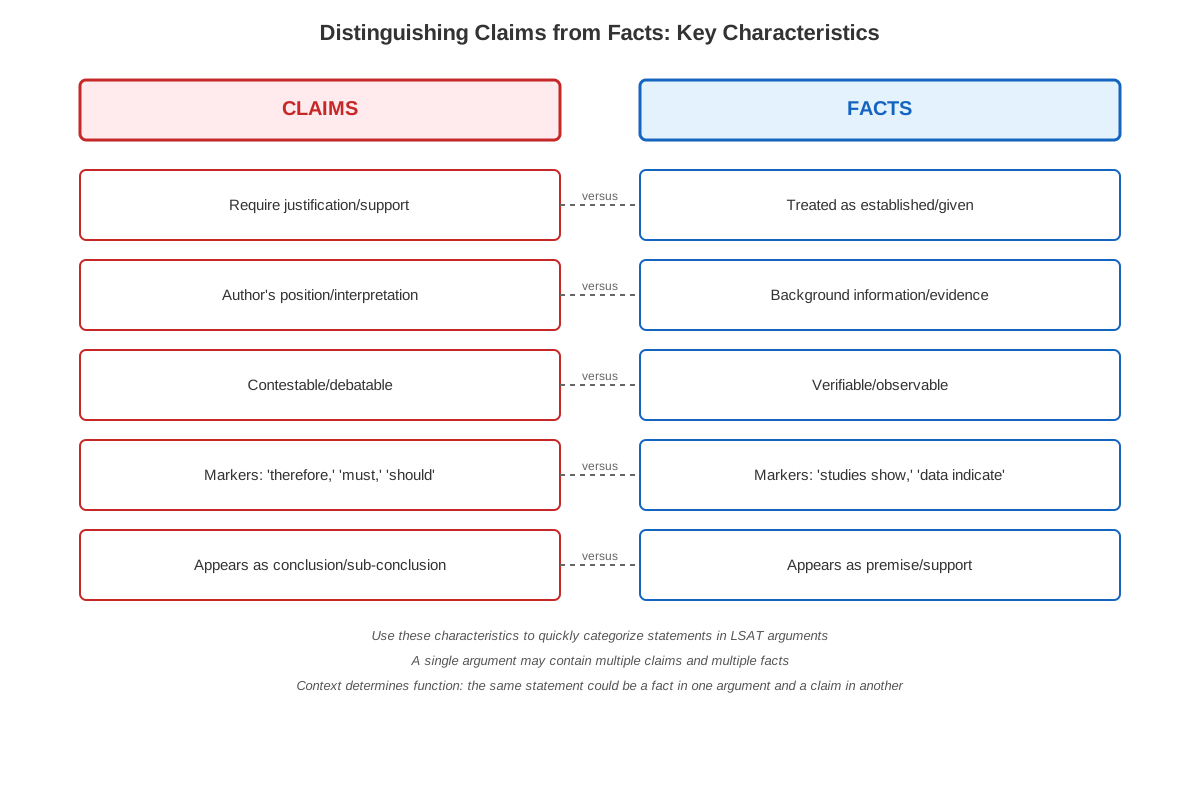
A claim is a statement that asserts a position, interpretation, judgment, or conclusion that requires justification or support. Claims represent what an argument is trying to establish or convince the reader to accept. They are contestable, meaning reasonable people might disagree about their truth or validity. In LSAT arguments, claims typically appear as conclusions, but they can also appear as intermediate steps in reasoning that themselves require support.
A fact, in the LSAT context, is a statement presented as established, given, or accepted for the purposes of the argument. Facts serve as the evidential foundation—the starting points from which reasoning proceeds. Importantly, the LSAT distinction between claims and facts is not about absolute truth in the real world, but rather about functional role within the argument. A statement functions as a fact when the argument treats it as not requiring further justification, regardless of whether it might be contestable outside the argument's context.
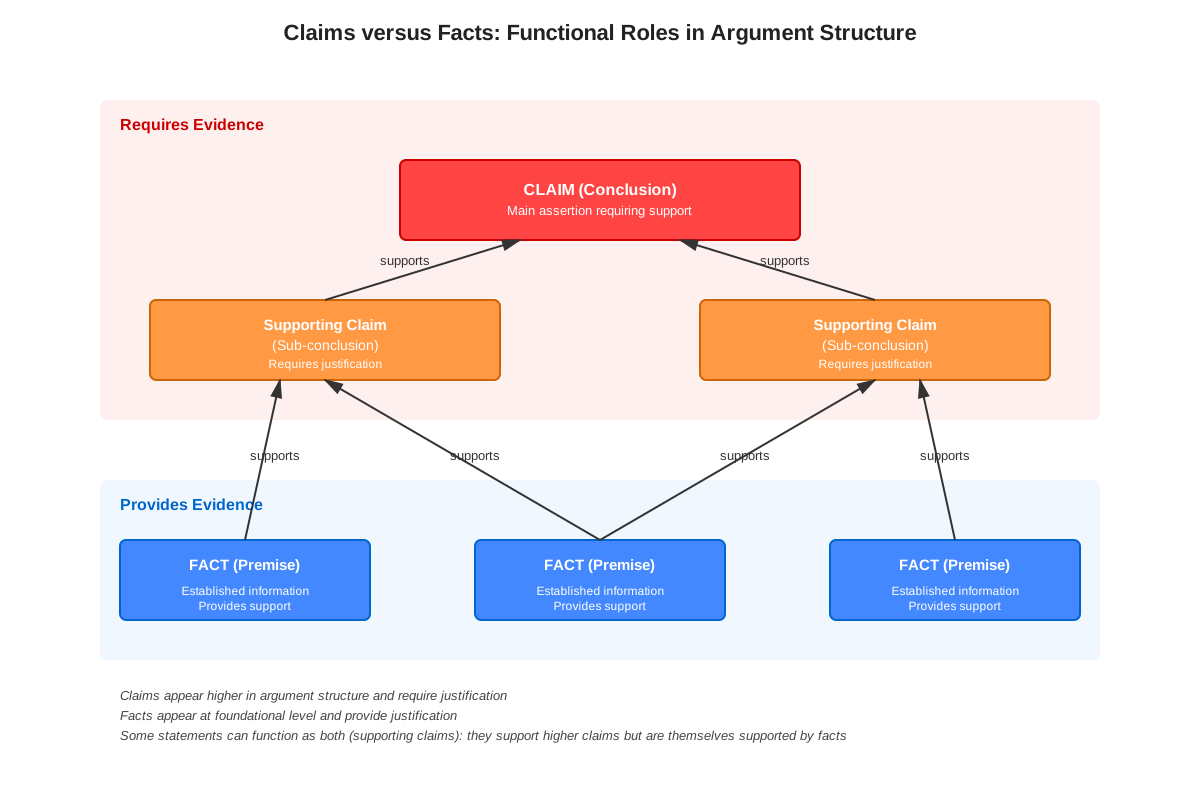
Functional Roles in Arguments
The claims versus facts distinction operates primarily at the functional level. Consider this example: "Studies show that 60% of adults exercise regularly. Therefore, most adults prioritize health." The first statement functions as a fact—it's presented as established data that grounds the argument. The second statement functions as a claim—it's an interpretation that requires the factual premise for support.
| Functional Role | Characteristics | Typical Indicators | Requires Support? |
|---|---|---|---|
| Fact (Premise) | Presented as given; serves as evidence; grounds the reasoning | "Studies show," "It is known that," "Research indicates" | No (within argument) |
| Claim (Conclusion) | Asserted as position; requires justification; what argument establishes | "Therefore," "Thus," "This suggests," "Clearly" | Yes |
| Intermediate Claim | Both supported by some facts and supports further claims | "This means," "It follows that" | Yes (but also provides support) |
Context-Dependent Nature
The LSAT frequently tests understanding that the same type of statement can function as either a claim or a fact depending on context. An expert opinion might be presented as an established fact in one argument ("Dr. Smith states that X") while in another argument, the same opinion might be the claim requiring support ("We should accept that X because of Dr. Smith's expertise").
This context-dependency means students must analyze how the argument treats each statement rather than applying rigid rules about what types of statements are always claims or always facts. The key question is: Does this argument present this statement as requiring support, or as providing support?
Implicit versus Explicit Treatment
Arguments don't always explicitly label statements as facts or claims. The LSAT tests whether students can recognize implicit treatment. When an argument says "Given that unemployment has risen, we must conclude that economic policy has failed," it implicitly treats the unemployment rise as fact and the policy failure as claim. The word "given" signals factual treatment, while "must conclude" signals a claim being advanced.
Recognizing implicit treatment requires attention to:
- Rhetorical positioning: Statements presented early often function as facts; statements presented after reasoning indicators function as claims
- Evidential language: "Data shows," "it is established," "everyone agrees" signal factual treatment
- Argumentative language: "Suggests," "indicates," "proves," "demonstrates" signal claims being advanced
- Conditional framing: "If X is true" treats X as hypothetical fact for argument purposes
The Claim-Fact Confusion Flaw
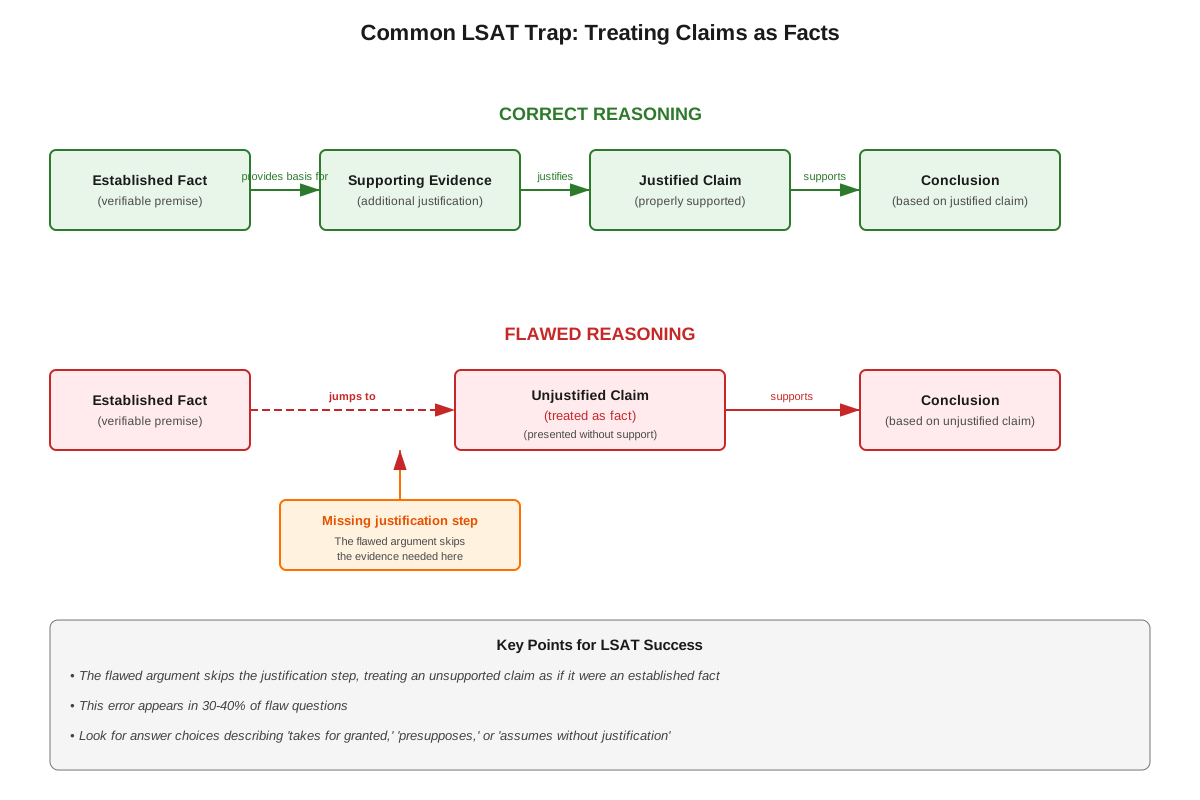
A critical reasoning flaw that the LSAT tests repeatedly is the inappropriate treatment of a claim as if it were an established fact. This occurs when an argument uses a contestable assertion as if it required no support, essentially building reasoning on an unestablished foundation.
Example: "Since artificial intelligence will inevitably surpass human intelligence, we should invest heavily in AI safety research." This argument treats "AI will inevitably surpass human intelligence" as an established fact when it's actually a contestable claim requiring its own support. The argument's conclusion about investment might be valid if the premise were true, but the premise itself needs justification.
Degrees of Factual Establishment
The LSAT recognizes gradations in how established a statement is:
- Stipulated facts: Statements the argument explicitly asks us to accept ("Assume that all participants were healthy")
- Empirical observations: Directly observable or measured phenomena ("The temperature was 72 degrees")
- Statistical data: Quantified findings from studies ("45% of respondents preferred option A")
- Expert consensus: Widely accepted professional judgments ("Physicists agree that...")
- Weak factual claims: Statements presented as fact but with limited support ("It is believed that...")
Understanding these gradations helps students recognize when the LSAT is testing whether they notice that an argument treats a weakly established statement as if it were strongly established.
Claims Requiring Different Types of Support
Different types of claims require different types of factual support:
- Causal claims ("X causes Y") require facts about correlation, temporal sequence, and mechanism
- Predictive claims ("X will happen") require facts about past patterns and current conditions
- Evaluative claims ("X is good/bad") require facts about consequences and criteria
- Interpretive claims ("X means Y") require facts about context and evidence
- Comparative claims ("X is better than Y") require facts about both X and Y on relevant dimensions
The LSAT tests whether students recognize when facts provided are insufficient or inappropriate for the type of claim being made.
Concept Relationships
The claims versus facts distinction forms the foundation for multiple interconnected logical reasoning concepts. At the most basic level, this distinction enables premise-conclusion identification: premises typically function as facts (within the argument's context) while conclusions function as claims. Understanding which statements are claims versus facts directly determines whether a student can accurately map an argument's structure.
This foundational distinction flows into assumption identification. Assumptions represent the unstated connections between factual premises and claimed conclusions. When an argument moves from facts to claims, any logical gap in that movement represents an assumption. Students who clearly distinguish claims from facts can more easily spot what additional facts would be needed to fully support the claim.
The relationship extends to evidence evaluation: strengthen and weaken questions test whether students can identify what additional facts would make a claim more or less plausible. This requires first recognizing what is being claimed versus what is already established as fact. Similarly, flaw identification often involves recognizing when an argument treats a claim as a fact, fails to provide factual support for a claim, or draws a claim that goes beyond what the facts support.
Textual relationship map:
Claims versus Facts → enables → Premise-Conclusion Identification → enables → Argument Structure Mapping → enables → Assumption Recognition → enables → Gap Analysis → enables → Strengthen/Weaken Question Success
Additionally: Claims versus Facts → enables → Flaw Recognition (treating claims as facts) → enables → Flaw Question Success
The concept also connects to source credibility: when arguments cite experts, studies, or authorities, students must recognize whether these sources are being used to establish facts or whether claims about what these sources show require additional support.
High-Yield Facts
⭐ The LSAT treats statements as facts when they are presented as given, established, or not requiring support within the argument's context, regardless of real-world contestability
⭐ Claims are statements that require justification or support; they represent what the argument is trying to establish or convince the reader to accept
⭐ The same type of statement (expert opinion, statistical data, causal assertion) can function as either claim or fact depending on how the argument treats it
⭐ A common LSAT flaw is treating a claim as if it were an established fact, building reasoning on an unestablished foundation
⭐ Conclusion indicators ("therefore," "thus," "consequently") typically signal claims, while premise indicators ("because," "since," "given that") typically introduce facts
- Intermediate statements can function as both claims (requiring support from earlier facts) and facts (providing support for later claims)
- The LSAT frequently tests whether students notice when an argument provides facts insufficient for the type of claim being made
- Evaluative and interpretive claims require more extensive factual support than descriptive claims
- When an argument says "studies show" or "research indicates," it typically treats the study findings as facts while the interpretation of those findings remains a claim
- Background information and context-setting statements typically function as facts that frame the argument rather than claims requiring support
Quick check — test yourself on Claims versus facts so far.
Try Flashcards →Common Misconceptions
Misconception: All statistics and data automatically count as facts in LSAT arguments.
Correction: While raw data often functions as factual premises, interpretations of data, claims about what data proves, and assertions about data's significance are claims requiring support. "60% of respondents preferred X" is typically treated as fact, but "This proves X is superior" is a claim.
Misconception: Expert opinions are always treated as facts because experts are authoritative.
Correction: Expert opinions can function as either facts or claims depending on context. When an argument cites an expert opinion as a premise ("Dr. Jones states that X, therefore Y"), it treats the opinion as fact. When an argument tries to establish that an expert opinion is correct, that opinion is the claim requiring support.
Misconception: Claims are always false or questionable, while facts are always true.
Correction: The claims versus facts distinction is about functional role in the argument, not about truth value. A claim might be entirely true but still require support within the argument's logic. A statement treated as fact might be false in reality but still functions as a given premise for the argument's purposes.
Misconception: The conclusion is always a claim and premises are always facts, making the distinction identical to premise-conclusion identification.
Correction: While conclusions typically are claims and premises typically function as facts, some premises can be unsupported claims themselves (representing flaws), and some conclusions can be treated as established facts in subsequent reasoning. The distinction is more nuanced than simple structural identification.
Misconception: If a statement appears early in an argument, it must be a fact; if it appears late, it must be a claim.
Correction: While positioning provides clues, it's not determinative. Arguments can present claims early and then attempt to support them, or present facts late as additional evidence. The functional role depends on logical relationships and indicator words, not just position.
Misconception: Conditional statements ("If X, then Y") are always claims about relationships.
Correction: Conditional statements can function as either facts or claims. "If it rains, the ground gets wet" might be presented as an established fact (a premise), while "If we implement this policy, crime will decrease" is typically a claim requiring support.
Worked Examples
Example 1: Distinguishing Claims from Facts in a Causal Argument
Argument: "Recent studies have documented a 30% increase in anxiety disorders among teenagers over the past decade. During this same period, social media usage among teenagers has increased by 250%. Clearly, social media is causing the rise in anxiety disorders."
Analysis:
Step 1 - Identify statements and their functions:
- Statement 1: "Studies have documented a 30% increase in anxiety disorders" - This is presented as an established fact. The phrase "studies have documented" signals that this is treated as given data, not requiring further support within this argument.
- Statement 2: "Social media usage has increased by 250%" - This is also presented as a fact, parallel to the first statement. It's offered as established data about the same time period.
- Statement 3: "Social media is causing the rise in anxiety disorders" - This is the claim. The word "clearly" is a conclusion indicator, and this statement represents a causal interpretation that requires support.
Step 2 - Analyze the logical relationship:
The argument treats two correlational facts (increases in both anxiety and social media use) as sufficient support for a causal claim. The facts establish correlation; the claim asserts causation.
Step 3 - Identify the gap:
The argument moves from factual premises about correlation to a causal claim without establishing the necessary connection. The facts don't address alternative explanations, the mechanism of causation, or whether social media use preceded anxiety increases in individual cases.
Step 4 - Apply to question types:
- For an assumption question: The argument assumes no other factor caused both increases, or that correlation implies causation in this case
- For a flaw question: The argument inappropriately infers causation from correlation
- For a weaken question: Evidence of alternative causes or evidence that anxiety preceded social media use would weaken
- For a strengthen question: Evidence of a causal mechanism or controlled studies showing causation would strengthen
Connection to learning objectives: This example demonstrates how claims versus facts appears in LSAT questions (causal reasoning), explains the reasoning pattern (facts about correlation supporting causal claims), and shows how to apply the distinction to solve problems (identifying what's established versus what requires support).
Example 2: Recognizing Context-Dependent Treatment
Argument A: "Dr. Martinez, a leading climatologist, has stated that global temperatures will rise 2 degrees by 2050. This prediction should inform our policy decisions, as expert projections provide the most reliable basis for long-term planning."
Argument B: "Many climatologists predict temperature increases of 2 degrees by 2050. However, Dr. Martinez has demonstrated that these predictions rely on flawed modeling assumptions. Therefore, we should be skeptical of the 2-degree prediction."
Analysis:
Step 1 - Identify how the same content functions differently:
In Argument A:
- "Dr. Martinez has stated that temperatures will rise 2 degrees" = Fact (presented as established premise)
- "This prediction should inform policy decisions" = Claim (conclusion requiring support)
- "Expert projections provide reliable basis for planning" = Claim (intermediate claim supporting the main conclusion)
In Argument B:
- "Many climatologists predict 2-degree increase" = Fact (presented as given)
- "These predictions rely on flawed assumptions" = Claim (Dr. Martinez's position that requires support)
- "We should be skeptical of the prediction" = Claim (main conclusion)
Step 2 - Recognize the functional shift:
The same temperature prediction functions as an established fact in Argument A (the premise we reason from) but as a contested claim in Argument B (something we're questioning). This demonstrates that the claims versus facts distinction depends on how the argument treats the statement, not on the statement's inherent nature.
Step 3 - Identify what each argument would need:
- Argument A needs support for why expert predictions are reliable and should guide policy
- Argument B needs support for the assertion that modeling assumptions are flawed
Step 4 - Apply to LSAT question types:
This type of context-dependent treatment appears frequently in:
- Parallel reasoning questions: Matching how statements function, not just their content
- Method of reasoning questions: Describing whether an argument accepts or challenges a position
- Point at issue questions: Identifying what's contested versus what's agreed upon
Connection to learning objectives: This example shows how the same content can be treated as either claim or fact depending on context, illustrating the reasoning pattern of functional role determination and demonstrating how to apply this understanding to multiple question types.
Exam Strategy
Approaching Claims versus Facts Questions
When encountering any LSAT Logical Reasoning question, implement this systematic approach:
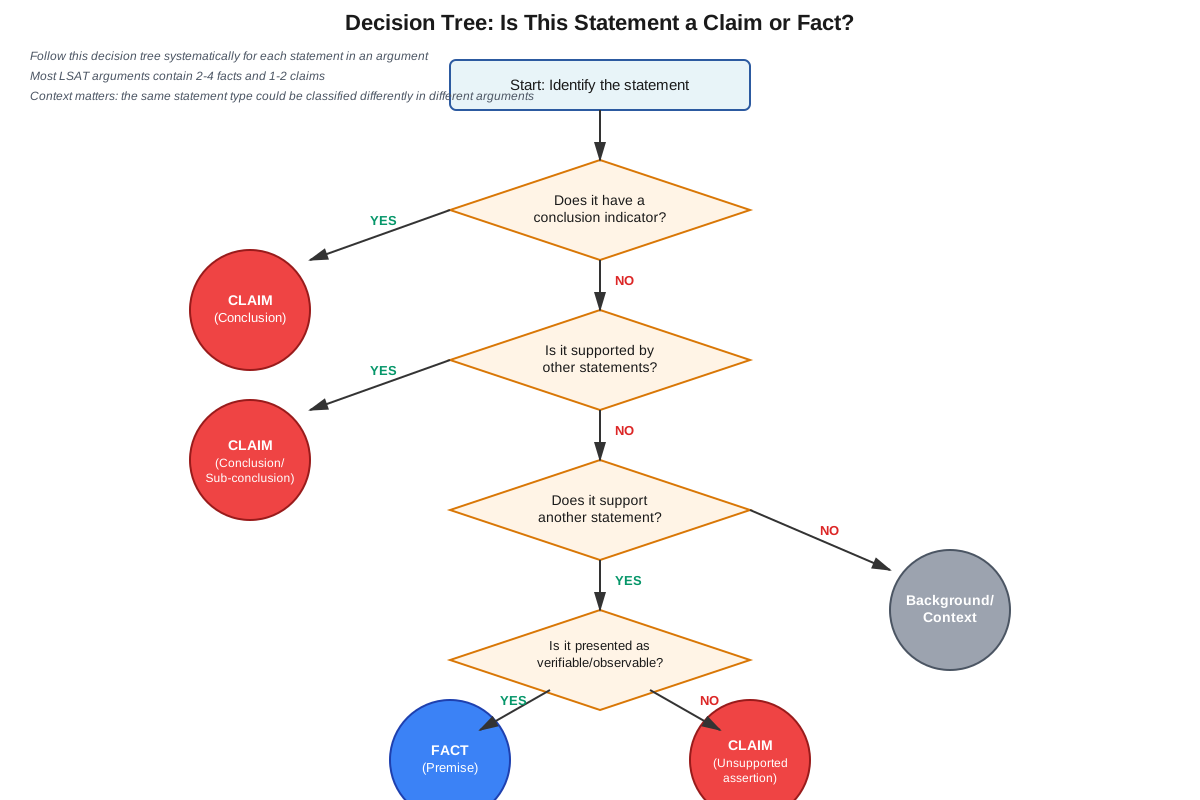
Step 1 - Read for functional roles: As you read the argument, mentally tag statements as "given" (fact) or "argued" (claim). Don't just identify what's said; identify how it's being used in the reasoning.
Step 2 - Watch for indicator words:
- Fact indicators: "studies show," "research indicates," "it is known that," "data reveals," "given that," "assuming that"
- Claim indicators: "therefore," "thus," "clearly," "suggests that," "proves that," "demonstrates that," "must be that"
Step 3 - Identify the main claim: Every argument has a primary claim (the main conclusion). Everything else either supports this claim (facts/premises) or represents intermediate claims that both require support and provide support.
Step 4 - Map the support structure: Draw mental arrows from facts to claims. If a statement has arrows pointing to it (it needs support), it's functioning as a claim. If arrows point from it (it provides support), it's functioning as a fact.
Trigger Words and Phrases
High-yield trigger phrases that signal claims: "This shows that," "This proves," "This demonstrates," "We can conclude," "It follows that," "This suggests," "This indicates," "Clearly," "Obviously," "Certainly"
High-yield trigger phrases that signal facts: "According to," "Studies have shown," "Research indicates," "It is established that," "Data reveals," "Experts agree," "It is known that," "Given that," "Assuming that"
Process of Elimination Tips
When evaluating answer choices:
- Eliminate answers that confuse claims with facts: If an answer choice describes a claim as if it were an established fact, or vice versa, it's likely wrong. For example, if an answer says "the argument uses the claim that X as evidence" but X is actually the conclusion, eliminate it.
- Eliminate answers that misidentify what requires support: If an answer suggests the argument fails to support something that's actually presented as a given fact, eliminate it. The argument doesn't need to support its premises.
- Eliminate answers that ignore the functional role: Focus on how statements function in the argument's logic, not just their content. An answer that focuses on content while ignoring function is typically incorrect.
- For flaw questions, look for claim-as-fact treatment: Answers describing the flaw as "treats a claim requiring support as if it were established" or "assumes without justification that X" often correctly identify claims versus facts issues.
Time Allocation Advice
The claims versus facts distinction should become automatic with practice, requiring minimal additional time. Aim to:
- During initial read (30-45 seconds): Simultaneously comprehend content and identify functional roles
- During question analysis (15-20 seconds): Quickly reference your mental map of what's claimed versus given
- During answer evaluation (30-45 seconds): Use claims versus facts understanding to eliminate wrong answers efficiently
If you find yourself spending extra time distinguishing claims from facts, you need more practice with indicator words and functional role recognition. This should become as automatic as identifying the conclusion.
Memory Techniques
The GIFT Mnemonic for Facts
Given - Facts are presented as given, not argued for
Indicators - Look for "studies show," "data indicates," "it is known"
Foundation - Facts provide the foundation/evidence for reasoning
Taken as true - Facts are taken as true within the argument's context
The CARS Mnemonic for Claims
Conclusion - Claims are what the argument concludes or asserts
Argued for - Claims require argument and support
Requires evidence - Claims need evidential backing
Supported by facts - Claims rest on factual premises
Visualization Strategy: The Building Metaphor
Visualize arguments as buildings:
- Facts are the foundation and building materials (concrete, established, solid)
- Claims are the structure being built (requires support, rests on foundation)
- Assumptions are the hidden supports (not visible but necessary for stability)
When reading an argument, mentally picture facts as the ground level and claims as structures rising from that ground. If a claim appears to float without factual foundation, you've identified a logical gap.
The Arrow Technique
Draw mental arrows as you read:
- Facts have arrows pointing away from them (they point toward what they support)
- Claims have arrows pointing toward them (they need support pointing at them)
- If a statement has both arrows toward and away, it's an intermediate claim
This kinesthetic/visual technique helps cement the functional role distinction.
Summary
The claims versus facts distinction represents a fundamental analytical skill for LSAT Logical Reasoning success. Claims are statements that require justification—positions, interpretations, or conclusions that the argument attempts to establish. Facts, in the LSAT context, are statements presented as given, established, or not requiring support within the argument's framework. This distinction is functional rather than absolute: the same type of statement can serve as either claim or fact depending on how the argument treats it. Mastering this distinction enables accurate premise-conclusion identification, assumption recognition, and flaw detection. The LSAT consistently tests whether students can recognize when arguments inappropriately treat claims as facts, when factual support is insufficient for the type of claim being made, and how statements function within the logical structure of reasoning. Success requires attention to indicator words, understanding of context-dependent functional roles, and systematic analysis of support relationships between statements.
Key Takeaways
- The claims versus facts distinction is about functional role in the argument (what requires support versus what provides support), not about absolute truth or falsity
- Claims require justification and represent what the argument is trying to establish; facts are presented as given and serve as evidential foundation
- The same content can function as either claim or fact depending on argumentative context—always analyze how the argument treats each statement
- A critical LSAT flaw is treating a contestable claim as if it were an established fact, building reasoning on an unestablished foundation
- Indicator words provide crucial clues: "studies show" and "given that" signal facts; "therefore" and "this proves" signal claims
- Approximately 45-50% of Logical Reasoning questions require distinguishing claims from facts, making this one of the highest-yield topics
- Mastering this distinction enables success across multiple question types: assumptions, flaws, strengthen/weaken, and method of reasoning
Related Topics
Premise and Conclusion Identification: Building directly on claims versus facts, this topic develops systematic techniques for mapping complete argument structure, including complex arguments with multiple premises and intermediate conclusions.
Assumption Questions: Understanding claims versus facts is prerequisite for assumption identification, which focuses on the unstated connections between factual premises and claimed conclusions—the logical gaps that must be filled.
Sufficient and Necessary Assumptions: This advanced topic distinguishes between assumptions that guarantee a conclusion (sufficient) and those required for it (necessary), building on the foundation of recognizing what claims need to be supported.
Flaw Questions: Many argument flaws involve inappropriate treatment of claims as facts, insufficient factual support for claims, or claims that exceed what facts establish—all applications of the claims versus facts distinction.
Strengthen and Weaken Questions: These questions test the ability to identify what additional facts would make claims more or less plausible, requiring clear understanding of what is claimed versus what is already established.
Practice CTA
Now that you've mastered the conceptual foundation of claims versus facts, it's time to cement your understanding through active practice. The distinction between claims and facts becomes automatic only through repeated application to actual LSAT questions. Challenge yourself with the practice questions and flashcards designed specifically for this topic—they'll help you recognize the patterns, internalize the indicator words, and develop the instant recognition that separates top scorers from average performers. Remember: understanding the concept is just the beginning; applying it under timed conditions is what translates knowledge into points. You've built the foundation—now build the skill through deliberate practice!
Sign up free to keep reading
Create a free AnvayaPrep account to finish this LSAT guide on Claims versus facts — plus flashcards and practice questions.