Overview
Concessions represent a critical argumentative structure that appears frequently throughout the LSAT Logical Reasoning section. A concession occurs when an author acknowledges a point that appears to weaken their position or supports an opposing viewpoint, but then proceeds to argue for their conclusion anyway. This rhetorical device demonstrates intellectual honesty while simultaneously strengthening the overall argument by preemptively addressing counterarguments. Understanding concessions is essential because they reveal the author's awareness of complexity and nuance, and they often signal pivotal moments in argument fundamentals where the reasoning shifts direction.
On the LSAT, recognizing lsat concessions enables test-takers to accurately map argument structure, identify the author's main conclusion despite apparent contradictions, and understand how seemingly opposing ideas can coexist within a single argument. Concessions typically appear with distinctive linguistic markers—words like "although," "despite," "admittedly," or "while it is true that"—which signal that the author is temporarily entertaining an opposing view before pivoting back to their primary position. This pattern of acknowledgment-then-rebuttal creates a sophisticated argumentative structure that the LSAT tests extensively.
Within the broader framework of logical reasoning, concessions connect intimately with other fundamental concepts including premises, conclusions, counterarguments, and argument strength. They represent a specific type of premise that initially appears to undermine the conclusion but ultimately serves to demonstrate the author's thoroughness and credibility. Mastering concessions allows students to navigate complex arguments where the author's position isn't immediately obvious, distinguish between what the author believes versus what they acknowledge, and identify the true logical structure underlying sophisticated reasoning patterns.
Learning Objectives
- [ ] Identify how Concessions appears in LSAT questions
- [ ] Explain the reasoning pattern behind Concessions
- [ ] Apply Concessions to solve LSAT-style problems accurately
- [ ] Distinguish between concessions and the author's main conclusion in complex arguments
- [ ] Recognize the linguistic markers that signal concessions in LSAT passages
- [ ] Evaluate how concessions affect argument strength and structure
- [ ] Predict how concessions will be tested across different Logical Reasoning question types
Prerequisites
- Basic argument structure: Understanding premises and conclusions is essential because concessions function as a special type of premise that appears to contradict the conclusion
- Indicator words: Familiarity with conclusion and premise indicators helps distinguish concession markers from other logical connectors
- Counterarguments: Recognizing opposing viewpoints is necessary because concessions explicitly acknowledge these alternative perspectives
- Argument mapping: The ability to diagram logical relationships enables visualization of how concessions fit within overall argument structure
Why This Topic Matters
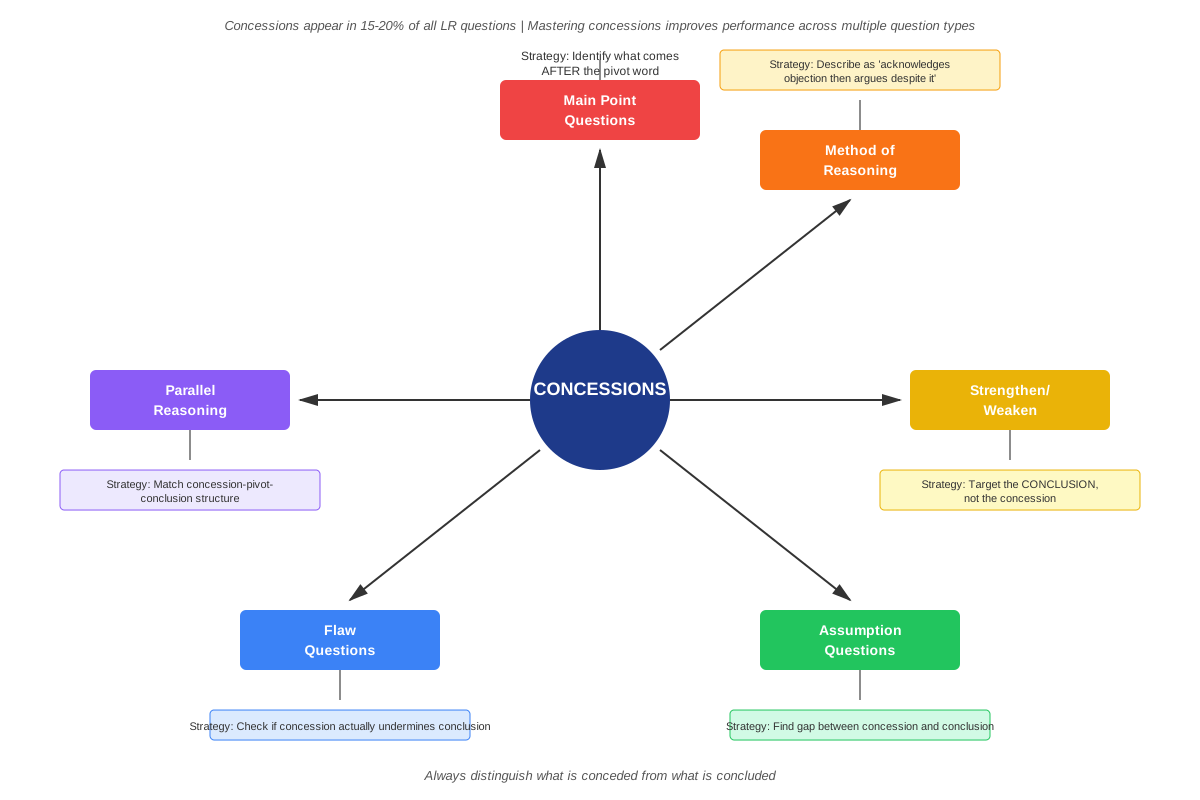
Concessions appear in approximately 15-20% of all Logical Reasoning questions on the LSAT, making them one of the most frequently tested argument fundamentals. They surface across virtually every question type, including Main Point, Method of Reasoning, Strengthen/Weaken, Assumption, Flaw, and Parallel Reasoning questions. The ability to identify and properly interpret concessions often determines whether a student selects the correct answer or falls for an attractive distractor.
In real-world contexts, concessions represent sophisticated argumentation used in legal briefs, judicial opinions, policy debates, and academic discourse—precisely the types of reasoning law students and attorneys must master. Attorneys regularly acknowledge unfavorable facts or opposing legal precedents (concessions) while arguing why their client should still prevail. This mirrors the LSAT's testing approach, where arguments acknowledge complications while maintaining a definitive position.
On the exam, concessions most commonly appear in passages where the author presents a nuanced position that requires acknowledging legitimate opposing considerations. Question stems might ask students to identify the main conclusion (requiring them to distinguish it from the concession), describe the argument's method of reasoning (where acknowledging a counterpoint is part of the technique), or identify assumptions (which often bridge the gap between the concession and the conclusion). Recognizing concessions prevents students from mistakenly identifying the conceded point as the author's actual position—a trap the LSAT sets repeatedly.
Core Concepts
Definition and Structure of Concessions
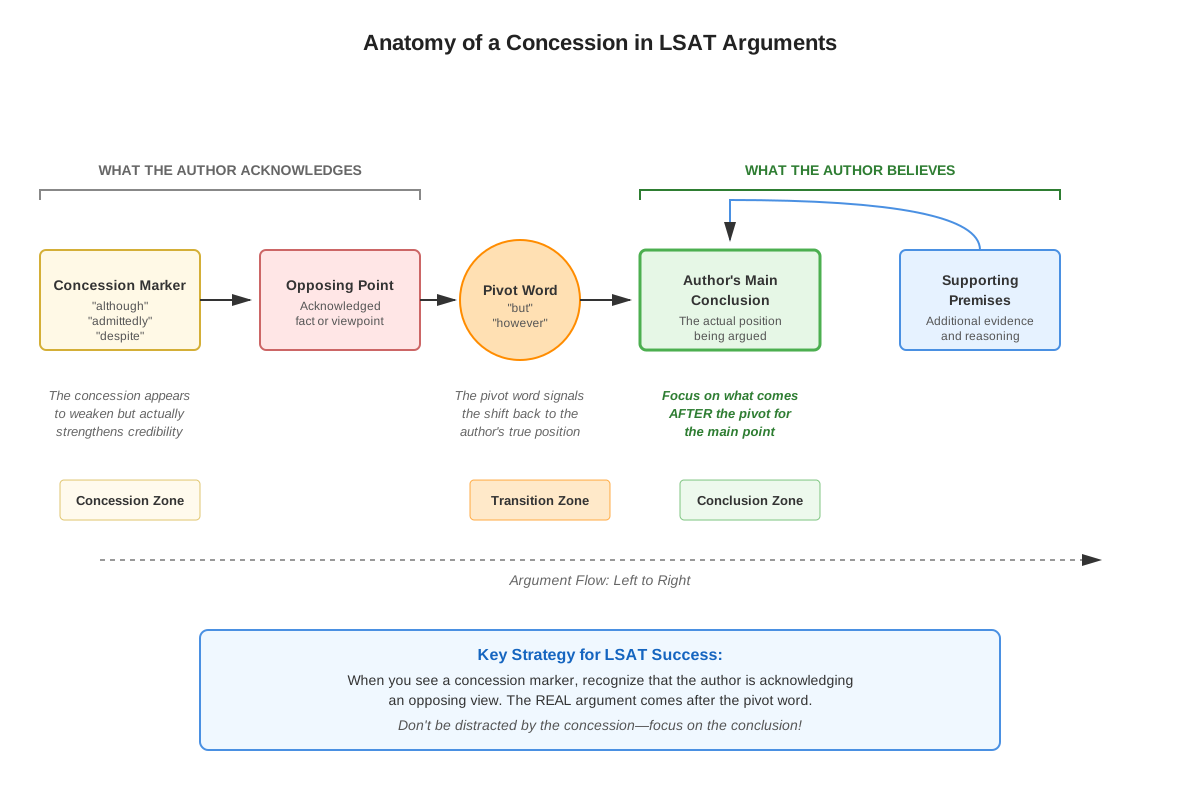
A concession is a statement within an argument where the author acknowledges a fact, consideration, or viewpoint that appears to undermine or contradict their main conclusion, but which the author does not accept as decisive against their position. The concession typically appears in a subordinate clause or preliminary statement, followed by the author's actual position in the main clause. This creates a "yes, but" structure: "Yes, X is true, BUT Y is my conclusion anyway."
The logical structure follows this pattern:
- Concession: Acknowledgment of opposing point or complicating factor
- Pivot: Transitional word or phrase indicating shift back to author's view
- Main argument: The author's actual conclusion and supporting reasoning
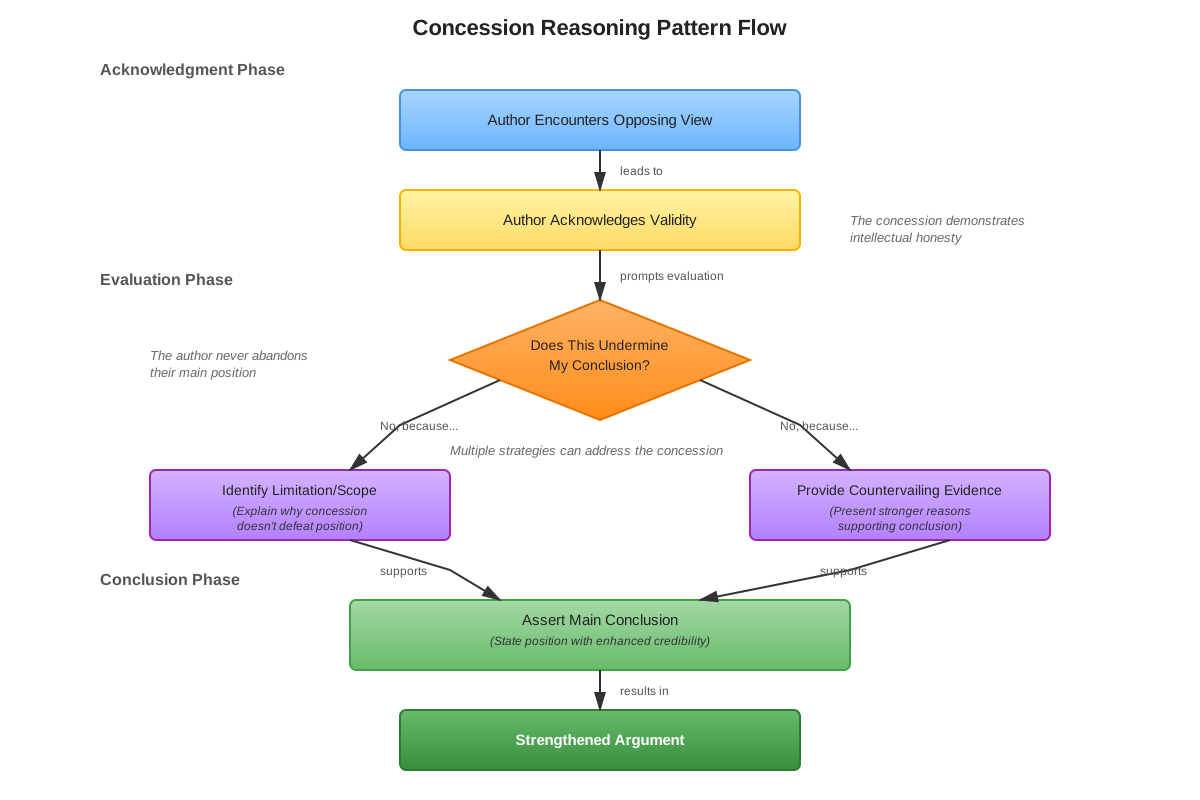
This structure serves multiple argumentative functions: it demonstrates the author's awareness of complexity, preemptively addresses potential objections, and paradoxically strengthens the argument by showing that the conclusion holds even when considering contrary evidence.
Linguistic Markers of Concessions
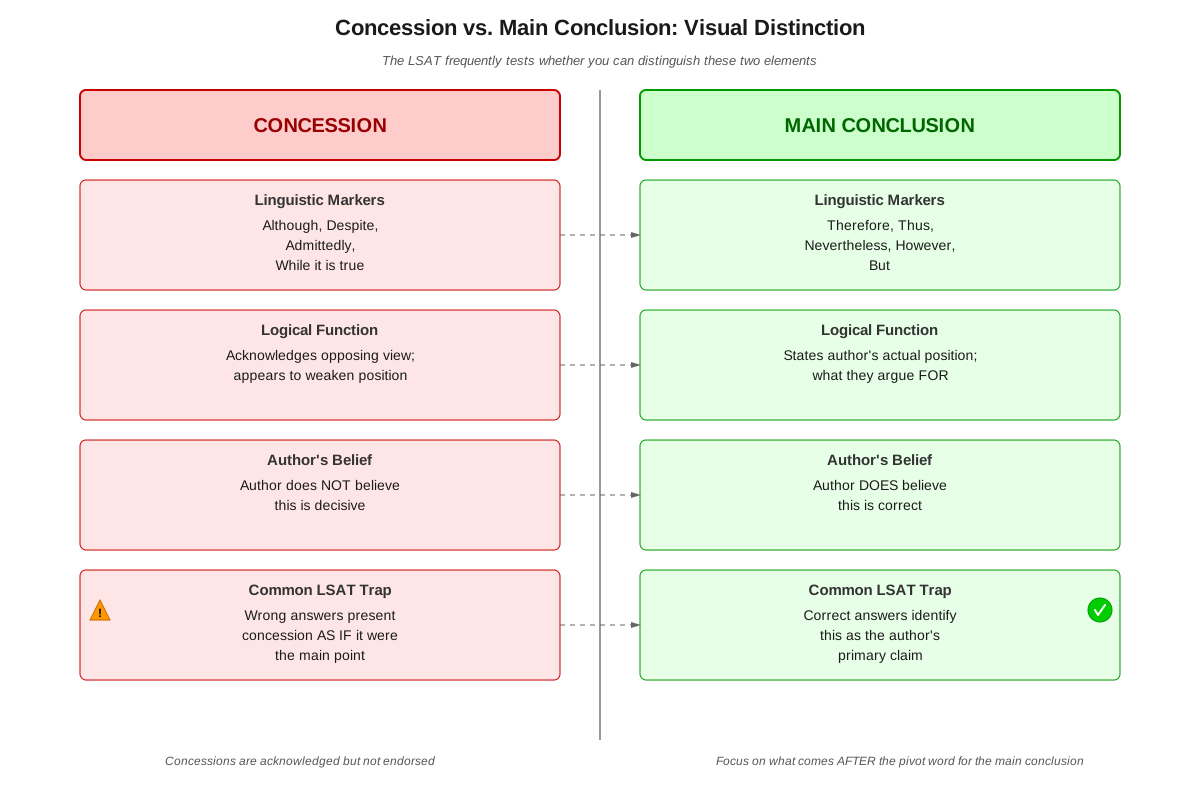
Lsat concessions are signaled by distinctive indicator words and phrases that alert careful readers to the acknowledgment-then-rebuttal pattern. These markers typically appear at the beginning of the concession clause:
| Concession Markers | Example Usage |
|---|---|
| Although, Though, Even though | "Although the policy is expensive, it will save lives." |
| While, Whereas | "While critics raise valid concerns, the benefits outweigh the costs." |
| Despite, In spite of | "Despite initial setbacks, the project succeeded." |
| Admittedly, Granted, To be sure | "Admittedly, the evidence is incomplete, but it still supports our conclusion." |
| It is true that, Certainly | "It is true that alternatives exist, yet none are as effective." |
| Notwithstanding | "Notwithstanding the risks, we should proceed." |
The pivot back to the author's position often uses contrastive connectors like "but," "however," "nevertheless," "nonetheless," "yet," or "still." Recognizing these two-part structures—concession marker followed by contrast marker—enables rapid identification of the argument's true direction.
Concessions vs. Counterarguments
Students must distinguish between concessions (which the author acknowledges but doesn't endorse) and counterarguments (which the author explicitly rebuts). A counterargument is an opposing position that the author presents in order to refute it with evidence or reasoning. A concession, by contrast, is accepted as true or valid but deemed insufficient to undermine the main conclusion.
Counterargument pattern: "Some argue X. However, this is wrong because [evidence/reasoning against X]."
Concession pattern: "X is true. However, Y is still my conclusion because [reasoning that accommodates X]."
In counterarguments, the author disputes the opposing claim's truth or validity. In concessions, the author accepts the claim but argues it doesn't defeat their conclusion. This distinction matters because LSAT questions frequently ask what the author believes or accepts as true—conceded points qualify, while counterarguments do not.
Function of Concessions in Argument Strength
Concessions can either strengthen or weaken arguments depending on how they're handled. A well-managed concession strengthens an argument by:
- Demonstrating intellectual honesty and credibility
- Preemptively addressing the strongest objections
- Showing that the conclusion survives scrutiny even when acknowledging complications
- Narrowing the scope of the claim to what can be legitimately defended
However, a poorly managed concession can weaken an argument when:
- The conceded point actually undermines the conclusion more than the author acknowledges
- The author fails to explain why the conclusion holds despite the concession
- The concession reveals an assumption that bridges the gap inadequately
LSAT questions exploit this dynamic by asking students to identify assumptions that connect concessions to conclusions, or by presenting answer choices that either properly or improperly account for conceded points.
Concessions in Different Question Types
Main Point questions: The concession is never the main conclusion. Students must identify the author's actual position, which appears after the pivot word. Incorrect answers often quote the concession verbatim.
Method of Reasoning questions: Correct answers might describe the argument as "acknowledging a consideration that appears to weaken the conclusion before arguing for that conclusion anyway" or "conceding a point to the opposition while maintaining the original position."
Assumption questions: The assumption often bridges the gap between the concession and the conclusion, explaining why the conclusion holds despite the acknowledged complication.
Strengthen/Weaken questions: Strengtheners often show why the conceded point is less significant than it appears; weakeners often show the conceded point is more damaging than acknowledged.
Flaw questions: The flaw might be that the author fails to adequately address how the conclusion survives the concession, or assumes without justification that the conceded point doesn't defeat the argument.
Concept Relationships
Concessions exist within a network of interconnected logical reasoning concepts. They represent a specific type of premise—one that appears to support an opposing conclusion but is incorporated into the author's argument nonetheless. This creates a relationship where: Counterargument → Concession (acknowledged as valid) → Requires bridging assumption → Leads to conclusion despite concession.
The relationship to indicator words is direct: concession markers function as a specialized subset of premise indicators that signal acknowledgment of opposing considerations. Understanding this connection enables students to map arguments accurately: Concession marker → Identifies opposing point → Contrast marker → Signals author's actual position.
Concessions also connect to argument scope and strength. By acknowledging limitations or opposing points, authors often narrow their claims to what can be defended: Broad claim → Concession reveals limitation → Refined, narrower conclusion. This relationship appears frequently in Strengthen/Weaken questions where answer choices either properly account for the concession's scope implications or ignore them.
The relationship to assumptions is particularly important: Concession (acknowledged weakness) + Assumption (why weakness isn't fatal) → Conclusion. Many Necessary Assumption questions test whether students recognize that the author must assume the conceded point doesn't defeat the conclusion.
Finally, concessions relate to argument evaluation because they affect how we assess reasoning quality: Argument with concession → Demonstrates awareness of complexity → Generally stronger than argument ignoring obvious objections. This relationship appears in Method of Reasoning and Argument Evaluation questions.
Quick check — test yourself on Concessions so far.
Try Flashcards →High-Yield Facts
⭐ Concessions are never the author's main conclusion—they represent acknowledged opposing points, not the author's actual position.
⭐ The word "although" and its synonyms signal concessions approximately 80% of the time they appear in LSAT arguments, making them among the most reliable structural indicators.
⭐ The author's main conclusion typically appears in the independent clause when a concession appears in a dependent clause (e.g., "Although X, Y" means Y is the conclusion).
⭐ Concessions require bridging assumptions—the author must assume that the conceded point doesn't defeat the conclusion, even though it appears to weaken it.
⭐ In Main Point questions, wrong answers frequently quote the concession verbatim, exploiting students who don't distinguish between what's acknowledged and what's concluded.
- Concessions demonstrate argumentative sophistication and typically strengthen rather than weaken well-constructed arguments.
- The pivot word (but, however, nevertheless) marks the transition from concession back to the author's position.
- Concessions can appear at the beginning, middle, or end of arguments, though beginning placement is most common.
- Multiple concessions can appear in a single argument, each requiring the author to explain why the conclusion holds nonetheless.
- Recognizing concessions helps eliminate wrong answers in Parallel Reasoning questions, where structural matching requires identifying corresponding concessions.
Common Misconceptions
Misconception: The concession represents what the author believes or concludes.
Correction: The concession represents what the author acknowledges as true or valid but does not accept as defeating their conclusion. The author's actual position appears after the pivot word in the main clause.
Misconception: Concessions always weaken arguments.
Correction: Well-managed concessions typically strengthen arguments by demonstrating intellectual honesty, preemptively addressing objections, and showing that the conclusion survives scrutiny even when acknowledging complications.
Misconception: "Although" and similar words always introduce concessions.
Correction: While these words frequently signal concessions (approximately 80% of the time), context matters. Occasionally they introduce straightforward contrasts without the acknowledgment-of-opposing-view structure that defines true concessions.
Misconception: Concessions and counterarguments are the same thing.
Correction: Counterarguments are opposing positions the author presents to refute them. Concessions are points the author accepts as true but argues don't defeat the conclusion. The author disputes counterarguments but accommodates concessions.
Misconception: If an argument contains a concession, it must be flawed.
Correction: Concessions are a normal feature of sophisticated argumentation. An argument is flawed only if it fails to adequately explain why the conclusion holds despite the concession, not merely because a concession exists.
Misconception: The concession always appears in the first sentence.
Correction: While concessions often appear early in arguments, they can appear anywhere. The structural relationship (subordinate clause with concession marker + main clause with conclusion) matters more than position.
Misconception: Concessions are always explicitly marked with indicator words.
Correction: While explicit markers are common on the LSAT, concessions can sometimes be implied through context, where the author acknowledges a point without using standard concession markers.
Worked Examples
Example 1: Main Point Question
Argument: "Although the new traffic regulations will inconvenience some commuters, they will significantly reduce accidents at dangerous intersections. The minor delays are a small price to pay for the substantial improvement in public safety that these regulations will provide."
Question: Which one of the following most accurately expresses the main conclusion of the argument?
Analysis:
- Identify the concession: "Although the new traffic regulations will inconvenience some commuters" — this is marked by "although" and acknowledges a negative aspect.
- Locate the pivot: The comma after "commuters" signals the transition to the author's actual position.
- Identify the main conclusion: The author's position appears in two parts: the immediate claim after the concession ("they will significantly reduce accidents") and the evaluative conclusion ("The minor delays are a small price to pay...").
- Determine which is the main conclusion: The second sentence provides the ultimate judgment—that the benefits outweigh the costs. This is the main conclusion because it's the overall point the author wants to establish.
- Eliminate wrong answers: Any answer choice that focuses on the inconvenience to commuters is quoting the concession, not the conclusion. Any answer that merely states regulations will reduce accidents is a supporting premise for the ultimate evaluative conclusion.
Correct approach: The main conclusion is that the benefits of the regulations justify their costs. This demonstrates how concessions (acknowledged inconvenience) support rather than undermine the author's ultimate position when properly managed.
Example 2: Method of Reasoning Question
Argument: "Admittedly, the proposed environmental regulations will impose costs on manufacturers. However, these costs are justified because the regulations will prevent significant environmental damage that would be far more expensive to remediate later. Furthermore, the regulations will spur innovation in clean technologies, ultimately benefiting the regulated industries."
Question: The argument proceeds by:
Analysis:
- Map the structure:
- Concession: "Admittedly, the proposed environmental regulations will impose costs on manufacturers"
- Pivot: "However"
- Main argument: Costs are justified because (a) preventing damage is cheaper than remediation, and (b) regulations spur beneficial innovation
- Identify the reasoning pattern: The argument acknowledges a point that appears to count against the conclusion (costs to manufacturers), then provides two reasons why the conclusion (regulations are justified) holds despite this acknowledged drawback.
- Characterize the method: This is a classic concession-then-rebuttal structure where the author accepts an opposing consideration as true but argues it's outweighed by other factors.
- Predict the correct answer: It should describe acknowledging a consideration that appears to weaken the position, then providing reasons why the position is correct anyway.
Correct approach: Look for answer choices describing "conceding a point to opponents before arguing that other considerations outweigh it" or "acknowledging a cost while arguing that benefits justify that cost." Avoid answers that suggest the author disputes the concession's truth or that fail to capture the acknowledgment-then-justification structure.
Exam Strategy
When approaching LSAT questions involving concessions, implement this systematic process:
Step 1: Scan for concession markers — Before reading the full argument, quickly scan for "although," "despite," "admittedly," and similar markers. Their presence alerts you to expect a concession-conclusion structure.
Step 2: Identify what's conceded vs. what's concluded — As you read, mentally label: "This is what they're acknowledging" and "This is what they actually believe." The conclusion appears after the pivot word in the independent clause.
Step 3: Note the gap — Recognize that a gap exists between the concession and conclusion. The author must assume this gap can be bridged—that the conceded point doesn't defeat the conclusion.
Step 4: Predict the answer — Before looking at choices, articulate: "The author concedes X but concludes Y." This prediction prevents confusion when answer choices quote the concession.
Step 5: Eliminate systematically — In Main Point questions, immediately eliminate any choice quoting the concession. In Method of Reasoning questions, eliminate choices that don't capture the acknowledgment-then-argument structure. In Assumption questions, look for choices that bridge the concession-conclusion gap.
Exam Tip: When you see "although" or "despite" in the first few words of an argument, the main conclusion almost always appears after the comma in that same sentence or in the immediately following sentence.
Time allocation: Concession-heavy arguments typically require 10-15 seconds longer to process than straightforward arguments because you must track both what's acknowledged and what's concluded. Budget this extra time rather than rushing and confusing the two.
Trigger phrases to watch for:
- "Although/Though/Even though" (beginning of sentence)
- "Admittedly/Granted/To be sure" (beginning of sentence)
- "Despite/In spite of" (followed by noun phrase)
- "While it is true that" (beginning of clause)
- "...but/however/nevertheless/nonetheless..." (marking the pivot)
Process-of-elimination strategy: In questions where you're unsure, ask: "Does this answer choice distinguish between what the author acknowledges and what the author concludes?" Correct answers almost always maintain this distinction; incorrect answers blur it.
Memory Techniques
The "YES, BUT" Mnemonic: Remember that concessions follow a YES, BUT structure:
- Yielding a point
- Expressing acknowledgment
- Signaling with markers
- But pivoting back
- Ultimately concluding differently
- Transitioning with contrast words
The CONCEDE Acronym for identifying concessions:
- Contrast marker follows
- Opposing point acknowledged
- Not the main conclusion
- Comes before the pivot
- Explicitly marked (usually)
- Demonstrates awareness
- Enables stronger argument
Visualization Strategy: Picture a seesaw where the concession is on one side (acknowledged but not decisive) and the conclusion is on the other side (heavier, winning out). The author's reasoning explains why the conclusion side outweighs the concession side.
The "Subordinate Clause Rule": When concessions appear in subordinate clauses (beginning with "although," "while," etc.), the main conclusion appears in the independent clause. Visualize the subordinate clause as literally subordinate—less important than the main clause.
Marker Word Grouping: Memorize concession markers in categories:
- Contrast conjunctions: Although, though, even though, while, whereas
- Prepositions: Despite, in spite of, notwithstanding
- Adverbs: Admittedly, granted, certainly, to be sure
- Phrases: It is true that, while it is true that
Summary
Concessions represent a sophisticated argumentative structure where authors acknowledge points that appear to weaken their position before arguing for their conclusion anyway. This "acknowledgment-then-rebuttal" pattern appears in 15-20% of LSAT Logical Reasoning questions across virtually all question types. Recognizing concessions requires identifying linguistic markers (although, despite, admittedly) that signal the acknowledgment, then locating the pivot word (but, however, nevertheless) that marks the transition to the author's actual position. The concession is never the main conclusion—it represents what the author accepts as true but not decisive. Understanding this distinction prevents the most common error: mistaking the conceded point for the author's position. Concessions create gaps in arguments that require bridging assumptions, making them particularly important for Assumption questions. They also affect argument structure in ways tested by Method of Reasoning questions and create scope limitations tested by Strengthen/Weaken questions. Mastering concessions enables accurate argument mapping, correct answer prediction, and systematic elimination of attractive distractors that quote concessions rather than conclusions.
Key Takeaways
- Concessions acknowledge opposing points but are never the author's main conclusion—the actual position appears after the pivot word in the independent clause
- Linguistic markers like "although," "despite," and "admittedly" signal concessions approximately 80% of the time, making them highly reliable structural indicators
- The concession-conclusion gap requires bridging assumptions—authors must assume the conceded point doesn't defeat their conclusion
- Well-managed concessions strengthen arguments by demonstrating intellectual honesty and showing conclusions survive scrutiny
- Main Point questions frequently include wrong answers that quote the concession verbatim, exploiting students who don't distinguish acknowledgment from conclusion
- Concessions appear across all Logical Reasoning question types, affecting how you approach Main Point, Method of Reasoning, Assumption, Strengthen/Weaken, and Flaw questions
- The "YES, BUT" structure captures the essence: Yes, the conceded point is true, BUT the conclusion holds anyway
Related Topics
Counterarguments and Rebuttals: Understanding how authors present and refute opposing positions (rather than merely acknowledging them) builds on concession recognition and enables complete argument mapping.
Necessary vs. Sufficient Assumptions: Many assumptions that bridge concession-conclusion gaps are necessary assumptions—the argument requires them to work despite the acknowledged complication.
Argument Scope and Precision: Concessions often reveal scope limitations in arguments, connecting to broader skills in identifying what arguments do and don't claim.
Strengthen and Weaken Questions: Advanced application of concession recognition involves identifying answer choices that either minimize the significance of conceded points (strengtheners) or amplify their importance (weakeners).
Complex Argument Structures: Mastering concessions enables progression to arguments with multiple layers, embedded concessions, and sophisticated rhetorical structures common in difficult LSAT passages.
Practice CTA
Now that you understand the structure, function, and testing patterns of concessions, you're ready to apply this knowledge to actual LSAT questions. Attempt the practice questions focusing specifically on identifying concession markers, distinguishing concessions from conclusions, and recognizing how concessions affect different question types. Use the flashcards to reinforce recognition of linguistic markers and structural patterns. Remember: every time you correctly identify a concession and avoid confusing it with the main conclusion, you're building the precise analytical skills that separate top LSAT scorers from the rest. Your ability to navigate these sophisticated argumentative structures will serve you not just on test day, but throughout law school and legal practice. Start practicing now—mastery comes through deliberate application of these principles to real LSAT arguments.
Sign up free to keep reading
Create a free AnvayaPrep account to finish this LSAT guide on Concessions — plus flashcards and practice questions.