Overview
In the LSAT Logical Reasoning section, success hinges on the ability to dissect arguments into their component parts. Among the most critical skills is identifying the conclusion of an argument—the main claim the author is trying to establish. Conclusion indicators are linguistic signposts that explicitly signal when an author is presenting their main point. These words and phrases function as navigational tools, guiding test-takers directly to the heart of an argument. Mastering conclusion indicators transforms what might otherwise be a time-consuming search into an efficient, systematic process.
Understanding LSAT conclusion indicators is not merely about memorizing a list of words; it requires developing an intuitive sense of how arguments are structured in formal reasoning contexts. The LSAT deliberately constructs arguments with varying levels of complexity, sometimes embedding conclusions in the middle of passages, other times placing them at the beginning or end. Conclusion indicators serve as explicit markers that cut through this complexity, allowing test-takers to quickly identify what the author is arguing for versus what evidence they're providing. This distinction is fundamental because nearly every Logical Reasoning question type—from Strengthen and Weaken to Assumption and Flaw questions—requires first identifying the conclusion accurately.
Within the broader framework of argument fundamentals, conclusion indicators work in tandem with premise indicators (words like "because," "since," and "given that") to reveal the logical structure of arguments. While premise indicators point to evidence and support, conclusion indicators point to claims being supported. Together, these linguistic markers form the scaffolding of logical reasoning, enabling test-takers to map arguments visually and understand the flow of reasoning from evidence to claim. This foundational skill underlies virtually all success in the Logical Reasoning section, making conclusion indicators one of the highest-yield topics in LSAT preparation.
Learning Objectives
- [ ] Identify how conclusion indicators appear in LSAT questions
- [ ] Explain the reasoning pattern behind conclusion indicators
- [ ] Apply conclusion indicators to solve LSAT-style problems accurately
- [ ] Distinguish between conclusion indicators and premise indicators in complex arguments
- [ ] Recognize when conclusions appear without explicit indicators and use context clues
- [ ] Evaluate arguments where multiple conclusion indicators appear and determine the main conclusion versus subsidiary conclusions
Prerequisites
- Basic sentence structure and grammar: Understanding subject-verb relationships and clause structure is essential for parsing complex LSAT arguments and identifying where one claim ends and another begins.
- Reading comprehension fundamentals: The ability to understand written passages at a college level ensures that students can focus on logical structure rather than struggling with vocabulary or syntax.
- Understanding of what constitutes an argument: Recognizing that arguments consist of claims supported by reasons provides the conceptual framework for distinguishing conclusions from premises.
Why This Topic Matters
In real-world contexts, the ability to identify conclusions is essential for critical thinking in law, business, medicine, and everyday decision-making. Legal professionals must identify the central claims in case law, contracts, and opposing counsel's arguments. Business analysts need to extract key recommendations from lengthy reports. Medical professionals must discern the primary diagnostic conclusion from supporting test results. The skill of identifying conclusions translates directly to professional success in any field requiring analytical reasoning.
On the LSAT specifically, conclusion identification appears in virtually every Logical Reasoning question. Statistical analysis of recent LSATs shows that approximately 95% of Logical Reasoning questions require identifying the conclusion as a first step. The most common question types—Main Point, Strengthen, Weaken, Assumption, Flaw, Parallel Reasoning, and Method of Reasoning—all depend on accurately identifying what the author is trying to prove. Even Inference questions, which don't present arguments per se, often require distinguishing between stated facts and conclusions drawn from those facts.
Conclusion indicators appear in LSAT passages in several characteristic ways: (1) as explicit markers in straightforward arguments where the author clearly signals their main point; (2) in complex arguments with multiple layers where subsidiary conclusions support a main conclusion; (3) in arguments where the conclusion appears at the beginning, requiring students to recognize that subsequent statements provide support rather than additional claims; and (4) in arguments deliberately constructed without indicators, testing whether students can identify conclusions through structural analysis alone. Mastering conclusion indicators provides the foundation for handling all these variations efficiently.
Core Concepts
What Are Conclusion Indicators?
Conclusion indicators are words or phrases that signal the author is about to state, or has just stated, their main claim or conclusion. These linguistic markers function as explicit signposts in arguments, directing readers to the central point the author wants to establish. In formal logic and LSAT contexts, the conclusion represents the statement that the author is arguing for—the claim that requires support from other statements (premises).
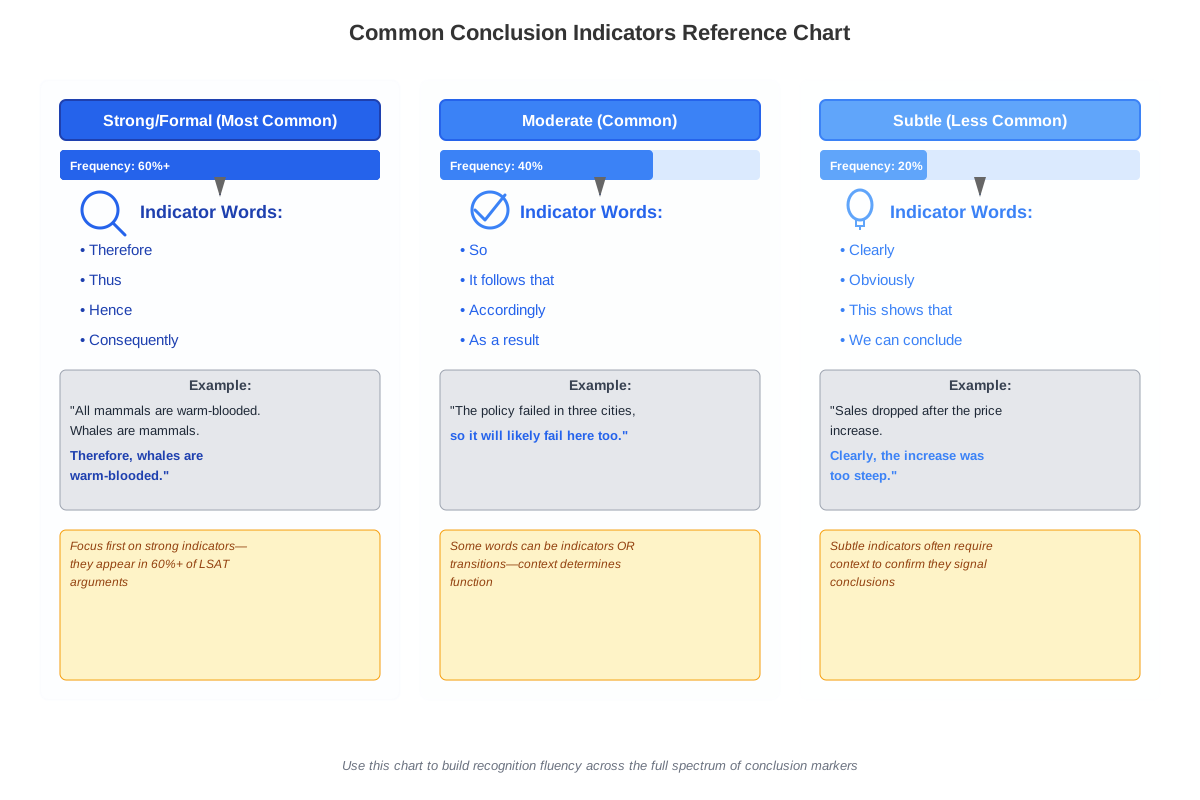
The most common conclusion indicators include:
- Therefore
- Thus
- Hence
- Consequently
- So
- It follows that
- We can conclude that
- This shows that
- This demonstrates that
- This proves that
- As a result
- Accordingly
- For this reason
- Which means that
- Clearly
- Obviously
These indicators typically appear immediately before or after the conclusion they signal. Understanding their function allows test-takers to quickly locate the conclusion without reading the entire argument multiple times.
The Logical Structure of Arguments
To fully understand conclusion indicators, one must grasp the basic structure of arguments in logical reasoning. Every argument on the LSAT consists of at least two components:
- Premises: Statements offered as evidence or support
- Conclusion: The claim being supported by the premises
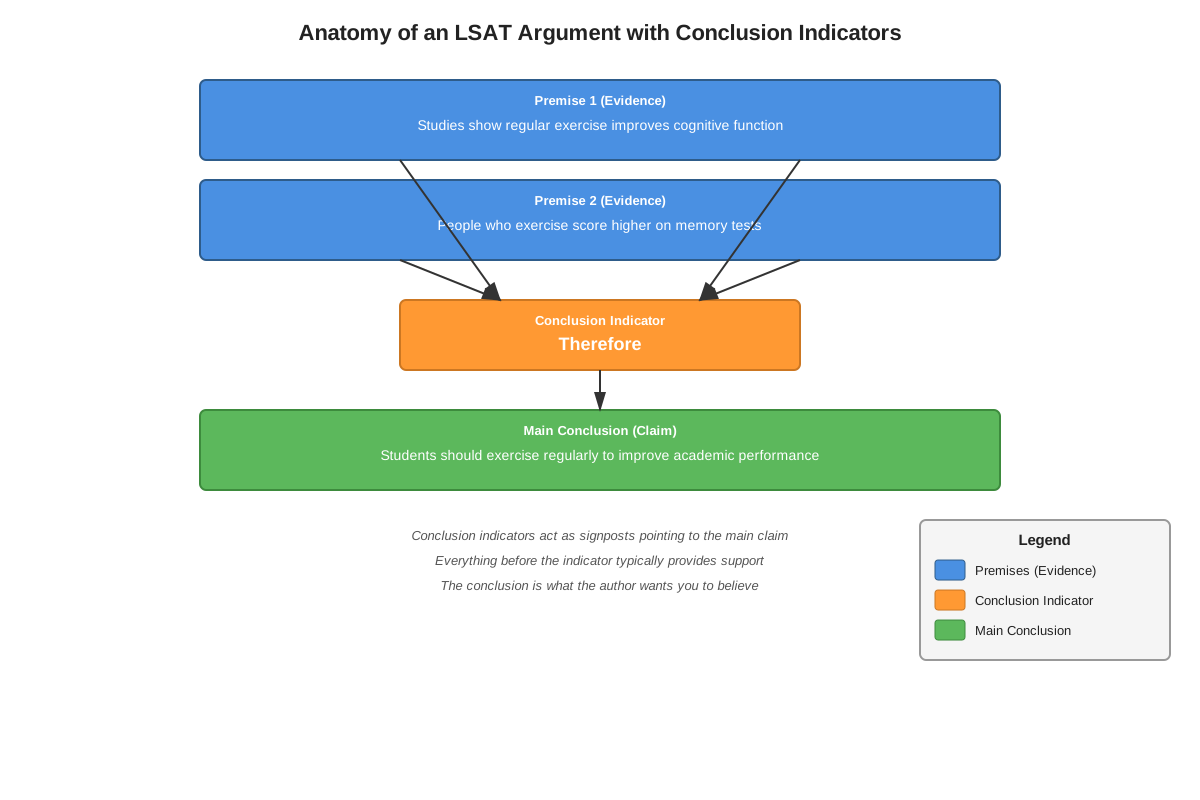
The relationship flows in one direction: premises support the conclusion. Conclusion indicators mark this relationship explicitly by signaling which statement occupies the "conclusion" role. Consider this simple structure:
[Premise] → supports → [Conclusion]When conclusion indicators appear, they make this structure explicit:
[Premise]. Therefore, [Conclusion].The word "therefore" signals that what follows is the claim being supported by what came before. This directional relationship is crucial: the conclusion is not simply the last statement in an argument—it's the statement that other statements are offered to support.
Distinguishing Conclusions from Premises
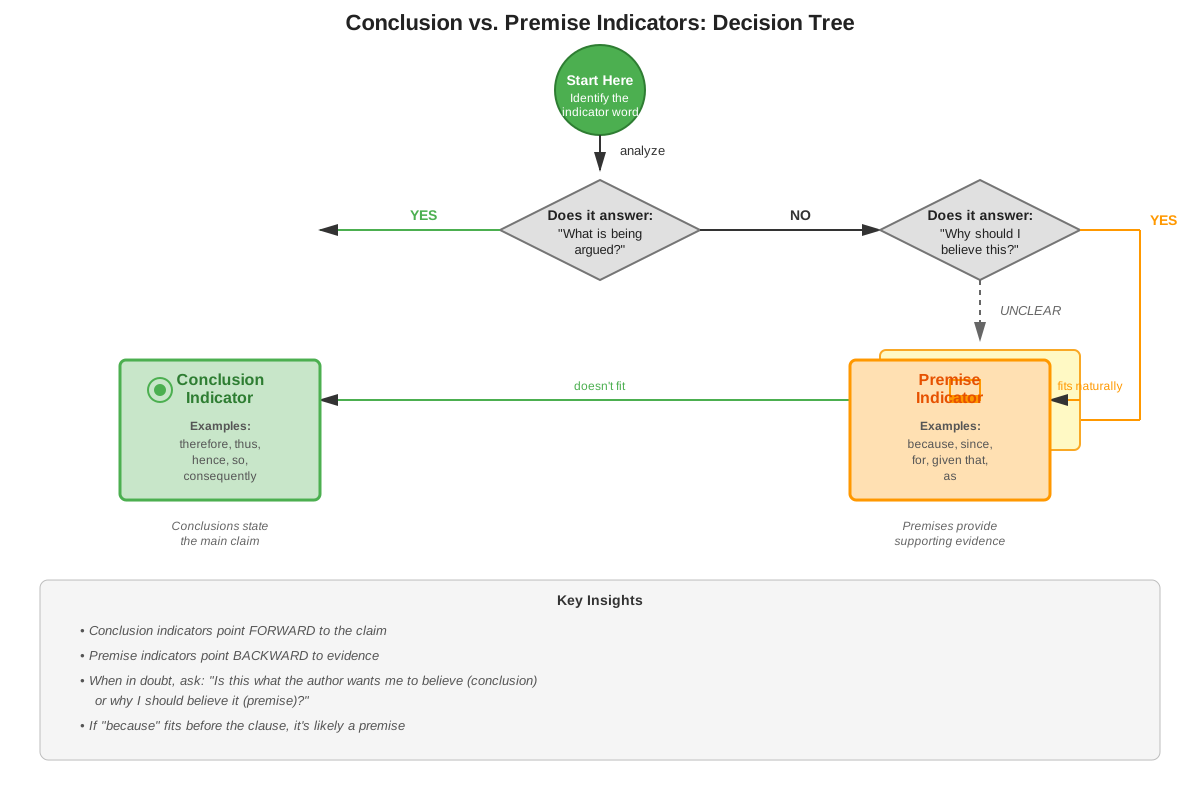
A critical skill involves distinguishing conclusion indicators from premise indicators. While conclusion indicators point to claims being supported, premise indicators point to supporting evidence. Common premise indicators include "because," "since," "given that," "for," "as," and "due to."
| Conclusion Indicators | Premise Indicators |
|---|---|
| Therefore | Because |
| Thus | Since |
| Hence | Given that |
| So | For |
| Consequently | As |
| It follows that | Due to |
| We can conclude | The reason is |
Understanding this distinction prevents a common error: mistaking a premise for a conclusion simply because it appears at the end of an argument. Consider:
"The company will succeed because it has strong leadership."
Here, "because" indicates that "it has strong leadership" is a premise supporting the conclusion "the company will succeed." The conclusion appears first, followed by supporting evidence.
Conclusion Placement Variations
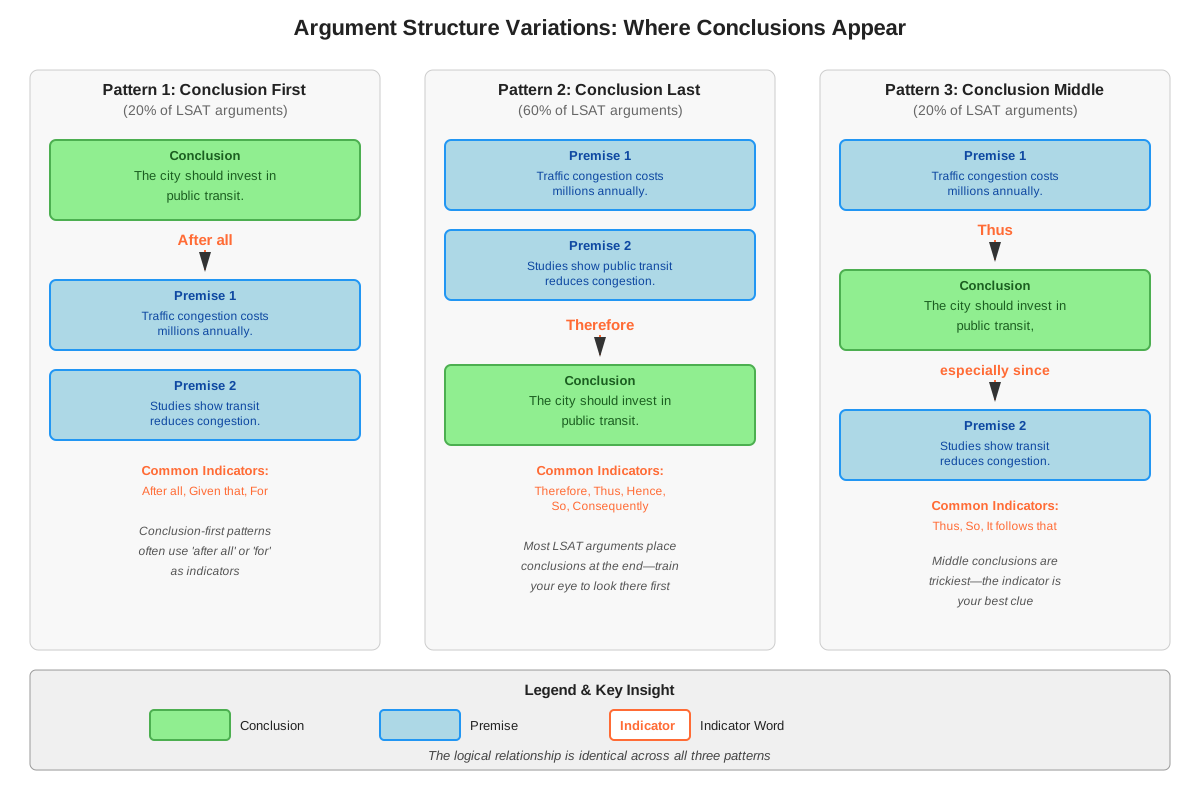
LSAT arguments deliberately vary where conclusions appear to test whether students truly understand argument structure or are simply assuming the last sentence is always the conclusion. Conclusions can appear:
- At the end: "All employees received bonuses. The company had a profitable year. Therefore, the company rewards success."
- At the beginning: "The company rewards success. After all, all employees received bonuses, and the company had a profitable year."
- In the middle: "All employees received bonuses. Thus, the company rewards success. The company had a profitable year."
- Without explicit indicators: "The company had a profitable year. All employees received bonuses. The company rewards success."
In the fourth example, context and logical structure reveal that "The company rewards success" is the conclusion—it's the claim that the other two statements support, even without an explicit indicator.
Main Conclusions vs. Subsidiary Conclusions
Complex LSAT arguments sometimes contain subsidiary conclusions (also called intermediate conclusions)—claims that are supported by some premises and in turn support the main conclusion. These create a chain of reasoning:
[Premise] → [Subsidiary Conclusion] → [Main Conclusion]For example: "Studies show exercise improves mood. Therefore, exercise benefits mental health. Consequently, schools should require physical education."
Here, "exercise benefits mental health" is a subsidiary conclusion (supported by the study premise) that serves as a premise for the main conclusion "schools should require physical education." Both "therefore" and "consequently" are conclusion indicators, but they mark different levels in the argument's hierarchy.
Identifying the main conclusion requires asking: "What is the ultimate point the author wants to establish?" The main conclusion is the claim that everything else in the argument ultimately supports.
Context-Based Conclusion Identification
Not all LSAT arguments include explicit conclusion indicators. In these cases, test-takers must use structural and contextual clues:
- The "Why?" test: Ask "Why?" after each statement. If other statements answer that question, you've found the conclusion.
- The "Therefore" test: Try inserting "therefore" before each statement. Where it fits naturally, you've likely found the conclusion.
- Support direction: Identify which statements provide reasons for other statements. The statement being supported is the conclusion.
- Author's purpose: Consider what the author is trying to convince you of—that's typically the conclusion.
These techniques ensure accurate conclusion identification even when indicators are absent.
Concept Relationships
Conclusion indicators exist within a broader ecosystem of argument fundamentals. They work in direct opposition to premise indicators: where premise indicators point to evidence, conclusion indicators point to claims. Together, these two types of indicators form a complete map of argument structure. The relationship can be visualized as:
Premise Indicators → Evidence/Support → Conclusion Indicators → Main ClaimUnderstanding conclusion indicators enables mastery of subsequent topics in Logical Reasoning. Once the conclusion is identified, students can:
- Analyze argument structure: Determine how premises connect to support the conclusion
- Identify assumptions: Recognize unstated premises necessary for the conclusion to follow
- Evaluate argument strength: Assess whether premises adequately support the conclusion
- Apply question-specific strategies: Use conclusion knowledge to strengthen, weaken, or parallel arguments
The relationship flows hierarchically: conclusion identification → argument structure analysis → question-type-specific techniques. Without accurately identifying conclusions, all subsequent analysis becomes unreliable.
Within the topic itself, the concepts connect as follows: Basic conclusion indicators → Conclusion vs. premise distinction → Conclusion placement variations → Main vs. subsidiary conclusions → Context-based identification. Each concept builds on the previous, moving from simple recognition to complex structural analysis.
Quick check — test yourself on Conclusion indicators so far.
Try Flashcards →High-Yield Facts
⭐ Conclusion indicators explicitly signal the main claim an author is trying to establish in an argument.
⭐ The most common conclusion indicators are "therefore," "thus," "hence," "so," and "consequently."
⭐ Conclusions can appear at the beginning, middle, or end of LSAT arguments—never assume the last sentence is the conclusion.
⭐ Approximately 95% of Logical Reasoning questions require identifying the conclusion as a foundational step.
⭐ Premise indicators (like "because" and "since") point to evidence, while conclusion indicators point to claims being supported.
- The word "so" is the most frequently used conclusion indicator on recent LSATs.
- Arguments can contain subsidiary conclusions that support the main conclusion, creating layered reasoning structures.
- Not all arguments include explicit conclusion indicators; context and structure must sometimes reveal the conclusion.
- The conclusion is the statement that other statements in the argument are offered to support, regardless of its position.
- Multiple conclusion indicators in a single argument often signal a chain of reasoning with intermediate steps.
- The phrases "it follows that" and "we can conclude that" are strong indicators that explicitly announce a conclusion.
- Words like "clearly" and "obviously" can function as conclusion indicators when they introduce claims rather than describe evidence.
- Identifying the conclusion incorrectly will cascade into errors on virtually every question type in Logical Reasoning.
Common Misconceptions
Misconception: The conclusion is always the last sentence in an argument.
Correction: Conclusions can appear anywhere in an argument—beginning, middle, or end. LSAT arguments deliberately vary conclusion placement to test true understanding of argument structure. Always use indicators and logical relationships, not position, to identify conclusions.
Misconception: Any sentence with a conclusion indicator is the main conclusion.
Correction: Some arguments contain subsidiary conclusions that support the main conclusion. When multiple conclusion indicators appear, identify which claim is the ultimate point the author wants to establish—that's the main conclusion. Subsidiary conclusions serve as intermediate steps in the reasoning chain.
Misconception: Conclusion indicators and premise indicators are interchangeable.
Correction: These indicators serve opposite functions. Conclusion indicators point to claims being supported, while premise indicators point to supporting evidence. Confusing them will cause you to misidentify the argument's structure entirely.
Misconception: If there's no conclusion indicator, the argument has no conclusion.
Correction: All arguments have conclusions, but not all arguments include explicit indicators. When indicators are absent, use structural analysis: identify which statement is being supported by the others through the "Why?" test or "Therefore" test.
Misconception: The conclusion is the most important or interesting statement in the argument.
Correction: The conclusion is the claim the author is arguing for, which may or may not be the most striking statement. Sometimes dramatic or surprising statements serve as premises supporting a more mundane conclusion. Focus on logical structure, not rhetorical impact.
Misconception: Words like "clearly" and "obviously" are just emphasis and don't indicate conclusions.
Correction: While these words do add emphasis, they often function as conclusion indicators when they introduce claims. "Clearly, the policy will fail" uses "clearly" to signal a conclusion. However, "The data clearly shows X" uses "clearly" as an adverb modifying "shows," not as a conclusion indicator.
Worked Examples
Example 1: Standard Conclusion Indicator
Argument: "Recent studies have shown that students who get adequate sleep perform better on standardized tests. Additionally, well-rested students report higher levels of concentration and lower stress. Therefore, schools should consider later start times to allow students more sleep."
Analysis:
Step 1: Scan for conclusion indicators. The word "therefore" appears before the final sentence, signaling a conclusion.
Step 2: Identify what "therefore" introduces: "schools should consider later start times to allow students more sleep." This is the conclusion.
Step 3: Verify by checking support direction. The first two sentences provide evidence (studies showing better performance, reports of higher concentration and lower stress) that support the claim about school start times.
Step 4: Apply the "Why?" test. Why should schools consider later start times? Because students who get adequate sleep perform better and experience benefits. The support flows toward the final claim.
Conclusion: "Schools should consider later start times to allow students more sleep."
Connection to Learning Objectives: This example demonstrates how conclusion indicators appear in straightforward LSAT arguments (Objective 1) and shows the reasoning pattern where evidence precedes the indicator and conclusion (Objective 2).
Example 2: Conclusion at the Beginning with Subsidiary Conclusion
Argument: "The city's new traffic policy will reduce congestion. After all, similar policies in comparable cities have decreased traffic by 20%. This demonstrates that the policy design is effective. Moreover, the city has allocated sufficient funding for implementation."
Analysis:
Step 1: Identify potential conclusions. The first sentence makes a claim: "The city's new traffic policy will reduce congestion." The phrase "after all" (a premise indicator) suggests what follows supports this claim.
Step 2: Examine the middle sentence. "This demonstrates that the policy design is effective" contains a conclusion indicator ("demonstrates that"). This is a subsidiary conclusion—it's supported by the evidence about other cities and in turn supports the main conclusion.
Step 3: Map the argument structure:
- Premise: Similar policies decreased traffic by 20%
- Subsidiary conclusion: The policy design is effective
- Additional premise: Sufficient funding allocated
- Main conclusion: The city's new traffic policy will reduce congestion
Step 4: Verify the main conclusion. Everything in the argument ultimately supports the opening claim. The evidence about other cities supports the subsidiary conclusion about effectiveness, which along with the funding premise supports the main conclusion about reducing congestion.
Main Conclusion: "The city's new traffic policy will reduce congestion."
Connection to Learning Objectives: This example shows how conclusions can appear at the beginning (Objective 1), demonstrates the reasoning pattern with layered conclusions (Objective 2), and requires distinguishing between main and subsidiary conclusions (Additional Objective 4). Successfully solving this requires applying conclusion indicators to complex argument structures (Objective 3).
Exam Strategy
When approaching LSAT Logical Reasoning questions, implement this systematic process for identifying conclusions:
Step 1: Scan for explicit indicators (5-10 seconds). Quickly read through the argument looking for conclusion indicators like "therefore," "thus," "hence," "so," and "consequently." If you find one, tentatively identify what it introduces as the conclusion.
Step 2: Verify with support direction (5-10 seconds). Confirm that other statements in the argument provide reasons for the identified conclusion. Ask: "Do the other statements answer 'why?' for this claim?"
Step 3: Check for subsidiary conclusions (5 seconds). If multiple conclusion indicators appear, determine which claim is the ultimate point—the main conclusion that everything else supports.
Step 4: Use context when indicators are absent (10-15 seconds). If no explicit indicators appear, apply the "Therefore" test: mentally insert "therefore" before each statement and see where it fits naturally. The statement that makes sense after "therefore" is likely the conclusion.
Exam Tip: The question stem often provides clues. "Main Point" questions explicitly ask for the conclusion. "Strengthen" and "Weaken" questions require identifying the conclusion to determine what needs support or attack. "Assumption" questions require knowing the conclusion to identify what's missing.
Trigger words to watch for:
- Strong conclusion indicators: therefore, thus, hence, consequently, so
- Moderate conclusion indicators: it follows that, we can conclude, this shows/demonstrates/proves
- Subtle conclusion indicators: clearly, obviously (when introducing claims)
- Premise indicators that signal the conclusion came before: because, since, for, after all, given that
Process-of-elimination tips:
- Eliminate answer choices that restate premises rather than the conclusion
- Eliminate choices that are too broad or too narrow compared to what the argument actually establishes
- Eliminate choices that introduce new information not present in the argument
- For Main Point questions, the correct answer will be the one statement that all others support
Time allocation: Spend 15-20 seconds identifying the conclusion before attempting to answer the question. This upfront investment saves time by preventing the need to re-read the argument multiple times. For complex arguments with subsidiary conclusions, allocate up to 30 seconds for structural analysis.
Memory Techniques
Mnemonic for common conclusion indicators: "The Three T's and S-C"
- Therefore
- Thus
- This shows/demonstrates/proves
- So
- Consequently
Visualization strategy: Picture an argument as an arrow diagram. Premises are arrows pointing toward the conclusion. When you see a conclusion indicator, visualize it as a target 🎯 that the arrows are aimed at. This mental image reinforces that conclusions are what premises point to and support.
Acronym for the verification process: "SCAM"
- Scan for indicators
- Check support direction
- Analyze for subsidiary conclusions
- Map the structure if needed
Contrast memory device: Remember that premise indicators and conclusion indicators are opposites by associating them with directions:
- Premise indicators = "BACK-ward looking" (because, as, since, given that—they look back at evidence)
- Conclusion indicators = "FOR-ward pointing" (therefore, thus, hence—they point forward to the claim)
Physical gesture technique: When practicing, point your finger forward when you encounter a conclusion indicator and backward when you encounter a premise indicator. This kinesthetic reinforcement helps cement the directional relationship in memory.
Summary
Conclusion indicators are linguistic signposts that explicitly mark the main claim an author is arguing for in logical reasoning contexts. Mastering these indicators—including "therefore," "thus," "hence," "so," and "consequently"—enables rapid identification of argument structure, which is foundational for success on virtually all LSAT Logical Reasoning question types. Conclusions can appear at any position in an argument (beginning, middle, or end), and some arguments contain subsidiary conclusions that support the main conclusion, creating layered reasoning structures. When explicit indicators are absent, structural analysis using the "Why?" test or "Therefore" test reveals the conclusion through support relationships. The key distinction between conclusion indicators (which point to claims being supported) and premise indicators (which point to supporting evidence) must be maintained to avoid structural misidentification. Approximately 95% of Logical Reasoning questions require accurate conclusion identification as a foundational step, making this among the highest-yield topics in LSAT preparation. Success requires both memorizing common indicators and developing the analytical skill to identify conclusions through logical structure when indicators are absent.
Key Takeaways
- Conclusion indicators are explicit linguistic markers that signal the main claim in an argument, with "therefore," "thus," "hence," "so," and "consequently" being the most common.
- Conclusions can appear anywhere in an argument—never assume the last sentence is the conclusion; always use indicators and logical structure to identify it.
- Distinguish conclusion indicators from premise indicators: conclusion indicators point to claims being supported, while premise indicators point to supporting evidence.
- Complex arguments may contain subsidiary conclusions that are supported by some premises and in turn support the main conclusion; identify which claim is the ultimate point.
- When indicators are absent, use the "Why?" test or "Therefore" test to identify which statement is being supported by the others.
- Accurate conclusion identification is foundational for approximately 95% of Logical Reasoning questions and must be mastered before advancing to question-specific strategies.
- Invest 15-30 seconds upfront to identify the conclusion correctly; this prevents time-consuming re-reading and cascading errors throughout the question.
Related Topics
Premise Indicators: Understanding words and phrases that signal supporting evidence (like "because," "since," and "given that") complements conclusion indicator mastery and completes the picture of argument structure mapping.
Argument Structure Diagramming: Once conclusions and premises are identified, learning to visually map arguments reveals logical relationships and gaps, enabling more sophisticated analysis.
Main Point Questions: This question type explicitly tests conclusion identification skills and provides an ideal context for applying conclusion indicator knowledge.
Assumption Questions: After identifying conclusions, assumption questions require determining what unstated premises are necessary for the conclusion to follow from the stated premises.
Strengthen and Weaken Questions: These question types require identifying the conclusion first, then determining what additional evidence would support or undermine it.
Mastering conclusion indicators creates the foundation for all these advanced topics, as each requires first knowing what claim the argument is trying to establish.
Practice CTA
Now that you understand conclusion indicators and their critical role in LSAT Logical Reasoning, it's time to cement this knowledge through active practice. Attempt the practice questions designed specifically for this topic, focusing on identifying conclusions quickly and accurately in various argument structures. Use the flashcards to drill common conclusion indicators until recognition becomes automatic. Remember: conclusion identification is a skill that improves dramatically with deliberate practice. Each argument you analyze strengthens your pattern recognition and builds the confidence needed for test day success. You've built the foundation—now reinforce it through application!
Sign up free to keep reading
Create a free AnvayaPrep account to finish this LSAT guide on Conclusion indicators — plus flashcards and practice questions.