Overview
Premise indicators are essential linguistic signals that help test-takers identify the evidence or support within an argument on the LSAT. These words and phrases function as signposts, alerting readers that what follows is a reason, fact, or piece of evidence being offered to support a conclusion. Mastering premise indicators is fundamental to success in Logical Reasoning sections because they enable rapid argument decomposition—the critical skill of breaking down complex passages into their constituent parts of premises and conclusions.
Understanding premise indicators transforms how students approach LSAT questions. Rather than reading arguments as undifferentiated blocks of text, skilled test-takers use these indicators to instantly recognize the logical structure underlying each passage. This recognition is not merely academic; it directly impacts performance on numerous question types, including Strengthen, Weaken, Assumption, Flaw, and Method of Reasoning questions. When students can quickly identify premises, they can more accurately assess argument validity, spot logical gaps, and predict what the test writers will ask.
Within the broader framework of argument fundamentals, premise indicators work in tandem with conclusion indicators to create a complete picture of argumentative structure. While conclusion indicators signal the main claim an author is trying to establish, premise indicators reveal the supporting evidence. Together, these tools form the foundation upon which all advanced LSAT premise indicators analysis is built. Students who master premise identification early in their preparation find that subsequent topics—such as assumption identification, conditional reasoning, and causal arguments—become significantly more manageable because they can reliably isolate the building blocks of every argument they encounter.
Learning Objectives
- [ ] Identify how premise indicators appear in LSAT questions across multiple question types
- [ ] Explain the reasoning pattern behind premise indicators and their function in argument structure
- [ ] Apply premise indicators to solve LSAT-style problems accurately and efficiently
- [ ] Distinguish between premise indicators and conclusion indicators in complex arguments
- [ ] Recognize when premises are present without explicit indicators (implicit premise identification)
- [ ] Evaluate the strength and relevance of premises once identified
- [ ] Utilize premise identification to improve speed and accuracy on timed sections
Prerequisites
- Basic sentence structure and grammar: Understanding subjects, predicates, and clauses is necessary to parse complex LSAT sentences and identify where one claim ends and another begins.
- Reading comprehension fundamentals: The ability to understand literal meaning in academic prose ensures students can grasp what premises actually state before analyzing their logical function.
- Familiarity with argument structure: Recognizing that arguments consist of claims (some supporting, some being supported) provides the conceptual framework into which premise indicators fit.
- Understanding of evidence vs. opinion: Distinguishing factual claims from value judgments helps students recognize what types of statements typically function as premises.
Why This Topic Matters
Premise indicators appear in approximately 85-90% of Logical Reasoning questions on the LSAT, making them one of the most frequently tested elements in the entire exam. Every argument-based question—which constitutes the vast majority of the Logical Reasoning section—requires students to identify what evidence is being offered. Without reliable premise identification skills, students waste precious seconds re-reading passages, misidentify argument structure, and select incorrect answer choices that address the wrong part of the argument.
In real-world applications, premise identification skills translate directly to critical thinking in legal practice, business analysis, and academic research. Lawyers must identify the evidence supporting opposing counsel's claims, business analysts must recognize the data underlying strategic recommendations, and researchers must evaluate the empirical support for theoretical positions. The LSAT tests this skill because it predicts success in law school, where students constantly analyze the reasoning in judicial opinions, statutes, and legal arguments.
On the exam itself, premise indicators appear most commonly in these contexts: Strengthen/Weaken questions (where students must identify what evidence already exists before determining what would support or undermine it), Assumption questions (where the gap between premises and conclusion must be identified), Flaw questions (where faulty reasoning often involves premises that don't adequately support conclusions), and Method of Reasoning questions (where students must describe how premises function in the argument). Additionally, premise indicators frequently appear in complex arguments with multiple sub-conclusions, where one claim serves as both the conclusion of one line of reasoning and a premise for another.
Core Concepts
Definition and Function of Premise Indicators
Premise indicators are words or phrases that signal the presence of evidence, reasons, or support for a conclusion. They function as linguistic markers that tell readers: "What follows is a fact, observation, or claim being offered as support for something else." These indicators don't make a statement true or false; they simply identify the statement's role within the argument's structure.
The primary function of premise indicators is to establish logical relationships. When an author writes "since the economy is growing," the word "since" indicates that "the economy is growing" is being offered as evidence for some other claim. Understanding this function is crucial because the same factual statement could serve different roles in different arguments depending on whether it's marked by a premise indicator, a conclusion indicator, or no indicator at all.
Common Premise Indicators
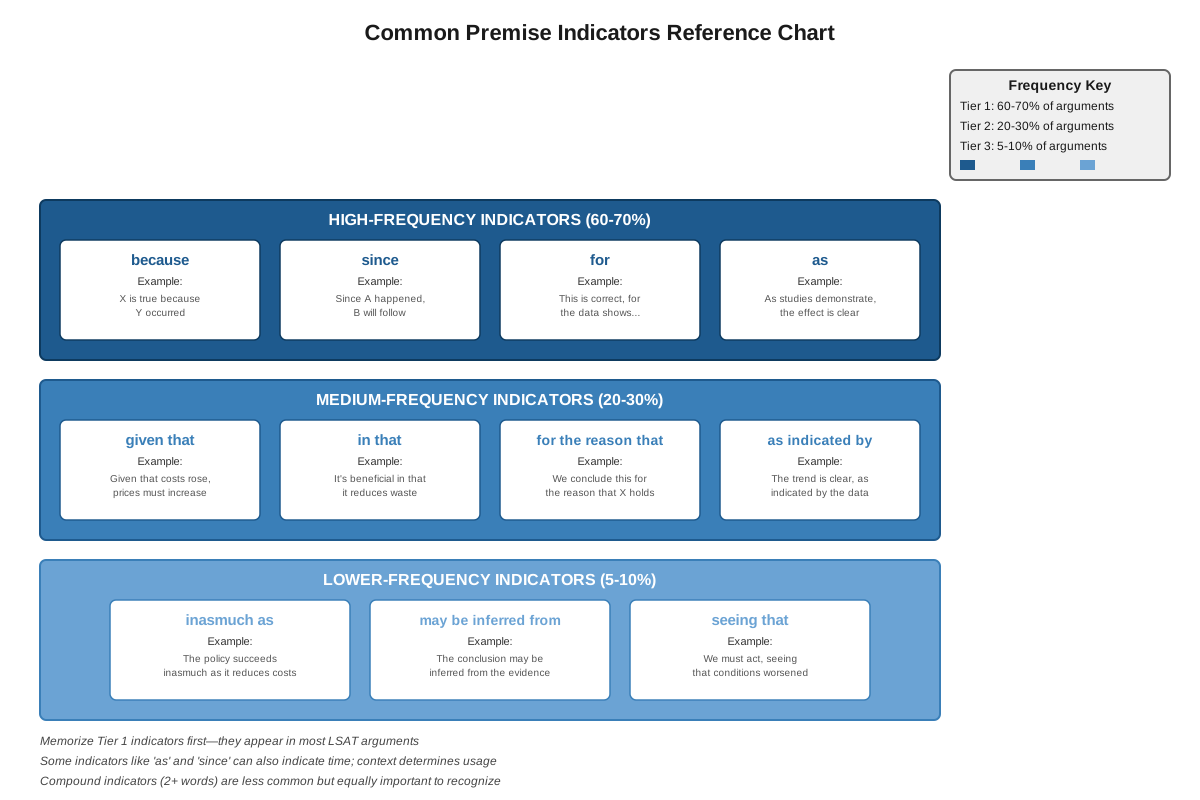
The following table organizes the most frequently encountered premise indicators on the LSAT:
| Category | Indicators | Usage Notes |
|---|---|---|
| Causal/Reason | because, since, for, as | Most common; "since" can also mean "from that time" |
| Evidence-Based | given that, in light of, considering that | Emphasizes factual basis |
| Assumption-Based | assuming that, supposing that, granted that | Indicates hypothetical premises |
| Support-Based | supported by, as indicated by, as shown by | Points to external evidence |
| Inference-Based | may be inferred from, follows from, inasmuch as | Suggests logical derivation |
Premise Indicator Patterns
Premise indicators typically appear in three structural patterns:
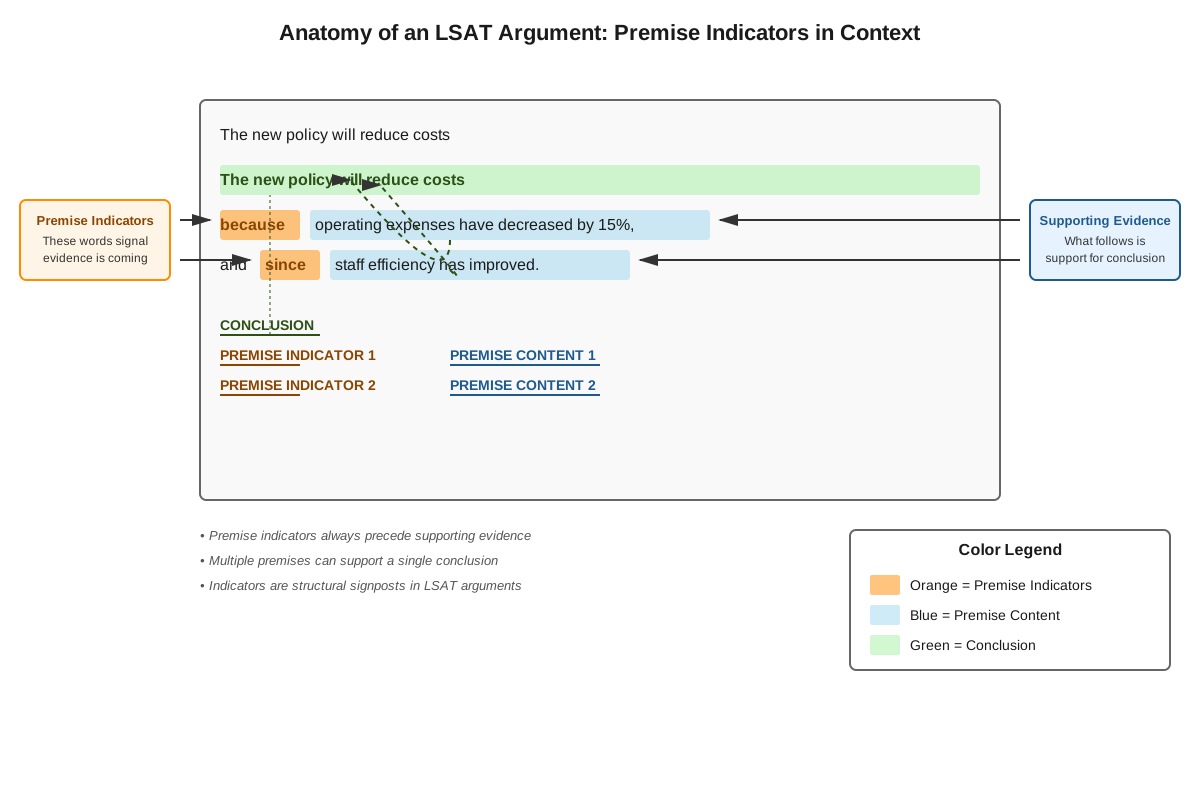
- Premise-first structure: "Because [premise], [conclusion]." The indicator appears at the beginning, immediately signaling that evidence is coming before the main claim.
- Conclusion-first structure: "[Conclusion], because [premise]." The indicator appears mid-argument, separating the conclusion from its supporting evidence.
- Multiple-premise structure: "[Conclusion], since [premise 1] and given that [premise 2]." Multiple indicators may appear, each introducing a separate piece of evidence.
Distinguishing Premises from Conclusions
The relationship between premises and conclusions is directional: premises provide support for conclusions, while conclusions are supported by premises. This directionality is key to understanding argument structure. A helpful test is the "therefore test": if you can logically insert "therefore" before a statement based on other statements in the argument, that statement is likely the conclusion, and the other statements are premises.
Consider this argument: "Since violent crime has decreased, the new policing policy is effective." The premise indicator "since" marks "violent crime has decreased" as the evidence. The conclusion "the new policing policy is effective" is what's being supported. The logical flow is: [Evidence about crime] → [Claim about policy effectiveness].
Implicit vs. Explicit Premises
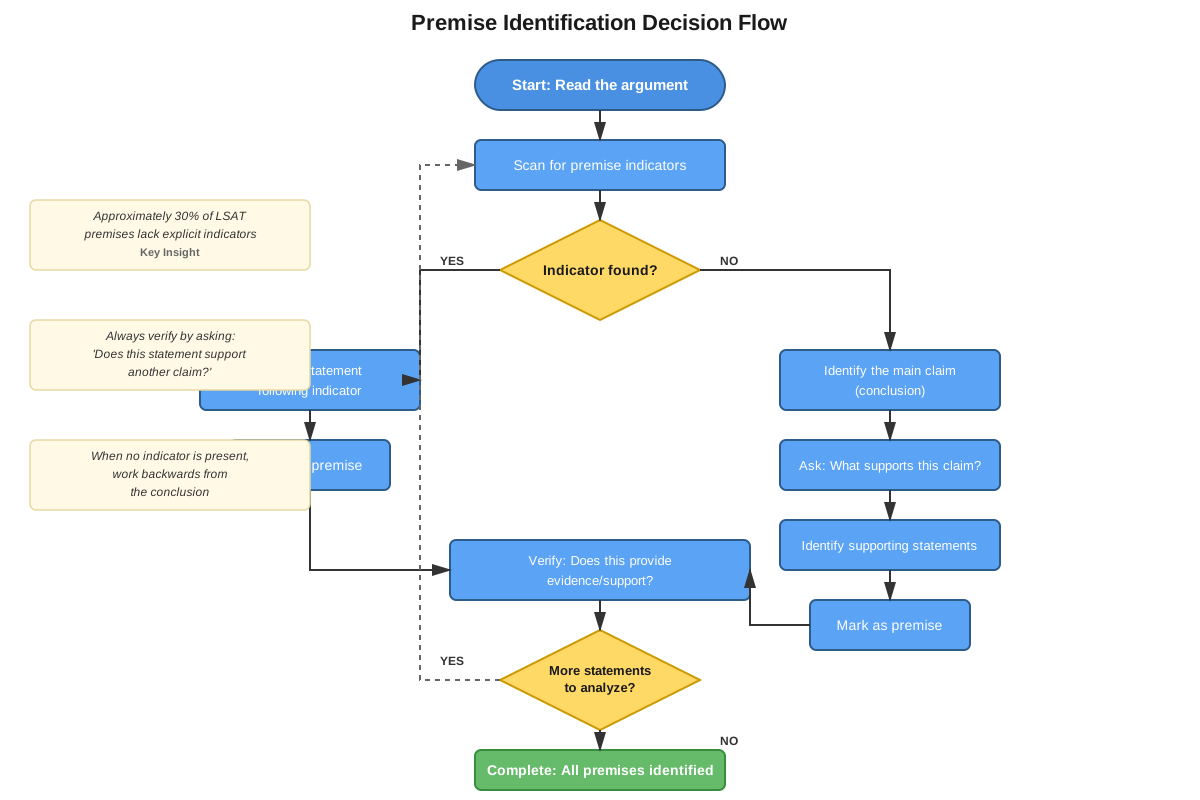
Not all premises are marked by indicators. Implicit premises appear without linguistic signals, requiring students to identify them through logical analysis. For example: "The defendant was at the scene. Therefore, the defendant committed the crime." The first statement functions as a premise despite lacking an indicator. Recognizing implicit premises requires understanding argument structure beyond mere indicator identification.
Explicit premises, marked by indicators, are easier to identify but may still require careful reading. In complex arguments, multiple explicit premises may support a single conclusion, or premises may be embedded in subordinate clauses: "Because the study, which was conducted over five years, showed significant results, the hypothesis is confirmed."
Context-Dependent Indicators
Some words function as premise indicators only in specific contexts. "Since" can indicate either a premise ("Since it's raining, the game is cancelled") or a temporal relationship ("Since 2010, prices have risen"). "For" can be a premise indicator ("The plan will fail, for it lacks funding") or a preposition ("This is for you"). Context and sentence structure determine the correct interpretation.
Compound and Complex Arguments
In sophisticated LSAT arguments, premises may support intermediate conclusions, which then serve as premises for the main conclusion. These sub-conclusions create layered argument structures. Premise indicators help identify each level: "Because [premise 1], [sub-conclusion]. Since [sub-conclusion], [main conclusion]." Recognizing these structures prevents students from misidentifying which claim is the ultimate conclusion.
Concept Relationships
Premise indicators connect directly to conclusion indicators (words like "therefore," "thus," "hence") to form a complete system for argument mapping. Together, these two types of indicators enable students to decompose any argument into its logical components. The relationship is complementary: premise indicators point to support, while conclusion indicators point to what's being supported.
Within the broader topic of argument fundamentals, premise indicators serve as the foundation for more advanced concepts. Once premises are identified, students can analyze assumptions (unstated premises necessary for the argument to work), evaluate logical flaws (ways premises fail to adequately support conclusions), and assess argument strength (how well premises actually support their conclusion).
The relationship map flows as follows:
Premise Indicators → enable → Premise Identification → leads to → Argument Structure Analysis → enables → Assumption Identification → supports → Argument Evaluation → facilitates → Answer Choice Analysis
Additionally, premise identification connects to conditional reasoning because conditional statements often function as premises ("If the law passes, taxes will increase. The law will pass. Therefore, taxes will increase."). It also relates to causal reasoning, as causal claims frequently appear as premises marked by indicators like "because" or "since."
High-Yield Facts
⭐ The most common premise indicators on the LSAT are "because," "since," "for," and "given that"—these appear in over 60% of arguments with explicit indicators.
⭐ Premise indicators signal evidence or support; they mark statements that provide reasons for accepting another claim.
⭐ Not all premises have indicators; approximately 30-40% of LSAT arguments contain implicit premises that must be identified through structural analysis.
⭐ The word "since" can function as either a premise indicator or a temporal marker; context determines which meaning applies.
⭐ Multiple premises can support a single conclusion, and each may be introduced by its own indicator.
- Premise indicators can appear at the beginning, middle, or end of sentences, requiring flexible reading strategies.
- In complex arguments, a statement can be both a conclusion (of one sub-argument) and a premise (for the main conclusion).
- The phrase "given that" typically introduces factual premises that the argument treats as established or uncontroversial.
- Premise indicators do not make statements true; they only identify the statement's role in the argument structure.
- Recognizing premise indicators improves reading speed by allowing students to mentally organize arguments while reading rather than after.
- The absence of premise indicators in a passage often signals a flawed argument or one that relies heavily on unstated assumptions.
- Conditional statements introduced by premise indicators ("because if X then Y") require special attention as they combine two logical structures.
Quick check — test yourself on Premise indicators so far.
Try Flashcards →Common Misconceptions
Misconception: Premise indicators always appear at the beginning of sentences.
Correction: Premise indicators can appear anywhere in a sentence. "The policy will succeed because it has broad support" places the indicator mid-sentence, after the conclusion. Students must read entire sentences before determining structure.
Misconception: Every statement with "because" or "since" is a premise.
Correction: Context matters. "Since 2015" uses "since" temporally, not logically. "Because of the weather" might be a causal explanation rather than part of an argument structure. Students must distinguish argumentative uses from other grammatical functions.
Misconception: Arguments with more premises are stronger than those with fewer premises.
Correction: Premise quantity doesn't determine argument strength; premise quality and relevance do. One highly relevant premise can provide stronger support than three tangentially related premises. The LSAT frequently tests this by including irrelevant premises as distractors.
Misconception: If a statement lacks a premise indicator, it must be the conclusion.
Correction: Statements without indicators could be premises, conclusions, background information, or context. Identifying argument structure requires analyzing logical relationships, not just counting indicators. Many arguments present premises without any indicators.
Misconception: Premise indicators and evidence are the same thing.
Correction: Premise indicators are words that signal evidence; they're not the evidence itself. "Because the study showed X" contains the indicator "because" and the evidence "the study showed X." Confusing the signal with the content leads to incomplete argument analysis.
Misconception: All premises are facts.
Correction: Premises can be facts, opinions, hypotheticals, or value judgments. What makes something a premise is its structural role (supporting a conclusion), not its truth value or objectivity. "Assuming justice is important" uses a value-based premise.
Worked Examples
Example 1: Basic Premise Identification
Passage: "The new transportation policy should be implemented. After all, it will reduce traffic congestion, and studies show that reduced congestion improves air quality."
Analysis:
Step 1: Identify potential indicators. "After all" is a premise indicator (synonymous with "because" or "since").
Step 2: Determine what follows the indicator. Two claims follow: (1) "it will reduce traffic congestion" and (2) "studies show that reduced congestion improves air quality."
Step 3: Identify the conclusion. "The new transportation policy should be implemented" appears before the indicator, suggesting it's the conclusion being supported.
Step 4: Map the structure:
- Conclusion: The new transportation policy should be implemented
- Premise 1: It will reduce traffic congestion
- Premise 2: Studies show that reduced congestion improves air quality
Step 5: Verify the logical flow. The premises provide reasons to accept the conclusion. The argument flows: [Evidence about congestion reduction and air quality] → [Recommendation to implement policy].
Connection to Learning Objectives: This example demonstrates how premise indicators appear in LSAT questions (Objective 1) and shows the reasoning pattern where evidence supports a policy recommendation (Objective 2).
Example 2: Complex Argument with Multiple Indicators
Passage: "The company's profits will increase next quarter. This is because consumer confidence is rising, and given that rising confidence typically leads to increased spending, we can expect higher sales. Since higher sales directly translate to increased profits, the projection is well-founded."
Analysis:
Step 1: Identify all indicators. "Because," "given that," and "since" all appear as premise indicators.
Step 2: Map the layered structure:
- Main conclusion: "The company's profits will increase next quarter"
- First premise (introduced by "because"): "consumer confidence is rising"
- Second premise (introduced by "given that"): "rising confidence typically leads to increased spending"
- Intermediate conclusion/premise: "we can expect higher sales"
- Third premise (introduced by "since"): "higher sales directly translate to increased profits"
- Final conclusion: "the projection is well-founded"
Step 3: Identify the logical chain:
[Consumer confidence rising] + [Confidence leads to spending] → [Higher sales expected] + [Sales translate to profits] → [Profits will increase]
Step 4: Recognize the sub-argument structure. "We can expect higher sales" functions as both a conclusion (supported by the first two premises) and a premise (supporting the main conclusion about profits).
Step 5: Note how multiple premise indicators create a complex but traceable argument structure. Each indicator signals a new piece of evidence entering the logical chain.
Connection to Learning Objectives: This example shows how premise indicators appear in complex, multi-layered arguments (Objective 1), demonstrates the reasoning pattern of chained support (Objective 2), and requires applying premise identification skills to untangle sophisticated argument structures (Objective 3).
Exam Strategy
Key Strategy: Read actively for structure, not just content. As you read each sentence, ask: "Is this evidence or a claim being supported?"
Approach for Timed Sections:
- Pre-read for indicators: Before diving into content analysis, quickly scan for premise and conclusion indicators. This 2-3 second investment provides a structural roadmap.
- Mark as you read: Develop a consistent notation system. Many successful test-takers underline premise indicators and bracket the premises they introduce, while circling conclusion indicators.
- Apply the "why/so what" test: For each statement, ask "Why should I believe this?" (points to premises) or "So what follows from this?" (points to conclusions).
Trigger Words to Watch:
- High-frequency indicators: "because," "since," "for," "as," "given that"
- Formal indicators: "inasmuch as," "in light of," "considering that"
- Assumption indicators: "assuming," "supposing," "granted that"
- Evidence indicators: "as shown by," "as indicated by," "supported by"
Process of Elimination Tips:
When answer choices reference "the argument's premises" or "evidence provided," immediately return to your premise identification. Incorrect answers often:
- Cite the conclusion as if it were a premise
- Reference background information that isn't actually offered as support
- Confuse intermediate conclusions with main premises
- Attribute to premises claims that are actually unstated assumptions
Time Allocation:
Spend 15-20 seconds on initial argument decomposition for each question. This upfront investment saves 30-45 seconds during answer choice evaluation because you won't need to re-read the passage multiple times. For complex arguments with multiple premises, invest an extra 5-10 seconds to map the structure clearly.
Question Type-Specific Strategies:
- Strengthen/Weaken: Identify all premises first; the correct answer will relate to the gap between these premises and the conclusion
- Assumption: Focus on what the premises don't say; assumptions bridge premise-conclusion gaps
- Flaw: Examine whether premises actually support the conclusion as strongly as the argument assumes
- Method of Reasoning: Be prepared to describe how premises function (e.g., "provides an example supporting the main claim")
Memory Techniques
Mnemonic for Common Premise Indicators: "BSFG-AL"
- Because
- Since
- For
- Given that
- As
- in Light of
Visualization Strategy: Picture arguments as buildings. The conclusion is the roof (what's being supported), and premises are the support columns (what provides support). Premise indicators are signs on each column saying "Support Column." This mental image reinforces the structural relationship.
The "Arrow Technique": When reading, mentally insert arrows after premise indicators: "Because [premise] → [conclusion]." This reinforces the directional flow of support and helps distinguish premises from conclusions.
Contrast Pair Memory: Learn premise and conclusion indicators together as opposites:
- Premise: "because" ↔ Conclusion: "therefore"
- Premise: "since" ↔ Conclusion: "thus"
- Premise: "for" ↔ Conclusion: "so"
This pairing helps prevent confusion and reinforces that these indicators mark opposite ends of the support relationship.
The "After All" Reminder: Remember that "after all" means "here's the reason" (premise indicator), not "finally" or "in conclusion." The phrase literally means "after considering everything, here's the evidence."
Summary
Premise indicators are linguistic signals that identify evidence, reasons, or support within LSAT arguments. Mastering these indicators—including common words like "because," "since," "for," and "given that"—enables rapid argument decomposition, which is essential for success across all Logical Reasoning question types. These indicators work by marking statements that provide support for conclusions, creating a directional relationship where premises flow toward the claims they support. While many premises are explicitly marked by indicators, students must also recognize implicit premises that lack such markers. Understanding premise indicators is foundational to argument fundamentals because it enables all subsequent analysis: identifying assumptions, evaluating logical flaws, and assessing argument strength. On the LSAT, premise identification appears in approximately 85-90% of Logical Reasoning questions, making it one of the highest-yield skills for test preparation. Students who can quickly and accurately identify premises gain significant advantages in both speed and accuracy, as they can immediately focus on the logical relationships that questions test rather than spending time re-reading passages to determine basic structure.
Key Takeaways
- Premise indicators are words or phrases that signal evidence or support for a conclusion, with "because," "since," "for," and "given that" being the most common on the LSAT.
- Premise identification is foundational to all Logical Reasoning analysis, enabling students to decompose arguments, identify assumptions, and evaluate logical strength.
- Not all premises have explicit indicators; approximately 30-40% of LSAT arguments require identifying implicit premises through structural analysis.
- Context determines whether words like "since" or "for" function as premise indicators or serve other grammatical purposes like temporal markers or prepositions.
- Complex arguments may contain multiple premises supporting a single conclusion, or layered structures where sub-conclusions serve as premises for main conclusions.
- Active reading for structure—identifying premises and conclusions while reading—saves significant time during answer choice evaluation and improves accuracy.
- Premise indicators appear across all Logical Reasoning question types, making them essential for Strengthen, Weaken, Assumption, Flaw, and Method of Reasoning questions.
Related Topics
Conclusion Indicators: The complementary skill to premise identification, conclusion indicators (like "therefore," "thus," "hence") mark the claims being supported. Mastering both types of indicators together provides complete argument mapping capability.
Argument Structure and Diagramming: Building on premise identification, this topic teaches formal methods for visually representing argument structure, including complex arguments with multiple layers of support.
Assumptions in Arguments: Once premises are identified, recognizing unstated assumptions—the missing links between premises and conclusions—becomes possible. This is one of the most tested concepts on the LSAT.
Sufficient and Necessary Assumptions: An advanced application of premise identification, distinguishing between assumptions that guarantee the conclusion (sufficient) and those required for it (necessary).
Logical Flaws and Fallacies: Understanding how premises can fail to adequately support conclusions, including common reasoning errors like hasty generalizations, false dichotomies, and causal fallacies.
Strengthen and Weaken Questions: These question types directly test the ability to identify premises and determine what additional evidence would support or undermine the argument's reasoning.
Practice CTA
Now that you understand premise indicators and their crucial role in LSAT Logical Reasoning, it's time to reinforce this knowledge through active practice. Complete the practice questions to test your ability to identify premise indicators in various contexts, from straightforward arguments to complex, multi-layered passages. Use the flashcards to drill the most common indicators until recognition becomes automatic—this automaticity will save you precious seconds on test day. Remember, premise identification is a skill that improves dramatically with deliberate practice. Each practice question you complete strengthens your ability to rapidly decompose arguments, setting the foundation for mastering every other Logical Reasoning concept. Your investment in mastering this fundamental skill will pay dividends across the entire LSAT.
Sign up free to keep reading
Create a free AnvayaPrep account to finish this LSAT guide on Premise indicators — plus flashcards and practice questions.