Overview
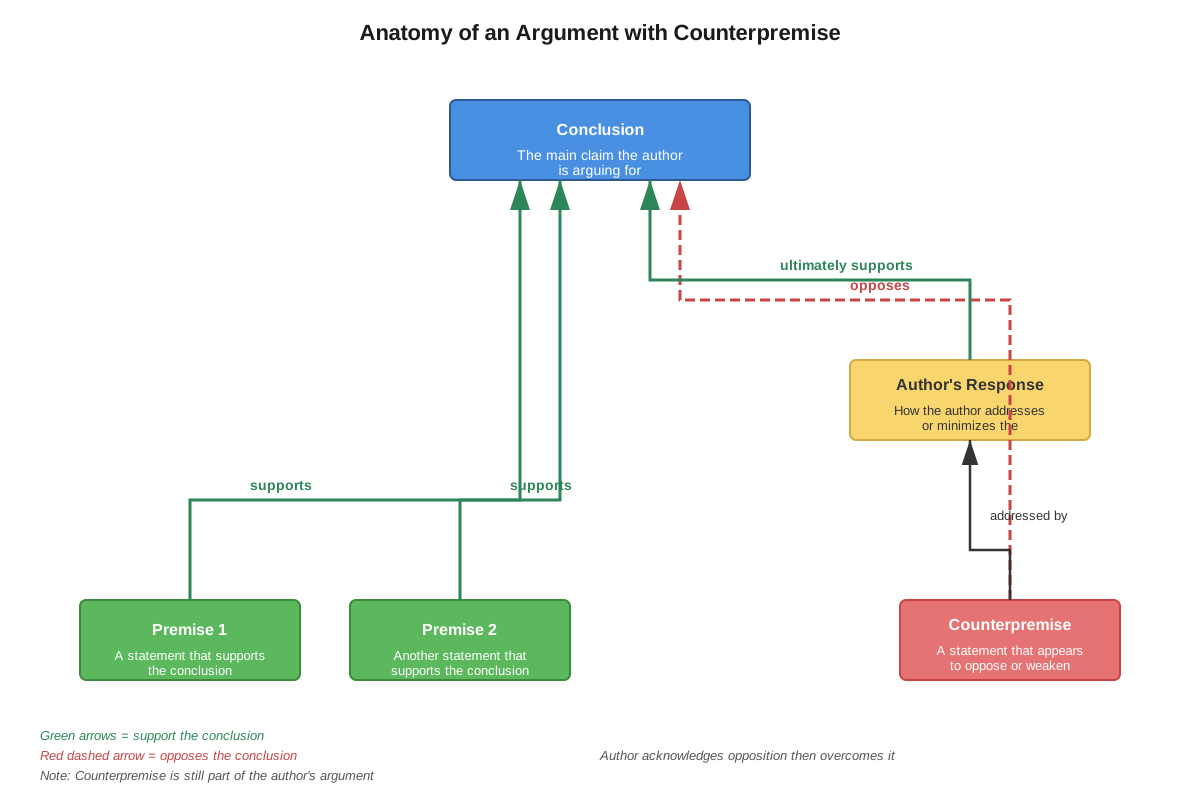
Counterpremises represent one of the most sophisticated and frequently tested elements of argument fundamentals in LSAT logical reasoning sections. A counterpremise is a statement within an argument that appears to work against the author's conclusion, acknowledging a point that might weaken the argument before the author attempts to overcome or minimize it. Unlike premises that directly support a conclusion, counterpremises introduce opposing considerations that the author must address to maintain argumentative credibility. Understanding counterpremises is essential because they reveal the author's awareness of potential objections and demonstrate how arguments can be structured to anticipate and respond to criticism.
The ability to identify and analyze counterpremises is crucial for success on the LSAT because these elements appear across multiple question types, including Strengthen/Weaken questions, Method of Reasoning questions, and Argument Structure questions. When test-takers can recognize counterpremises, they gain insight into the complete architecture of an argument, understanding not just what the author claims but also what objections the author acknowledges. This recognition becomes particularly important when evaluating argument strength, identifying assumptions, or determining how an author responds to potential criticism.
Counterpremises connect to broader logical reasoning concepts by illustrating how arguments function in realistic contexts where authors must address competing viewpoints. They demonstrate that strong arguments don't simply ignore opposing evidence but rather acknowledge and attempt to overcome it. This topic builds upon fundamental understanding of premises and conclusions while preparing students for more advanced concepts like assumption identification, argument evaluation, and critical reasoning. Mastering counterpremises enables test-takers to navigate complex argumentative structures with confidence and precision.
Learning Objectives
- [ ] Identify how Counterpremises appears in LSAT questions
- [ ] Explain the reasoning pattern behind Counterpremises
- [ ] Apply Counterpremises to solve LSAT-style problems accurately
- [ ] Distinguish counterpremises from regular premises and counterarguments
- [ ] Analyze how authors use counterpremises to strengthen their overall arguments
- [ ] Predict common LSAT question types that test counterpremise recognition
- [ ] Evaluate the effectiveness of an author's response to a counterpremise
Prerequisites
- Basic Argument Structure: Understanding of premises, conclusions, and how they relate is essential because counterpremises function as a special type of premise within arguments
- Indicator Words: Familiarity with conclusion and premise indicators helps distinguish counterpremises from other argument components
- Logical Support Relationships: Knowledge of how statements support or oppose conclusions enables recognition of when a statement works against the author's position
- Reading Comprehension: Ability to parse complex sentences and identify author's intent is necessary to detect subtle counterpremises
Why This Topic Matters
Counterpremises appear in real-world argumentation whenever writers or speakers acknowledge potential weaknesses in their positions. Legal briefs, policy debates, scientific papers, and business proposals all employ counterpremises to demonstrate thoroughness and credibility. By acknowledging opposing considerations, arguers show intellectual honesty and strengthen their positions by preemptively addressing objections. This skill translates directly to legal practice, where attorneys must anticipate opposing counsel's arguments and address them proactively.
On the LSAT, counterpremises appear in approximately 15-20% of Logical Reasoning questions, making them a high-yield topic for test preparation. They most commonly appear in Method of Reasoning questions (where test-takers must identify the role a statement plays), Argument Structure questions (where understanding the complete architecture matters), and occasionally in Strengthen/Weaken questions (where recognizing what the author already acknowledges helps eliminate wrong answers). The LSAT frequently tests whether students can distinguish counterpremises from regular premises, understand how they function within arguments, and recognize when authors successfully or unsuccessfully address them.
Common manifestations include arguments where authors acknowledge economic costs before arguing for policy benefits, recognize exceptions before making general claims, or admit limitations before asserting overall validity. The LSAT often presents counterpremises using specific linguistic markers, making pattern recognition a valuable skill. Questions may ask test-takers to identify "the role played by" a particular statement, describe "the method of reasoning," or determine "how the argument proceeds," all of which require counterpremise recognition.
Core Concepts
Definition and Function of Counterpremises
A counterpremise is a statement within an argument that acknowledges a point opposing or potentially weakening the author's conclusion, which the author then attempts to overcome, minimize, or outweigh with other considerations. Unlike a simple premise that supports the conclusion, a counterpremise introduces tension into the argument by recognizing a contrary fact, consideration, or perspective. The key characteristic is that the counterpremise remains part of the author's own argument—it's not an external objection but rather the author's acknowledgment of a potential weakness.
Counterpremises serve several strategic functions in argumentation. First, they demonstrate intellectual honesty and awareness of complexity, making arguments appear more credible and nuanced. Second, they allow authors to control the narrative by addressing objections on their own terms rather than leaving them for opponents to raise. Third, they set up a structure where the author can show why, despite the acknowledged opposing consideration, the conclusion still holds. This creates a "yes, but" pattern that characterizes many sophisticated arguments.
The relationship between counterpremises and conclusions is indirect. While regular premises provide direct support for conclusions, counterpremises provide indirect support by acknowledging and then overcoming objections. The overall argument structure becomes: "Although X is true (counterpremise), Y is also true (regular premise), therefore Z (conclusion)." The counterpremise makes the argument stronger by showing the author has considered multiple perspectives.
Linguistic Markers and Identification
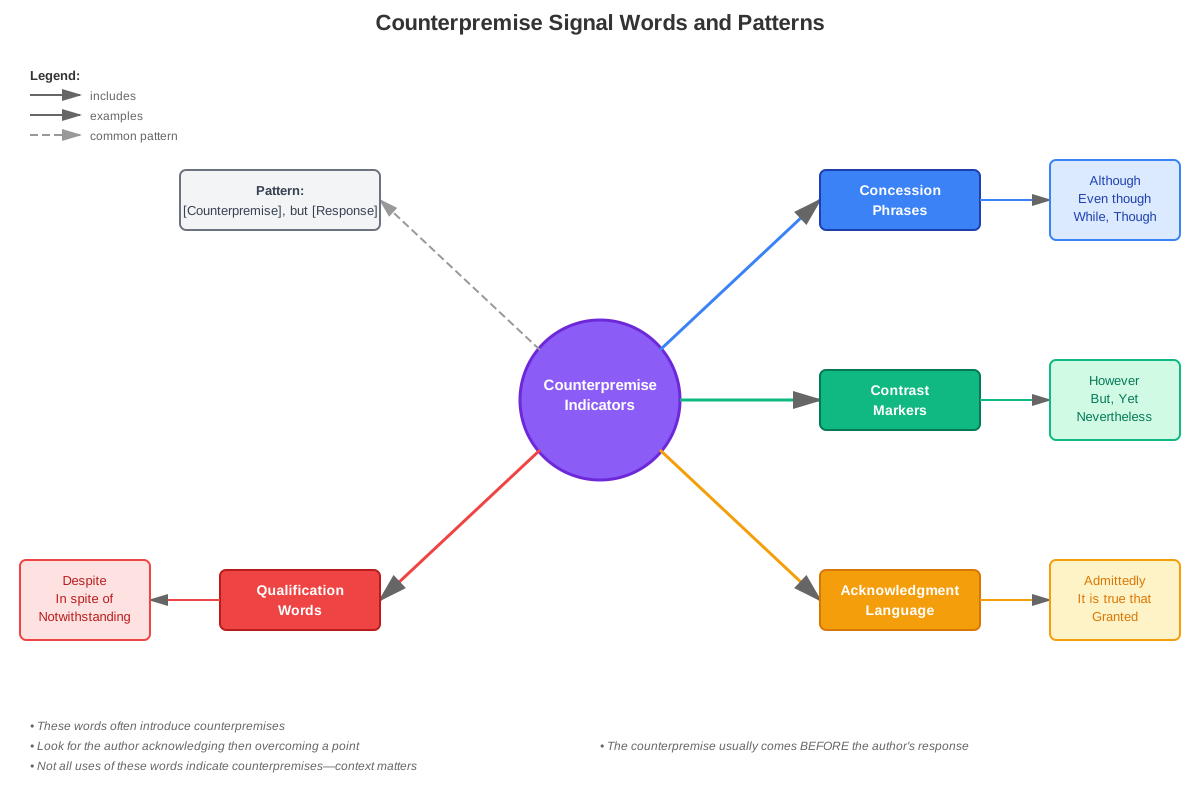
LSAT counterpremises typically appear with specific linguistic markers that signal concession or acknowledgment. Common indicators include:
- Concessive conjunctions: "although," "though," "even though," "while," "whereas"
- Admittedly phrases: "admittedly," "granted," "to be sure," "certainly," "it is true that"
- Contrast markers: "but," "however," "yet," "nevertheless," "nonetheless," "still"
- Acknowledgment phrases: "despite the fact that," "in spite of," "notwithstanding"
The structure often follows a pattern where the counterpremise appears first, followed by a contrast marker, then the main premise and conclusion. For example: "Although the policy would be expensive (counterpremise), it would save lives (premise), so we should implement it (conclusion)." However, the order can vary, with counterpremises sometimes appearing mid-argument or even after the conclusion.
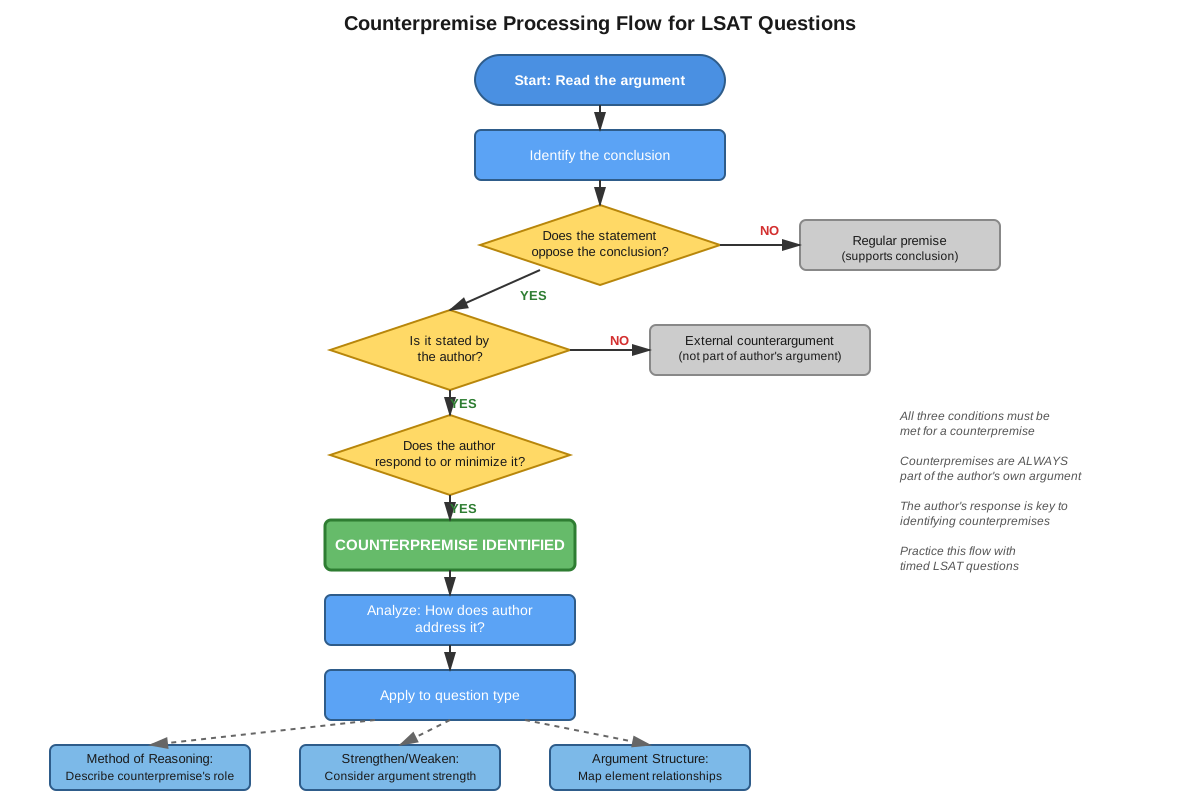
Identification requires attention to both linguistic markers and logical function. A statement is a counterpremise only if it: (1) appears to work against the conclusion, (2) is acknowledged by the author (not presented as an opponent's view to be rejected), and (3) is followed by reasoning that attempts to overcome or outweigh it. Test-takers must distinguish counterpremises from background information, opposing arguments that are rejected, and regular premises that might seem negative but actually support the conclusion.
Counterpremises vs. Related Concepts
Understanding counterpremises requires distinguishing them from similar but distinct argumentative elements:
| Element | Function | Relationship to Conclusion | Author's Stance |
|---|---|---|---|
| Counterpremise | Acknowledges opposing point within author's argument | Appears to oppose but is overcome | Acknowledged as valid but outweighed |
| Regular Premise | Directly supports conclusion | Supports | Endorsed fully |
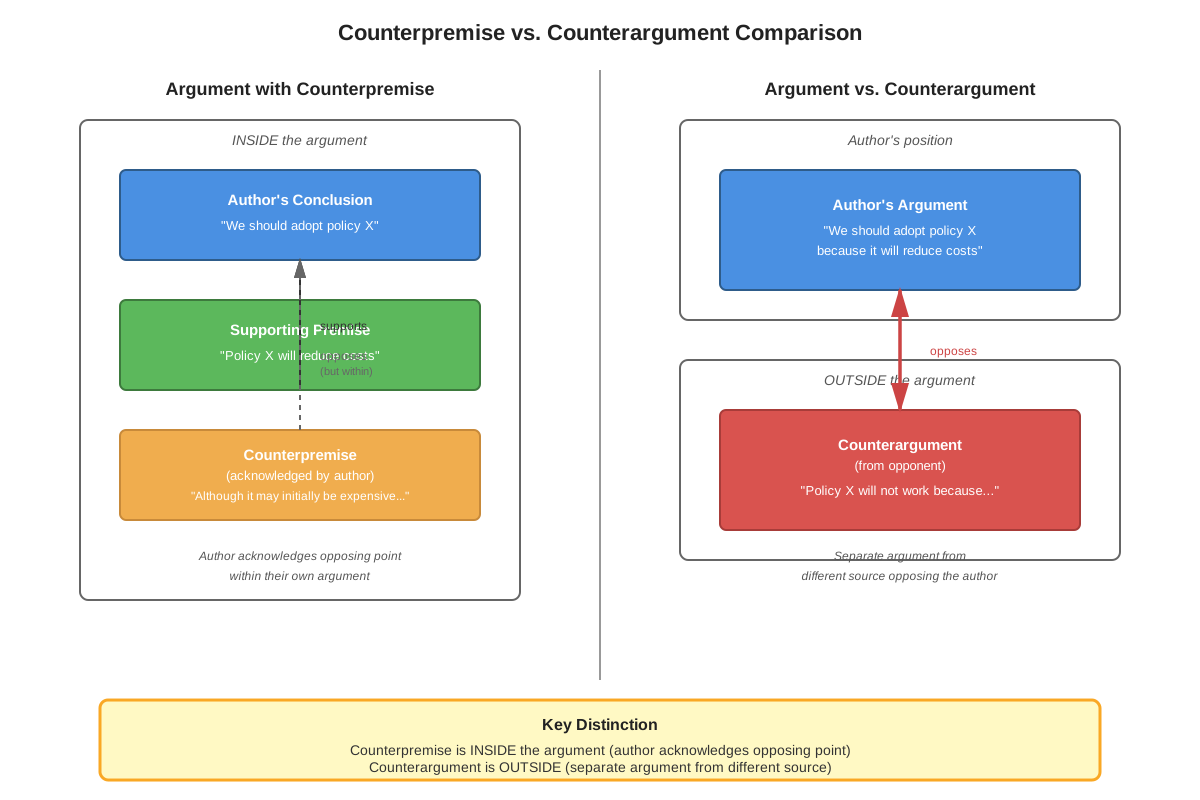
| Counterargument | External opposing argument | Opposes | Rejected or refuted |
| Background/Context | Provides setting or information | Neutral | Neither endorsed nor opposed |
| Intermediate Conclusion | Supported by some premises, supports main conclusion | Supports | Endorsed as step toward main point |
The critical distinction between counterpremises and counterarguments is ownership. Counterpremises are part of the author's own reasoning—the author accepts them as true and incorporates them into the argument. Counterarguments are external positions that the author presents only to reject or refute them. For example, "Critics claim the policy is too expensive, but they are wrong" presents a counterargument to be rejected, while "The policy is expensive, but it will save lives" presents a counterpremise to be outweighed.
Argument Patterns Involving Counterpremises
Several common patterns incorporate counterpremises in LSAT arguments:
- Outweighing Pattern: The author acknowledges a negative consideration but argues that positive considerations outweigh it
- Structure: "Although X (negative), Y (positive) is more important, so Z"
- Example: "Although the treatment has side effects, it effectively cures the disease, so patients should use it"
- Minimizing Pattern: The author acknowledges an objection but argues it is less significant than it appears
- Structure: "While X seems problematic, it is actually minor because Y, so Z"
- Example: "While the cost seems high, it represents only 1% of the budget, so we can afford it"
- Conditional Pattern: The author acknowledges a problem exists under certain conditions but argues those conditions don't apply
- Structure: "X would be a problem if Y, but Y is not the case, so Z"
- Example: "The plan would fail if participation were low, but participation will be high, so the plan will succeed"
- Comparative Pattern: The author acknowledges a flaw but argues alternatives are worse
- Structure: "X has drawback Y, but alternatives have worse drawback Z, so X is best"
- Example: "This solution is imperfect, but all other solutions are more flawed, so we should adopt this one"
How Authors Respond to Counterpremises
After introducing a counterpremise, authors must provide reasoning that overcomes or addresses it. The strength of an argument often depends on how effectively the author handles the counterpremise. Strong responses include:
- Quantitative outweighing: Showing that benefits numerically exceed costs
- Qualitative superiority: Arguing that one consideration is more important in kind, not just degree
- Temporal resolution: Showing that the problem is temporary while benefits are lasting
- Scope limitation: Demonstrating that the problem affects fewer cases than benefits
- Causal mitigation: Explaining how negative effects can be prevented or reduced
Weak responses that the LSAT may test include:
- Ignoring the counterpremise: Failing to actually address the acknowledged problem
- Changing the subject: Shifting to a different issue rather than resolving the tension
- Circular reasoning: Using the conclusion to dismiss the counterpremise
- False equivalence: Treating unequal considerations as if they balance out
Concept Relationships
Counterpremises connect to other argument fundamentals through a web of logical relationships. At the most basic level, counterpremises are a specialized type of premise, so understanding general premise function is prerequisite to understanding counterpremises specifically. The relationship flows: Basic Premises → Specialized Premise Types → Counterpremises.
Within argument structure, counterpremises interact with conclusions by creating tension that must be resolved. This relationship is: Counterpremise (creates apparent opposition to) → Conclusion ← (supported by) Regular Premises. The author's task is to show why the regular premises overcome the counterpremise, creating a complete argument structure: Counterpremise + Regular Premises + Reasoning → Conclusion.
Counterpremises also connect to assumption identification because the gap between acknowledging a problem and claiming it's overcome often contains unstated assumptions. The relationship is: Counterpremise → (creates need for) → Assumption → (which supports) → Conclusion. For example, if an author says "Although expensive, the policy will work," the assumption might be "The benefits justify the expense."
Understanding counterpremises enables progression to more advanced topics like argument evaluation, where students must assess whether an author successfully addresses acknowledged weaknesses. It also connects to strengthen/weaken questions, where recognizing what the author already acknowledges helps identify what would genuinely strengthen or weaken the argument versus what merely restates acknowledged points.
Quick check — test yourself on Counterpremises so far.
Try Flashcards →High-Yield Facts
⭐ Counterpremises are statements within an argument that appear to oppose the conclusion but are acknowledged by the author as part of their own reasoning
⭐ Common linguistic markers for counterpremises include "although," "while," "admittedly," "granted," and "despite"
⭐ Counterpremises differ from counterarguments because the author accepts counterpremises as true rather than rejecting them
⭐ After introducing a counterpremise, the author must provide reasoning that overcomes, outweighs, or minimizes it
⭐ Method of Reasoning questions frequently test whether students can identify the role a counterpremise plays in an argument
- Counterpremises appear in approximately 15-20% of LSAT Logical Reasoning questions
- Arguments with counterpremises often follow a "yes, but" structure
- The strength of an argument with a counterpremise depends on how effectively the author addresses the acknowledged weakness
- Counterpremises can appear at the beginning, middle, or end of an argument
- Recognizing counterpremises helps eliminate wrong answers in Strengthen/Weaken questions by identifying what the author already acknowledges
- Counterpremises demonstrate argumentative sophistication and awareness of complexity
- The LSAT may ask test-takers to describe how an argument "proceeds" or "is structured," requiring counterpremise recognition
Common Misconceptions
Misconception: Any negative statement in an argument is a counterpremise → Correction: A counterpremise must specifically appear to work against the conclusion while being acknowledged by the author. Negative statements that support the conclusion (e.g., "The current system is failing, so we need change") are regular premises, not counterpremises.
Misconception: Counterpremises weaken arguments → Correction: Counterpremises can actually strengthen arguments by demonstrating the author's awareness of complexity and ability to address objections. A well-handled counterpremise makes an argument more credible and robust.
Misconception: Counterarguments and counterpremises are the same thing → Correction: Counterarguments are external opposing positions that the author rejects, while counterpremises are points the author acknowledges as valid but argues can be overcome or outweighed.
Misconception: If an author acknowledges a problem, they must solve it completely → Correction: Authors often acknowledge problems and argue they are outweighed by benefits rather than eliminated entirely. The argument can still be valid if the benefits sufficiently outweigh the acknowledged costs.
Misconception: Counterpremises always appear at the beginning of arguments → Correction: While counterpremises often appear early (especially after "although" or "while"), they can appear anywhere in an argument, including after the conclusion has been stated.
Misconception: Background information that seems negative is a counterpremise → Correction: Background information provides context without taking a position for or against the conclusion. Counterpremises specifically acknowledge points that appear to oppose the conclusion.
Misconception: All uses of "but" or "however" indicate counterpremises → Correction: These words can introduce contrasts between any types of statements. A counterpremise specifically requires that the contrasted statement appears to oppose the conclusion.
Worked Examples
Example 1: Identifying Counterpremises in Method of Reasoning
Stimulus: "Although implementing the new safety regulations would cost the company $2 million annually, the regulations would prevent accidents that currently cost the company $5 million per year in liability and lost productivity. Therefore, the company should implement the new safety regulations."
Question: The statement that implementing the regulations would cost $2 million annually plays which of the following roles in the argument?
Analysis:
Step 1: Identify the conclusion. The conclusion is signaled by "therefore": "the company should implement the new safety regulations."
Step 2: Identify the main premise supporting this conclusion. The main premise is that "the regulations would prevent accidents that currently cost the company $5 million per year."
Step 3: Analyze the statement in question. "Implementing the new safety regulations would cost the company $2 million annually" appears to work against implementing the regulations (the conclusion), since costs are typically reasons not to do something.
Step 4: Note the linguistic marker. The statement begins with "Although," a classic counterpremise indicator that signals acknowledgment of an opposing consideration.
Step 5: Determine how the author treats this statement. The author acknowledges this cost as real but argues it is outweighed by the $5 million in prevented costs. The author doesn't reject or dispute the $2 million cost; instead, the author incorporates it into the argument and shows why the conclusion holds despite it.
Conclusion: This is a counterpremise. The correct answer would describe it as "a consideration that appears to count against the conclusion but that the author argues is outweighed by other considerations" or "an acknowledged cost that the author contends is offset by greater benefits."
Connection to Learning Objectives: This example demonstrates how to identify counterpremises (Objective 1), explains the reasoning pattern of acknowledging costs while arguing they're outweighed (Objective 2), and shows how to apply this knowledge to Method of Reasoning questions (Objective 3).
Example 2: Distinguishing Counterpremises from Counterarguments
Stimulus: "Some critics argue that the proposed tax increase would harm economic growth. However, these critics ignore the fact that the revenue would fund infrastructure improvements that actually stimulate growth. While the tax increase might cause short-term uncertainty, the long-term benefits of better infrastructure far outweigh any temporary concerns. Therefore, the tax increase should be implemented."
Question: Which statement, if any, represents a counterpremise in this argument?
Analysis:
Step 1: Identify the conclusion. "The tax increase should be implemented."
Step 2: Examine the first statement about critics. "Some critics argue that the proposed tax increase would harm economic growth." This is presented as what "critics argue," and the author immediately says these critics "ignore the fact," indicating rejection. This is a counterargument being dismissed, not a counterpremise.
Step 3: Examine the statement about short-term uncertainty. "While the tax increase might cause short-term uncertainty" is introduced with "while," a counterpremise indicator. The author acknowledges this as a genuine concern (using "might cause" rather than "critics falsely claim").
Step 4: Determine how the author handles this statement. The author doesn't reject the possibility of short-term uncertainty but instead argues that "long-term benefits...far outweigh any temporary concerns." This is the classic outweighing pattern.
Step 5: Confirm the distinction. The first statement is a counterargument (external view to be rejected), while the second is a counterpremise (acknowledged concern to be outweighed).
Conclusion: "The tax increase might cause short-term uncertainty" is the counterpremise. The statement about critics is a counterargument, not a counterpremise, because the author rejects it rather than acknowledging and overcoming it.
Connection to Learning Objectives: This example shows how to distinguish counterpremises from similar concepts (Objective 4), demonstrates the outweighing reasoning pattern (Objective 2), and applies these distinctions to accurately analyze argument structure (Objective 3).
Exam Strategy
When approaching LSAT questions involving counterpremises, follow this systematic process:
Step 1: Read for Structure First. Before focusing on content, identify the conclusion and note any linguistic markers like "although," "while," "admittedly," or "granted." These markers often signal counterpremises and help you understand the argument's architecture quickly.
Step 2: Apply the Opposition Test. For any statement that might be a counterpremise, ask: "Does this statement appear to work against the conclusion?" If yes, proceed to Step 3. If no, it's not a counterpremise.
Step 3: Apply the Acknowledgment Test. Ask: "Does the author accept this statement as true, or present it only to reject it?" If the author accepts it, it's likely a counterpremise. If the author rejects it, it's a counterargument.
Step 4: Look for the Response. Identify how the author addresses the potential counterpremise. Do they outweigh it, minimize it, show it doesn't apply, or fail to address it adequately? This often determines the correct answer.
Trigger Words to Watch For:
- Concession indicators: "although," "though," "even though," "while," "whereas," "despite," "in spite of"
- Acknowledgment phrases: "admittedly," "granted," "to be sure," "certainly," "it is true that," "no doubt"
- Contrast markers following counterpremises: "but," "however," "yet," "nevertheless," "nonetheless," "still"
Process of Elimination Tips:
- In Method of Reasoning questions, eliminate answers that describe counterpremises as "rejected" or "disputed"—the author acknowledges them as valid
- In Strengthen/Weaken questions, eliminate answers that merely restate what the author already acknowledges through counterpremises
- Eliminate answers that confuse counterpremises with regular premises or counterarguments
- Be wary of answers that claim counterpremises weaken arguments—they often strengthen them by showing awareness
Time Allocation: Spend 15-20 seconds identifying argument structure, including any counterpremises, before reading the question. This upfront investment saves time by preventing re-reading and helps you anticipate question types. For Method of Reasoning questions specifically testing counterpremises, allocate 60-75 seconds total.
Exam Tip: If you see "although" or "while" at the beginning of an argument, immediately flag it as likely containing a counterpremise. This pattern appears in 60-70% of arguments with counterpremises.
Memory Techniques
Acronym for Counterpremise Identification - COAT:
- Concession words present ("although," "while," "granted")
- Opposes the conclusion (appears to work against it)
- Acknowledged by author (not rejected)
- Then overcome (author provides response)
Visualization Strategy: Picture an argument as a bridge leading to a conclusion. Regular premises are support beams holding the bridge up. A counterpremise is a weight on the bridge that the author acknowledges but shows the bridge can still support. The author doesn't deny the weight exists (that would be rejecting a counterargument) but demonstrates the bridge is strong enough despite it.
Mnemonic for Common Patterns - "COME":
- Comparative (alternatives are worse)
- Outweighing (benefits exceed costs)
- Minimizing (problem is smaller than it seems)
- Exception (problem doesn't apply here)
Sound-Alike Memory Aid: "Counter-premise" sounds like "counter the premise," but remember it's actually the opposite—it's a premise that appears to counter the conclusion, not other premises. Think: "Counters conclusion, but author CONcedes it's true."
Pattern Recognition Phrase: Remember "YES, BUT" structure:
- YES = counterpremise (acknowledging the opposing point)
- BUT = transition to overcoming reasoning
- This helps you recognize the two-part structure instantly
Summary
Counterpremises represent a sophisticated argumentative technique where authors acknowledge points that appear to oppose their conclusions before demonstrating why those conclusions hold despite the acknowledged opposition. Unlike regular premises that directly support conclusions or counterarguments that authors reject, counterpremises are incorporated into the author's own reasoning as valid considerations that are nevertheless overcome, outweighed, or minimized. Recognition of counterpremises requires attention to both linguistic markers (especially concessive conjunctions like "although" and "while") and logical function (statements that appear to oppose the conclusion but are acknowledged rather than rejected). The LSAT frequently tests counterpremise recognition in Method of Reasoning questions, Argument Structure questions, and occasionally in Strengthen/Weaken questions, making this a high-yield topic that appears in 15-20% of Logical Reasoning questions. Mastery requires distinguishing counterpremises from similar concepts, understanding common patterns (outweighing, minimizing, comparative, and conditional), and recognizing how effectively authors respond to the weaknesses they acknowledge. Strong performance on counterpremise questions depends on systematic analysis of argument structure and careful attention to how authors treat opposing considerations.
Key Takeaways
- Counterpremises are statements within arguments that appear to oppose the conclusion but are acknowledged by the author as valid considerations that can be overcome
- The key linguistic markers include "although," "while," "admittedly," "granted," and "despite," which signal acknowledgment of opposing points
- Counterpremises differ fundamentally from counterarguments because authors accept counterpremises as true rather than rejecting them
- Common patterns include outweighing (benefits exceed costs), minimizing (problem is less significant), comparative (alternatives are worse), and conditional (problem doesn't apply)
- Method of Reasoning questions frequently test counterpremise recognition, making this a high-yield topic for LSAT preparation
- Effective counterpremise analysis requires the COAT test: Concession words, Opposes conclusion, Acknowledged by author, Then overcome
- Understanding counterpremises strengthens performance across multiple question types by revealing complete argument architecture
Related Topics
Assumptions in Arguments: Counterpremises often create gaps that require assumptions to bridge. Understanding how authors move from acknowledging problems to claiming conclusions hold requires identifying unstated assumptions. Mastering counterpremises provides foundation for assumption identification.
Strengthen and Weaken Questions: Recognizing what authors already acknowledge through counterpremises helps identify what would genuinely strengthen or weaken arguments versus what merely restates known information. This topic builds directly on counterpremise recognition.
Method of Reasoning Questions: These questions explicitly test ability to identify the roles different statements play in arguments, with counterpremises being one of the most commonly tested roles. Counterpremise mastery is essential for this question type.
Argument Evaluation: Assessing argument quality requires determining whether authors successfully address acknowledged weaknesses. Understanding counterpremises enables sophisticated evaluation of argumentative effectiveness.
Parallel Reasoning: Matching argument structures requires recognizing when arguments contain counterpremises and finding parallel structures. This advanced skill builds on counterpremise identification.
Practice CTA
Now that you understand counterpremises—how to identify them, how they function in arguments, and how they appear on the LSAT—it's time to reinforce this knowledge through active practice. Attempt the practice questions to test your ability to recognize counterpremises in various contexts and question types. Use the flashcards to drill the key distinctions and patterns until they become automatic. Remember that counterpremise recognition is a skill that improves dramatically with deliberate practice. Each question you analyze strengthens your pattern recognition and deepens your understanding of argument structure. You're building essential skills that will serve you across the entire Logical Reasoning section. Start practicing now to transform this knowledge into test-day performance!
Sign up free to keep reading
Create a free AnvayaPrep account to finish this LSAT guide on Counterpremises — plus flashcards and practice questions.