Overview
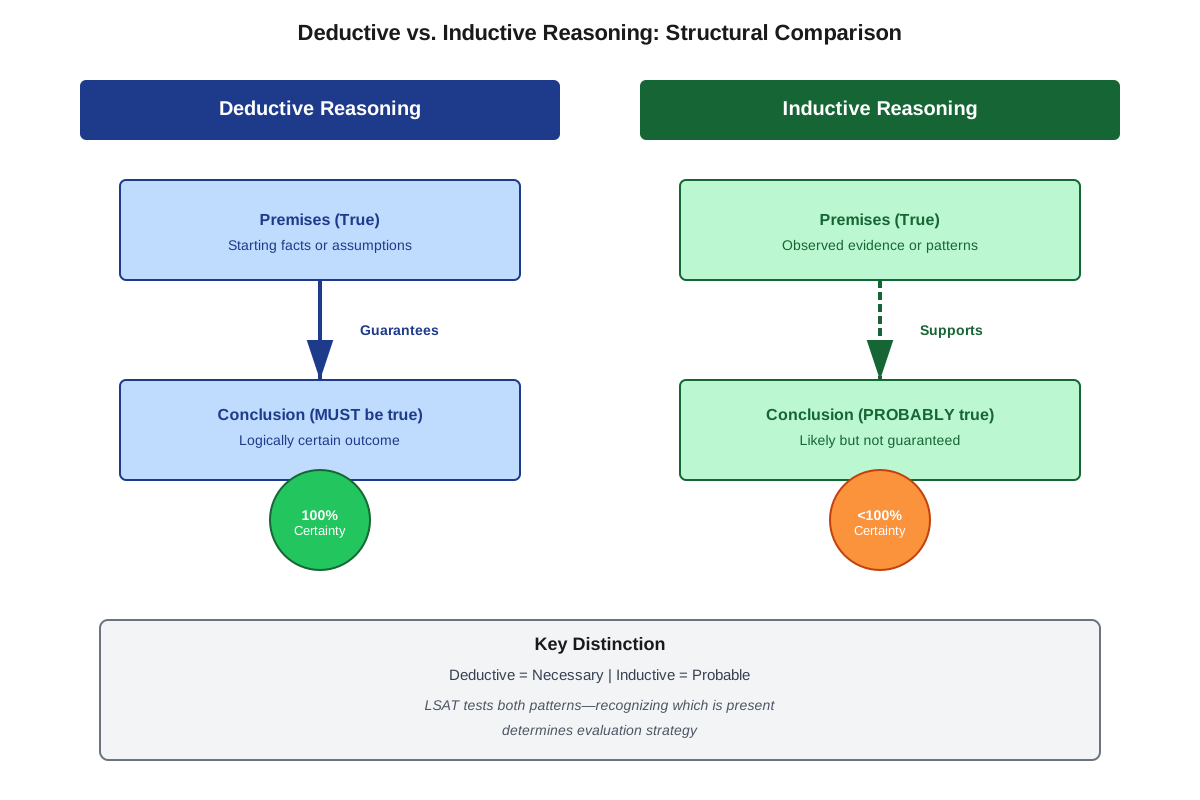
Deductive reasoning is one of the two fundamental reasoning patterns tested on the LSAT, alongside inductive reasoning. In deductive arguments, the conclusion follows necessarily from the premises—if the premises are true, the conclusion must be true. This ironclad logical connection makes deductive reasoning the gold standard of logical validity. On the LSAT, understanding deductive reasoning is essential because it appears across multiple question types, including Must Be True questions, Parallel Reasoning questions, and Formal Logic questions. The ability to recognize when an argument claims deductive certainty versus probabilistic support fundamentally shapes how test-takers should evaluate argument structure and validity.
The LSAT tests logical reasoning skills by presenting arguments that students must analyze, strengthen, weaken, or parallel. Deductive reasoning represents the strongest form of logical support possible—when premises guarantee a conclusion rather than merely making it probable. This distinction between "must be true" and "likely to be true" separates deductive from inductive reasoning and determines the appropriate standards for evaluating an argument's success. Mastering deductive reasoning enables students to identify when an LSAT argument makes absolute claims versus probabilistic ones, which directly impacts how to assess logical gaps and answer choices.
Within argument fundamentals, deductive reasoning serves as a cornerstone concept that connects to formal logic, conditional reasoning, and argument structure analysis. The LSAT frequently constructs questions around deductive patterns, particularly those involving conditional statements (if-then relationships), categorical logic (all/some/no statements), and necessary versus sufficient conditions. Understanding lsat deductive reasoning patterns allows students to move beyond surface-level comprehension to recognize the underlying logical architecture that determines whether conclusions follow validly from their premises.
Learning Objectives
- [ ] Identify how Deductive reasoning appears in LSAT questions
- [ ] Explain the reasoning pattern behind Deductive reasoning
- [ ] Apply Deductive reasoning to solve LSAT-style problems accurately
- [ ] Distinguish between deductive and inductive reasoning patterns in LSAT arguments
- [ ] Recognize the formal logical structures that underpin deductive arguments
- [ ] Evaluate whether a conclusion follows necessarily or only probably from given premises
- [ ] Construct valid deductive inferences from conditional and categorical statements
Prerequisites
- Basic argument structure: Understanding premises and conclusions is essential because deductive reasoning describes the relationship between these components—students must identify what supports what before evaluating whether that support is deductive.
- Conditional statements: Familiarity with if-then relationships is necessary because many deductive patterns on the LSAT involve conditional logic, where the truth of one statement guarantees the truth of another.
- Logical validity versus soundness: Recognizing that validity concerns logical structure (whether conclusions follow from premises) while soundness concerns both structure and truth helps students understand that deductive reasoning addresses the former.
Why This Topic Matters
Deductive reasoning appears in approximately 30-40% of LSAT Logical Reasoning questions, making it one of the highest-yield topics for test preparation. Questions explicitly testing deductive reasoning include Must Be True/Most Supported questions (which ask what necessarily follows from the stimulus), Parallel Reasoning questions (which require matching deductive structures), and Main Point questions (where recognizing deductive certainty helps identify conclusions). Additionally, understanding deductive reasoning is crucial for Sufficient Assumption questions, where the correct answer creates a deductively valid argument, and Flaw questions, where recognizing when an argument treats inductive reasoning as if it were deductive represents a common error pattern.
In real-world applications, deductive reasoning forms the foundation of legal analysis, mathematical proof, computer programming logic, and philosophical argumentation. Attorneys use deductive reasoning when applying legal rules to specific facts: if the law states X, and these facts satisfy X's conditions, then the legal consequence must follow. This mirrors the LSAT's emphasis on rule-based reasoning and precise logical relationships.
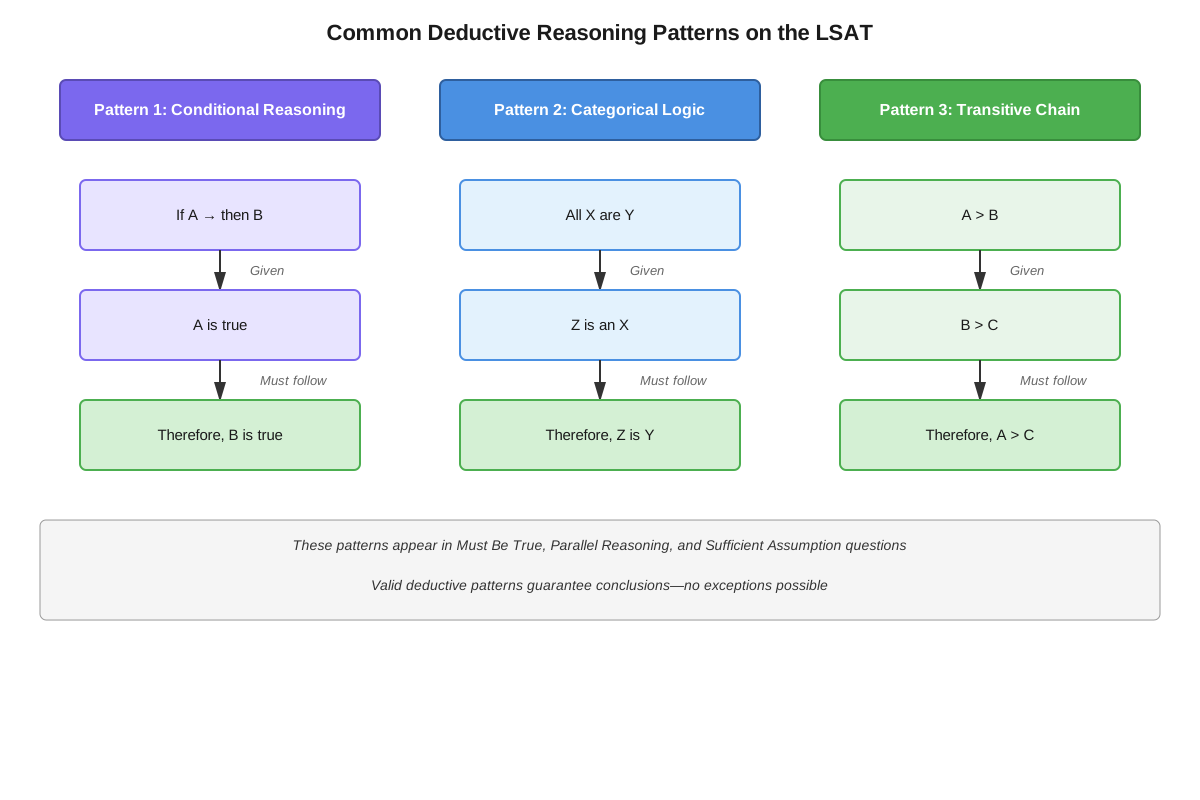
On the exam, deductive reasoning most commonly appears through formal logic structures: conditional chains (if A then B, if B then C, therefore if A then C), categorical syllogisms (all X are Y, all Y are Z, therefore all X are Z), and contrapositive reasoning (if A then B, therefore if not-B then not-A). The LSAT also tests deductive reasoning through Must Be True questions that present a set of facts and ask what necessarily follows, requiring students to make only those inferences that are logically guaranteed rather than merely probable or possible.
Core Concepts
Definition and Characteristics of Deductive Reasoning
Deductive reasoning is a logical process in which a conclusion follows necessarily from the premises. When an argument is deductively valid, it is impossible for the premises to be true while the conclusion is false. This represents the strongest possible logical relationship between premises and conclusion. The defining characteristic of deductive reasoning is necessity: the conclusion must be true if the premises are true, not merely probably true or likely true.
Deductive arguments make absolute claims about their conclusions. The argument structure guarantees the conclusion through logical form rather than empirical observation or probabilistic inference. For example: "All LSAT students study logic. Maria is an LSAT student. Therefore, Maria studies logic." If the premises are true, the conclusion cannot possibly be false—this is the hallmark of deductive validity.
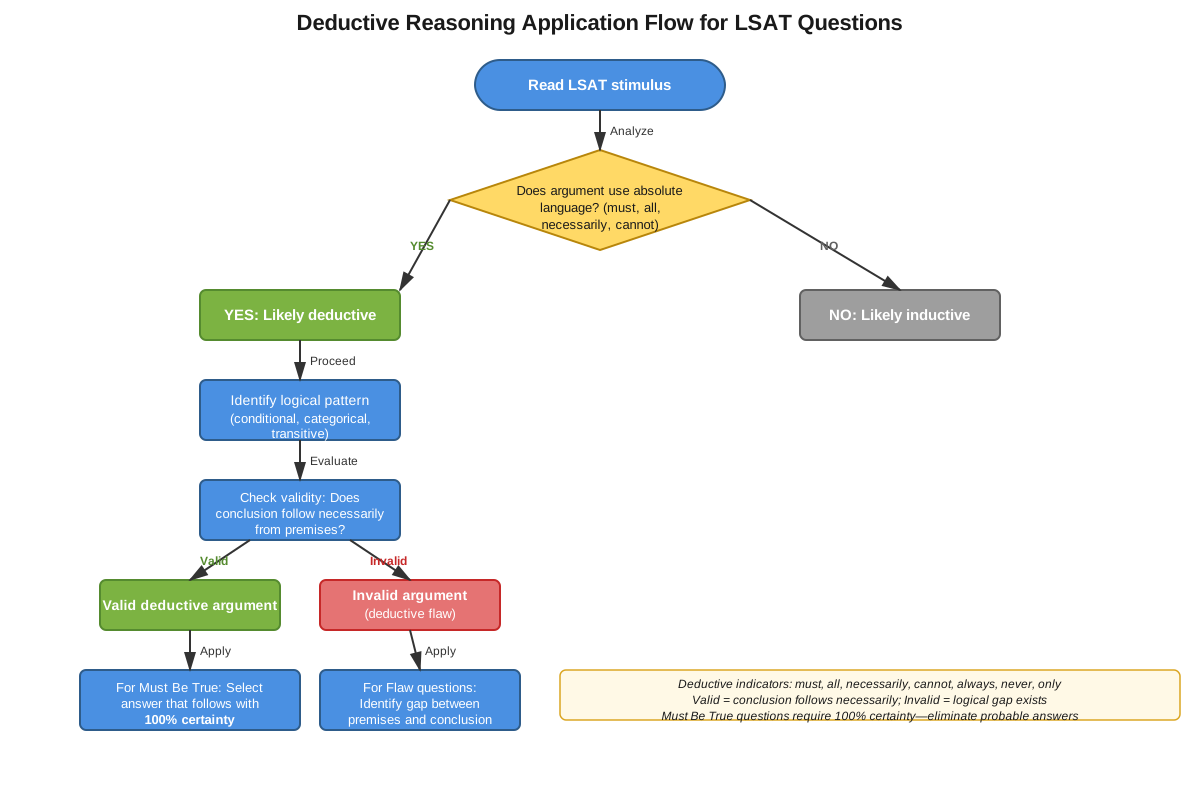
The LSAT tests deductive reasoning by presenting arguments where conclusions are supposed to follow necessarily from premises, then asking students to identify what must be true, what assumption would make the argument valid, or whether the reasoning pattern matches another argument. Understanding that "must be true" signals deductive reasoning helps students apply the appropriate standard of evaluation.
Deductive Validity versus Soundness
A deductive argument can be valid (the conclusion follows necessarily from the premises) without being sound (valid with true premises). The LSAT primarily tests validity—the logical structure—rather than the actual truth of premises. This distinction is crucial because students must evaluate whether conclusions follow from premises as stated, regardless of whether those premises reflect reality.
Consider: "All birds can fly. Penguins are birds. Therefore, penguins can fly." This argument is deductively valid (the conclusion follows necessarily from the premises) but unsound (the first premise is false). The LSAT expects students to recognize that the logical structure is valid even when premises are questionable. Conversely, an argument with true premises can be invalid: "Most lawyers are analytical. Sarah is analytical. Therefore, Sarah is a lawyer." The conclusion doesn't follow necessarily, making this invalid despite potentially true premises.
Common Deductive Patterns on the LSAT
Conditional Reasoning (If-Then Statements)
Conditional statements form the backbone of LSAT deductive reasoning. A conditional has a sufficient condition (the "if" part) and a necessary condition (the "then" part). The basic rule: if the sufficient condition occurs, the necessary condition must occur.
Valid deductive inferences from conditionals include:
- Modus Ponens: If A then B; A is true; therefore B is true
- Modus Tollens (Contrapositive): If A then B; B is false; therefore A is false
- Chain Reasoning: If A then B; if B then C; therefore if A then C
Invalid patterns that the LSAT tests include:
- Affirming the Consequent: If A then B; B is true; therefore A is true (INVALID)
- Denying the Antecedent: If A then B; A is false; therefore B is false (INVALID)
Categorical Logic
Categorical statements involve relationships between groups using quantifiers: all, some, no, most. Deductive inferences follow strict rules:
| Statement Type | Logical Form | Valid Inference |
|---|---|---|
| All A are B | A → B | If something is A, it must be B |
| No A are B | A → ~B | If something is A, it cannot be B |
| Some A are B | At least one A is B | Cannot make universal claims |
| Most A are B | >50% of A are B | Limited deductive power |
The classic categorical syllogism combines two premises to reach a necessary conclusion: "All A are B. All B are C. Therefore, all A are C." The LSAT frequently tests whether students can recognize valid versus invalid categorical inferences.
Formal Logic Chains
The LSAT often presents multiple conditional or categorical statements that can be chained together. Students must track these relationships to determine what must be true. For example:
- All students who score 170+ studied formal logic
- Everyone who studied formal logic completed practice tests
- Therefore: All students who score 170+ completed practice tests
This chain reasoning represents pure deductive inference—each link guarantees the next, making the final conclusion necessary if the premises are true.
Deductive versus Inductive Reasoning
Understanding the contrast between deductive and inductive reasoning is essential for LSAT success. Inductive reasoning draws probable conclusions from evidence—the premises support the conclusion but don't guarantee it. Most LSAT arguments are inductive, making claims that go beyond what the premises strictly entail.
| Aspect | Deductive Reasoning | Inductive Reasoning |
|---|---|---|
| Conclusion strength | Necessary/certain | Probable/likely |
| Premise-conclusion relationship | Conclusion contained in premises | Conclusion extends beyond premises |
| Validity | Can be valid or invalid | Evaluated as strong or weak |
| LSAT question types | Must Be True, Parallel Reasoning | Strengthen, Weaken, Assumption |
| Logical standard | Does conclusion follow necessarily? | Does evidence make conclusion probable? |
The LSAT tests whether students recognize this distinction. An argument that treats inductive reasoning as if it were deductive commits a logical flaw. For example: "Most successful lawyers were good students. Therefore, if you're a good student, you'll be a successful lawyer." This treats a probabilistic relationship ("most") as if it guaranteed the conclusion deductively.
Must Be True Inferences
Must Be True questions directly test deductive reasoning by presenting a set of facts and asking what necessarily follows. The correct answer must be true if the stimulus is true—no exceptions, no probability, no additional assumptions. These questions reward students who can distinguish between:
- Must be true: Logically guaranteed by the stimulus
- Could be true: Consistent with the stimulus but not required
- Likely true: Probable based on the stimulus but not certain
The key skill is making only those inferences that are deductively valid. If the stimulus states "Some lawyers are judges," students cannot infer "Some judges are lawyers" (though it happens to be true) because "some" statements don't reverse. However, from "All judges are lawyers," students can validly infer "If someone is a judge, they are a lawyer."
Concept Relationships
Deductive reasoning serves as the foundation for multiple interconnected LSAT concepts. The relationship map flows as follows:
Argument Structure → Deductive Reasoning → Formal Logic Applications
Understanding basic argument structure (premises supporting conclusions) enables recognition of deductive reasoning patterns, which in turn allows students to work with formal logic systems involving conditionals and categorical statements.
Deductive Reasoning ↔ Conditional Logic: These concepts are bidirectional—most conditional reasoning on the LSAT is deductive (if the sufficient condition is met, the necessary condition must follow), and many deductive patterns involve conditional statements.
Deductive Reasoning → Sufficient Assumptions: Sufficient Assumption questions ask for a premise that, when added, makes the argument deductively valid. Understanding what "deductively valid" means is prerequisite to identifying sufficient assumptions.
Deductive Reasoning vs. Inductive Reasoning: These represent contrasting reasoning patterns. Recognizing whether an argument claims deductive certainty or inductive probability determines the appropriate evaluation standard and identifies potential flaws.
Deductive Reasoning → Parallel Reasoning: Parallel Reasoning questions require matching the logical structure of arguments, often involving deductive patterns like conditional chains or categorical syllogisms.
The relationship between deductive reasoning and formal logic is particularly important: formal logic provides the symbolic systems (if-then statements, quantifiers, logical operators) that make deductive patterns explicit and analyzable. Students who master deductive reasoning can more easily learn formal logic notation, and vice versa.
High-Yield Facts
⭐ Deductive reasoning produces conclusions that must be true if the premises are true—necessity, not probability, is the standard.
⭐ Valid deductive inferences from "If A then B" include: A therefore B (modus ponens) and not-B therefore not-A (contrapositive).
⭐ Invalid patterns include affirming the consequent (B therefore A) and denying the antecedent (not-A therefore not-B).
⭐ Must Be True questions test deductive reasoning—the correct answer is logically guaranteed by the stimulus.
⭐ "Some" statements (at least one) have limited deductive power and don't reverse or chain like "all" statements.
- Deductive validity concerns logical structure, not the actual truth of premises—an argument can be valid with false premises.
- Categorical syllogisms require a middle term that connects the two premises: All A are B, All B are C, therefore All A are C.
- The contrapositive of a conditional statement is logically equivalent to the original: "If A then B" equals "If not-B then not-A."
- Deductive arguments are either valid or invalid—there's no middle ground like "somewhat valid" or "mostly valid."
- Most LSAT arguments are inductive, but recognizing when an argument claims deductive certainty is crucial for identifying flaws and evaluating reasoning.
- Sufficient Assumption questions ask for a premise that makes the argument deductively valid, bridging the gap between premises and conclusion.
- Parallel Reasoning questions often involve matching deductive structures, particularly conditional and categorical patterns.
- The LSAT tests whether students can distinguish between what must be true, what could be true, and what is merely likely based on given information.
Quick check — test yourself on Deductive reasoning so far.
Try Flashcards →Common Misconceptions
Misconception: If an argument's premises are true and its conclusion is true, the argument is deductively valid.
Correction: Deductive validity concerns whether the conclusion follows necessarily from the premises, not whether both happen to be true. An argument can have true premises and a true conclusion while being invalid if the conclusion doesn't follow logically from those specific premises.
Misconception: "Most" statements allow the same deductive inferences as "all" statements.
Correction: "Most" (meaning more than 50%) has very limited deductive power. From "Most A are B" and "Most B are C," you cannot conclude "Most A are C" or make any other universal claims. Only "all" and "no" statements support strong categorical inferences.
Misconception: The contrapositive and the converse of a conditional statement are the same thing.
Correction: The contrapositive (if not-B then not-A) is logically equivalent to the original (if A then B), but the converse (if B then A) is not. Confusing these leads to invalid inferences, a common LSAT trap.
Misconception: Deductive reasoning is better or more important than inductive reasoning.
Correction: Deductive and inductive reasoning serve different purposes. Most real-world and LSAT arguments are inductive because they make claims that extend beyond their premises. The LSAT tests both patterns, and success requires recognizing which standard applies to each argument.
Misconception: If a conclusion could be true based on the premises, it must be true.
Correction: Must Be True questions require conclusions that are necessarily true, not merely possible or consistent with the premises. Many wrong answers on these questions are statements that could be true but aren't guaranteed by the stimulus.
Misconception: Adding more premises always makes a deductive argument stronger.
Correction: Deductive arguments are either valid or invalid based on their logical structure. Adding premises might make an invalid argument valid, but a valid deductive argument is already as strong as possible—the conclusion follows with certainty. Additional premises don't make it "more certain."
Misconception: Formal logic notation is required to work with deductive reasoning on the LSAT.
Correction: While formal logic notation can be helpful, the LSAT presents arguments in natural language, and students can successfully identify deductive patterns through careful reading and logical analysis without symbolic notation. The key is understanding the logical relationships, not the symbols.
Worked Examples
Example 1: Must Be True Question
Stimulus: "All members of the debate team have strong analytical skills. Everyone with strong analytical skills excels at standardized tests. No one who excels at standardized tests struggles with time management."
Question: Which one of the following must be true?
Answer Choices:
(A) Some people who struggle with time management are not on the debate team.
(B) Everyone on the debate team excels at standardized tests.
(C) Most people with strong analytical skills are on the debate team.
(D) If someone struggles with time management, they are not on the debate team.
(E) Some people who excel at standardized tests are on the debate team.
Solution Process:
Step 1: Identify the deductive structure. The stimulus presents a chain of conditional statements:
- Debate team → Strong analytical skills
- Strong analytical skills → Excel at standardized tests
- Excel at standardized tests → NOT struggle with time management
Step 2: Chain these conditionals together:
- Debate team → Strong analytical skills → Excel at standardized tests → NOT struggle with time management
Step 3: Evaluate each answer choice against what must be true:
(A) "Some people who struggle with time management are not on the debate team" - This could be true, but it's not necessarily true. The stimulus tells us that no one on the debate team struggles with time management, but it doesn't tell us anything about people who do struggle with time management. They might all be off the debate team, or there might be no such people. NOT NECESSARILY TRUE.
(B) "Everyone on the debate team excels at standardized tests" - Following the chain: Debate team → Strong analytical skills → Excel at standardized tests. This follows deductively from the first two conditionals. MUST BE TRUE.
(C) "Most people with strong analytical skills are on the debate team" - This reverses the first conditional. We know debate team → analytical skills, but we cannot infer analytical skills → debate team. INVALID INFERENCE.
(D) "If someone struggles with time management, they are not on the debate team" - This is the contrapositive of our chain. If someone struggles with time management, they don't excel at standardized tests (contrapositive of statement 3), which means they don't have strong analytical skills (contrapositive of statement 2), which means they're not on the debate team (contrapositive of statement 1). MUST BE TRUE.
(E) "Some people who excel at standardized tests are on the debate team" - This reverses the conditional chain. We cannot infer this from the given information. INVALID INFERENCE.
Answer: Both (B) and (D) must be true, but if forced to choose one, (D) demonstrates more sophisticated understanding of contrapositive reasoning, which the LSAT often rewards. However, (B) is the more direct inference from the chain.
Connection to Learning Objectives: This example demonstrates identifying deductive reasoning in LSAT questions (the conditional chain structure), explaining the reasoning pattern (conditional chaining and contrapositive), and applying it to solve problems accurately (eliminating invalid inferences).
Example 2: Parallel Reasoning with Deductive Structure
Stimulus: "No effective medication is without side effects. Some herbal remedies are effective medications. Therefore, some herbal remedies have side effects."
Question: Which one of the following arguments is most similar in its reasoning to the argument above?
Answer Choices:
(A) All politicians make promises. Some promises are broken. Therefore, some politicians break promises.
(B) No valuable antique is inexpensive. Some furniture is valuable antique. Therefore, some furniture is not inexpensive.
(C) Every successful business requires capital. Some startups are successful businesses. Therefore, some startups require capital.
(D) Most athletes train daily. Some students are athletes. Therefore, some students train daily.
(E) All lawyers passed the bar exam. Some lawyers specialize in tax law. Therefore, some people who passed the bar exam specialize in tax law.
Solution Process:
Step 1: Identify the logical structure of the original argument:
- Premise 1: No A are B (No effective medications are without side effects = All effective medications have side effects)
- Premise 2: Some C are A (Some herbal remedies are effective medications)
- Conclusion: Some C are B (Some herbal remedies have side effects)
This is a valid categorical syllogism: All A are B, Some C are A, therefore Some C are B.
Step 2: Translate to positive form for clarity:
- All effective medications have side effects
- Some herbal remedies are effective medications
- Therefore, some herbal remedies have side effects
Step 3: Match this structure in the answer choices:
(A) Structure: All A are B, Some B are C, therefore Some A are C. This doesn't match—the middle term (promises) appears in different positions. INCORRECT STRUCTURE.
(B) Structure: No A are B (All valuable antiques are expensive), Some C are A, therefore Some C are not B (Some C are expensive). This matches! CORRECT STRUCTURE.
(C) Structure: All A are B, Some C are A, therefore Some C are B. This matches the structure perfectly. CORRECT STRUCTURE.
(D) Structure: Most A are B, Some C are A, therefore Some C are B. The use of "most" instead of "all" changes the logical structure—this is inductive, not deductive. INCORRECT STRUCTURE.
(E) Structure: All A are B, Some A are C, therefore Some B are C. The middle term appears in different positions. INCORRECT STRUCTURE.
Step 4: Choose between (B) and (C). Both have valid categorical syllogism structures, but (C) matches exactly (All-Some-Some with the same term positions), while (B) uses a negative formulation. (C) is the better parallel.
Answer: (C)
Connection to Learning Objectives: This example requires identifying deductive reasoning patterns (categorical syllogisms), explaining the reasoning structure (All A are B, Some C are A, therefore Some C are B), and applying this understanding to match logical structures across different content.
Exam Strategy
Recognizing Deductive Reasoning Questions
Trigger phrases that signal deductive reasoning include:
- "Must be true"
- "Properly inferred"
- "Follows logically"
- "If the statements above are true, which one of the following must also be true"
- "Conclusion follows logically if which one of the following is assumed"
When these phrases appear, apply deductive standards: the correct answer must be guaranteed by the stimulus, not merely supported or made probable.
Approaching Must Be True Questions
- Read carefully for formal logic structures: Look for "all," "no," "some," "if-then," and other quantifiers that signal deductive patterns.
- Chain conditionals systematically: Write out conditional chains if needed, tracking what leads to what.
- Test answer choices against the stimulus: Ask "Could this be false if the stimulus is true?" If yes, eliminate it.
- Avoid bringing in outside knowledge: Must Be True questions test only what follows from the stimulus, not what's true in the real world.
- Watch for contrapositive reasoning: The LSAT frequently tests whether students recognize that "If A then B" means "If not-B then not-A."
Time Management
Must Be True questions typically take 60-90 seconds because they require careful logical analysis. Don't rush—these questions reward precision. However, if a stimulus presents complex formal logic, consider whether diagramming will save time or cost time. For straightforward conditional chains, mental tracking often suffices.
Process of Elimination Tips
Eliminate answer choices that:
- Could be false: If you can construct a scenario where the stimulus is true but the answer choice is false, eliminate it
- Reverse conditionals: Watch for answers that flip "if A then B" to "if B then A"
- Overstate quantifiers: If the stimulus says "some," eliminate answers that say "all" or "most"
- Introduce new information: Must Be True answers must be inferable from the stimulus alone
Common Traps
The LSAT sets traps by offering answer choices that:
- Are probably true but not necessarily true
- Confuse sufficient and necessary conditions
- Present the converse instead of the contrapositive
- Use "some" when the stimulus supports "all" (understating) or vice versa (overstating)
Memory Techniques
VALID - Remember valid deductive patterns:
- Verify the conditional chain
- Affirm the sufficient condition (modus ponens)
- Look for the contrapositive
- Invalidate by denying the necessary condition (modus tollens)
- Don't reverse conditionals
"All roads lead to Rome" - Visualize conditional chains as roads: if you're on road A, you must reach destination B. If you're not at destination B, you couldn't have been on road A (contrapositive).
The "Some" Limitation - Remember: "Some" means "at least one" and has minimal deductive power. Think of "some" as a weak link in a chain—it doesn't support strong inferences.
Contrapositive Flip-and-Negate - To form a contrapositive: flip the order and negate both parts. "If rain, then wet" becomes "If not wet, then no rain." Visualize flipping a card over and seeing the negative image.
Must vs. Could vs. Likely - Create a mental hierarchy:
- Must = 100% certain (deductive)
- Likely = Probable but not certain (inductive)
- Could = Possible but not required (consistent)
Only "must" satisfies deductive reasoning questions.
Summary
Deductive reasoning represents the strongest form of logical support, where conclusions follow necessarily from premises. On the LSAT, deductive reasoning appears primarily through formal logic structures—conditional statements, categorical syllogisms, and logical chains—that guarantee conclusions rather than merely making them probable. The key distinction between deductive and inductive reasoning lies in necessity: deductive conclusions must be true if premises are true, while inductive conclusions are only probably true. Must Be True questions directly test deductive reasoning by asking what necessarily follows from a stimulus, requiring students to make only those inferences that are logically guaranteed. Valid deductive patterns include modus ponens (affirming the sufficient condition), modus tollens (denying the necessary condition via contrapositive), and categorical syllogisms (chaining "all" statements). Invalid patterns that the LSAT tests include affirming the consequent and denying the antecedent. Success with deductive reasoning requires recognizing formal logic structures, distinguishing between what must be true versus what could be true, and applying strict logical standards without importing outside assumptions or treating inductive reasoning as if it were deductive.
Key Takeaways
- Deductive reasoning produces necessary conclusions—if premises are true, the conclusion must be true, not merely probably true
- Valid conditional inferences include modus ponens (if A then B; A; therefore B) and contrapositive reasoning (if A then B; not-B; therefore not-A)
- Must Be True questions test deductive reasoning—correct answers are logically guaranteed by the stimulus, not merely supported or made probable
- "All" and "no" statements support strong deductive inferences, while "some" and "most" statements have limited deductive power
- Deductive validity concerns logical structure, not the truth of premises—an argument can be valid with false premises or invalid with true premises
- The LSAT frequently tests whether students confuse valid patterns (contrapositive) with invalid patterns (converse)
- Recognizing whether an argument claims deductive certainty or inductive probability determines the appropriate evaluation standard and identifies potential logical flaws
Related Topics
Conditional Logic and Formal Logic: Mastering deductive reasoning provides the foundation for working with complex conditional statements, sufficient and necessary conditions, and formal logic notation. These topics extend deductive reasoning into more sophisticated logical systems.
Sufficient Assumption Questions: Understanding deductive reasoning is essential for Sufficient Assumption questions, which ask for a premise that makes an argument deductively valid. Students must recognize what logical gap needs filling to create necessity.
Parallel Reasoning Questions: These questions require matching the deductive structure of arguments, often involving conditional chains or categorical syllogisms. Deductive reasoning mastery enables students to abstract logical form from content.
Flaw Questions: Many logical flaws involve treating inductive reasoning as if it were deductive or making invalid deductive inferences. Recognizing valid deductive patterns helps identify when arguments violate logical principles.
Inductive Reasoning: Understanding deductive reasoning's contrast with inductive reasoning—where conclusions are probable rather than necessary—helps students recognize which evaluation standard applies to each LSAT argument.
Practice CTA
Now that you understand the fundamental patterns of deductive reasoning, it's time to apply these concepts to actual LSAT questions. Work through the practice questions to test your ability to identify deductive structures, make valid inferences, and distinguish between what must be true versus what could be true. The flashcards will help reinforce key patterns like modus ponens, contrapositive reasoning, and categorical syllogisms. Remember: deductive reasoning rewards precision and careful logical analysis. Each practice question you complete strengthens your ability to recognize these high-yield patterns under timed conditions. You've built the foundation—now build the skill through deliberate practice!
Sign up free to keep reading
Create a free AnvayaPrep account to finish this LSAT guide on Deductive reasoning — plus flashcards and practice questions.