Overview
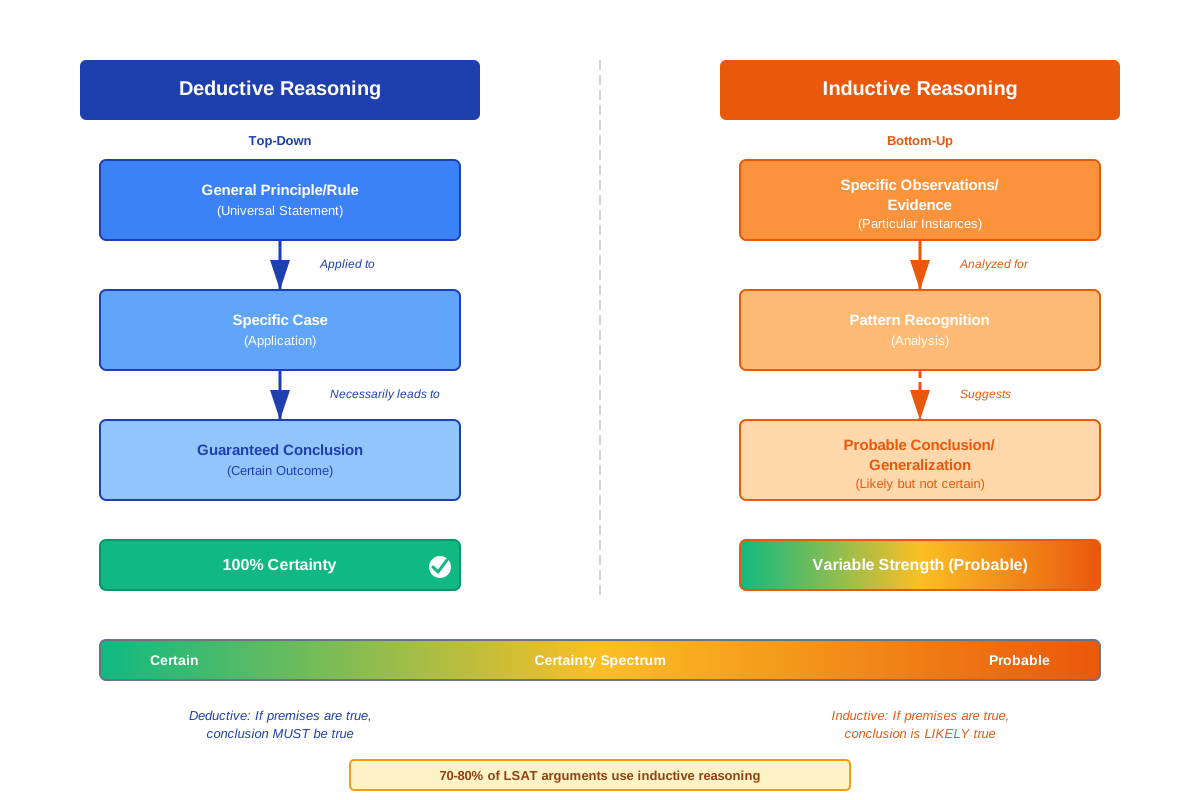
Inductive reasoning forms the backbone of most arguments encountered on the LSAT Logical Reasoning section. Unlike deductive reasoning, which guarantees its conclusions when premises are true, inductive reasoning draws probable conclusions from observed patterns, evidence, or past experiences. On the LSAT, understanding inductive reasoning is not merely helpful—it is essential. The majority of arguments you'll encounter use inductive logic, moving from specific observations to general conclusions or from known cases to predictions about unknown cases.
The LSAT tests your ability to recognize, analyze, and evaluate inductive arguments across multiple question types. Whether you're identifying assumptions, strengthening or weakening arguments, finding flaws, or drawing inferences, you'll need to understand how inductive reasoning operates. These arguments appear in approximately 70-80% of Logical Reasoning questions, making this topic one of the highest-yield areas for score improvement. Mastering inductive reasoning means understanding that conclusions are supported by evidence but not guaranteed—they exist on a spectrum of strength rather than being simply "valid" or "invalid."
Within the broader framework of argument fundamentals, inductive reasoning represents the practical, real-world form of argumentation. While deductive logic provides certainty, inductive logic provides the tools we use to make decisions under uncertainty—exactly what the LSAT tests. Understanding inductive reasoning connects directly to recognizing argument structure, identifying premises and conclusions, evaluating evidence quality, and spotting logical vulnerabilities. This foundational knowledge enables success across all logical reasoning question types and serves as the gateway to advanced LSAT skills.
Learning Objectives
- [ ] Identify how Inductive reasoning appears in LSAT questions
- [ ] Explain the reasoning pattern behind Inductive reasoning
- [ ] Apply Inductive reasoning to solve LSAT-style problems accurately
- [ ] Distinguish between strong and weak inductive arguments based on evidence quality
- [ ] Recognize the five major types of inductive reasoning patterns tested on the LSAT
- [ ] Evaluate what would strengthen or weaken an inductive argument
- [ ] Predict common vulnerabilities in inductive arguments before reading answer choices
Prerequisites
- Basic argument structure: Understanding premises and conclusions is essential because inductive reasoning describes the relationship between these components.
- Difference between deductive and inductive logic: Recognizing that deductive arguments aim for certainty while inductive arguments aim for probability helps categorize argument types quickly.
- Conditional reasoning basics: Many inductive arguments contain conditional elements, and distinguishing between necessary and sufficient conditions aids in evaluation.
- Evidence evaluation fundamentals: The ability to assess whether evidence is relevant and sufficient underlies all inductive reasoning analysis.
Why This Topic Matters
In real-world contexts, inductive reasoning governs how scientists form hypotheses, how doctors diagnose patients, how lawyers build cases, and how policymakers craft legislation. Every time someone draws a conclusion from data, makes a prediction based on trends, or infers a cause from observed effects, they're using inductive reasoning. Law school and legal practice rely heavily on inductive reasoning—attorneys must construct arguments from evidence, anticipate opposing arguments, and identify weaknesses in reasoning chains.
On the LSAT, inductive reasoning appears in approximately 15-18 questions per test across the two Logical Reasoning sections. It forms the foundation for these high-frequency question types:
- Strengthen/Weaken questions (20-25% of all LR questions): Require understanding what makes inductive arguments more or less probable
- Assumption questions (15-20%): Test your ability to identify unstated premises that inductive arguments depend upon
- Flaw questions (15-20%): Focus on common errors in inductive reasoning patterns
- Inference questions (10-15%): Ask what can be inductively concluded from given information
- Parallel Reasoning questions (5-10%): Require matching inductive reasoning structures
The LSAT presents inductive reasoning through various contexts: scientific studies, causal claims, predictions, generalizations from samples, and analogical reasoning. Recognizing these patterns quickly allows test-takers to anticipate vulnerabilities and predict correct answers before reviewing all options—a crucial time-saving strategy.
Core Concepts
Definition and Characteristics of Inductive Reasoning
Inductive reasoning is a form of argumentation in which premises provide support for a conclusion without guaranteeing its truth. The conclusion extends beyond what the premises strictly entail, making an inferential leap from observed cases to unobserved cases, from specific instances to general principles, or from correlations to causal relationships. This distinguishes inductive reasoning from deductive reasoning, where valid arguments with true premises must have true conclusions.
Key characteristics of inductive arguments include:
- Probabilistic conclusions: The conclusion is likely or probable, not certain
- Ampliative nature: The conclusion contains information not present in the premises
- Defeasibility: New evidence can weaken or strengthen the argument
- Strength spectrum: Arguments range from very strong to very weak rather than being simply valid or invalid
On the LSAT, recognizing these characteristics helps identify when an argument is vulnerable to counterevidence, requires assumptions about unobserved cases, or depends on the quality and representativeness of evidence.
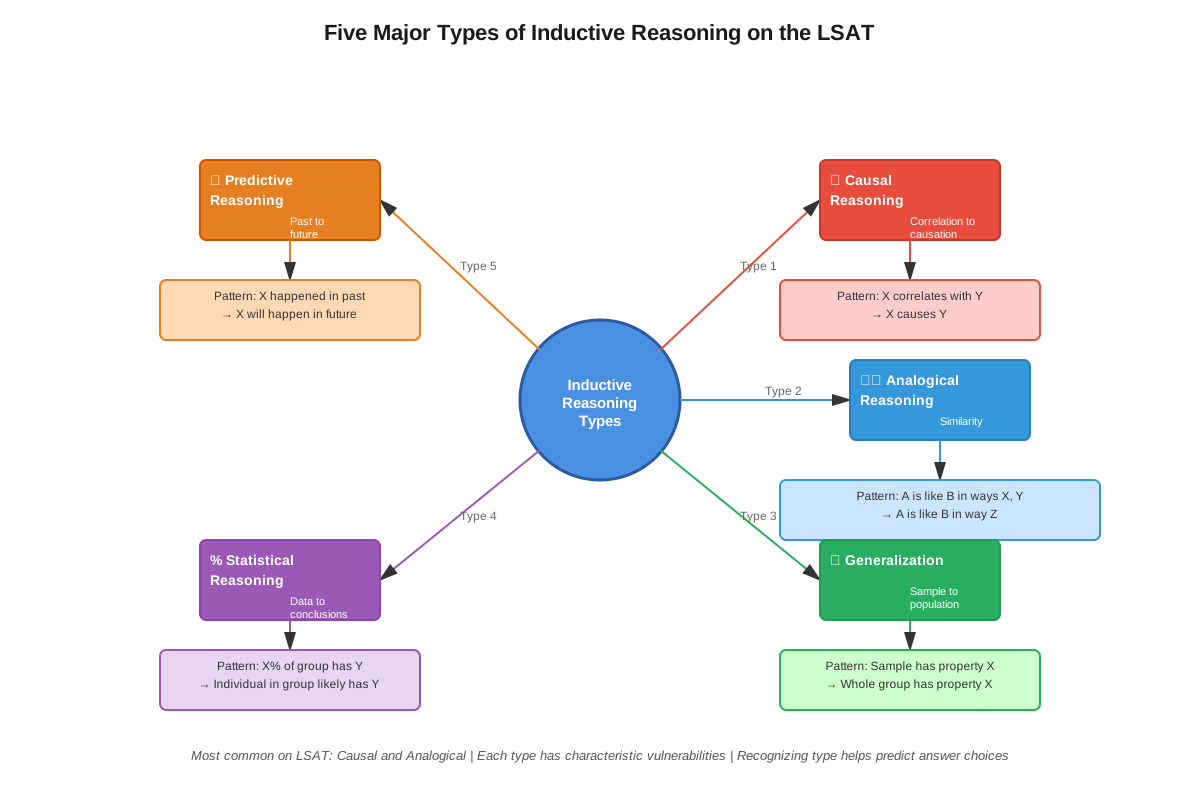
Five Major Types of Inductive Reasoning
1. Generalization (Statistical Induction)
Generalization moves from specific observed instances to a general conclusion about all or most members of a category. The argument pattern follows this structure:
Pattern: X% of observed As are Bs → Therefore, approximately X% of all As are Bs
Example: "In a survey of 500 law students, 80% reported high stress levels. Therefore, approximately 80% of all law students experience high stress."
Vulnerabilities:
- Sample size too small
- Sample not representative (selection bias)
- Relevant differences between sample and population
- Margin of error not considered
2. Causal Reasoning
Causal arguments claim that one phenomenon causes another based on observed correlations, temporal sequences, or experimental data. This is the most frequently tested inductive pattern on the LSAT.
Pattern: A and B are correlated → Therefore, A causes B
Example: "After the city installed speed cameras, traffic accidents decreased by 30%. Therefore, speed cameras caused the reduction in accidents."
Vulnerabilities:
- Correlation without causation (coincidence)
- Reverse causation (B causes A instead)
- Common cause (C causes both A and B)
- Multiple contributing factors ignored
- Temporal sequence doesn't prove causation
3. Analogical Reasoning
Analogical arguments conclude that because two things are similar in some respects, they will be similar in another respect.
Pattern: A and B share characteristics X, Y, Z. A has characteristic Q. → Therefore, B has characteristic Q.
Example: "Like Earth, Mars has polar ice caps, seasonal changes, and a 24-hour day. Earth supports life. Therefore, Mars likely supports life."
Vulnerabilities:
- Relevant differences outweigh similarities
- Similarities cited are superficial or irrelevant
- The characteristic being predicted depends on factors not shared
4. Predictive Reasoning
Predictive arguments use past patterns or current trends to forecast future events.
Pattern: X has occurred in circumstances C in the past → Circumstances C will occur again → Therefore, X will occur again
Example: "Every economic recession in the past 50 years was preceded by rising interest rates. Interest rates are rising now. Therefore, a recession will occur soon."
Vulnerabilities:
- Past patterns may not continue
- Relevant circumstances have changed
- Sample of past cases too limited
- Confounding variables not considered
5. Inference to Best Explanation (Abductive Reasoning)
This pattern identifies the hypothesis that best explains available evidence.
Pattern: Evidence E is observed. Hypothesis H would explain E better than alternatives. → Therefore, H is probably true.
Example: "The ancient structure is precisely aligned with astronomical events, contains mathematical ratios found in nature, and required advanced engineering. The best explanation is that the builders possessed sophisticated scientific knowledge."
Vulnerabilities:
- Alternative explanations not adequately considered
- "Best" explanation still might be improbable
- Evidence could be explained by multiple hypotheses
- Explanation assumes facts not in evidence
Evaluating Inductive Strength
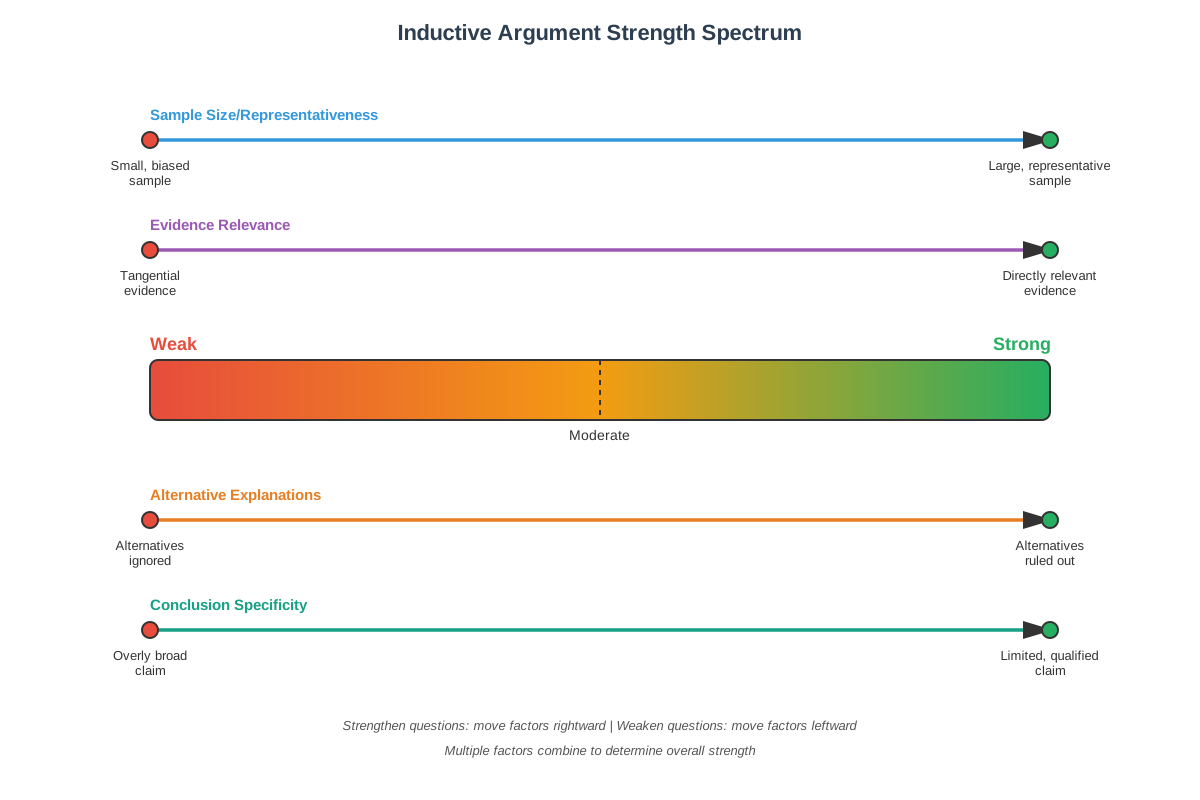
The strength of an inductive argument depends on multiple factors that LSAT questions frequently test:
| Strength Factor | Strong Argument | Weak Argument |
|---|---|---|
| Sample Size | Large, adequate sample | Small, insufficient sample |
| Representativeness | Sample mirrors population | Sample is biased or skewed |
| Relevance | Evidence directly supports conclusion | Evidence is tangential or irrelevant |
| Alternative Explanations | Alternatives ruled out | Alternatives remain plausible |
| Specificity | Precise, limited conclusion | Overly broad conclusion |
| Background Knowledge | Consistent with established facts | Contradicts known information |
Common Inductive Reasoning Patterns on the LSAT
The LSAT repeatedly tests specific inductive patterns that appear across question types:
- Survey/Study Arguments: Draw conclusions from research data, often vulnerable to sampling issues or alternative interpretations
- Plan/Proposal Arguments: Predict that a proposed action will achieve desired results, vulnerable to implementation problems or unintended consequences
- Explanation Arguments: Offer a causal explanation for an observed phenomenon, vulnerable to alternative explanations
- Comparison Arguments: Conclude something about one case based on another case, vulnerable to relevant differences
- Trend Arguments: Project that current patterns will continue, vulnerable to changing circumstances
Concept Relationships
Inductive reasoning connects to other argument fundamentals in a hierarchical structure. Understanding argument structure (identifying premises and conclusions) enables recognition of inductive patterns. Once an inductive pattern is identified, specific evaluation techniques apply: causal arguments require checking for alternative causes, generalizations require assessing sample quality, and analogies require examining relevant differences.
Relationship Map:
Argument Structure → Identify Inductive Pattern → Recognize Specific Vulnerabilities → Predict Question Type → Apply Targeted Strategy
Within inductive reasoning itself, the five major types share common vulnerabilities. All inductive arguments are strengthened by more relevant evidence, larger samples, and elimination of alternatives. They're weakened by contradictory evidence, relevant differences, and plausible alternatives. This means that mastering the evaluation framework for one type (such as causal reasoning) transfers partially to others.
Inductive reasoning also connects forward to advanced topics. Understanding inductive strength is prerequisite for:
- Necessary Assumptions: What must be true for an inductive leap to be reasonable
- Sufficient Assumptions: What would guarantee an inductive conclusion
- Principle Questions: General rules that justify specific inductive inferences
- Paradox Resolution: Explaining apparent contradictions in inductive evidence
The relationship between inductive and deductive reasoning is complementary rather than oppositional. Many LSAT arguments contain both elements: an inductive inference followed by deductive reasoning, or deductive steps leading to an inductive conclusion. Recognizing which portions are inductive helps identify where arguments are most vulnerable.
High-Yield Facts
⭐ Inductive arguments on the LSAT are never perfectly valid—they always contain some logical gap between premises and conclusion.
⭐ Causal reasoning is the most frequently tested inductive pattern, appearing in approximately 30-40% of Strengthen/Weaken questions.
⭐ Correlation does not establish causation—always consider reverse causation, common cause, and coincidence as alternatives.
⭐ Sample size and representativeness are the two most common vulnerabilities in generalization arguments.
⭐ The strength of an analogy depends on the relevance of similarities and the absence of relevant differences.
- Inductive arguments can be strengthened or weakened but never made completely valid or invalid.
- Temporal sequence (A before B) is necessary but not sufficient to establish causation.
- The more specific and limited the conclusion, the stronger the inductive argument.
- Alternative explanations weaken inductive arguments even if they're not proven true—mere plausibility is sufficient.
- Predictive arguments assume that relevant conditions remain constant between past and future cases.
- Expert testimony strengthens inductive arguments when the expert has relevant credentials and no conflicts of interest.
- Inductive arguments from authority depend on the authority being genuine and the claim being within their expertise.
- The absence of evidence against a conclusion does not constitute evidence for it (absence of evidence ≠ evidence of absence).
- Inductive strength is cumulative—multiple weak pieces of evidence can collectively create a strong argument.
- Most LSAT wrong answers in Strengthen/Weaken questions are irrelevant rather than having opposite effects.
Quick check — test yourself on Inductive reasoning so far.
Try Flashcards →Common Misconceptions
Misconception: Inductive arguments are "bad" or "flawed" by nature because they don't guarantee their conclusions.
Correction: Inductive arguments are the appropriate form of reasoning when dealing with probability, predictions, and incomplete information. They're not inherently flawed—they're evaluated on a spectrum of strength. The LSAT tests your ability to recognize when inductive arguments are strong or weak, not to reject induction entirely.
Misconception: If an argument contains any inductive reasoning, it can be dismissed as invalid.
Correction: "Validity" is a technical term that applies only to deductive arguments. Inductive arguments are evaluated as strong or weak, not valid or invalid. Many strong inductive arguments provide excellent reasons to accept their conclusions despite not guaranteeing them.
Misconception: Correlation always suggests some causal relationship, even if not direct causation.
Correction: Correlations can be entirely coincidental, especially with small sample sizes or when examining many variables. The LSAT frequently includes correlations that are pure coincidence, and recognizing this possibility is crucial for Weaken questions.
Misconception: To weaken an inductive argument, you must prove the conclusion false.
Correction: Weakening an inductive argument only requires reducing the probability that the conclusion follows from the premises. You can weaken an argument by introducing alternative explanations, showing the evidence is less representative than claimed, or revealing relevant differences—without proving the conclusion false.
Misconception: Larger samples always make generalizations stronger.
Correction: Sample size matters, but representativeness is equally or more important. A biased sample of 10,000 is weaker than a representative sample of 500. The LSAT frequently tests whether students recognize that how a sample is selected matters more than its size alone.
Misconception: If A causes B, then more A will always cause more B.
Correction: Causal relationships can be non-linear, have thresholds, or involve diminishing returns. The LSAT tests whether students assume causal relationships are simple and proportional when they might be complex.
Misconception: The best explanation must be the correct explanation.
Correction: Inference to best explanation only establishes that one hypothesis explains evidence better than considered alternatives. It doesn't prove that hypothesis is true—there might be unconsidered explanations, or all considered explanations might be wrong.
Misconception: Past patterns reliably predict future events.
Correction: Predictive reasoning assumes relevant conditions remain constant. The LSAT frequently includes answer choices that point out changed circumstances, making past patterns poor predictors of future events.
Worked Examples
Example 1: Causal Reasoning
Argument: "A recent study found that people who drink coffee daily have a 20% lower risk of developing Parkinson's disease than those who don't drink coffee. Therefore, drinking coffee protects against Parkinson's disease."
Analysis:
Step 1 - Identify the reasoning pattern: This is causal reasoning. The argument moves from a correlation (coffee drinking associated with lower Parkinson's rates) to a causal claim (coffee protects against Parkinson's).
Step 2 - Identify the conclusion: "Drinking coffee protects against Parkinson's disease" (causal claim).
Step 3 - Identify the evidence: Study showing correlation between coffee consumption and lower Parkinson's rates.
Step 4 - Identify the logical gap: The argument assumes the correlation indicates causation. It doesn't consider:
- Reverse causation: Early Parkinson's symptoms might reduce coffee consumption
- Common cause: A genetic factor might both increase coffee tolerance and decrease Parkinson's risk
- Confounding variables: Coffee drinkers might have other protective lifestyle factors
- Selection bias: The study sample might not be representative
Step 5 - Predict question types and answers:
- Weaken: Would show alternative explanation (e.g., "People genetically predisposed to Parkinson's disease tend to find coffee unpleasant and avoid it")
- Strengthen: Would eliminate alternatives (e.g., "The study controlled for all other lifestyle factors and found coffee's protective effect remained")
- Assumption: Would state what must be true (e.g., "Early symptoms of Parkinson's disease do not cause people to reduce coffee consumption")
Key Takeaway: This example demonstrates how LSAT inductive reasoning questions test your ability to recognize that correlation requires additional support before establishing causation.
Example 2: Generalization
Argument: "A survey of 200 students at Elite University found that 75% plan to attend graduate school. Therefore, approximately three-quarters of all college students plan to attend graduate school."
Analysis:
Step 1 - Identify the reasoning pattern: This is generalization (statistical induction). The argument moves from a sample (200 Elite University students) to a broader population (all college students).
Step 2 - Identify the conclusion: "Approximately three-quarters of all college students plan to attend graduate school."
Step 3 - Identify the evidence: Survey of 200 students at one university showing 75% graduate school plans.
Step 4 - Identify the logical gap: The argument assumes the sample is representative of all college students. Problems include:
- Sample from only one university (Elite University might attract more graduate-school-oriented students)
- Sample size might be adequate for Elite University but not for generalizing to all colleges
- No information about how students were selected for the survey
- Elite University students likely differ from typical college students in relevant ways
Step 5 - Predict question types and answers:
- Weaken: Would show sample is unrepresentative (e.g., "Elite University students are significantly more likely to pursue advanced degrees than students at most colleges")
- Strengthen: Would show sample is representative (e.g., "Elite University's student body demographics closely match those of college students nationwide")
- Flaw: Would identify the representativeness problem (e.g., "The argument treats a sample drawn from an atypical population as representative of a much broader population")
Key Takeaway: This example illustrates how generalization arguments depend critically on sample representativeness, not just sample size—a distinction the LSAT frequently tests.
Exam Strategy
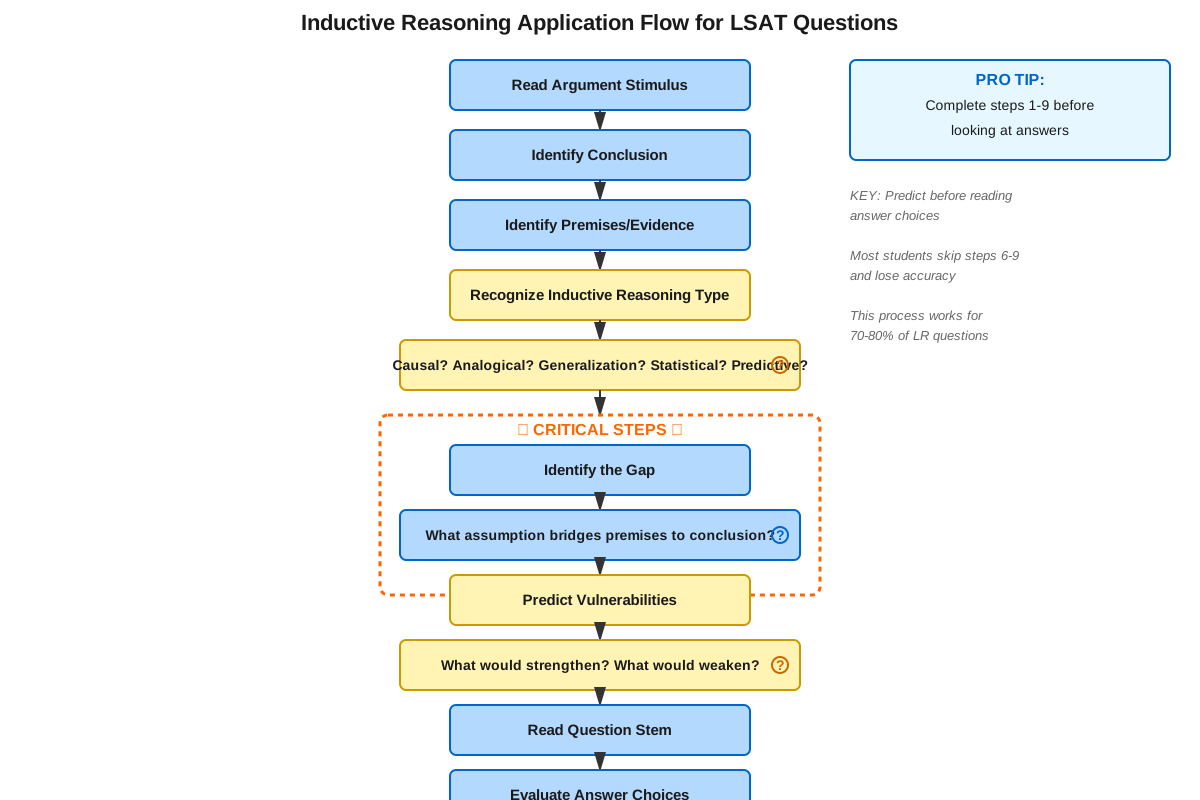
Approaching Inductive Reasoning Questions
Step 1 - Quickly identify the inductive pattern (5-10 seconds):
- Look for trigger words: "therefore," "thus," "suggests," "indicates," "probably," "likely"
- Identify whether the argument involves causation, generalization, analogy, prediction, or explanation
- This pattern recognition tells you what vulnerabilities to expect
Step 2 - Locate the conclusion and evidence (10-15 seconds):
- Underline or mentally note the conclusion
- Identify what evidence supports it
- Recognize the logical gap between evidence and conclusion
Step 3 - Predict the vulnerability before reading answers (5-10 seconds):
- For causal arguments: alternative causes, reverse causation, common cause
- For generalizations: sample size, representativeness, selection bias
- For analogies: relevant differences
- For predictions: changed circumstances
- For explanations: alternative explanations
Step 4 - Eliminate wrong answers efficiently (20-30 seconds):
- Most wrong answers are irrelevant—they don't affect the logical gap
- Some wrong answers affect the wrong gap (e.g., addressing causation when the argument is about generalization)
- In Strengthen/Weaken questions, wrong answers sometimes have the opposite effect but are usually just irrelevant
Trigger Words and Phrases
Causal reasoning indicators:
- "causes," "leads to," "results in," "produces," "brings about"
- "because of," "due to," "as a result of," "is responsible for"
- "explains why," "accounts for," "is the reason that"
Generalization indicators:
- "survey," "study," "poll," "sample," "research found"
- "most," "many," "typically," "generally," "usually"
- "percentage," "proportion," "rate"
Analogical reasoning indicators:
- "similarly," "likewise," "in the same way," "just as"
- "comparable to," "analogous to," "parallel"
Predictive reasoning indicators:
- "will," "is likely to," "probably," "can be expected"
- "trend," "pattern," "historically," "in the past"
Explanation indicators:
- "explains," "accounts for," "the reason is," "this is because"
- "hypothesis," "theory," "suggests that"
Process of Elimination Tips
Exam Tip: In Strengthen/Weaken questions, eliminate answers that are irrelevant before considering whether remaining answers have the right effect. Approximately 60-70% of wrong answers are simply irrelevant.
- Relevance test: Does this answer choice address the specific logical gap in the argument? If not, eliminate immediately.
- Scope test: Does this answer match the scope of the conclusion? If the conclusion is about "some" and the answer is about "all," be suspicious.
- Direction test (for Strengthen/Weaken): Does this answer have any effect on the argument? If you can't explain how it makes the conclusion more or less likely, eliminate it.
- Extreme language: Be cautious of answers with "always," "never," "only," "must"—these are often too strong for inductive arguments.
Time Allocation
- Reading the stimulus: 30-40 seconds
- Identifying pattern and predicting vulnerability: 10-15 seconds
- Reading question stem: 5 seconds
- Evaluating answer choices: 30-40 seconds
- Total per question: 75-100 seconds (1:15-1:40)
For difficult inductive reasoning questions, invest extra time in prediction (Step 3) rather than reading answers multiple times. A clear prediction makes answer evaluation much faster.
Memory Techniques
CAUSAL Mnemonic for Causal Reasoning Vulnerabilities
Correlation doesn't prove causation
Alternative causes exist
Uncontrolled variables present
Sample might be biased
Assumptions about mechanism
Lack of temporal information
RAGS Mnemonic for Evaluating Generalizations
Representative sample?
Adequate size?
Group properly defined?
Selection method appropriate?
The "Three C's" of Weakening Causal Arguments
- Coincidence: The correlation is accidental
- Common Cause: A third factor causes both observed phenomena
- Causation Reversed: The supposed effect actually causes the supposed cause
Visualization Strategy for Analogies
Create a mental two-column table:
- Left column: Similarities between compared items
- Right column: Differences between compared items
- Ask: "Are the similarities relevant to the conclusion?"
- Ask: "Are the differences relevant to the conclusion?"
The analogy is strong when relevant similarities outweigh relevant differences.
The "PAST" Test for Predictive Arguments
Pattern identified correctly?
Assumptions about continuity warranted?
Sample of past cases adequate?
Time period relevant?
Summary
Inductive reasoning forms the foundation of most LSAT Logical Reasoning questions, appearing in 70-80% of arguments across all question types. Unlike deductive reasoning, which guarantees conclusions, inductive reasoning provides probable support through five major patterns: generalization, causal reasoning, analogical reasoning, predictive reasoning, and inference to best explanation. Each pattern has characteristic vulnerabilities that the LSAT repeatedly tests. Causal arguments are vulnerable to alternative explanations, reverse causation, and common causes. Generalizations depend on sample size and representativeness. Analogies require relevant similarities and absence of relevant differences. Predictions assume constant conditions. Explanations must rule out alternatives. Success on LSAT inductive reasoning questions requires quickly identifying the reasoning pattern, recognizing the logical gap between evidence and conclusion, predicting vulnerabilities before reading answer choices, and efficiently eliminating irrelevant answers. The key insight is that inductive arguments exist on a strength spectrum—they can be strengthened or weakened but never made perfectly valid or completely invalid. Mastering inductive reasoning enables success across Strengthen, Weaken, Assumption, Flaw, and Inference questions, making it the highest-yield topic in Logical Reasoning.
Key Takeaways
- Inductive reasoning moves from specific evidence to probable conclusions, creating a logical gap that LSAT questions exploit through Strengthen, Weaken, Assumption, and Flaw questions.
- The five major inductive patterns—generalization, causal reasoning, analogy, prediction, and explanation—each have predictable vulnerabilities that repeat across LSAT questions.
- Causal reasoning is the most frequently tested pattern; always consider alternative causes, reverse causation, and common causes before accepting causal claims.
- Sample representativeness matters more than sample size in generalization arguments—a biased large sample is weaker than a representative small sample.
- Predicting vulnerabilities before reading answer choices dramatically improves speed and accuracy by providing a clear target for answer evaluation.
- Most wrong answers in inductive reasoning questions are irrelevant rather than having opposite effects—eliminate based on relevance first.
- Inductive strength is cumulative and context-dependent—multiple pieces of weak evidence can create strong arguments, and argument strength depends on background knowledge and alternative explanations.
Related Topics
Necessary and Sufficient Assumptions: Building on inductive reasoning, assumption questions test what must be true (necessary) or what would guarantee (sufficient) an inductive conclusion. Mastering inductive patterns enables quick identification of assumption gaps.
Strengthen and Weaken Questions: These question types directly test inductive reasoning evaluation skills. Understanding the five major inductive patterns and their vulnerabilities is prerequisite for systematic strengthening and weakening.
Flaw Questions: Most flaws on the LSAT involve errors in inductive reasoning—confusing correlation with causation, overgeneralizing from small samples, or drawing analogies with relevant differences. Inductive reasoning mastery makes flaw identification automatic.
Formal Logic and Conditional Reasoning: While inductive reasoning deals with probability, formal logic deals with certainty. Understanding both enables recognition of which portions of complex arguments are inductive versus deductive.
Argument Evaluation and Method of Reasoning: These advanced question types require describing how arguments work. Mastering inductive patterns provides the vocabulary and framework for these descriptions.
Practice CTA
Now that you understand the patterns, vulnerabilities, and evaluation strategies for inductive reasoning, it's time to apply this knowledge. Attempt the practice questions to test your ability to identify inductive patterns quickly, predict vulnerabilities accurately, and select correct answers efficiently. Each practice question reinforces the pattern recognition skills that separate high scorers from average performers. Use the flashcards to drill the five major inductive patterns and their characteristic vulnerabilities until recognition becomes automatic. Remember: inductive reasoning appears in the majority of LSAT Logical Reasoning questions, making this practice time your highest-yield investment for score improvement. Your ability to spot causal reasoning, recognize unrepresentative samples, and identify relevant differences will directly translate to points on test day.
Sign up free to keep reading
Create a free AnvayaPrep account to finish this LSAT guide on Inductive reasoning — plus flashcards and practice questions.