Overview
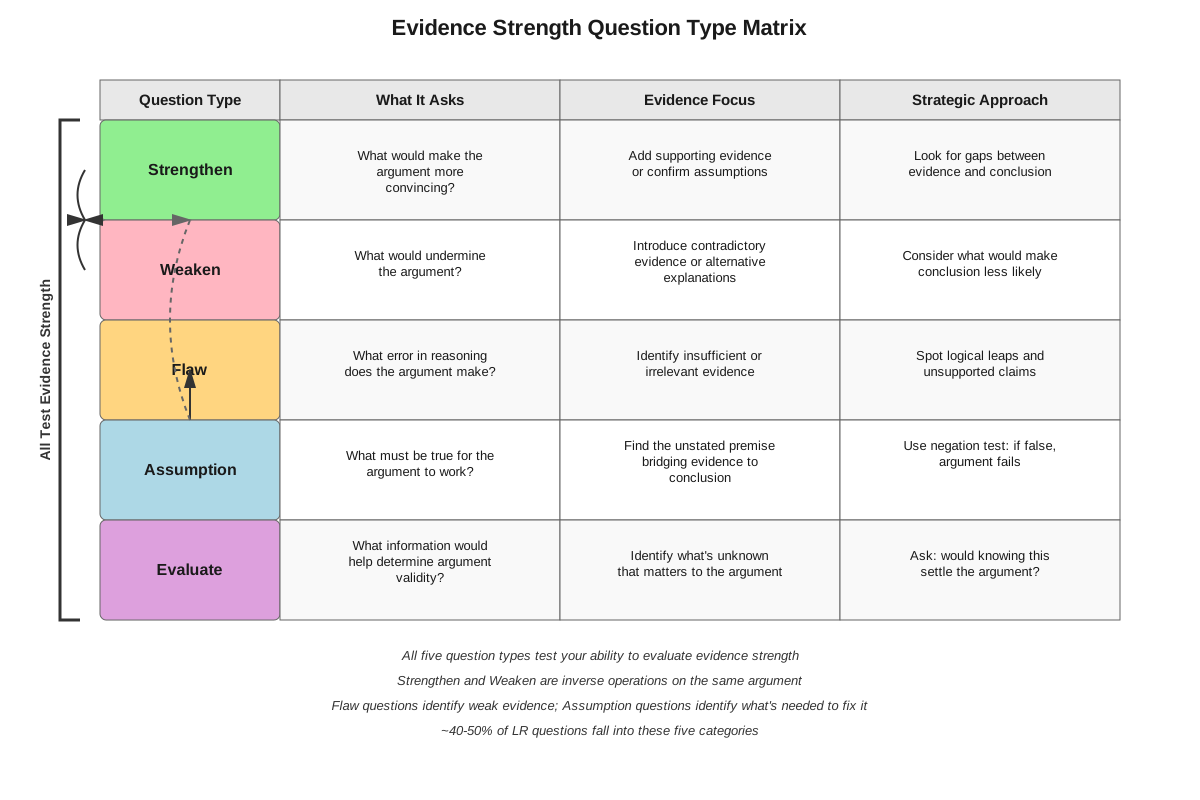
Evidence strength is a foundational concept in LSAT logical reasoning that examines how well premises support a conclusion within an argument. Understanding evidence strength is critical because the LSAT frequently tests the ability to evaluate whether the evidence provided actually justifies the claim being made. This concept appears across multiple question types, including Strengthen, Weaken, Flaw, Assumption, and Evaluate questions—making it one of the most versatile and high-yield topics in argument fundamentals.
At its core, evidence strength concerns the degree to which premises make a conclusion more or less likely to be true. Strong evidence creates a robust logical connection between premises and conclusion, while weak evidence leaves significant gaps or fails to adequately support the claim. The LSAT tests this concept by presenting arguments with varying degrees of evidential support and asking test-takers to identify weaknesses, recognize what would strengthen or weaken the reasoning, or determine what assumptions are necessary to bridge gaps in the argument.
Mastering LSAT evidence strength provides the analytical foundation for virtually all Logical Reasoning questions. It connects directly to identifying assumptions (the unstated premises needed to make evidence sufficient), recognizing flaws (patterns where evidence fails to support conclusions), and evaluating arguments (determining what additional information would affect the argument's validity). This topic serves as the bridge between simply identifying argument components (premises and conclusions) and performing sophisticated analysis of argument quality—the skill that separates high scorers from average performers on the LSAT.
Learning Objectives
- [ ] Identify how Evidence strength appears in LSAT questions
- [ ] Explain the reasoning pattern behind Evidence strength
- [ ] Apply Evidence strength to solve LSAT-style problems accurately
- [ ] Distinguish between sufficient and insufficient evidence in complex arguments
- [ ] Evaluate the relevance and adequacy of evidence for specific conclusions
- [ ] Recognize common patterns of weak evidential support that appear repeatedly on the LSAT
- [ ] Predict what type of evidence would strengthen or weaken a given argument
Prerequisites
- Argument structure identification: Recognizing premises and conclusions is essential because evidence strength specifically examines the relationship between these components.
- Basic logical connectives: Understanding how "if-then," "all," "some," and other logical terms function helps assess whether evidence actually supports what the argument claims.
- Distinction between facts and inferences: Evidence strength requires differentiating between what is stated (the evidence) and what is concluded (the claim requiring support).
Why This Topic Matters
Evidence strength is not merely an academic exercise—it reflects the critical thinking skills necessary for legal reasoning, policy analysis, and everyday decision-making. Lawyers must constantly evaluate whether the evidence presented in a case adequately supports legal conclusions, making this skill directly relevant to law school and legal practice. Beyond the legal profession, the ability to assess evidential support is fundamental to scientific reasoning, business strategy, and informed citizenship.
On the LSAT, evidence strength appears in approximately 40-50% of all Logical Reasoning questions, either directly or as a component of the reasoning required. Strengthen questions (asking what would make an argument more convincing) and Weaken questions (asking what would undermine an argument) explicitly test evidence strength. Additionally, Flaw questions frequently identify insufficient evidence as the error in reasoning, while Assumption questions ask test-takers to identify what must be true to make the evidence sufficient. Even Inference questions sometimes require evaluating which conclusion the evidence can adequately support.
Common manifestations in LSAT passages include: arguments that generalize from limited samples, causal claims based on correlational evidence, predictions based on past patterns, analogical reasoning that assumes similarity across cases, and explanations that fail to rule out alternative possibilities. Recognizing these patterns allows test-takers to quickly identify where evidence falls short and predict what the question will ask.
Core Concepts
Defining Evidence Strength
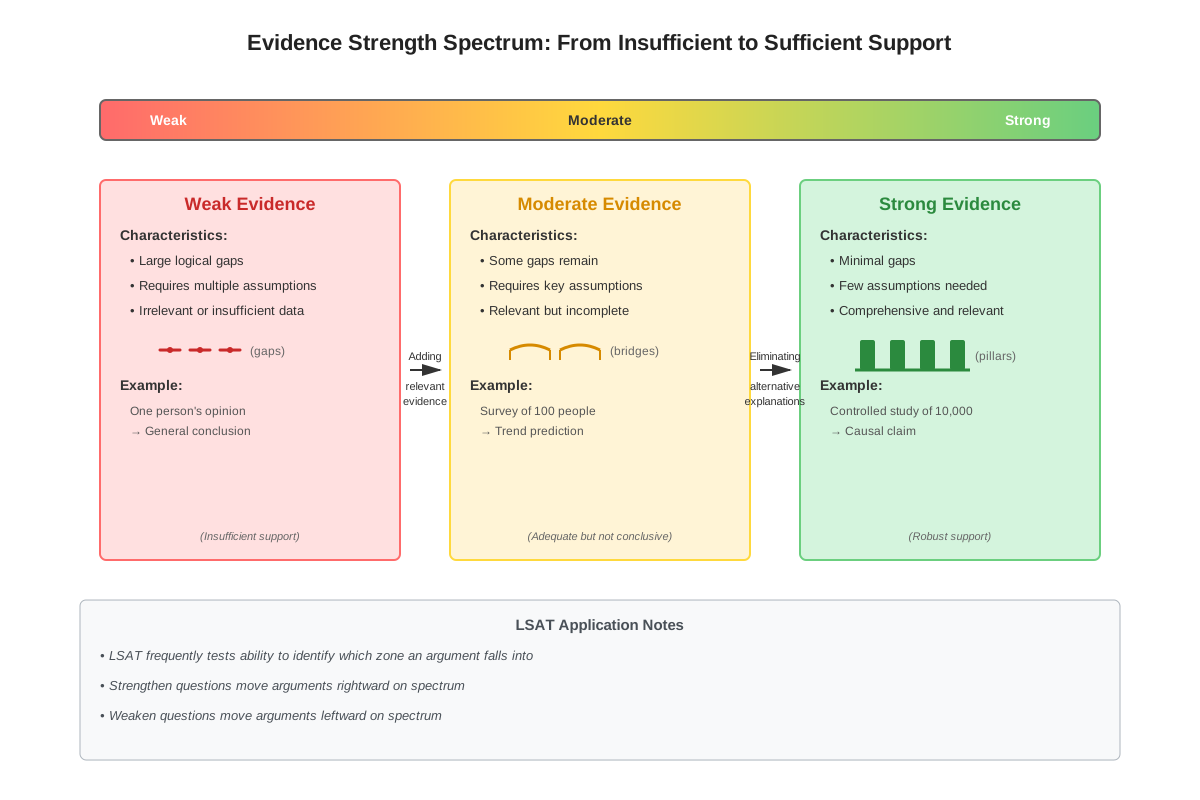
Evidence strength refers to the degree to which premises provide logical support for a conclusion. Strong evidence makes the conclusion highly probable or necessarily true, while weak evidence leaves the conclusion uncertain or inadequately supported. The LSAT does not typically present arguments with completely irrelevant evidence; instead, it presents arguments where evidence has some connection to the conclusion but falls short of fully justifying it.
Evidence can be insufficient in several ways: it may be too limited in scope (a small sample used to support a broad generalization), it may fail to establish the type of relationship claimed (correlation presented as causation), it may ignore relevant alternatives (assuming one explanation without ruling out others), or it may rely on questionable assumptions (taking for granted connections that require justification).
The Sufficiency Spectrum
Evidence exists on a spectrum from completely insufficient to fully sufficient:
| Evidence Quality | Characteristics | LSAT Example |
|---|---|---|
| Insufficient | Premises provide minimal or no support; major gaps exist | "One person liked the movie, so it will be a blockbuster" |
| Weak | Some connection exists but significant doubts remain | "Sales increased after the ad campaign, so the campaign caused the increase" |
| Moderate | Evidence supports conclusion but alternatives remain plausible | "Most customers surveyed were satisfied, so the business is doing well" |
| Strong | Evidence makes conclusion highly probable with few gaps | "All observed samples contained the chemical, so the next sample will likely contain it" |
| Sufficient | Evidence guarantees or necessitates the conclusion | "All mammals have hearts; whales are mammals; therefore whales have hearts" |
The LSAT most frequently presents arguments in the "weak" to "moderate" range, where evidence provides some support but leaves exploitable gaps. Test-takers must identify these gaps to answer questions correctly.
Relevance vs. Adequacy
Two distinct dimensions determine evidence strength: relevance and adequacy. Relevance concerns whether the evidence relates to the conclusion at all—does it address the right topic? Adequacy concerns whether the evidence, even if relevant, is sufficient in quantity, quality, or scope to justify the conclusion.
For example, if an argument concludes "This medication is safe for humans," evidence about the medication's effects on mice is relevant (it relates to safety) but may be inadequate (animal studies don't guarantee human safety). The LSAT exploits this distinction by presenting evidence that seems related but doesn't actually establish what the conclusion claims.
Common Patterns of Weak Evidence
Sampling Issues
Arguments frequently generalize from limited or unrepresentative samples. An argument might survey college students and conclude something about all adults, or observe a phenomenon in one city and claim it applies nationwide. The evidence is weak because the sample may not represent the broader population.
Correlation-Causation Confusion
Perhaps the most common pattern on the LSAT involves treating correlation as causation. When two things occur together or in sequence, the argument assumes one caused the other without ruling out alternative explanations: reverse causation (B caused A instead of A causing B), common cause (C caused both A and B), or coincidence.
Temporal Reasoning Flaws
Arguments often assume that because something was true in the past, it will remain true in the future, or that a trend will continue unchanged. This evidence is weak because circumstances change, and past patterns don't guarantee future outcomes.
Analogical Weakness
When arguments reason by analogy ("X worked in situation A, so X will work in situation B"), the evidence is only as strong as the similarity between the situations. The LSAT exploits this by presenting analogies where relevant differences exist between the compared cases.
Incomplete Consideration of Alternatives
Many arguments present one explanation or solution without considering whether other possibilities might be equally or more plausible. The evidence is weak because it hasn't established that the proposed explanation is better than alternatives.
Strengthening and Weakening Evidence
Understanding evidence strength requires recognizing what would make evidence more or less adequate:
Strengtheners typically:
- Provide additional confirming instances
- Rule out alternative explanations
- Establish that the sample is representative
- Show that necessary conditions are met
- Demonstrate that the relationship is causal, not merely correlational
- Address potential objections or counterexamples
Weakeners typically:
- Introduce alternative explanations
- Show the sample is unrepresentative or too small
- Reveal relevant differences in analogies
- Demonstrate that necessary conditions are not met
- Provide counterexamples
- Show that correlation does not imply causation in this case
The Role of Assumptions in Evidence Strength
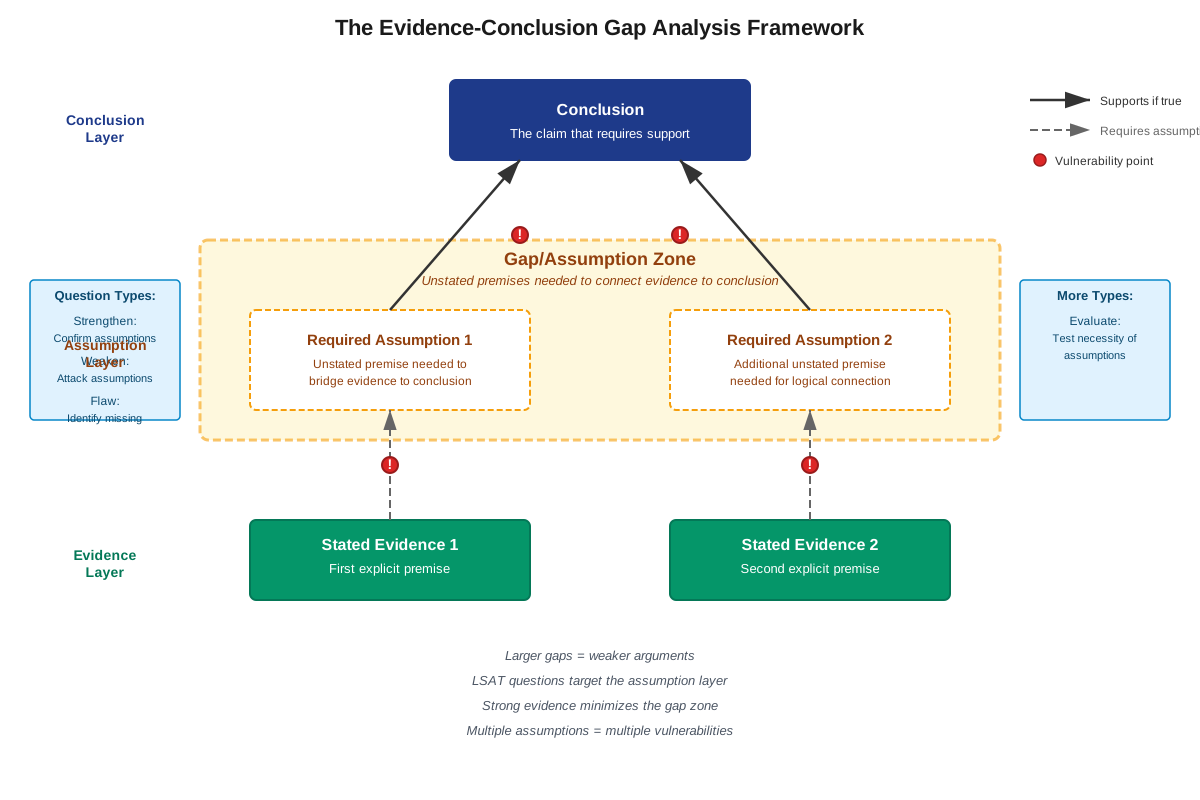
Evidence strength connects intimately with assumptions. When evidence is insufficient, assumptions are the unstated premises that, if true, would bridge the gap between evidence and conclusion. Identifying what an argument assumes reveals where its evidence is weak. For instance, if an argument concludes that a policy will succeed based on its success elsewhere, it assumes the situations are relevantly similar—an assumption that, if false, means the evidence is weak.
Concept Relationships
Evidence strength serves as the central hub connecting multiple logical reasoning concepts. The relationship flows as follows:
Argument Structure → Evidence Strength → Assumptions, Flaws, and Evaluation
First, identifying argument structure (premises and conclusions) enables the analysis of evidence strength—one must know what is being used as evidence and what conclusion it supposedly supports. Once evidence strength is assessed, several analytical paths open:
- Weak evidence reveals assumptions: Gaps in evidential support indicate what must be assumed for the argument to work
- Insufficient evidence constitutes flaws: Many logical flaws are simply patterns of weak evidence (hasty generalization, false cause, weak analogy)
- Evidence strength determines what strengthens/weakens: Understanding where evidence is weak predicts what information would help or hurt the argument
Within the topic itself, concepts connect hierarchically:
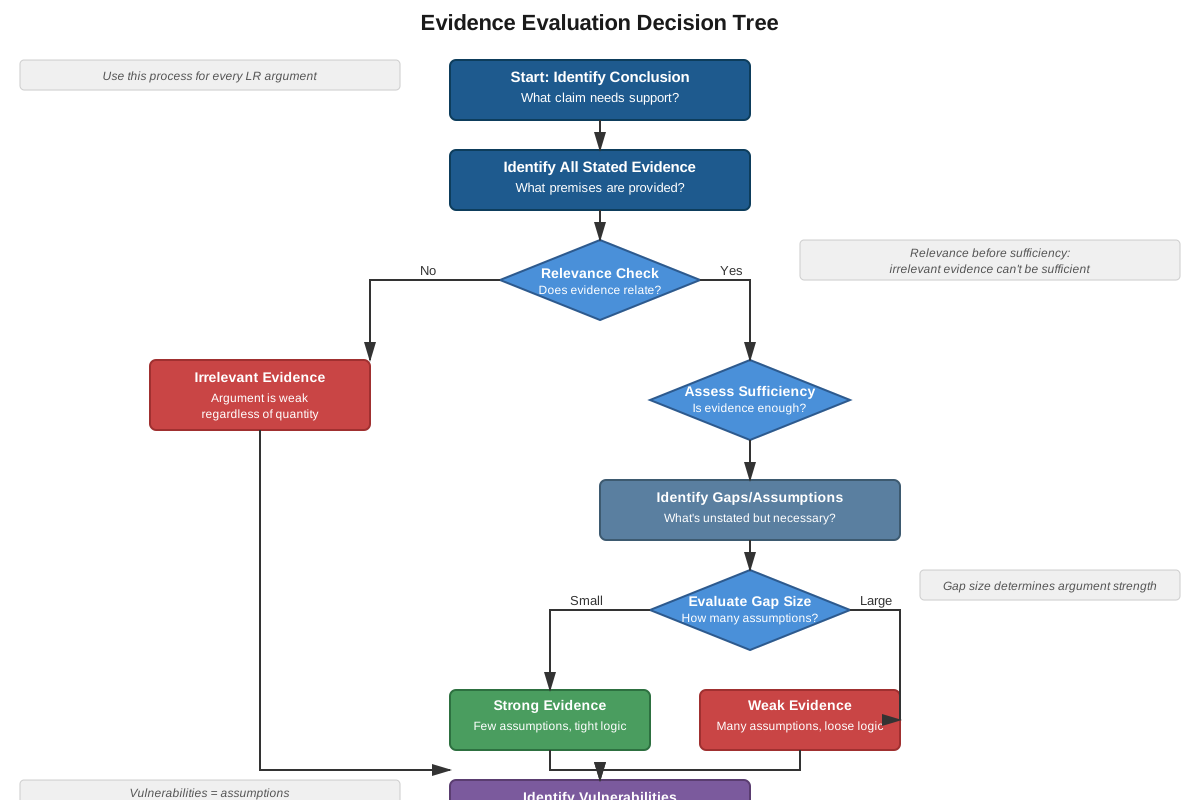
- Relevance (Is the evidence related?) must be established before
- Adequacy (Is there enough relevant evidence?) can be assessed, which reveals
- Specific patterns of weakness (sampling issues, causal confusion, etc.), which indicate
- What assumptions are being made and therefore
- What would strengthen or weaken the argument
This conceptual chain means that mastering evidence strength provides the foundation for tackling the majority of Logical Reasoning question types on the LSAT.
High-Yield Facts
⭐ Evidence strength refers to how well premises support a conclusion, ranging from insufficient to fully sufficient
⭐ Approximately 40-50% of LSAT Logical Reasoning questions directly test evidence strength through Strengthen, Weaken, Flaw, or Assumption questions
⭐ Correlation does not establish causation—this is the single most common evidence weakness on the LSAT
⭐ Small or unrepresentative samples provide weak evidence for broad generalizations
⭐ Evidence from analogies is only as strong as the relevant similarities between the compared situations
- Evidence can be relevant to a conclusion but still inadequate to support it fully
- Past patterns provide weak evidence for future predictions unless continuity is established
- Arguments that fail to consider alternative explanations have weak evidence
- Strengtheners typically rule out alternatives or provide additional confirming evidence
- Weakeners typically introduce alternatives or show the evidence is unrepresentative
- Necessary assumptions, when identified, reveal exactly where evidence is insufficient
- The LSAT rarely presents completely irrelevant evidence; instead, it presents evidence with subtle inadequacies
- Evidence about one group (e.g., animals) may be inadequate for conclusions about another group (e.g., humans)
- Temporal sequence (A happened before B) does not establish causation without additional evidence
- Expert opinion provides stronger evidence than anecdotal reports, but still requires the expert to be qualified in the relevant domain
Quick check — test yourself on Evidence strength so far.
Try Flashcards →Common Misconceptions
Misconception: If evidence is relevant to the conclusion, it must be sufficient to support it.
Correction: Relevance and adequacy are distinct. Evidence can relate to the conclusion without being strong enough to justify it. For example, one positive customer review is relevant to whether a product is good but inadequate to support that conclusion.
Misconception: Strong evidence means the conclusion is definitely true.
Correction: Even strong evidence typically makes a conclusion probable rather than certain. The LSAT deals primarily with inductive arguments where evidence supports but doesn't guarantee conclusions. Only deductively valid arguments with true premises guarantee their conclusions.
Misconception: Weak evidence means the argument is completely wrong or the conclusion is false.
Correction: Weak evidence means the premises don't adequately support the conclusion—it doesn't mean the conclusion is false. The conclusion might still be true; it's just not well-supported by the evidence provided.
Misconception: More evidence always means stronger evidence.
Correction: Quantity matters less than quality and relevance. Ten examples from an unrepresentative sample provide weaker evidence than three examples from a properly representative sample. The LSAT tests whether students focus on the right qualities of evidence.
Misconception: If an argument has weak evidence, any additional information will strengthen it.
Correction: Only information that specifically addresses the gaps in the evidence will strengthen the argument. Irrelevant additional information, even if true, doesn't improve evidence strength. Strengtheners must target the specific weaknesses in the reasoning.
Misconception: Statistical evidence is always stronger than anecdotal evidence.
Correction: While statistics can provide strong evidence, poorly designed studies or misinterpreted statistics can be weaker than well-chosen examples. The LSAT tests whether students evaluate the quality of statistical evidence rather than accepting it uncritically.
Misconception: Evidence strength is subjective or a matter of opinion.
Correction: While reasonable people might disagree about borderline cases, logical principles determine evidence strength objectively. The LSAT tests whether students can apply these principles consistently, not whether they have personal opinions about arguments.
Worked Examples
Example 1: Identifying Weak Evidence and Predicting Strengtheners
Argument: "Sales of electric vehicles increased by 30% in the year following the government's announcement of new tax incentives for electric vehicle purchases. Therefore, the tax incentives caused the increase in sales."
Analysis:
Step 1: Identify the conclusion and evidence
- Conclusion: The tax incentives caused the increase in sales
- Evidence: Sales increased 30% after the incentives were announced
Step 2: Assess evidence strength
The evidence shows correlation (temporal sequence) but doesn't establish causation. This is weak evidence because:
- Alternative explanations aren't ruled out (gas prices might have increased, new attractive models might have been released, environmental awareness might have grown)
- The evidence doesn't show that people who bought vehicles actually used the incentives
- Other factors could have caused both the incentive announcement and the sales increase
Step 3: Identify the assumption
The argument assumes no other significant factors caused the sales increase—that the incentive was the primary or sole cause.
Step 4: Predict what would strengthen the argument
Strong strengtheners would:
- Rule out alternative causes (e.g., "Gas prices and vehicle model availability remained constant during this period")
- Show the mechanism worked (e.g., "Surveys showed 85% of new electric vehicle buyers cited the tax incentive as their primary motivation")
- Provide comparative evidence (e.g., "In neighboring countries without such incentives, electric vehicle sales remained flat")
Connection to learning objectives: This example demonstrates how to identify weak evidence (correlation-causation confusion), explain the reasoning pattern (assuming causation from temporal sequence), and predict what would strengthen the argument.
Example 2: Evaluating Evidence Adequacy in a Complex Argument
Argument: "A study of 100 patients at a single hospital found that those who received Treatment X recovered faster than those who received standard care. Treatment X should therefore be adopted as the standard treatment for this condition nationwide."
Analysis:
Step 1: Identify conclusion and evidence
- Conclusion: Treatment X should become the nationwide standard
- Evidence: 100 patients at one hospital recovered faster with Treatment X
Step 2: Evaluate evidence on multiple dimensions
| Dimension | Assessment | Issue |
|---|---|---|
| Relevance | High | Recovery speed is relevant to treatment decisions |
| Sample size | Moderate | 100 patients provides some data but may be insufficient for nationwide policy |
| Representativeness | Weak | Single hospital may not represent diverse populations |
| Scope of conclusion | Weak | Evidence from one setting used to support nationwide conclusion |
| Consideration of other factors | Weak | Doesn't address cost, side effects, long-term outcomes |
Step 3: Identify multiple weaknesses
- Sampling issue: One hospital's patients may not represent the national population (different demographics, severity of illness, etc.)
- Incomplete evidence: Faster recovery is only one consideration; safety, cost, and long-term outcomes matter too
- Scope gap: Evidence about what worked in one context used to support universal implementation
Step 4: Determine what the argument assumes
- Patients at this hospital are representative of patients nationwide
- Faster recovery is the only or most important criterion for treatment selection
- The treatment will work equally well in different healthcare settings
- No significant downsides exist that would outweigh the faster recovery
Step 5: Predict question types
This argument could appear in:
- Weaken questions: "Which of the following, if true, most undermines the argument?" (Answer: something showing the sample is unrepresentative or that important factors weren't considered)
- Assumption questions: "The argument depends on which of the following?" (Answer: that the hospital's patients are representative)
- Strengthen questions: "Which of the following, if true, most supports the argument?" (Answer: evidence that the treatment worked across diverse populations or that other important factors also favor Treatment X)
Connection to learning objectives: This example shows how to apply evidence strength analysis to solve LSAT-style problems by systematically evaluating multiple dimensions of evidence quality and predicting what questions might ask.
Exam Strategy
Approaching Evidence Strength Questions
When encountering any Logical Reasoning question, follow this systematic approach:
- Identify the conclusion first: Know what claim the evidence is supposed to support
- Locate the evidence: Identify what premises are offered as support
- Assess the gap: Determine where the evidence falls short of fully supporting the conclusion
- Predict the answer: Before looking at choices, anticipate what would strengthen, weaken, or be assumed
Trigger Words and Phrases
Watch for these indicators of evidence strength issues:
Causal language: "caused," "led to," "resulted in," "because of," "due to" → Often signals correlation-causation confusion
Generalizing language: "all," "always," "never," "everyone," "no one" → Often signals overgeneralization from limited evidence
Predictive language: "will," "is going to," "is likely to" → Often signals weak temporal reasoning
Analogical language: "similarly," "likewise," "just as," "in the same way" → Often signals weak analogy
Sampling language: "a study found," "research shows," "a survey of" → Check whether the sample is representative
Process of Elimination Tips
For Strengthen questions:
- Eliminate answers that are irrelevant to the conclusion
- Eliminate answers that address a different gap than the one in the argument
- Eliminate answers that actually weaken the argument
- Choose the answer that most directly addresses the argument's central weakness
For Weaken questions:
- Eliminate answers that strengthen the argument
- Eliminate answers that are irrelevant
- Eliminate answers that address minor rather than major weaknesses
- Choose the answer that introduces the most serious doubt about the conclusion
For Assumption questions:
- Use the negation test: If negating an answer choice destroys the argument, it's a necessary assumption
- Eliminate answers that are too strong (the argument doesn't need to assume extreme claims)
- Eliminate answers that are irrelevant to the gap between evidence and conclusion
Time Allocation
- Spend 15-20 seconds identifying the argument structure
- Spend 10-15 seconds assessing evidence strength and identifying the gap
- Spend 5-10 seconds predicting the answer
- Spend 30-40 seconds evaluating answer choices
- Total: approximately 60-85 seconds per question
Exam Tip: The most common wrong answers in evidence strength questions are those that are relevant to the topic but don't address the specific gap in the argument. Always ask: "Does this answer choice address the exact weakness I identified?"
Memory Techniques
The CASTS Mnemonic for Common Evidence Weaknesses
Correlation ≠ Causation (temporal sequence doesn't prove cause)
Analogy weaknesses (assuming similarity without justification)
Sampling issues (unrepresentative or too small)
Temporal reasoning (past doesn't guarantee future)
Sufficiency gaps (evidence relevant but inadequate)
Visualization Strategy: The Bridge Metaphor
Visualize arguments as bridges from evidence (one side) to conclusion (other side). Strong evidence creates a solid, complete bridge. Weak evidence creates a bridge with gaps, missing planks, or shaky supports. Assumptions are the invisible supports that must exist for the bridge to hold. Strengtheners add supports or planks; weakeners remove them or show they're unstable.
The "So What?" Test
When evaluating evidence, repeatedly ask "So what?" If the evidence is "Sales increased after the policy," ask "So what? Does that prove the policy caused it?" This mental habit forces explicit recognition of gaps between evidence and conclusion.
Acronym for Strengtheners: RACE
Rule out alternatives
Add confirming evidence
Connect evidence to conclusion more directly
Establish necessary conditions are met
Summary
Evidence strength is the cornerstone of LSAT Logical Reasoning, examining how well premises support conclusions. Arguments present evidence on a spectrum from insufficient to fully sufficient, with most LSAT arguments falling in the weak-to-moderate range where evidence provides some support but leaves exploitable gaps. The most common patterns of weak evidence include correlation-causation confusion, sampling issues, weak analogies, unjustified temporal predictions, and failure to consider alternatives. Understanding evidence strength requires distinguishing between relevance (whether evidence relates to the conclusion) and adequacy (whether it's sufficient to support the conclusion). This concept connects directly to identifying assumptions (the unstated premises needed to bridge gaps), recognizing flaws (patterns of insufficient evidence), and predicting what would strengthen or weaken arguments. Mastering evidence strength enables test-takers to systematically analyze arguments, predict question types, and efficiently eliminate wrong answers across the majority of Logical Reasoning questions.
Key Takeaways
- Evidence strength measures how well premises support conclusions, ranging from insufficient to fully sufficient
- The LSAT primarily tests evidence strength through Strengthen, Weaken, Flaw, and Assumption questions, comprising 40-50% of Logical Reasoning
- Correlation-causation confusion is the single most common evidence weakness on the LSAT
- Evidence can be relevant without being adequate—relevance and sufficiency are distinct dimensions
- Identifying gaps in evidence reveals what an argument assumes and predicts what would strengthen or weaken it
- Common patterns include sampling issues, weak analogies, temporal reasoning flaws, and failure to rule out alternatives
- Systematic analysis (identify conclusion → locate evidence → assess gap → predict answer) dramatically improves accuracy and speed
Related Topics
Necessary and Sufficient Assumptions: Building on evidence strength, this topic distinguishes between assumptions that must be true for an argument to work (necessary) and those that would guarantee the conclusion (sufficient). Mastering evidence strength provides the foundation for identifying both types.
Causal Reasoning: A specialized application of evidence strength focusing specifically on arguments that claim one thing causes another. Understanding general evidence strength principles enables deeper analysis of causal claims.
Formal Logic and Conditional Reasoning: While evidence strength deals with inductive arguments (where evidence makes conclusions probable), formal logic deals with deductive arguments (where evidence guarantees conclusions). Both require evaluating premise-conclusion relationships.
Argument Evaluation Questions: These questions explicitly ask what information would be most useful in assessing an argument's strength, directly testing the ability to identify where evidence is weak.
Parallel Reasoning: Recognizing evidence strength patterns helps identify structurally similar arguments, as parallel reasoning questions require matching the quality and type of evidential support across arguments.
Practice CTA
Now that you understand evidence strength, it's time to apply these concepts to actual LSAT questions. The practice questions and flashcards will reinforce your ability to quickly identify weak evidence, predict what questions will ask, and eliminate wrong answers efficiently. Remember: evidence strength is not just theoretical knowledge—it's a practical skill that improves dramatically with deliberate practice. Each practice question you analyze strengthens your pattern recognition and speeds up your reasoning process. Approach the practice materials systematically, using the strategies outlined in this guide, and you'll see measurable improvement in your Logical Reasoning performance.
Sign up free to keep reading
Create a free AnvayaPrep account to finish this LSAT guide on Evidence strength — plus flashcards and practice questions.