Overview
Explicit assumptions form a critical foundation for understanding how arguments work on the LSAT. In logical reasoning, an assumption is an unstated piece of information that must be true for an argument's conclusion to follow logically from its premises. However, explicit assumptions represent a unique category: they are assumptions that the author directly states within the argument itself, making them visible and identifiable components of the reasoning structure.
Understanding explicit assumptions is essential for mastering LSAT explicit assumptions questions because they help students distinguish between what an argument directly claims versus what it leaves unstated. This distinction becomes crucial when analyzing argument structure, identifying gaps in reasoning, and evaluating the strength of conclusions. Explicit assumptions serve as the building blocks that connect premises to conclusions, and recognizing them allows test-takers to map the complete logical pathway an author follows.
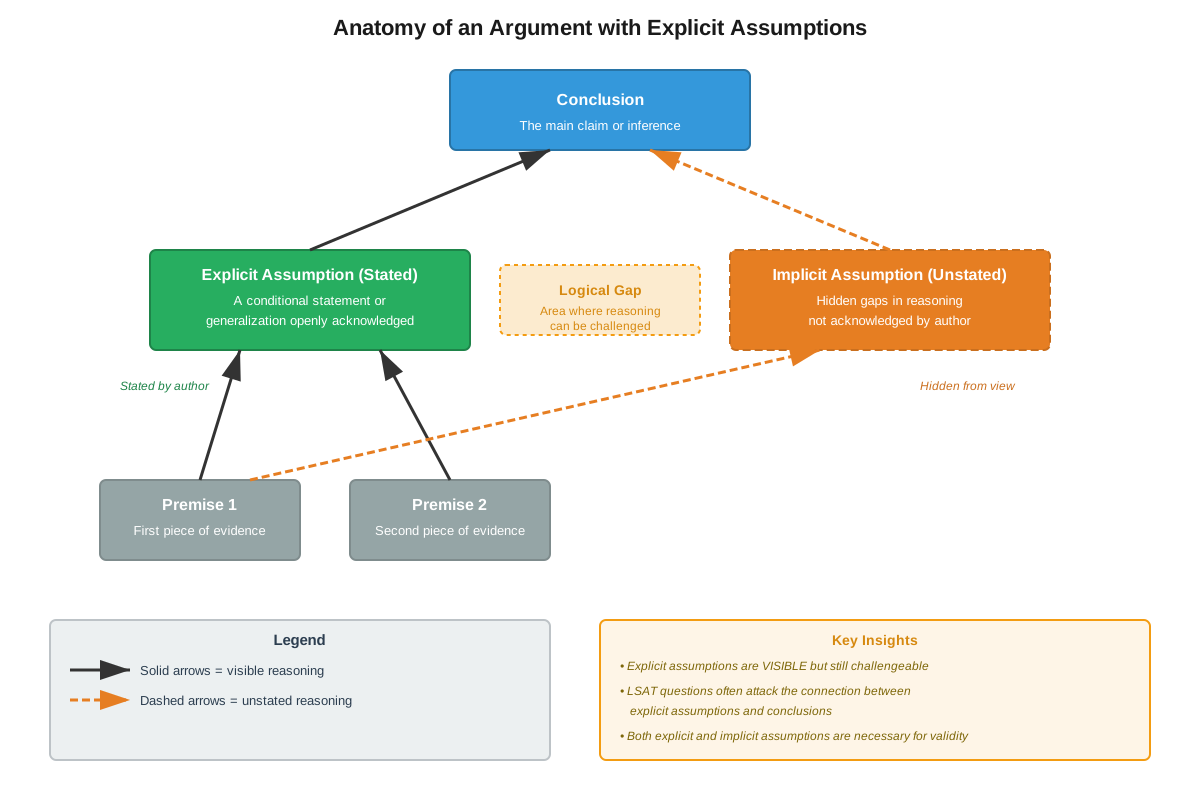
Within the broader context of argument fundamentals, explicit assumptions occupy a middle ground between premises (evidence) and conclusions (claims). They represent conditional statements, generalizations, or principles that the author openly acknowledges as necessary for their reasoning. Mastering this topic enables students to tackle more complex question types including Necessary Assumption, Sufficient Assumption, Strengthen, Weaken, and Flaw questions—all of which require precise understanding of how arguments are constructed and what makes them vulnerable to criticism.
Learning Objectives
- [ ] Identify how explicit assumptions appear in LSAT questions
- [ ] Explain the reasoning pattern behind explicit assumptions
- [ ] Apply explicit assumptions to solve LSAT-style problems accurately
- [ ] Distinguish between explicit assumptions and implicit (unstated) assumptions in arguments
- [ ] Evaluate how explicit assumptions connect premises to conclusions in logical chains
- [ ] Recognize when explicit assumptions contain logical vulnerabilities or gaps
- [ ] Predict what additional assumptions would be needed to strengthen arguments containing explicit assumptions
Prerequisites
- Basic argument structure: Understanding the distinction between premises, conclusions, and assumptions is necessary because explicit assumptions function as stated bridges between evidence and claims.
- Conditional reasoning fundamentals: Recognizing "if-then" relationships helps identify when explicit assumptions establish necessary or sufficient conditions.
- Indicator words: Familiarity with conclusion indicators (therefore, thus, hence) and premise indicators (because, since, given that) enables proper identification of argument components.
- Logical validity concepts: Understanding what makes an argument valid versus sound provides the framework for evaluating how explicit assumptions contribute to or undermine reasoning.
Why This Topic Matters
Explicit assumptions appear in approximately 40-50% of all Logical Reasoning questions on the LSAT, making them one of the highest-yield topics for test preparation. While students often focus on identifying unstated assumptions, recognizing and analyzing explicit assumptions is equally critical because these stated assumptions frequently contain the logical vulnerabilities that LSAT questions exploit.
In real-world applications, the ability to identify explicit assumptions is essential for legal reasoning, policy analysis, and critical evaluation of arguments. Lawyers must recognize when opposing counsel makes explicit assumptions that can be challenged, and judges must evaluate whether the assumptions underlying legal arguments are sound. This skill translates directly to law school case analysis and legal writing.
On the LSAT, explicit assumptions commonly appear in several question types:
- Assumption questions that ask what the argument depends upon (requiring students to identify gaps even when some assumptions are stated)
- Strengthen/Weaken questions where the correct answer targets an explicit assumption
- Flaw questions that identify problems with stated assumptions
- Method of Reasoning questions that describe how explicit assumptions function in the argument structure
- Parallel Reasoning questions where matching explicit assumptions helps identify structurally similar arguments
The LSAT frequently presents arguments where explicit assumptions appear reasonable on the surface but contain subtle logical gaps. Test-makers design wrong answers that seem to address these explicit assumptions while actually missing the deeper unstated assumptions. Students who can precisely identify and analyze explicit assumptions gain a significant advantage in eliminating trap answers.
Core Concepts
Definition and Characteristics of Explicit Assumptions
An explicit assumption is a statement within an argument that the author directly expresses as a necessary component of their reasoning. Unlike implicit assumptions (which remain unstated), explicit assumptions are visible in the text and typically serve as intermediate steps connecting evidence to conclusions. These assumptions often take the form of general principles, conditional statements, or causal claims that the author openly relies upon.
Key characteristics include:
- Direct statement within the argument text
- Function as a bridge between premises and conclusion
- Often contain qualifying language ("generally," "typically," "usually")
- May establish rules, principles, or patterns the argument depends upon
- Can be identified by asking "What is the author taking for granted that they've actually stated?"
The Role of Explicit Assumptions in Argument Structure
Explicit assumptions occupy a unique position in logical reasoning because they simultaneously function as both premises (stated components) and assumptions (taken-for-granted elements). When an author makes an explicit assumption, they acknowledge a gap in their reasoning but attempt to fill it with a stated claim rather than leaving it implicit.
Consider this structure:
Premise → Explicit Assumption → Conclusion
For example:
- Premise: "The new policy reduced costs by 15%"
- Explicit Assumption: "Policies that reduce costs are beneficial"
- Conclusion: "Therefore, the new policy is beneficial"
The explicit assumption here bridges the factual premise (cost reduction) to the evaluative conclusion (beneficial). Without this stated assumption, the logical connection would be incomplete.
Distinguishing Explicit from Implicit Assumptions
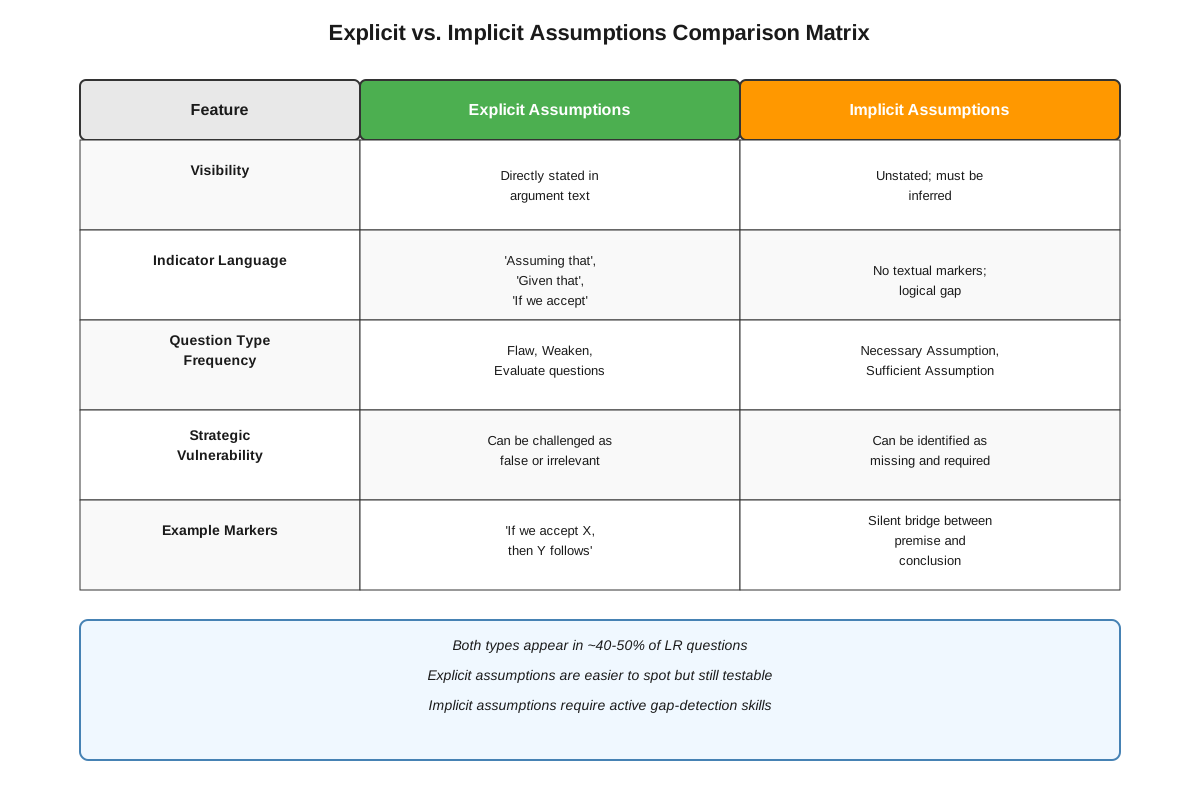
| Feature | Explicit Assumptions | Implicit Assumptions |
|---|---|---|
| Visibility | Directly stated in text | Unstated; must be inferred |
| Function | Acknowledged bridge | Hidden gap in reasoning |
| LSAT Treatment | May contain vulnerabilities | Primary target of assumption questions |
| Author Awareness | Author recognizes need | Author may be unaware |
| Identification Method | Read directly from passage | Derive from premise-conclusion gap |
Understanding this distinction is crucial because LSAT questions often present arguments with explicit assumptions that seem to complete the reasoning, but actually leave critical implicit assumptions unstated. The test-makers exploit this by offering answer choices that address the explicit assumption (wrong) rather than the implicit assumption (correct).
Common Forms of Explicit Assumptions
Causal Explicit Assumptions: These state that one phenomenon causes another or that a correlation indicates causation.
- Example: "Since sales increased after the advertising campaign, and increased sales following advertising typically indicate the campaign's effectiveness, the campaign was effective."
Categorical Explicit Assumptions: These place items into categories or apply general rules to specific cases.
- Example: "This medication is a stimulant, and stimulants generally increase alertness, so this medication will increase alertness."
Conditional Explicit Assumptions: These establish if-then relationships that the argument relies upon.
- Example: "If the theory is correct, we should observe X. We observed X, so the theory is correct."
Comparative Explicit Assumptions: These assume that comparisons are valid or that differences/similarities are relevant.
- Example: "City A and City B have similar demographics, so policies that worked in City A should work in City B."
Identifying Explicit Assumptions in LSAT Passages
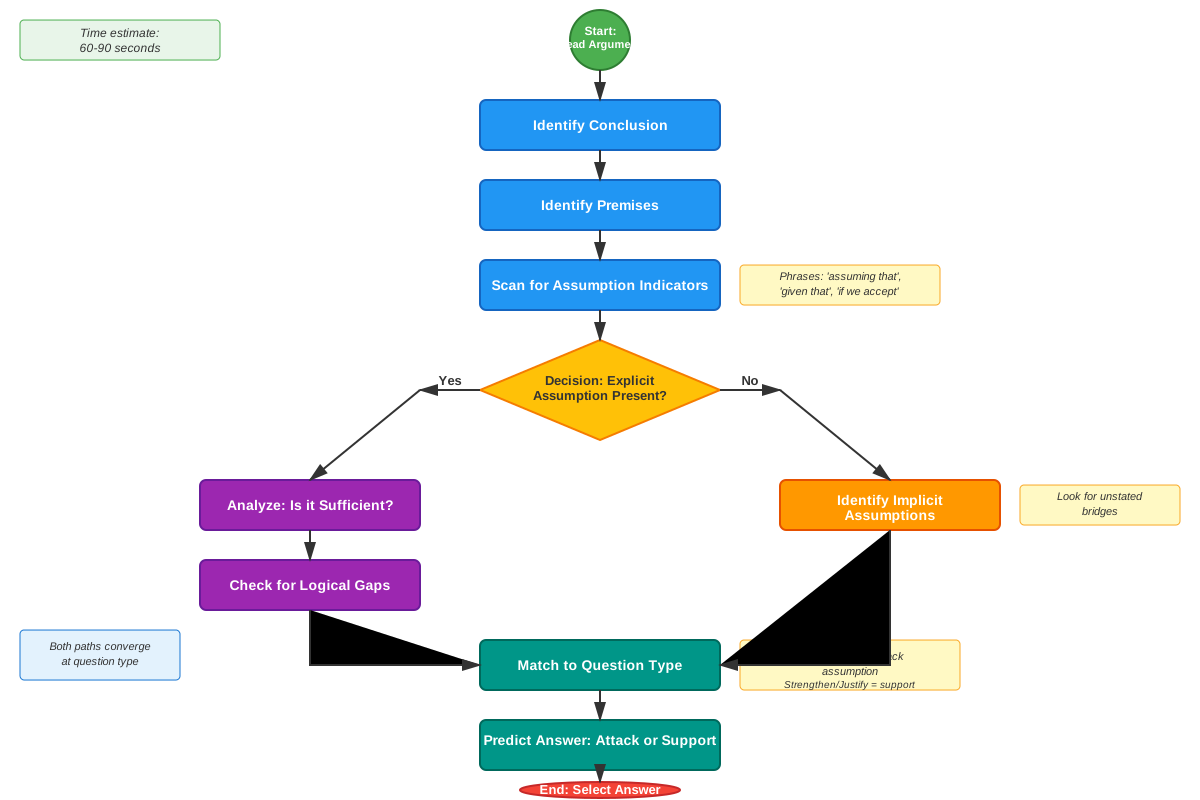
The process for identifying explicit assumptions involves:
- Locate the conclusion: Identify what the argument is trying to prove
- Identify the premises: Find the evidence offered in support
- Map the logical connection: Determine what stated principles or rules connect evidence to conclusion
- Look for qualifying language: Words like "generally," "typically," "usually," "often" signal explicit assumptions
- Identify principle statements: Phrases like "it follows that," "this means," or "therefore we can assume" often introduce explicit assumptions
- Check for stated conditionals: "If-then" statements that the argument relies upon are explicit assumptions
Vulnerabilities in Explicit Assumptions
Even when authors state their assumptions explicitly, these assumptions may contain logical weaknesses:
- Overgeneralization: The explicit assumption applies a rule too broadly
- Unwarranted causation: The stated causal relationship may not hold
- False equivalence: The explicit assumption treats different things as similar
- Temporal issues: The explicit assumption assumes past patterns continue
- Scope problems: The explicit assumption extends beyond what the evidence supports
LSAT questions frequently exploit these vulnerabilities by asking students to identify flaws, weaken arguments, or recognize what additional assumptions are needed even when explicit assumptions are present.
The Relationship Between Explicit Assumptions and Logical Gaps
A critical insight for LSAT success is recognizing that explicit assumptions often reveal where logical gaps exist. When an author feels compelled to state an assumption explicitly, they're acknowledging a potential weakness in their reasoning. However, the explicit assumption they provide may not fully address the gap, leaving implicit assumptions still necessary.
For example:
- Premise: "90% of customers rated the product highly"
- Explicit Assumption: "High customer ratings generally indicate product quality"
- Conclusion: "The product is high quality"
The explicit assumption seems to complete the reasoning, but implicit assumptions remain:
- The sample of customers is representative
- Customers are qualified to judge quality
- "High rating" and "high quality" measure the same thing
LSAT questions often target these remaining implicit assumptions while offering wrong answers that merely restate or support the explicit assumption.
Concept Relationships
The concepts within explicit assumptions form an interconnected web of logical relationships. Explicit assumptions serve as the foundation, connecting directly to argument structure by functioning as stated bridges between premises and conclusions. This connection flows through conditional reasoning when explicit assumptions take "if-then" forms, and through causal reasoning when they assert cause-effect relationships.
The relationship map follows this pattern:
Argument Structure → contains → Explicit Assumptions → which may be → Causal/Categorical/Conditional → revealing → Logical Gaps → requiring → Implicit Assumptions → tested by → LSAT Question Types
Explicit assumptions connect to prerequisite topics through their dependence on understanding basic argument components. Students must first recognize premises and conclusions before identifying the stated assumptions connecting them. The topic also relates forward to more advanced concepts like Necessary Assumptions (what must be true even beyond explicit assumptions) and Sufficient Assumptions (what would guarantee the conclusion if added to explicit assumptions).
Within the broader unit of Argument Fundamentals, explicit assumptions represent the transition point between simple argument identification and complex argument analysis. They prepare students for evaluating argument strength, identifying flaws, and understanding how arguments can be strengthened or weakened.
High-Yield Facts
⭐ Explicit assumptions are directly stated in the argument text, unlike implicit assumptions which must be inferred from gaps in reasoning.
⭐ Approximately 40-50% of Logical Reasoning questions involve analyzing assumptions, with many arguments containing both explicit and implicit assumptions.
⭐ The presence of an explicit assumption does not eliminate the need for implicit assumptions; arguments often require both.
⭐ Qualifying language like "generally," "typically," "usually," and "often" frequently signals explicit assumptions that may contain logical vulnerabilities.
⭐ LSAT wrong answers often restate or support explicit assumptions rather than addressing the critical implicit assumptions the question targets.
- Explicit assumptions most commonly appear in causal, categorical, and conditional forms on the LSAT.
- When an author states an assumption explicitly, they're acknowledging a potential gap in their reasoning but may not fully address it.
- Explicit assumptions can themselves contain logical flaws such as overgeneralization, false equivalence, or unwarranted causation.
- Identifying explicit assumptions requires mapping the logical pathway from premises through intermediate steps to the conclusion.
- The LSAT frequently tests whether students can distinguish between what an argument states (explicit) and what it requires but doesn't state (implicit).
- Explicit assumptions often establish general principles or rules that the argument applies to specific cases.
- Recognizing explicit assumptions helps predict what additional information would strengthen or weaken an argument.
- Method of Reasoning questions often describe how explicit assumptions function in argument structure.
- Parallel Reasoning questions require matching explicit assumptions between arguments to identify structural similarity.
- Explicit assumptions in LSAT arguments frequently contain subtle scope shifts or category errors that create vulnerabilities.
Quick check — test yourself on Explicit assumptions so far.
Try Flashcards →Common Misconceptions
Misconception: If an argument states an assumption explicitly, no additional assumptions are needed.
Correction: Explicit assumptions often leave critical implicit assumptions unstated. An argument can contain multiple layers of assumptions, and stating one doesn't eliminate the need for others. The LSAT frequently tests this by presenting arguments with explicit assumptions that seem complete but actually require additional unstated assumptions.
Misconception: Explicit assumptions are always flawed or problematic.
Correction: Explicit assumptions are not inherently flawed; they're simply stated components of reasoning. Some explicit assumptions are perfectly reasonable and well-supported. The LSAT tests whether students can evaluate which explicit assumptions are vulnerable and which are sound, not whether all stated assumptions are problematic.
Misconception: The correct answer to an assumption question will always address the explicit assumption mentioned in the argument.
Correction: LSAT assumption questions typically target implicit assumptions—the unstated gaps in reasoning. Wrong answers often restate or support the explicit assumption as a trap, while the correct answer identifies what the argument needs but doesn't state. Students must look beyond what's explicitly stated to find what's implicitly required.
Misconception: Explicit assumptions and premises are the same thing.
Correction: While both are stated in the argument, premises are factual claims or evidence, whereas explicit assumptions are principles, rules, or connections that the author takes for granted. Premises provide data; explicit assumptions provide the logical framework for interpreting that data. For example, "Sales increased 20%" is a premise, while "Increased sales indicate success" is an explicit assumption.
Misconception: Identifying explicit assumptions is easier than identifying implicit assumptions because they're stated in the text.
Correction: While explicit assumptions are visible, recognizing them requires understanding their function in the argument structure, which can be challenging. Students must distinguish between simple premises and assumptions that serve as logical bridges. Additionally, the LSAT often embeds explicit assumptions in complex sentence structures or presents them in ways that obscure their role as assumptions rather than mere facts.
Misconception: All conditional statements in arguments are explicit assumptions.
Correction: Not every "if-then" statement functions as an assumption. Some conditional statements are premises (evidence) or conclusions (claims). An explicit assumption must serve as a taken-for-granted bridge in the reasoning. Students should ask whether the conditional statement is something the author assumes to connect evidence to conclusion, or whether it's the evidence or conclusion itself.
Misconception: Explicit assumptions always use obvious signal words like "assume" or "presume."
Correction: Explicit assumptions rarely use these direct signals. Instead, they appear as general principles, causal claims, or categorical statements that the argument relies upon. They're often introduced with phrases like "this indicates," "it follows that," "generally," or "typically," or they may appear as standalone statements without any special markers.
Worked Examples
Example 1: Identifying and Analyzing Explicit Assumptions
Argument: "The city's new traffic management system reduced average commute times by 12% during its first six months of operation. Traffic management systems that reduce commute times typically improve residents' quality of life. Therefore, the new system has improved residents' quality of life."
Question: Which of the following is an assumption required by the argument?
Step 1 - Identify the Conclusion: "The new system has improved residents' quality of life."
Step 2 - Identify the Premises:
- The system reduced average commute times by 12%
- Traffic management systems that reduce commute times typically improve quality of life (this is the explicit assumption)
Step 3 - Analyze the Explicit Assumption: The argument explicitly states that systems reducing commute times "typically" improve quality of life. This is a stated assumption—the author openly acknowledges this principle as part of their reasoning.
Step 4 - Identify the Logical Gap: Despite the explicit assumption, gaps remain:
- Does a 12% reduction qualify as significant enough to trigger the "typical" improvement?
- Are there other factors that might prevent quality of life improvement despite reduced commute times?
- Is "average" commute time reduction the right measure for quality of life impact?
Step 5 - Predict the Answer: The correct answer will address an implicit assumption, not restate the explicit one. We need something like: "The 12% reduction is sufficient to produce the typical quality of life improvement" or "No other factors have offset the benefits of reduced commute times."
Wrong Answer Trap: "Traffic management systems that reduce commute times generally benefit residents." This merely restates the explicit assumption and is therefore incorrect—it's already stated in the argument.
Correct Answer Type: "The reduction in average commute times reflects reduced commute times for most individual residents." This addresses an implicit assumption about whether the average represents individual experiences, which the argument requires but doesn't state.
Connection to Learning Objectives: This example demonstrates how to identify explicit assumptions (the "typically improve quality of life" statement), explain the reasoning pattern (general principle applied to specific case), and apply this understanding to eliminate wrong answers that merely restate what's already explicit.
Example 2: Distinguishing Multiple Assumption Layers
Argument: "Archaeologists discovered pottery fragments at the excavation site that date to approximately 3000 BCE. Since pottery production requires settled agricultural communities, and settled agricultural communities typically develop complex social hierarchies, the society at this location likely had a complex social hierarchy around 3000 BCE."
Question: The argument's conclusion follows logically if which of the following is assumed?
Step 1 - Map the Argument Structure:
- Premise: Pottery fragments date to 3000 BCE
- Explicit Assumption 1: "Pottery production requires settled agricultural communities"
- Explicit Assumption 2: "Settled agricultural communities typically develop complex social hierarchies"
- Conclusion: This society likely had complex social hierarchy around 3000 BCE
Step 2 - Identify What's Explicit: The argument explicitly states two assumptions as part of its reasoning chain. These are openly acknowledged as necessary connections.
Step 3 - Find the Implicit Gaps: Despite these explicit assumptions, several implicit assumptions remain:
- The pottery was produced at this location (not imported)
- The community that produced the pottery still existed in 3000 BCE
- The "typical" development of hierarchies applies to this specific community
- The time frame for hierarchy development aligns with the pottery date
Step 4 - Evaluate Answer Choices:
Wrong Answer: "Settled agricultural communities generally produce pottery." This reverses the explicit assumption and isn't necessary for the argument.
Wrong Answer: "Complex social hierarchies are characteristic of settled agricultural communities." This restates Explicit Assumption 2 in different words—it's already in the argument.
Wrong Answer: "The pottery fragments are representative of the society's pottery production." While this might strengthen the argument, it's not necessary for the conclusion to follow from the premises.
Correct Answer: "The pottery fragments were produced by people living at the excavation site rather than imported from elsewhere." This addresses a critical implicit assumption—the argument assumes local production to conclude that a settled agricultural community (and therefore hierarchy) existed at this location. Without this assumption, the pottery could have been traded from elsewhere, breaking the logical chain.
Step 5 - Verify the Logic: If the pottery was imported, then its presence doesn't indicate a settled agricultural community at this site, which means we can't conclude this society had a complex hierarchy. The assumption is necessary for the conclusion to follow.
Key Insight: This example shows how arguments can contain multiple explicit assumptions (pottery requires settlement; settlement leads to hierarchy) while still depending on critical implicit assumptions (the pottery was locally produced). The LSAT tests whether students can see beyond the stated assumptions to identify what remains unstated but necessary.
Exam Strategy
Approaching Explicit Assumption Questions
When encountering LSAT questions involving explicit assumptions, follow this systematic approach:
First Pass - Identify the Explicit: Read the argument carefully and mark any stated assumptions, general principles, or rules the author openly relies upon. Look for qualifying language and principle statements.
Second Pass - Find the Implicit: After identifying explicit assumptions, ask "What else must be true?" The correct answer typically addresses gaps that remain even after the explicit assumptions are stated.
Eliminate Restatements: Immediately eliminate answer choices that merely restate, paraphrase, or support the explicit assumptions already in the argument. These are trap answers designed to catch students who don't distinguish explicit from implicit.
Test Necessity: For assumption questions, use the negation test on remaining answers. If negating an answer choice destroys the argument, it's necessary. If the argument survives negation, eliminate that choice.
Trigger Words and Phrases
Watch for these indicators of explicit assumptions in LSAT arguments:
- Qualifying language: "generally," "typically," "usually," "often," "most," "commonly"
- Principle indicators: "it follows that," "this means," "this indicates," "this suggests"
- Causal language: "leads to," "results in," "causes," "produces," "brings about"
- Categorical language: "all," "any," "every," "no," "none"
- Conditional markers: "if," "when," "whenever," "only if," "unless"
In answer choices, watch for:
- Restatement flags: "as the argument states," "as mentioned," "as indicated"
- Scope shifts: Changes in degree, quantity, or category from the argument
- Temporal markers: "always," "never," "will," "must" (often too strong)
Process of Elimination Strategy
Tier 1 Elimination - Restatements: Remove any answer that restates explicit assumptions from the argument. These are never correct for assumption questions.
Tier 2 Elimination - Irrelevant Scope: Eliminate answers that address topics, categories, or time periods not discussed in the argument.
Tier 3 Elimination - Reversed Logic: Remove answers that reverse the argument's logical direction or confuse necessary and sufficient conditions.
Tier 4 Evaluation - Remaining Choices: For remaining answers, apply the negation test or ask "Does the argument absolutely require this to be true?"
Time Allocation
For questions involving explicit assumptions:
- Initial read: 30-45 seconds to understand the argument and identify explicit assumptions
- Question stem analysis: 5-10 seconds to determine what type of assumption is needed
- Answer evaluation: 45-60 seconds to eliminate wrong answers and verify the correct choice
- Total time: Approximately 90-120 seconds per question
Exam Tip: Don't spend extra time analyzing explicit assumptions during your initial read. Note them quickly and move on to finding what's implicit. The LSAT rewards students who can see beyond what's stated to what's required but unstated.
Common Question Stem Variations
Recognize these question stems that test explicit assumptions:
- "Which of the following is an assumption on which the argument depends?"
- "The argument requires assuming which of the following?"
- "Which of the following is assumed by the argument?"
- "The conclusion follows logically if which of the following is assumed?"
For these questions, the correct answer will typically address implicit assumptions, while wrong answers often restate explicit ones.
Memory Techniques
The BRIDGE Acronym
Remember that explicit assumptions serve as BRIDGES in arguments:
- Between premises and conclusion
- Rules or principles stated openly
- Intermediate steps in reasoning
- Directly visible in text
- Gaps they acknowledge but may not fully fill
- Exposed to logical scrutiny
- Signal words often present (typically, generally, usually)
The Two-Layer Visualization
Visualize arguments as having two layers:
Surface Layer (visible): Premises → Explicit Assumptions → Conclusion
Deep Layer (hidden): Implicit Assumptions connecting all surface elements
When reading arguments, imagine peeling back the surface layer to reveal the hidden assumptions beneath. The LSAT tests the deep layer, not the surface.
The "Already There" Test
Create a mental stamp that says "ALREADY THERE" to mark explicit assumptions. When evaluating answer choices, mentally stamp any choice that restates something already in the argument. This physical visualization helps avoid trap answers.
The Qualifying Language Highlighter
Train yourself to mentally highlight qualifying words: "typically," "generally," "usually," "often," "most." These words signal explicit assumptions and also indicate potential vulnerabilities (what about the atypical cases?).
The Three-Question Sequence
Memorize this sequence for every argument:
- "What does the author state?" (Identify explicit assumptions)
- "What does the author need?" (Identify implicit assumptions)
- "What's the gap between them?" (Find the answer)
Summary
Explicit assumptions represent a crucial component of LSAT logical reasoning, functioning as stated bridges between premises and conclusions. Unlike implicit assumptions that remain hidden, explicit assumptions are directly expressed in argument text, often using qualifying language like "typically," "generally," or "usually." Understanding explicit assumptions requires recognizing that they serve dual roles: they are both stated components of arguments and taken-for-granted elements that may contain logical vulnerabilities. The LSAT frequently tests whether students can distinguish between explicit assumptions already present in arguments and implicit assumptions that remain unstated but necessary. Success on these questions demands looking beyond what arguments state explicitly to identify what they require but don't express. Explicit assumptions commonly appear in causal, categorical, and conditional forms, and they often reveal where logical gaps exist even when authors attempt to address them. The key to mastering this topic lies in recognizing that the presence of explicit assumptions doesn't eliminate the need for implicit assumptions—arguments typically require both layers to be logically complete.
Key Takeaways
- Explicit assumptions are stated directly in arguments, distinguishing them from implicit assumptions that must be inferred from logical gaps
- The presence of explicit assumptions doesn't eliminate implicit assumptions; LSAT questions typically target what remains unstated despite explicit acknowledgments
- Qualifying language signals explicit assumptions and often indicates potential vulnerabilities in reasoning
- Wrong answers frequently restate explicit assumptions while correct answers address implicit assumptions the argument requires
- Explicit assumptions function as bridges connecting premises to conclusions but may not fully close logical gaps
- Multiple assumption layers exist in most LSAT arguments, requiring analysis of both what's stated and what's required but unstated
- Systematic identification of explicit assumptions enables prediction of implicit assumptions and more efficient answer elimination
Related Topics
Implicit Assumptions: After mastering explicit assumptions, students progress to identifying unstated assumptions that arguments depend upon. This topic builds directly on understanding explicit assumptions by teaching how to recognize gaps that remain even when some assumptions are stated.
Necessary vs. Sufficient Assumptions: This advanced topic distinguishes between assumptions that must be true for conclusions to follow (necessary) and assumptions that guarantee conclusions (sufficient). Understanding explicit assumptions provides the foundation for this distinction.
Argument Structure and Mapping: Learning to diagram complete argument structures, including both explicit and implicit assumptions, enables more sophisticated analysis of complex reasoning chains.
Flaw Identification: Many logical flaws involve problems with explicit assumptions—overgeneralization, false causation, or unwarranted comparisons. Mastering explicit assumptions prepares students to identify these specific flaw types.
Strengthen and Weaken Questions: These question types often target explicit assumptions by asking what information would support or undermine stated principles in arguments. Understanding explicit assumptions enables prediction of correct answer patterns.
Practice CTA
Now that you've mastered the fundamentals of explicit assumptions, it's time to apply this knowledge to actual LSAT questions. The practice questions and flashcards will reinforce your ability to distinguish explicit from implicit assumptions, identify logical gaps, and eliminate trap answers that merely restate what arguments already state. Remember: the LSAT rewards students who can see beyond the surface of arguments to identify what's truly necessary but unstated. Each practice question you complete strengthens your pattern recognition and builds the automatic responses needed for test-day success. Approach the practice materials systematically, applying the BRIDGE acronym and the three-question sequence to every argument you encounter. Your investment in deliberate practice now will translate directly to points on test day.
Sign up free to keep reading
Create a free AnvayaPrep account to finish this LSAT guide on Explicit assumptions — plus flashcards and practice questions.