Overview
Implicit assumptions form the invisible backbone of nearly every argument encountered on the LSAT. These unstated premises bridge the gap between an argument's evidence and its conclusion, making them essential to understanding logical reasoning on the exam. When an author presents an argument, they rarely spell out every single step in their reasoning chain. Instead, they rely on assumptions—beliefs or principles they take for granted—that must be true for their conclusion to follow logically from their premises. Mastering the identification and analysis of implicit assumptions is not merely helpful for LSAT success; it is absolutely fundamental to performing well on Logical Reasoning sections.
The LSAT tests implicit assumptions more frequently than almost any other concept in argument fundamentals. Questions may ask test-takers to identify an assumption, strengthen or weaken an argument by addressing its assumptions, or recognize when an argument fails because a necessary assumption is false. Understanding implicit assumptions enables students to see the complete logical structure of arguments, even when parts of that structure remain hidden. This skill separates high scorers from average performers because it reveals the vulnerability points in arguments—the places where reasoning can break down.
Within the broader landscape of Logical Reasoning, implicit assumptions connect directly to argument structure, validity, and soundness. They represent the "missing links" that must exist for premises to support conclusions adequately. This topic builds upon basic argument identification skills and serves as the foundation for more advanced question types including Necessary Assumption, Sufficient Assumption, Strengthen, Weaken, and Flaw questions. Without a solid grasp of how to identify and evaluate implicit assumptions, students will struggle with approximately 60-70% of all Logical Reasoning questions on the LSAT.
Learning Objectives
- [ ] Identify how implicit assumptions appear in LSAT questions
- [ ] Explain the reasoning pattern behind implicit assumptions
- [ ] Apply implicit assumptions to solve LSAT-style problems accurately
- [ ] Distinguish between necessary and sufficient assumptions in arguments
- [ ] Recognize the gap between evidence and conclusion that assumptions must bridge
- [ ] Evaluate whether a given statement qualifies as an assumption of an argument
- [ ] Predict likely assumptions before reviewing answer choices
Prerequisites
- Basic argument structure: Understanding premises, conclusions, and how to identify them is essential because assumptions connect these elements
- Conditional reasoning fundamentals: Recognizing if-then relationships helps identify when arguments assume conditional connections between ideas
- Validity versus soundness: Knowing the difference between logical structure and truth of premises clarifies what assumptions do in arguments
- Common argument patterns: Familiarity with causal, analogical, and statistical reasoning helps predict what types of assumptions different argument structures require
Why This Topic Matters
Understanding implicit assumptions has profound real-world applications beyond the LSAT. Critical thinking in professional contexts—whether in law, business, medicine, or policy—requires identifying unstated premises in proposals, contracts, and strategic plans. Lawyers must recognize assumptions in opposing counsel's arguments to effectively challenge them. Business leaders must identify assumptions in market analyses to assess risk. This cognitive skill enables individuals to evaluate the strength of reasoning in everyday contexts, from news articles to political speeches to advertising claims.
On the LSAT specifically, implicit assumptions appear in approximately 60-70% of all Logical Reasoning questions. The exam includes dedicated question types that explicitly test this concept: Necessary Assumption questions (which ask what must be true for the argument to work) and Sufficient Assumption questions (which ask what would guarantee the conclusion follows). Beyond these direct question types, understanding assumptions is crucial for Strengthen questions (which make assumptions more likely to be true), Weaken questions (which attack assumptions), Flaw questions (which identify problematic assumptions), and Evaluate questions (which test whether assumptions hold). Even Method of Reasoning and Parallel Reasoning questions often require recognizing what assumptions underlie argument structures.
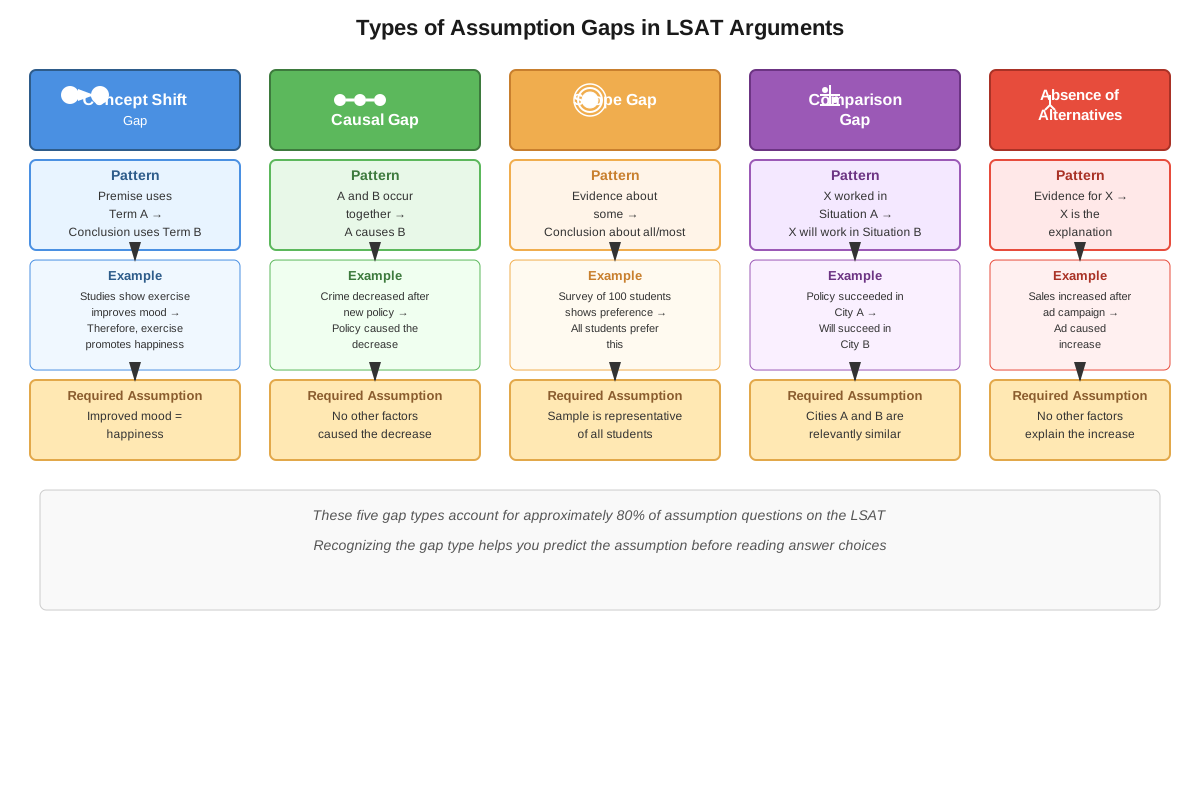
Common manifestations in LSAT passages include arguments that jump from specific evidence to broad conclusions, arguments that assume causal relationships from correlational data, arguments that presume representativeness of samples, arguments that take for granted that terms used in premises and conclusions refer to the same things, and arguments that assume no alternative explanations exist for observed phenomena. Recognizing these patterns allows test-takers to anticipate what assumptions an argument requires before even looking at answer choices.
Core Concepts
What Are Implicit Assumptions?
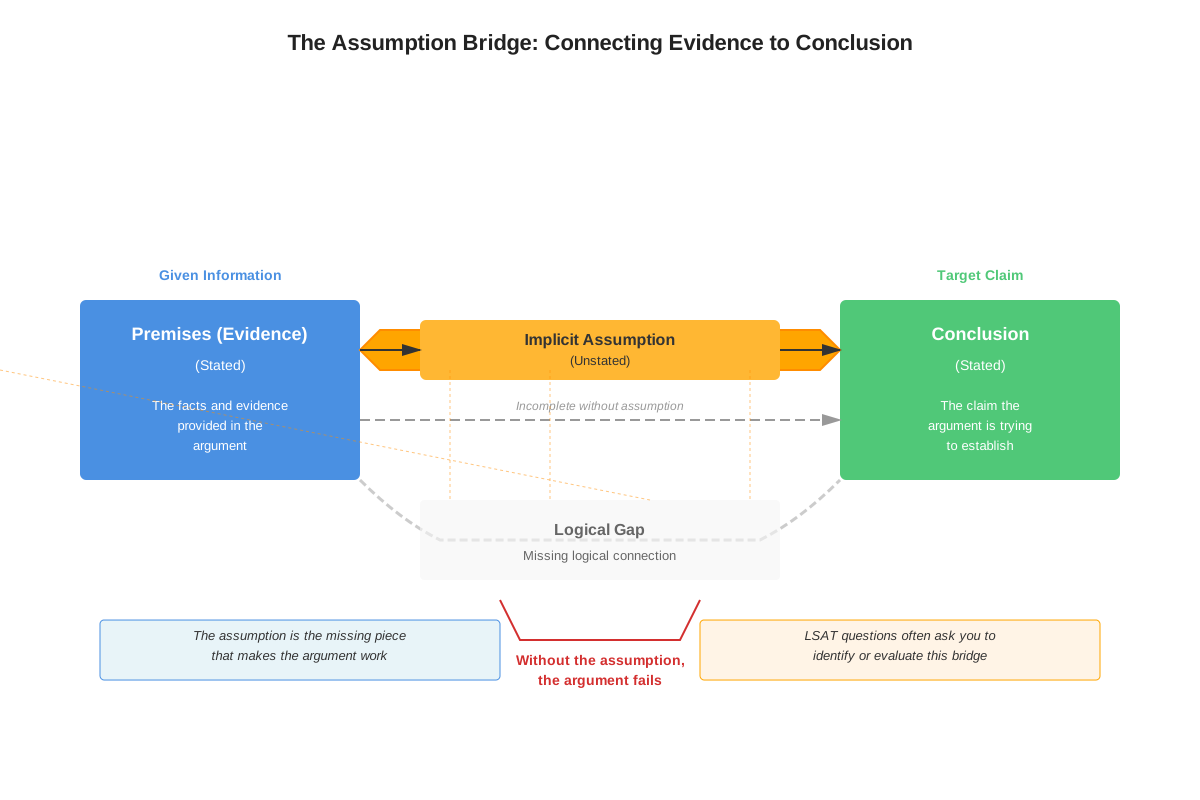
An implicit assumption is an unstated premise that must be true (or that the author believes to be true) for an argument's conclusion to follow logically from its stated premises. Unlike explicit premises, which appear directly in the argument text, implicit assumptions remain hidden in the logical structure. They represent the "glue" that holds arguments together, filling gaps between evidence and conclusions.
Every argument with a gap between its premises and conclusion contains at least one implicit assumption. The LSAT exploits this reality by constructing arguments with deliberate gaps, then testing whether students can identify what must bridge those gaps. Understanding that assumptions are necessary for arguments to work—that without them, the reasoning falls apart—is crucial for LSAT success.
The Assumption Gap
The most important concept in understanding implicit assumptions is recognizing the assumption gap: the logical distance between what an argument states (its premises) and what it claims (its conclusion). This gap exists whenever a conclusion contains information, concepts, or scope that the premises alone do not establish.
Consider this simple example:
- Premise: Sarah scored in the 99th percentile on the LSAT.
- Conclusion: Sarah will be an excellent lawyer.
The gap here is obvious: scoring well on a test does not automatically translate to professional excellence. The argument assumes a connection between test performance and lawyering ability. Specifically, it assumes that LSAT scores predict legal competence, that no other factors matter more than test scores, and that Sarah possesses other necessary qualities for legal practice.
Identifying assumption gaps requires careful comparison between premises and conclusions. Look for:
- New concepts in the conclusion not mentioned in premises
- Scope shifts from specific to general or vice versa
- Causal claims drawn from correlational evidence
- Comparative judgments without comparative evidence
- Prescriptive conclusions from descriptive premises
Types of Assumptions on the LSAT
The LSAT primarily tests two categories of assumptions, though the distinction matters more for some question types than others:
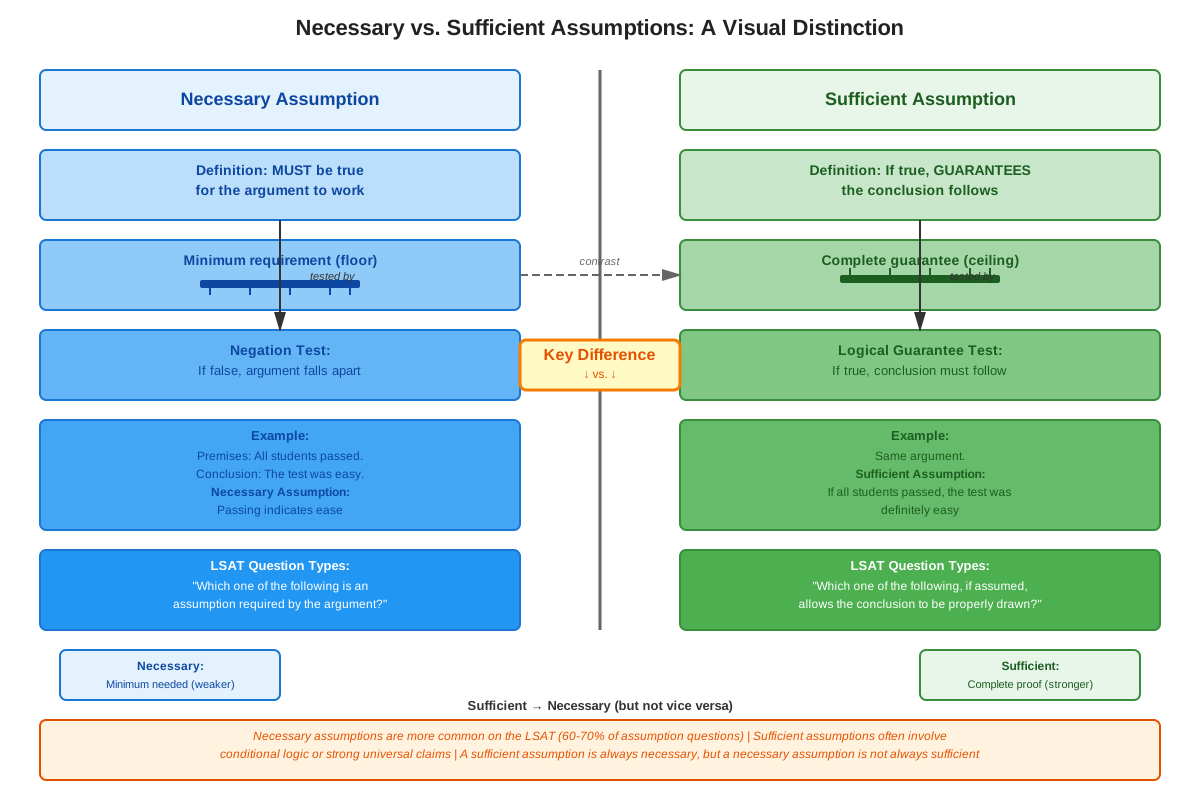
| Assumption Type | Definition | Role in Argument | LSAT Question Types |
|---|---|---|---|
| Necessary Assumption | Must be true for the conclusion to follow; if false, argument fails | Minimum requirement for validity | Necessary Assumption, Weaken, Flaw |
| Sufficient Assumption | If true, guarantees the conclusion follows; may be stronger than needed | Completes the logical chain definitively | Sufficient Assumption, Principle |
Necessary assumptions represent the minimum beliefs required for an argument to work. They are vulnerable points—if you can prove a necessary assumption false, the entire argument collapses. The LSAT frequently asks students to identify these because doing so reveals argument weaknesses.
Sufficient assumptions go beyond minimum requirements to guarantee conclusions. They often take the form of broad principles or conditional statements that, if accepted, make the conclusion inescapable. These assumptions may include more than strictly necessary, but they ensure logical validity.
Common Assumption Patterns
Certain assumption patterns appear repeatedly on the LSAT. Recognizing these patterns accelerates assumption identification:
- Causal Assumptions: When arguments claim X causes Y based on correlation, they assume no alternative causes exist, no reverse causation occurs, and the correlation reflects genuine causation rather than coincidence.
- Representativeness Assumptions: When arguments generalize from samples to populations, they assume the sample accurately represents the whole, no relevant differences exist between sample and population, and sample size is adequate.
- Analogy Assumptions: When arguments reason that because A and B share some characteristics, they share others, they assume the shared characteristics are relevant to the conclusion and no relevant differences exist between A and B.
- Term Shift Assumptions: When different terms appear in premises versus conclusions, arguments assume these terms relate in specific ways—often that they're equivalent, overlapping, or connected by some principle.
- Feasibility Assumptions: When arguments recommend actions, they assume the actions are possible, practical, and won't produce worse consequences than the problem they address.
The Negation Test for Necessary Assumptions
The negation test provides a reliable method for verifying whether a statement is a necessary assumption. To apply it:
- Identify the statement you're testing
- Negate it (make it false or opposite)
- Ask: "If this negated statement were true, would the argument fall apart?"
- If yes, the original statement is a necessary assumption
- If no, it's not necessary (though it might strengthen the argument)
For example, consider the argument: "The new medication reduced symptoms in clinical trials. Therefore, it will help patients in general practice."
Test statement: "Clinical trial conditions resemble real-world conditions."
Negated: "Clinical trial conditions do NOT resemble real-world conditions."
If trial conditions differ significantly from real-world conditions, the argument fails—trial results wouldn't predict real-world effectiveness. Therefore, the resemblance between trial and real-world conditions is a necessary assumption.
Defender Assumptions versus Linking Assumptions
Defender assumptions protect arguments from potential objections by ruling out alternative explanations, counterexamples, or complicating factors. They essentially say "nothing else interferes with this reasoning."
Linking assumptions connect concepts that appear separate in the argument, bridging gaps between premise terms and conclusion terms. They establish relationships that make the logical leap possible.
Both types appear frequently on the LSAT, and many arguments contain both. Defender assumptions often use language like "no other factors," "nothing prevents," or "no alternative explanation." Linking assumptions typically connect the specific subject matter of premises to the specific subject matter of conclusions.
Concept Relationships
The concept of implicit assumptions sits at the center of a web of logical reasoning skills. Understanding argument structure (identifying premises and conclusions) → enables recognition of assumption gaps → which allows identification of implicit assumptions → which in turn enables evaluation of argument strength and validity.
Implicit assumptions connect directly to conditional reasoning because many assumptions take conditional form ("If the premises are true, then certain other things must also be true"). They relate to argument evaluation because recognizing assumptions reveals where arguments are vulnerable to attack. They underpin causal reasoning analysis because causal arguments always assume alternative explanations don't hold.
The relationship flows outward to specific question types: Necessary Assumption questions directly test assumption identification → Strengthen questions ask what makes assumptions more likely true → Weaken questions ask what makes assumptions less likely true → Flaw questions identify when arguments rely on problematic assumptions → Sufficient Assumption questions ask what assumption would guarantee the conclusion.
Understanding implicit assumptions also connects forward to more advanced topics like formal logic and argument construction, where students must not only identify assumptions in existing arguments but also recognize what assumptions would be needed to build valid arguments from scratch.
High-Yield Facts
⭐ Every argument with a gap between premises and conclusion contains at least one implicit assumption
⭐ Necessary assumptions, if false, cause arguments to fail completely—this makes them testable through negation
⭐ The most common assumption gaps involve new concepts in conclusions, causal claims from correlational evidence, and scope shifts
⭐ Sufficient assumptions guarantee conclusions follow but may include more than strictly necessary
⭐ Causal arguments always assume no alternative causes, no reverse causation, and genuine causal connection rather than mere correlation
- Representativeness assumptions underlie all arguments that generalize from samples to populations
- Term shift assumptions bridge different vocabulary used in premises versus conclusions
- Defender assumptions rule out potential objections or alternative explanations
- Linking assumptions connect separate concepts that appear in premises and conclusions
- The negation test works only for necessary assumptions, not sufficient assumptions
- Arguments can have multiple necessary assumptions simultaneously
- Recognizing assumption patterns (causal, representativeness, analogy, feasibility) speeds up analysis
- Assumptions are always unstated—if explicitly stated, they're premises, not assumptions
Quick check — test yourself on Implicit assumptions so far.
Try Flashcards →Common Misconceptions
Misconception: Assumptions are the same as inferences or conclusions.
Correction: Assumptions are unstated premises that support conclusions, while inferences and conclusions are what arguments establish or claim. Assumptions are inputs to reasoning; conclusions are outputs.
Misconception: Every statement that strengthens an argument is a necessary assumption.
Correction: Many statements can strengthen arguments without being necessary. A necessary assumption must be required for the argument to work at all—its negation must destroy the argument. Strengtheners make arguments better but aren't always essential.
Misconception: Sufficient assumptions and necessary assumptions are interchangeable terms.
Correction: These are distinct concepts. Necessary assumptions are minimum requirements (without them, arguments fail). Sufficient assumptions guarantee conclusions (with them, conclusions must follow). Sufficient assumptions are typically stronger and broader than necessary.
Misconception: The longest or most complex answer choice is usually the correct assumption.
Correction: LSAT assumption answers vary in length and complexity. Correct assumptions precisely fill the specific gap in the argument, whether that requires simple or complex language. Many wrong answers are deliberately complex to appear sophisticated.
Misconception: Assumptions must be realistic or true in the real world.
Correction: Arguments can rely on false or unrealistic assumptions. The LSAT tests whether you can identify what an argument assumes, not whether those assumptions are actually true. Many LSAT arguments contain flawed reasoning based on questionable assumptions.
Misconception: If an argument mentions a concept, it doesn't assume anything about that concept.
Correction: Arguments frequently assume relationships, properties, or implications about concepts they mention. Merely mentioning "cost" doesn't mean the argument has established what costs matter, how to measure them, or how they compare to benefits.
Misconception: Assumptions only appear in obviously flawed arguments.
Correction: All arguments that don't explicitly state every step in their reasoning contain assumptions. Even strong arguments with reasonable assumptions still technically assume their unstated premises. The LSAT tests assumption identification in both strong and weak arguments.
Worked Examples
Example 1: Causal Assumption
Argument: "City crime rates dropped 15% in the year after the police department increased foot patrols. Therefore, increasing foot patrols caused the reduction in crime."
Question: Which of the following is an assumption required by the argument?
Analysis Process:
- Identify the conclusion: Increased foot patrols caused the crime reduction
- Identify the premise: Crime dropped 15% after foot patrols increased
- Identify the gap: The premise shows correlation (timing), but the conclusion claims causation
- Recognize the pattern: This is a classic causal assumption pattern
- Predict assumptions needed:
- No other factors caused the crime reduction
- The timing wasn't coincidental
- Crime didn't drop for unrelated reasons
- Foot patrols can actually affect crime rates
Correct Answer: "No other significant changes in city policy or demographics occurred during this period that would affect crime rates."
Why this is correct: This is a defender assumption that rules out alternative causes. If other major changes occurred (economic improvement, demographic shifts, other policy changes), they could explain the crime reduction instead of foot patrols. Negating this assumption destroys the argument: if other significant changes DID occur, we can't attribute the crime drop to foot patrols specifically.
Why wrong answers fail:
- "Foot patrols are the most cost-effective crime prevention method" - Not necessary; the argument only claims they caused this reduction, not that they're most cost-effective
- "Crime rates will continue to drop if foot patrols continue" - About future predictions, not necessary for the causal claim about what already happened
- "Citizens prefer foot patrols to vehicle patrols" - Citizen preference is irrelevant to whether foot patrols caused the crime reduction
Example 2: Term Shift Assumption
Argument: "The new software increased employee productivity by 20% in our pilot program. Therefore, implementing this software company-wide will improve our overall business performance."
Question: The argument assumes which of the following?
Analysis Process:
- Identify the conclusion: Company-wide software implementation will improve overall business performance
- Identify the premise: Software increased employee productivity 20% in pilot program
- Identify the gap: Multiple gaps exist:
- Term shift: "productivity" (premise) → "business performance" (conclusion)
- Scope shift: "pilot program" → "company-wide"
- Representativeness: pilot results predict company-wide results
- Recognize the patterns: Term shift assumption + representativeness assumption
- Predict assumptions needed:
- Productivity increases translate to business performance improvements
- Pilot program participants represent the broader company
- No factors will prevent company-wide implementation from working
Correct Answer: "Increased employee productivity contributes to improved overall business performance."
Why this is correct: This is a linking assumption that bridges the term shift from "productivity" to "business performance." These are not synonymous—productivity could increase while business performance declines (if, for example, employees produce more of something customers don't want). The argument requires that productivity gains actually improve business outcomes. Apply the negation test: if increased productivity does NOT contribute to business performance, the argument completely fails.
Why wrong answers fail:
- "The software is affordable for company-wide implementation" - This is a feasibility consideration but not required for the logical connection between productivity and performance
- "Employees will accept the new software" - While practical, this isn't necessary for the logical claim that IF implemented, it will improve performance
- "The pilot program included employees from every department" - This would strengthen representativeness but isn't strictly necessary; the argument could work even if the pilot was limited
Exam Strategy
Approaching Assumption Questions
When facing LSAT implicit assumptions questions, follow this systematic approach:
- Read the argument carefully and identify the conclusion first - Everything else supports or relates to this
- Identify the premises - What evidence does the argument provide?
- Spot the gap - What logical distance exists between premises and conclusion? What new concepts, scope changes, or logical leaps appear?
- Predict the assumption - Before looking at answers, articulate what must be true for this argument to work
- Evaluate each answer choice - Does it fill the gap you identified?
- Apply the negation test (for Necessary Assumption questions) - Does negating the answer choice destroy the argument?
Trigger Words and Phrases
Watch for these indicators that signal assumption-heavy arguments:
- Causal language: "caused by," "resulted in," "led to," "because of," "responsible for"
- Recommendation language: "should," "must," "ought to," "needs to"
- Generalization language: "all," "every," "always," "never," "typically"
- Comparison language: "better than," "more effective," "superior to"
- Prediction language: "will," "is likely to," "probably"
These words often indicate gaps between what's established and what's claimed, creating space for assumptions.
Process of Elimination Tips
Eliminate answers that:
- Merely restate premises or conclusions (assumptions are unstated)
- Go beyond the argument's scope (introducing irrelevant new topics)
- Reverse the argument's logic
- Are too extreme when the argument is moderate
- Address tangential issues rather than the core logical gap
Keep answers that:
- Connect premise concepts to conclusion concepts
- Rule out alternative explanations (defender assumptions)
- Address the specific gap you identified
- When negated, make the argument fall apart (for Necessary Assumption questions)
- If true, would guarantee the conclusion (for Sufficient Assumption questions)
Time Allocation
For assumption questions, allocate approximately:
- 30 seconds: Reading and understanding the argument
- 20 seconds: Identifying the gap and predicting the assumption
- 40 seconds: Evaluating answer choices
- 10 seconds: Confirming your selection (negation test if needed)
Don't rush the initial analysis. Time spent understanding the argument structure and gap pays dividends when evaluating answers. Students who jump immediately to answer choices often waste more time being confused by wrong answers than they would have spent on careful initial analysis.
Memory Techniques
The GAPS Acronym
Remember what creates assumption gaps with GAPS:
- Generalization (from specific to broad)
- Alternatives (ruling out other explanations)
- Principles (connecting different concepts)
- Scope shifts (changes in subject, time, or degree)
The Negation Test Mnemonic
"Flip it and Rip it": Flip the assumption to its opposite, and see if it rips the argument apart. If the argument survives the flip, the assumption isn't necessary.
Assumption Type Visualization
Picture arguments as bridges:
- Premises = one side of a river
- Conclusion = the other side
- Assumptions = the invisible support beams holding up the bridge
- Necessary assumptions = beams that, if removed, cause collapse
- Sufficient assumptions = adding so many beams the bridge is guaranteed stable
The "What Must Be True?" Question
For any argument, repeatedly ask: "What must be true for this to make sense?" This simple question naturally leads to assumption identification. Make it a habit to ask this before looking at answer choices.
Summary
Implicit assumptions represent the unstated premises that bridge gaps between an argument's evidence and its conclusions. Mastering this concept is essential for LSAT success because assumptions appear in the majority of Logical Reasoning questions, either as the direct focus or as the key to evaluating argument strength. The core skill involves identifying the assumption gap—the logical distance between what an argument states and what it claims—then determining what must be true to bridge that gap. The LSAT tests two main types of assumptions: necessary assumptions (minimum requirements for arguments to work) and sufficient assumptions (guarantees that conclusions follow). Common assumption patterns include causal assumptions, representativeness assumptions, analogy assumptions, term shift assumptions, and feasibility assumptions. The negation test provides a reliable method for verifying necessary assumptions: if negating a statement destroys the argument, that statement is a necessary assumption. Success requires systematic analysis: identify the conclusion, recognize the premises, spot the gap, predict the assumption, and then evaluate answer choices against your prediction. Understanding implicit assumptions not only enables direct assumption question success but also provides the foundation for analyzing strengthen, weaken, flaw, and evaluation questions.
Key Takeaways
- Implicit assumptions are unstated premises that must be true for arguments to work, filling gaps between evidence and conclusions
- The assumption gap—the logical distance between premises and conclusions—is where assumptions live and where arguments are most vulnerable
- Necessary assumptions are minimum requirements; if false, arguments fail completely (testable through negation)
- Sufficient assumptions guarantee conclusions follow but may include more than strictly necessary
- Common patterns (causal, representativeness, analogy, term shift, feasibility) help predict what assumptions arguments require
- The negation test reliably identifies necessary assumptions: negate the statement and see if the argument collapses
- Systematic analysis (conclusion → premises → gap → prediction → evaluation) dramatically improves accuracy and speed on assumption questions
Related Topics
Strengthen and Weaken Questions: These question types directly build on assumption identification—strengthening questions ask what makes assumptions more likely true, while weakening questions attack assumptions. Mastering implicit assumptions makes these questions significantly easier.
Flaw Questions: Many argument flaws involve problematic assumptions (assuming causation from correlation, overgeneralizing, false dichotomies). Understanding assumptions enables recognition of why these reasoning patterns fail.
Sufficient Assumption and Principle Questions: These advanced question types require identifying what assumption would guarantee a conclusion follows, building directly on the foundation of assumption identification.
Formal Logic and Conditional Reasoning: Many assumptions take conditional form, and understanding formal logic helps identify and evaluate these assumptions more precisely.
Argument Evaluation Questions: These questions ask what information would be most useful in assessing an argument—typically information that tests whether key assumptions hold true.
Practice CTA
Now that you understand the fundamental concepts behind implicit assumptions, it's time to put this knowledge into practice. Work through the practice questions to test your ability to identify assumption gaps, predict assumptions, and apply the negation test. Use the flashcards to reinforce key concepts and patterns. Remember: assumption identification is a skill that improves dramatically with deliberate practice. Each practice question you analyze strengthens your ability to see the invisible logical structure of arguments—the exact skill that separates high scorers from average performers on the LSAT. You've built the foundation; now build the mastery through application.
Sign up free to keep reading
Create a free AnvayaPrep account to finish this LSAT guide on Implicit assumptions — plus flashcards and practice questions.