Overview
Identifying what is being argued is the foundational skill upon which all logical reasoning success on the LSAT depends. Before evaluating whether an argument is strong or weak, before identifying assumptions or flaws, test-takers must first accurately recognize what conclusion the author is actually trying to establish. This seemingly simple task becomes surprisingly complex when arguments are embedded in dense prose, when conclusions appear at the beginning or middle rather than the end, or when multiple claims compete for attention. The LSAT deliberately constructs passages where the main conclusion is obscured by background information, intermediate conclusions, and supporting evidence, testing whether students can cut through rhetorical complexity to identify the argumentative core.
This topic represents the entry point to argument fundamentals and serves as the diagnostic skill that determines success across virtually every Logical Reasoning question type. Whether facing assumption questions, strengthen/weaken questions, flaw questions, or method of reasoning questions, the first critical step remains constant: determine what the author is trying to prove. Students who misidentify the main conclusion will inevitably select incorrect answer choices, even if they understand other logical principles perfectly. The LSAT exploits this vulnerability by crafting arguments where subsidiary points sound more emphatic or interesting than the actual conclusion, where indicator words are absent or misleading, and where the argumentative structure requires careful analysis rather than superficial reading.
Mastering conclusion identification creates a cascade of benefits throughout the Logical Reasoning section. Once the main conclusion is correctly identified, the supporting premises become clear, the logical structure emerges, and the relationship between evidence and claim becomes analyzable. This skill connects directly to recognizing argument structure, distinguishing premises from conclusions, understanding the role of subsidiary conclusions, and ultimately evaluating argument quality. Without this foundational competency, students find themselves perpetually confused about what the question is asking them to evaluate, leading to time waste, frustration, and preventable errors.
Learning Objectives
- [ ] Identify how identifying what is being argued appears in LSAT questions
- [ ] Explain the reasoning pattern behind identifying what is being argued
- [ ] Apply identifying what is being argued to solve LSAT-style problems accurately
- [ ] Distinguish main conclusions from subsidiary conclusions, background information, and premises in complex arguments
- [ ] Recognize and utilize conclusion indicator words and premise indicator words to map argument structure
- [ ] Analyze arguments where the conclusion appears in non-standard positions (beginning, middle, or implied)
- [ ] Evaluate answer choices that paraphrase or restate conclusions using different language
Prerequisites
- Basic reading comprehension: Understanding sentence-level meaning is essential because conclusion identification requires parsing complex syntax and recognizing relationships between clauses.
- Familiarity with argument structure terminology: Knowing what "premise," "conclusion," "evidence," and "claim" mean provides the vocabulary necessary to think analytically about argumentative components.
- Ability to distinguish facts from opinions: Conclusions are claims the author wants to establish as true, while premises are offered as reasons; recognizing this distinction prevents confusion between what is being argued versus what is being used to argue.
Why This Topic Matters
In real-world contexts, the ability to identify what someone is actually arguing proves invaluable for legal practice, policy analysis, academic research, and everyday critical thinking. Lawyers must recognize the central claim in opposing counsel's arguments to effectively rebut them. Policy analysts must distinguish between a politician's main thesis and supporting talking points. This skill prevents manipulation through rhetorical misdirection and enables precise engagement with ideas rather than superficial responses to emotionally charged language.
On the LSAT, conclusion identification appears with extraordinary frequency and importance. While "Main Point" questions explicitly ask test-takers to identify the conclusion (appearing 2-4 times per Logical Reasoning section), virtually every other question type implicitly requires this skill. Assumption questions ask what must be true for the conclusion to follow; strengthen/weaken questions ask what would make the conclusion more or less likely; flaw questions ask what's wrong with the reasoning leading to the conclusion. Conservative estimates suggest that 90% of Logical Reasoning questions require accurate conclusion identification as the first analytical step. Students who misidentify conclusions will systematically select wrong answers even when they understand the question type perfectly.
The LSAT tests this skill through several common patterns: arguments where the conclusion appears in the first sentence rather than the last; arguments with multiple conclusions where students must distinguish main from subsidiary; arguments where the conclusion lacks indicator words; arguments where emphatic language appears in premises rather than conclusions; and arguments where the conclusion must be inferred from context rather than explicitly stated. Test-makers deliberately exploit the natural tendency to assume the last sentence is the conclusion or to mistake the most emotionally charged statement for the main point.
Core Concepts
The Anatomy of an Argument
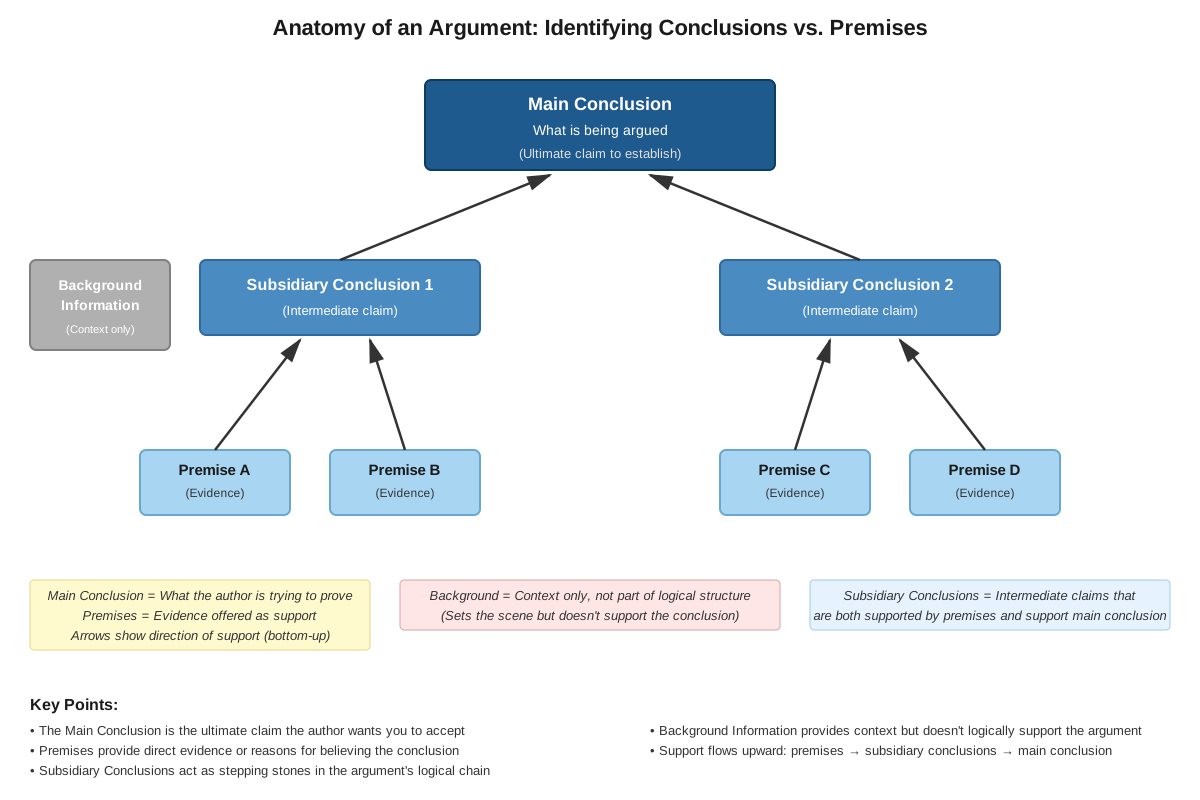
An argument consists of one or more premises (statements offered as evidence or reasons) supporting a conclusion (the claim the author wants to establish as true). The conclusion represents what is being argued—the destination of the reasoning process. Premises represent the path taken to reach that destination. In the simplest arguments, this structure is transparent: "The sidewalk is wet because it rained." Here, "it rained" is the premise, and "the sidewalk is wet" is the conclusion. However, LSAT identifying what is being argued requires handling far more complex structures where multiple premises support intermediate conclusions, which in turn support a main conclusion.
The main conclusion (also called the primary conclusion or ultimate conclusion) represents the author's central claim—the overarching point the entire argument exists to establish. Subsidiary conclusions (also called intermediate conclusions or sub-conclusions) are claims that function as both conclusions (supported by some premises) and premises (supporting the main conclusion). Consider: "The company will lose market share because consumer preferences are shifting toward sustainable products, and the company has failed to develop any eco-friendly alternatives. Therefore, investors should sell their stock." The main conclusion is "investors should sell their stock." The subsidiary conclusion is "the company will lose market share," which is supported by two premises about consumer preferences and the company's product line.
Conclusion Indicator Words
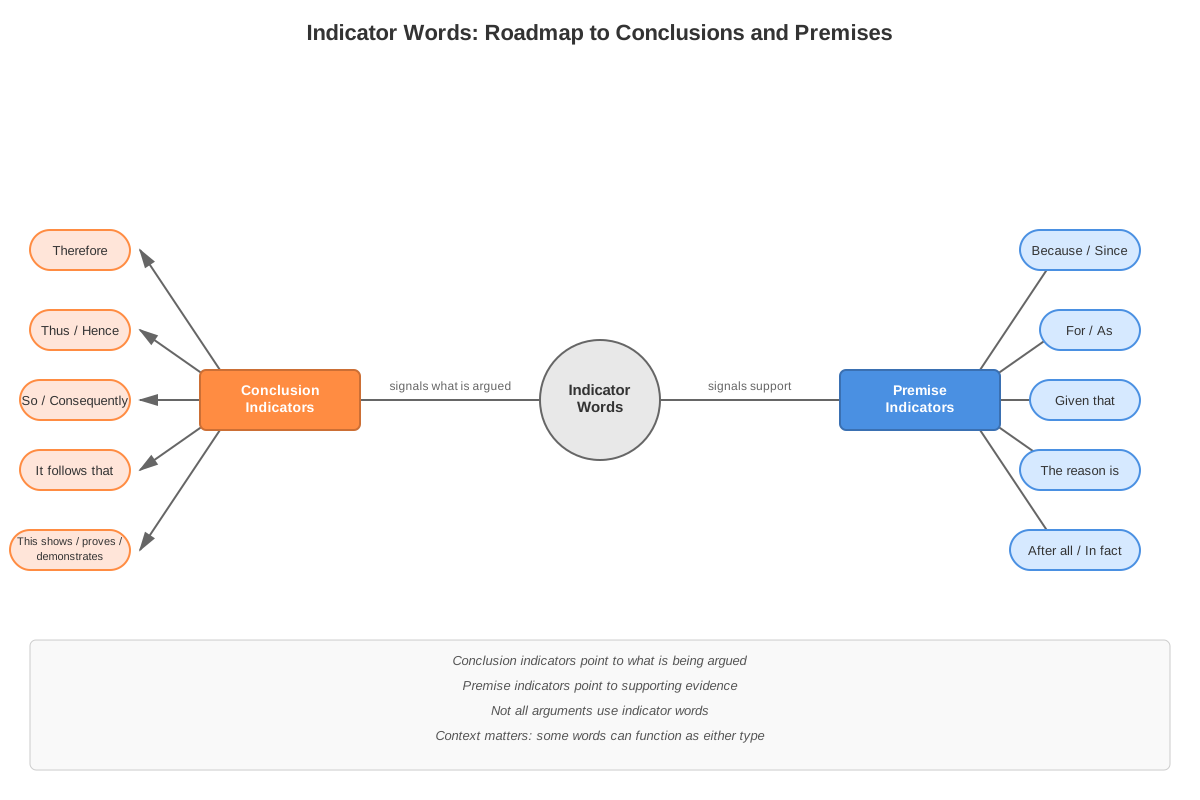
Conclusion indicators are linguistic signals that the author is about to state what they're trying to prove. Recognizing these words dramatically improves conclusion identification accuracy:
| Common Conclusion Indicators | Example Usage |
|---|---|
| Therefore | "Therefore, the policy should be adopted." |
| Thus | "Thus, we can conclude the hypothesis is false." |
| Hence | "Hence, the defendant is liable." |
| Consequently | "Consequently, the regulation will fail." |
| So | "So the original assumption was incorrect." |
| It follows that | "It follows that the program will succeed." |
| We can conclude that | "We can conclude that the theory is sound." |
| This shows that | "This shows that the approach is flawed." |
| This means that | "This means that the prediction was accurate." |
| This implies that | "This implies that the system needs reform." |
However, the LSAT frequently omits these indicators or uses them deceptively. Some arguments contain no indicator words at all. Others use conclusion indicators for subsidiary conclusions while leaving the main conclusion unmarked. Advanced test-takers never rely solely on indicator words but instead analyze the logical structure to determine what is supporting what.
Premise Indicator Words
Premise indicators signal that evidence or reasons are being offered. These words help identify what is NOT the conclusion:
| Common Premise Indicators | Example Usage |
|---|---|
| Because | "Because the data shows a correlation..." |
| Since | "Since the law was enacted..." |
| For | "For the experiment yielded unexpected results..." |
| Given that | "Given that the conditions have changed..." |
| As indicated by | "As indicated by the survey results..." |
| The reason is that | "The reason is that the mechanism is flawed..." |
| For the reason that | "For the reason that the precedent is clear..." |
| May be inferred from | "May be inferred from the historical pattern..." |
| As | "As the temperature rises..." |
| After all | "After all, the evidence is overwhelming..." |
Understanding premise indicators helps eliminate wrong answer choices on Main Point questions. If a statement is introduced with "because" or "since," it cannot be the main conclusion—it's evidence supporting something else.
Positional Analysis
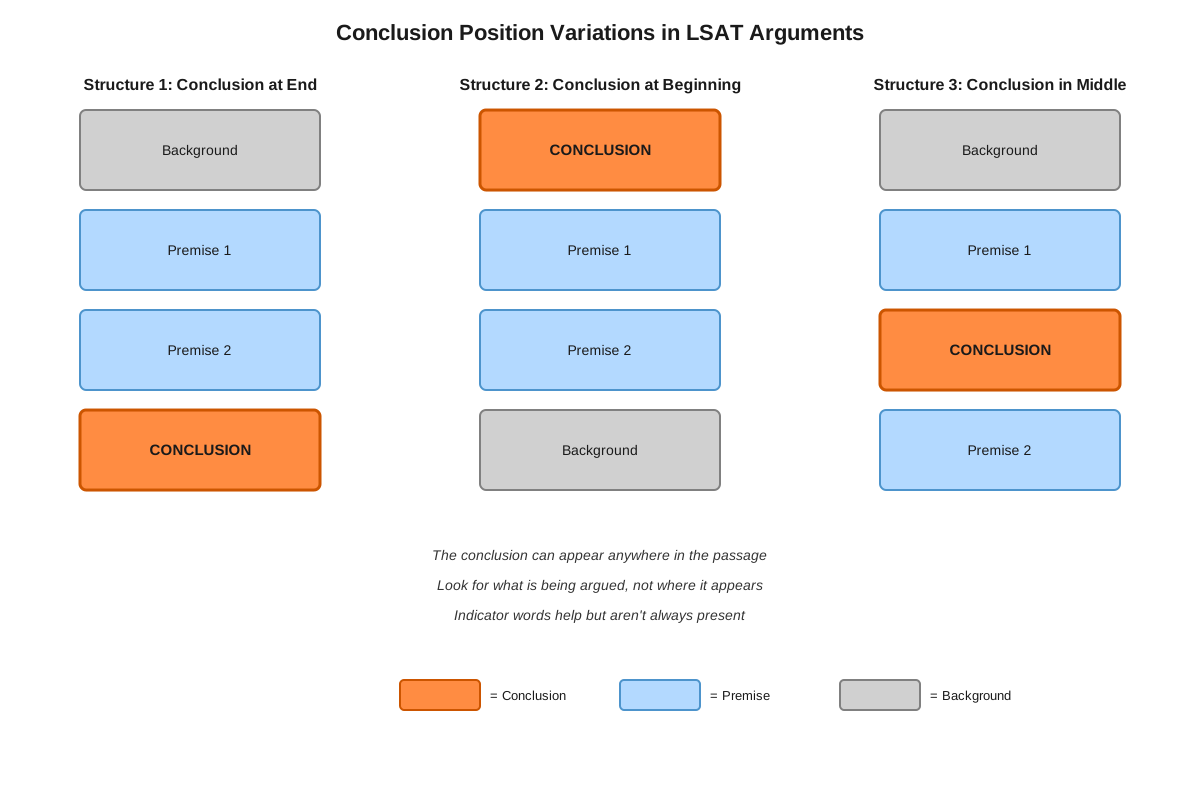
While many arguments place the conclusion at the end, the LSAT frequently violates this expectation. Conclusions can appear:
- At the beginning: "The policy will fail. Consumer behavior patterns show resistance to similar interventions, and the enforcement mechanism is inadequate." The first sentence is the conclusion; everything following provides support.
- In the middle: "Recent studies show increased pollution levels. The environmental regulations are therefore insufficient. Additional monitoring will be required to track the problem." The middle sentence is the main conclusion, supported by the first sentence and leading to a practical implication in the third.
- At the end (traditional): "The defendant had motive and opportunity. Forensic evidence places him at the scene. Therefore, he committed the crime." The final sentence is the conclusion.
- Implied but not stated: Some arguments present only premises, leaving the conclusion implicit. These are rare on the LSAT but appear occasionally in inference questions.
The "Why?" Test
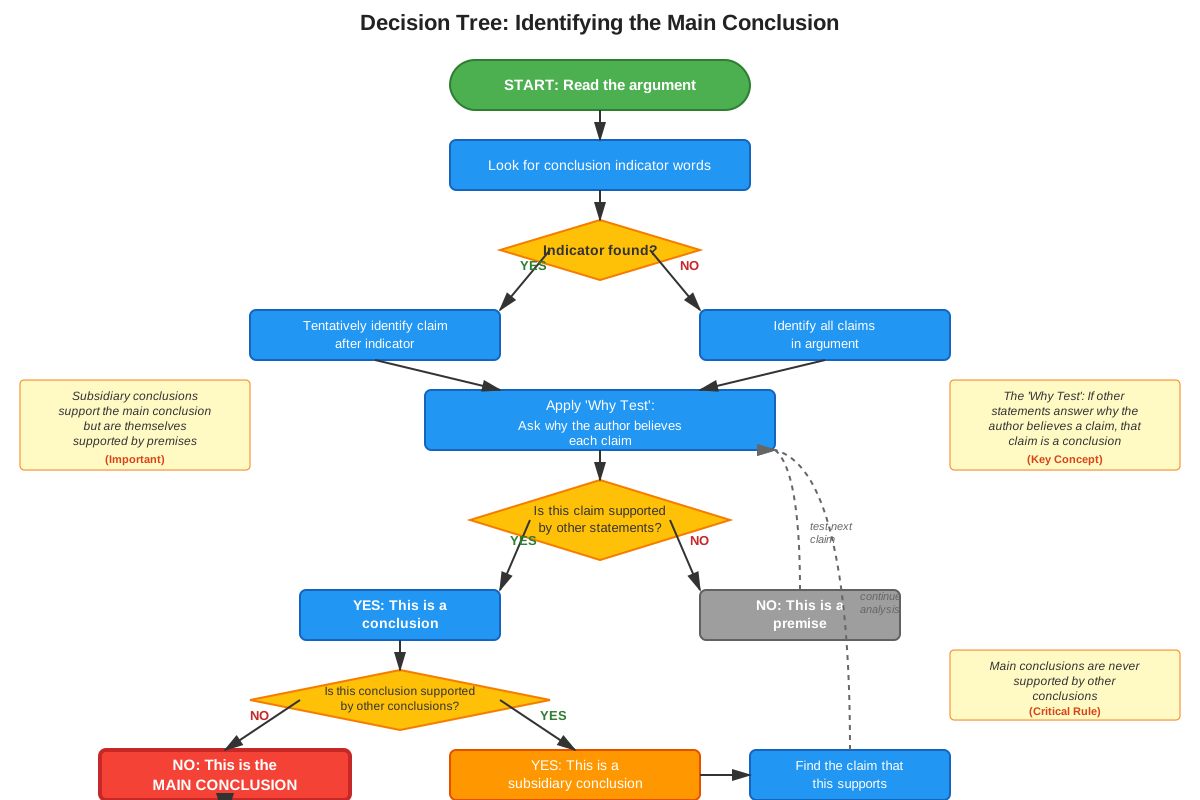
The most reliable method for identifying conclusions is the "Why?" test. The conclusion is the statement that the author would answer if asked "Why should I believe that?" The premises are the answers to that question. Apply this test systematically:
- Read a candidate conclusion and ask "Why should I believe this?"
- If the argument provides reasons, that statement is likely the conclusion
- If the statement itself provides reasons for something else, it's a premise
For example: "The bridge is structurally unsound because the inspection revealed significant corrosion in the support beams." Ask "Why should I believe the bridge is structurally unsound?" The argument answers: because of the corrosion. Therefore, "the bridge is structurally unsound" is the conclusion.
Main vs. Subsidiary Conclusions
Complex arguments contain multiple conclusions in a hierarchical structure. The main conclusion is the ultimate claim—the final destination of the reasoning. Subsidiary conclusions are intermediate stops that support the main conclusion while being supported by other premises.
Structure example:
- Premise 1: The medication reduces symptoms in 80% of patients
- Premise 2: The medication has minimal side effects
- Subsidiary Conclusion: The medication is effective (supported by Premises 1 and 2)
- Premise 3: Effective medications should be widely available
- Main Conclusion: The medication should be approved for general use (supported by the subsidiary conclusion and Premise 3)
On Main Point questions, wrong answer choices frequently present subsidiary conclusions. Test-takers must ask: "Is this the ultimate point, or does this support something else?"
Context and Background Information
Not every statement in an argument is either a premise or conclusion. Context and background information set the stage but don't directly support the conclusion. Consider: "The city has experienced rapid population growth over the past decade. Traffic congestion has increased dramatically. Therefore, the city should invest in public transportation." The first sentence provides context; the second is a premise; the third is the conclusion. Distinguishing context from premises prevents misidentifying the argument's structure.
Concept Relationships
The skill of identifying what is being argued serves as the foundation for all other argument fundamentals. Once the conclusion is identified, the premises become clear by elimination—everything offered in support of the conclusion is a premise. This identification enables the next critical skill: analyzing argument structure, which examines how premises relate to conclusions and to each other.
Conclusion identification directly enables assumption identification. An assumption is an unstated premise required for the conclusion to follow from the stated premises. Without knowing what conclusion the author is trying to establish, identifying what must be assumed becomes impossible. Similarly, strengthen and weaken questions ask what would make the conclusion more or less likely to be true—a question that presupposes accurate conclusion identification.
The relationship flows as follows:
Identifying the Conclusion → enables → Distinguishing Premises from Conclusions → enables → Mapping Argument Structure → enables → Identifying Assumptions → enables → Evaluating Argument Strength → enables → Answering All Question Types
This skill also connects to reading comprehension more broadly. The ability to identify main ideas in Reading Comprehension passages shares cognitive mechanisms with conclusion identification in Logical Reasoning. Both require distinguishing central claims from supporting details, recognizing hierarchical relationships between ideas, and avoiding distraction by interesting but peripheral information.
Quick check — test yourself on Identifying what is being argued so far.
Try Flashcards →High-Yield Facts
⭐ The conclusion is what the author is trying to prove, not what they use to prove it—this fundamental distinction separates conclusions from premises in every argument.
⭐ Conclusion indicator words (therefore, thus, hence, consequently, so) signal conclusions, but their absence doesn't mean there is no conclusion—many LSAT arguments omit indicators entirely.
⭐ The last sentence is NOT automatically the conclusion—the LSAT frequently places conclusions at the beginning or middle of arguments to test whether students rely on position rather than logical analysis.
⭐ Subsidiary conclusions function as both conclusions (supported by some premises) and premises (supporting the main conclusion)—distinguishing main from subsidiary conclusions is essential for Main Point questions.
⭐ The "Why?" test reliably identifies conclusions: the conclusion is the statement that the argument provides reasons to believe—if you ask "Why should I believe this?" and the argument answers, you've found the conclusion.
- Premise indicator words (because, since, for, given that) signal that what follows is evidence, not the conclusion—statements introduced by these words cannot be the main conclusion.
- Context and background information are neither premises nor conclusions—they set the stage but don't directly support the conclusion.
- Main Point questions explicitly ask for the conclusion, while most other question types implicitly require conclusion identification as the first analytical step.
- Wrong answer choices on Main Point questions frequently present premises, subsidiary conclusions, or paraphrases that distort the conclusion's scope or strength.
- The conclusion is often the most controversial or debatable claim in the argument—premises tend to be more factual or widely accepted statements offered as support.
- Emphatic or emotionally charged language can appear in premises rather than conclusions—the LSAT tests whether students mistake rhetorical emphasis for logical centrality.
- Some arguments present multiple independent conclusions rather than a hierarchical structure—these are rare but require recognizing that no single statement is the main point.
- The conclusion's scope (how broad or narrow the claim is) must match the premises' scope—overly broad or narrow answer choices misrepresent the conclusion.
- Implied conclusions require inference from the premises—these appear more commonly in Inference questions than Main Point questions.
- Recognizing the conclusion enables efficient reading—once identified, everything else can be categorized as either supporting the conclusion or providing context.
Common Misconceptions
Misconception: The last sentence is always the conclusion.
Correction: While many arguments place conclusions at the end, the LSAT frequently positions conclusions at the beginning or middle. Logical structure, not position, determines what is being argued. Always apply the "Why?" test rather than assuming positional conventions.
Misconception: The most emphatic or strongly worded statement is the conclusion.
Correction: Authors often use emphatic language in premises to make them more persuasive. The conclusion is determined by logical function (what is being supported) rather than rhetorical force. A calmly stated claim supported by emphatic premises is still the conclusion.
Misconception: Conclusion indicator words always introduce the main conclusion.
Correction: Indicator words sometimes introduce subsidiary conclusions rather than the main conclusion. Additionally, many arguments lack indicator words entirely. Indicators are helpful hints, not definitive markers.
Misconception: Every sentence is either a premise or a conclusion.
Correction: Arguments also contain context, background information, concessions, and rhetorical flourishes that serve neither function. Not every statement directly participates in the logical structure.
Misconception: If a statement is true or factual, it must be a premise rather than a conclusion.
Correction: Conclusions can be factual claims that the author is trying to establish as true. The distinction between premise and conclusion is functional (what supports what), not epistemological (what is true or false).
Misconception: Main Point questions are easy because they just ask for a summary.
Correction: Main Point questions test precise understanding of the conclusion's scope, strength, and content. Wrong answers often present accurate summaries of premises or subsidiary conclusions, requiring careful discrimination.
Misconception: The conclusion is always explicitly stated.
Correction: While most LSAT arguments state their conclusions explicitly, some (particularly in Inference questions) present only premises and ask what conclusion follows. Additionally, some conclusions are partially implied, requiring careful interpretation.
Worked Examples
Example 1: Conclusion at the Beginning
Argument: "The city's new parking policy will reduce traffic congestion. Studies from similar cities show that increasing parking fees by 50% reduces downtown vehicle traffic by 20%. The policy raises fees by 60%, exceeding the threshold shown to be effective. Additionally, the city has improved public transportation options, providing viable alternatives to driving."
Analysis:
Step 1: Identify candidate conclusions. The first sentence makes a predictive claim: "The city's new parking policy will reduce traffic congestion." The remaining sentences provide supporting information.
Step 2: Apply the "Why?" test. Why should we believe the policy will reduce congestion? Because studies show fee increases reduce traffic, because this policy exceeds the effective threshold, and because alternatives exist. The argument provides reasons to believe the first sentence.
Step 3: Check for conclusion indicators. No explicit indicators appear, demonstrating that positional analysis and logical structure matter more than indicator words.
Step 4: Distinguish from subsidiary conclusions. No intermediate conclusions appear here—all subsequent statements directly support the main claim.
Conclusion: "The city's new parking policy will reduce traffic congestion" is what is being argued. Everything else serves as premises supporting this prediction.
Connection to Learning Objectives: This example demonstrates how conclusions appear in non-standard positions (beginning rather than end) and how to apply the "Why?" test when indicator words are absent.
Example 2: Main vs. Subsidiary Conclusion
Argument: "Recent archaeological evidence shows that the ancient city was abandoned suddenly rather than gradually. Household items were left in place, and there is no evidence of the gradual decline in building maintenance that characterizes slow abandonment. This sudden abandonment was most likely caused by a natural disaster. Historical records from neighboring regions mention a severe earthquake during the relevant time period, and geological surveys confirm that the area is seismically active. Therefore, the earthquake hypothesis should be the focus of future research."
Analysis:
Step 1: Identify all conclusions. Three claims appear: (1) the city was abandoned suddenly, (2) the abandonment was caused by a natural disaster, and (3) future research should focus on the earthquake hypothesis.
Step 2: Determine the hierarchical structure.
- Claim 1 is supported by evidence about household items and lack of gradual decline
- Claim 2 is supported by Claim 1 (sudden abandonment suggests disaster)
- Claim 3 is supported by Claim 2 and additional evidence about earthquakes
Step 3: Identify the main conclusion. The argument exists to establish what researchers should do (focus on the earthquake hypothesis). Claims 1 and 2 are subsidiary conclusions that build toward this recommendation.
Step 4: Recognize the indicator word. "Therefore" introduces the final claim, signaling the main conclusion.
Conclusion: "The earthquake hypothesis should be the focus of future research" is the main conclusion. The other claims are subsidiary conclusions that support this ultimate recommendation.
Connection to Learning Objectives: This example illustrates the distinction between main and subsidiary conclusions, demonstrates how arguments build hierarchically, and shows how indicator words can help identify the main conclusion when multiple conclusions appear.
Exam Strategy
Systematic Approach to Conclusion Identification
When approaching any Logical Reasoning question, follow this process:
- Read the question stem first to determine if conclusion identification is explicitly required (Main Point questions) or implicitly necessary (most other types)
- Read the argument actively, marking conclusion indicators (therefore, thus, hence) and premise indicators (because, since, for) as you encounter them
- Apply the "Why?" test to candidate conclusions: ask "Why should I believe this?" and see if the argument provides answers
- Check positional assumptions: don't assume the last sentence is the conclusion; verify through logical analysis
- Distinguish main from subsidiary conclusions by asking whether a claim supports something else or represents the ultimate point
Trigger Words and Phrases
Watch for these patterns that signal conclusion identification is critical:
- Question stems containing "main point," "main conclusion," "primary purpose," or "most accurately expresses the conclusion"
- Question stems asking what the argument "attempts to establish" or "seeks to prove"
- Any question asking about assumptions, flaws, or strengthening/weakening (all require knowing the conclusion first)
Process of Elimination Tips
On Main Point questions, eliminate answer choices that:
- Present premises rather than conclusions (often introduced by "because" or "since" in the passage)
- State subsidiary conclusions rather than the main conclusion
- Overstate or understate the conclusion's strength (watch for "must," "proves," "definitely" vs. "suggests," "likely," "probably")
- Expand or narrow the conclusion's scope beyond what the argument actually claims
- Introduce concepts not mentioned in the conclusion (even if discussed in premises)
Time Allocation
Spend 10-15 seconds identifying the conclusion before attempting to answer any question. This upfront investment prevents the 30-60 seconds wasted when students realize mid-question that they've misidentified what is being argued. For Main Point questions specifically, spend 20-25 seconds on conclusion identification, as this is the entire task.
Common Traps to Avoid
The LSAT exploits predictable errors:
- Position trap: Placing the conclusion at the beginning when students expect it at the end
- Emphasis trap: Using strong language in premises while stating the conclusion mildly
- Subsidiary conclusion trap: Offering a subsidiary conclusion as a wrong answer on Main Point questions
- Scope trap: Presenting answer choices that are too broad or too narrow compared to the actual conclusion
- Paraphrase trap: Restating the conclusion using different words, testing whether students recognize conceptual equivalence
Memory Techniques
The WITS Acronym
Remember WITS for conclusion identification:
- Why? (Apply the "Why?" test—the conclusion is what the argument gives reasons to believe)
- Indicators (Look for "therefore," "thus," "hence," but don't rely on them exclusively)
- Test position (Don't assume the last sentence is the conclusion)
- Subsidiary vs. main (Distinguish intermediate conclusions from the ultimate point)
The Support Flow Visualization
Visualize arguments as rivers flowing toward the ocean:
- Tributaries = individual premises
- Rivers = subsidiary conclusions (fed by premises, flowing toward the main conclusion)
- Ocean = main conclusion (the ultimate destination)
Ask: "Where does all the support ultimately flow?" That destination is the main conclusion.
The "So What?" Chain
For complex arguments, create a "So What?" chain:
- Read a statement
- Ask "So what?" or "What does this support?"
- Follow the chain until you reach a statement that isn't used to support anything else
- That final statement is the main conclusion
The Indicator Word Song
Create a mental jingle for conclusion indicators: "Therefore, thus, and hence we go, consequently, so we know, it follows that we can conclude, this shows the point we've pursued."
Summary
Identifying what is being argued constitutes the foundational skill for LSAT Logical Reasoning success. The conclusion—what the author is trying to prove—must be distinguished from premises (supporting evidence), subsidiary conclusions (intermediate claims), and background information. While conclusion indicator words like "therefore," "thus," and "hence" provide helpful signals, the LSAT frequently omits these markers or uses them for subsidiary rather than main conclusions. The most reliable identification method is the "Why?" test: the conclusion is the statement that the argument provides reasons to believe. Conclusions can appear at the beginning, middle, or end of arguments, requiring logical analysis rather than positional assumptions. Main Point questions explicitly test this skill, while virtually all other Logical Reasoning question types implicitly require accurate conclusion identification as the first analytical step. Students must distinguish main conclusions from subsidiary conclusions, recognize that emphatic language can appear in premises rather than conclusions, and avoid assuming the last sentence is automatically the main point. Mastering this skill enables all subsequent argument analysis, including assumption identification, argument evaluation, and flaw recognition.
Key Takeaways
- The conclusion is what the author is trying to prove; premises are what they use to prove it—this functional distinction is fundamental to all argument analysis
- Apply the "Why?" test systematically: the conclusion is the statement that the argument provides reasons to believe
- Conclusion indicator words (therefore, thus, hence) help but are neither necessary nor sufficient for conclusion identification
- The LSAT frequently places conclusions at the beginning or middle of arguments, testing whether students analyze logical structure rather than relying on positional conventions
- Distinguish main conclusions (the ultimate point) from subsidiary conclusions (intermediate claims that support the main conclusion while being supported by premises)
- Main Point questions explicitly ask for the conclusion, but 90% of Logical Reasoning questions implicitly require conclusion identification as the first analytical step
- Wrong answer choices on Main Point questions commonly present premises, subsidiary conclusions, or distortions of the conclusion's scope or strength
Related Topics
Distinguishing Premises from Conclusions: Once the conclusion is identified, recognizing what serves as supporting evidence becomes straightforward. This topic deepens understanding of argument structure and prepares students for assumption questions.
Argument Structure and Diagramming: After mastering conclusion identification, students learn to map how premises relate to conclusions and to each other, including parallel support, chain reasoning, and complex hierarchical structures.
Assumption Questions: These questions ask what must be true for the conclusion to follow from the premises. Accurate conclusion identification is the prerequisite for recognizing logical gaps that assumptions must fill.
Strengthen and Weaken Questions: These question types ask what would make the conclusion more or less likely to be true. Without knowing what conclusion is being argued, evaluating what affects its likelihood becomes impossible.
Flaw Questions: Identifying reasoning errors requires first knowing what conclusion the author is trying to establish and what premises they offer in support. The flaw is the gap between premises and conclusion.
Practice CTA
Now that you understand how to identify what is being argued, it's time to apply this skill to actual LSAT questions. Complete the practice questions associated with this topic, focusing on systematically applying the "Why?" test and distinguishing main from subsidiary conclusions. Pay special attention to arguments where the conclusion appears in unexpected positions or lacks indicator words—these represent the LSAT's most challenging applications of this skill. Review the flashcards to reinforce conclusion and premise indicator words until recognition becomes automatic. Remember: every minute invested in mastering conclusion identification pays dividends across every Logical Reasoning question type. This is the foundation upon which all other skills are built—master it completely before progressing to more advanced topics.
Sign up free to keep reading
Create a free AnvayaPrep account to finish this LSAT guide on Identifying what is being argued — plus flashcards and practice questions.