Overview
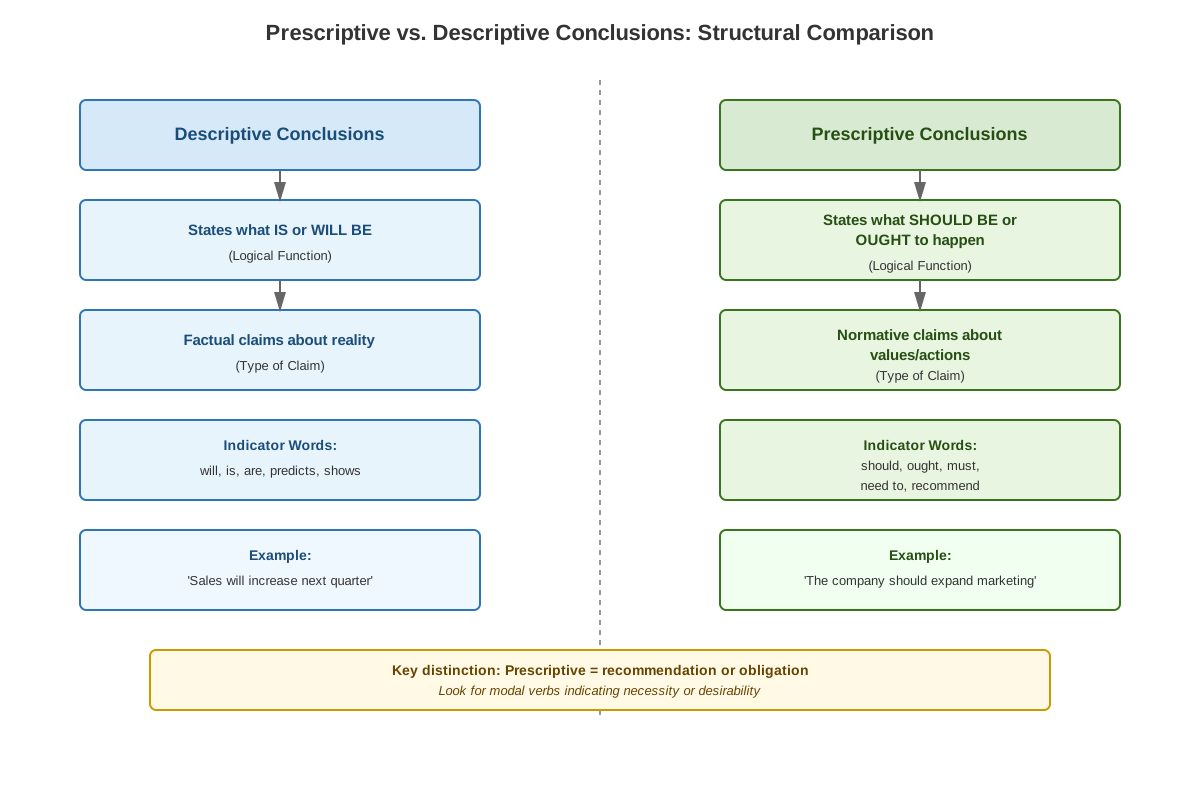
Prescriptive conclusions represent a critical category of argument structure that appears frequently throughout the LSAT Logical Reasoning sections. Unlike descriptive conclusions that merely state what is or what will be, prescriptive conclusions tell us what should be, what ought to happen, or what action someone must take. These conclusions contain normative claims—recommendations, obligations, advice, or value judgments about what is desirable or necessary. Understanding how to identify and evaluate prescriptive conclusions is fundamental to success on the LSAT, as they appear in approximately 15-20% of Logical Reasoning questions and require a distinct analytical approach.
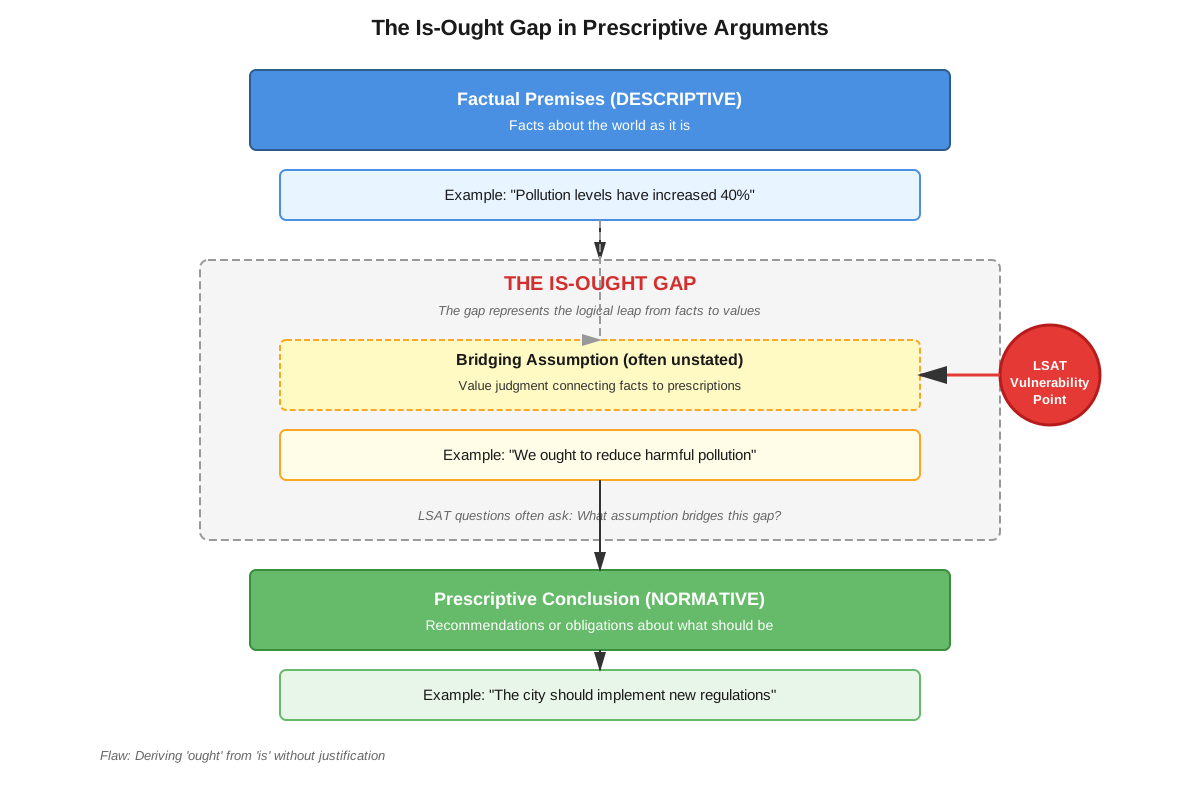
The significance of prescriptive conclusions extends beyond mere identification. These arguments introduce an additional logical layer because they bridge the gap between factual premises (what is) and normative conclusions (what should be). This creates unique vulnerabilities in reasoning that the LSAT frequently tests. For instance, an argument might present purely factual evidence about pollution levels but conclude that a city should implement new environmental regulations. The logical leap from facts to values, from description to prescription, represents a common pattern of reasoning that test-makers exploit to create challenging questions.
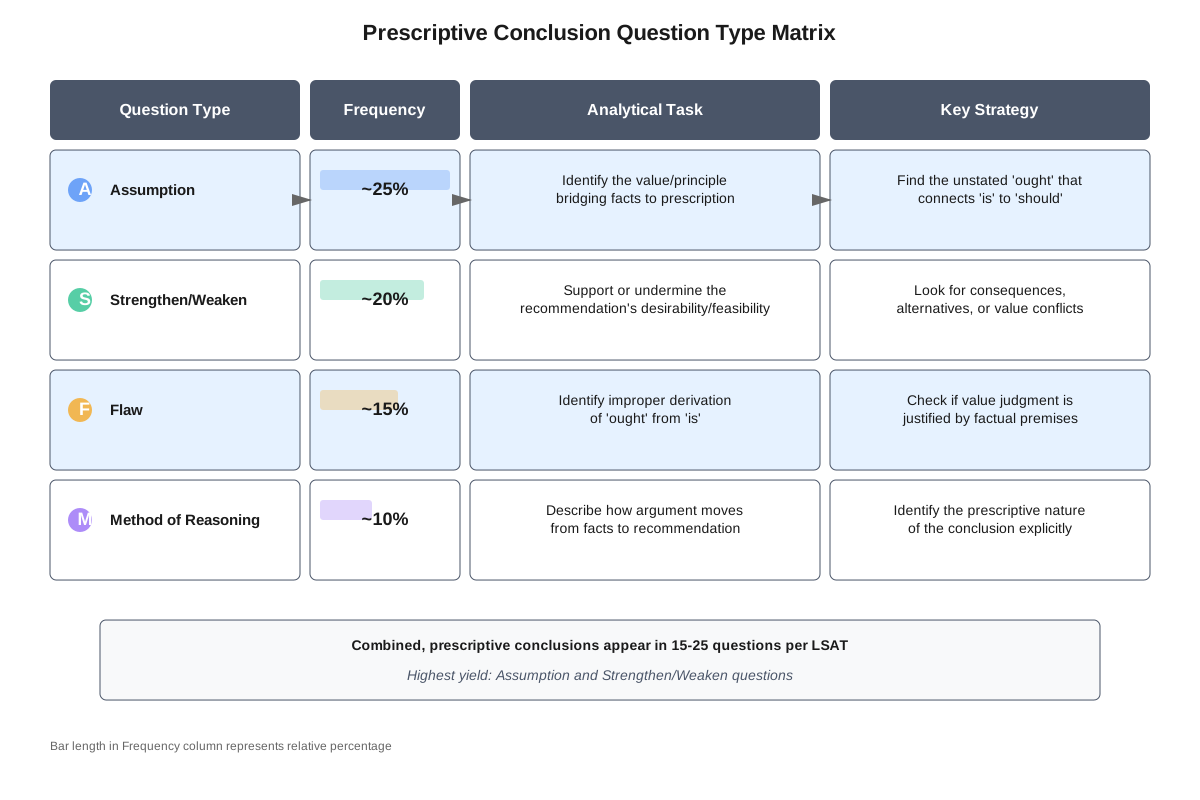
Within the broader framework of argument fundamentals in Logical Reasoning, prescriptive conclusions occupy a special position. They connect to assumption questions (what values or principles must be assumed?), strengthen/weaken questions (what evidence supports or undermines the recommendation?), and flaw questions (does the argument improperly derive an "ought" from an "is"?). Mastering prescriptive conclusions provides a foundation for understanding how arguments move from evidence to action, from observation to recommendation, and from analysis to advocacy—skills that permeate the entire LSAT.
Learning Objectives
- [ ] Identify how prescriptive conclusions appear in LSAT questions
- [ ] Explain the reasoning pattern behind prescriptive conclusions
- [ ] Apply prescriptive conclusions to solve LSAT-style problems accurately
- [ ] Distinguish prescriptive conclusions from descriptive conclusions in complex arguments
- [ ] Recognize the logical gap between factual premises and normative conclusions
- [ ] Evaluate the sufficiency of evidence supporting prescriptive claims
- [ ] Identify the implicit value judgments underlying prescriptive arguments
Prerequisites
- Basic argument structure: Understanding premises and conclusions is essential because prescriptive conclusions function as a specific type of conclusion that requires distinct analytical treatment.
- Indicator words: Familiarity with conclusion indicators ("therefore," "thus," "consequently") helps locate prescriptive claims within argument passages.
- Descriptive vs. normative statements: Recognizing the difference between statements of fact and statements of value provides the foundation for identifying prescriptive elements.
- Logical validity concepts: Understanding what makes an argument valid or invalid is necessary to evaluate whether factual premises adequately support prescriptive conclusions.
Why This Topic Matters
Prescriptive conclusions appear across multiple question types on the LSAT, making them one of the highest-yield topics in Logical Reasoning. They feature prominently in Assumption questions (approximately 25% of such questions), Strengthen/Weaken questions (roughly 20%), Flaw questions (about 15%), and Method of Reasoning questions. The ability to quickly identify a prescriptive conclusion and understand its logical requirements can save valuable time and improve accuracy across 15-25 questions on a typical LSAT.
In real-world contexts, prescriptive reasoning pervades legal, policy, and ethical discourse—precisely the domains law students and attorneys navigate daily. Legal arguments frequently move from factual findings to recommendations about what courts should decide, what laws should be enacted, or what actions parties must take. Understanding prescriptive conclusions develops the analytical skills necessary for legal practice, where distinguishing between what the law is and what it should be represents a fundamental competency.
On the LSAT, prescriptive conclusions typically appear in arguments about policy recommendations, ethical obligations, business decisions, personal advice, and institutional reforms. Common scenarios include: arguments concluding that a government should adopt a particular policy, that individuals ought to change their behavior, that companies must implement new practices, or that institutions should prioritize certain values. The test-makers favor these arguments because they create natural opportunities to test whether students can identify the logical gap between factual evidence and normative recommendations.
Core Concepts
Defining Prescriptive Conclusions
A prescriptive conclusion is a statement that expresses what should be done, what ought to happen, or what action is recommended, required, or advisable. These conclusions contain normative language that goes beyond merely describing reality to advocating for a particular course of action or expressing a value judgment. The defining characteristic is the presence of normative force—the conclusion doesn't just predict or describe; it prescribes, recommends, or obligates.
Prescriptive conclusions typically contain modal verbs and normative terms such as "should," "ought to," "must," "need to," "it is necessary that," "it is advisable to," "it would be better to," or "the right course of action is." However, prescriptive force can also be conveyed through imperative constructions ("Implement the policy immediately") or through evaluative language ("The best approach is to...").
The Is-Ought Gap
The philosophical foundation underlying LSAT prescriptive conclusions involves what philosophers call the "is-ought problem" or "is-ought gap." This concept, articulated by David Hume, recognizes that statements about what is (descriptive facts) do not automatically entail statements about what ought to be (prescriptive recommendations). This logical gap creates the primary vulnerability in arguments with prescriptive conclusions.
Consider this structure:
- Premise: Pollution levels have increased 30% in the city (descriptive fact)
- Conclusion: The city should implement stricter emissions standards (prescriptive recommendation)
The logical gap here is evident: even if we accept the factual premise, the prescriptive conclusion requires additional assumptions about values, priorities, and consequences. Perhaps pollution is bad, perhaps reducing it is worth the cost, perhaps emissions standards are an effective solution—but none of these value judgments or causal claims appear explicitly in the premise.
Components of Prescriptive Arguments
Prescriptive arguments on the LSAT typically contain three elements:
- Factual premises: Descriptive statements about the current situation, evidence, data, or circumstances
- Implicit value assumptions: Unstated beliefs about what is good, bad, important, or desirable
- Prescriptive conclusion: The recommendation, obligation, or advised course of action
The LSAT tests whether students recognize that element #2 (the value assumption) is necessary to bridge the gap between #1 and #3. Strong test-takers automatically ask: "What value judgment or principle must be true for this recommendation to follow from these facts?"
Types of Prescriptive Language
| Prescriptive Type | Example Language | Strength of Obligation |
|---|---|---|
| Strong obligation | "must," "is required to," "is obligated to" | Highest—indicates necessity |
| Moderate recommendation | "should," "ought to," "it is advisable to" | Medium—indicates strong preference |
| Weak suggestion | "could," "might consider," "it would be beneficial to" | Lower—indicates option worth considering |
| Comparative prescription | "better to," "preferable to," "more important to" | Variable—depends on context |
| Imperative | "Implement," "Adopt," "Choose" | High—direct command form |
Understanding these gradations helps identify the strength of the prescriptive claim and evaluate whether the evidence provided is sufficient to support that level of obligation or recommendation.
Common Prescriptive Patterns on the LSAT
Several recurring patterns characterize prescriptive arguments in Logical Reasoning:
Pattern 1: Problem-Solution Arguments
- Premises establish that a problem exists
- Conclusion prescribes a specific solution
- Gap: Why is this solution appropriate, effective, or preferable to alternatives?
Pattern 2: Goal-Means Arguments
- Premises establish a desired goal or outcome
- Conclusion prescribes a means to achieve that goal
- Gap: Will the prescribed means actually achieve the goal? Are there better alternatives?
Pattern 3: Evidence-Policy Arguments
- Premises present research findings or empirical evidence
- Conclusion recommends a policy based on that evidence
- Gap: Do the values implicit in the policy align with accepted priorities? Are there countervailing considerations?
Pattern 4: Comparative Evaluation Arguments
- Premises compare two or more options
- Conclusion prescribes choosing one option over others
- Gap: Are the comparison criteria appropriate? Have all relevant factors been considered?
Evaluating Prescriptive Arguments
When evaluating arguments with prescriptive conclusions, consider these critical questions:
- Value alignment: Does the conclusion assume values or priorities not established in the premises?
- Causal efficacy: Does the recommended action actually produce the desired outcome?
- Feasibility: Is the prescribed action practically possible given constraints?
- Comparative analysis: Are alternative courses of action adequately considered?
- Side effects: Does the argument account for potential negative consequences?
- Scope matching: Do the premises support the full scope of the prescriptive claim?
These evaluation criteria appear repeatedly in Strengthen, Weaken, and Assumption questions involving prescriptive conclusions.
Concept Relationships
The concept of prescriptive conclusions connects intimately with several other argument fundamentals. At the most basic level, prescriptive conclusions represent a specific type of conclusion, so understanding general conclusion identification skills is prerequisite. The relationship flows: General Conclusion Identification → Distinguishing Conclusion Types → Recognizing Prescriptive Conclusions.
Prescriptive conclusions have a special relationship with assumptions. Every prescriptive argument contains at least one value assumption—an unstated belief about what is good, important, or desirable. This creates the relationship: Prescriptive Conclusion → Requires Value Assumption → Tested in Assumption Questions. Understanding prescriptive conclusions therefore directly enables success on assumption questions.
The is-ought gap concept connects prescriptive conclusions to flaw identification. One common flaw pattern is "deriving an ought from an is without justification," which specifically targets prescriptive reasoning. The relationship is: Prescriptive Conclusion + Insufficient Value Justification → Logical Flaw → Flaw Question Answer.
Within the topic itself, concepts build hierarchically: Identifying Prescriptive Language → Understanding the Is-Ought Gap → Recognizing Implicit Value Assumptions → Evaluating Argument Strength → Applying to Question Types. Each level depends on mastery of the previous level, creating a clear learning progression.
High-Yield Facts
⭐ Prescriptive conclusions contain normative language indicating what should be done, not merely what is or will be the case.
⭐ The most common prescriptive indicators are "should," "ought to," "must," "need to," and "it is necessary that."
⭐ Every prescriptive argument contains an implicit value assumption bridging factual premises and normative conclusions.
⭐ The is-ought gap represents the logical space between descriptive facts and prescriptive recommendations that must be filled by value judgments.
⭐ Prescriptive conclusions appear in approximately 15-20% of Logical Reasoning questions across multiple question types.
- Prescriptive arguments are particularly vulnerable to alternative solution objections—other ways to achieve the same goal.
- Comparative prescriptive claims ("X is better than Y") require assumptions about the criteria for comparison.
- Imperative statements ("Implement the policy") function as prescriptive conclusions even without explicit "should" language.
- Prescriptive conclusions can be conditional ("If the goal is X, then we should do Y") or unconditional ("We should do Y").
- The strength of prescriptive language (must vs. should vs. could) affects what evidence is sufficient to support the conclusion.
- Prescriptive arguments often fail to consider feasibility constraints, making "practical impossibility" a common weakening strategy.
- Value assumptions in prescriptive arguments often involve prioritizing one goal over competing goals.
Quick check — test yourself on Prescriptive conclusions so far.
Try Flashcards →Common Misconceptions
Misconception: All conclusions containing "should" are prescriptive conclusions.
Correction: While "should" typically indicates a prescriptive conclusion, context matters. "The package should arrive tomorrow" is a prediction (descriptive), not a recommendation (prescriptive). True prescriptive conclusions recommend actions or express obligations, not merely predictions about what will likely occur.
Misconception: Prescriptive conclusions are always explicitly stated with normative language.
Correction: Prescriptive force can be conveyed through imperative constructions ("Choose option A"), evaluative comparisons ("The best approach is X"), or contextual implication. The key is whether the conclusion advocates for an action or expresses what ought to be done, regardless of the specific wording.
Misconception: If factual premises are true, a prescriptive conclusion automatically follows.
Correction: This misconception ignores the is-ought gap. Factual premises alone never entail prescriptive conclusions without additional value assumptions. Even overwhelming factual evidence requires normative principles to generate prescriptive recommendations.
Misconception: Prescriptive arguments are inherently weaker than descriptive arguments.
Correction: Prescriptive arguments are not inherently weak; they simply require different types of support. A prescriptive argument with explicit value premises and strong causal evidence can be just as sound as a descriptive argument. The LSAT tests whether students recognize what type of support prescriptive conclusions need.
Misconception: Identifying a prescriptive conclusion is sufficient for answering LSAT questions.
Correction: Identification is only the first step. Success requires understanding the specific logical requirements of prescriptive reasoning—particularly the value assumptions and causal claims necessary to support the recommendation. The LSAT tests analytical depth, not mere recognition.
Misconception: All prescriptive conclusions involve policy recommendations or large-scale decisions.
Correction: Prescriptive conclusions can involve personal advice ("You should see a doctor"), individual choices ("Sarah ought to accept the job offer"), or small-scale recommendations ("The restaurant should add more vegetarian options"). The scale of the recommendation doesn't determine whether a conclusion is prescriptive.
Worked Examples
Example 1: Assumption Question with Prescriptive Conclusion
Argument: "Studies show that employees who work from home are 15% more productive than those who work in offices. Additionally, remote work reduces overhead costs for companies by eliminating the need for large office spaces. Therefore, companies should transition to fully remote work arrangements."
Question: Which of the following is an assumption required by the argument?
Analysis:
Step 1: Identify the conclusion type
The conclusion "companies should transition to fully remote work arrangements" is clearly prescriptive—it recommends an action companies ought to take.
Step 2: Identify the premises
- Premise 1: Remote employees are 15% more productive (factual claim)
- Premise 2: Remote work reduces overhead costs (factual claim)
Step 3: Identify the is-ought gap
The premises present factual benefits (productivity, cost savings), but the conclusion prescribes what companies should do. What value assumption bridges this gap?
Step 4: Determine necessary assumptions
For this prescriptive conclusion to follow, the argument must assume:
- Productivity and cost savings are sufficiently important to companies to justify the transition
- There are no countervailing disadvantages that outweigh these benefits
- Full remote work is feasible for the companies in question
- The benefits observed in studies will translate to the recommended policy
Step 5: Evaluate answer choices
The correct answer would likely state something like: "The benefits of increased productivity and reduced costs outweigh any potential disadvantages of remote work arrangements." This assumption is necessary because without it, the factual benefits don't justify the prescriptive recommendation.
Key Takeaway: Prescriptive conclusions in Assumption questions always require value assumptions that establish why the factual premises justify the recommended action.
Example 2: Flaw Question with Prescriptive Conclusion
Argument: "Archaeological evidence indicates that ancient civilizations that developed writing systems experienced more rapid technological advancement than those that did not. Modern developing nations seeking to accelerate their economic growth should therefore prioritize literacy programs above all other educational initiatives."
Question: The reasoning in the argument is flawed in that it:
Analysis:
Step 1: Identify the conclusion
"Modern developing nations... should therefore prioritize literacy programs above all other educational initiatives" is a strong prescriptive conclusion (note "should" and "above all other").
Step 2: Map the reasoning
- Premise: Ancient civilizations with writing → rapid technological advancement (historical correlation)
- Conclusion: Modern nations should prioritize literacy programs (prescriptive recommendation)
Step 3: Identify logical gaps
Multiple problems exist:
- Temporal/contextual gap: Ancient civilizations ≠ modern nations (different contexts)
- Causal assumption: Correlation between writing and advancement doesn't prove writing caused advancement
- Comparative prescription: "Above all other" is extreme—requires showing literacy is more important than every alternative
- Value assumption: Assumes technological advancement (ancient context) = economic growth (modern context)
Step 4: Identify the primary flaw
The most significant flaw is deriving a strong prescriptive conclusion ("should prioritize above all other") from limited historical evidence without establishing that: (a) the historical pattern applies to modern contexts, (b) literacy programs would produce similar effects today, and (c) no other educational initiatives could be equally or more effective.
Step 5: Select the answer
The correct answer would likely state: "takes evidence of a correlation in one context as sufficient basis for a strong recommendation in a different context" or "fails to consider that factors other than literacy programs might be equally or more effective in promoting economic growth."
Key Takeaway: Prescriptive conclusions with strong language ("above all other," "must," "only") require proportionally strong evidence. Flaws often involve insufficient evidence for the strength of the prescription or failure to consider alternatives.
Exam Strategy
Identification Strategy
When reading LSAT arguments, immediately flag prescriptive conclusions by scanning for normative language. Train your eye to catch "should," "ought," "must," "need to," "advisable," and "better to." Circle or mentally note these indicators, as they signal that the argument will require value assumptions and that certain question types become more likely.
Exam Tip: If you identify a prescriptive conclusion, immediately ask yourself: "What value or principle must be true for this recommendation to follow from these facts?" This question prepares you for Assumption, Strengthen, Weaken, and Flaw questions.
Question Type Strategies
For Assumption Questions: The correct answer to a prescriptive argument will often state a value principle or establish that the recommended action actually achieves a desired goal. Use the negation test: if you negate the answer choice, does the argument fall apart? For prescriptive conclusions, negating value assumptions typically destroys the argument.
For Strengthen Questions: Look for answer choices that:
- Provide evidence the recommended action achieves its intended goal
- Establish that the values implicit in the recommendation are appropriate
- Show that alternative courses of action are inferior
- Demonstrate feasibility of the prescription
For Weaken Questions: Look for answer choices that:
- Show the recommended action won't achieve its goal or has negative side effects
- Present superior alternative solutions
- Demonstrate practical impossibility or excessive cost
- Challenge the value priorities implicit in the recommendation
For Flaw Questions: Common flaws in prescriptive arguments include:
- Deriving "ought" from "is" without value justification
- Assuming a course of action will achieve its goal without evidence
- Failing to consider alternatives
- Making recommendations too strong for the evidence provided
Time Management
Prescriptive conclusions often appear in more complex arguments because they involve an additional logical layer (the is-ought gap). Budget slightly more time for these questions—approximately 1:30 to 1:45 rather than the standard 1:20. However, if you've practiced identifying the value gap quickly, you can often eliminate wrong answers rapidly because they fail to address the normative dimension of the argument.
Process of Elimination
When eliminating answer choices for prescriptive arguments:
- Eliminate answers that address only factual matters without touching on values, goals, or principles
- Eliminate answers that address the wrong prescriptive element (e.g., a different recommendation than the one in the conclusion)
- For Assumption questions, eliminate answers that, when negated, leave the argument intact
- For Strengthen/Weaken questions, eliminate answers that don't affect whether the recommended action is advisable
Memory Techniques
The "SHOULD" Mnemonic for analyzing prescriptive conclusions:
- Search for normative language (should, ought, must)
- Highlight the is-ought gap
- Outline implicit value assumptions
- Uncover alternative solutions not considered
- Link premises to conclusion via values
- Determine if evidence matches prescription strength
Visualization Strategy: Picture prescriptive arguments as bridges. The factual premises are one side of a river (the "is" side), and the prescriptive conclusion is the other side (the "ought" side). The value assumptions are the bridge supports that must be in place for the bridge to hold. If the supports (value assumptions) are missing or weak, the bridge collapses.
The "Three Questions" Technique: For any prescriptive conclusion, automatically ask:
- What should be done? (Identify the prescription)
- Why should it be done? (Identify the goal or value)
- Will it work? (Identify the causal assumption)
These three questions capture the essential logical requirements of prescriptive reasoning and prepare you for most question types.
Acronym for Common Prescriptive Indicators: SOMAN
- Should
- Ought to
- Must
- Advisable to
- Necessary that
Summary
Prescriptive conclusions represent a high-yield category of argument structure on the LSAT, appearing across multiple Logical Reasoning question types. These conclusions express what should be done, what ought to happen, or what action is recommended, distinguishing them from descriptive conclusions that merely state facts or predictions. The critical analytical challenge with prescriptive conclusions involves recognizing the is-ought gap—the logical space between factual premises and normative recommendations that must be bridged by value assumptions. Every prescriptive argument implicitly assumes certain values, priorities, or principles that justify moving from descriptive evidence to prescriptive recommendations. Success on LSAT questions involving prescriptive conclusions requires identifying these implicit assumptions, evaluating whether the evidence supports the strength of the prescription, considering alternative courses of action, and assessing whether the recommended action will achieve its intended goal. The most common prescriptive indicators include "should," "ought to," "must," and "need to," though prescriptive force can also be conveyed through imperative constructions or evaluative language. Mastering prescriptive conclusions provides a foundation for success on Assumption, Strengthen, Weaken, and Flaw questions, making this topic essential for achieving a high LSAT score.
Key Takeaways
- Prescriptive conclusions recommend actions or express obligations using normative language like "should," "ought," or "must," distinguishing them from descriptive conclusions about facts or predictions.
- The is-ought gap represents the logical space between factual premises and prescriptive conclusions that must be filled by value assumptions—unstated beliefs about what is good, important, or desirable.
- Every prescriptive argument requires at least one value assumption to bridge from descriptive evidence to normative recommendations, making these assumptions prime targets for LSAT questions.
- Prescriptive conclusions appear in 15-20% of Logical Reasoning questions across Assumption, Strengthen, Weaken, Flaw, and Method of Reasoning question types.
- Strong prescriptive language ("must," "above all other") requires proportionally stronger evidence than weak prescriptive language ("could," "might consider").
- Common vulnerabilities in prescriptive arguments include failure to consider alternatives, insufficient evidence that the recommended action achieves its goal, and unjustified value assumptions.
- Quickly identifying prescriptive conclusions and automatically asking "What value assumption bridges the is-ought gap?" dramatically improves speed and accuracy on LSAT Logical Reasoning questions.
Related Topics
Sufficient and Necessary Assumptions: Understanding prescriptive conclusions enables deeper analysis of assumption questions, particularly recognizing that value assumptions are often necessary assumptions in prescriptive arguments. Mastering prescriptive reasoning provides the foundation for distinguishing between assumptions that guarantee the conclusion (sufficient) and those merely required for it (necessary).
Strengthen and Weaken Questions: Prescriptive conclusions create specific vulnerabilities that strengthen and weaken answer choices exploit. Further study of these question types builds on prescriptive reasoning by exploring how evidence about feasibility, effectiveness, and alternatives affects prescriptive arguments.
Flaw Questions: Many common logical flaws specifically target prescriptive reasoning, including "deriving ought from is," "failing to consider alternatives," and "assuming a plan will achieve its goal." Mastering prescriptive conclusions enables recognition of these flaw patterns.
Principle Questions: Principle questions often involve identifying or applying normative principles that justify prescriptive conclusions. Understanding prescriptive reasoning provides the foundation for recognizing how general principles support specific recommendations.
Practice CTA
Now that you understand prescriptive conclusions and their logical requirements, you're ready to apply this knowledge to practice questions. The concepts covered here—identifying prescriptive language, recognizing the is-ought gap, and uncovering value assumptions—will appear repeatedly throughout your LSAT preparation. Challenge yourself with the practice questions and flashcards to reinforce these skills. Remember: recognizing a prescriptive conclusion is just the beginning; the real analytical work involves understanding what logical support these conclusions require. Each practice question you complete strengthens your ability to quickly identify prescriptive patterns and apply the right analytical framework. You're building essential skills that will serve you not only on test day but throughout your legal education and career. Start practicing now to transform these concepts into automatic analytical reflexes.
Sign up free to keep reading
Create a free AnvayaPrep account to finish this LSAT guide on Prescriptive conclusions — plus flashcards and practice questions.