Overview
Recognizing subtle conclusions is a foundational skill in LSAT Logical Reasoning that separates high scorers from average performers. While many test-takers can identify obvious conclusions marked by indicator words like "therefore" or "thus," the LSAT frequently embeds conclusions in unexpected positions within arguments—at the beginning, middle, or even disguised as background information. This skill requires students to distinguish between premises (evidence) and conclusions (claims supported by evidence) even when the argument structure deliberately obscures this relationship. Mastering this ability is essential because correctly identifying the conclusion is the first step in analyzing argument structure, evaluating reasoning quality, and selecting correct answers across multiple question types.
The importance of this topic extends beyond simple identification exercises. Argument fundamentals form the bedrock of LSAT success, and recognizing conclusions—especially subtle ones—enables students to tackle Main Point questions, Strengthen/Weaken questions, Assumption questions, and Flaw questions with confidence. When conclusions are presented without traditional indicator words, or when they appear before their supporting premises, students must rely on deeper logical analysis rather than surface-level pattern recognition. This analytical depth is precisely what the LSAT tests and what law schools value in prospective students.
Within the broader landscape of Logical Reasoning, recognizing subtle conclusions connects directly to understanding argument structure, identifying assumptions, and evaluating logical validity. Once students can reliably identify what an argument is trying to prove (the conclusion), they can then assess how well the evidence supports that claim, what unstated assumptions bridge the gap between premises and conclusion, and where logical vulnerabilities exist. This topic serves as the gateway skill that unlocks more advanced analytical techniques tested throughout the LSAT.
Learning Objectives
- [ ] Identify how recognizing subtle conclusions appears in LSAT questions
- [ ] Explain the reasoning pattern behind recognizing subtle conclusions
- [ ] Apply recognizing subtle conclusions to solve LSAT-style problems accurately
- [ ] Distinguish between conclusions and premises when no indicator words are present
- [ ] Recognize conclusions that appear at the beginning or middle of arguments
- [ ] Differentiate between main conclusions and subsidiary conclusions in complex arguments
- [ ] Identify when background information is being mistaken for a conclusion
Prerequisites
- Basic understanding of argument structure: Students must know that arguments consist of premises (evidence) and conclusions (claims); this forms the foundation for distinguishing between these components when they're not clearly marked.
- Familiarity with standard conclusion indicators: Recognizing words like "therefore," "thus," "hence," and "consequently" provides a baseline from which to understand what makes certain conclusions "subtle."
- Ability to identify premise indicators: Understanding markers like "because," "since," and "given that" helps students recognize what is NOT the conclusion, narrowing down possibilities.
- Reading comprehension at college level: The ability to parse complex sentences and understand logical relationships between ideas is essential for detecting subtle argumentative structures.
Why This Topic Matters
In real-world legal practice, attorneys must identify the central claims in opposing arguments, judicial opinions, and statutory language—often when those claims are deliberately obscured or embedded within complex reasoning. The ability to recognize subtle conclusions translates directly to reading case law, analyzing contracts, and constructing persuasive arguments where the thesis may need to be inferred from context rather than explicitly stated.
On the LSAT, recognizing subtle conclusions appears with remarkable frequency across multiple question types. Approximately 15-20% of Logical Reasoning questions are Main Point questions that directly test this skill, but the ability impacts performance on nearly every question type. Strengthen/Weaken questions require identifying what claim needs support or attack. Assumption questions demand understanding what the argument is trying to prove before finding the logical gap. Flaw questions necessitate recognizing the conclusion to evaluate whether the reasoning adequately supports it. Even Parallel Reasoning questions require matching argument structures, which begins with identifying conclusions.
This topic commonly appears in LSAT passages through several patterns: arguments that begin with their conclusion before presenting evidence; arguments where the conclusion appears mid-passage surrounded by premises; arguments containing multiple claims where only one is the main conclusion while others serve as intermediate conclusions or premises; and arguments that present the conclusion as though it were an established fact or background information. The test writers deliberately craft these structures to challenge students who rely solely on indicator words rather than logical analysis.
Core Concepts
The Nature of Conclusions in Arguments
A conclusion is the claim that an argument is attempting to establish or prove. It represents the author's main point—the statement that all other information in the argument is designed to support. Unlike premises, which provide evidence or reasons, the conclusion is what the argument is arguing FOR. The fundamental test for identifying a conclusion is asking: "What is this argument trying to convince me of?" or "What claim is being supported by the other statements?"
In subtle conclusion scenarios, the LSAT removes or minimizes the linguistic cues that typically signal conclusions. Instead of relying on indicator words, students must analyze the logical relationships between statements. The conclusion is the statement that is SUPPORTED by others, not the statement that SUPPORTS others. This relationship remains constant regardless of where the conclusion appears in the passage or how it's phrased.
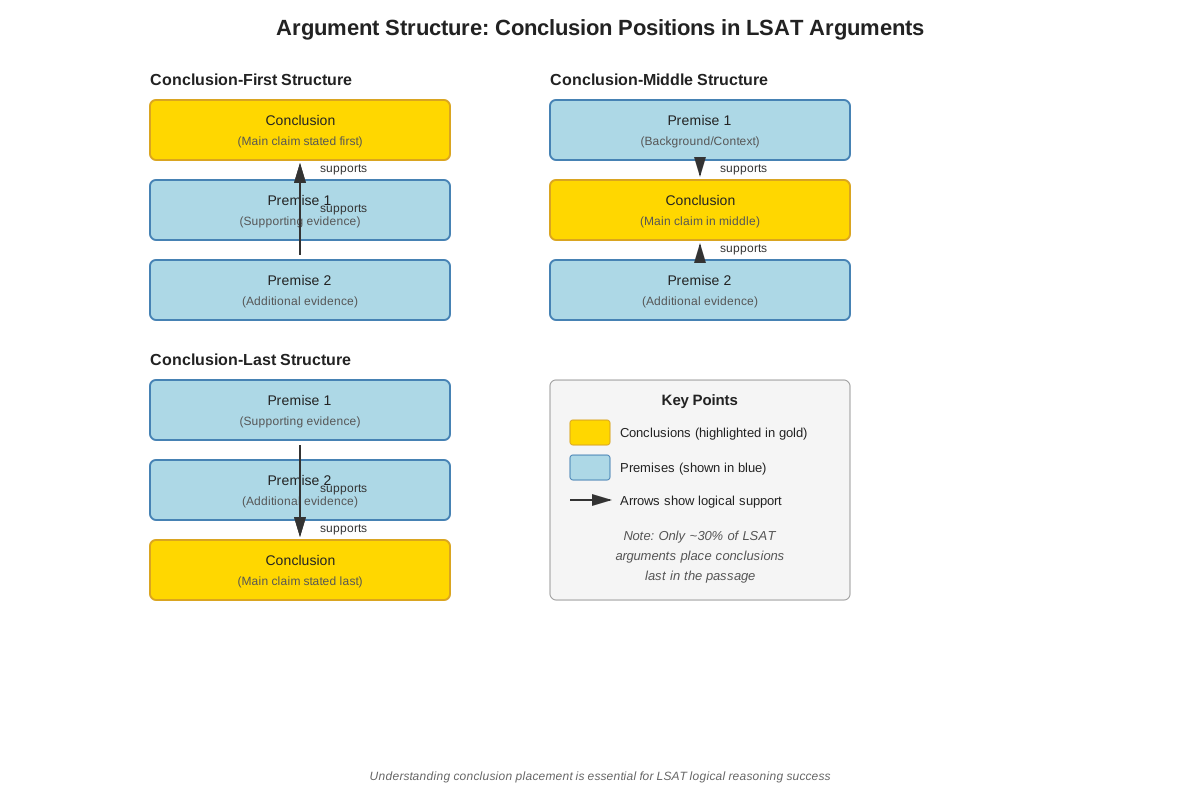
Positional Variations of Conclusions
Standard position (conclusion-last): The most familiar structure places the conclusion at the end, following all premises. Example: "The museum's attendance has increased by 40% since the new exhibit opened. Visitor surveys show high satisfaction ratings. Therefore, the new exhibit has been successful." This structure feels natural because it mirrors how we often present arguments in conversation.
Inverted position (conclusion-first): Arguments frequently begin with the conclusion, then provide supporting evidence. Example: "The new exhibit has been successful. The museum's attendance has increased by 40% since it opened, and visitor surveys show high satisfaction ratings." This structure is equally valid but requires students to recognize that the first statement is being supported by what follows, not supporting what follows.
Embedded position (conclusion-middle): The most challenging structure places the conclusion between premises. Example: "The museum's attendance has increased by 40% since the new exhibit opened. This demonstrates the exhibit's success. Visitor surveys consistently show high satisfaction ratings, and social media mentions have tripled." Here, the conclusion appears as the second statement, with premises both before and after it.
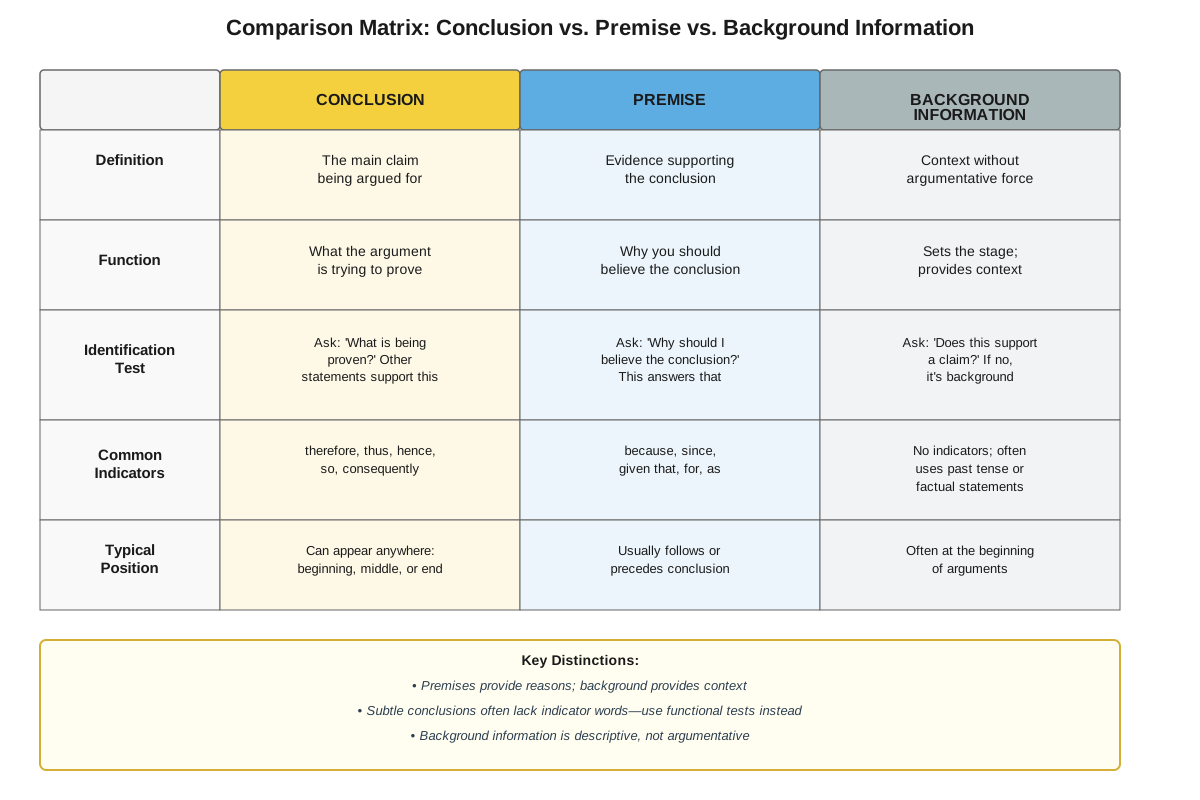
Distinguishing Conclusions from Other Statement Types
| Statement Type | Function | Relationship to Conclusion | Example Indicators |
|---|---|---|---|
| Main Conclusion | Primary claim being argued | Supported by all premises | "therefore," "thus," "consequently" |
| Subsidiary Conclusion | Intermediate claim | Supports main conclusion; supported by some premises | "which means," "which shows" |
| Premise | Evidence/reason | Supports conclusion | "because," "since," "given that" |
| Background Information | Context | Neither supports nor is supported | "historically," "in general" |
| Counterpoint | Opposing view | Acknowledged then refuted | "some argue," "critics claim" |
The "Why?" Test for Identifying Conclusions
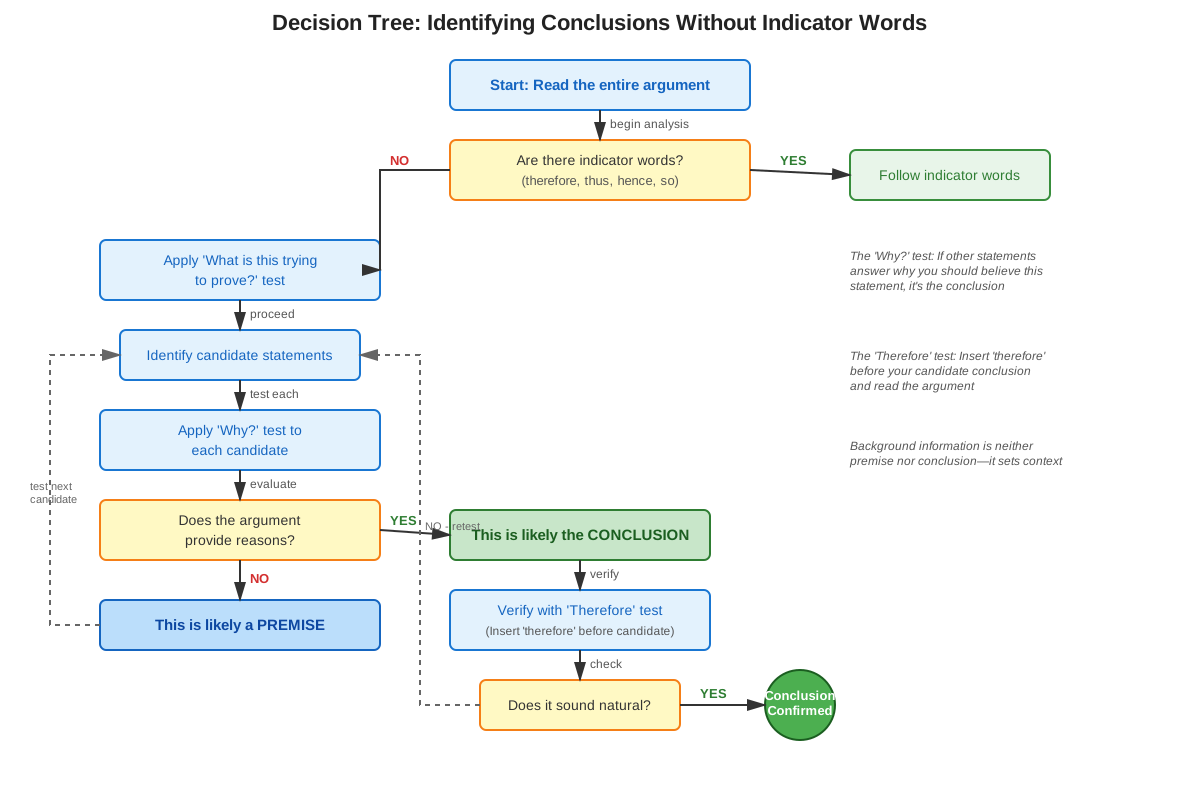
One of the most reliable techniques for recognizing subtle conclusions involves the "why?" test. When examining a statement, ask "Why should I believe this?" If the passage provides reasons, that statement is likely the conclusion. Conversely, if a statement answers the question "Why?" about another statement, it's functioning as a premise.
Consider: "Electric vehicles will dominate the market within a decade. Battery technology has improved dramatically, and governments worldwide are implementing combustion engine bans." Asking "Why will electric vehicles dominate?" yields the answer: because of battery improvements and government bans. These are premises supporting the conclusion about market dominance.
Subsidiary vs. Main Conclusions
Complex arguments often contain subsidiary conclusions—intermediate claims that serve as premises for the main conclusion while themselves being supported by other premises. The structure looks like: Premise → Subsidiary Conclusion → Main Conclusion.
Example: "Studies show that regular exercise reduces stress hormones [premise]. This means exercise improves mental health [subsidiary conclusion]. Therefore, employers should provide gym memberships to reduce workplace stress [main conclusion]." The claim about mental health is both supported by evidence (the study) and supports another claim (the employer recommendation). The main conclusion is the ultimate point the argument is making—what the entire argument is building toward.
Conclusions Disguised as Facts
The LSAT frequently presents conclusions using factual-sounding language that masks their argumentative nature. Phrases like "It is clear that," "Obviously," "The evidence shows that," or "Research demonstrates that" can introduce conclusions while making them sound like established facts. Students must recognize that these phrases often signal the author's interpretation or claim rather than objective background information.
Example: "Recent studies on sleep patterns reveal interesting trends. It is clear that modern technology disrupts natural sleep cycles." The second sentence, despite sounding factual, is actually the conclusion—an interpretation of the studies mentioned in the first sentence (the premise).
Context Clues for Subtle Conclusions
When indicator words are absent, several context clues help identify conclusions:
- Controversy or debate: Statements that take a position on a debatable issue are more likely to be conclusions than neutral premises
- Prescriptive language: Claims about what "should" or "must" happen typically function as conclusions
- Predictive statements: Claims about future events often serve as conclusions supported by current evidence
- Evaluative judgments: Statements assessing whether something is good, bad, effective, or problematic usually function as conclusions
- Causal claims: Assertions that X causes Y frequently serve as conclusions, with evidence for the causal relationship serving as premises
Concept Relationships
The skill of recognizing subtle conclusions serves as the foundation for virtually all other logical reasoning competencies. The relationship flows as follows:
Recognizing Subtle Conclusions → enables → Understanding Argument Structure → enables → Identifying Assumptions → enables → Evaluating Argument Strength
Within this topic itself, the concepts build progressively. Understanding the basic definition of a conclusion (what the argument is trying to prove) leads to recognizing positional variations (conclusions can appear anywhere). This recognition enables distinguishing between main and subsidiary conclusions (some claims support the ultimate point while being supported themselves). These skills collectively allow students to identify conclusions even when disguised as facts or presented without indicator words.
The connection to prerequisite knowledge is direct: familiarity with standard conclusion indicators provides the baseline pattern, while recognizing subtle conclusions extends that pattern to non-standard presentations. The relationship to argument fundamentals is hierarchical—identifying the conclusion is the first step in any argument analysis, making it the most fundamental of the fundamentals.
This topic also connects forward to advanced skills. Once students can reliably identify subtle conclusions, they can tackle Necessary Assumption questions (finding what must be true for the conclusion to follow), Sufficient Assumption questions (finding what would guarantee the conclusion), Strengthen/Weaken questions (finding what affects the conclusion's support), and Flaw questions (identifying why the conclusion isn't adequately supported).
High-Yield Facts
⭐ The conclusion is the statement that is SUPPORTED by other statements, not the statement that SUPPORTS other statements—this relationship holds regardless of position or wording.
⭐ Approximately 30-40% of LSAT arguments place the conclusion at the beginning rather than the end, making positional flexibility essential.
⭐ The "why?" test reliably identifies conclusions: if the passage answers "why should I believe this statement?", that statement is the conclusion.
⭐ Subsidiary conclusions are both supported by premises AND support the main conclusion—they occupy a middle position in the logical chain.
⭐ Phrases like "it is clear that" or "obviously" often introduce conclusions disguised as facts, signaling the author's claim rather than established information.
- Main Point questions directly test conclusion identification and appear in approximately 15-20% of Logical Reasoning questions.
- Background information provides context but neither supports nor is supported by other statements—it's neutral descriptive content.
- Counterpoints (opposing views) are presented to be refuted, not as the argument's conclusion, even when they appear prominently.
- Prescriptive language ("should," "must," "ought to") typically signals conclusions about what actions to take or policies to adopt.
- When multiple claims appear in an argument, the main conclusion is the one that all other claims ultimately support—the final destination of the logical chain.
- Conclusions can be implicit in some arguments, requiring inference from the premises, though this is less common on the LSAT than in real-world reasoning.
- The conclusion is not necessarily the most important or interesting statement—it's specifically the claim being argued for.
Quick check — test yourself on Recognizing subtle conclusions so far.
Try Flashcards →Common Misconceptions
Misconception: The conclusion always appears at the end of an argument. → Correction: Conclusions can appear at the beginning, middle, or end of arguments. Position is determined by the author's stylistic choice, not logical necessity. Students must analyze logical relationships rather than relying on position.
Misconception: Statements with conclusion indicator words are always the main conclusion. → Correction: Indicator words can introduce subsidiary conclusions or even premises in complex arguments. The word "therefore" might introduce an intermediate step rather than the ultimate point. Always verify that the statement is the final claim being supported.
Misconception: The longest or most complex statement is the conclusion. → Correction: Conclusions are often simple, direct claims, while premises may contain detailed evidence, statistics, or explanations. Complexity indicates information density, not logical function.
Misconception: Background information at the beginning of an argument is never the conclusion. → Correction: While background often provides context, arguments sometimes begin with their conclusion phrased as though it were established fact. Students must distinguish between neutral context and arguable claims.
Misconception: Every argument has only one conclusion. → Correction: Complex arguments contain both subsidiary conclusions (intermediate claims) and a main conclusion (ultimate point). Identifying the main conclusion requires determining which claim all others ultimately support.
Misconception: If a statement sounds factual or is supported by evidence, it cannot be the conclusion. → Correction: Conclusions are claims supported by evidence—that's what makes them conclusions. The presence of supporting evidence confirms rather than disqualifies a statement as the conclusion.
Misconception: The author's opinion is always the conclusion. → Correction: While conclusions often express the author's position, authors may present others' conclusions to critique them, or may include their opinions as premises supporting a different conclusion. The conclusion is specifically the claim being argued for in that particular argument.
Worked Examples
Example 1: Conclusion-First Structure
Passage: "The city should implement a bike-sharing program. Urban areas with such programs have seen significant reductions in traffic congestion. Additionally, bike-sharing reduces carbon emissions and improves public health by encouraging physical activity. The initial infrastructure investment is modest compared to road expansion projects."
Analysis Process:
Step 1: Identify all claims in the argument.
- Claim 1: The city should implement a bike-sharing program
- Claim 2: Urban areas with bike-sharing have reduced traffic congestion
- Claim 3: Bike-sharing reduces carbon emissions
- Claim 4: Bike-sharing improves public health
- Claim 5: Infrastructure investment is modest
Step 2: Apply the "why?" test to the first claim.
- Why should the city implement bike-sharing?
- The passage provides four reasons: traffic reduction, emission reduction, health improvement, and modest cost
Step 3: Check if any other claims answer "why?" about each other.
- Claims 2-5 all support Claim 1
- None of Claims 2-5 support each other; they're independent reasons
Step 4: Identify the conclusion.
- Conclusion: "The city should implement a bike-sharing program" (first sentence)
- Premises: All subsequent statements providing reasons for this recommendation
Key Insight: The prescriptive language ("should implement") signals a recommendation being argued for. The conclusion-first structure is identified by recognizing that everything following the first statement provides reasons to believe it.
Example 2: Embedded Conclusion with Subsidiary Conclusion
Passage: "Recent archaeological discoveries have uncovered advanced irrigation systems in the ancient settlement. These systems demonstrate sophisticated engineering knowledge. Therefore, the civilization must have had a specialized class of engineers. This finding challenges the prevailing theory that the society was organized into only two classes: farmers and rulers."
Analysis Process:
Step 1: Identify all claims and their relationships.
- Statement 1: Archaeological discoveries found irrigation systems (premise—evidence)
- Statement 2: Systems demonstrate sophisticated knowledge (subsidiary conclusion)
- Statement 3: Civilization had specialized engineers (subsidiary conclusion)
- Statement 4: Finding challenges two-class theory (main conclusion)
Step 2: Map the logical flow.
- Statement 1 (evidence) → supports → Statement 2 (interpretation of evidence)
- Statement 2 → supports → Statement 3 (inference from interpretation)
- Statement 3 → supports → Statement 4 (broader implication)
Step 3: Identify the main conclusion.
- What is the ultimate point being argued? That the prevailing theory is challenged
- Statements 1-3 all build toward this final claim
- Main Conclusion: "This finding challenges the prevailing theory that the society was organized into only two classes"
Step 4: Distinguish subsidiary conclusions.
- Statement 2 is supported by Statement 1 but also supports Statement 3—it's a subsidiary conclusion
- Statement 3 is supported by Statements 1-2 but also supports Statement 4—it's also a subsidiary conclusion
- The chain flows: Evidence → Interpretation → Inference → Main Conclusion
Key Insight: The main conclusion appears last and represents the broadest claim—the ultimate point the argument is making. The subsidiary conclusions serve as stepping stones in the logical progression. The word "therefore" appears before a subsidiary conclusion, not the main conclusion, demonstrating why indicator words alone are insufficient.
Exam Strategy
Systematic Approach to Identifying Subtle Conclusions
Step 1: Read the entire argument first without trying to identify the conclusion immediately. Understanding the complete context prevents premature conclusions about which statement is the conclusion.
Step 2: Identify all distinct claims in the argument. Separate factual statements from interpretive claims, and note which statements make arguable assertions versus providing neutral information.
Step 3: Apply the "why?" test systematically to each claim. For each statement, ask whether the passage provides reasons to believe it. The statement with the most support from other statements is likely the conclusion.
Step 4: Check for subsidiary conclusions by asking whether any supported statements also support other statements. Map the logical chain to identify the ultimate destination.
Step 5: Verify using the "so what?" test. The main conclusion answers the question "What is the ultimate point of this argument?" or "What is the author trying to convince me of?"
Trigger Words and Phrases
Conclusion indicators (but verify they introduce the main conclusion, not a subsidiary one):
- Therefore, thus, hence, consequently, so, accordingly
- This shows that, this demonstrates that, this proves that
- It follows that, we can conclude that
- Clearly, obviously, evidently (when introducing claims, not facts)
Premise indicators (these introduce what is NOT the conclusion):
- Because, since, for, given that, as
- The reason is, this is supported by
- The evidence shows, studies indicate (when introducing data, not interpretations)
Subsidiary conclusion indicators:
- Which means, which shows, which suggests
- This indicates that, this implies that
Process of Elimination Tips
When Main Point questions offer answer choices, eliminate options that:
- Restate premises without capturing what they support
- Present background information rather than arguable claims
- Describe subsidiary conclusions rather than the ultimate point
- Introduce information not mentioned in the passage
- Are too broad or too narrow relative to the argument's scope
The correct answer will be the statement that all other information in the passage is designed to support, even if it's paraphrased rather than quoted directly.
Time Allocation
Spend 15-20 seconds identifying the conclusion before attempting to answer any question about an argument. This initial investment saves time by preventing the need to re-read the passage multiple times. For Main Point questions specifically, allocate 45-60 seconds total: 15-20 seconds identifying the conclusion, 25-35 seconds evaluating answer choices, and 5-10 seconds verifying the selection.
Exam Tip: If you're struggling to identify the conclusion, try reading the argument backward. Start with the last sentence and ask "What supports this?" Then move to the second-to-last sentence and repeat. The conclusion is the statement that is supported but doesn't support anything that follows it.
Memory Techniques
The SUPPORT Acronym
Statement being argued for
Ultimately what the author wants you to believe
Provided with reasons by other statements
Position-independent (can appear anywhere)
Often prescriptive or evaluative
Relationship test: supported, not supporting
Test with "why?" to confirm
Visualization Strategy
Picture arguments as arrows flowing toward a target. Premises are arrows pointing toward the conclusion (the target). When you identify a statement, visualize whether arrows point TO it (making it a conclusion) or FROM it (making it a premise). The main conclusion is the ultimate target with the most arrows pointing toward it and no arrows pointing away from it.
The "Because-Therefore" Flip
When reading an argument, mentally insert "because" before premises and "therefore" before potential conclusions, even if these words don't appear in the text. If the insertion makes logical sense, you've correctly identified the relationship. Example: "Electric vehicles will dominate [therefore implied] because battery technology has improved and governments are banning combustion engines."
Positional Reminder: "FML"
First (conclusion can appear first)
Middle (conclusion can appear in the middle)
Last (conclusion can appear last)
This reminds students that position is irrelevant to logical function—conclusions can appear anywhere, so they must analyze relationships rather than relying on position.
Summary
Recognizing subtle conclusions is the foundational skill for LSAT Logical Reasoning success, requiring students to identify the main claim an argument is trying to establish regardless of position, indicator words, or presentation style. The conclusion is defined by its logical relationship to other statements—it is supported by premises rather than supporting them—and this relationship remains constant whether the conclusion appears first, last, or embedded in the middle of an argument. Students must distinguish between main conclusions (the ultimate point) and subsidiary conclusions (intermediate claims that both receive and provide support), while also differentiating conclusions from premises, background information, and counterpoints. The "why?" test provides a reliable method for identification: the statement that the passage provides reasons to believe is the conclusion. Success requires moving beyond dependence on indicator words to analyze logical relationships, recognize prescriptive and evaluative language that signals conclusions, and systematically map the flow of support within arguments. This skill directly impacts performance on Main Point questions and indirectly affects every other Logical Reasoning question type, as correctly identifying what an argument is trying to prove is the essential first step in evaluating its reasoning, identifying its assumptions, and determining what would strengthen or weaken it.
Key Takeaways
- The conclusion is the statement that is SUPPORTED by other statements, identifiable through the "why?" test regardless of position or indicator words
- Conclusions can appear at the beginning, middle, or end of arguments—position is stylistic, not logical
- Subsidiary conclusions are both supported by premises AND support the main conclusion, occupying a middle position in the logical chain
- Phrases like "it is clear that" or "obviously" often disguise conclusions as facts, requiring careful analysis of whether a claim is being argued for
- Main Point questions directly test this skill, but identifying conclusions correctly is essential for success on all Logical Reasoning question types
- Prescriptive language ("should," "must") and evaluative judgments typically signal conclusions rather than neutral premises
- The main conclusion represents the ultimate point of the argument—what all other claims are building toward—not necessarily the most complex or interesting statement
Related Topics
Identifying Assumptions: Once students can reliably identify conclusions, the next step is finding the unstated premises that connect explicit premises to the conclusion. This skill builds directly on conclusion recognition because assumptions bridge the gap between what's stated and what's concluded.
Argument Structure and Diagramming: Understanding how premises, subsidiary conclusions, and main conclusions relate spatially and logically enables students to visualize complex arguments and identify structural patterns that repeat across LSAT questions.
Strengthen and Weaken Questions: These question types require identifying the conclusion first, then determining what additional information would make the conclusion more or less likely to be true. Mastery of subtle conclusion recognition is prerequisite to success on these high-frequency question types.
Flaw Questions: Evaluating whether an argument's reasoning is sound requires first identifying what the argument is trying to prove, then assessing whether the evidence adequately supports that conclusion. Recognizing subtle conclusions enables students to spot gaps in reasoning.
Main Point vs. Primary Purpose: While closely related, these question types test different skills—Main Point asks for the conclusion, while Primary Purpose asks for the author's goal in presenting the argument. Understanding this distinction builds on conclusion recognition skills.
Practice CTA
Now that you understand how to recognize subtle conclusions in LSAT arguments, it's time to apply these skills to actual test-style questions. The practice questions and flashcards for this topic will challenge you to identify conclusions in various positions, distinguish main from subsidiary conclusions, and recognize conclusions presented without indicator words. Each practice attempt strengthens your analytical reflexes and builds the pattern recognition that leads to faster, more accurate performance on test day. Remember: the difference between a good LSAT score and a great one often comes down to mastering these fundamental skills that others overlook. You've invested the time to understand the concepts—now invest the time to make them automatic through deliberate practice.
Sign up free to keep reading
Create a free AnvayaPrep account to finish this LSAT guide on Recognizing subtle conclusions — plus flashcards and practice questions.