Overview
Separating argument from explanation is a foundational skill in logical reasoning that distinguishes between two fundamentally different types of discourse: arguments that attempt to persuade by providing reasons to believe a conclusion, and explanations that attempt to clarify why something that is already accepted as true has occurred. This distinction is critical for LSAT success because the test frequently presents passages where students must identify whether the author is arguing for a claim or explaining an accepted fact. Misidentifying the purpose of a passage leads to systematic errors across multiple question types, including Main Point, Assumption, Strengthen/Weaken, and Flaw questions.
The ability to separate arguments from explanations represents a crucial component of argument fundamentals because it determines how students should analyze the logical structure of a passage. When facing an argument, the test-taker must evaluate whether the premises adequately support the conclusion and identify gaps in reasoning. When facing an explanation, the focus shifts to understanding causal relationships and whether the explanation adequately accounts for the phenomenon in question. The LSAT exploits students' tendency to conflate these two forms of reasoning, creating trap answers that apply argument-analysis techniques to explanations or vice versa.
Mastering this topic creates a foundation for advanced logical reasoning skills. Once students can reliably distinguish arguments from explanations, they can more accurately identify conclusions, recognize assumption types, and apply the appropriate evaluation criteria. This skill also connects directly to understanding conditional reasoning, causal reasoning, and the structure of complex arguments where explanatory components may be embedded within larger argumentative structures.
Learning Objectives
- [ ] Identify how separating argument from explanation appears in LSAT questions
- [ ] Explain the reasoning pattern behind separating argument from explanation
- [ ] Apply separating argument from explanation to solve LSAT-style problems accurately
- [ ] Distinguish between argumentative and explanatory discourse in complex passages containing both elements
- [ ] Recognize indicator words and contextual clues that signal whether a passage is arguing or explaining
- [ ] Evaluate whether a given set of statements functions to persuade or to clarify causation
Prerequisites
- Basic understanding of premise and conclusion structure: Necessary because arguments are built from premises supporting conclusions, and recognizing these components is essential before determining whether they form an argument or explanation
- Familiarity with causal reasoning: Relevant because explanations typically involve causal relationships explaining why something occurred
- Recognition of conclusion indicators: Important because these words can signal arguments, though their presence alone doesn't guarantee argumentative structure
- Understanding of factual claims versus disputed claims: Critical because explanations typically address accepted facts while arguments address disputed conclusions
Why This Topic Matters
The distinction between arguments and explanations appears throughout everyday reasoning, academic discourse, scientific writing, and legal analysis. In legal contexts—the domain most relevant to LSAT preparation—attorneys must distinguish between explaining why events occurred (establishing facts) and arguing what those facts mean (persuading about conclusions). Judges write opinions that both explain their reasoning and argue for particular interpretations of law. The ability to separate these functions is essential for legal analysis and critical thinking in professional contexts.
On the LSAT, separating argument from explanation appears with high frequency across multiple question types. Approximately 15-20% of Logical Reasoning questions either directly test this distinction or require it as a preliminary step before answering correctly. The topic appears most commonly in Main Point questions (where students must identify whether the main point is a conclusion being argued for or a phenomenon being explained), Assumption questions (where the type of assumption depends on whether the passage is arguing or explaining), and Method of Reasoning questions (where answer choices may describe argumentative versus explanatory structures).
This topic commonly appears in passages about scientific phenomena, historical events, social trends, and behavioral patterns. The LSAT frequently presents passages that describe an observed phenomenon and then provide reasons why it occurred, testing whether students recognize this as explanation rather than argument. Alternatively, passages may argue that a particular explanation is correct among competing alternatives—a structure that combines both argumentative and explanatory elements. Trap answers consistently exploit confusion between these structures, making this one of the highest-yield topics for score improvement.
Core Concepts
Defining Arguments
An argument is a set of statements where one or more premises are offered as reasons to believe a conclusion that is in question or dispute. The defining characteristic of an argument is that it attempts to persuade the reader or listener that something is true, should be done, or is the case. The conclusion of an argument is not assumed to be accepted by the audience; rather, the arguer provides evidence or reasoning to convince the audience to accept it.
Arguments have three essential features: (1) a conclusion that represents a claim the arguer wants the audience to accept, (2) one or more premises that provide support for that conclusion, and (3) an implicit or explicit inference that the premises make the conclusion more likely to be true. The strength of an argument depends on whether the premises, if true, actually provide good reasons to believe the conclusion.
Defining Explanations
An explanation is a set of statements that attempts to clarify why or how something that is already accepted as true or factual has come about. The defining characteristic of an explanation is that it takes some phenomenon, event, or fact as given and provides reasons for its occurrence. Unlike arguments, explanations do not attempt to convince the audience that the phenomenon exists or occurred—that is already accepted. Instead, they illuminate the causes, mechanisms, or reasons behind it.
Explanations have three essential features: (1) an explanandum (the phenomenon being explained), which is treated as an accepted fact, (2) an explanans (the explaining statements), which provide the reasons or causes for the explanandum, and (3) a causal or clarifying relationship between the explanans and explanandum. The quality of an explanation depends on whether it adequately accounts for why the phenomenon occurred.
The Core Distinction
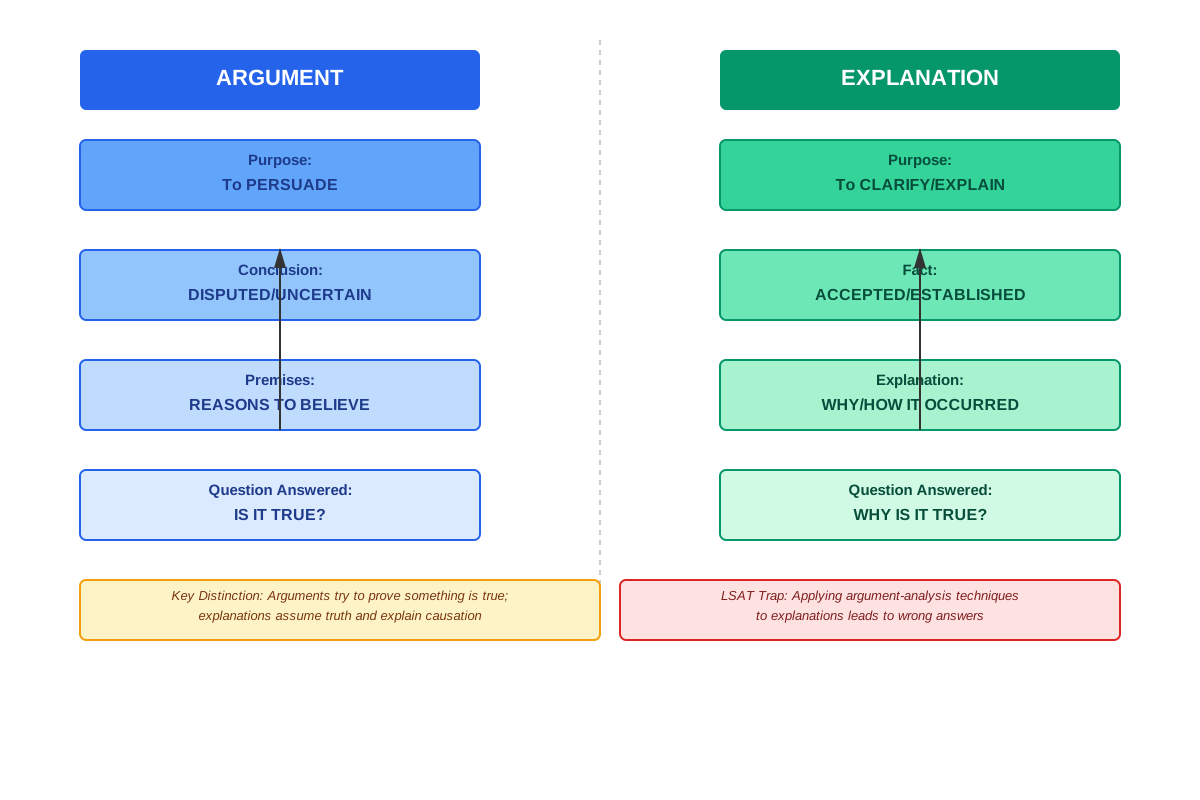
The fundamental difference between arguments and explanations lies in what is being questioned versus what is being accepted:
| Feature | Argument | Explanation |
|---|---|---|
| Purpose | To persuade that something is true | To clarify why something is true |
| Status of main claim | Disputed or in question | Accepted as fact |
| Direction of support | Premises support conclusion | Causes/reasons account for phenomenon |
| What's being established | That something is the case | Why something is the case |
| Evaluation criteria | Do premises make conclusion more likely? | Does explanation adequately account for the fact? |
Consider these parallel examples:
Argument: "The defendant must have been at the crime scene because his fingerprints were found on the weapon."
- The conclusion (defendant was at crime scene) is what's being argued for
- The premise (fingerprints on weapon) is offered as evidence
- The passage attempts to persuade us the defendant was present
Explanation: "The defendant was at the crime scene. This is because he was the first responder who secured the weapon."
- The fact (defendant was at crime scene) is accepted
- The explanation (he was first responder) clarifies why this fact is true
- The passage attempts to account for an accepted fact, not persuade us of it
Indicator Words and Context
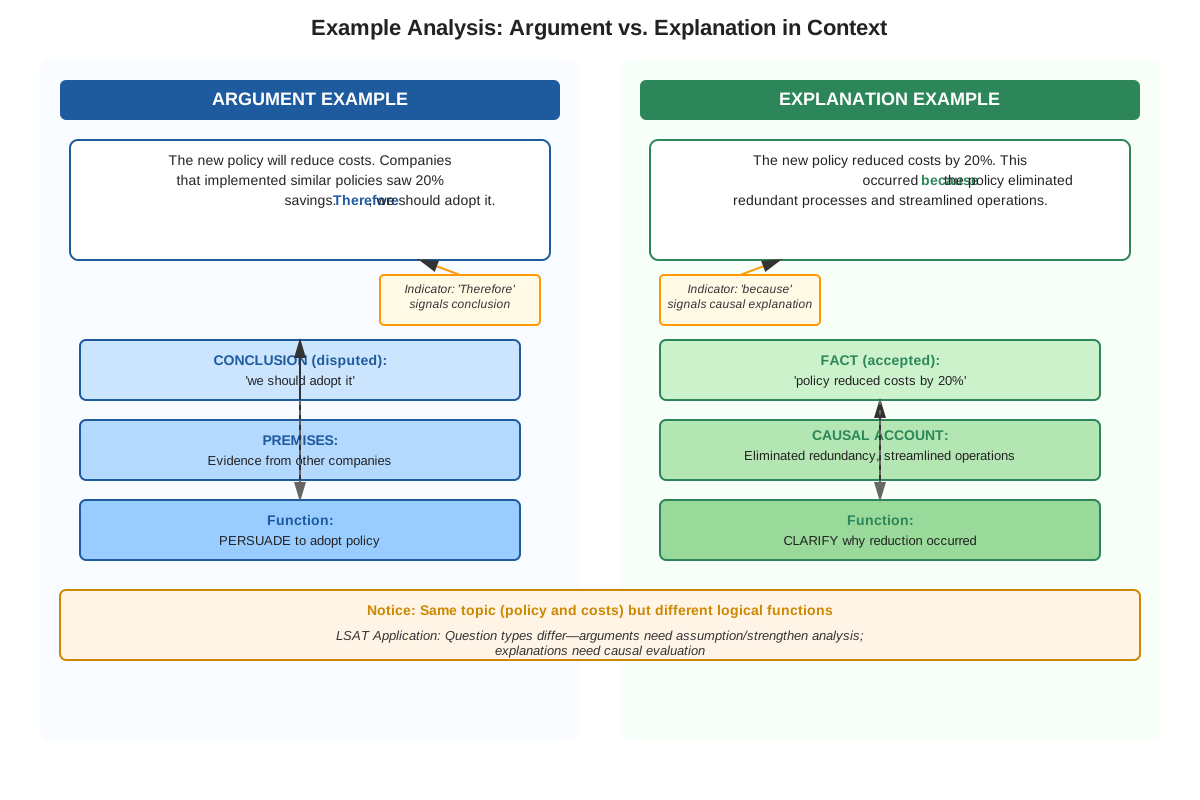
While conclusion indicators like "therefore," "thus," and "so" often signal arguments, they can also appear in explanations. The key is examining what role these words play:
Argumentative use: "The sales increased significantly. Therefore, the marketing campaign must have been effective."
- "Therefore" introduces a conclusion being argued for
- The effectiveness of the campaign is what's in question
Explanatory use: "The marketing campaign was highly effective. This is because it targeted the right demographic."
- "Because" introduces an explanation for an accepted fact
- The effectiveness is treated as given; the targeting explains why
Context provides crucial clues. Questions like "Why did X happen?" or "What accounts for X?" typically introduce explanations. Phrases like "X must be true" or "X is likely" typically introduce arguments. However, the most reliable method is identifying whether the main claim is presented as disputed (argument) or accepted (explanation).
Complex Structures: Arguments About Explanations
The LSAT frequently presents passages that argue for a particular explanation among competing alternatives. These structures combine both argumentative and explanatory elements:
"Scientists have observed that the dinosaurs went extinct 65 million years ago. Some have suggested this was due to volcanic activity, but the extinction was more likely caused by an asteroid impact. Evidence shows an iridium layer in rock strata from that period, and iridium is rare on Earth but common in asteroids."
This passage contains:
- An accepted fact (dinosaur extinction)
- Competing explanations (volcanic activity vs. asteroid impact)
- An argument for one explanation over another (the asteroid explanation is more likely)
The overall structure is argumentative because the author is arguing which explanation is correct. However, the conclusion itself is an explanation of the extinction. Recognizing this dual nature is essential for answering questions correctly.
Practical Application Steps
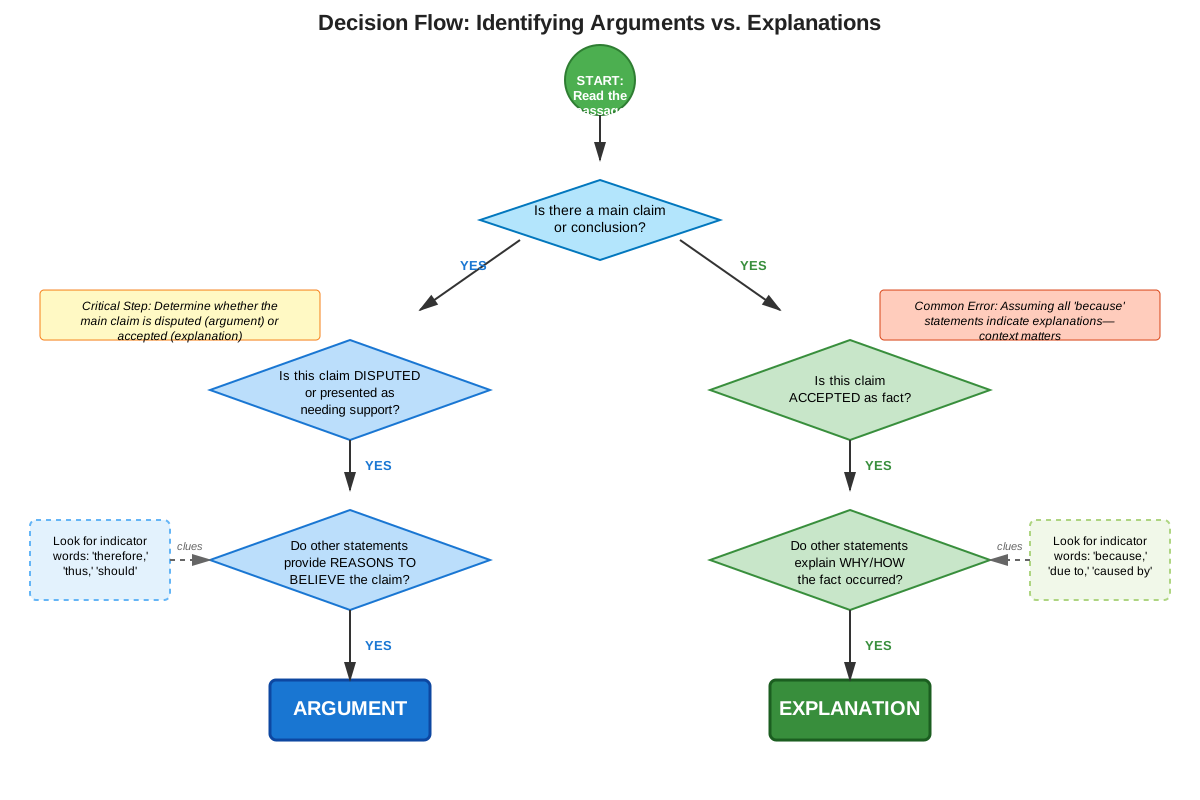
To separate arguments from explanations systematically:
- Identify the main claim: What is the primary statement the passage revolves around?
- Assess its status: Is this claim presented as disputed/in question, or as an accepted fact?
- Examine the supporting statements: Do they provide evidence that the main claim is true, or do they explain why an accepted fact occurred?
- Check the context: Does the passage respond to "Is X true?" (argument) or "Why is X true?" (explanation)?
- Consider the author's purpose: Is the author trying to convince you of something, or clarify something already accepted?
Concept Relationships
The distinction between arguments and explanations serves as a gateway concept that influences how students approach nearly every other topic in logical reasoning. When students correctly identify a passage as an argument, they activate argument-analysis skills: identifying the conclusion, finding assumptions, evaluating whether premises support the conclusion, and considering alternative possibilities. When students correctly identify a passage as an explanation, they shift to explanation-analysis skills: understanding causal mechanisms, evaluating whether the explanation adequately accounts for the phenomenon, and considering alternative explanations.
This topic connects directly to assumption identification because the type of assumption differs between arguments and explanations. Arguments contain assumptions that bridge gaps between premises and conclusions (e.g., "X is evidence for Y" assumes a connection between X and Y). Explanations contain assumptions about causal mechanisms (e.g., "X explains Y" assumes X is capable of causing Y and no other factors prevented this causation).
The relationship flows as follows: Separating argument from explanation → determines → Type of logical structure → determines → Appropriate analysis method → determines → Correct answer to questions. Misidentifying the structure at the first step cascades into errors at every subsequent step.
Within this topic, the core concepts build hierarchically: Understanding the definitions of arguments and explanations → enables → Recognizing the core distinction → enables → Identifying indicator words and context → enables → Analyzing complex structures with both elements → enables → Systematic application to LSAT passages.
High-Yield Facts
⭐ An argument attempts to persuade that a conclusion is true; an explanation attempts to clarify why an accepted fact is true
⭐ The key diagnostic question is: "Is the main claim presented as disputed or as accepted?"
⭐ Explanations take a phenomenon as given and provide causes or reasons for it; arguments provide evidence that a claim should be accepted
⭐ The same indicator words ("because," "since," "therefore") can appear in both arguments and explanations; context determines which is present
⭐ Arguments about explanations (arguing which explanation is correct) have an overall argumentative structure even though the conclusion is itself an explanation
- Explanations typically answer "why" or "how" questions, while arguments typically answer "whether" or "what" questions
- In explanations, the explanandum (phenomenon being explained) is treated as factual; in arguments, the conclusion is what's being established as factual
- Strengthening an argument requires evidence that makes the conclusion more likely true; strengthening an explanation requires evidence that the proposed cause actually produced the effect
- Assumptions in arguments bridge premises to conclusions; assumptions in explanations concern causal mechanisms and the absence of alternative causes
- Scientific passages often explain phenomena (why something occurs) rather than argue for conclusions, making this distinction especially important for science-heavy LSAT sections
Quick check — test yourself on Separating argument from explanation so far.
Try Flashcards →Common Misconceptions
Misconception: Any passage with "because" is an argument providing reasons for a conclusion.
Correction: "Because" can introduce either premises in an argument or causes in an explanation. The distinction depends on whether the main claim is disputed (argument) or accepted (explanation). "The plant died because it lacked water" is an explanation if the death is accepted; "The plant must have lacked water because it died" is an argument if we're establishing the lack of water.
Misconception: Explanations don't have logical structure or can't be evaluated for quality.
Correction: Explanations have rigorous logical structure with explanans and explanandum, and can be evaluated for adequacy. A good explanation must show that the proposed cause is sufficient to produce the effect, that the cause was actually present, and that no other factors prevented the causal relationship. LSAT questions frequently test whether explanations adequately account for phenomena.
Misconception: If a passage describes a causal relationship, it must be an explanation.
Correction: Causal relationships can appear in both arguments and explanations. An argument might conclude that X caused Y (arguing for a causal claim), while an explanation might use the accepted fact that X caused Y to explain why Y occurred. The difference is whether the causal relationship itself is what's being established or is being used to clarify an accepted phenomenon.
Misconception: Arguments are always trying to convince someone to do something or change their mind.
Correction: While some arguments are persuasive in the sense of advocating action, logical arguments simply attempt to establish that a claim is true or likely true. An argument can present a conclusion that the audience might readily accept once they see the evidence, but it's still an argument because the conclusion is what's being established rather than assumed.
Misconception: The presence of evidence or data means a passage is an argument.
Correction: Evidence can support either arguments or explanations. In arguments, evidence supports the conclusion that something is true. In explanations, evidence might support that a proposed explanation is correct (making it an argument about explanations), or evidence might be part of the explanation itself, showing how the cause produced the effect.
Misconception: Explanations are always about past events while arguments are about present or future claims.
Correction: Both arguments and explanations can concern any time frame. An explanation might clarify why a current phenomenon exists or predict why something will occur in the future. An argument might establish that something happened in the past. The temporal frame doesn't determine whether discourse is argumentative or explanatory.
Worked Examples
Example 1: Basic Distinction
Passage: "Consumer confidence has increased dramatically over the past quarter. This increase occurred because unemployment rates dropped to historic lows and wage growth accelerated."
Analysis:
Step 1 - Identify the main claim: "Consumer confidence has increased dramatically"
Step 2 - Assess its status: The increase is presented as an established fact, not something being argued for. The passage doesn't say "consumer confidence must have increased" or provide evidence that it increased.
Step 3 - Examine supporting statements: The statements about unemployment and wages explain WHY the increase occurred, not whether it occurred.
Step 4 - Check context: The passage answers "Why did consumer confidence increase?" not "Did consumer confidence increase?"
Step 5 - Author's purpose: To clarify the causes of an accepted phenomenon, not to persuade that the phenomenon occurred.
Conclusion: This is an explanation. The increase in consumer confidence is the explanandum (accepted fact being explained), and the unemployment and wage factors are the explanans (the causes explaining it).
LSAT Application: If a question asked "Which of the following, if true, most strengthens the above?", the correct answer would provide evidence that unemployment and wages actually do cause consumer confidence changes, or that these were the primary factors rather than other possible causes. Wrong answers might provide additional evidence that consumer confidence increased—but that's already accepted and doesn't need strengthening.
Example 2: Argument About Explanations
Passage: "Archaeologists have discovered that the ancient city of Petra was abandoned around 700 CE. Some scholars attribute this to earthquakes that damaged the city's water systems. However, the abandonment was more likely due to changing trade routes. Historical records show that by 700 CE, maritime trade had replaced overland routes, and Petra's economy depended entirely on its position along overland trade paths. Cities that similarly depended on these routes were also abandoned during this period."
Analysis:
Step 1 - Identify the main claim: "The abandonment was more likely due to changing trade routes"
Step 2 - Assess its status: This explanation is presented as disputed—the author is arguing it's more likely than the earthquake explanation. The word "however" signals disagreement with an alternative view.
Step 3 - Examine supporting statements: The statements about maritime trade, economic dependence, and other cities provide evidence that the trade route explanation is correct, not just clarification of how trade routes caused abandonment.
Step 4 - Check context: The passage responds to "Which explanation for abandonment is correct?" not just "Why was Petra abandoned?"
Step 5 - Author's purpose: To persuade that one explanation is better than another.
Conclusion: This is an argument (specifically, an argument about which explanation is correct). The overall structure is argumentative even though the conclusion is itself an explanation. The abandonment of Petra is accepted; what's being argued is WHY it was abandoned.
LSAT Application: If asked to identify an assumption, the correct answer would bridge the evidence to the conclusion that trade routes explain abandonment—for example, "Petra had no significant economic activities other than trade" or "The earthquake damage was not severe enough to force abandonment." If asked to weaken the argument, the correct answer would suggest the trade route explanation is inadequate or the earthquake explanation is better—for example, "Archaeological evidence shows the water systems were completely destroyed by earthquakes, making the city uninhabitable."
Exam Strategy
When approaching LSAT questions involving separating argument from explanation, implement this systematic process:
Initial Read Strategy: On the first read, actively ask "Is the author trying to convince me that something is true, or explain why something true occurred?" Flag passages that describe phenomena followed by "because" or "due to" statements—these are prime candidates for explanation structures.
Trigger Words to Watch:
- Explanation indicators: "This is because," "This occurred because," "The reason is," "This explains why," "accounts for," "is due to"
- Argument indicators: "Therefore," "thus," "must be," "probably," "likely," "suggests that," "shows that"
- Ambiguous words requiring context: "since," "because," "for," "as"
Question-Specific Approaches:
For Main Point questions: Determine whether the main point is a conclusion being argued for or a phenomenon being explained. Wrong answers often present the explanandum (accepted fact) as if it were the conclusion, or present background information as the main point.
For Assumption questions: First identify whether the passage is an argument or explanation. If it's an argument, look for assumptions connecting premises to conclusion. If it's an explanation, look for assumptions about causal mechanisms. If it's an argument about explanations, look for assumptions that the proposed explanation is adequate and alternatives are inadequate.
For Strengthen/Weaken questions: If the passage is an explanation, strengthening means showing the proposed cause actually produces the effect; weakening means showing alternative causes or that the proposed cause is insufficient. If the passage is an argument, strengthening means making the conclusion more likely given the premises; weakening means making it less likely.
Process of Elimination Tips:
- Eliminate answers that treat an accepted fact as if it needs to be proven (in explanations)
- Eliminate answers that treat a disputed conclusion as if it's already accepted (in arguments)
- Eliminate answers that apply argument-analysis to explanations or vice versa
- Watch for answers that confuse the explanandum with the explanans
Time Allocation: Spend 5-10 seconds on initial classification (argument vs. explanation) before diving into detailed analysis. This upfront investment prevents wasting time pursuing wrong answer paths. If uncertain, look for whether the main claim is preceded by evidence (suggesting argument) or followed by causes (suggesting explanation).
Memory Techniques
The PERSUADE vs. CLARIFY Mnemonic:
- Premises support disputed conclusion = Argument
- Causes account for accepted fact = Explanation
The Question Test: Mentally insert the passage into these question frames:
- "Is [main claim] true?" → If this fits, it's likely an argument
- "Why is [main claim] true?" → If this fits, it's likely an explanation
The Status Check Acronym - DAFT:
- Disputed claim → Argument
- Accepted fact → Explanation
- Fact being established → Argument
- Taken as given → Explanation
Visual Metaphor: Think of arguments as bridges (premises bridge to a conclusion you're trying to reach) and explanations as roots (causes that explain why an existing tree/phenomenon is there). When you see a passage, ask: "Am I building a bridge to somewhere new, or tracing roots of something already present?"
The "Already There" Test: If you can add "which we already know" after the main claim without changing the passage's meaning, it's an explanation. "Consumer confidence increased [which we already know] because unemployment dropped" works. "Consumer confidence must have increased [which we already know] because unemployment dropped" sounds wrong—the "must have" signals we're establishing it, not explaining it.
Summary
Separating argument from explanation is a critical logical reasoning skill that distinguishes between discourse that attempts to persuade (arguments) and discourse that attempts to clarify causation (explanations). Arguments present premises as reasons to believe a disputed conclusion, while explanations present causes or reasons that account for an accepted fact or phenomenon. The key diagnostic is determining whether the main claim is presented as something to be established (argument) or as something already accepted that needs clarification (explanation). This distinction appears throughout LSAT Logical Reasoning questions and determines the appropriate analysis method. Students must recognize that the same indicator words can appear in both structures, making context essential. Complex passages may argue for one explanation over alternatives, combining argumentative structure with explanatory content. Mastering this distinction enables accurate identification of conclusions, assumptions, and the appropriate criteria for evaluating logical strength, making it one of the highest-yield topics for LSAT score improvement.
Key Takeaways
- Arguments attempt to persuade that a conclusion is true; explanations attempt to clarify why an accepted fact is true—this is the fundamental distinction
- The diagnostic question is whether the main claim is disputed (argument) or accepted (explanation)
- Indicator words like "because" and "therefore" can appear in both arguments and explanations; context determines which is present
- Arguments about explanations have an overall argumentative structure even though the conclusion is itself an explanation
- Correctly identifying whether a passage is an argument or explanation determines the appropriate analysis method and the correct answer to most question types
- Assumptions, strengthening, and weakening all work differently for arguments versus explanations
- The LSAT frequently exploits confusion between these structures, making this distinction essential for avoiding trap answers
Related Topics
Identifying Conclusions: Once students can separate arguments from explanations, they must accurately identify which statement is the conclusion in argumentative passages. This skill builds directly on understanding that conclusions are disputed claims being argued for, not accepted facts being explained.
Causal Reasoning: Explanations typically involve causal relationships, making causal reasoning essential for evaluating explanations. Understanding how to assess whether X actually causes Y, whether alternative causes exist, and whether the causal mechanism is adequate builds on the foundation of recognizing explanatory structures.
Assumption Identification: Different types of assumptions appear in arguments versus explanations. Mastering the argument/explanation distinction enables students to recognize whether they should look for evidential assumptions (connecting premises to conclusions) or causal assumptions (about mechanisms and alternative causes).
Strengthen and Weaken Questions: The method for strengthening or weakening depends entirely on whether the passage is an argument or explanation. This topic directly applies the argument/explanation distinction to one of the most common LSAT question types.
Practice CTA
Now that you understand how to separate arguments from explanations, it's time to cement this knowledge through active practice. Attempt the practice questions associated with this topic, focusing on applying the systematic process outlined in the Exam Strategy section. As you work through problems, consciously identify whether each passage is arguing or explaining before attempting to answer the question. Use the flashcards to reinforce the key distinctions and diagnostic questions. Remember: this skill becomes automatic with practice, and mastering it will improve your performance across multiple question types. Every practice problem is an opportunity to strengthen your ability to recognize these fundamental structures instantly and accurately.
Sign up free to keep reading
Create a free AnvayaPrep account to finish this LSAT guide on Separating argument from explanation — plus flashcards and practice questions.