Overview
Subconclusions represent one of the most sophisticated structural elements in logical reasoning arguments, serving as both a conclusion supported by premises and simultaneously as a premise supporting a further conclusion. Understanding subconclusions is essential for mastering argument fundamentals on the LSAT, as they appear frequently across multiple question types and require students to parse complex argumentative structures with precision. A subconclusion acts as an intermediate step in reasoning—it's a claim that the author argues for using some evidence, then uses that established claim to support an even broader or more significant conclusion.
The ability to identify and work with subconclusions distinguishes high-scoring test-takers from average performers. Many LSAT questions specifically target this skill, asking students to identify the role a particular statement plays in an argument, to recognize which claims depend on which other claims, or to understand how removing one piece of reasoning would affect the overall argument structure. LSAT subconclusions challenge students because they require holding multiple layers of reasoning in mind simultaneously and understanding that a single statement can function in two different capacities within the same argument.
Mastering subconclusions provides a foundation for virtually all advanced logical reasoning skills. This topic connects directly to argument structure analysis, assumption identification, strengthening and weakening questions, and method of reasoning questions. When students can reliably identify subconclusions, they gain the ability to map arguments visually, predict what assumptions connect different parts of reasoning chains, and quickly eliminate answer choices that mischaracterize argument structure. This skill is not merely academic—it represents the core analytical ability the LSAT measures: understanding how claims relate to one another in complex reasoning.
Learning Objectives
- [ ] Identify how Subconclusions appears in LSAT questions
- [ ] Explain the reasoning pattern behind Subconclusions
- [ ] Apply Subconclusions to solve LSAT-style problems accurately
- [ ] Distinguish subconclusions from main conclusions and premises in multi-layered arguments
- [ ] Recognize indicator words and structural patterns that signal subconclusions
- [ ] Analyze how removing a subconclusion would affect the logical chain of an argument
- [ ] Evaluate the strength of support relationships between premises, subconclusions, and main conclusions
Prerequisites
- Basic argument structure: Understanding what constitutes a premise and conclusion is essential because subconclusions function as both, requiring students to first recognize these fundamental components.
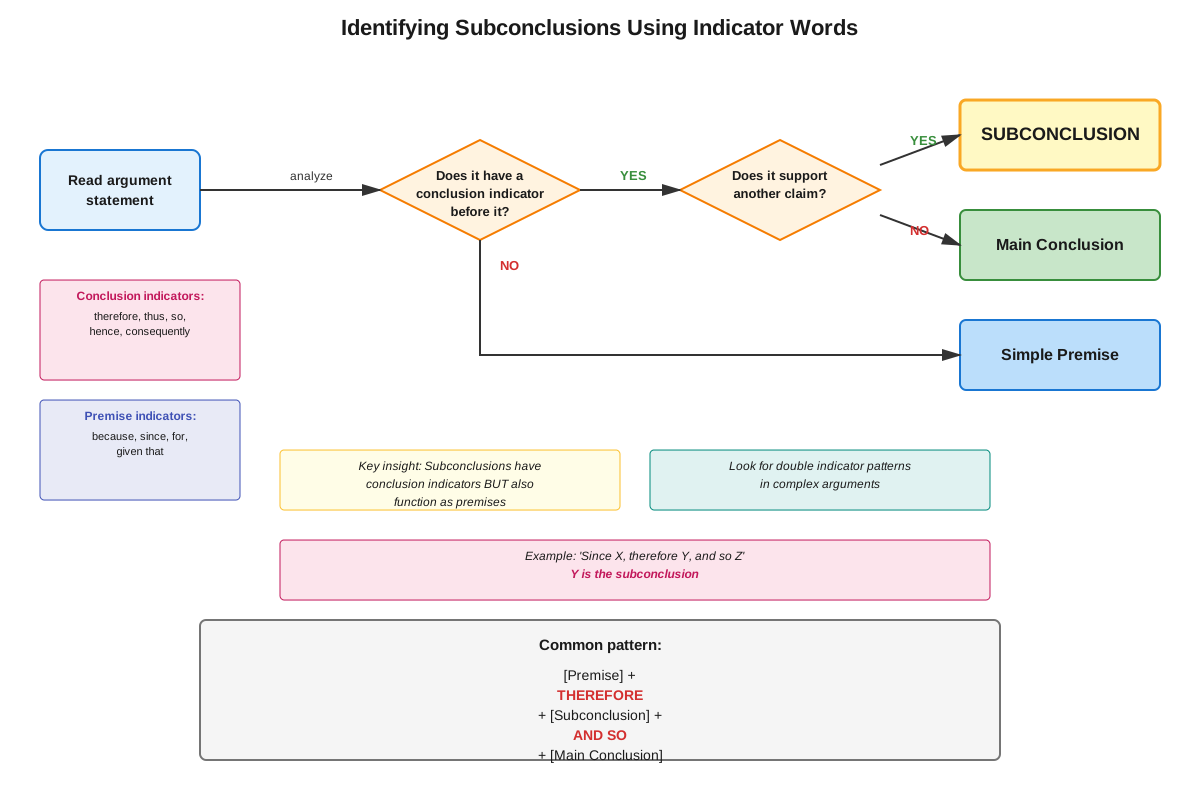
- Indicator words: Familiarity with conclusion indicators (therefore, thus, so) and premise indicators (because, since, for) helps identify where subconclusions appear in argument chains.
- Logical relationships: Recognizing how claims support one another provides the foundation for understanding how subconclusions create intermediate steps in reasoning.
- Reading comprehension: The ability to parse complex sentences and identify main ideas enables students to distinguish between different levels of claims within arguments.
Why This Topic Matters
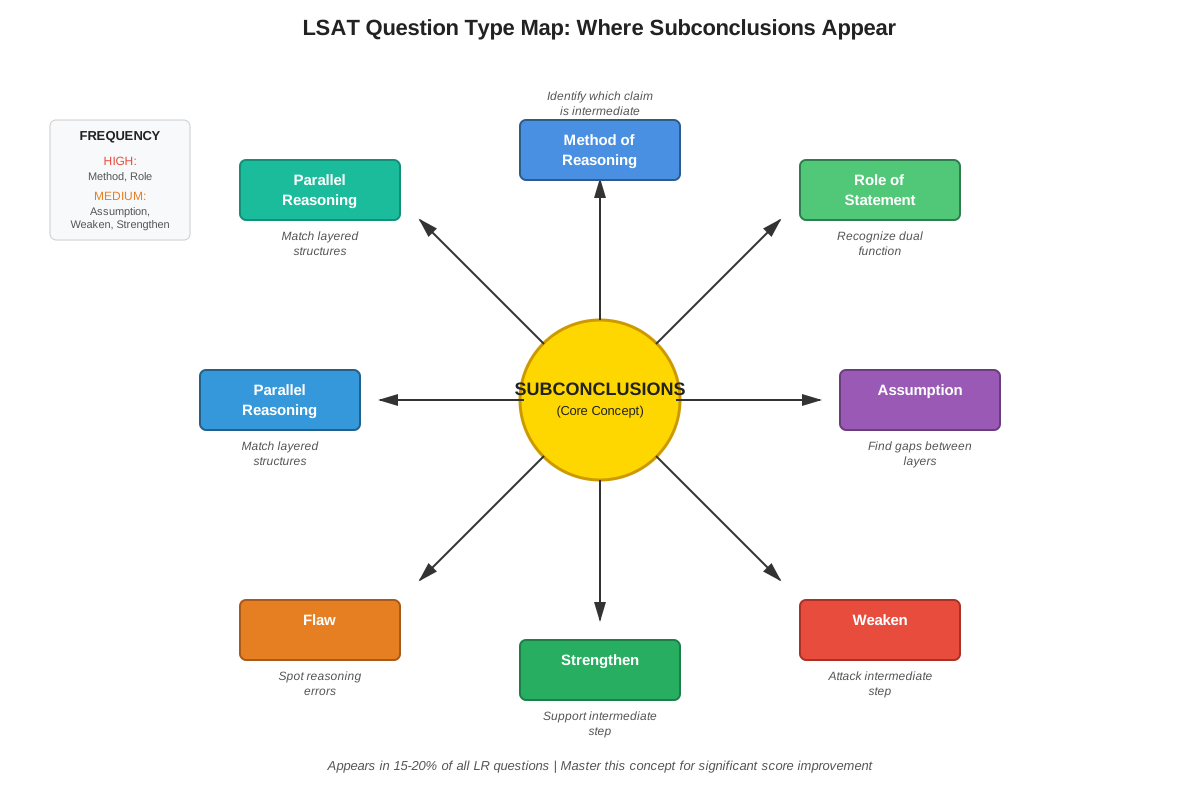
Subconclusions appear in approximately 15-20% of all Logical Reasoning questions on the LSAT, making them one of the highest-yield structural concepts to master. They feature prominently in Method of Reasoning questions, Role of a Statement questions, and Argument Structure questions, but also appear indirectly in Assumption, Strengthen, Weaken, and Flaw questions where understanding the argument's architecture is crucial for selecting correct answers.
In real-world applications, the ability to identify subconclusions reflects sophisticated critical thinking skills essential for legal practice. Attorneys must construct multi-layered arguments where intermediate conclusions build toward broader legal claims. Judges write opinions that establish subsidiary findings before reaching ultimate holdings. Contract negotiations involve establishing preliminary agreements that support final terms. The LSAT tests this skill because it directly predicts success in legal reasoning.
On the exam, subconclusions most commonly appear in arguments containing three or more distinct claims, often introduced by phrases like "this suggests that" or "from this we can conclude." They're particularly prevalent in science-based passages where researchers draw intermediate findings from data before reaching broader theoretical conclusions, and in policy arguments where authors establish that a problem exists (subconclusion) before arguing for a specific solution (main conclusion). Question stems that explicitly test subconclusions include "Which one of the following most accurately describes the role played in the argument by the claim that..." and "The claim that X figures in the argument in which one of the following ways?"
Core Concepts
Definition and Dual Function
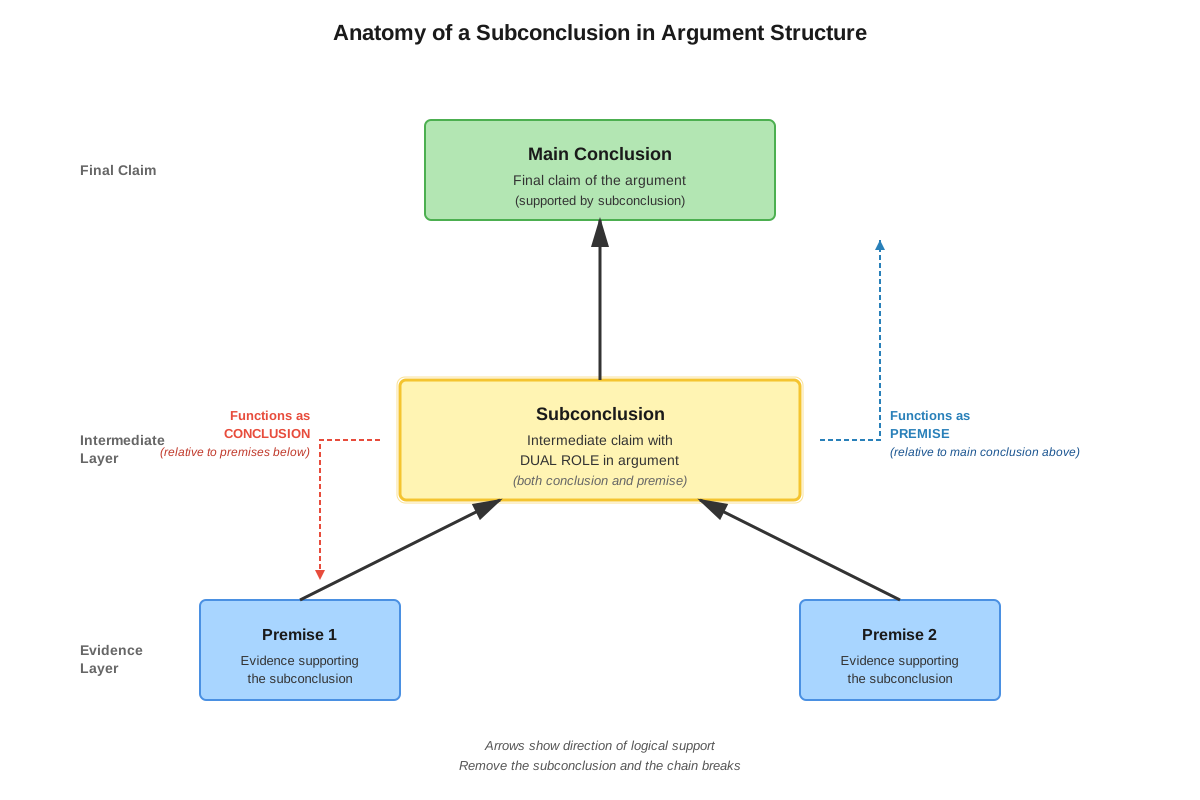
A subconclusion is a statement within an argument that serves a dual role: it functions as a conclusion supported by one or more premises, while simultaneously serving as a premise that supports the argument's main conclusion. This dual nature makes subconclusions the "middle layer" in multi-tiered arguments. Unlike simple premises (which only provide support) or main conclusions (which only receive support), subconclusions both receive and provide support within the logical chain.
Consider this structure:
- Premise → supports → Subconclusion → supports → Main Conclusion
The subconclusion is argued for (making it a conclusion relative to its supporting premises) and argues for something else (making it a premise relative to the main conclusion). This intermediate position creates a logical bridge that allows arguments to build complexity and move from specific observations to broader claims.
Identifying Subconclusions: The "Why" and "So What" Test
The most reliable method for identifying subconclusions involves asking two questions about any claim in an argument:
- "Why should I believe this?" If the argument provides reasons (premises) supporting the claim, it functions as a conclusion.
- "So what? What does this support?" If the claim is used to support another claim, it functions as a premise.
When both answers are "yes"—when the argument both supports the claim AND uses it to support something else—the claim is a subconclusion. This test works because it directly examines the logical relationships rather than relying solely on indicator words, which can be misleading or absent.
Structural Patterns and Indicator Words
While not always present, certain indicator words frequently signal subconclusions:
| Position | Common Indicators | Example |
|---|---|---|
| Before subconclusion | "This shows that...", "This suggests...", "This means...", "Therefore...", "Thus..." | "The data shows increased sales. This suggests consumer confidence is rising." |
| After subconclusion | "...and so...", "...which means...", "...from which we can conclude..." | "Consumer confidence is rising, which means the economy will strengthen." |
| Connecting to main conclusion | "Consequently...", "It follows that...", "Hence..." | "Consumer confidence is rising. Consequently, we should invest now." |
However, many subconclusions appear without explicit indicators, requiring structural analysis rather than keyword recognition. The logical relationships themselves—not the words—define the subconclusion.
Multi-Layer Argument Architecture
Arguments can contain multiple subconclusions, creating complex reasoning chains:
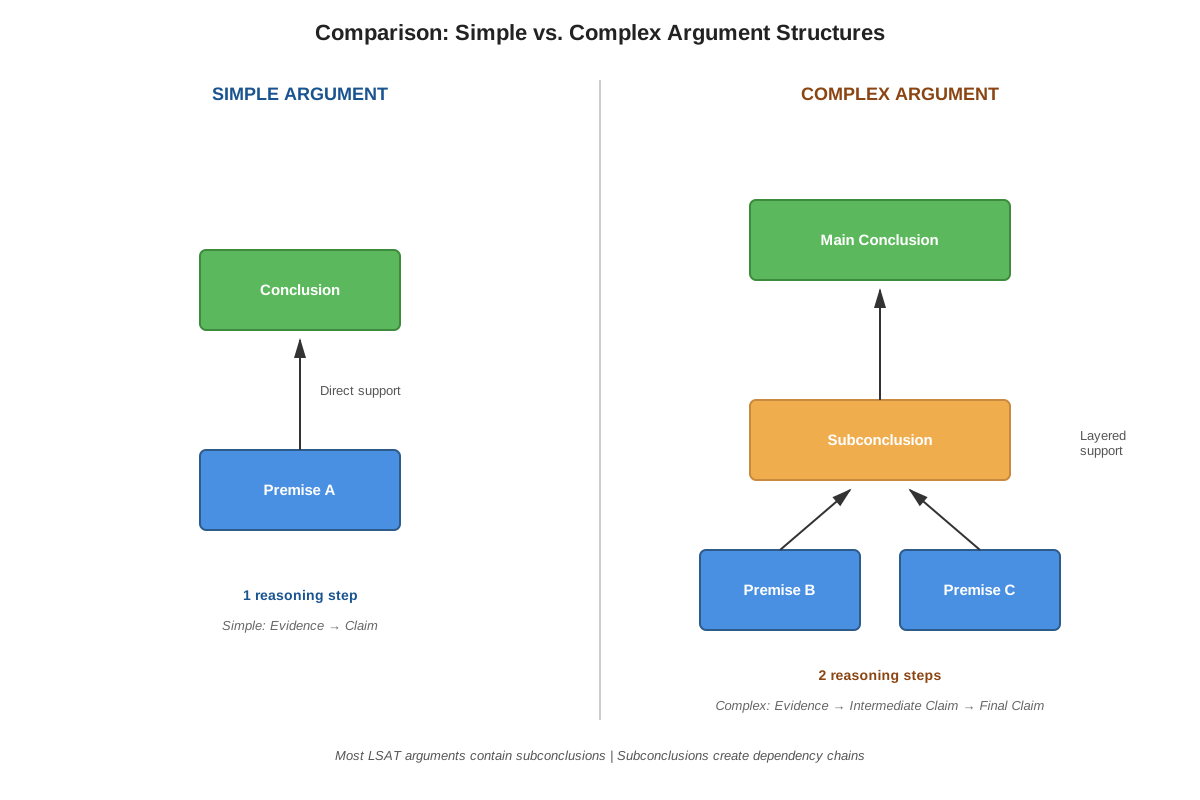
Simple structure (one subconclusion):
Premise 1 + Premise 2
        ↓
   Subconclusion
        ↓
  Main Conclusion
Complex structure (multiple subconclusions):
Premise 1 → Subconclusion A
                ↓
Premise 2 → Subconclusion B → Main Conclusion
                ↓
Premise 3 → Subconclusion C
In complex structures, some subconclusions may support other subconclusions before ultimately supporting the main conclusion. Understanding these architectures helps students recognize that arguments can have multiple "levels" of reasoning, each building on the previous level.
Distinguishing Main Conclusions from Subconclusions
The main conclusion represents the argument's ultimate point—the primary claim the author wants the reader to accept. It receives support but provides no support to other claims within the argument. In contrast, subconclusions are "stepping stones" toward the main conclusion.
Three reliable methods distinguish them:
- The "main point" test: Ask "What is the author's primary purpose in making this argument?" The answer is the main conclusion.
- The "support flow" test: Map which claims support which. The claim that receives support but gives none is the main conclusion; claims that both receive and give support are subconclusions.
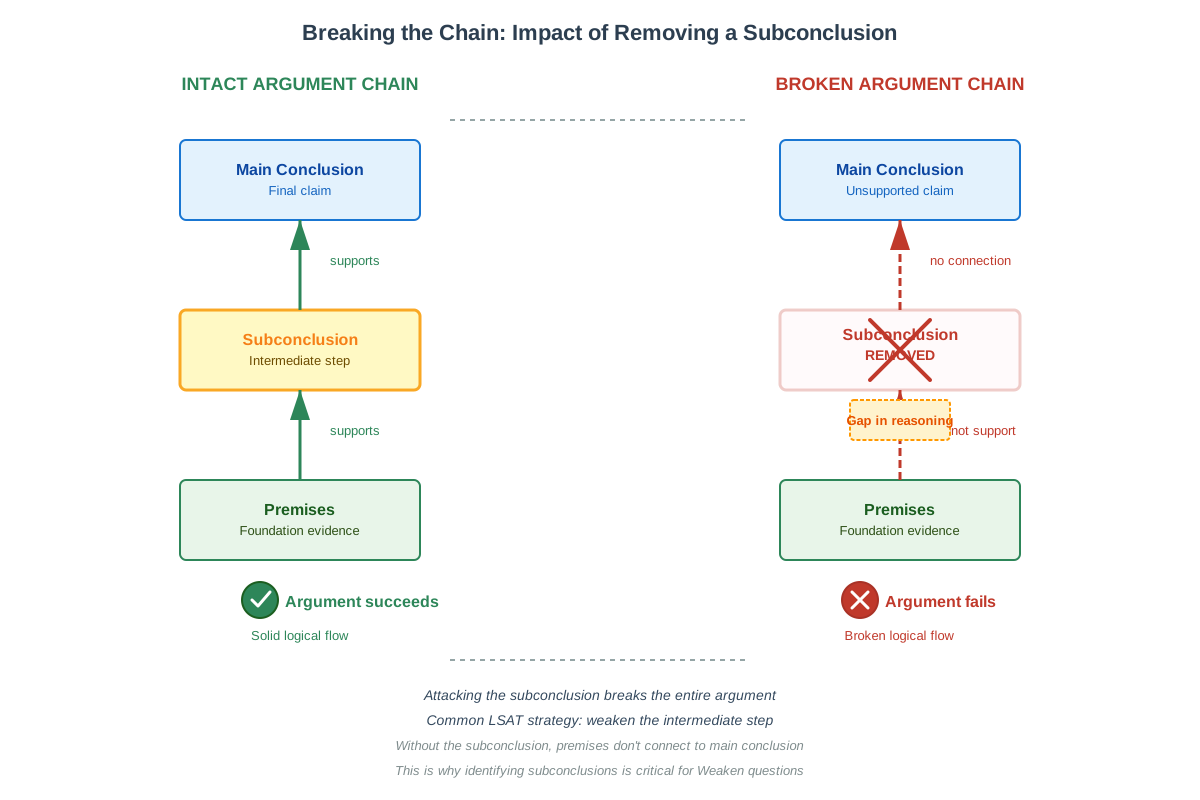
- The "removal test": If removing a claim would eliminate the argument's primary purpose, it's likely the main conclusion. If removal would create a logical gap but the main point could still stand, it's likely a subconclusion.
Context and Placement
Subconclusions can appear anywhere in an argument—beginning, middle, or end. Their position doesn't determine their function; only their logical relationships do. However, certain patterns are common:
- Early placement: Often introduces a problem or establishes a fact that the rest of the argument builds upon
- Middle placement: Most common position, serving as a clear bridge between initial evidence and final conclusion
- Late placement: Sometimes appears just before the main conclusion as a penultimate step in reasoning
The Role in Assumption Questions
Understanding subconclusions is crucial for assumption questions because assumptions can connect premises to subconclusions, subconclusions to main conclusions, or both. When an argument contains a subconclusion, students must identify which logical gap they're being asked to fill—the gap between premises and subconclusion, or between subconclusion and main conclusion. Misidentifying the relevant gap leads to selecting wrong answers that address the wrong part of the argument's structure.
Concept Relationships
Subconclusions exist at the intersection of multiple fundamental logical reasoning concepts. They directly build upon understanding of basic argument structure (premises and conclusions), as students must first recognize these elements before identifying statements that function as both. The concept of logical support relationships is essential—subconclusions demonstrate that support can flow through multiple levels rather than moving directly from premises to conclusion.
The relationship map flows as follows:
Premises → provide evidence for → Subconclusions → which provide evidence for → Main Conclusions
This creates a dependency chain where assumptions may be required at multiple points: between premises and subconclusions, and between subconclusions and main conclusions. Understanding subconclusions therefore enables more sophisticated assumption identification, as students must recognize which logical gap a question targets.
Subconclusions connect forward to advanced topics like argument evaluation (strengthening/weakening), where students must understand which part of a multi-layered argument is being affected by new information. They also relate to method of reasoning questions, which explicitly test whether students can describe how different parts of arguments function. The concept of sufficient and necessary conditions often appears in arguments with subconclusions, where establishing one condition (subconclusion) is necessary for establishing another (main conclusion).
Finally, subconclusions relate to argument mapping and formal logic, as they represent intermediate steps in logical chains that can be symbolized and analyzed systematically. Mastering subconclusions enables students to mentally visualize argument structure, a skill that accelerates performance across all Logical Reasoning question types.
High-Yield Facts
⭐ A subconclusion both receives support from premises and provides support to the main conclusion—it has a dual function in argument structure.
⭐ The "why" and "so what" test reliably identifies subconclusions: if an argument both supports a claim AND uses it to support something else, it's a subconclusion.
⭐ Subconclusions can appear anywhere in an argument (beginning, middle, or end)—position doesn't determine function.
⭐ Indicator words like "this suggests," "this shows," and "therefore" often precede subconclusions, but many subconclusions appear without explicit indicators.
⭐ The main conclusion is the argument's ultimate point and only receives support; subconclusions both receive and provide support.
- Arguments can contain multiple subconclusions, creating complex multi-layer reasoning structures.
- Removing a subconclusion creates a logical gap in the argument but doesn't necessarily eliminate the main point.
- Assumptions can connect premises to subconclusions, subconclusions to main conclusions, or both.
- Role of Statement questions frequently test whether students can identify claims as subconclusions versus premises or main conclusions.
- In Method of Reasoning questions, correct answers often describe how subconclusions function as "intermediate conclusions" or "subsidiary conclusions."
- Subconclusions are more common in longer, more complex arguments (4+ sentences) than in brief arguments.
- Science and policy arguments frequently use subconclusions to move from specific data to broader theoretical or practical claims.
Quick check — test yourself on Subconclusions so far.
Try Flashcards →Common Misconceptions
Misconception: Subconclusions always appear in the middle of arguments, between premises and the main conclusion.
Correction: Subconclusions can appear anywhere in an argument. Their function is determined by logical relationships (what supports them and what they support), not by their physical position in the text. An argument might state its main conclusion first, then provide a subconclusion, then offer premises supporting that subconclusion.
Misconception: Every argument contains a subconclusion.
Correction: Many LSAT arguments have simple structures with only premises directly supporting a main conclusion, containing no subconclusions. Subconclusions appear primarily in more complex, multi-layered arguments. Not every claim that isn't the main conclusion is automatically a subconclusion—it might simply be a premise.
Misconception: Indicator words like "therefore" and "thus" always signal subconclusions.
Correction: These words indicate conclusions generally, but they might introduce the main conclusion rather than a subconclusion. Students must examine what the claim supports (if anything) to determine whether it's a subconclusion or main conclusion. Additionally, many subconclusions appear without any indicator words.
Misconception: The longest or most complex sentence in an argument is the subconclusion.
Correction: Sentence length and complexity don't determine logical function. A subconclusion might be stated simply while premises are complex, or vice versa. Only the support relationships—what supports what—determine which claims are subconclusions.
Misconception: If a claim is supported by evidence, it must be the main conclusion.
Correction: Both main conclusions and subconclusions receive support from evidence. The distinguishing feature is that subconclusions also provide support to another claim (the main conclusion), while main conclusions only receive support. Students must trace the full chain of reasoning to distinguish them.
Misconception: Subconclusions are less important than main conclusions, so identifying them doesn't matter much.
Correction: Many LSAT questions specifically test understanding of subconclusions, and misidentifying them leads to wrong answers on Role of Statement, Method of Reasoning, Assumption, and Argument Structure questions. Additionally, understanding subconclusions is essential for mapping complex arguments and identifying where logical gaps exist.
Worked Examples
Example 1: Identifying a Subconclusion
Argument: "Recent studies show that employees who work from home are 13% more productive than office workers. This increased productivity suggests that remote work arrangements benefit companies financially. Therefore, businesses should expand remote work options to maximize profits."
Analysis:
Step 1: Identify all claims in the argument.
- Claim 1: "Employees who work from home are 13% more productive than office workers"
- Claim 2: "Remote work arrangements benefit companies financially"
- Claim 3: "Businesses should expand remote work options to maximize profits"
Step 2: Apply the "why" and "so what" test to each claim.
For Claim 1:
- Why should I believe this? The argument cites "recent studies"—this is a premise supported by external evidence.
- So what? This claim supports Claim 2 (the productivity increase suggests financial benefits).
- Function: Premise (only provides support, doesn't receive it from within the argument)
For Claim 2:
- Why should I believe this? The argument provides Claim 1 as evidence (increased productivity suggests financial benefits).
- So what? This claim supports Claim 3 (financial benefits are a reason to expand remote work).
- Function: Subconclusion (receives support from Claim 1, provides support to Claim 3)
For Claim 3:
- Why should I believe this? The argument provides Claim 2 as the reason (financial benefits justify expansion).
- So what? Nothing—this is the argument's ultimate point.
- Function: Main conclusion (only receives support)
Step 3: Map the structure.
Premise: Remote workers are 13% more productive
              ↓
Subconclusion: Remote work benefits companies financially
              ↓
Main Conclusion: Businesses should expand remote work options
Connection to Learning Objectives: This example demonstrates how to identify subconclusions by examining support relationships rather than relying solely on indicator words. The phrase "this suggests" signals that Claim 2 is a conclusion drawn from Claim 1, while "therefore" signals that Claim 3 is drawn from Claim 2, revealing the multi-layer structure.
Example 2: Complex Argument with Multiple Subconclusions
Argument: "Archaeological evidence indicates that ancient civilizations in coastal regions developed advanced navigation techniques. These navigation skills would have enabled long-distance sea travel. Furthermore, genetic studies show remarkable similarities between populations separated by vast oceans. This genetic similarity could only result from historical contact between these populations. Consequently, ancient civilizations must have engaged in transoceanic voyages far earlier than previously believed."
Analysis:
Step 1: Identify all claims.
- Claim A: Ancient coastal civilizations developed advanced navigation techniques
- Claim B: These navigation skills would have enabled long-distance sea travel
- Claim C: Genetic studies show similarities between populations separated by oceans
- Claim D: This genetic similarity could only result from historical contact
- Claim E: Ancient civilizations engaged in transoceanic voyages earlier than believed
Step 2: Map support relationships.
Claim A → supports → Claim B (navigation techniques enable travel)
Claim C → supports → Claim D (genetic data suggests contact)
Claims B + D → support → Claim E (both lines of evidence support the main conclusion)
Step 3: Identify functions.
- Claim A: Premise (supported by archaeological evidence, supports B)
- Claim B: Subconclusion 1 (supported by A, supports E)
- Claim C: Premise (supported by genetic studies, supports D)
- Claim D: Subconclusion 2 (supported by C, supports E)
- Claim E: Main conclusion (supported by B and D, supports nothing else)
Structure:
Premise A: Advanced navigation → Subconclusion B: Could travel long distances
                                            ↓
                                    Main Conclusion E:
                                    Transoceanic voyages
                                    occurred earlier
                                            ↑
Premise C: Genetic similarities → Subconclusion D: Historical contact occurred
Key Insight: This argument contains two parallel subconclusions (B and D), each supported by different evidence, that converge to support a single main conclusion. This demonstrates that complex arguments can have multiple reasoning chains that work together. Understanding this structure is essential for questions asking which claim plays which role, or what would weaken or strengthen different parts of the argument.
Connection to Learning Objectives: This example shows how to apply subconclusion analysis to complex, multi-layered arguments typical of difficult LSAT questions. It demonstrates that identifying subconclusions requires tracing complete support chains and recognizing that arguments can have parallel reasoning structures.
Exam Strategy
Approaching Subconclusion Questions
When facing questions that test subconclusions, follow this systematic approach:
- Read the question stem first to determine if it explicitly asks about argument structure, the role of a statement, or method of reasoning—these are prime subconclusion questions.
- Map the argument by identifying all claims and drawing arrows showing what supports what. This visual representation makes subconclusions immediately apparent.
- Apply the dual-function test to any claim you suspect might be a subconclusion: verify that it both receives support from some claims and provides support to others.
- Eliminate answer choices that mischaracterize the claim's function (e.g., calling a subconclusion a "premise" or "main conclusion").
Trigger Words and Phrases
Watch for these question stem patterns that indicate subconclusion testing:
- "The claim that [X] figures in the argument in which one of the following ways?"
- "Which one of the following most accurately describes the role played by the statement that [X]?"
- "The argument proceeds by..."
- "The argument's conclusion is supported by..."
- "Which one of the following is a conclusion for which support is provided, and which in turn supports the argument's main conclusion?"
In the argument itself, these phrases often (but not always) signal subconclusions:
- "This suggests that..."
- "This shows that..."
- "From this we can conclude..."
- "This means that..."
- "It follows that..." (when followed by more reasoning)
Process of Elimination Tips
For Role of Statement questions:
- Eliminate answers describing the claim as a "premise" if the argument provides reasons supporting it.
- Eliminate answers describing it as "the main conclusion" if it's used to support another claim.
- Look for answers using language like "intermediate conclusion," "subsidiary conclusion," or describing the dual function explicitly.
- Be cautious of answers that correctly identify one function (e.g., "supported by evidence") but ignore the other function (e.g., failing to mention it supports another claim).
Time Allocation
Subconclusion questions typically require 60-90 seconds—slightly longer than average because they demand careful structural analysis. However, time invested in mapping the argument saves time on answer choice evaluation, as the correct answer becomes obvious once the structure is clear. Don't rush the mapping phase; a clear structure makes elimination rapid and confident.
For complex arguments with multiple subconclusions, consider spending up to 2 minutes if the question is worth it, but practice efficient mapping techniques to reduce this time with experience.
Memory Techniques
The "Bridge" Visualization
Remember that subconclusions are BRIDGES in argument structure:
- Both receive and provide support
- Reasoning flows through them
- Intermediate position in logic chain
- Dual function (conclusion AND premise)
- Gap-fillers between evidence and main point
- Essential for complex arguments
- Supported by premises, support main conclusion
The "Sandwich" Mnemonic
Think of argument structure as a sandwich:
- Top bun = Main Conclusion (the ultimate point)
- Filling = Subconclusion (the middle layer that makes it substantial)
- Bottom bun = Premises (the foundation)
The filling (subconclusion) touches both buns—it rests on the bottom (supported by premises) and holds up the top (supports the main conclusion).
The "Why-So" Acronym
For identifying subconclusions, remember WHY-SO:
- What supports this claim? (Why should I believe it?)
- How does it function?
- Yes to both questions = subconclusion
- Supports what other claim? (So what?)
- Only if it both receives and provides support
The "Traffic Light" System
Visualize argument flow like traffic:
- Green (Go) = Premises (where reasoning starts)
- Yellow (Transition) = Subconclusions (intermediate step)
- Red (Stop) = Main Conclusion (where reasoning ends)
Just as yellow lights are between green and red, subconclusions are between premises and main conclusions.
Summary
Subconclusions represent intermediate steps in logical reasoning that both receive support from premises and provide support to main conclusions, functioning simultaneously as both conclusions and premises within argument structures. Mastering subconclusions requires understanding their dual nature, recognizing that they create multi-layered reasoning chains essential to complex arguments. The most reliable identification method involves applying the "why" and "so what" test: if an argument both supports a claim with evidence AND uses that claim to support another claim, it's a subconclusion. While indicator words like "this suggests" and "therefore" sometimes signal subconclusions, their presence or absence isn't definitive—only the logical support relationships determine function. Subconclusions appear frequently on the LSAT across multiple question types, particularly Role of Statement and Method of Reasoning questions, making them high-yield content for test preparation. Understanding subconclusions enables students to map complex arguments, identify assumptions at different levels of reasoning, and accurately evaluate how new information strengthens or weakens different parts of argumentative structures.
Key Takeaways
- Subconclusions have a dual function: they are conclusions supported by premises AND premises supporting the main conclusion—this intermediate position defines them.
- The "why" and "so what" test reliably identifies subconclusions: if the argument both provides reasons for a claim and uses that claim to support something else, it's a subconclusion.
- Position in text doesn't determine function: subconclusions can appear anywhere in an argument; only logical support relationships matter.
- Not all arguments contain subconclusions: simple arguments move directly from premises to main conclusion without intermediate steps.
- Subconclusions are high-yield for the LSAT: they appear in 15-20% of Logical Reasoning questions and are explicitly tested in Role of Statement and Method of Reasoning questions.
- Mapping argument structure reveals subconclusions: drawing arrows showing what supports what makes the multi-layer architecture visible and obvious.
- Understanding subconclusions enables advanced skills: identifying where assumptions are needed, predicting how new information affects arguments, and evaluating complex reasoning chains all depend on recognizing subconclusions.
Related Topics
Argument Structure and Mapping: Building on subconclusion mastery, this topic teaches systematic techniques for diagramming complex arguments, including parallel reasoning, counterarguments, and conditional chains. Understanding subconclusions is essential before advancing to comprehensive argument mapping.
Assumption Questions: This question type requires identifying unstated premises that connect different parts of arguments. Since assumptions can link premises to subconclusions or subconclusions to main conclusions, mastering subconclusions enables more precise assumption identification.
Method of Reasoning Questions: These questions explicitly test whether students can describe how arguments are structured and how different claims function. Subconclusion mastery directly enables success on these questions, which often ask about intermediate conclusions.
Strengthen and Weaken Questions: Understanding which part of a multi-layered argument is being affected by new information requires recognizing subconclusions. Advanced strengthen/weaken questions target specific links in reasoning chains.
Formal Logic and Conditional Reasoning: Subconclusions often appear in arguments involving conditional statements, where establishing one condition (subconclusion) enables establishing another (main conclusion). This topic builds on subconclusion understanding to analyze complex logical chains.
Practice CTA
Now that you've mastered the fundamentals of subconclusions, it's time to cement your understanding through active practice. Attempt the practice questions designed specifically for this topic, focusing on applying the "why" and "so what" test to identify subconclusions in various argument structures. Use the flashcards to reinforce your recognition of indicator words and structural patterns. Remember: understanding subconclusions intellectually is just the first step—developing the ability to identify them quickly and accurately under timed conditions requires deliberate practice. Each practice question you work through strengthens your pattern recognition and builds the confidence you need to excel on test day. You've built a strong foundation; now apply it!
Sign up free to keep reading
Create a free AnvayaPrep account to finish this LSAT guide on Subconclusions — plus flashcards and practice questions.