Overview
Analogy assumptions represent one of the most frequently tested reasoning patterns in LSAT Logical Reasoning sections. When an argument draws a comparison between two situations, cases, or entities and concludes that what is true in one case must be true in the other, it relies fundamentally on the assumption that the two situations are sufficiently similar in all relevant respects. These arguments appear regularly on the LSAT, and recognizing them is crucial for success on assumption questions, flaw questions, strengthen/weaken questions, and parallel reasoning questions.
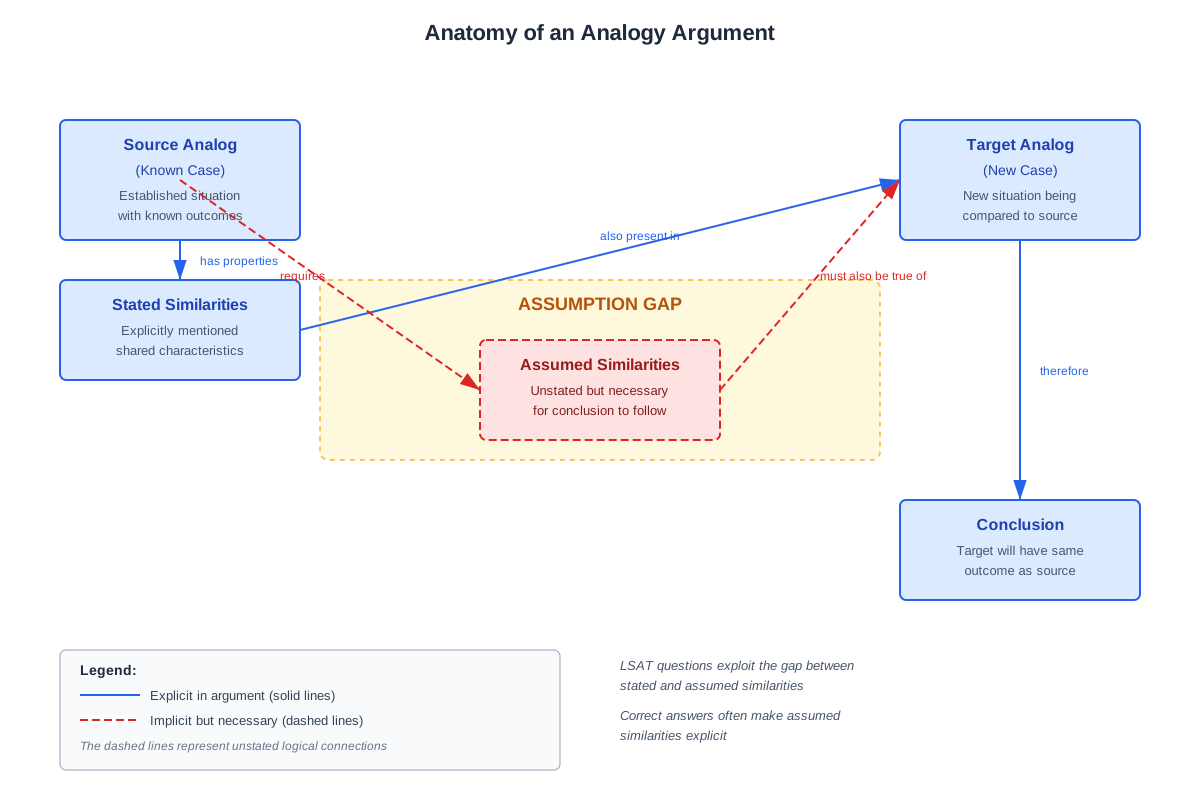
The core structure of analogical reasoning involves comparing a known case (the source analog) to a new case (the target analog) and inferring that because they share certain characteristics, they will share additional characteristics. However, such reasoning is only valid if the two cases are relevantly similar—that is, similar in ways that actually matter to the conclusion being drawn. The gap between stated similarities and assumed similarities creates the logical vulnerability that the LSAT exploits in these questions.
Understanding lsat analogy assumptions is essential because they connect to broader principles of conditional reasoning, causal reasoning, and sufficient/necessary conditions. When students master analogy assumptions, they develop a critical eye for evaluating comparative arguments across all question types. This skill extends beyond pure assumption questions into strengthen/weaken questions (where answer choices often highlight relevant differences or similarities) and method of reasoning questions (where the test asks students to identify that an argument proceeds by analogy). The ability to spot unstated assumptions in analogical reasoning represents a cornerstone skill for achieving elite LSAT scores.
Learning Objectives
- [ ] Identify how Analogy assumptions appears in LSAT questions
- [ ] Explain the reasoning pattern behind Analogy assumptions
- [ ] Apply Analogy assumptions to solve LSAT-style problems accurately
- [ ] Distinguish between relevant and irrelevant similarities when evaluating analogies
- [ ] Recognize the specific language patterns that signal analogical reasoning in LSAT stimuli
- [ ] Predict the most common ways the LSAT will test analogy assumptions across different question types
- [ ] Evaluate answer choices by determining whether they address the gap between compared situations
Prerequisites
- Basic argument structure: Understanding premises and conclusions is essential because analogy arguments follow the standard structure where comparative premises support a conclusion about similarity.
- Assumption question fundamentals: Students must know what assumptions are (unstated premises necessary for the conclusion) to identify what makes analogies work.
- Conditional reasoning basics: Many analogy arguments implicitly rely on conditional logic (if X has property A and outcome B, then Y with property A will have outcome B).
- Premise-conclusion identification: Recognizing where the comparison occurs (premises) versus what is being inferred (conclusion) is critical for spotting the assumption gap.
Why This Topic Matters
Analogy assumptions appear in approximately 15-20% of all Logical Reasoning questions on the LSAT, making them one of the highest-yield patterns to master. They surface most commonly in assumption questions (both necessary and sufficient), flaw questions (where the flaw is "reasoning by analogy without establishing relevant similarity"), and strengthen/weaken questions (where correct answers often highlight relevant differences or similarities).
In real-world contexts, analogical reasoning pervades legal argumentation. Attorneys constantly argue that a current case should be decided like a precedent case because the situations are sufficiently similar. Judges evaluate whether the similarities are legally relevant. The LSAT tests this skill because it directly predicts success in legal reasoning. Understanding when analogies are strong versus weak is fundamental to case law analysis, statutory interpretation, and persuasive legal writing.
On the exam, analogy assumptions typically appear in arguments that compare: scientific studies or experiments, historical situations, different groups of people, business practices across companies, policies in different jurisdictions, or hypothetical scenarios to real situations. The LSAT frequently disguises these comparisons, so recognizing the underlying analogical structure—even when the word "similar" or "like" doesn't appear—is crucial for efficient question-solving.
Core Concepts
The Structure of Analogical Arguments
An analogical argument follows a predictable pattern: it establishes that two entities (situations, cases, groups, etc.) share one or more characteristics, then concludes they will share an additional characteristic. The formal structure looks like this:
- Entity A has characteristics X, Y, and Z
- Entity B has characteristics X and Y
- Therefore, Entity B probably has characteristic Z
The analogy assumption is that entities A and B are similar in all relevant respects—that is, there are no differences between them that would prevent the conclusion from following. This assumption bridges the gap between the stated similarities and the inferred similarity.
Relevant vs. Irrelevant Similarities
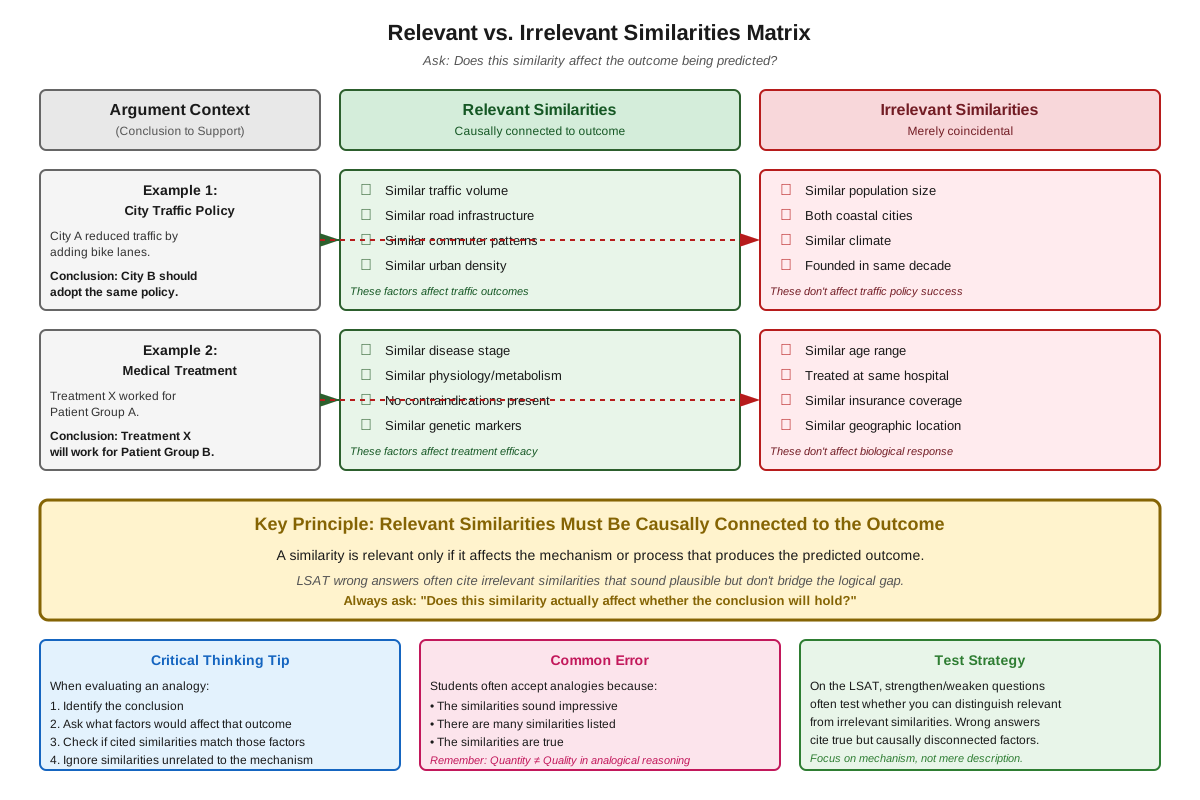
Not all similarities matter equally. A similarity is relevant if it affects the likelihood of the conclusion being true. For example, if an argument concludes that a medication effective in rats will be effective in humans because both are mammals, the assumption is that being mammals is the relevant similarity. However, if rats and humans differ significantly in metabolism, body size, or cellular structure in ways that affect drug efficacy, these differences undermine the analogy.
The LSAT exploits this distinction constantly. Wrong answer choices in assumption questions often present similarities that sound plausible but are actually irrelevant to the conclusion. Correct answers identify the specific similarities that must hold for the argument to work.
The Assumption Gap in Analogies
Every analogical argument contains an assumption gap—the logical space between "these things are similar in some ways" and "therefore they're similar in this additional way." The LSAT tests whether students can identify what must be true to bridge this gap.
Consider this structure:
- Stated: Policy worked in Country A
- Stated: Country B shares economic feature X with Country A
- Concluded: Policy will work in Country B
- Assumed: Countries A and B don't differ in other ways relevant to the policy's success
The assumption is always about the absence of relevant differences or the presence of additional relevant similarities.
Types of Analogy Assumptions on the LSAT
| Type | Description | Example Structure |
|---|---|---|
| No Relevant Differences | Assumes the compared entities don't differ in ways that matter | "There are no differences between the two cities that would affect traffic patterns" |
| Sufficient Similarity | Assumes the stated similarities are enough to support the conclusion | "The similarities in climate are sufficient to predict crop yields" |
| Causal Mechanism Transfer | Assumes the causal relationship in one case will operate the same way in another | "What caused success in the first company will cause success in the second" |
| Scope Limitation | Assumes the comparison is limited to the relevant domain | "The comparison holds for the specific aspect being discussed, not all aspects" |
Identifying Analogy Arguments
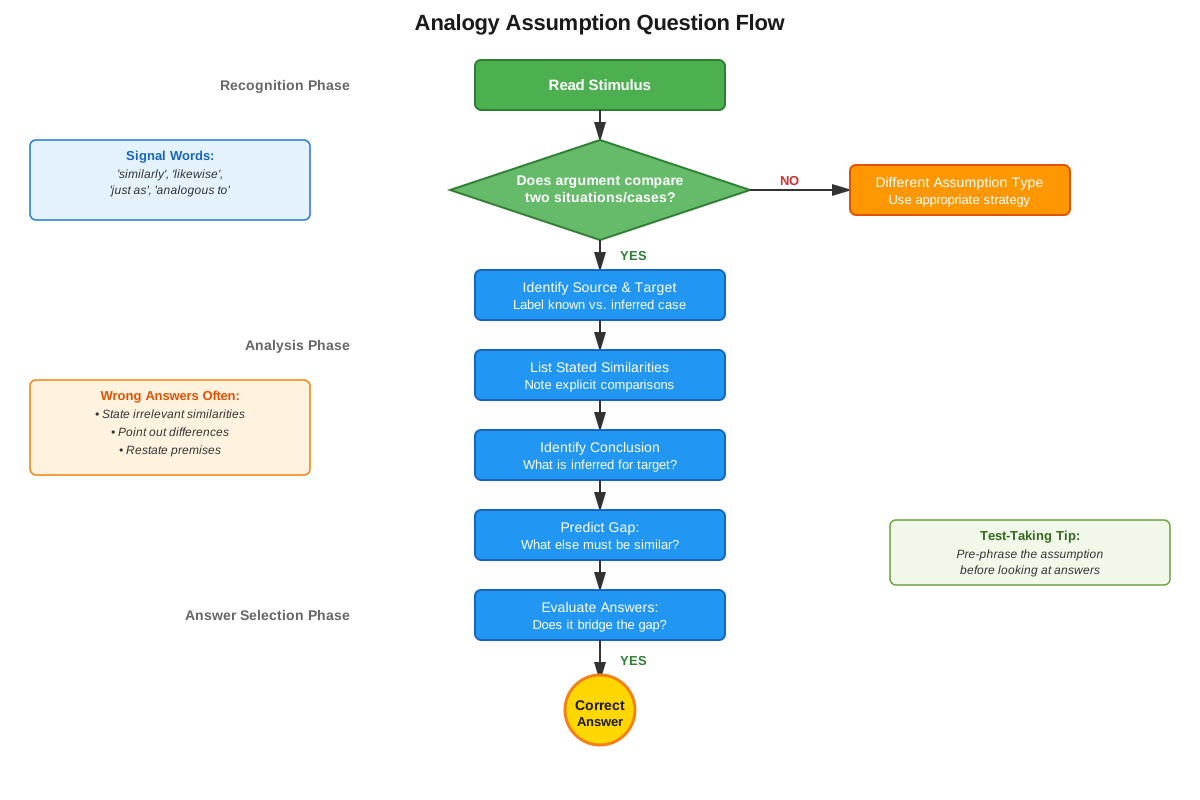
Several linguistic markers signal analogical reasoning:
- Explicit comparison words: "similarly," "likewise," "in the same way," "just as," "analogous to"
- Parallel structure: "X did Y and achieved Z; therefore, A should do Y to achieve Z"
- Historical precedent: "In the past, when X occurred, Y resulted; now X is occurring again"
- Study comparisons: "A study of Group A found X; therefore, we can expect X in Group B"
- Hypothetical parallels: "If we wouldn't accept X in Situation A, we shouldn't accept it in Situation B"
However, many LSAT analogy arguments don't use explicit comparison language. Students must recognize the underlying structure: whenever an argument uses evidence from one case to draw a conclusion about a different case, analogical reasoning is at work.
The Necessity Test for Analogy Assumptions
To determine whether an assumption is necessary for an analogical argument, apply the negation test: negate the assumption and see if the argument falls apart. For analogy assumptions specifically:
- Identify the two entities being compared
- Identify what's being concluded about the second entity based on the first
- Negate the proposed assumption (usually by asserting a relevant difference exists)
- Check if the negation destroys the argument
If negating the assumption makes the argument fail, the assumption is necessary.
Common Analogy Assumption Patterns
The LSAT recycles certain analogy assumption patterns:
Pattern 1: Study Generalization
- Premise: Study of Group A showed result X
- Conclusion: Group B will show result X
- Assumption: Groups A and B are similar in ways relevant to X
Pattern 2: Historical Precedent
- Premise: In past situation P, action A led to outcome O
- Conclusion: In current situation C, action A will lead to outcome O
- Assumption: Situations P and C are similar in ways relevant to the causal relationship
Pattern 3: Policy Transfer
- Premise: Policy worked in Location L1
- Conclusion: Policy will work in Location L2
- Assumption: L1 and L2 are similar in ways relevant to the policy's effectiveness
Pattern 4: Comparative Prediction
- Premise: Entity E1 with features F succeeded
- Conclusion: Entity E2 with features F will succeed
- Assumption: No other features besides F are necessary for success
Concept Relationships
Analogy assumptions connect intimately with several other Logical Reasoning concepts. They represent a specific application of the broader category of assumption questions, where students must identify unstated premises. Within assumption questions, analogy assumptions are distinct from causal assumptions (which assume a cause-effect relationship) and representativeness assumptions (which assume a sample represents a population).
The relationship flows as follows:
Assumption Questions (general) → branches into → Analogy Assumptions (specific type) → which requires understanding → Relevant vs. Irrelevant Differences → which connects to → Strengthen/Weaken Questions (where highlighting differences weakens analogies and highlighting similarities strengthens them)
Additionally, analogy assumptions relate to flaw questions because "reasoning by analogy without establishing relevant similarity" is a common flaw type. They also connect to parallel reasoning questions, where students must match the structure of analogical arguments.
The prerequisite knowledge of conditional reasoning supports analogy assumptions because many analogies implicitly contain conditional statements: "If X has property P and outcome O, then Y with property P will have outcome O." Understanding this conditional structure helps students see why the assumption (that P is sufficient for O, or that no other properties matter) is necessary.
Finally, analogy assumptions relate to method of reasoning questions, where correct answers might state "the argument proceeds by drawing a parallel between two situations" or "uses a comparison to support its conclusion."
High-Yield Facts
⭐ Analogy assumptions always involve the claim that two compared entities are similar in all relevant respects or lack relevant differences.
⭐ The LSAT most commonly tests analogy assumptions through necessary assumption questions, where the correct answer eliminates a potential relevant difference.
⭐ When an argument cites a study, historical example, or precedent to support a conclusion about a different situation, it's using analogical reasoning.
⭐ Relevant similarities are those that actually affect the likelihood of the conclusion; irrelevant similarities are distractors.
⭐ The negation test is particularly effective for analogy assumptions: if asserting a relevant difference exists destroys the argument, the assumption that no such difference exists is necessary.
- Analogy assumptions appear in approximately 15-20% of Logical Reasoning questions across all question types.
- Strengthen questions often have correct answers that highlight additional similarities between compared entities.
- Weaken questions often have correct answers that highlight relevant differences between compared entities.
- Flaw questions may describe the error as "takes for granted that the two situations are comparable in all relevant respects."
- Wrong answers in analogy assumption questions often present similarities that are true but irrelevant to the conclusion.
- The LSAT rarely uses explicit language like "by analogy"; students must recognize the comparative structure.
- Temporal analogies (past to present) are especially common in LSAT arguments about policy and prediction.
- Scientific study analogies (from one group to another) appear frequently in both Logical Reasoning sections.
- The assumption is not that the entities are identical in all respects, only in respects relevant to the conclusion.
- Multiple relevant differences can exist; the assumption typically addresses the most significant potential difference.
Quick check — test yourself on Analogy assumptions so far.
Try Flashcards →Common Misconceptions
Misconception: Analogy assumptions require that the two compared entities be identical in every way.
Correction: Analogy assumptions only require similarity in relevant respects—those that affect the conclusion. Two entities can differ in countless ways as long as those differences don't undermine the specific inference being made.
Misconception: If an argument mentions any similarity between two things, it must be using analogical reasoning.
Correction: Analogical reasoning specifically involves using similarities to infer an additional characteristic or outcome. Merely noting that two things share a feature without drawing a further inference is not analogical reasoning.
Misconception: The correct answer to an analogy assumption question will always use words like "similar" or "comparable."
Correction: Correct answers often express the assumption by stating that a specific relevant difference does NOT exist, or that a particular feature IS shared, without using explicit comparison language.
Misconception: All similarities mentioned in the premises are relevant to the conclusion.
Correction: Arguments often include irrelevant similarities as distractors. Students must evaluate which similarities actually matter to the specific conclusion being drawn.
Misconception: Analogy assumptions only appear in assumption questions.
Correction: While they're tested directly in assumption questions, analogical reasoning appears across question types: flaw questions (identifying the analogical flaw), strengthen/weaken questions (adding similarities or differences), method of reasoning questions (describing the analogical structure), and parallel reasoning questions (matching analogical patterns).
Misconception: If two entities share multiple characteristics, the analogy is automatically strong.
Correction: The number of similarities matters less than whether those similarities are relevant. Two entities could share dozens of irrelevant features while differing in the one feature that matters most to the conclusion.
Misconception: Historical analogies assume the past and present are identical.
Correction: Historical analogies only assume that the past and present are similar in ways relevant to the causal relationship or outcome being predicted. They allow for many differences as long as those differences don't affect the specific mechanism or result in question.
Worked Examples
Example 1: Study Comparison
Stimulus: "A recent study found that employees who work in offices with natural lighting report higher job satisfaction than those in offices with only artificial lighting. Therefore, installing more windows in our office building will increase employee satisfaction."
Question: Which of the following is an assumption required by the argument?
Analysis:
- Identify the analogy structure: The argument compares employees in the study (with natural lighting) to employees in "our office building" and concludes that what was true in the study will be true in our building.
- Identify what's being compared:
- Source analog: Employees in the study's offices
- Target analog: Employees in "our office building"
- Shared characteristic (stated): Natural lighting
- Inferred characteristic: Increased satisfaction
- Identify the assumption gap: The argument assumes that the employees in our office building are similar to the study participants in ways relevant to how lighting affects satisfaction. It also assumes that natural lighting was actually the cause of increased satisfaction in the study (not some other factor).
- Predict the assumption: The offices/employees must not differ in ways that would prevent natural lighting from having the same effect. For example, the assumption might be that our employees don't have different preferences, that our building's structure allows for effective natural lighting, or that no other factors in our office would override the lighting effect.
- Evaluate answer choices (hypothetical):
- (A) "The employees in our office building have similar preferences regarding workplace environment as the study participants." ✓ This addresses a potential relevant difference.
- (B) "Natural lighting is the most important factor in job satisfaction." ✗ Too strong; the argument only needs natural lighting to increase satisfaction, not be the most important factor.
- (C) "The study included a large number of participants." ✗ This addresses study validity, not the comparison between study participants and our employees.
- (D) "Installing windows is cost-effective." ✗ Irrelevant to whether it will increase satisfaction.
- (E) "Our office building currently has only artificial lighting." ✗ This might be implied but isn't necessary for the conclusion that adding windows will increase satisfaction.
Answer: (A) is correct because it eliminates a relevant difference that could undermine the analogy.
Example 2: Historical Precedent
Stimulus: "When the city of Riverside implemented a congestion pricing system for downtown traffic five years ago, traffic decreased by 30% within six months. The city of Lakewood is considering a similar congestion pricing system. If implemented, Lakewood can expect similar reductions in traffic."
Question: The argument's conclusion follows logically if which one of the following is assumed?
Analysis:
- Identify the analogy structure: The argument uses Riverside's past experience to predict Lakewood's future outcome.
- Map the comparison:
- Source analog: Riverside (past)
- Target analog: Lakewood (future)
- Shared characteristic: Congestion pricing system
- Inferred outcome: 30% traffic reduction
- Identify potential relevant differences: The cities might differ in:
- Population size or density
- Availability of public transportation alternatives
- Economic factors affecting residents' ability to pay
- Geographic layout or traffic patterns
- Cultural attitudes toward driving
- Time period (economic conditions may have changed)
- Predict the assumption: The argument must assume that Riverside and Lakewood don't differ in ways that would affect how congestion pricing impacts traffic. The assumption eliminates relevant differences.
- Evaluate answer choices (hypothetical):
- (A) "Lakewood and Riverside have similar population densities." ✓ This addresses a potentially relevant difference that could affect how congestion pricing works.
- (B) "Congestion pricing is the most effective way to reduce traffic." ✗ The argument doesn't need this to be the most effective method, just that it will work.
- (C) "Lakewood's traffic problem is worse than Riverside's was." ✗ This doesn't establish that the solution will work similarly; if anything, it suggests a difference.
- (D) "Residents of Lakewood support congestion pricing." ✗ Support might affect implementation but isn't necessary for the prediction about traffic reduction if implemented.
- (E) "Riverside's traffic reduction has been maintained over five years." ✗ This addresses sustainability but not whether Lakewood will see initial similar results.
Answer: (A) is correct because population density could significantly affect whether congestion pricing produces similar results, making this similarity necessary for the argument.
Exam Strategy
Recognizing Analogy Arguments Quickly
When reading LSAT stimuli, watch for these triggers that signal analogical reasoning:
- Comparison words: "similarly," "likewise," "just as," "in the same way"
- Study citations: "A study of X found..." followed by a conclusion about Y
- Historical references: "In the past, when X happened..." followed by a prediction
- Precedent language: "In other cases," "previously," "other examples show"
- Parallel structure: Two situations described with parallel grammar
Even without explicit markers, if the argument uses evidence from one case to conclude something about a different case, treat it as analogical reasoning.
Approaching Assumption Questions with Analogies
- Identify the two entities being compared (underline or mentally note them)
- Identify what's concluded about the second entity based on the first
- Ask: "What could be different between these entities that would break the argument?"
- Predict: The assumption will eliminate that relevant difference or assert a necessary similarity
- Evaluate answer choices by negating them—if the negation reveals a relevant difference that destroys the argument, that's your answer
Process of Elimination Tips
Eliminate answer choices that:
- Present similarities that are true but irrelevant to the specific conclusion
- Are too strong (using "only," "most important," "always") when the argument needs a more modest assumption
- Address the internal validity of the source analog rather than the comparison between analogs
- Introduce new information not connected to bridging the analogy gap
- State something that would be true whether or not the conclusion follows
Keep answer choices that:
- Eliminate a specific, plausible relevant difference
- Assert that a particular feature relevant to the conclusion is shared
- Address the mechanism or causal relationship that must transfer from one case to the other
- Use modest language ("can," "some," "not all") that matches the argument's scope
Time Allocation
Analogy assumption questions typically require 1:15-1:30 to solve accurately. Spend:
- 20-30 seconds: Reading and identifying the analogical structure
- 15-20 seconds: Predicting the assumption (what relevant difference must not exist)
- 30-40 seconds: Evaluating answer choices with the negation test
If you're stuck between two answer choices, apply the negation test rigorously to both—the one whose negation more directly destroys the argument is correct.
Common Trap Patterns
The LSAT frequently includes wrong answers that:
- State obvious truths that don't bridge the assumption gap ("The study participants were real people")
- Reverse the logic (stating what would strengthen the analogy rather than what's assumed)
- Address irrelevant similarities (features the entities share that don't matter to the conclusion)
- Go too far (claiming the entities are identical rather than similar in relevant respects)
Memory Techniques
The COMPARE Acronym
Use COMPARE to remember how to analyze analogy assumptions:
- Cases: Identify the two cases/entities being compared
- Outcome: What outcome or characteristic is being inferred?
- Mechanism: What mechanism or causal relationship must transfer?
- Parallels: What similarities are stated in the premises?
- Assumption: What relevant similarity is assumed but unstated?
- Relevance: Are the stated similarities actually relevant to the conclusion?
- Eliminate: What relevant differences must be eliminated?
Visualization Strategy
Picture analogy arguments as two parallel columns:
Source Analog          Target Analog
--------------         --------------
Feature A    ------>   Feature A (stated)
Feature B    ------>   Feature B (stated)
Feature C    ------>   Feature C (assumed/concluded)
The assumption is that the arrow from Feature C is valid—that nothing prevents the transfer of this characteristic.
The "Relevant Difference" Mantra
When you identify analogical reasoning, immediately ask: "What could be relevantly different?" This question focuses your attention on the assumption gap. The correct answer will typically eliminate the most plausible relevant difference.
Pattern Recognition Shortcut
Memorize these three most common analogy patterns:
- Study → Population: "Study found X in Group A, so Group B will show X"
- Past → Present: "X caused Y in the past, so X will cause Y now"
- Place → Place: "Policy worked in Location A, so it will work in Location B"
When you spot one of these patterns, you know the assumption will address relevant differences between the groups, time periods, or locations.
Summary
Analogy assumptions represent a critical reasoning pattern on the LSAT, appearing in 15-20% of Logical Reasoning questions. These arguments compare two entities—situations, groups, time periods, or cases—and conclude that what is true in one will be true in the other based on stated similarities. The fundamental assumption underlying all analogical reasoning is that the compared entities are similar in all relevant respects, meaning they don't differ in ways that would undermine the specific conclusion being drawn. Students must distinguish between relevant similarities (those that actually affect the conclusion) and irrelevant similarities (those that don't matter). The LSAT tests this through assumption questions (where correct answers eliminate relevant differences), strengthen/weaken questions (where answers add similarities or differences), and flaw questions (where the flaw is failing to establish relevant similarity). Mastering analogy assumptions requires recognizing comparative structures even without explicit comparison language, predicting what relevant differences could exist, and applying the negation test to evaluate whether an assumption is necessary. Success depends on focusing on relevance rather than mere similarity and understanding that arguments need similarity in specific respects, not identity in all respects.
Key Takeaways
- Analogy assumptions bridge the gap between stated similarities and inferred similarities by assuming no relevant differences exist between compared entities
- Relevant similarities are those that actually affect the conclusion; the LSAT uses irrelevant similarities as distractors
- The three most common analogy patterns are study-to-population, past-to-present, and location-to-location comparisons
- Apply the negation test: if asserting a relevant difference exists destroys the argument, the assumption that no such difference exists is necessary
- Correct answers often eliminate specific relevant differences rather than asserting complete similarity
- Watch for analogical reasoning even without explicit comparison words—any argument using one case to conclude about another case employs analogy
- Focus on mechanism transfer: the assumption often involves whether the causal relationship or mechanism that operated in one case will operate in the other
Related Topics
Causal Assumptions: While analogy assumptions involve comparing entities, causal assumptions involve inferring cause-effect relationships. Many analogy arguments implicitly contain causal reasoning (assuming the cause in one case will operate the same way in another), making these topics closely related.
Strengthen and Weaken Questions: Mastering analogy assumptions directly improves performance on strengthen/weaken questions, where correct answers frequently highlight additional similarities (strengthen) or relevant differences (weaken) between compared entities.
Flaw Questions: "Reasoning by analogy without establishing relevant similarity" is a common flaw type. Understanding analogy assumptions enables students to recognize when arguments fail to justify their comparative reasoning.
Sufficient Assumption Questions: While necessary assumption questions ask what must be true, sufficient assumption questions ask what would guarantee the conclusion. For analogies, sufficient assumptions often assert complete similarity in all potentially relevant respects.
Parallel Reasoning: These questions require matching argument structures, and analogical arguments have distinctive structures that students must recognize and replicate.
Practice CTA
Now that you've mastered the conceptual framework of analogy assumptions, it's time to apply this knowledge to actual LSAT questions. The practice questions and flashcards will reinforce your ability to quickly identify analogical reasoning, predict assumptions, and eliminate wrong answers efficiently. Remember: recognizing the pattern is half the battle—the other half is systematically evaluating what relevant differences could exist and finding the answer choice that addresses them. Each practice question you complete strengthens your pattern recognition and builds the automaticity you need to excel on test day. You've built the foundation; now make it instinctive through deliberate practice!
Sign up free to keep reading
Create a free AnvayaPrep account to finish this LSAT guide on Analogy assumptions — plus flashcards and practice questions.