Overview
Causal assumptions represent one of the most frequently tested reasoning patterns on the LSAT Logical Reasoning section. These assumptions appear when an argument concludes that one event or condition causes another, based on observed correlations, temporal sequences, or other evidence. Understanding causal reasoning is essential because approximately 15-20% of Logical Reasoning questions involve causal relationships, making this one of the highest-yield topics for test preparation.
The LSAT tests causal assumptions because they reveal critical thinking skills that law schools value: the ability to distinguish between correlation and causation, identify alternative explanations, and recognize when evidence fails to support a causal claim. Arguments with causal conclusions almost always contain gaps in reasoning—unstated assumptions that must be true for the conclusion to follow logically from the premises. Mastering lsat causal assumptions enables students to quickly identify these gaps and select correct answers on assumption questions, strengthen/weaken questions, and flaw questions.
Within the broader landscape of logical reasoning, causal assumptions connect to fundamental concepts of sufficient and necessary conditions, conditional reasoning, and argument structure. While conditional logic deals with "if-then" relationships, causal reasoning addresses "because of" relationships. Both require identifying unstated connections between premises and conclusions, but causal arguments introduce specific vulnerabilities: reverse causation, third-party causes, coincidence, and the possibility that correlation exists without any causal mechanism. Understanding these vulnerabilities is the key to excelling on LSAT questions involving causal reasoning.
Learning Objectives
- [ ] Identify how Causal assumptions appears in LSAT questions
- [ ] Explain the reasoning pattern behind Causal assumptions
- [ ] Apply Causal assumptions to solve LSAT-style problems accurately
- [ ] Distinguish between correlation and causation in argument structures
- [ ] Recognize the five major types of causal reasoning flaws
- [ ] Evaluate whether evidence provided is sufficient to support a causal claim
- [ ] Generate alternative explanations that would weaken causal arguments
Prerequisites
- Basic argument structure: Understanding premises, conclusions, and the gap between them is essential because causal assumptions fill specific gaps in causal arguments
- Correlation vs. causation distinction: Recognizing that two events occurring together does not prove one causes the other forms the foundation for identifying causal reasoning flaws
- Conditional reasoning fundamentals: Familiarity with sufficient and necessary conditions helps distinguish causal relationships (X causes Y) from conditional relationships (if X, then Y)
- Assumption question mechanics: Knowing how to identify what an argument takes for granted enables recognition of the specific assumptions causal arguments require
Why This Topic Matters
Causal reasoning pervades legal thinking, policy analysis, and everyday decision-making. Attorneys must evaluate whether evidence proves causation in tort cases, whether policy changes will produce intended effects, and whether correlations in data support causal claims. The LSAT tests this reasoning pattern extensively because it directly predicts success in law school case analysis and legal writing.
On the LSAT, causal assumptions appear in approximately 3-5 questions per Logical Reasoning section, accounting for roughly 15-20% of all questions. These questions span multiple question types: assumption (necessary and sufficient), strengthen, weaken, flaw, and occasionally method of reasoning questions. The test makers favor causal reasoning because it creates clear right and wrong answers while testing sophisticated analytical skills.
Common manifestations include: arguments concluding that a new policy caused observed changes, studies claiming one variable causes another based on correlation, historical analyses attributing effects to specific causes, and predictions that implementing a cause will produce a desired effect. The LSAT particularly favors scenarios where temporal sequence (A happened before B) or correlation (A and B occur together) is used as evidence for causation, creating predictable gaps that test-takers must identify.
Core Concepts
The Basic Structure of Causal Arguments
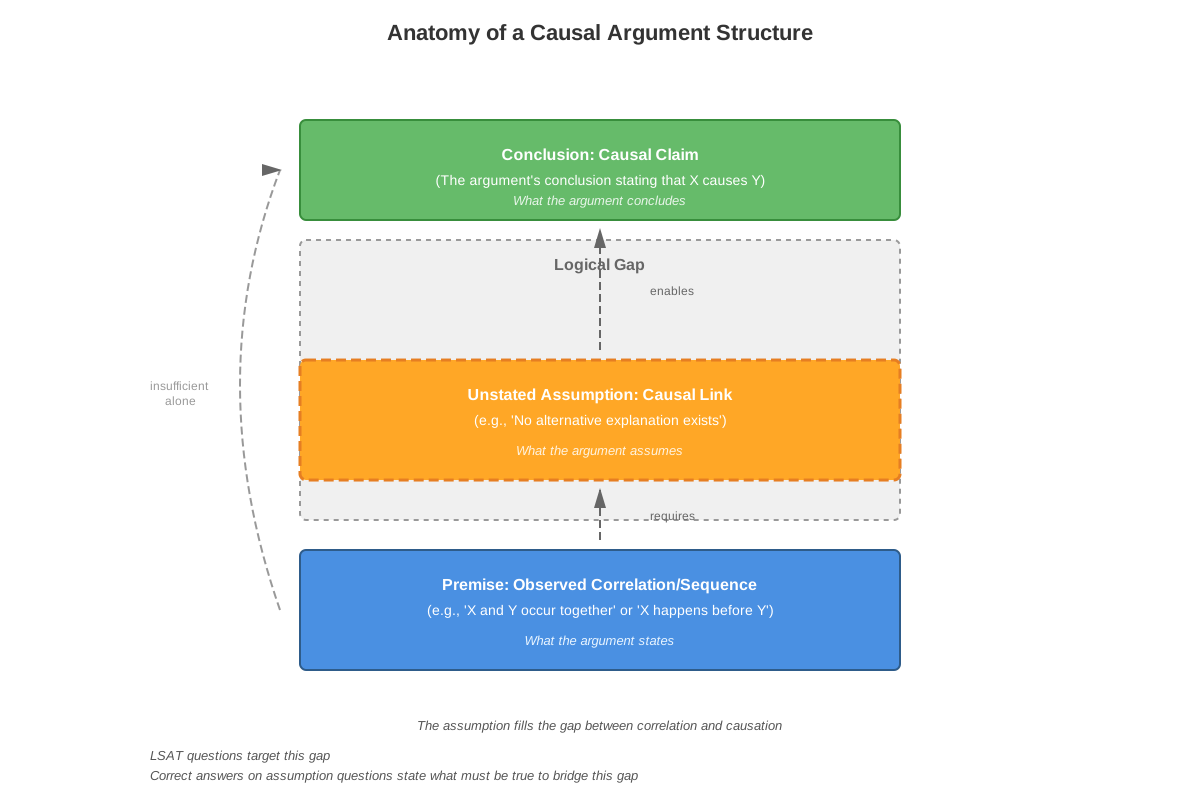
A causal assumption is an unstated belief that one event, condition, or factor (the cause) brings about or produces another event, condition, or factor (the effect). In LSAT arguments, causal claims typically follow this structure:
Premise: Evidence of correlation, temporal sequence, or association between X and Y
Conclusion: X causes Y (or Y is caused by X)
Gap: The argument assumes no alternative explanations exist
The fundamental gap in causal reasoning is that evidence of relationship does not prove causation. The argument must assume away multiple alternative possibilities that would explain the observed relationship without the claimed causal connection.
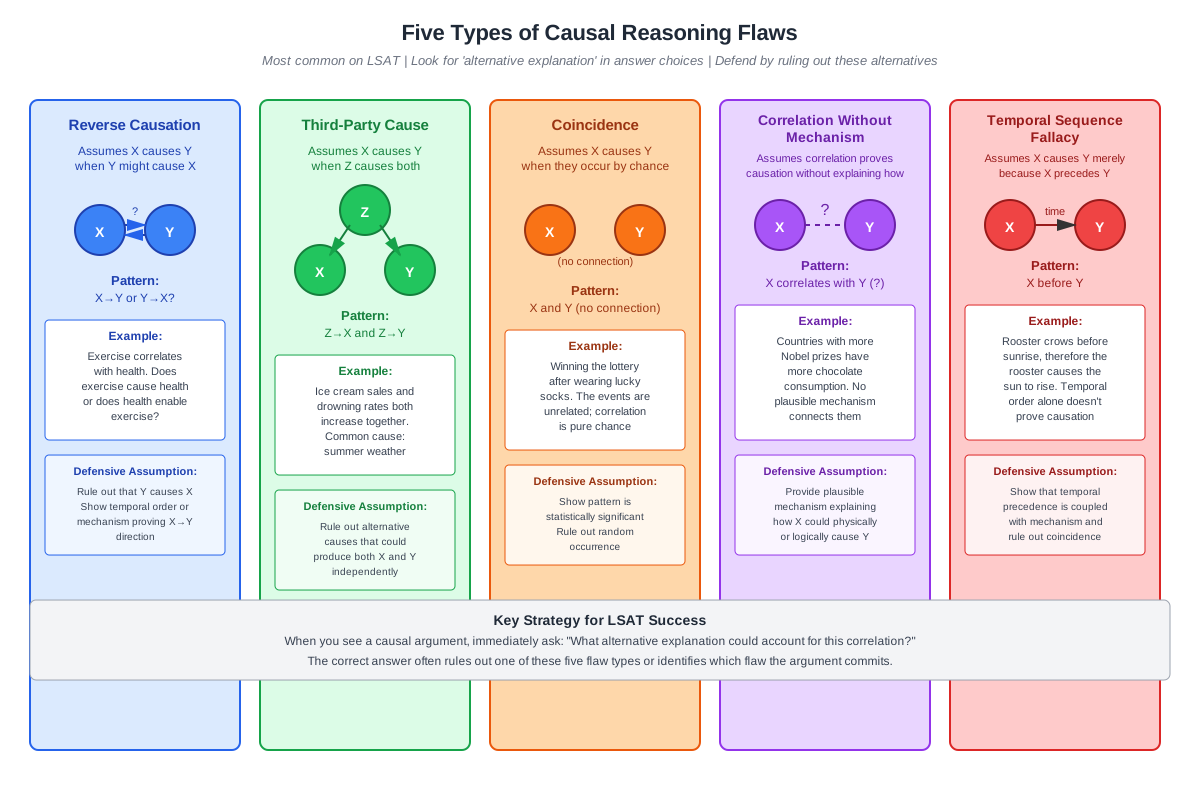
The Five Major Causal Reasoning Flaws
Understanding the specific ways causal arguments can fail is essential for LSAT success:
| Flaw Type | Description | Example |
|---|---|---|
| Reverse Causation | Assumes X causes Y when Y might cause X | Concluding stress causes illness when illness might cause stress |
| Third-Party Cause | Assumes X causes Y when Z might cause both | Concluding ice cream causes drowning when summer weather causes both |
| Coincidence | Assumes causation when correlation is accidental | Concluding a lucky charm caused success when timing was coincidental |
| Correlation Without Causation | Assumes any correlation implies causation | Concluding shoe size causes reading ability when both correlate with age |
| Temporal Sequence Fallacy | Assumes X causes Y simply because X preceded Y | Concluding a rooster's crow causes sunrise |
Identifying Causal Language
The LSAT uses specific language patterns to signal causal claims. Recognizing these trigger words enables rapid identification:
Direct causal language:
- "causes," "caused by," "brings about," "produces," "results in"
- "leads to," "gives rise to," "generates," "creates"
- "is responsible for," "accounts for," "explains why"
Indirect causal language:
- "because of," "due to," "owing to," "thanks to"
- "as a result of," "as a consequence of," "stems from"
- "the reason for," "the source of," "the explanation for"
Predictive causal language (claiming a cause will produce future effects):
- "will cause," "will lead to," "will result in," "will produce"
- "should cause," "is likely to cause," "tends to cause"
The Causal Assumption Pattern
When an LSAT argument makes a causal claim, it systematically assumes:
- No reverse causation: The effect doesn't actually cause what's claimed as the cause
- No alternative causes: No other factor causes the effect
- No coincidence: The correlation isn't accidental or random
- Actual mechanism exists: Some actual causal mechanism connects cause and effect
- Conditions remain constant: Other relevant factors don't change and confound the relationship
These assumptions work together. An argument claiming "increased exercise caused the weight loss" assumes exercise doesn't just correlate with weight loss due to a third factor (like illness causing both increased activity and weight loss), that weight loss didn't somehow cause increased exercise, that the timing wasn't coincidental, that exercise actually can cause weight loss through some mechanism, and that other factors (like diet) remained constant.
Necessary vs. Sufficient Causal Assumptions
On assumption questions specifically, understanding what the argument must assume (necessary assumption) versus what would guarantee the conclusion (sufficient assumption) is crucial:
Necessary causal assumptions eliminate one specific alternative explanation or vulnerability. They're typically narrow: "The weight loss wasn't caused by dietary changes" or "Increased exercise didn't merely correlate with weight loss by coincidence."
Sufficient causal assumptions eliminate all alternative explanations simultaneously. They're typically broad: "Nothing other than increased exercise could have caused the weight loss" or "Increased exercise was the only relevant factor that changed."
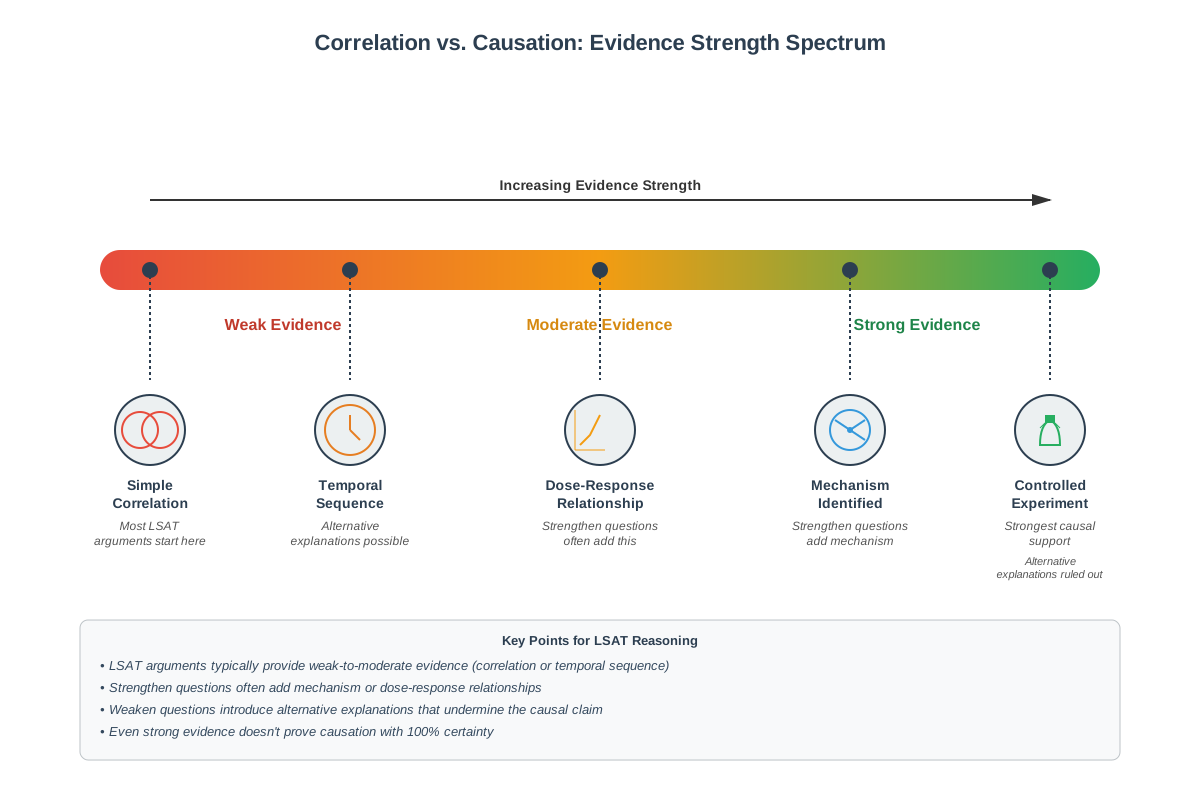
Evidence Types in Causal Arguments
The LSAT presents different evidence types to support causal claims, each with characteristic vulnerabilities:
Temporal evidence (X happened before Y): Assumes temporal sequence implies causation, vulnerable to coincidence and third-party causes that preceded both events.
Correlational evidence (X and Y occur together): Assumes correlation implies causation, vulnerable to reverse causation, third-party causes, and coincidence.
Experimental evidence (When X was introduced, Y followed): Assumes the experimental intervention caused the observed effect, vulnerable to confounding variables and alternative explanations for the change.
Comparative evidence (Group with X has more Y than group without X): Assumes the difference in X explains the difference in Y, vulnerable to other differences between groups.
Concept Relationships
The concepts within causal reasoning form an interconnected system. The basic structure of causal arguments (premise about relationship → conclusion about causation) creates the foundation. This structure inherently contains gaps, which manifest as the five major causal reasoning flaws. Each flaw represents a specific unstated assumption the argument requires.
Identifying causal language → enables recognition of → causal argument structure → which reveals → specific assumptions required → which connect to → necessary vs. sufficient assumptions → determining → correct answer selection
The relationship to prerequisite topics flows naturally: basic argument structure provides the framework for identifying premises and conclusions, while correlation vs. causation supplies the fundamental insight that relationships don't prove causation. Conditional reasoning offers a contrasting relationship type, helping students distinguish "if X then Y" from "X causes Y."
Causal assumptions connect forward to strengthen/weaken questions (where students must identify what would make causal claims more or less likely), flaw questions (where students must describe the causal reasoning error), and method of reasoning questions (where students must characterize how causal arguments proceed).
High-Yield Facts
⭐ Correlation between two events never, by itself, proves causation—arguments concluding causation from correlation always contain assumptions
⭐ Temporal sequence (X before Y) does not prove X caused Y—coincidence and third-party causes remain possible
⭐ Causal arguments assume no reverse causation—they assume the claimed cause isn't actually the effect
⭐ Causal arguments assume no alternative causes—they assume no other factor explains the observed effect
⭐ Causal arguments assume the correlation isn't coincidental—they assume the relationship is meaningful, not random
- Causal language includes "causes," "leads to," "results in," "because of," "due to," and "accounts for"
- Necessary assumptions for causal arguments eliminate one specific alternative explanation
- Sufficient assumptions for causal arguments eliminate all alternative explanations simultaneously
- Experimental evidence for causation still requires assuming no confounding variables affected results
- Comparative evidence for causation requires assuming groups differ only in the claimed causal factor
- The Negation Test works powerfully on causal assumptions: if negating an answer choice destroys the argument, it's a necessary assumption
- Causal predictions (X will cause Y) assume past causal relationships continue into the future
- Multiple causes can produce the same effect, so showing X causes Y doesn't prove X is the only cause
- Causal chains (X causes Y causes Z) require each link to hold and assume no breaks in the sequence
- Statistical correlation strength doesn't prove causation—even perfect correlation might be coincidental or due to third-party causes
Quick check — test yourself on Causal assumptions so far.
Try Flashcards →Common Misconceptions
Misconception: If X and Y are strongly correlated, X must cause Y or Y must cause X.
Correction: Strong correlation can result from a third factor causing both X and Y, or from pure coincidence. Correlation strength indicates relationship strength, not causation.
Misconception: If X happened before Y, and then Y occurred, X caused Y.
Correction: Temporal sequence is necessary but not sufficient for causation. Many events precede other events without causing them. The argument must rule out coincidence and alternative causes.
Misconception: Causal assumptions only appear in assumption questions.
Correction: Causal reasoning appears across question types including strengthen, weaken, flaw, method of reasoning, and parallel reasoning questions. The same causal gaps appear regardless of question type.
Misconception: Showing that X can cause Y proves that X did cause Y in a specific instance.
Correction: Demonstrating a causal mechanism is possible doesn't prove it operated in a particular case. Alternative causes might have produced the effect instead.
Misconception: Eliminating one alternative cause proves the claimed causation.
Correction: Eliminating one alternative cause strengthens the argument but doesn't prove causation unless all alternative causes are eliminated. Multiple alternative explanations typically exist.
Misconception: If an experiment shows X followed by Y, X caused Y.
Correction: Experimental evidence is stronger than mere correlation but still requires assuming no confounding variables, proper controls, and that the experimental conditions reflect real-world conditions.
Misconception: Necessary assumptions for causal arguments must explicitly state "X causes Y."
Correction: Necessary assumptions often eliminate specific alternatives ("The effect wasn't caused by Z") rather than directly asserting the causal claim.
Worked Examples
Example 1: Basic Causal Assumption Question
Argument: "Company profits increased by 15% in the quarter following the implementation of the new management training program. Therefore, the management training program caused the increase in profits."
Question: Which of the following is an assumption required by the argument?
Analysis:
Step 1: Identify the causal claim
The conclusion explicitly states the training program caused the profit increase.
Step 2: Identify the evidence
The evidence is temporal sequence: profits increased after the program was implemented.
Step 3: Identify the gap
The argument moves from temporal sequence to causation. This requires assuming:
- No reverse causation (profits didn't somehow cause the training)
- No alternative causes (nothing else caused the profit increase)
- Not coincidental (the timing wasn't accidental)
Step 4: Predict the assumption
The correct answer will eliminate one specific alternative explanation. Likely options include: "No other significant changes occurred during that quarter" or "Market conditions didn't improve during that quarter."
Step 5: Evaluate answer choices
Correct answer: "No major competitor went out of business during that quarter."
This is necessary because if a major competitor disappeared, that alternative cause could fully explain the profit increase without the training program having any effect. The argument must assume this didn't happen.
Connection to learning objectives: This example demonstrates identifying causal language ("caused"), explaining the reasoning pattern (temporal sequence to causation), and applying the framework to eliminate alternative causes.
Example 2: Complex Causal Assumption with Multiple Variables
Argument: "Studies show that countries with higher chocolate consumption have more Nobel Prize winners per capita. This demonstrates that eating chocolate enhances cognitive function, leading to greater intellectual achievement."
Question: The argument's reasoning is most vulnerable to criticism on the grounds that it fails to consider whether...
Analysis:
Step 1: Identify the causal claim
The argument concludes chocolate consumption causes enhanced cognitive function, which causes intellectual achievement (a causal chain).
Step 2: Identify the evidence
The evidence is correlation: chocolate consumption and Nobel Prizes occur together across countries.
Step 3: Identify multiple vulnerabilities
This argument has several major gaps:
- Reverse causation: Maybe intellectual achievement leads to higher income, which enables chocolate consumption
- Third-party cause: Maybe national wealth causes both chocolate consumption (expensive) and better education (producing Nobel winners)
- Coincidence: Maybe the correlation is accidental
- Ecological fallacy: Maybe country-level correlation doesn't reflect individual-level causation
Step 4: Predict the criticism
The correct answer will point out one of these alternative explanations, most likely the third-party cause (wealth) since it's the most plausible.
Step 5: Evaluate answer choices
Correct answer: "...wealthier countries both consume more chocolate and invest more heavily in education and research."
This identifies the third-party cause vulnerability. If national wealth causes both chocolate consumption and the conditions producing Nobel winners, the correlation between chocolate and prizes doesn't indicate causation.
Connection to learning objectives: This example shows identifying causal assumptions in complex arguments with multiple steps, explaining why correlational evidence doesn't prove causation, and applying knowledge of third-party causes to evaluate arguments.
Exam Strategy
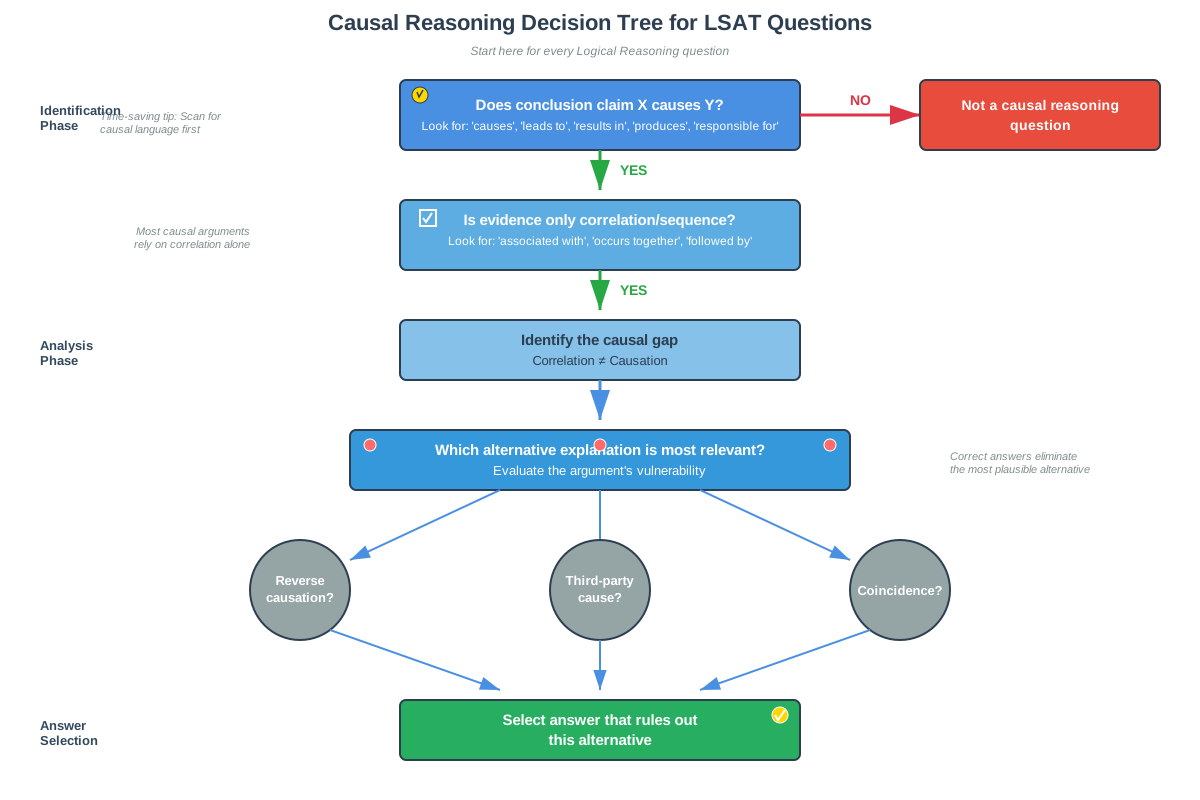
Systematic Approach to Causal Questions
- Scan for causal language in the conclusion first (causes, leads to, results in, because of, due to)
- Identify what evidence type supports the causal claim (temporal, correlational, experimental, comparative)
- Immediately think "alternative explanations" before reading answer choices
- Generate the big three alternatives: reverse causation, third-party cause, coincidence
- Match your prediction to answer choices rather than evaluating each choice independently
Trigger Words and Phrases
High-Alert Causal Triggers: When you see these phrases, immediately activate causal reasoning analysis: "caused by," "resulted from," "led to," "because of," "accounts for," "explains why," "is responsible for," "brought about"
Subtle Causal Triggers: These imply causation without explicit causal language: "the reason," "the source," "thanks to," "stems from," "owing to," "given that" (when used to explain, not just provide evidence)
Process of Elimination Tips
Eliminate answers that:
- Strengthen the causal claim rather than identifying an assumption (on assumption questions)
- Address irrelevant factors that don't connect to the cause-effect relationship
- State the conclusion rather than an assumption
- Are too extreme (using "only," "always," "never") for necessary assumption questions
- Fail the Negation Test: if negating the choice doesn't hurt the argument, eliminate it
Keep answers that:
- Eliminate one specific alternative explanation
- Rule out reverse causation
- Rule out third-party causes
- Rule out coincidence
- Address confounding variables in experimental evidence
Time Allocation Advice
Causal reasoning questions should take 60-90 seconds once you've mastered the pattern:
- 15-20 seconds: Read argument, identify causal claim and evidence type
- 10-15 seconds: Generate alternative explanations
- 20-30 seconds: Evaluate answer choices against your prediction
- 10-15 seconds: Verify with Negation Test if needed
If you're taking longer, you're likely evaluating each answer choice independently rather than predicting first. Practice generating the three major alternatives (reverse causation, third-party cause, coincidence) within 10 seconds of identifying a causal argument.
Memory Techniques
The RACE Mnemonic for Causal Vulnerabilities
Reverse causation - Could the effect actually cause what's claimed as the cause?
Alternative causes - Could something else cause the effect?
Coincidence - Could the correlation be accidental?
Evidence insufficient - Does the evidence type actually support causation?
When you see causal language, mentally run through RACE to identify the argument's vulnerabilities.
The "Before/With/After" Framework
Visualize three boxes:
[BEFORE] → [WITH] → [AFTER]
- BEFORE: What happened before both events? (third-party cause)
- WITH: What happens alongside both events? (correlation, third-party cause)
- AFTER: What happened after? (reverse causation, temporal sequence)
This spatial framework helps organize alternative explanations quickly.
The Causation Checklist Acronym: MEANT
Mechanism exists - Is there a plausible way X could cause Y?
Evidence sufficient - Does the evidence type support causation?
Alternatives ruled out - Are other causes eliminated?
No reverse causation - Is the causal direction correct?
Timing not coincidental - Is the correlation meaningful?
An argument claiming causation must have MEANT to prove it—if any element is missing, the argument contains an assumption.
Summary
Causal assumptions represent the gap between evidence of relationships (correlation, temporal sequence, association) and conclusions about causation. The LSAT tests this reasoning pattern extensively because it requires sophisticated analytical thinking: distinguishing correlation from causation, generating alternative explanations, and recognizing when evidence fails to support causal claims. Every causal argument on the LSAT contains assumptions—typically that no reverse causation occurred, no alternative causes exist, and the correlation isn't coincidental. Mastering causal reasoning requires recognizing causal language, identifying evidence types, systematically generating the major alternative explanations (reverse causation, third-party causes, coincidence), and matching these alternatives to answer choices. The key insight is that evidence of relationship never proves causation by itself; arguments must assume away alternative explanations. Success on causal reasoning questions comes from immediately activating this framework when causal language appears, predicting the specific assumption required, and efficiently eliminating wrong answers that don't address the causal gap.
Key Takeaways
- Correlation never proves causation—causal arguments always contain assumptions about alternative explanations
- The three major alternatives to check are reverse causation, third-party causes, and coincidence
- Causal language triggers include "causes," "leads to," "results in," "because of," "due to," and "accounts for"
- Temporal sequence (X before Y) is necessary but not sufficient for causation—coincidence remains possible
- Necessary assumptions eliminate one specific alternative; sufficient assumptions eliminate all alternatives
- Generate alternatives before reading answer choices—predict what the argument must assume, then match
- The Negation Test works powerfully on causal assumptions—if negating an answer destroys the argument, it's necessary
Related Topics
Strengthen and Weaken Questions with Causal Arguments: Once you understand causal assumptions, you can identify what would make causal claims more likely (eliminating alternatives) or less likely (introducing alternatives). Mastering causal assumptions is prerequisite to excelling on these question types.
Flaw Questions: Many flaw questions ask you to describe errors in causal reasoning. Understanding causal assumptions enables you to recognize and articulate these flaws using LSAT language like "treats correlation as if it established causation" or "fails to consider alternative explanations."
Method of Reasoning Questions: Some questions ask how causal arguments proceed. Understanding the pattern (evidence of relationship → conclusion of causation) enables you to recognize and describe this reasoning method.
Conditional Logic and Causation: While distinct, causal and conditional reasoning sometimes interact. Understanding both enables you to distinguish "if X then Y" from "X causes Y" and recognize when arguments conflate these relationships.
Practice CTA
Now that you understand the framework for causal assumptions, the next step is deliberate practice. Attempt the practice questions for this topic, focusing on identifying causal language, generating alternative explanations before reading answer choices, and applying the RACE framework. Each practice question reinforces the pattern recognition that makes causal reasoning questions fast and predictable. Use the flashcards to drill causal language triggers and the major alternative explanations until they become automatic. Remember: causal reasoning appears in 15-20% of Logical Reasoning questions—mastering this topic will directly improve your score. You've built the framework; now apply it until the pattern becomes second nature.
Sign up free to keep reading
Create a free AnvayaPrep account to finish this LSAT guide on Causal assumptions — plus flashcards and practice questions.