Overview
The assumption gap is one of the most critical concepts tested in LSAT Logical Reasoning sections. It represents the unstated connection between an argument's premises and its conclusion—the missing logical link that must be true for the argument to hold together. Understanding assumption gaps is essential because approximately 25-30% of all Logical Reasoning questions directly test this concept through assumption questions, strengthen/weaken questions, and flaw questions.
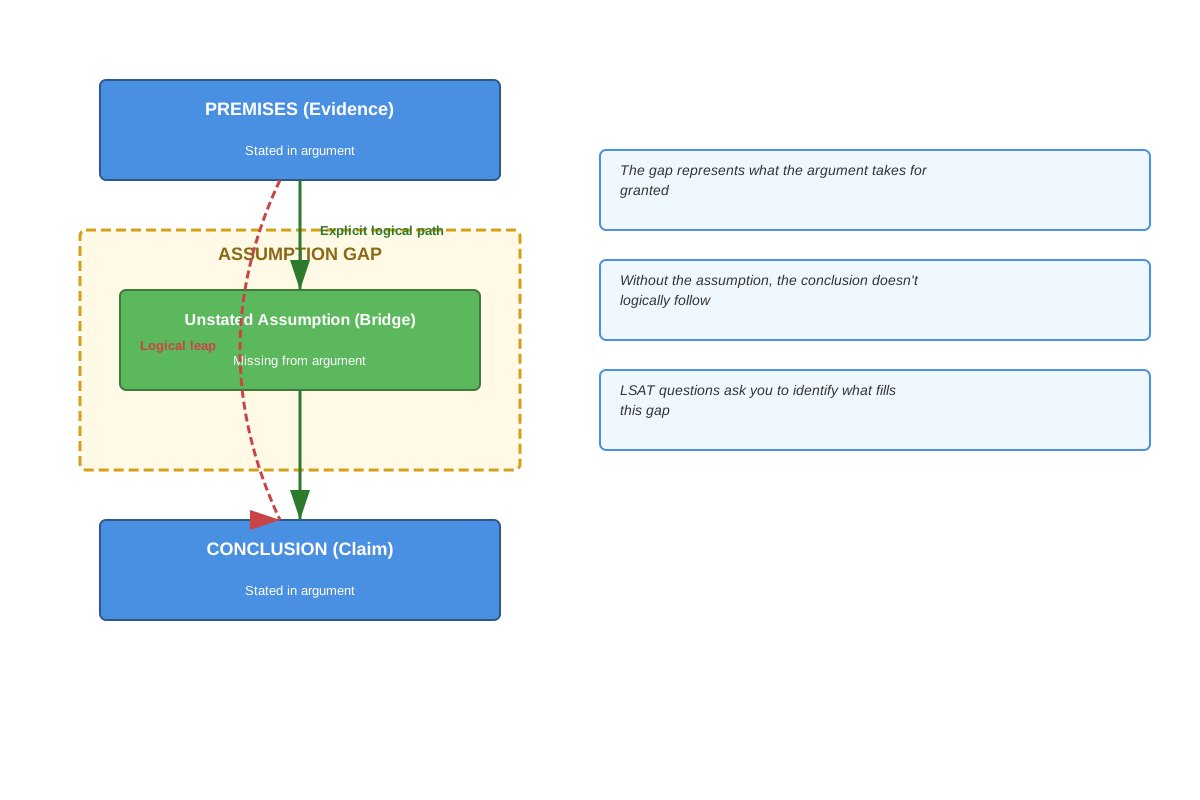
An assumption gap exists whenever an argument jumps from evidence to conclusion without explicitly stating all the logical steps required to make that leap valid. The LSAT tests whether students can identify these gaps, recognize what must be assumed to bridge them, and evaluate whether those assumptions are reasonable. This skill mirrors real-world critical thinking: lawyers must identify unstated assumptions in opposing counsel's arguments, judges must recognize logical gaps in legal reasoning, and effective advocates must ensure their own arguments rest on solid, explicit foundations rather than questionable assumptions.
Mastering assumption gaps provides the foundation for success across multiple question types in Logical Reasoning. Once students can reliably identify the gap between premises and conclusion, they can more easily strengthen arguments (by supporting the assumption), weaken arguments (by attacking the assumption), identify flaws (by recognizing problematic assumptions), and evaluate inferences (by determining what must be true given the premises). This topic serves as a cornerstone skill that elevates performance across the entire Logical Reasoning section.
Learning Objectives
- [ ] Identify how Assumption gap appears in LSAT questions
- [ ] Explain the reasoning pattern behind Assumption gap
- [ ] Apply Assumption gap to solve LSAT-style problems accurately
- [ ] Distinguish between sufficient assumptions and necessary assumptions in arguments
- [ ] Predict the assumption gap before reviewing answer choices
- [ ] Eliminate answer choices that are irrelevant to bridging the specific gap in an argument
Prerequisites
- Basic argument structure: Understanding premises, conclusions, and how to identify each component is essential because assumption gaps exist specifically between these elements
- Conditional reasoning fundamentals: Recognizing if-then relationships helps identify when arguments assume conditional connections that aren't explicitly stated
- Causal reasoning basics: Many assumption gaps involve unstated causal relationships, so understanding how cause-and-effect arguments work is necessary
- Scope and language shifts: Recognizing when an argument introduces new terms or concepts in the conclusion that weren't present in the premises helps locate assumption gaps
Why This Topic Matters
In legal practice, identifying assumption gaps is fundamental to constructing persuasive arguments and dismantling opposing positions. Attorneys must recognize what their arguments take for granted and ensure those assumptions can withstand scrutiny. Similarly, they must identify the weakest assumptions in opposing arguments to effectively challenge them. This skill extends beyond law to business strategy, policy analysis, scientific reasoning, and everyday decision-making.
On the LSAT, assumption-related questions appear with remarkable frequency and predictability. Approximately 12-15 questions per test directly involve identifying or working with assumptions. These include:
- Necessary Assumption questions (4-6 per test): "Which one of the following is an assumption required by the argument?"
- Sufficient Assumption questions (2-3 per test): "Which one of the following, if assumed, allows the conclusion to be properly drawn?"
- Strengthen/Weaken questions (8-10 per test): Often require identifying the assumption to determine what would support or undermine it
- Flaw questions (4-5 per test): Frequently describe arguments that fail because they rely on questionable assumptions
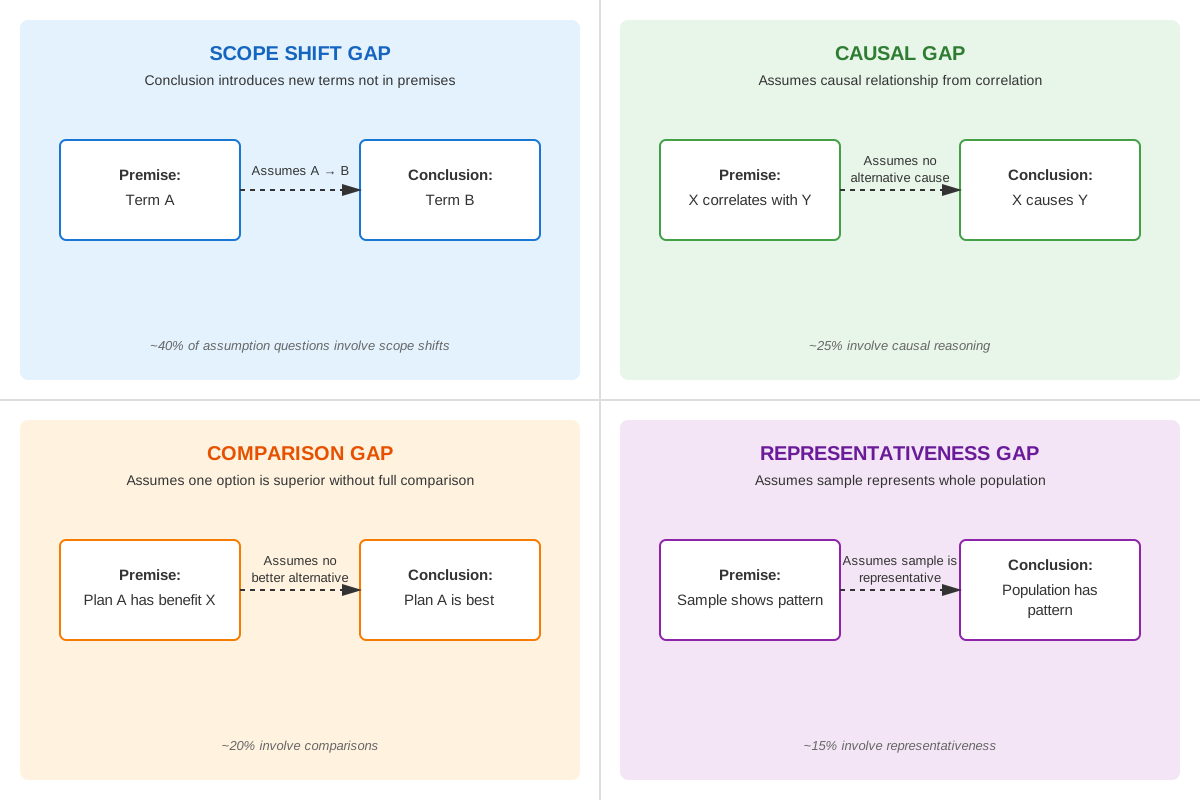
The lsat assumption gap appears most commonly when arguments shift scope between premises and conclusion, introduce new concepts, make causal claims, use comparative reasoning, or rely on representativeness. Test-makers deliberately craft arguments with identifiable gaps, making this a highly learnable and predictable skill that directly translates to point gains.
Core Concepts
What Is an Assumption Gap?
An assumption gap is the logical space between an argument's stated evidence (premises) and its conclusion. It represents information that must be true for the conclusion to follow logically from the premises but is never explicitly stated in the argument. Every LSAT argument with an assumption gap is technically invalid without that assumption—the conclusion doesn't necessarily follow from the premises alone.
Consider this simple example:
- Premise: Sarah scored in the 99th percentile on the LSAT.
- Conclusion: Therefore, Sarah will be an excellent lawyer.
The gap here is obvious: the argument assumes that LSAT performance predicts lawyering ability. This connection is never stated but must be true for the conclusion to follow. The assumption gap is the unstated bridge: "High LSAT scores indicate future excellence as a lawyer."
Types of Assumption Gaps
Scope Shifts
The most common assumption gap involves a scope shift—when the conclusion introduces a concept, term, or category not present in the premises. The argument assumes these different concepts are connected.
Pattern: Premises discuss X → Conclusion discusses Y → Assumption: X relates to Y in the way the argument requires
Example:
- Premise: The new policy will reduce carbon emissions by 30%.
- Conclusion: Therefore, the policy will significantly improve public health.
- Gap: Assumes reduced carbon emissions lead to improved public health
Causal Assumptions
Arguments that conclude one thing causes another often contain gaps about alternative explanations, the direction of causation, or whether correlation indicates causation.
Pattern: Premises show correlation or temporal sequence → Conclusion claims causation → Assumption: No alternative cause exists, and the relationship is genuinely causal
Example:
- Premise: Countries with higher chocolate consumption have more Nobel Prize winners.
- Conclusion: Eating chocolate enhances cognitive ability leading to Nobel Prizes.
- Gap: Assumes chocolate causes the cognitive enhancement (rather than wealth enabling both chocolate consumption and better education)
Comparison Gaps
When arguments compare two things and draw conclusions, they assume the comparison is valid and relevant factors are similar.
Pattern: Premises describe situation A → Conclusion applies information to situation B → Assumption: A and B are relevantly similar
Example:
- Premise: The medication was effective in laboratory mice.
- Conclusion: The medication will be effective in humans.
- Gap: Assumes mice and humans respond similarly to this medication
Representativeness Gaps
Arguments that generalize from a sample to a population assume the sample is representative.
Pattern: Premises describe a sample → Conclusion generalizes to a population → Assumption: The sample accurately represents the population
Example:
- Premise: In a survey of gym members, 80% support the new fitness tax.
- Conclusion: Most city residents support the new fitness tax.
- Gap: Assumes gym members' views represent all city residents' views
Temporal Assumptions
Arguments about future events or ongoing situations often assume conditions will remain constant or that past patterns will continue.
Pattern: Premises describe past/present → Conclusion predicts future → Assumption: Relevant conditions won't change
Example:
- Premise: Our company's revenue has grown 15% annually for five years.
- Conclusion: We'll need to hire 50 new employees next year.
- Gap: Assumes the growth trend will continue
Necessary vs. Sufficient Assumptions
Understanding the distinction between necessary and sufficient assumptions is crucial for assumption questions.
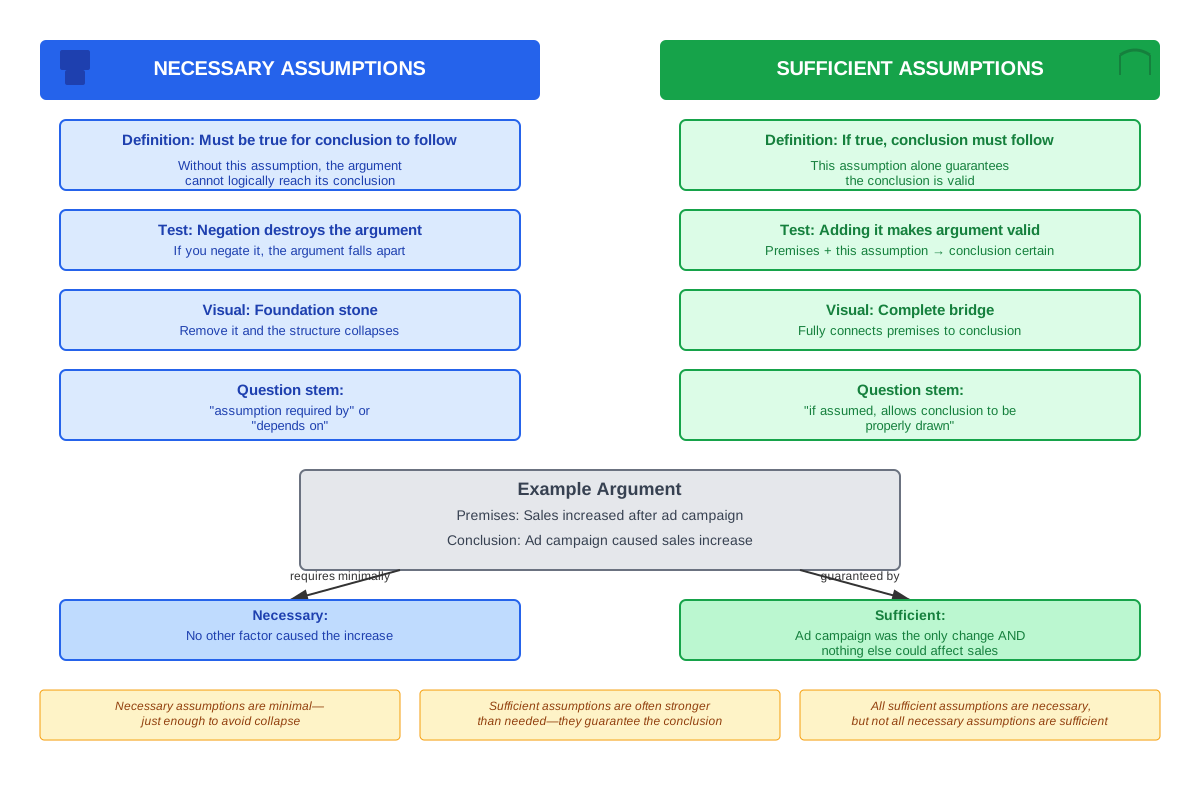
| Necessary Assumptions | Sufficient Assumptions |
|---|---|
| Must be true for the conclusion to possibly follow | If true, guarantee the conclusion follows |
| Minimum requirement | Often stronger than needed |
| Tested by negation: if false, argument falls apart | Tested by logical completion: makes argument airtight |
| More common on LSAT | Less common but appear in "justify" questions |
| Example: "assumes that" questions | Example: "allows the conclusion to be properly drawn" |
Necessary assumption example:
- Argument: "This restaurant serves excellent food because the chef trained in France."
- Necessary assumption: French culinary training has some relationship to food quality (even minimal)
- If this is false (French training is completely irrelevant), the argument collapses
Sufficient assumption example:
- Same argument
- Sufficient assumption: All chefs trained in France produce excellent food
- This guarantees the conclusion but is stronger than necessary
The Negation Test for Necessary Assumptions
The negation test is the most reliable technique for identifying necessary assumptions. If negating an answer choice destroys the argument, that choice states a necessary assumption.
Process:
- Identify the argument's conclusion
- Negate the answer choice (make it false)
- Ask: "Does this negation make the conclusion unable to follow from the premises?"
- If yes, it's a necessary assumption
- If the argument still could work, it's not necessary
Example application:
- Argument: "The company's profits increased after implementing the new software, so the software caused the profit increase."
- Answer choice: "No other significant changes occurred during this period."
- Negation: "Other significant changes DID occur during this period."
- Result: The negation destroys the argument (other changes could explain the profits), so this IS a necessary assumption.
Concept Relationships
The assumption gap concept connects to virtually every other Logical Reasoning skill. Understanding these relationships creates a comprehensive framework for LSAT success.
Foundational relationship: Argument Structure → Assumption Gap
- Before identifying gaps, students must distinguish premises from conclusions
- The gap always exists between these two components
Parallel relationship: Assumption Gap ↔ Flaw Identification
- Most flaws involve problematic assumptions
- Identifying the gap reveals the flaw
- Example: A scope shift gap represents a "scope shift flaw"
Application relationship: Assumption Gap → Strengthen/Weaken Questions
- Strengthening an argument means supporting its assumption
- Weakening an argument means undermining its assumption
- The gap must be identified before determining what would affect the argument
Refinement relationship: Assumption Gap → Sufficient Assumption Questions
- These questions ask for assumptions that completely close the gap
- Requires understanding not just what's missing, but what would make the argument airtight
Evaluation relationship: Assumption Gap → Evaluation Questions
- These ask what information would be most useful in assessing the argument
- The answer typically helps determine whether the assumption is reasonable
Textual map:
Argument Structure → Identify Premises & Conclusion → Locate Assumption Gap → Classify Gap Type (Scope/Causal/Comparison/etc.) → Apply Negation Test → Eliminate Wrong Answers → Select Correct Assumption
High-Yield Facts
⭐ The assumption gap always involves information that is necessary for the conclusion but not stated in the premises—if it's explicitly stated, it's not an assumption.
⭐ Scope shifts are the most common type of assumption gap on the LSAT—whenever the conclusion introduces new terminology not present in the premises, an assumption connects the old and new terms.
⭐ The negation test is the definitive method for confirming necessary assumptions—if negating an answer choice destroys the argument, that choice is a necessary assumption.
⭐ Correct assumption answers often sound obvious or even weak—they state the minimum necessary connection, not the strongest possible claim.
⭐ Wrong answers to assumption questions frequently go beyond what's necessary—they may strengthen the argument but aren't required for it to work.
- Causal arguments almost always assume no alternative explanation exists for the observed effect.
- Comparison-based arguments assume the compared entities are similar in all relevant respects.
- Arguments using evidence from samples assume those samples are representative of the larger population.
- Temporal arguments assume relevant conditions remain stable over time unless otherwise indicated.
- The correct assumption answer will always be about the specific gap in the specific argument—general statements about the topic are usually wrong.
- Necessary assumptions can be tested by asking "Could the argument work if this were false?"—if yes, it's not necessary.
- Sufficient assumptions often use strong conditional language ("all," "every," "only") while necessary assumptions use weaker language.
- Arguments with multiple premises may have multiple assumptions, but LSAT questions ask for one key assumption.
- The assumption gap is typically smallest when premises and conclusion use identical terminology and largest when they introduce entirely new concepts.
Quick check — test yourself on Assumption gap so far.
Try Flashcards →Common Misconceptions
Misconception: The assumption must be something the author consciously thought about but chose not to state.
Correction: Assumptions are logical requirements of the argument structure, regardless of the author's awareness. The LSAT tests logical relationships, not authorial intent. An assumption exists whenever it must be true for the conclusion to follow, whether or not anyone considered it.
Misconception: Stronger statements make better assumptions.
Correction: Necessary assumptions state the minimum required for the argument to work. An answer that says "All X are Y" is usually too strong when "Some X are Y" or "X can be Y" would suffice. Test-takers often incorrectly choose answers that would strengthen the argument beyond what's necessary.
Misconception: If an answer choice is true or reasonable, it must be the assumption.
Correction: The correct assumption must specifically bridge the gap in the particular argument. Many true statements are irrelevant to the argument's logical structure. An assumption must connect the specific premises to the specific conclusion.
Misconception: The assumption will introduce completely new information not mentioned in the argument.
Correction: While assumptions aren't stated, they connect concepts that ARE in the argument. The assumption bridges the gap between premise concepts and conclusion concepts—it doesn't introduce entirely unrelated ideas. Look for answers that link terms from the premises to terms in the conclusion.
Misconception: Assumptions are always controversial or questionable claims.
Correction: Many LSAT assumptions are quite reasonable or even obvious—they're just unstated. The test isn't asking whether the assumption is good or bad, only whether it's necessary for the argument. Some arguments rest on perfectly sensible assumptions that simply weren't made explicit.
Misconception: Every statement that would help the argument is an assumption.
Correction: Many statements would strengthen an argument without being necessary for it. A necessary assumption is specifically something that, if false, would make the conclusion unable to follow from the premises. Use the negation test to distinguish necessary assumptions from mere supporting points.
Misconception: The assumption gap is always about the main conclusion.
Correction: While most LSAT questions focus on the main conclusion, some arguments have intermediate conclusions that also rest on assumptions. Identify which conclusion the question asks about and find the gap relevant to that specific inferential step.
Worked Examples
Example 1: Scope Shift Gap
Argument:
"The city's new recycling program has increased the amount of material collected for recycling by 40% over the past year. Therefore, the program has been successful in reducing the city's environmental impact."
Question: Which one of the following is an assumption required by the argument?
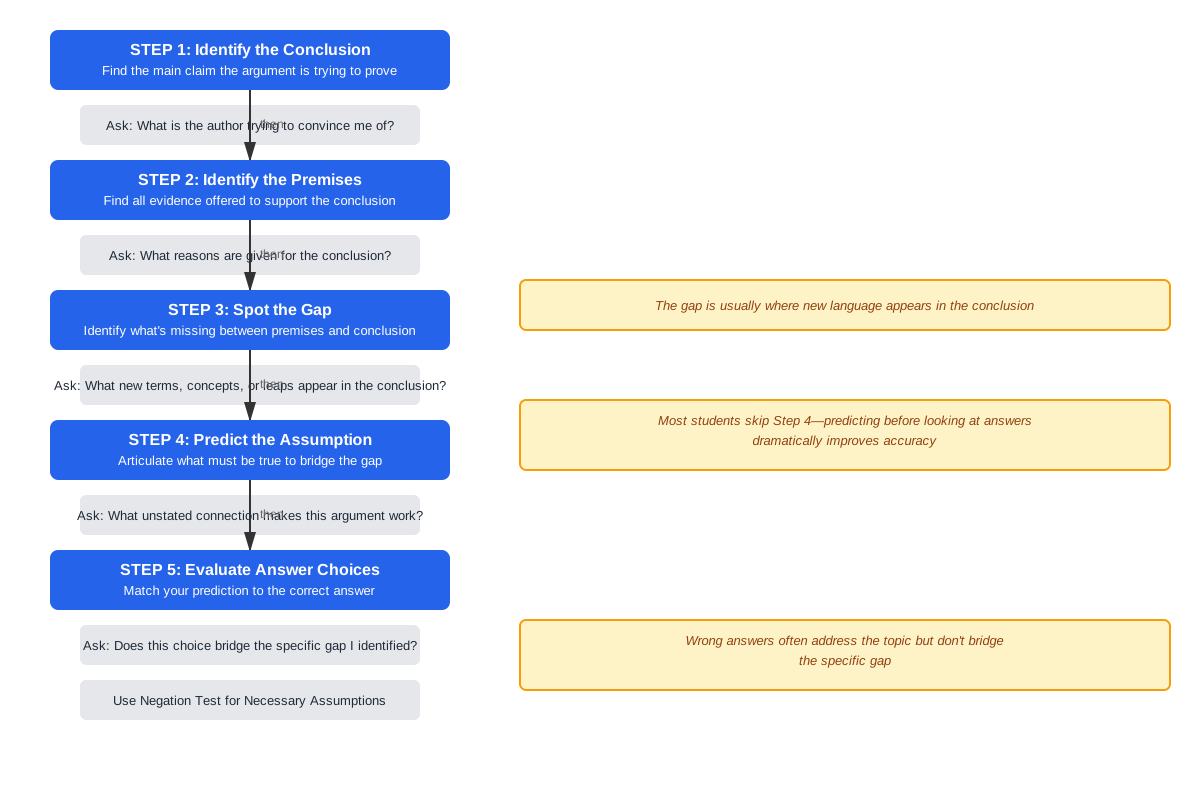
Step 1: Identify the conclusion
"The program has been successful in reducing the city's environmental impact."
Step 2: Identify the premises
The program increased collected recycling material by 40%.
Step 3: Locate the assumption gap
Notice the scope shift: Premises discuss "amount collected for recycling" while the conclusion discusses "reducing environmental impact." These are different concepts. The argument assumes they're connected.
Step 4: Predict the assumption
Before looking at answers, predict: "The increased collection of recycling material leads to reduced environmental impact" or "The collected material is actually recycled in an environmentally beneficial way."
Step 5: Evaluate answer choices
(A) The city's environmental impact was significant before the program began.
- Analysis: This doesn't bridge the gap. Even if true, it doesn't connect collection amounts to impact reduction.
- Negation test: "The impact wasn't significant before" → The argument could still work.
- Verdict: Not necessary.
(B) The material collected through the program is actually recycled rather than sent to landfills.
- Analysis: This directly addresses whether collection leads to environmental benefit.
- Negation test: "The material is NOT actually recycled" → If collected material goes to landfills anyway, the program hasn't reduced environmental impact. The argument collapses.
- Verdict: This is necessary! ✓
(C) Other cities have had success with similar recycling programs.
- Analysis: What happens in other cities doesn't affect whether THIS program reduces THIS city's impact.
- Negation test: "Other cities haven't had success" → This city's program could still work.
- Verdict: Not necessary.
(D) Residents support the recycling program.
- Analysis: Support doesn't bridge the gap between collection and environmental impact.
- Negation test: "Residents don't support it" → The program could still reduce impact.
- Verdict: Not necessary.
(E) The program will continue to increase collection amounts in future years.
- Analysis: Future performance doesn't affect whether the program has already reduced impact.
- Negation test: "It won't continue" → Past impact reduction could still have occurred.
- Verdict: Not necessary.
Answer: (B)
Connection to learning objectives: This example demonstrates identifying the assumption gap (scope shift from "collection" to "environmental impact"), explaining the reasoning pattern (unstated connection between different concepts), and applying the negation test to solve accurately.
Example 2: Causal Gap
Argument:
"Studies show that students who eat breakfast before school perform better on standardized tests than students who skip breakfast. School administrators should therefore implement a breakfast program to improve test scores."
Question: The argument depends on assuming which one of the following?
Step 1: Identify the conclusion
"School administrators should implement a breakfast program to improve test scores."
Step 2: Identify the premises
Students who eat breakfast perform better on tests than those who skip breakfast.
Step 3: Locate the assumption gap
This is a causal argument. The premises show correlation (breakfast-eaters perform better), and the conclusion assumes causation (providing breakfast will cause better performance). The gap involves alternative explanations and whether the relationship is genuinely causal.
Step 4: Predict the assumption
The argument must assume: "Eating breakfast causes better performance (rather than some other factor causing both)" and "Providing breakfast through a school program will have the same effect as students eating breakfast on their own."
Step 5: Evaluate answer choices
(A) Students who currently skip breakfast would eat breakfast if the school provided it.
- Analysis: This addresses whether the program would work practically.
- Negation test: "Students wouldn't eat the provided breakfast" → Then the program couldn't improve scores. The argument fails.
- Verdict: This is necessary! ✓
(B) Breakfast is the most important meal of the day for academic performance.
- Analysis: The argument only needs breakfast to help, not to be "most important."
- Negation test: "Lunch is more important" → Breakfast could still improve scores.
- Verdict: Too strong; not necessary.
(C) Students who eat breakfast are more motivated than those who skip it.
- Analysis: This actually suggests an alternative explanation (motivation, not breakfast, causes better performance).
- Negation test: "Breakfast-eaters aren't more motivated" → This would strengthen the argument, not weaken it.
- Verdict: Not necessary; if anything, the argument assumes this is false.
(D) Standardized test performance is the most important measure of student success.
- Analysis: The argument's goal is improving test scores; it doesn't need to assume this is the most important measure.
- Negation test: "Other measures are more important" → The program could still improve test scores.
- Verdict: Not necessary.
(E) The school has sufficient funding for a breakfast program.
- Analysis: This is about feasibility, not logical necessity.
- Negation test: "The school lacks funding" → This makes the recommendation impractical but doesn't break the logical connection between breakfast and performance.
- Verdict: Not necessary for the logical argument.
Answer: (A)
Connection to learning objectives: This example shows identifying a causal assumption gap, explaining the reasoning pattern (correlation to causation), and distinguishing between logical necessity and practical considerations.
Exam Strategy
Approaching Assumption Questions
Step 1: Identify the question type
Look for keywords: "assumes," "assumption," "depends on assuming," "takes for granted," "presupposes." Distinguish necessary assumption questions ("required," "depends on") from sufficient assumption questions ("allows the conclusion to be properly drawn," "enables the conclusion to follow logically").
Step 2: Find the conclusion first
Always identify the conclusion before analyzing the argument. Underline or bracket it. The assumption gap exists between the premises and THIS specific conclusion.
Step 3: Identify the gap before reading answers
Actively predict the assumption by asking:
- What new concept appears in the conclusion that wasn't in the premises?
- What connection between premise and conclusion is unstated?
- What could make this argument fall apart?
Step 4: Use the negation test strategically
For necessary assumption questions, negate promising answer choices. If the negation destroys the argument, you've found the answer. If the argument could still work, eliminate that choice.
Trigger Words and Phrases
In the question stem:
- "Assumes," "assumption required," "depends on assuming" → Necessary assumption
- "Takes for granted," "presupposes" → Necessary assumption
- "Allows the conclusion to be properly drawn," "enables the conclusion to follow logically" → Sufficient assumption
- "If assumed, allows" → Sufficient assumption
In the argument:
- "Therefore," "thus," "consequently" → Marks the conclusion; look for gaps between what comes before and after
- "Because," "since," "given that" → Marks premises; compare these to the conclusion
- Comparative language ("better," "more," "less") → Often indicates comparison gaps
- Causal language ("causes," "leads to," "results in") → Often indicates causal gaps
- Predictive language ("will," "should," "must") → Often indicates temporal assumption gaps
Process of Elimination Tips
Eliminate answers that:
- Introduce completely new concepts unrelated to either premises or conclusion
- Are too strong when weaker statements would suffice (watch for "all," "every," "only," "never")
- Would strengthen but aren't necessary (use negation test to confirm)
- Restate the premises or conclusion (assumptions are unstated by definition)
- Address practical feasibility rather than logical necessity (funding, time, resources)
- Go in the wrong direction (e.g., suggesting the conclusion is false)
Favor answers that:
- Connect premise concepts to conclusion concepts explicitly
- Rule out alternative explanations in causal arguments
- Establish relevant similarity in comparison arguments
- Sound obvious or minimal (necessary assumptions are often simple)
- Fail the negation test (when negated, they destroy the argument)
Time Allocation
- Reading the argument: 20-30 seconds (read carefully, identify conclusion)
- Predicting the gap: 10-15 seconds (don't skip this step)
- Evaluating answer choices: 30-45 seconds (use negation test on 1-2 promising answers)
- Total per question: 60-90 seconds
If stuck after 90 seconds, make your best guess and move on. Assumption questions are high-value but shouldn't consume excessive time. Return if time permits at the end of the section.
Memory Techniques
SCAN Acronym for Finding Gaps
Scope shifts - New terms in conclusion?
Causal claims - Correlation assumed to be causation?
Analogies/Comparisons - Different things assumed similar?
Necessary conditions - What must be true but isn't stated?
The Bridge Visualization
Visualize the argument as two cliffs: the premises on one side, the conclusion on the other. The assumption is the bridge connecting them. If the bridge collapses (negation test), you fall into the gap and can't reach the conclusion. This mental image helps remember that assumptions connect stated elements.
The "But What If?" Technique
When reading an argument, immediately ask "But what if...?" to identify assumptions:
- "But what if the terms mean different things?"
- "But what if something else caused it?"
- "But what if the comparison isn't valid?"
- "But what if conditions change?"
The answer to "but what if?" reveals what the argument assumes isn't true.
NOT Test Mnemonic
Negate the answer choice
Observe if the argument fails
That's your assumption!
This three-step process helps remember the negation test procedure during the exam.
The Minimum Connection Rule
Remember: "Necessary assumptions state the MINIMUM connection needed." When choosing between a stronger and weaker answer, the weaker one is usually correct for necessary assumption questions. Think "minimum" to avoid choosing overly strong answers.
Summary
The assumption gap represents the unstated logical connection between an argument's premises and conclusion—the missing link that must be true for the argument to hold together. Mastering this concept is essential for LSAT success because assumption-related questions appear 12-15 times per test across multiple question types. The most common gaps involve scope shifts (new terms in the conclusion), causal reasoning (assuming correlation indicates causation), comparisons (assuming relevant similarity), and representativeness (assuming samples reflect populations). The negation test provides a reliable method for identifying necessary assumptions: if negating an answer choice destroys the argument, that choice states a necessary assumption. Successful students identify the conclusion first, locate the gap between premises and conclusion, predict the assumption before reviewing answers, and systematically eliminate choices that are too strong, introduce irrelevant concepts, or fail the negation test. Understanding assumption gaps not only enables direct success on assumption questions but also provides the foundation for strengthen/weaken questions, flaw questions, and evaluation questions, making it one of the highest-yield topics in Logical Reasoning.
Key Takeaways
- The assumption gap is the unstated connection between premises and conclusion—identify it by finding what new concept or relationship appears in the conclusion that wasn't explicitly established in the premises.
- Use the negation test to confirm necessary assumptions—if negating an answer choice makes the conclusion unable to follow from the premises, that choice is a necessary assumption.
- Scope shifts are the most common gap type—whenever the conclusion introduces terminology not present in the premises, an assumption connects the old and new terms.
- Necessary assumptions state minimum requirements, not maximum support—correct answers often sound weak or obvious because they express only what must be true, not what would most strengthen the argument.
- Predict the gap before reading answer choices—actively identifying the assumption gap improves accuracy and speed by providing a target to match against the options.
- Causal arguments assume no alternative explanations exist—when an argument concludes one thing causes another, it assumes other potential causes aren't responsible for the observed effect.
- Every assumption question is solvable through systematic analysis—identify the conclusion, locate the gap, predict the assumption, and apply the negation test to confirm your answer.
Related Topics
Strengthen and Weaken Questions: Once you can identify assumption gaps, strengthen questions ask what would support those assumptions while weaken questions ask what would undermine them. Mastering assumptions makes these question types significantly easier.
Flaw Questions: Most logical flaws involve problematic assumptions—scope shifts, causal errors, and faulty comparisons are all described as flaws. Understanding assumption gaps enables you to recognize and articulate these flaws.
Sufficient Assumption Questions: These ask for assumptions that would make the argument's conclusion follow with certainty. They require understanding not just what's missing, but what would completely close the gap.
Evaluation Questions: These ask what information would be most useful in assessing an argument's strength. The answer typically helps determine whether the argument's key assumption is reasonable.
Parallel Reasoning Questions: Identifying assumption gaps helps match argument structures because arguments with similar gaps have similar logical patterns, even when discussing different topics.
Practice CTA
Now that you understand assumption gaps, it's time to put this knowledge into practice. Work through the practice questions to apply the negation test, identify different gap types, and build the pattern recognition that leads to automatic, confident performance on test day. Review the flashcards to reinforce the key concepts, trigger words, and strategies. Remember: assumption questions are among the most predictable and learnable question types on the LSAT. With systematic practice, you'll develop the ability to spot gaps instantly and select correct answers with confidence. Every practice question you complete strengthens your skills and moves you closer to your target score. Start practicing now—you've got this!
Sign up free to keep reading
Create a free AnvayaPrep account to finish this LSAT guide on Assumption gap — plus flashcards and practice questions.