Overview
Assumption in argument from authority represents a critical reasoning pattern that appears frequently on the LSAT Logical Reasoning section. This pattern involves arguments that rely on expert testimony, credentials, or authoritative sources to support their conclusions. When an argument cites an authority figure—whether a scientist, historian, professional, or specialist—it makes several implicit assumptions about that authority's qualifications, relevance, and reliability. Understanding these hidden assumptions is essential for success on assumption questions, which ask test-takers to identify what must be true for an argument to work.
The LSAT tests this concept because real-world reasoning constantly involves evaluating expert claims. Lawyers must assess witness credibility, expert testimony, and the weight of authoritative sources. When an argument states "According to Dr. Smith, a leading cardiologist, this treatment is effective," it assumes Dr. Smith is indeed qualified, that cardiology is relevant to this particular treatment, that Dr. Smith is unbiased, and that her expertise hasn't been misrepresented. Missing any of these assumptions can invalidate the entire argument. The logical reasoning skills required to identify these gaps translate directly to legal practice and critical thinking in professional contexts.
Within the broader landscape of LSAT Logical Reasoning, arguments from authority connect to several other question types including Strengthen, Weaken, and Flaw questions. Mastering this topic provides a foundation for recognizing how arguments can be vulnerable when they depend on external sources rather than direct evidence. This pattern also intersects with concepts like representativeness, bias, and relevance—all high-yield areas for LSAT success.
Learning Objectives
- [ ] Identify how Assumption in argument from authority appears in LSAT questions
- [ ] Explain the reasoning pattern behind Assumption in argument from authority
- [ ] Apply Assumption in argument from authority to solve LSAT-style problems accurately
- [ ] Distinguish between necessary and sufficient assumptions in authority-based arguments
- [ ] Evaluate the strength of different types of authority citations
- [ ] Recognize the five core assumption categories that underlie arguments from authority
- [ ] Predict common wrong answer choices in assumption questions involving authorities
Prerequisites
- Basic argument structure: Understanding premises and conclusions is essential because authority-based arguments follow standard argument patterns where the authority's statement serves as a premise supporting a conclusion.
- Necessary vs. sufficient assumptions: This distinction matters because LSAT assumption questions specifically ask for necessary assumptions—what must be true—rather than what would be helpful.
- Conditional reasoning fundamentals: Many authority-based arguments contain implicit conditional relationships (if an expert says X, then X is likely true) that require conditional logic skills.
- Argument evaluation skills: The ability to identify argument weaknesses helps recognize what assumptions would need to be true to shore up those vulnerabilities.
Why This Topic Matters
Arguments from authority pervade legal reasoning, academic discourse, and everyday decision-making. Courts rely heavily on expert witnesses, and attorneys must constantly evaluate whether those experts are qualified, whether their testimony is relevant, and whether their conclusions are reliable. The ability to identify hidden assumptions in authority-based claims is fundamental to legal practice, making this a high-priority topic for law school admissions testing.
On the LSAT, arguments from authority appear in approximately 10-15% of Logical Reasoning questions across all question types. They are particularly common in Assumption questions (both Necessary and Sufficient), Strengthen/Weaken questions, and Flaw questions. The pattern appears in both scored sections of Logical Reasoning, making it a high-yield topic that can significantly impact overall scores. Test-takers who master this pattern gain a substantial advantage because these questions follow predictable patterns once the underlying assumptions are understood.
This topic typically appears in passages where an argument cites a study, quotes an expert, references a professional organization, or appeals to someone's credentials. Common contexts include scientific research, historical claims, professional recommendations, and technical assessments. The LSAT often presents scenarios where the authority seems credible at first glance, but careful analysis reveals questionable assumptions about expertise, bias, or relevance.
Core Concepts
The Structure of Arguments from Authority
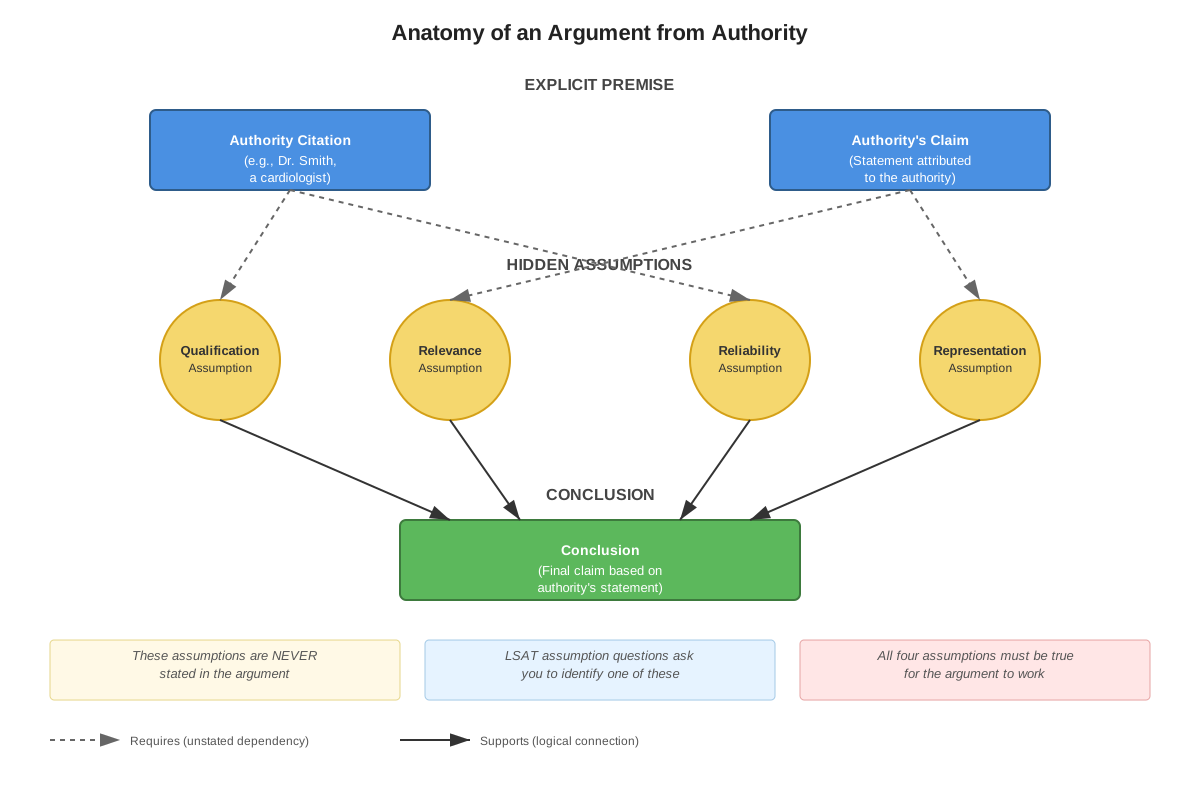
An argument from authority follows a predictable structure: it presents a claim made by someone with apparent expertise or credentials, then uses that claim to support a conclusion. The basic pattern is: "Expert X says Y, therefore Y is true (or probably true)." This reasoning pattern is not inherently fallacious—we rely on experts constantly in modern life—but it depends entirely on several assumptions being true. The LSAT exploits this dependency by creating arguments where one or more critical assumptions are questionable or unstated.
The strength of an authority-based argument depends on the relationship between the authority's qualifications and the specific claim being made. A Nobel Prize-winning physicist has strong authority on quantum mechanics but not necessarily on economic policy. This distinction between general credentials and specific relevance is a frequent testing point on the LSAT.
The Five Core Assumption Categories
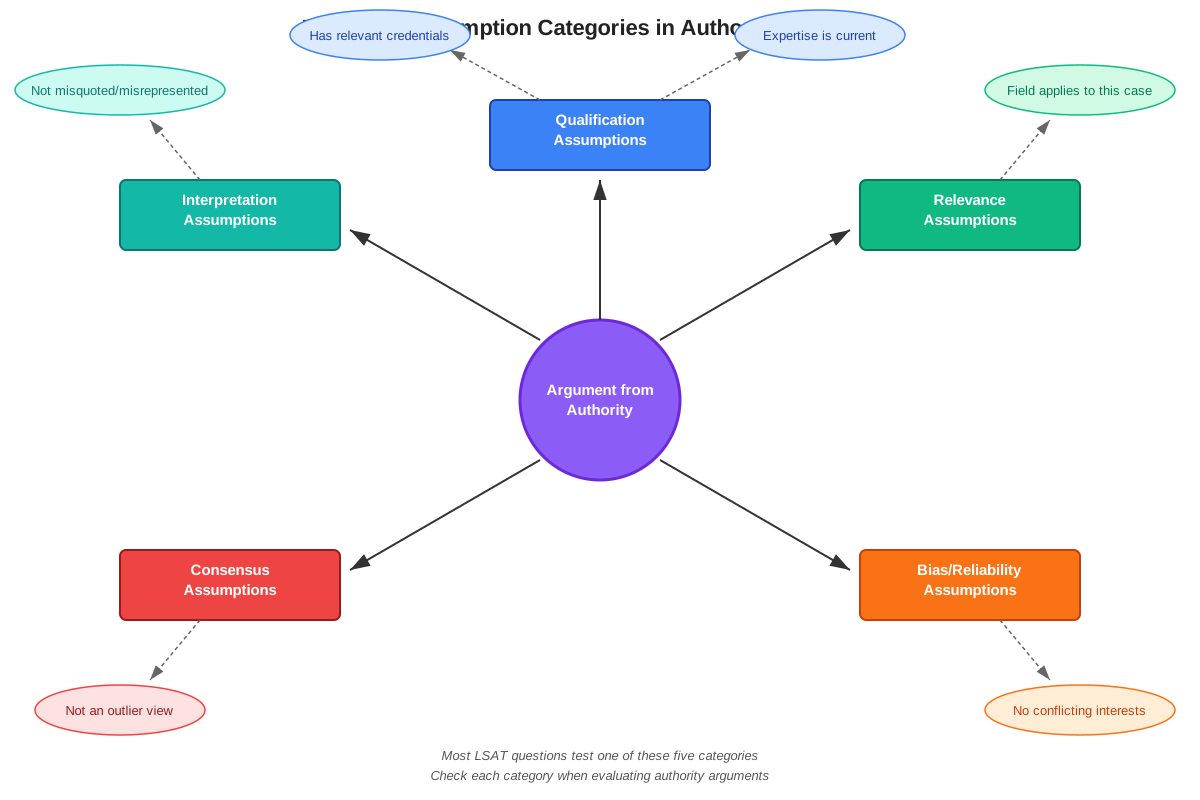
Arguments from authority rest on five fundamental assumption categories that appear repeatedly on the LSAT:
1. Expertise Assumption: The authority actually possesses relevant expertise in the specific area being discussed. This assumes the person has appropriate training, education, or experience. An argument citing "Dr. Johnson, a physician" assumes Dr. Johnson's medical expertise is relevant to the specific medical claim being made. If Dr. Johnson is a dermatologist commenting on cardiac surgery, this assumption fails.
2. Relevance Assumption: The authority's area of expertise directly applies to the specific claim or conclusion. Even genuine expertise may not transfer across domains. A climate scientist's expertise is relevant to climate change but not necessarily to climate policy or economic impacts of climate legislation. The LSAT frequently tests whether the cited authority's field actually covers the specific issue at hand.
3. Reliability Assumption: The authority is providing accurate, honest information without misrepresentation. This assumes the expert isn't lying, hasn't been misquoted, and hasn't had their views taken out of context. It also assumes the authority is reporting their genuine professional opinion rather than speculation or personal bias.
4. Bias Assumption: The authority lacks conflicts of interest or motivations that would compromise objectivity. An argument assumes the expert isn't financially incentivized to reach a particular conclusion, doesn't have personal stakes in the outcome, and isn't influenced by ideology or allegiance. A pharmaceutical company executive commenting on their own drug's safety raises obvious bias concerns.
5. Consensus Assumption: The authority's view represents mainstream expert opinion rather than an outlier position. When an argument cites "scientists say" or "experts agree," it assumes this isn't a fringe view rejected by most qualified professionals. One expert's opinion may not reflect the field's consensus, and the LSAT often exploits this gap.
How Assumptions Function in Authority Arguments
Assumptions in authority-based arguments serve as invisible bridges between the premise (the authority's statement) and the conclusion. Without these assumptions, the argument collapses. Consider this argument: "Dr. Martinez, a biologist, states that the new pesticide is safe for humans. Therefore, farmers should use this pesticide." This argument assumes Dr. Martinez specializes in toxicology or a relevant biological field, that she has studied this specific pesticide, that she has no financial ties to the pesticide manufacturer, that her definition of "safe" matches the argument's use, and that other experts agree with her assessment.
The LSAT tests whether test-takers can identify which assumption, if false, would most severely damage the argument. This requires understanding the logical dependency structure: some assumptions are more critical than others. If Dr. Martinez is a marine biologist with no toxicology training, the argument fails completely. If she has minor consulting fees from the industry, the argument is weakened but not destroyed.
Distinguishing Necessary from Sufficient Assumptions
Necessary assumptions are conditions that must be true for the argument to work—without them, the argument fails. Sufficient assumptions are conditions that, if true, would guarantee the conclusion. LSAT assumption questions typically ask for necessary assumptions. In authority arguments, a necessary assumption might be "The expert has actually studied this specific case," while a sufficient assumption might be "The expert is the world's leading authority and has conducted extensive research on this exact issue." The sufficient assumption is stronger than needed; the necessary assumption is the minimum required.
The Negation Test helps identify necessary assumptions: if negating a statement destroys the argument, that statement is a necessary assumption. For an authority argument, negating "The expert has relevant qualifications" would eliminate any reason to trust their testimony, thus destroying the argument.
Common Authority Types on the LSAT
| Authority Type | Example | Common Assumptions Tested |
|---|---|---|
| Academic Expert | "Professor Chen, an economist, argues..." | Field relevance, current knowledge, consensus |
| Professional Practitioner | "Dr. Williams, a surgeon, recommends..." | Specific expertise, bias from practice patterns |
| Research Study | "A recent study shows..." | Methodology, sample size, researcher bias |
| Professional Organization | "The Medical Association states..." | Member consensus, organizational bias |
| Historical Expert | "Historian Rodriguez claims..." | Access to sources, interpretation validity |
| Technical Specialist | "Engineer Thompson concludes..." | Specific technical area, practical vs. theoretical knowledge |
Concept Relationships
The core concepts within arguments from authority form a hierarchical dependency structure. At the foundation lies the basic argument structure (premise → conclusion), upon which the authority citation is built as a special type of premise. This authority premise then requires the five core assumptions (expertise, relevance, reliability, bias, consensus) to function properly. Each assumption category can be further analyzed through the necessary vs. sufficient distinction, which determines how strongly each assumption must hold for the argument to succeed.
These concepts connect to prerequisite knowledge in several ways. The expertise assumption relies on understanding conditional reasoning: IF someone is an expert in field X, THEN their claims about X carry weight. The relevance assumption connects to scope issues in arguments—a common LSAT concept where premises don't actually support the conclusion because they address different domains. The bias assumption relates to source evaluation skills tested across multiple question types.
Arguments from authority also connect forward to related LSAT topics. Understanding these assumptions enables mastery of Strengthen questions (where answer choices might confirm an assumption) and Weaken questions (where answer choices might undermine an assumption). The pattern also appears in Flaw questions, where the correct answer might identify "relies on the testimony of an authority whose expertise is questionable" or similar formulations.
The relationship map flows as follows: Basic Argument Structure → Authority as Premise Type → Five Core Assumptions → Necessary/Sufficient Distinction → Application to Multiple Question Types (Assumption, Strengthen, Weaken, Flaw) → Advanced Evaluation Skills.
High-Yield Facts
⭐ Arguments from authority assume the cited expert has specific, relevant expertise in the exact area being discussed, not just general credentials.
⭐ The LSAT frequently tests whether an authority's field of expertise actually applies to the specific claim being made.
⭐ A necessary assumption in authority arguments is that the expert's view hasn't been misrepresented or taken out of context.
⭐ Arguments citing a single expert assume that expert's view is not an outlier rejected by most qualified professionals in the field.
⭐ Authority-based arguments assume the expert lacks conflicts of interest or bias that would compromise their objectivity.
- When an argument cites credentials (PhD, MD, Professor), it assumes those credentials are relevant to the specific claim, not just impressive-sounding.
- Arguments referencing "studies" or "research" assume the methodology was sound and the sample was representative.
- The phrase "experts agree" or "scientists say" assumes genuine consensus exists, not just that some experts hold this view.
- Authority arguments assume the expert has current, up-to-date knowledge rather than outdated information.
- When multiple experts are cited, the argument assumes they are independent sources rather than all relying on the same underlying data.
- Arguments from authority assume the expert is commenting within their professional capacity, not offering personal opinion outside their expertise.
- The LSAT often includes wrong answers that strengthen the argument rather than identifying necessary assumptions.
- Correct answers to assumption questions involving authority often address the gap between general expertise and specific application.
Quick check — test yourself on Assumption in argument from authority so far.
Try Flashcards →Common Misconceptions
Misconception: Any statement by someone with credentials is automatically a strong argument from authority.
Correction: Credentials must be specifically relevant to the claim. A medical doctor's opinion on legal matters carries no more weight than a layperson's view. The LSAT specifically tests whether test-takers recognize that general expertise doesn't transfer across domains.
Misconception: If an expert is biased, their argument is automatically invalid.
Correction: Bias weakens an argument but doesn't necessarily invalidate it. The LSAT tests whether bias is a necessary assumption (the expert must be unbiased for the argument to work) versus whether bias is merely a weakening factor. An expert with minor conflicts might still provide valuable testimony.
Misconception: Arguments from authority are always fallacious or weak.
Correction: Relying on genuine expertise is often the most rational approach to complex topics. The LSAT doesn't penalize all authority arguments—it tests whether specific assumptions underlying those arguments are justified. A well-qualified, unbiased expert commenting within their field provides strong support.
Misconception: The assumption is that the expert is the best or most qualified authority available.
Correction: The argument only assumes the expert is sufficiently qualified and reliable, not that they're the optimal choice. Necessary assumptions are minimal requirements, not ideal conditions. The expert needs adequate expertise, not supreme expertise.
Misconception: If an argument cites an expert, the assumption must be about that expert's qualifications.
Correction: While expertise is one common assumption, the LSAT also tests relevance, bias, consensus, and reliability. Sometimes the expert's qualifications are clearly established in the passage, and the assumption involves whether their view is representative or whether they've been accurately quoted.
Misconception: Longer, more detailed answer choices are more likely to be correct assumptions.
Correction: The LSAT includes verbose wrong answers that go beyond what's necessary. Correct assumption answers are often concise and precisely address the logical gap. Test-takers should focus on logical necessity, not answer length.
Misconception: The assumption must make the argument perfect or airtight.
Correction: Necessary assumptions only need to be minimally true for the argument to work at all. They don't need to make the argument conclusive. An assumption might be "The expert has some relevant training" rather than "The expert is perfectly qualified."
Worked Examples
Example 1: Medical Authority
Argument: "Dr. Sarah Chen recommends that patients with chronic back pain try acupuncture before considering surgery. Dr. Chen is a physician with 20 years of experience. Therefore, acupuncture is an effective treatment for chronic back pain that should be tried before surgery."
Question: Which of the following is an assumption required by the argument?
Analysis:
First, identify the argument structure. The premise is Dr. Chen's recommendation based on her credentials (physician, 20 years experience). The conclusion is that acupuncture should be tried before surgery for chronic back pain.
Next, identify the logical gap. We know Dr. Chen is a physician with experience, but we don't know if her experience is relevant to back pain or pain management. We also don't know if she has expertise in evaluating acupuncture specifically. The argument jumps from "Dr. Chen recommends this" to "this is effective."
Apply the five core assumption categories:
- Expertise: Does Dr. Chen have relevant medical expertise? She's a physician, but is she a pain specialist, orthopedist, or relevant specialist?
- Relevance: Is her 20 years of experience relevant to back pain and acupuncture evaluation?
- Reliability: Has she actually studied acupuncture's effectiveness?
- Bias: Does she have financial interests in acupuncture clinics?
- Consensus: Do other pain specialists agree with this recommendation?
Likely correct answer: "Dr. Chen's medical experience includes expertise in treating chronic back pain" or "Dr. Chen has knowledge of the relative effectiveness of acupuncture and surgery for back pain."
This addresses the relevance assumption—the gap between being a physician generally and having specific expertise in the exact condition and treatments discussed. Without this assumption, her recommendation carries no more weight than any physician's opinion on any medical topic.
Wrong answer examples and why they're wrong:
- "Acupuncture is always more effective than surgery" - This is too strong; the argument only claims acupuncture should be tried first, not that it's always better.
- "Dr. Chen is the most experienced physician in the country" - This is sufficient but not necessary; she only needs adequate expertise, not supreme expertise.
- "All patients with chronic back pain should avoid surgery" - This goes beyond the argument's scope and isn't required for the reasoning to work.
Example 2: Scientific Study Authority
Argument: "A recent study by biologists at a major university found that introducing wolves into the ecosystem reduced deer overpopulation and improved forest health. City planners should therefore introduce wolves into the forested areas surrounding our city to address our deer overpopulation problem."
Question: The argument depends on assuming which of the following?
Analysis:
The argument structure moves from a scientific study's findings (wolves helped in one ecosystem) to a policy recommendation (introduce wolves in our city's forests).
Identify the gaps:
- The study was conducted in some ecosystem, but is that ecosystem comparable to our city's forests?
- The biologists studied this issue, but were they studying ecosystems similar to ours?
- The study found benefits, but were there also risks or downsides not mentioned?
- The study's context might differ significantly from our city's situation.
Apply the assumption categories:
- Expertise: The biologists presumably have relevant expertise (this seems solid).
- Relevance: This is the major gap—does their study of one ecosystem apply to our different ecosystem?
- Reliability: Was the study properly conducted? (Likely assumed but not the main gap.)
- Bias: Did the researchers have objectivity? (Possible but not the primary issue.)
- Consensus: Do other ecologists agree? (Not directly addressed.)
The biggest logical gap is the relevance assumption—specifically, whether the studied ecosystem is sufficiently similar to our city's forests that the findings transfer.
Likely correct answer: "The forested areas surrounding the city are sufficiently similar to the ecosystem studied by the biologists" or "The conditions that allowed wolves to reduce deer overpopulation in the study also exist in the forests near the city."
This addresses the critical gap between the study's context and the proposed application. Without this assumption, the study's findings might be completely irrelevant to our situation.
Wrong answer examples:
- "Wolves are the only way to reduce deer overpopulation" - Too extreme; the argument only claims wolves would work, not that they're the only solution.
- "The biologists are experts in wolf behavior" - While possibly helpful, the argument already establishes they're biologists who studied this issue; this doesn't address the main gap.
- "Introducing wolves will have no negative consequences" - This would strengthen the argument but isn't necessary for the basic reasoning that wolves could address overpopulation.
Exam Strategy
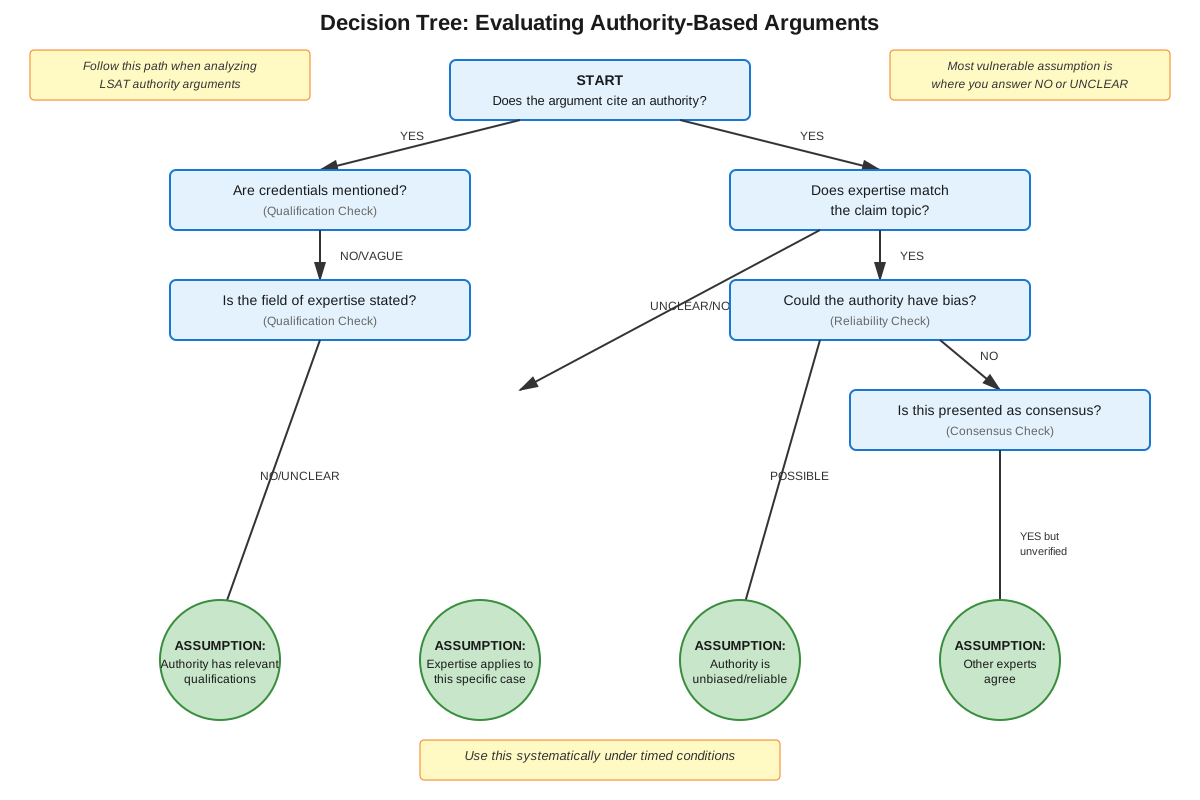
When approaching LSAT questions involving arguments from authority, follow this systematic process:
Step 1: Identify the authority citation - Look for phrases like "Dr. X states," "according to experts," "a study shows," "Professor Y argues," or any reference to credentials or expertise. Mark this clearly as you read.
Step 2: Identify the specific claim - What exactly is the authority saying? Be precise about the scope and content of their claim. Is it about all cases or specific situations? Is it a strong claim or a qualified one?
Step 3: Identify the conclusion - What is the argument trying to prove using this authority? Often the conclusion extends beyond what the authority actually said.
Step 4: Spot the gap - Ask yourself: What's the difference between the authority's credentials/statement and the conclusion? This gap is where assumptions live.
Step 5: Apply the five-category framework - Systematically consider: Expertise (do they have it?), Relevance (does it apply here?), Reliability (are they trustworthy?), Bias (are they objective?), Consensus (is this mainstream?).
Trigger words and phrases to watch for:
- "Dr./Professor/Expert X claims/states/argues"
- "According to [authority]"
- "A study/research shows"
- "Scientists/historians/economists say"
- "[Credential] recommends/concludes"
- "Leading expert"
- "Renowned authority"
These phrases signal that the argument's strength depends on assumptions about the cited authority.
Process of elimination tips:
- Eliminate answers that would strengthen the argument but aren't necessary (apply the Negation Test: if negating the answer doesn't destroy the argument, it's not a necessary assumption)
- Eliminate answers that are too strong or extreme (necessary assumptions are minimal requirements)
- Eliminate answers that address irrelevant aspects of the authority (if the passage already establishes expertise, the assumption likely involves relevance or bias instead)
- Eliminate answers that simply restate information already in the passage
- Keep answers that address the gap between the authority's specific expertise and the specific claim being made
Time allocation advice:
Spend 15-20 seconds identifying the argument structure and authority citation, 20-30 seconds analyzing the gap and predicting the assumption category, and 30-40 seconds evaluating answer choices. Don't rush the initial analysis—correctly identifying the gap makes answer choice evaluation much faster. If stuck between two answers, apply the Negation Test to both and choose the one whose negation more severely damages the argument.
Exam Tip: The LSAT loves to present impressive-sounding credentials that aren't actually relevant to the specific claim. A "renowned scientist" might be renowned in physics but commenting on biology. Train yourself to ask: "Is this expert's specific area of expertise directly applicable to this specific claim?"
Memory Techniques
The EXPERT Acronym for the five core assumption categories:
- Expertise: Does the authority have it?
- X-fer (Transfer/Relevance): Does expertise transfer to this specific claim?
- Probity (Reliability): Is the authority honest and accurate?
- Equity (Bias): Is the authority objective and unbiased?
- Representative (Consensus): Does this view represent mainstream expert opinion?
- Testify: Is the authority testifying within their professional capacity?
The "Credential vs. Claim" Visualization: Picture a bridge between two islands. One island is labeled "Authority's Credentials" and the other is "Specific Claim." The bridge represents the assumptions needed to connect them. If the bridge has gaps (missing assumptions), you can't get from credentials to claim. This visual helps identify where assumptions are needed.
The Three R's of Authority Evaluation:
- Right expertise: Does the authority have the correct type of expertise?
- Right topic: Is the authority commenting on the right topic within their field?
- Right representation: Does the authority's view represent the field correctly?
The "So What?" Test: After reading an authority citation, ask "So what?" If the answer isn't obvious, that's where the assumption lives. "Dr. Smith is a biologist" → "So what? Why should I trust her claim about this pesticide?" → The assumption must be that her biology expertise is relevant to pesticide safety.
Summary
Arguments from authority are a high-yield LSAT pattern where arguments rely on expert testimony, credentials, or authoritative sources to support conclusions. These arguments depend on five core assumption categories: the authority must have genuine expertise, that expertise must be relevant to the specific claim, the authority must be reliable and accurately represented, the authority must lack disqualifying bias, and the authority's view must represent mainstream expert opinion rather than an outlier position. The LSAT tests whether test-takers can identify which assumptions are necessary for authority-based arguments to succeed. Success requires recognizing that impressive credentials don't automatically transfer across domains, that one expert's view may not represent consensus, and that the gap between general expertise and specific application is where assumptions typically hide. The key skill is identifying the logical gap between what the authority's credentials establish and what the argument's conclusion requires, then determining which assumption must be true to bridge that gap. Mastering this pattern provides advantages across multiple question types including Assumption, Strengthen, Weaken, and Flaw questions.
Key Takeaways
- Arguments from authority assume five core elements: expertise, relevance, reliability, lack of bias, and representativeness of expert consensus
- The most commonly tested assumption is relevance—whether the authority's specific expertise applies to the specific claim being made
- Impressive credentials don't automatically validate claims outside the authority's specific area of expertise
- Necessary assumptions are minimal requirements for the argument to work, not ideal conditions that would make the argument perfect
- Apply the Negation Test: if negating a statement destroys the argument, that statement is a necessary assumption
- The LSAT frequently includes wrong answers that would strengthen the argument but aren't logically necessary
- Systematic analysis using the five-category framework (EXPERT acronym) prevents missing critical assumptions
Related Topics
Strengthen and Weaken Questions with Authority Arguments: Once you understand assumptions in authority arguments, you can predict what would strengthen them (confirming an assumption) or weaken them (undermining an assumption). This topic builds directly on assumption identification skills.
Flaw Questions - Appeal to Inappropriate Authority: This question type explicitly asks test-takers to identify when an argument improperly relies on authority. Mastering assumptions in authority arguments makes these flaw questions straightforward.
Causal Reasoning with Expert Claims: Many authority arguments involve experts making causal claims. Understanding both authority assumptions and causal reasoning assumptions together enables mastery of complex hybrid arguments.
Sufficient Assumption Questions: While this guide focuses on necessary assumptions, sufficient assumption questions also feature authority arguments. The same framework applies, but the correct answer will be stronger—providing a guarantee rather than a minimum requirement.
Evaluate the Argument Questions: These questions ask what additional information would help assess an argument's strength. For authority arguments, this often involves information about the expert's qualifications, bias, or the consensus in their field.
Practice CTA
Now that you've mastered the core concepts of assumptions in arguments from authority, it's time to apply this knowledge to actual LSAT questions. The practice questions and flashcards will reinforce your ability to quickly identify authority citations, spot logical gaps, and predict correct answers before evaluating choices. Remember: the LSAT rewards systematic analysis over intuition. Use the EXPERT framework, apply the Negation Test, and focus on the gap between credentials and claims. Each practice question you complete strengthens your pattern recognition and builds the confidence needed for test day success. You've built the foundation—now practice until these skills become automatic.
Sign up free to keep reading
Create a free AnvayaPrep account to finish this LSAT guide on Assumption in argument from authority — plus flashcards and practice questions.