Overview
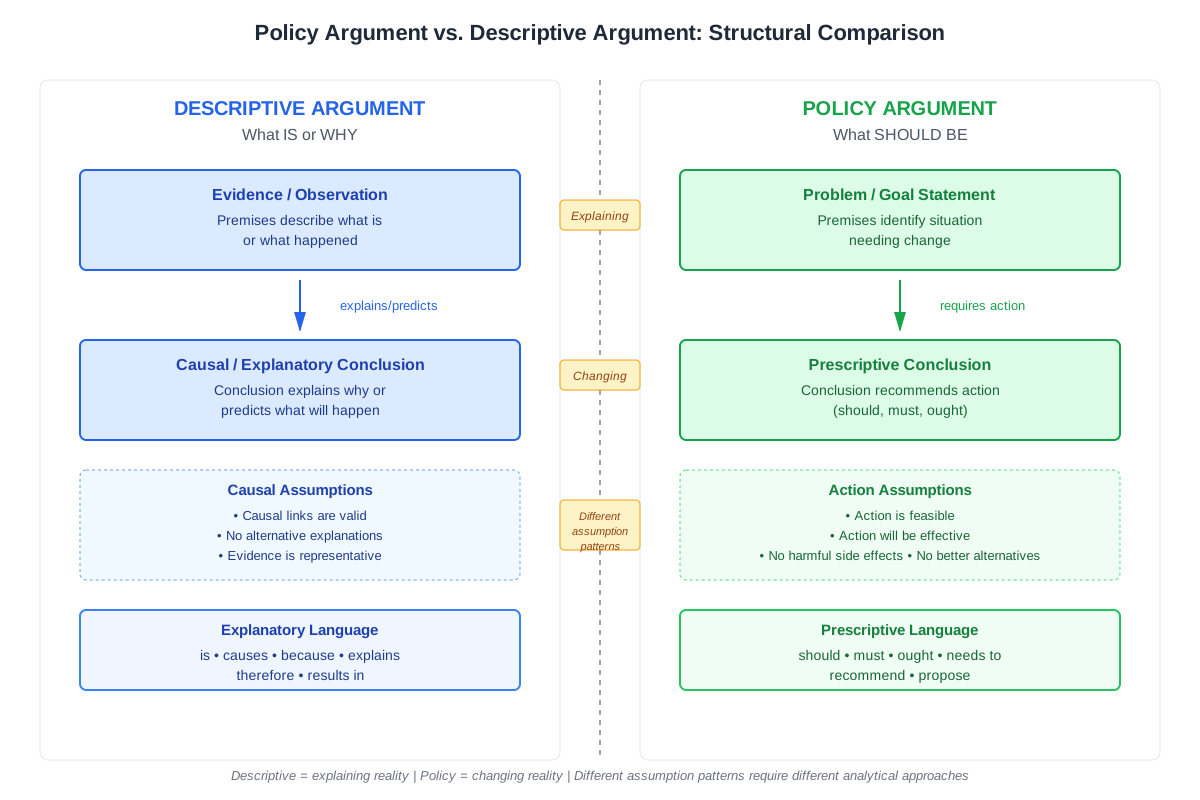
Assumption in policy arguments represents one of the most frequently tested patterns on the LSAT Logical Reasoning section. Policy arguments propose that a certain action should or should not be taken to achieve a particular goal or solve a specific problem. These arguments appear in approximately 15-20% of all assumption questions on the exam, making them a critical area for mastery. Unlike descriptive arguments that explain what is or what causes something, policy arguments prescribe what ought to be done, typically signaled by words like "should," "must," "ought to," or "needs to."
The unique challenge of LSAT assumption in policy arguments lies in recognizing the gap between the proposed action and the desired outcome. Test-makers exploit the fact that policy recommendations inherently contain multiple unstated premises: assumptions about feasibility, effectiveness, side effects, alternative solutions, and implementation. Students must identify which unstated premise is necessary for the argument to hold—meaning without that assumption, the argument falls apart completely.
Understanding assumptions in policy arguments connects directly to broader logical reasoning skills tested throughout the LSAT. This topic builds upon fundamental assumption identification while adding layers of complexity specific to prescriptive reasoning. Mastering this concept strengthens performance not only on assumption questions but also on Strengthen, Weaken, and Flaw questions, where policy arguments frequently appear. The analytical framework developed here—questioning whether a proposed solution will actually work, whether it's feasible, and whether alternatives exist—applies across multiple question types and serves as a foundation for the Arguments section of the LSAT Writing Sample.
Learning Objectives
- [ ] Identify how Assumption in policy arguments appears in LSAT questions
- [ ] Explain the reasoning pattern behind Assumption in policy arguments
- [ ] Apply Assumption in policy arguments to solve LSAT-style problems accurately
- [ ] Distinguish between necessary and sufficient assumptions in policy contexts
- [ ] Recognize the five major categories of assumptions common to policy arguments
- [ ] Evaluate answer choices using the negation test specifically for policy assumptions
- [ ] Predict likely assumptions before reviewing answer choices to increase accuracy and speed
Prerequisites
- Basic argument structure identification: Understanding premises, conclusions, and the gap between them is essential because policy arguments follow this structure while adding prescriptive elements
- Necessary vs. sufficient conditions: Policy arguments often hinge on whether proposed actions are necessary or sufficient to achieve goals, requiring clear understanding of these logical relationships
- Fundamental assumption question mechanics: Students must already know what makes an assumption "necessary" and how to apply the negation test before tackling the added complexity of policy contexts
- Conditional reasoning basics: Many policy arguments contain implicit conditional statements (if we do X, then Y will result) that require conditional logic skills to analyze properly
Why This Topic Matters
Policy arguments pervade real-world reasoning in law, business, government, and everyday decision-making. Lawyers must evaluate whether proposed legal remedies will achieve their intended effects, whether regulations will work as designed, and whether alternative approaches might be superior. The analytical skills developed through studying policy argument assumptions translate directly to legal practice, where attorneys constantly assess the unstated premises underlying proposed courses of action.
On the LSAT, policy arguments appear in approximately 3-5 questions per test across both Logical Reasoning sections. They show up most frequently in Assumption questions (both Necessary and Sufficient variants), but also appear regularly in Strengthen, Weaken, Flaw, and Evaluate questions. The LSAT tests policy arguments more heavily than many other argument types because they require multi-layered analysis and reveal a test-taker's ability to think critically about practical reasoning—skills essential for law school and legal practice.
Common manifestations include: arguments proposing new laws or regulations, recommendations for organizational policy changes, suggestions for solving social problems, proposals for resource allocation, and arguments about what individuals or groups should do. The test-makers favor policy arguments because they naturally contain multiple assumption types, allowing for sophisticated wrong answer choices that seem plausible but aren't actually necessary for the argument's validity.
Core Concepts
Structure of Policy Arguments
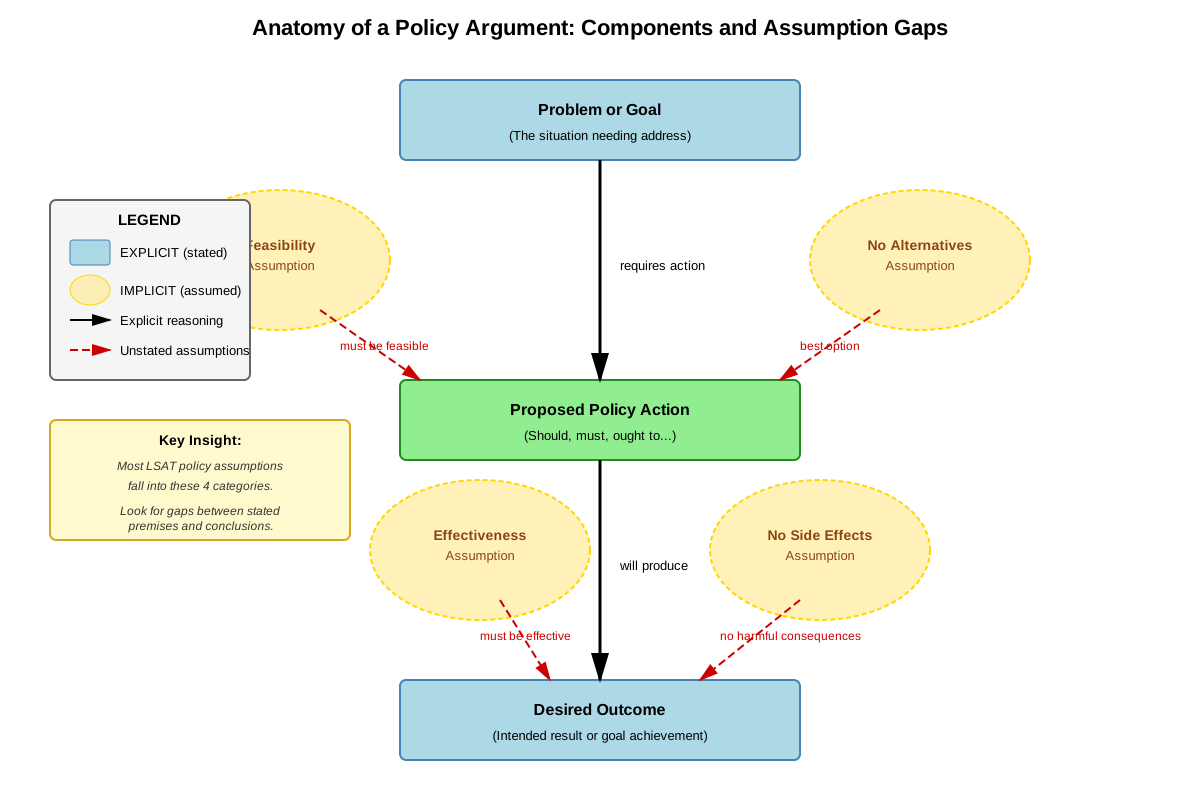
A policy argument contains three essential components: (1) a problem or goal, (2) a proposed action or policy, and (3) an implicit or explicit claim that the action will address the problem or achieve the goal. The conclusion typically uses prescriptive language indicating what should be done. The premises provide reasons why this action is appropriate, often describing the current situation or the nature of the problem.
The critical feature distinguishing policy arguments from other argument types is the means-end reasoning structure. The argument proposes a means (the policy) to achieve an end (the goal). This structure inherently creates multiple gaps where assumptions hide. The argument must assume the means will actually produce the end, that the means is feasible, that no prohibitive side effects will occur, and often that no better alternative exists.
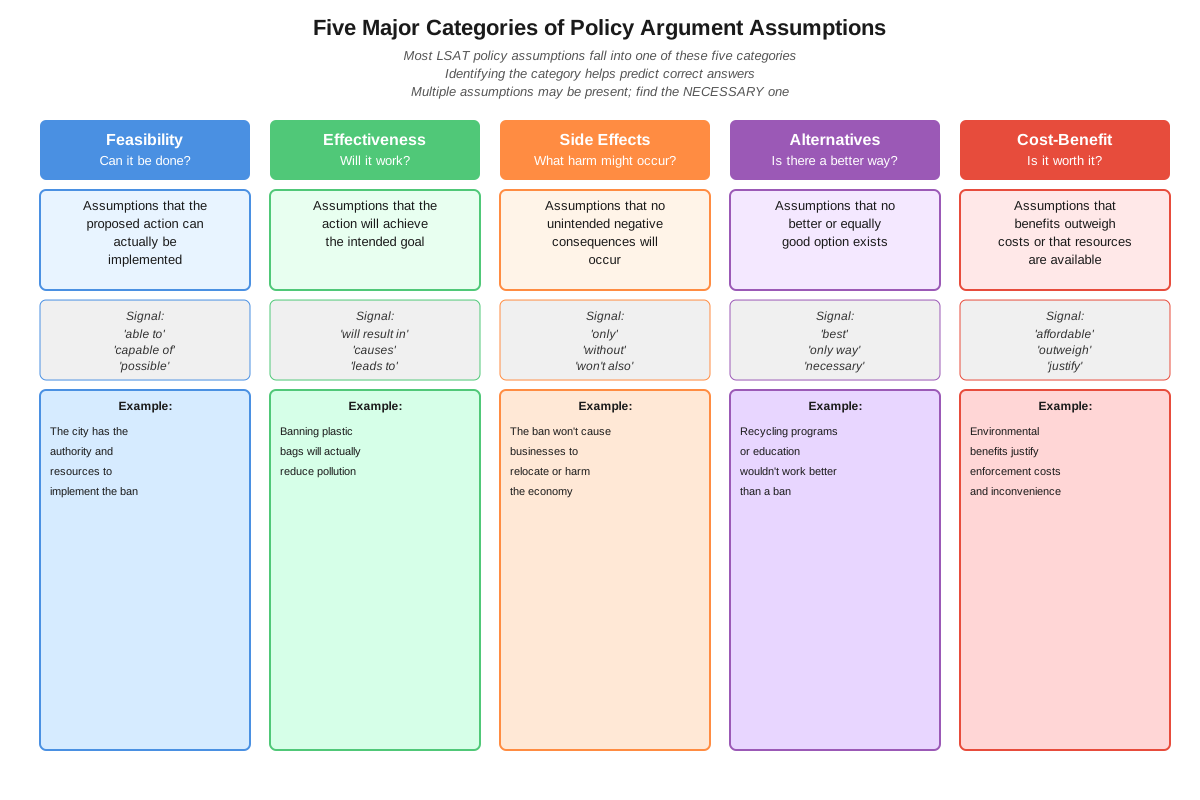
Five Major Categories of Policy Assumptions
1. Feasibility Assumptions: These assumptions address whether the proposed policy can actually be implemented. The argument assumes that the necessary resources exist, that the action is physically or practically possible, that no insurmountable obstacles prevent implementation, and that the relevant actors have the ability to carry out the policy. For example, an argument proposing that a city should build a new subway system assumes the city has or can obtain the necessary funding, engineering expertise, and legal authority.
2. Effectiveness Assumptions: The argument must assume that the proposed action will actually achieve the intended goal. This is often the most tested assumption type in policy arguments. The policy might be feasible but ineffective if the causal mechanism assumed by the argument doesn't work as expected. An argument claiming "The city should increase police patrols to reduce crime" assumes that increased patrols will actually deter criminal activity—an effectiveness assumption that could be questioned.
3. No Prohibitive Side Effects Assumptions: Policy arguments typically focus on the intended positive outcome while ignoring potential negative consequences. The argument implicitly assumes that no side effects will be so severe that they outweigh the benefits or make the policy inadvisable. A proposal to "reduce traffic by increasing tolls" assumes the economic burden on commuters won't cause unacceptable hardship or that businesses won't suffer from reduced customer access.
4. No Superior Alternative Assumptions: When an argument proposes a specific policy, it often assumes that no better alternative exists to achieve the same goal. This assumption becomes necessary when the argument's conclusion is that a particular action "should" be taken rather than merely that it "could" be taken. The strength of this assumption varies—sometimes the argument only needs to assume no alternative is clearly superior, not that the proposed policy is optimal.
5. Value/Priority Assumptions: Policy arguments frequently assume that the goal being pursued is worth pursuing or should be prioritized over competing goals. An argument proposing that "schools should eliminate arts programs to fund STEM education" assumes that STEM education should be prioritized over arts education—a value assumption that could be challenged.
The Assumption Gap in Policy Arguments
The assumption gap in policy arguments is typically wider than in purely descriptive arguments because policy reasoning requires multiple logical leaps. Consider this structure:
Premise: Problem X exists
Premise: Policy Y addresses problems like X in some way
Conclusion: Therefore, we should implement Policy Y
The gaps include: Will Y actually solve X (not just similar problems)? Can Y be implemented? Will Y's benefits outweigh its costs? Is Y the best available option? Each gap represents a potential assumption that the LSAT might test.
Identifying Policy Arguments on the LSAT
Policy arguments are identifiable through specific linguistic markers:
| Signal Type | Examples |
|---|---|
| Prescriptive verbs | should, must, ought to, needs to, has to |
| Recommendation language | recommend, propose, suggest, advise |
| Imperative constructions | "The city must...", "We need to..." |
| Conditional prescriptions | "If we want X, we should do Y" |
| Evaluative conclusions | "The best approach is...", "It would be wise to..." |
The Negation Test for Policy Assumptions
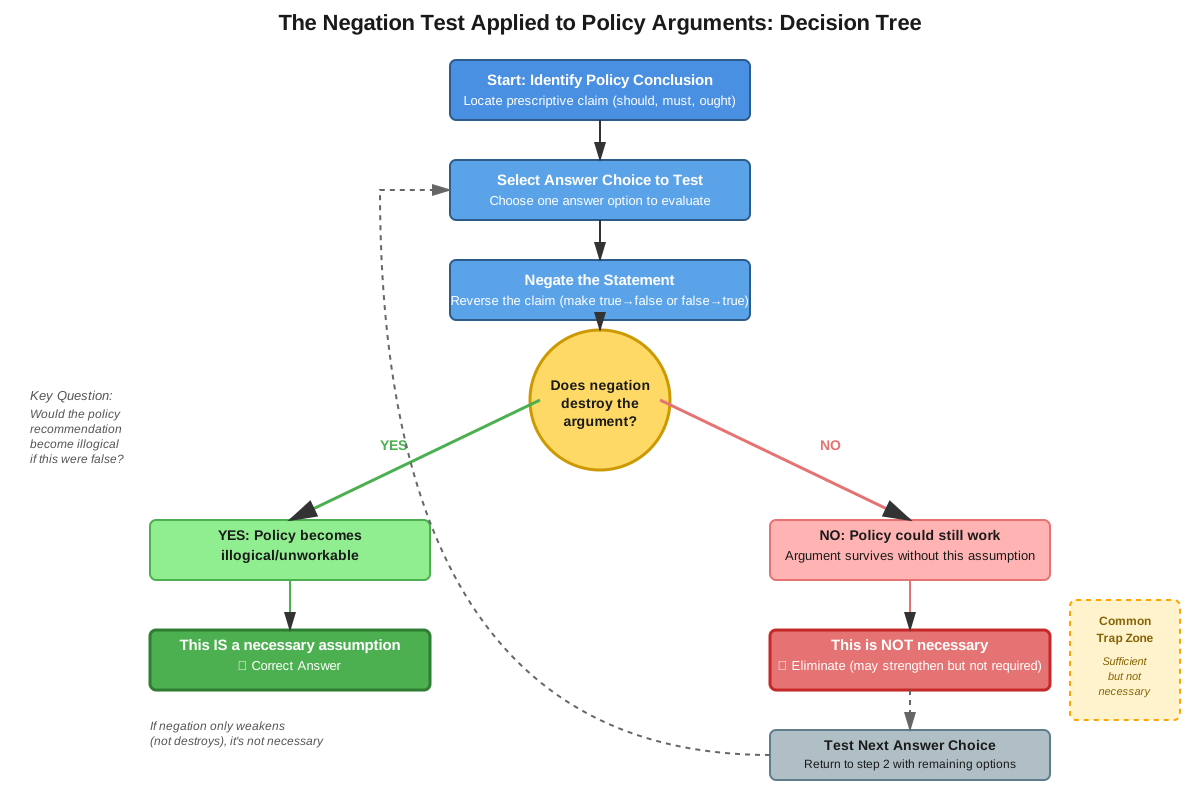
The negation test remains the gold standard for identifying necessary assumptions, but it requires careful application in policy contexts. To apply it: (1) negate the answer choice, (2) determine whether the negated statement destroys the argument, (3) if the argument falls apart, the original statement is a necessary assumption.
For policy arguments, negating an assumption often reveals that the proposed action won't work, can't be implemented, or isn't advisable. For example, if an answer choice states "The proposed policy is financially feasible," its negation "The proposed policy is not financially feasible" would destroy any argument recommending that policy's implementation.
Common Wrong Answer Patterns
LSAT test-makers create predictable wrong answer types for policy assumption questions:
- Sufficient but not necessary: The answer would help the argument but isn't required for it to work
- Reverses the logic: Confuses what the policy assumes with what would follow from the policy
- Addresses the wrong gap: Focuses on a different assumption type than what the argument actually requires
- Too strong: Makes a claim stronger than what the argument needs (e.g., assuming something is "the only way" when the argument only needs it to be "a way")
- Irrelevant comparison: Introduces comparisons the argument doesn't rely upon
Concept Relationships
The concepts within policy argument assumptions form an interconnected analytical framework. The structure of policy arguments (means-end reasoning) creates the foundation that generates the five major categories of assumptions. Each category represents a different way the means-end connection can fail. The assumption gap concept explains why policy arguments contain multiple potential assumptions—each gap in the reasoning chain requires a bridging assumption.
The negation test serves as the verification tool for all assumption types, while identification markers help students quickly recognize when they're dealing with a policy argument. Understanding common wrong answer patterns connects back to the five categories by revealing how test-makers exploit each assumption type to create plausible distractors.
This topic builds directly on prerequisite knowledge of basic argument structure by adding the prescriptive dimension. The connection to conditional reasoning appears when policy arguments contain implicit conditionals ("If we implement X, then Y will result"). The relationship to necessary vs. sufficient conditions manifests in distinguishing between assumptions that must be true (necessary) versus those that would guarantee the conclusion (sufficient).
Policy argument assumptions connect forward to Strengthen and Weaken questions, where the same assumption categories appear as answer choices that either support or undermine the argument. They also relate to Flaw questions, where failing to consider feasibility, side effects, or alternatives constitutes a reasoning error. The analytical framework developed here—systematically questioning whether a policy will work, can be implemented, and is advisable—applies across all these question types.
Relationship Map:
Policy Argument Structure → Creates Multiple Assumption Gaps → Five Assumption Categories → Each Category Generates Specific Wrong Answer Patterns → Negation Test Distinguishes Correct from Incorrect → Skills Transfer to Strengthen/Weaken/Flaw Questions
High-Yield Facts
⭐ Policy arguments propose that a specific action should be taken, distinguished by prescriptive language like "should," "must," "ought to," or "needs to."
⭐ The five major assumption categories in policy arguments are: feasibility, effectiveness, no prohibitive side effects, no superior alternative, and value/priority assumptions.
⭐ Effectiveness assumptions—that the proposed policy will actually achieve the intended goal—are the most frequently tested assumption type in policy arguments.
⭐ The negation test remains the most reliable method for identifying necessary assumptions: if negating an answer choice destroys the argument, that choice states a necessary assumption.
⭐ Policy arguments inherently contain a means-end reasoning structure, creating multiple gaps where assumptions can hide between the proposed action and the desired outcome.
- Feasibility assumptions address whether the policy can be implemented given resource, practical, and capability constraints.
- No prohibitive side effects assumptions acknowledge that policies may have negative consequences that could outweigh benefits.
- No superior alternative assumptions become necessary when the conclusion claims a specific action "should" be taken rather than merely "could" be taken.
- Wrong answers often provide sufficient rather than necessary assumptions—they would help the argument but aren't required for it to work.
- Policy arguments appear in 3-5 questions per LSAT, spanning Assumption, Strengthen, Weaken, Flaw, and Evaluate question types.
- Value assumptions underlie policy arguments when the desirability of the goal itself isn't explicitly justified in the premises.
- The assumption gap in policy arguments is typically wider than in descriptive arguments because prescriptive reasoning requires additional logical leaps.
Quick check — test yourself on Assumption in policy arguments so far.
Try Flashcards →Common Misconceptions
Misconception: Any statement that would help the policy argument is a necessary assumption.
Correction: Necessary assumptions are only those statements without which the argument completely fails. Many statements would strengthen the argument without being necessary for it. Use the negation test—only if negating the statement destroys the argument is it a necessary assumption.
Misconception: If a policy argument mentions a goal, it must assume that goal is the most important priority.
Correction: The argument only needs to assume the goal is worth pursuing and that achieving it justifies the proposed action. It doesn't need to assume the goal is more important than all other possible goals unless the argument explicitly compares priorities or claims resources should be diverted from other purposes.
Misconception: Policy arguments always assume no alternatives exist.
Correction: The no-alternative assumption is only necessary when the conclusion states that a specific action "should" be taken in a way that excludes other options. If the conclusion merely recommends an action as "one way" or "a good approach," the argument doesn't assume no alternatives exist—only that this particular approach will work.
Misconception: Feasibility assumptions are always about money and resources.
Correction: Feasibility encompasses multiple dimensions: financial resources, technical capability, legal authority, practical implementation, time constraints, and human capacity. An argument might assume technical feasibility (the technology exists), legal feasibility (the action is permitted), or practical feasibility (people will comply) without making financial assumptions.
Misconception: The correct answer to a policy assumption question will always address the most obvious gap in the argument.
Correction: LSAT test-makers often focus on subtle, easily overlooked assumptions rather than the most glaring gaps. The obvious gap might be addressed in the premises or might be too strong to be necessary. Students should systematically consider all five assumption categories rather than jumping to the most apparent issue.
Misconception: If the argument provides some evidence that the policy will work, it doesn't assume effectiveness.
Correction: Even when premises provide some support for effectiveness, gaps remain. An argument might cite evidence that a policy worked elsewhere but still assumes the circumstances are similar enough for it to work here. Or it might show the policy addresses one aspect of a problem but assume it will address the problem comprehensively.
Worked Examples
Example 1: Identifying Effectiveness Assumptions
Argument: "City traffic congestion has increased by 30% over the past five years, leading to productivity losses and air quality problems. The city should implement a congestion pricing system that charges drivers fees for entering the downtown area during peak hours. London implemented a similar system and saw traffic decrease by 20%."
Question: Which of the following is an assumption required by the argument?
Analysis Process:
Step 1: Identify the argument structure
- Problem: Traffic congestion causing productivity losses and air quality issues
- Proposed policy: Implement congestion pricing
- Implicit conclusion: This will solve or reduce the problem
- Evidence: London's success with a similar system
Step 2: Identify the assumption gaps
This is clearly a policy argument (uses "should"). The argument provides some evidence for effectiveness (London example) but gaps remain:
- Will the policy work in this city as it did in London? (effectiveness)
- Can the city implement such a system? (feasibility)
- Will the benefits outweigh costs/side effects?
- Are there better alternatives?
Step 3: Predict the assumption
The most significant gap is effectiveness—the argument assumes the London results will transfer to this city. This requires assuming relevant similarities between the cities.
Step 4: Evaluate answer choices
(A) "The city has the technical infrastructure to implement congestion pricing."
- This addresses feasibility, not the main gap. Negation: "The city lacks the infrastructure." This would be problematic, but the argument's primary logical leap is about effectiveness, not feasibility.
(B) "Reducing traffic congestion will improve both productivity and air quality."
- This connects the solution to the stated problems. Negation: "Reducing traffic won't improve productivity and air quality." If true, the argument falls apart—why implement the policy? This is necessary.
(C) "Congestion pricing is the most cost-effective solution to traffic problems."
- This is too strong. The argument only needs the policy to work, not to be the best option. This addresses a no-superior-alternative assumption but in an unnecessarily strong form.
(D) "London's traffic patterns are identical to this city's traffic patterns."
- Too strong. The argument doesn't need identical patterns, only sufficient similarity for the policy to work. This is a common trap—making the assumption stronger than necessary.
(E) "Drivers will not find ways to avoid the congestion fees."
- This addresses a potential side effect or implementation issue, but the argument doesn't require that no one avoids the fees—only that enough people respond to reduce congestion.
Answer: (B)
Connection to Learning Objectives: This example demonstrates how to identify policy arguments through prescriptive language, explains the reasoning pattern (means-end structure with effectiveness gap), and applies systematic analysis to solve the problem accurately. The negation test confirms (B) is necessary—without the connection between reduced traffic and the stated benefits, the argument fails.
Example 2: Distinguishing Necessary from Sufficient Assumptions
Argument: "The university's library is overcrowded during exam periods, with students unable to find seating. The university should extend library hours until 2 AM during exam weeks. A survey showed that 65% of students would use the library during late-night hours if it were open."
Question: Which of the following is an assumption on which the argument depends?
Analysis Process:
Step 1: Identify the structure
- Problem: Overcrowding during exam periods
- Proposed solution: Extend hours until 2 AM
- Evidence: Student survey showing demand for late hours
Step 2: Map the assumption gaps
The argument assumes extending hours will reduce overcrowding. But how? The logic is: if the library is open more hours, the same number of students will be spread across more time, reducing crowding at any given time. This requires assuming students will actually redistribute across the extended hours rather than simply adding late-night use to their existing daytime use.
Step 3: Consider assumption categories
- Effectiveness: Will extended hours actually reduce crowding?
- Feasibility: Can the university staff the library until 2 AM?
- Side effects: Will there be security or cost issues?
- No alternative: Is this better than other solutions?
Step 4: Evaluate choices
(A) "Extending library hours is less expensive than building additional library space."
- This addresses a no-alternative assumption but isn't necessary. The argument doesn't compare alternatives or mention cost. Negation: "Extending hours is more expensive than building space." The argument could still work if the university has the budget or if cost isn't the deciding factor.
(B) "At least some students who would use the library during late-night hours currently use it during the day."
- This is crucial. If all late-night users would be additional users (not redistributed from daytime), the policy wouldn't reduce crowding—it would just add more total use. Negation: "No students who would use late-night hours currently use it during the day." This means all 65% are new users, so daytime crowding wouldn't decrease. The argument fails. This is necessary.
(C) "Most students prefer to study late at night rather than during the day."
- Too strong and not necessary. The argument only needs some redistribution, not a preference for late-night study. This would be sufficient to guarantee the policy works but isn't necessary.
(D) "The library has adequate staff willing to work until 2 AM."
- This addresses feasibility. While practical, the argument's logical structure doesn't require this assumption—the argument is about whether the policy would solve the problem, not whether it can be implemented. On the LSAT, effectiveness assumptions are typically tested more than feasibility assumptions unless the argument explicitly raises implementation concerns.
(E) "Students cannot study effectively in their dormitories."
- This explains why students want library access but isn't necessary for the argument that extended hours will reduce crowding. The argument works regardless of why students use the library.
Answer: (B)
Connection to Learning Objectives: This example shows how to distinguish between necessary assumptions (B) and sufficient assumptions (C). It demonstrates the reasoning pattern specific to policy arguments about resource allocation—the assumption that the policy will redistribute demand rather than simply increase total demand. The negation test clearly reveals why (B) is necessary while other plausible-sounding choices are not.
Exam Strategy
Immediate Recognition Strategy: Train yourself to identify policy arguments within the first sentence by watching for prescriptive language. The moment you see "should," "must," "ought to," or "recommend," mentally categorize the argument as policy-based and activate your five-category assumption framework. This immediate recognition allows you to read more strategically, anticipating where assumptions will hide.
Pre-Phrasing Technique: Before looking at answer choices, spend 5-10 seconds articulating the assumption gap in your own words. Ask yourself: "What must be true for this policy to work?" Focus on the most significant logical leap in the argument. Pre-phrasing prevents you from being seduced by sophisticated wrong answers and dramatically increases accuracy.
Systematic Category Checking: When evaluating answer choices, mentally run through the five assumption categories in order: (1) Will it work? (2) Can it be done? (3) Are side effects acceptable? (4) Is it the best option? (5) Is the goal worth pursuing? This systematic approach ensures you don't miss subtle assumptions and helps you understand why wrong answers fail.
Negation Test Application: For policy arguments, the negation test is particularly powerful. When you've narrowed to two answer choices, negate each and ask: "Does this destroy the argument's recommendation?" Be careful with the strength of negation—negate "will work" to "won't necessarily work," not to "definitely won't work." The negation should be logical opposition, not extreme opposite.
Trigger Words for Each Category:
- Effectiveness: "will result in," "will achieve," "will solve," "will reduce"
- Feasibility: "can be implemented," "is possible," "resources exist," "capable of"
- Side effects: "without causing," "will not result in," "won't lead to"
- Alternatives: "no better way," "the best approach," "superior to other options"
- Values: "worth pursuing," "should be prioritized," "more important than"
Time Allocation: Spend approximately 1:15-1:30 on policy assumption questions. They typically require more analysis time than other assumption questions due to multiple potential gaps, but the systematic framework should keep you efficient. If you're spending more than 1:45, you're likely overthinking—trust your pre-phrase and apply the negation test to your top choice.
Common Trap Avoidance: Watch for answer choices that are sufficient but not necessary (they would guarantee the conclusion but aren't required), that are too strong (using "only," "all," or "most" when the argument needs weaker claims), or that address a different assumption category than the argument's primary gap. The LSAT loves to offer feasibility assumptions when the argument's main gap is effectiveness, or vice versa.
Memory Techniques
FENSA Acronym: Remember the five major assumption categories with FENSA:
- Feasibility (Can we do it?)
- Effectiveness (Will it work?)
- No prohibitive side effects (Will it cause problems?)
- Superior alternative (Is there a better way?)
- Axiology/values (Is the goal worthwhile?)
The Policy Bridge Visualization: Picture the argument as a bridge from "Current Problem" to "Desired Outcome." The proposed policy is the bridge structure. Each assumption category represents a potential weakness in the bridge: Feasibility = materials exist to build it; Effectiveness = the bridge reaches the other side; No side effects = the bridge won't collapse; No alternative = this is the right bridge design; Values = the other side is worth reaching.
The Three W's for Quick Analysis: When you identify a policy argument, immediately ask:
- Will it work? (effectiveness)
- Way to do it? (feasibility)
- Worth it? (side effects and values)
Negation Test Reminder - "DESTROY": The negation must DESTROY the argument, not merely weaken it. If the negated statement leaves the argument limping but alive, it's not a necessary assumption.
Prescriptive Language Trigger List: Memorize this quick-recognition list: "should, must, ought, needs to, has to, recommend, propose, suggest, advise, it would be wise, the best approach, necessary to." Seeing any of these should immediately activate your policy argument analysis framework.
Summary
Assumption in policy arguments represents a high-yield LSAT topic that combines prescriptive reasoning with the fundamental skill of identifying unstated premises. Policy arguments propose that specific actions should be taken to achieve goals or solve problems, creating a means-end reasoning structure that generates multiple assumption gaps. The five major categories of assumptions—feasibility, effectiveness, no prohibitive side effects, no superior alternative, and value/priority—provide a systematic framework for analyzing these arguments. Effectiveness assumptions, which address whether the proposed policy will actually achieve its intended goal, are the most frequently tested type. The negation test remains the gold standard for identifying necessary assumptions: if negating a statement destroys the argument, that statement is a necessary assumption. Success on policy assumption questions requires immediate recognition of prescriptive language, systematic analysis using the five-category framework, pre-phrasing before reviewing answer choices, and careful application of the negation test to distinguish necessary from merely helpful assumptions. The analytical skills developed through mastering policy argument assumptions transfer directly to Strengthen, Weaken, and Flaw questions, making this topic foundational for overall Logical Reasoning success.
Key Takeaways
- Policy arguments use prescriptive language ("should," "must," "ought to") to recommend specific actions, creating a means-end reasoning structure with multiple assumption gaps
- The five assumption categories (FENSA: Feasibility, Effectiveness, No side effects, Superior alternative, Axiology/values) provide a systematic framework for analyzing policy arguments
- Effectiveness assumptions—that the proposed policy will actually achieve the intended goal—are the most frequently tested assumption type on the LSAT
- The negation test reliably identifies necessary assumptions: negate the answer choice and determine whether the argument falls apart completely
- Wrong answers often provide sufficient rather than necessary assumptions, are too strong for what the argument requires, or address the wrong assumption category
- Pre-phrasing the assumption gap before reviewing answer choices dramatically increases accuracy and prevents distraction by sophisticated wrong answers
- Policy argument analysis skills transfer directly to Strengthen, Weaken, and Flaw questions, making this topic foundational for Logical Reasoning success
Related Topics
Strengthen and Weaken Questions with Policy Arguments: Once you've mastered identifying assumptions in policy arguments, the next step is understanding how to strengthen or weaken these arguments. The same five assumption categories provide the framework—strengthening answers provide evidence supporting an assumption, while weakening answers suggest an assumption is false.
Flaw Questions - Unwarranted Assumptions in Policy Reasoning: Policy arguments frequently appear in Flaw questions, where the correct answer identifies that the argument "fails to consider" feasibility issues, side effects, or alternatives. Mastering assumption identification makes flaw recognition straightforward.
Sufficient Assumption Questions: While this guide focuses on necessary assumptions, sufficient assumption questions also feature policy arguments. Understanding the difference between what must be true (necessary) versus what would guarantee the conclusion (sufficient) builds on the foundation established here.
Evaluate Questions: These questions ask what additional information would be most useful in assessing an argument. For policy arguments, the answer typically addresses one of the five assumption categories—knowing which assumption is most crucial helps identify what information would be most valuable.
Practice CTA
Now that you've mastered the conceptual framework for assumption in policy arguments, it's time to apply these skills to actual LSAT questions. The practice questions and flashcards will reinforce your ability to quickly identify policy arguments, systematically analyze assumption gaps using the five-category framework, and confidently apply the negation test to distinguish correct from incorrect answer choices. Remember: understanding the concepts is only half the battle—speed and accuracy come from deliberate practice. Each practice question you complete strengthens your pattern recognition and makes the analytical process more automatic. Approach the practice materials with the same systematic strategy outlined in this guide, and you'll see measurable improvement in both accuracy and timing. You've built the foundation—now it's time to make these skills second nature through focused practice.
Sign up free to keep reading
Create a free AnvayaPrep account to finish this LSAT guide on Assumption in policy arguments — plus flashcards and practice questions.